Sample Category Title
EUR/CHF Mid-Day Outlook
Daily Pivots: (S1) 1.1260; (P) 1.1279; (R1) 1.1301; More...
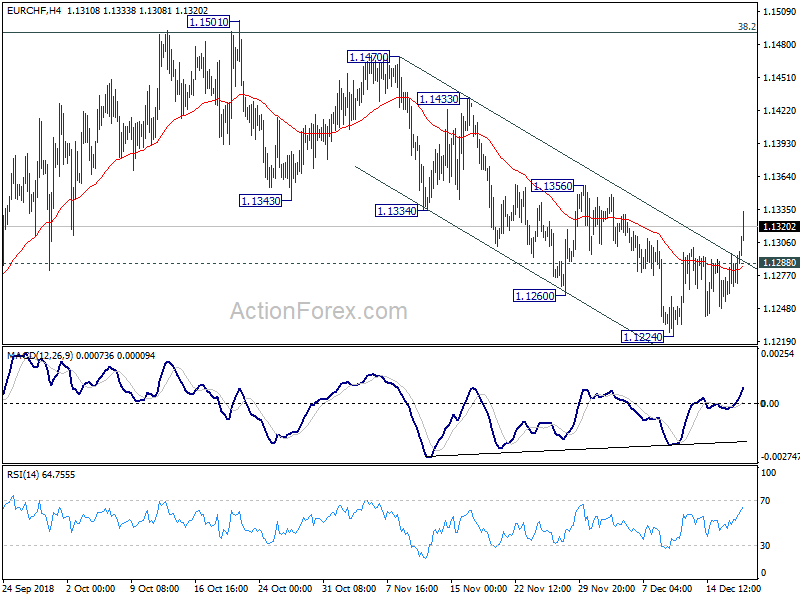
EUR/CHF rises to as high as 1.1333 so far today as rebound from 1.1224 accelerates. Intraday bias remains on the upside for 1.1356 resistance first. Decisive break there should confirm near term reversal. In that case, further rally should be seen back to 1.1501 resistance. On the downside, below 1.1288 will turn bias neutral first. But retreat should be combined well above 1.1224 low to bring another rally.
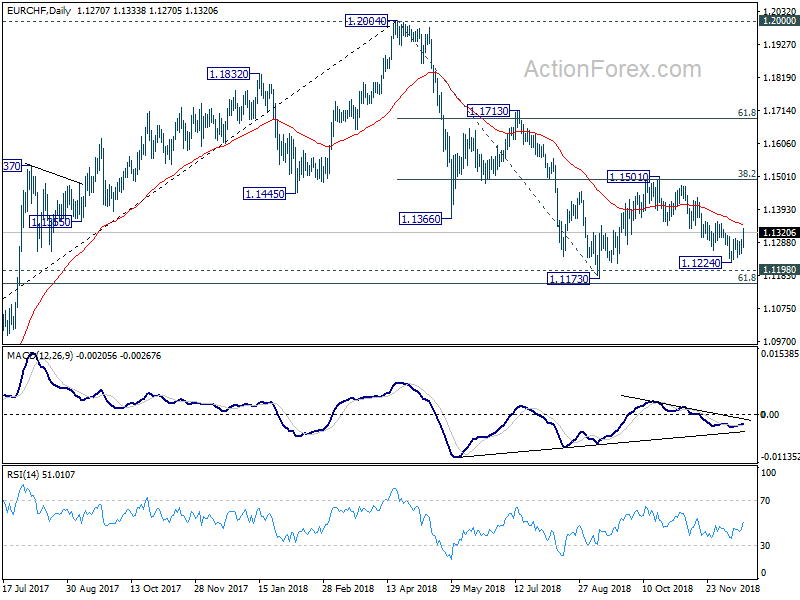
In the bigger picture, price actions from 1.2004 medium term top is seen as a correction only. Downside should be contained by support zone of 1.1198 (2016 high) and 61.8% retracement of 1.0629 to 1.2004 at 1.1154 to complete it and bring rebound. A break of 1.2 key resistance is still expected in the medium term long term. However, sustained break of the mentioned support zone will mark reversal of the long term trend. In that case, 1.0629 key support will be back into focus.
Euro Surges as EU Finally Approved Italian Budget, Dollar Mixed Awaiting FOMC Guidance
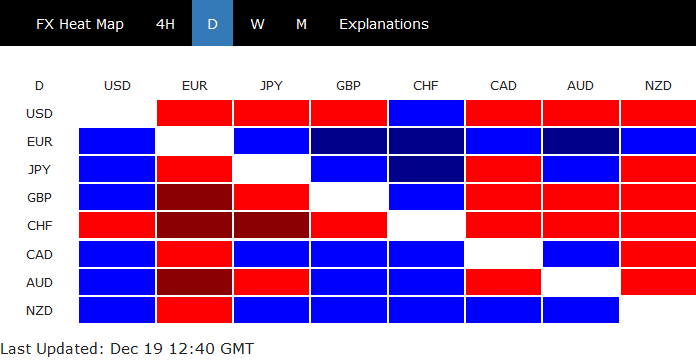
Euro rises broadly today as Italy finally got its 2019 budget plan approved by the European Commission. Disciplinary actions are now avoided. Italian 10-yield yields tumbles sharply and is pressing September's low. For now, Yen follows as the second strongest. Canadian Dollar is recovering today as oil prices turned sideway after this week's sharp fall. The Loonie also pays little attention to slowing CPI reading. Sterling is the weakest one, followed by Australian Dollar.
Technically, EUR/CHF's strong rise today re-affirmed the case of near term bullish reversal. Focus will be on 1.1356 resistance next and break will pave the way back to 1.1501 resistance. EUR/AUD also strengthens notably and is eyeing 1.5887 resistance. Break will resume rebound from 1.5346 to 1.6 handle next. Otherwise, EUR/USD, GBP/USD USD/CHF and USD/JPY are staying in familiar range.
In other markets, FTSE is up 0.98% at the time of writing, DAX is up 0.57%% and CAC is up 0.61%. German 10 year yield is down -0.008 at 0.238. Italian 10 year yield is down -0.166 at 2.781. German-Italian spread is below 260. Earlier in Asia, Nikkei dropped -0.6%, Hong Kong HSI rose 0.20%, China Shanghai SSE dropped -1.05%, Singapore Strait Times rose 0.43%, mixed.
Released in early US session, Canadian CPI slowed to 1.7% yoy in November, down from 2.4% yoy and missed expectation of 1.8% yoy. CPI core common was unchanged at 1.9% yoy. CPI core median dropped from 2.0% to 1.9%. CPI core trimmed slowed from 2.1% yoy to 1.9% yoy.
Dollar mixed as FOMC rate decisions awaited
US Dollar is mixed as markets await FOMC rate decision. In short, Fed is widely expected to raise federal funds rate by 25bps to 2.25-2.50% today. The question is on the rate path in 2019 after all the political pressures Fed policymakers faced. The new economic projections will provide the key guidance to market expectations. More on the projections here.
Also, here are some suggested readings on FOMC:
- Fed Likely Hikes Rate in December, Future Path More Dovish
- S&P 500: Dovish Fed Hike Enough to Support US Stocks?
- Four Fed Scenarios And One Market
- Trade The Fed Decision
- USD/JPY: Will The Fed Deliver A Present Or A Lump Of Coal For Buck Bulls?
- Will the Fed be Less Dovish than Markets Expect?
- FOMC Preview: What Do We Expect?
- What To Expect From The Last Fed Meeting In 2018?
EU Dombrovskis confirmed budget agreement with Italy to avoid EDP
European Commission Vice-President Valdis Dombrovskis confirmed that an agreement is made with Italy regarding 2019 budget. He tweeted that "A lot of hard work and negotiation went into finding solution on the Italian budget. Let's face it: the solution on the table is not ideal. But it allows us to avoid an Excessive Deficit Procedure at this stage, provided that the agreed measures are fully implemented."
He added that "I hope this solution would also be the basis for balanced budgetary & economic policies in Italy. Italy urgently needs to restore confidence in its economy to ease financial conditions and support investment. Ultimately, this is what will support purchasing power of all Italians."
UK CPI dropped to 2.3%, core down to 1.8%
UK CPI slowed to 2.3% yoy in November, down from 2.4% and matched expectations. But core CPI also slowed to 1.8% yoy, down from 1.9% yoy and missed expectation of 1.9% yoy. RPI also slowed to 3.2% yoy, down from 3.3% yoy and missed expectation of 3.3% yoy.
PPI input slowed to 5.6% yoy, down from 10.3% yoy, below expectation of 9.6% yoy. PPI output slowed to 3.1%yoy, down from 3.3% yoy, matched expectations. PPI output core slowed to 2.4% yoy, down from 2.5% yoy, above expectation of 2.3% yoy.
House price index slowed to 2.7% yoy in October, missed expectation of 3.3% yoy.
Low level US and China officials clashed at WTO
Reuters reported that two rather low level US and China officials clashed at the WTO today in closed-door talks. US Ambassador to WTO Dennis Shea accused China of doing "outright steal" technology of the US and said "this is not acceptable".
China's envoy said US administration's "reckless actions" were the root cause of the crisis in global multilateral trade system. And he hoped that both countries can "move in the same direction with mutual respect to contribute to the stability of world economic and trade environment".
Asian business sentiment stays low on trade war concerns
The Thomson Reuters/INSEAD Asian Business Sentiment Index rose to 63 in Q4, up from 58 in Q3 which was a near three year low. While readings above 50 still indicates a positive outlook, the result is still one of the lowest readings in years.
Antonio Fatas from INSEAD noted in the release that "this confirms the reading of the previous quarter: there is more uncertainty, there are increasing concerns about growth," And, "this doesn't mean there is going to be a crisis over the next quarters, but if there is one, this is an indication that it wouldn't be a large surprise to some."
Global trade war is, by some distance, the biggest perceived risks to business outlook. China slowdown and higher interest rates followed and then Brexit. The report also noted that, "the dispute between the world's two biggest economies, threatens businesses throughout the region due to global value chains."
Released in Asian session, Japan trade deficit widened to JPY -0.49% in November. Australia Westpac leading index dropped -0.1% mom in November.
EUR/CHF Mid-Day Outlook
Daily Pivots: (S1) 1.1260; (P) 1.1279; (R1) 1.1301; More...
EUR/CHF rises to as high as 1.1333 so far today as rebound from 1.1224 accelerates. Intraday bias remains on the upside for 1.1356 resistance first. Decisive break there should confirm near term reversal. In that case, further rally should be seen back to 1.1501 resistance. On the downside, below 1.1288 will turn bias neutral first. But retreat should be combined well above 1.1224 low to bring another rally.
In the bigger picture, price actions from 1.2004 medium term top is seen as a correction only. Downside should be contained by support zone of 1.1198 (2016 high) and 61.8% retracement of 1.0629 to 1.2004 at 1.1154 to complete it and bring rebound. A break of 1.2 key resistance is still expected in the medium term long term. However, sustained break of the mentioned support zone will mark reversal of the long term trend. In that case, 1.0629 key support will be back into focus.
Economic Indicators Update
| GMT | Ccy | Events | Actual | Forecast | Previous | Revised |
|---|---|---|---|---|---|---|
| 23:30 | AUD | Westpac Leading Index M/M Nov | -0.10% | 0.10% | ||
| 23:50 | JPY | Trade Balance (JPY) Nov | -0.49T | -0.31T | -0.30T | -0.29T |
| 07:00 | EUR | German PPI M/M Nov | 0.10% | -0.10% | 0.30% | |
| 07:00 | EUR | German PPI Y/Y Nov | 3.30% | 3.20% | 3.30% | |
| 09:30 | GBP | CPI M/M Nov | 0.20% | 0.20% | 0.10% | |
| 09:30 | GBP | CPI Y/Y Nov | 2.30% | 2.30% | 2.40% | |
| 09:30 | GBP | Core CPI Y/Y Nov | 1.80% | 1.90% | 1.90% | |
| 09:30 | GBP | RPI M/M Nov | 0.00% | 0.10% | 0.10% | |
| 09:30 | GBP | RPI Y/Y Nov | 3.20% | 3.30% | 3.30% | |
| 09:30 | GBP | PPI Input M/M Nov | -2.30% | 0.60% | 0.80% | |
| 09:30 | GBP | PPI Input Y/Y Nov | 5.60% | 9.60% | 10.00% | 10.30% |
| 09:30 | GBP | PPI Output M/M Nov | 0.20% | -0.10% | 0.30% | |
| 09:30 | GBP | PPI Output Y/Y Nov | 3.10% | 3.10% | 3.30% | |
| 09:30 | GBP | PPI Output Core M/M Nov | 0.10% | 0.20% | 0.30% | 0.40% |
| 09:30 | GBP | PPI Output Core Y/Y Nov | 2.40% | 2.30% | 2.40% | 2.50% |
| 09:30 | GBP | House Price Index Y/Y Oct | 2.70% | 3.30% | 3.50% | |
| 13:30 | USD | Current Account Balance (CAD) Q3 | -125B | -125B | -101B | |
| 13:30 | CAD | CPI M/M Nov | -0.40% | -0.40% | 0.30% | |
| 13:30 | CAD | CPI Y/Y Nov | 1.70% | 1.80% | 2.40% | |
| 13:30 | CAD | CPI Core - Common Y/Y Nov | 1.90% | 1.90% | 1.90% | |
| 13:30 | CAD | CPI Core - Median Y/Y Nov | 1.90% | 2.00% | 2.00% | |
| 13:30 | CAD | CPI Core - Trim Y/Y Nov | 1.90% | 2.10% | 2.10% | |
| 15:00 | USD | Existing Home Sales Nov | 5.20M | 5.22M | ||
| 15:30 | USD | Crude Oil Inventories | -1.2M | |||
| 19:00 | USD | FOMC Rate Decision (Lower Bound) | 2.25% | 2.25% | ||
| 19:00 | USD | FOMC Rate Decision (Upper Bound) | 2.50% | 2.50% | ||
| 19:30 | USD | FOMC Press Conference |
Canadian Dollar Steadies, but CPI Could Renew Volatility
USD/CAD has reversed directions on Wednesday and posted slight losses. Currently, the pair is trading at 1.3445, down 0.17% on the day. On the release front, Canada releases inflation indicators, led by CPI. The indicator is expected to decline by 0.4%. There are no major releases out of the U.S., but traders will be busy keeping an eye on the Federal Reserve, which is expected to raise rates to a range between 2.25 and 2.50 percent.
The markets are expecting the Federal Reserve is expected to raise interest rates on Wednesday, which would mark the fourth rate hike in 2018. The odds of a rate hike have dropped sharply – only last week, the odds of a hike stood at 77%, but are currently at 66%.
A key factor in the drop is the latest equity sell-off. On Monday, the S&P 500 Index sank to its lowest level since October 2017. Rate hikes are unusual when stock markets are in a downward spiral, but the Fed is likely to press the rate trigger. At the same time, the Fed may try to soothe the nervous markets with a cautious message about further tightening next year, which has boosted the euro ahead of the meeting. Just a few months ago, there was heady talk of three or four rates in 2019, but analysts are now predicting just one hike, as the U.S economy is showing signs of slowing down.
Weaker oil prices have hurt the Canadian economy, dragging down growth and inflation. CPI, the primary gauge of consumer inflation, has struggled, with two declines in the past three months. Will inflation fall again in November? If so, the Canadian dollar could continue to slide. The currency has declined for four straight weeks, dropping 1.8% in that time. In addition to soft oil prices, the global trade war has taken a bite out of Canada’s export sector. The Bank of Canada is expected to respond by scaling back rate hikes. The bank has raised rates three times this year, but stayed on the sidelines at the December meeting. With the Federal Reserve expected to raise rates just once or twice in 2019, there will be less pressure on the BoC to raise rates in 2019.
Into US session: Euro strongest as Italian budget deal made, Dollar soft ahead of FOMC
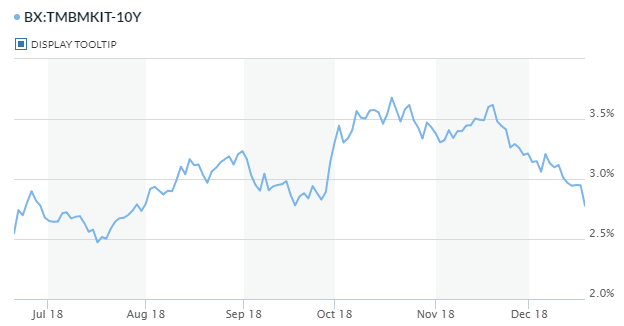
Entering US session, Euro is trading as the strongest one today. European Commission finally agreed with Italy on its 2019 budget, thus the so called "Excessive Deficit Procedure". Italian 10 year yield tumble to as low as 2.778. German-Italian spread also narrowed to 253. Swiss Franc is, as a result of relief rally in European stocks too, trading as the weakest one for today. Dollar is the second weakest as markets await FOMC rate decision.
In short, Fed is widely expected to raise federal funds rate by 25bps to 2.25-2.50% today. The question is on the rate path in 2019 after all the political pressures Fed policymakers faced. The new economic projections will provide the key guidance to market expectations. More on the projections here.
Also, here are some suggested readings on FOMC:
- Fed Likely Hikes Rate in December, Future Path More Dovish
- S&P 500: Dovish Fed Hike Enough to Support US Stocks?
- Four Fed Scenarios And One Market
- Trade The Fed Decision
- USD/JPY: Will The Fed Deliver A Present Or A Lump Of Coal For Buck Bulls?
- Will the Fed be Less Dovish than Markets Expect?
- FOMC Preview: What Do We Expect?
- What To Expect From The Last Fed Meeting In 2018?
In European markets, at the time of writing:
- FTSE is up 1.00%
- DAX is up 0.73%
- CAC is up 0.72%
- German 10 year yield is down -0.004 at 0.243
- Italian 10 year yield is down -0.169 at 2.778
Earlier in Asia:
- Nikkei dropped -0.60%
- Hong Kong HSI rose 0.20%
- China Shanghai SSE dropped -1.05%
- Singapore Strait Times rose 0.43%
- Japan 10 year JGB yield rose 0.0048 to 0.033
DAX Edges Higher, Investors Anxiously Await FOMC Statement
The DAX index has moved higher in the Wednesday session. Currently, the index is at 10,806, up 0.28% on the day. In economic news, it’s a light day. The sole indicator was German PPI, which dipped to 0.1% in November, above the estimate of -0.1%. This was its weakest gain since February. The markets are expecting the Federal Reserve to raise rate hikes by a quarter-point, to a range between 2.25 and 2.50 percent.
After plunging more than 6% in the first week of December, the DAX has steadied. Still, investors remain nervous, with global markets showing sharp volatility. In the U.S., the S&P 500 Index sank to its lowest level since October 2017. One factor which has weighed on the markets is the row over the Italian budget, which the EU said was in breach of its financial requirements. There was good news on Wednesday, after reports that Italy and the EU had reached a deal, whereby Italy would lower its deficit target to 2.04%, down from its original target of 2.4%. For weeks, Italy and the EU had appeared to be on a collision course, with the EU threatening unprecedented sanctions against the Italian government.
The Federal Reserve is widely expected to raise rates on Thursday, even though rate hikes are unusual when stock markets are in a downward spiral. The Fed may “compensate” the markets and try to soothe nervous investors by sending out a cautious message about further tightening next year. Such a move would likely boost global stock markets, which posted sharp losses in early December, after hawkish remarks from Fed Chair Jerome Powell. Investors will be combing through the rate statement, which should be considered a market-mover.
Year ahead – Gold: Worst- & Best-Case Scenarios in 2019
The gold price hasn't looked back since touching its lowest level of 1,046 and the upcoming year looks even more promising.
Gold prices hit 1-week high today and steady they go. Since the price made a low of $1,046 back in 2015, it has never looked back. As of today, it is trading at $1,248. Having said this, the price is down by -4.05% year-to-date, but daily chart shows that the trend is still skewed to the upside. The primary reason we saw some losses in 2018 was the hawkish monetary policy adopted by the Federal Reserve Bank.
The Fed has increased the interest rates three times so far this year and another rate hike is firmly on the cards when the Fed meets on Wednesday. Another hike will push the interest rates in the U.S. to their highest level in a decade. These interest rates hikes have pushed the dollar index towards its peak point (97.71) for the year. In other words, the dollar index has had one dominant trend this year- the uptrend.
The greenback and gold have an inverse relation. The reason we have not seen strength in the inverse relationship between the yellow metal and the dollar is mainly because of the feeble world economic growth. The tumult in Paris, the Brexit chaos and the trade war between Washington and Beijing have crippled optimism among investors.
Going into 2019, the yellow metal is likely to shine more as cracks have started to surface in the U.S. economy. The U.S. equity markets are on track to record the worst performance in a decade. Trump can no longer brag about this. The housing market, a leading indicator to gauge the economic health of the country, is showing some serious concerns. Business investment has dried up in the third quarter and effects of tax cuts by Trump administration have almost vanished.
Can the U.S. economy end up in recession in 2019?
This is the question that many will be asking. Under the current circumstances, it may not be far stretched to say that if the recession doesn’t see the daylight in 2019, it is likely to see it in 2020. Having said this, it is vital to look back at history and see how they have dealt with a similar situation. The below chart shows that the Fed has hardly increased the interest rate when the equity markets are soft.
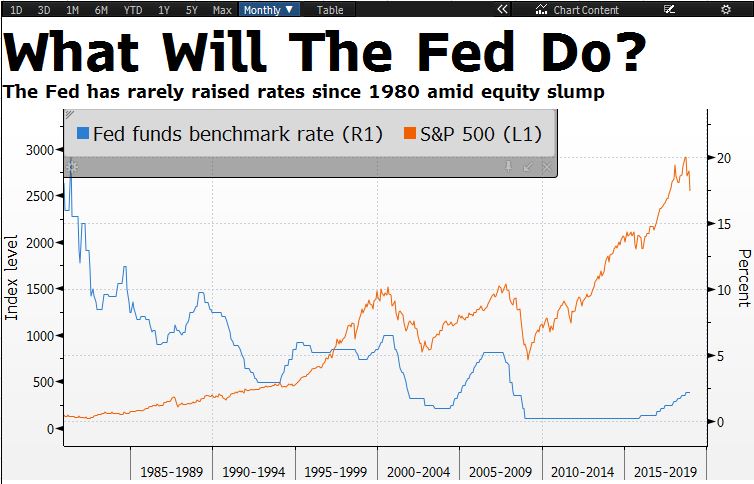
Investors and the Fed will be observing the economy very prudently and this will dictate the volatility for the gold price. Looking at the historical chart of gold, it shows that volatility is ready to pop. The explosion in yellow metal’s volatility is due for some time as it is currently sitting at a historical low level. Investors are already worried about global growth and if these concerns change into a global recession, the above scenario can easily come in to play.
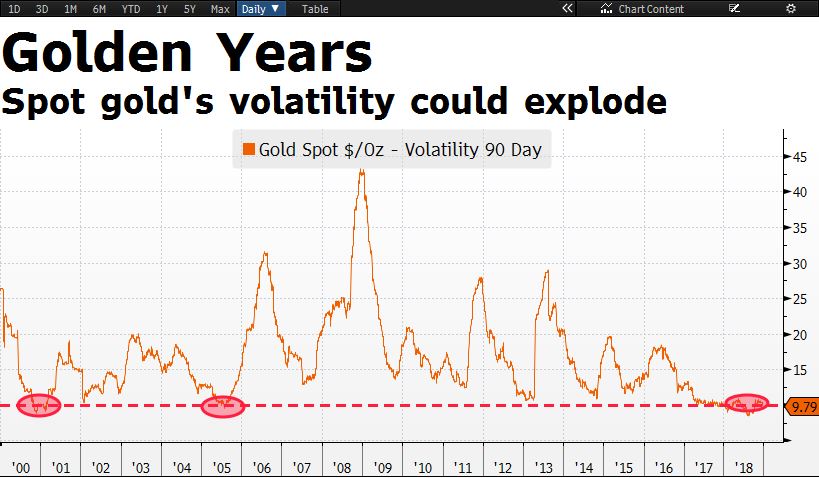
All in all, it is highly likely that we will see an uptrend for gold and factors such as feeble economic growth, escalation in the geopolitics in Europe, the Middle East and stronger threats to Trump’s presidency could drive the price way above the $1600 mark in 2019. However, a controlled Fed policy and a stable economic growth may only push the price towards $1400.
EUR/USD – Euro Rally Continues As Investors Expect Dovish Fed Statement
EUR/USD continues to head higher this week. In the Wednesday session, the pair is trading at 1.1410, up 0.40% on the day. On the release front, German PPI dipped to 0.1% in November, its weakest gain since February. In the U.S., there are no major indicators. All eyes will be on the Federal Reserve, which is expected to raise rates to a range between 2.25 and 2.50 percent.
The euro is enjoying a strong week, with gains of close to 1 percent. The markets are expecting the Federal Reserve is expected to raise interest rates on Wednesday, which would mark the fourth rate hike in 2018. The odds of a rate hike have dropped sharply – only last week, the odds of a hike stood at 77%, but are currently at 66%.
A key factor in the drop is the latest equity sell-off. On Monday, the S&P 500 Index sank to its lowest level since October 2017. Rate hikes are unusual when stock markets are in a downward spiral, but the Fed is likely to press the rate trigger. At the same time, the Fed may try to soothe the nervous markets with a cautious message about further tightening next year, which has boosted the euro ahead of the meeting. Just a few months ago, there was heady talk of three or four rates in 2019, but analysts are now predicting just one hike, as the U.S economy is showing signs of slowing down.
After a weak third quarter of growth in the eurozone, there are serious concerns that the slowdown will affect fourth quarter numbers as well. ECB policymakers have plenty of headaches, whether domestically or abroad. The global trade war has taken a bite out of German and eurozone exports, and uncertainty over Brexit and the Italian budget have soured investor confidence, which has put pressure on the euro. EUR/USD has declined 2.7% since July 1, and will likely face more headwinds before the end of the year.
WAVES Price Soared By 50%, Trade Volumes Spiked By 340%
In the last 24 hours, the Waves token has soared in price by almost 50%. Over the week, the rate jumped by almost 116%, cryptocurrency trading volumes grew by almost 340% over the past few days, reaching $ 102 million.
For the past one week Waves price has been successfully coasting the green line amidst the red prevailing in the market. The revamped Waves mobile wallet is one of the factors that have harnessed goodwill for this project. The Waves team has integrated the entire waves business into a smart phone application that is easy to use. They have by this act opened up the Waves platform to a wider demographic audience of smart phone users that would see it adoption fast track ahead of other projects.
This is because the newly upgraded mobile wallet provides access to a built- in DEX and fiat gateways. The ease of access and instant trading available on mobile without the need to expose private keys has the propensity to pull in millions of users to the Waves platform thereby driving up demand for WAVES. With exciting features like finger scanning, touch and face ID to further support security the refurbished Waves wallet is built for the average crypto user and this is likely to be a source of long term growth.
The Fed, Finally
The Fed, finally
Here we are, the last FOMC meeting of the year. According to the latest Bloomberg survey, the Federal Reserve is expected to lift short-term interest rates by another 25bps - which would bring the target band up to 2.25%-2.50% - to the highest level since March 2008. The chances that Jerome Powell would stand idle today are very thin as the Fed had already widely communicate on a December hike. Backpedalling would send a terrible signal to investors as it would suggest that the US economy could not withstand another rate hike.
Therefore, we expect that the Federal Reserve would come with a dovish hike. During the press conference, Jerome Powell would provide little guidance and emphasize the need for optionality. In other words, the Fed would not commit to any further tightening move and stick to a data-dependent approach.
The big question now is how will the market react? Both the financial and economic backdrops, as well as the huge amount of private and public debts, have made investors less and less confident regarding further increase of borrowing costs. Jerome Powell will therefore have the difficult task to deliver a dovish hike, while remaining at the same time positive about the economic outlook. It promises to be an interesting day in both the equity and FX market. On Wednesday morning, the greenback was trading lower against most of its peers at traders brace for impact, while global equities were grinding higher, suggesting that the Fed would indeed switch to a more dovish stance.
BoJ set to maintain lose monetary policy unchanged by year end
Facing the hardest contraction in four years during the third quarter of 2018, the Japanese economy is facing difficulties amid a weakening business outlook. Recently, the Japanese cabinet has been revising its growth forecast for the economy to the downside for 2018 and 2019 to 0.90% and 1.30% from prior 1.50% estimate while the BoJ is expecting a more conservative scenario for 2019, with annual GDP growth numbers below 1%, thus confirming that the central bank authority will be maintaining its ultra-loose monetary policy by the end of its two-day meeting ending on Thursday.
Indeed, as the Japanese trade deficit is widening in two consecutive times, with November numbers given at JPY -737.3 billion ($ -6.5 billion) due to a sharp rise in imports from the US and stagnant export numbers, it seems clear that the BoJ is not expected to move its policy rate so far maintained at -0.10% since 2016. Additionally, given current state of trade dispute between China and the US, which ultimately threatens a total disruption of supply chains in exporting regions such as Japan, New Zealand and Europe for instance, and the resumption of trade talks with the US in January, it becomes apparent that further trade widening due to lower external demand of goods and larger imports of US goods should occur.
We would therefore expect Japanese export volumes to drop amid a global economic slowdown in the periods to come. However, the outlook could be changing rapidly if uncertainties in the economy start dropping.
USD/JPY is currently valued at 112.37, heading along 111.80 short-term.
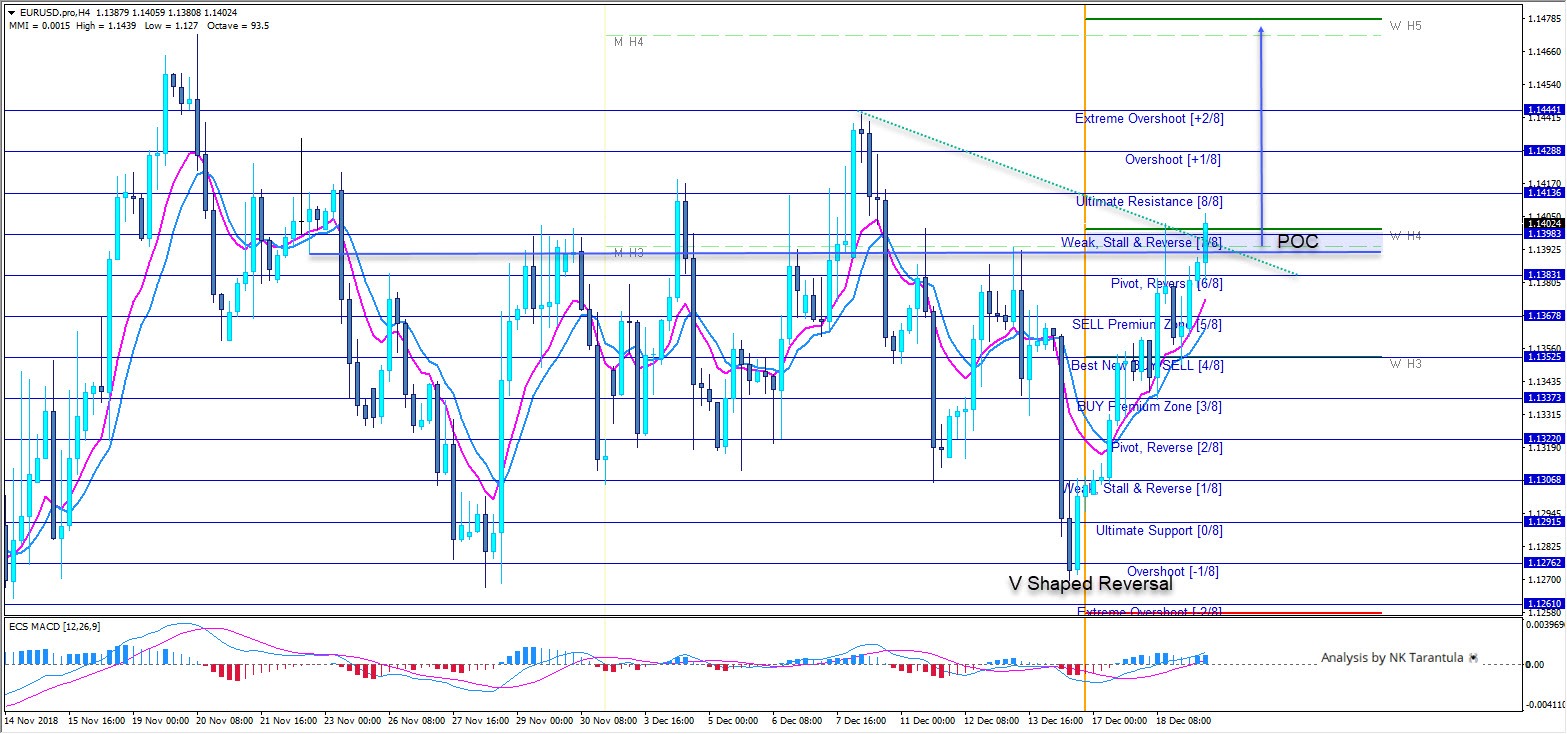
EUR/USD Close Above W H4 Will Target 1.1445 And 1.1478
The EUR/USD has formed a V Shaped Reversal at the bottom but the price is still range bound. A strong H4/ D1 close above 1.1400 is needed for new bullish bounce.
The EUR should be more resilient than other G10 currencies amidst the threat of US-China trade war. I’ve repeated many times that I was buying the dips and I think it’s the way to go.
The POC zone has formed within 1.1390-1.1400 but any bounce above 1.1352 is considered bullish. The price is getting close to overshot levels as it is breaking a retracement trend line. If the price proceeds further up 1.1444 is next level followed by 1.1475 zone in the case of continuation. Only a drop below 1.1335 will be considered neutral to bearish.