Sample Category Title
Cryptocurrencies Bounce Back!
Cryptocurrencies bounce back!
Cryptos rallied sharply on Monday, as many investors believe this is the end of the bear market. Bitcoin recovered from a 15-month low, jumping from around USD 3,200 to USD 3,583. Ethereum surged 15% to $96, while EOS rose almost 30% in less than 24 hours to hit $2.54. Volumes increased across the board. After months of hunting bear, investors are chasing the bull. But is the turnaround sustainable? Investors should remain cautious: this could be a short-term reaction, another sell-off cannot be ruled out. Given the sharp appreciation of the last 24 hours, short-term weakness appears certain.
Crude oil tanks
Oil prices are back below their level at the OPEC + meeting. Brent Crude and WTI are currently trading at 58.66 and 49.09 respectively, approaching 58.10 and 48.50 short-term. Dropping by more than 30% since their early October 2018 high, they are still headed down, despite the effort from OPEC + to reduce supply by 1.2 million barrels per day. Worries of a deceleration in global economic growth should weigh on the demand, as the US, recently named the largest oil producer worldwide, is ramping up its production by 8 million bpd by year-end. This means OPEC + production will have to be reduced further to convince investors of a supply shortage. However, recovery potential is not to be neglected. US-China resolution of trade policies is advancing. Crude prices are expected to drop further short-term, as a recent speech from China’s President Xi Jinping made no specific mention of reforms. This week’s Central Economic Work Conference in China should provide more details, which should comfort investors that Chinese authorities are willing to implement tax reforms.
Macro outlook worries markets
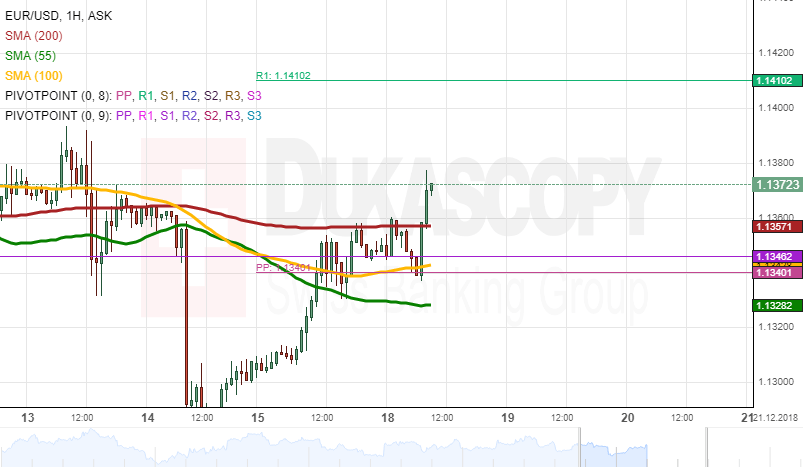
Investors are pricing in coming economic events. The Japanese yen is gaining ground against major currency pairs while the recent Xi Jinping speech on the occasion of China’s 40th anniversary of Reform and Opening did not reassure investors that further reforms would be implemented. US futures are stabilizing after a sharp drop Monday, while Asian and European shares remain red across the board. Japanese Topix and Nikkei 225 indices are trading at May 2017 and March 2018 lows, closing today’s session at -1.99% and -1.82%, while Euro Stoxx 50 is down 0.50% at opening. As the US Federal Reserve meeting approaches, followed by the Bank of England, the Bank of Japan and others (6 central bank rate decisions in total), equities will be volatile this week. EUR/USD is currently trading at 1.1375, approaching 1.1390 short-term amid expectations of a more dovish Fed following Wednesday’s FOMC meeting.
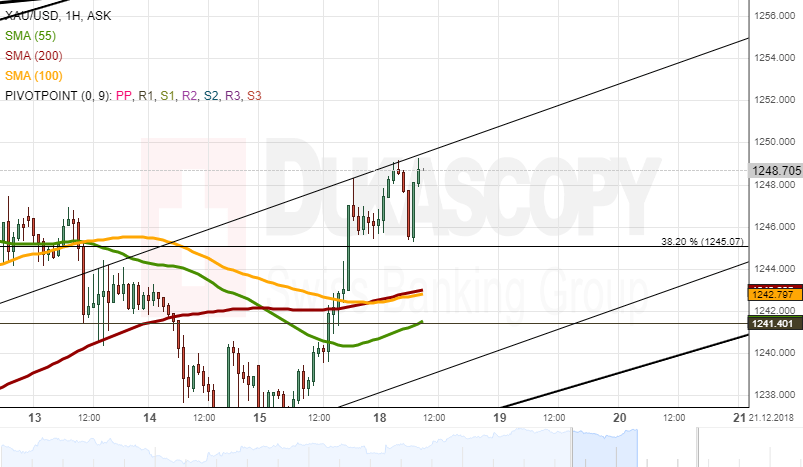
XAU/USD Analysis: Surges To 1,252.00
During Tuesday's morning hours, the yellow metal was trading above the 38.20% Fibonacci retracement level at the 1,248.70 mark.
Most likely, the 38.20% Fibo will push the rate to trade upwards to reach the 1,252.00 level during the trading session. Moreover, the 100-hour and the 200-hour simple moving averages will also support the rate during the day.
On the other side, the gold could be resisted by the upper boundary of the freshly drawn pattern line at the 1,250 mark to push the rate to trade sideways at the 1,246.00 level.
USD/JPY Analysis: Slumps By 0.90%
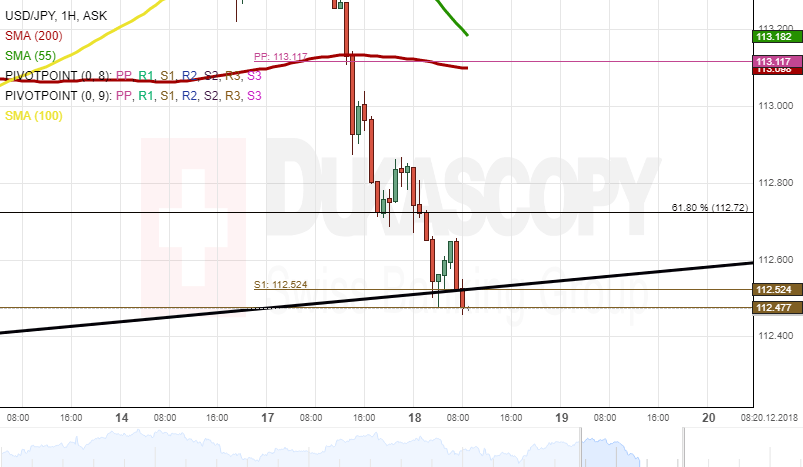
During the previous day trading session, the US Dollar depreciated against the Japanese Yen by 102 pips or 0.90% and was luckily stopped by the ascending dominant pattern line at 112.50 mark.
Most likely, the US Dollar will appreciate against the Japanese Yen to trade near the 61.80% Fibonacci retracement level at the 112.72 mark.
On the other hand, the rate could pass the support of the descending dominant pattern line to trade towards the 50.00% Fibonacci retracement level at the 112.16 mark.
DAX Recovers After Rough Start To Week, Fed Rate Announcement Eyed
The DAX index has posted considerable gains in the Tuesday, erasing most of the losses seen on Monday. Currently, the index is at 10,818, up 0.70% on the day. In economic news, German Ifo Business Climate dipped to 101.0, down from 1o2.0 and shy of the estimate of 101.8. This is the fourth straight drop for the indicator, as business confidence continues to weaken. On Wednesday, the Federal Reserve is expected to raise the benchmark rate by a quarter-point.
At last week's policy meeting, the ECB officially terminated its bond-purchasing program (QE), after three years. The program pumped some 2.6 trillion euros into the economy, and played an important role in boosting growth and inflation levels. However, the move comes at a time when the eurozone economy has slowed down, after a strong performance in the first half of 2018. Final CPI dropped to 1.9% in November, down from 2.2% a month earlier. This was below the initial forecast of 2 percent.
The eurozone slowed down in Q3, and all signs point to weak numbers in the fourth quarter as well. Global trade tensions have taken a bite out of eurozone exports, and uncertainty over Brexit and the Italian budget have soured investor confidence and raised risk apprehension.
All eyes will be on the Federal Reserve on Wednesday, which winds up its rate policy meeting. The Fed is expected to raise interest rates on Wednesday, which would mark the fourth rate hike in 2018. The CME has pegged the odds of a rate hike at 69%, down from 80% just one week ago. A key factor in the drop is the latest sell-off in global equity numbers. The week started poorly, as the S&P fell on Monday to its lowest level since October 2017. Rate hikes are unusual when stock markets are swooning, so traders should be prepared for the Fed to send a dovish message to the markets, along with a quarter-point rate hike.
EUR/USD – Euro Moves Higher, Shrugs Off Soft German Confidence Report
EUR/USD has moved higher in the Tuesday session, continuing the upward movement seen on Monday. Currently, the pair is trading at 1.1373, up 0.23% on the day. On the release front, German Ifo Business Climate dipped to 101.0, down from 1o2.0 and shy of the estimate of 101.8. This is the fourth straight drop for the indicator, as business confidence continues to weaken, albeit slowly.
A milestone was reached last week, as the ECB officially terminated its bond-purchasing program (QE), after three years. The program pumped some 2.6 trillion euros into the economy, and played an important role in boosting growth and inflation levels. However, the move comes at a time when the eurozone economy has slowed down, after a strong performance in the first half of 2018. Final CPI dropped to 1.9% in November, down from 2.2% a month earlier. This was below the initial forecast of 2 percent.
After a weak third quarter of growth in the eurozone, there are serious concerns that the slowdown will affect fourth quarter numbers as well. Global trade tensions have taken a bite out of eurozone exports, and uncertainty over Brexit and the Italian budget have soured investor confidence, which has put pressure on the euro. EUR/USD has declined 2.7% since July 1, and faces more headwinds before the end of the year.
The Federal Reserve is expected to raise interest rates on Wednesday, which would mark the fourth rate hike in 2018. The CME has pegged the odds of a rate hike at 69%, down from 80% just one week ago. A key factor in the drop is the latest equity sell-off. The week started poorly, as the S&P fell on Monday to its lowest level since October 2017. Rate hikes are unusual when stock markets are swooning, so traders should be prepared for the Fed to send a dovish message to the markets, along with a quarter-point rate hike.
Worst Annual Decline Since 2008
Hopes of Santa Claus rally coming to town are dashed because the only powerful trend for the markets is the downtrend. The S&P500 is down nearly -4.78% YTD and the Dow Jones index has lost nearly -4.56% YTD. The situation is even worse when we look at the other side of the Atlantic, European markets are in the deep red territory. The Euro stoxx50 is down by 12.57%, the FTSE 100 index has plunged -11.80% and the DAX index is down by whopping -16.61%. So for the markets to experience the Santa Claus rally, it may as well peel off Santa from high street shops first.
What supported the markets so far was the robust U.S. economic data. However, the economic data has started to derail over in the U.S. The home builders sentiment number released yesterday fell to a level not seen since 2015. Remember, the housing data is widely considered as the leading indicator to measure the economic health of the country. The ongoing weakness in this area doesn’t paint an optimistic picture for the economy.
Of course, the weakness in this area is stimulated by the ongoing interest rate hikes by the Fed. The economy isn’t robust enough to stand the current pace of interest rate hikes, at least this is what the data is articulating. This week, the Fed is meeting again and it is widely expected that Jerome Powell, the Fed president will increase the interest rates again ignoring the economic health of the country or the markets. Basically, it seems like that the Fed has decided not to cave into any one’s will, doesn’t matter if it is the president of the United States or some market participants.
If we look at the equity markets, there isn’t anything positive there. To put things in perspective, the S&P 500 index is on track to record the second-worst December ever for the index. The S&P 500 index has touched its lowest level for the year and the current sell-off marks the worst annual decline since 2008. Clearly, bears are in strong control. Any upward move presents nothing but an opportunity for the sellers to join the current downtrend. Doesn’t matter if we are talking about the small cap of big cap stocks, the theme is the same..
Of course, the counter-argument is that the market is really cheap and the bulls usually step back in the market when stocks are cheap. The forward one-year price-earning ratio for the S&P 500 index has touched a level not seen since 2014 (close enough to kiss its five-year average) and for the European markets (EuroStoxx 600), this has plunged to a level not experienced since 2013 (dropped below its 10-year average).
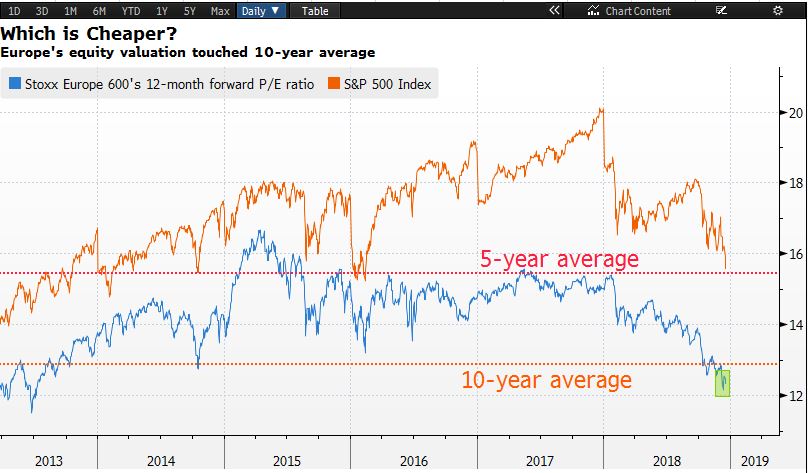
Clearly, the European stocks present a lot more value for those who are into buying low and selling high. European shares are beaten down mainly due to the Brexit related political headlines and slowing economic growth in Italy has made matters worse.
As long as this hostage situation prevail, I think it may be just difficult to see any new trend emerging for the European markets. Thus, the European markets despite being cheap may still not become part of the shopping list for investors.
GBP/USD Analysis: Will Depreciate
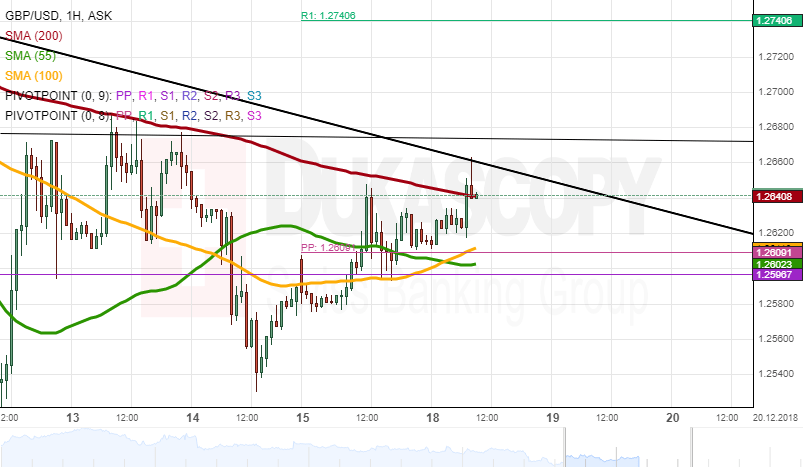
The British Pound was trading sideways to stay at the 1.2600 level during the previous session. On Tuesday morning, the currency exchange rate was resisted by the 200-hour simple moving average to trade at the 1.2633 mark.
The British Pound will trade downwards during the day. Most likely, the rate will get resisted by the 200-hour SMA to pass through the most of the technical indicators to trade below to the monthly S1 at 1.2596.
On the other side, the British Pound could appreciate against the US Dollar to break the descending medium pattern line at 1.2600 mark to trade towards the weekly R1 at the 1.2740 mark.
USD/JPY Outlook: Steep Fall Accelerates On Expectations Of Dovish Fed And Pressures Key Supports At 112.23/04
The pair extends steep fall from 113.70 high (13 Dec) into third straight day broke below daily cloud which was penetrated on Monday.
Break of strong support at 112.46 (daily cloud base / Fibo 61.8% of 111.37/114.20 rally) opened key near-term support at 112.23 (6/10 Dec double-bottom, also Fibo 23.6% of larger 104.63/144.54 rally) and 112.04 (Fibo 76.4% of 111.37/114.20 bull-leg).
Sustained break here would generate strong bearish signal and risk extension towards 111.37 (26 Oct spike low) and pivot at 110.76 (Fibo 38.2% of 104.63/114.54) in extension.
Bearish sentiment is boosted by risk-off mode and expectations of dovish Fed on Wednesday, which could further weaken the dollar.
Daily studies in strong bearish setup add to negative scenario.
Res: 112.46; 112.85; 113.08; 113.20
Sup: 112.23; 111.77; 111.37; 110.76
BOJ: Loss in Communication Hinders Policy Effectiveness
The government of Japan downgrades its forecasts on GDP growth and inflation for the coming years. This evidences the failure of the transmission mechanism of the monetary policy adopted by the Bank of Japan. We believe the central bank has already run out of solutions to rescue sluggish economic growth and disinflation. At the upcoming meeting, it would reiterate the exceptional accommodative monetary policy stance, with the key policy focus on yield curve control.
Government Downgrades Economic Outlook
The Cabinet Office announced that the GDP growth forecast for fiscal 2018 (year ending in March 2019) is revised lower to +0.9%, compared with the previous projection of +1.5%. Growth for fiscal 2019 is also trimmed to +1.3%, from previous estimate of +1.5%.
Concerning the components, capital expenditure is expected to expand +2.7%, compared with previous estimate of +3.4%, amid global economic growth slowdown. Growth in private consumption is unrevised at +1.2%, as the impact of a consumption tax hike scheduled in October would be offset by fiscal stimulus.
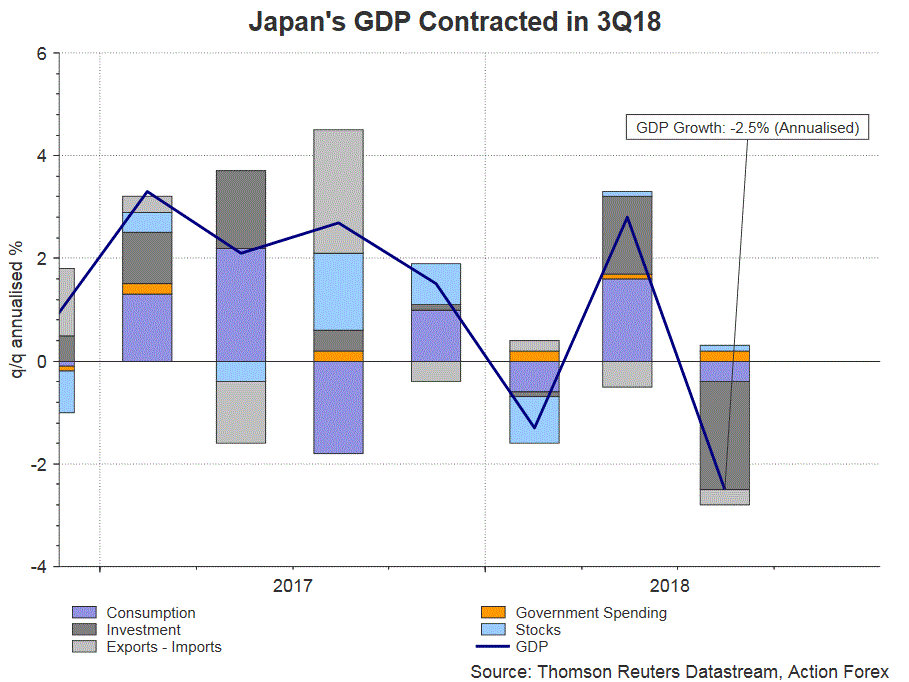
The government, however, remains upbeat on exports, expecting growth of +3% despite US-China trade war.
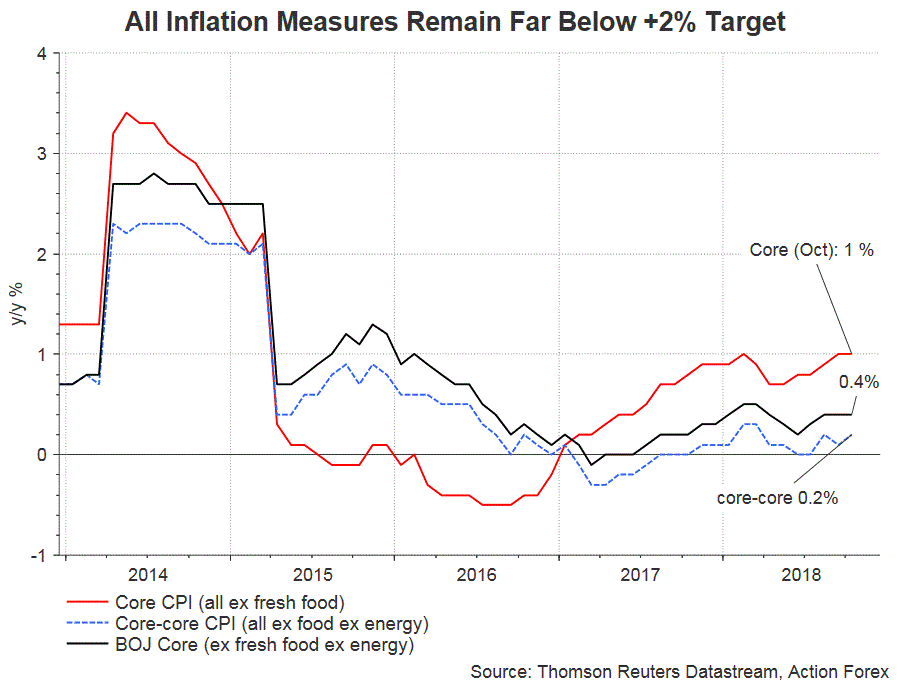
On inflation, CPI are revised lower to +1% (previous: +1.1%) and +1.1% (previous: +1.5%) for fiscal 2018 and 2019 respectively.
 Brief Review of BOJ Monetary Policy after 2007/08 Global Financial Crisis
BOJ has kept the policy rate around 0% since late 1990s, as the country’s economy has been suffering from stagnation after the burst of asset bubbles in 1991-92. As such, rate cut, although the central bank had done so, is not a feasible policy tool for BOJ to stimulate the economy in the outbreak of the 2007/08 Global Financial Crisis.
QE, while it appeared unconventional in the policy by the Fed or the ECB, had been adopted by BOJ from 2001-2006. The severity of the global financial crisis, however, had called for a return to QE in January 2009.
In April 2013, BOJ introduced a tool called qualitative and quantitative easing (QQE). While the quantitative part is asset purchases (JGB purchases at a pace of 80 trillion yen/ year), the qualitative part is and inflation-overshooting commitment, under which BOJ continues expanding the monetary base until the year-on-year rate of increase in the observed CPI (all items less fresh food) exceeds 2% and stays above the target in a stable manner.
Through this commitment, BOJ aims to enhance the credibility of achieving the price stability target of 2% among the public. QQE was then “enhanced” with negative interest rate (the policy rate has been staying at -0.1% to 0% since early 2016) and yield curve control (YCC) in 2016. In July 2018, the central bank tweaked the YCC measure modestly, allowing the yields to move in the range of +0.2% and – 0.2%, from previous range of +0.1% and -0.1%.
To summarize, BOJ’s existing monetary policy tools include keeping policy rate at -0.1%, purchasing JGBs at a pace of 80 trillion yen/ year and yield curve control -keeping 10-year JGB yield at 0%, with trading band at +0.2% and – 0.2%.
Miscommunication between BOJ and Market
The transmission mechanism is critical to the success of monetary policy. When a central bank lowers its policy rate, which is usually the short-term interest rate it charges on lending money to commercial banks, it aims at influencing the commercial banks to also lower their interest rates charged on loans to corporations and individuals. Eventually, asset prices and general economic conditions are affected as a result of the rate cut.
Therefore, a monetary decision intends to influence the aggregate demand, interest rates, and amounts of money and credit in the market. These would in turn influence the overall economic performance.
BOJ’s actions have from time to time been misread by the market. This problem has greatly affected the effectiveness of the policies it adopted.
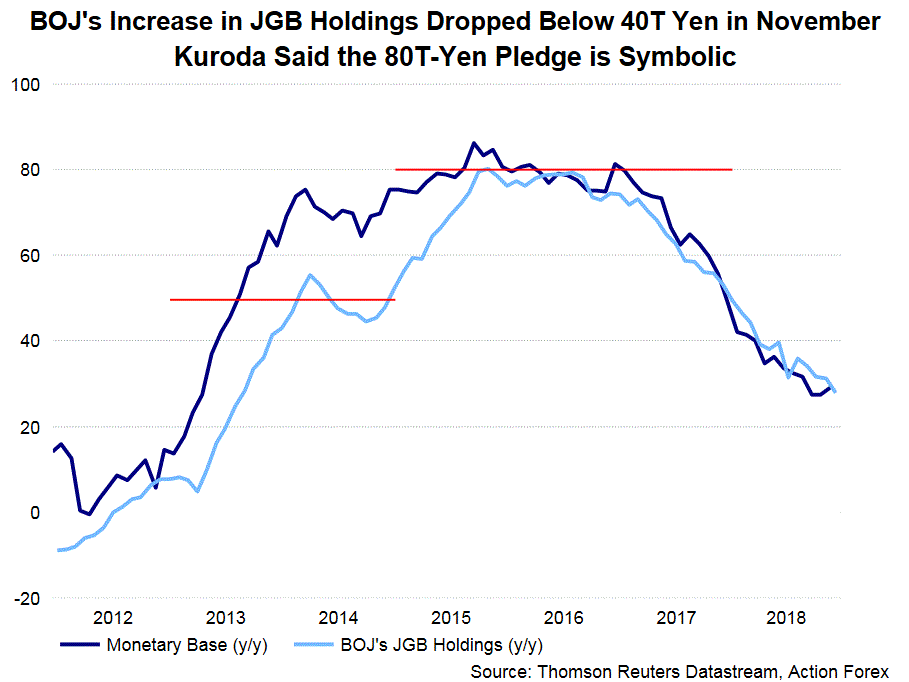
For example, while BOJ has reiterated in every meeting statement that it would continue to buy JGBs at an annual pace of 80 trillion yen, the actual increase in BOJ's holdings has been falling consistently since 4Q16. The annual increase fell to 58 trillion yen and below 40 trillion yen in December 2017 and November 2018, respectively.
No clarification was made by officials until speculations that BOJ had been tapering became so intense. A more clarification was made at a Bloomberg interview in October. Governor Haruhiko Kuroda admitted that the 80 trillion yen purchase is only a symbolic measure by now and the market should focus on YCC.
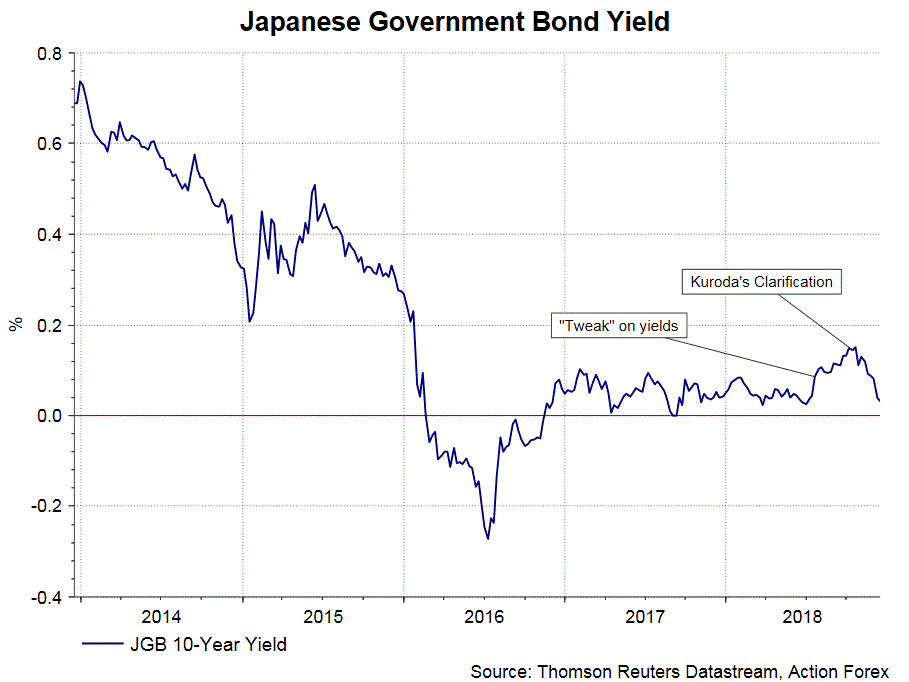
Another example is BOJ’s recent tweak on YCC, allowing the yields to move in the range of +0.2% and – 0.2%, from previous range of +0.1% and -0.1%. The one-way increase in yields suggests that the market interpreted the tweak as with tightening bias.
Attempting to downplay speculations on BOJ’s exit from stimulus measures, Kuroda noted at the above-mentioned interview that only a change in interest rate target would be a signal for policy shift. He added that interest rates would stay at the current level as inflation has stayed weak. JGB yields corrected after his words, together with expectations that the global rate hike cycle might end soon.
It is so obvious that BOJ would have to keep stimulus for an extended period of time, given economic stagnation and weak inflation. While BOJ has reiterated the accommodative policy stance, it appears ambivalent on how to implement the tools.
Unlike Fed and ECB, BOJ has been reserved, refraining from preemptive communication with the public on the policy measures unless tightening speculations have sent Japanese yen or bond yields soar to very high levels. Back in March, the yen jumped after Kuroda indicated that BOJ may find itself thinking about exiting its stimulus in the year starting in April 2019.
Over the past 20 years, Japan has lost competitiveness in exports to rivalries in China and South Korea. Elevated exchange rate due to yen’s role in carry trades has only exacerbated the problem. This is undoubtedly an arduous mission for BOJ to try to reverse the scenario.
Besides implementing the “innovative” measures trying to revive the economy, the central bank should also improve its communication with the market. This should facilitate the transmission mechanism and improve the effectiveness of its policies.
EUR/USD Analysis: Appreciated To Trade At 1.1320
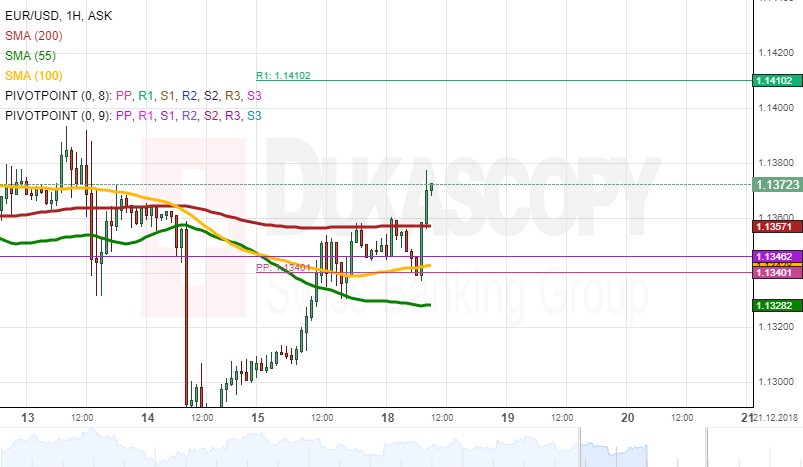
During the previous trading session, the European Single Currency broke the resistance of the monthly pivot point at the 1.1346 mark. On Tuesday morning, the rate was located between the 55-hour and the 100-hour simple moving averages at the 1.1345 mark.
Most likely, the currency exchange rate will keep trading sideways to stay at 1.1300 level. Note, the 200-hour SMA should resist the rate from surge during the day.
However, the monthly pivot point at the 1.1346 mark could support the rate to trade near the weekly R1 at 1.1410 mark.