

Sample Category Title
Loonie Declines Awaiting Inflation and Retail Sales
Canadian inflation figures will hit the markets on Wednesday at 1330 GMT as well as retail sales and GDP numbers that are scheduled to be released on Friday at 1330 GMT. On December 5, the Bank of Canada (BOC) left its benchmark interest rate unchanged at 1.75%, after raising it by 25bps in the preceding meeting as was widely expected. It remained the highest rate since December 2008. Policymakers mentioned that more interest rate hikes will be needed to keep inflation into a range of 2% target and that will depend on several factors, which include consumption and housing, global trade policy developments, oil prices and the Bank’s assessment of the economy’s spare capacity.
The nation’s inflation as gauged by the Consumer Price Index (CPI) is expected to have increased by 1.8% on an annual basis in November versus 2.4% in the previous month. Underlying measures of inflation – the common, median and trim CPIs, which are watched closely by the Bank of Canada – will also come out at the same time. Moreover, retail sales are forecast to have grown by 0.4% m/m in October, accelerating from the 0.2% rate in September. Excluding automobiles and parts that tend to be highly volatile, core retail sales are expected to have jumped by 0.2% m/m, from 0.1% m/m previously. Canada’s economy is forecasted to have grown by 0.2% in October, on a monthly basis, picking up some steam after a negative reading of 0.1% before.
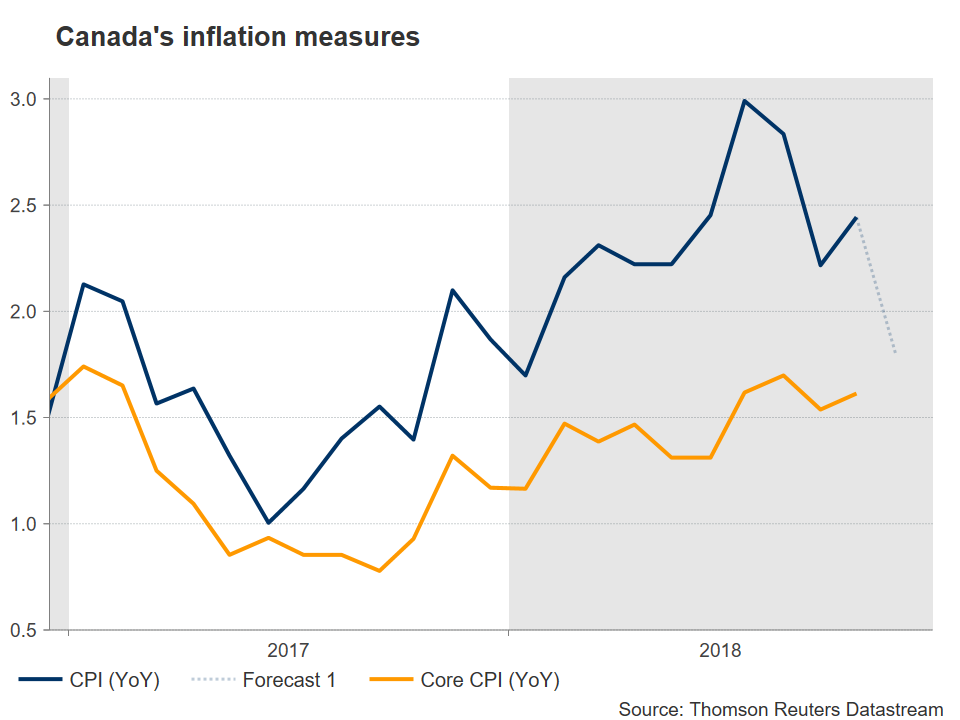
Inflation numbers have the potential to shed some light, despite the confusion with regards to the BOC’s future plans. The slide in the headline CPI may be owed to the decrease in oil prices, but if this is accompanied by a decline in the core rate as well, investors may be convinced that the Bank will refrain from acting anytime in the first half of 2019. On the other hand, an upside surprise in this data set could encourage them to add to their bets of a rate hike early next year.
At its last meeting, the Bank left rates steady, however, the statement had a dovish tone compared to the hawkish one in the previous time, prompting market participants to take their January rate-hike bets off the table. More recently, BOC Governor, Stephen Poloz sounded even more dovish, saying rate hikes “can be interrupted” in an interview with CTV on Monday.
That said, Canada’s record employment numbers for November may have increase some hopes that officials could eventually push the hiking button at one of their upcoming gatherings. Canada’s manufacturing PMI touched a three-month high, driven by a record rise in surveyed employment, while the headline seasonally adjusted IHS Markit Manufacturing Purchasing Managers’ Index (PMI) jumped to 54.9 in November, up from 53.9 in October, to signal the sharpest improvement in business conditions since August.
It has been a rough one-and-a-half months for the Canadian dollar. The currency has been under pressure since the beginning of October, losing more than 4% versus the US dollar during this time. Weak oil prices and a cooling US economy have dampened Canada’s growth momentum, and the BOC responded by remaining on the sidelines and maintaining interest rates steady.
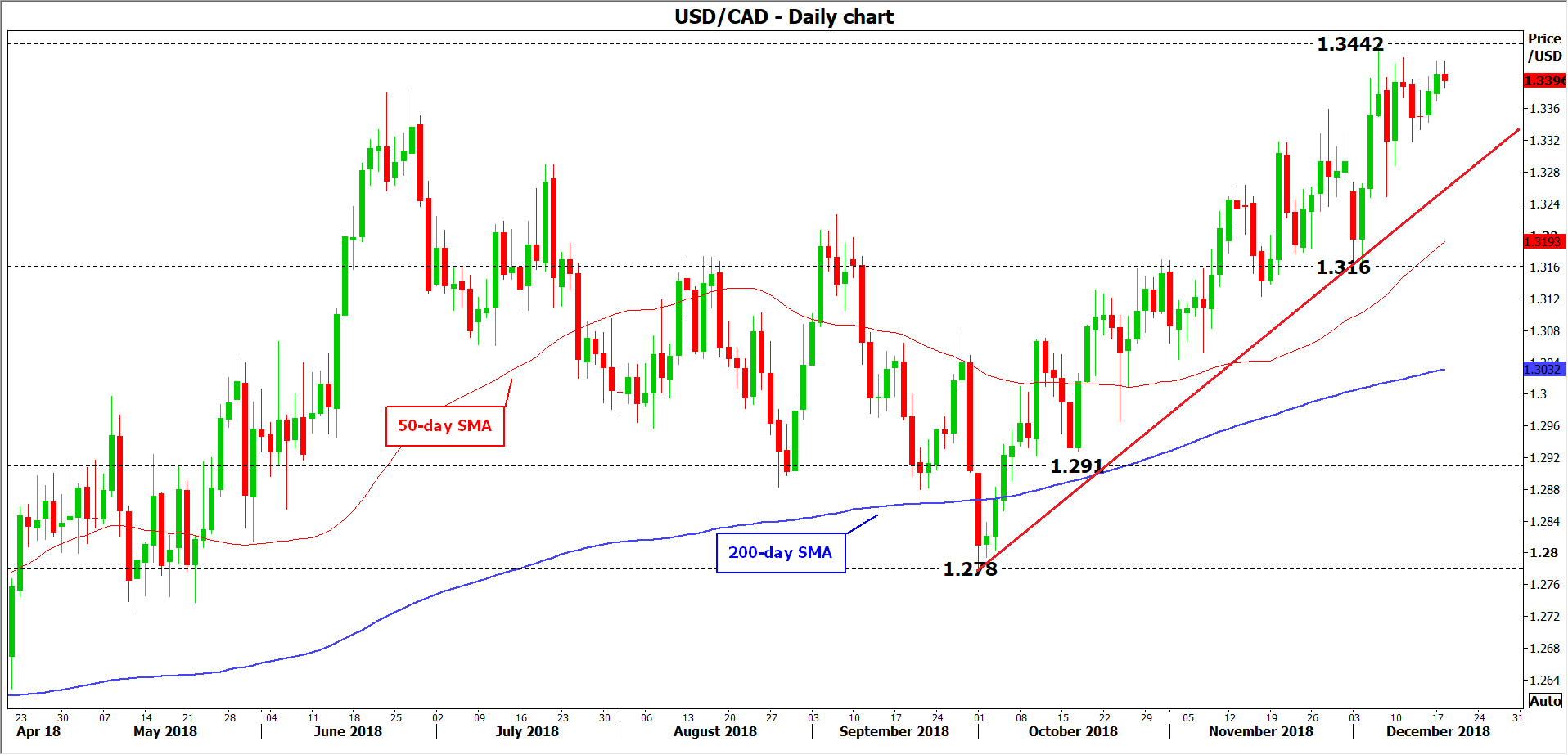
Stronger figures than expected would endorse further the scenario for a January or March rate increase and could help the loonie to recover somewhat. Having a look at dollar/loonie, in the daily timeframe, a downside movement could send prices towards the ascending trend line, around 1.3300, drawn from the lows of October 1. A penetration of this line could open the door for the 1.3160 support level, which holds beneath the 50-day simple moving average (SMA).
On the other side, a disappointing set of data could bring the Canadian dollar under renewed selling pressure. So, dollar/loonie could head even higher, challenging once again the 18-month high of 1.3443, achieved on December 6. An upside break could send prices towards the 1.3540 resistance, identified by the highs on June 2017.
Overall, besides monetary policy considerations, the domestic currency is affected from the performance of the oil market as Canada is a major oil producing country.
Sunset Market Commentary
Markets
Global core bonds paired intraday gains today in a fragile risk environment. Asian equity markets continued yesterday’s sell-off on WS, giving safe havens some upward potential. US Treasuries and German Bunds opened neutral, but with an upward appetite as European equities opened in red as well. The German IFO business confidence colored the European calendar today and decreased to 101.0 in December, down from 102.0 the month before. Market consensus was 101.7. The forward looking component printed lower than expected too. It had little impact on trading as the German DAX index was one of few European indices that traded (little) in green throughout the day. US housing data surprised on the upside, after recent data pointed to a cooling down of the housing market. However, investors keep their focus on the Fed meeting of tomorrow. US Treasuries and German Bunds fell lower in the run up to the US opening. Main stock markets gain over 1.0%, putting further pressure on core bonds. The US yield curve edges lower with changes ranging from 0.8 bps (2-yr) to 1.2 bps (5-yr). The German yield curve is mixed with changes varying between -0.9 bps (30-yr) to +0.3 bps (2-yr).
The euro remained well bid with volatility fairly muted going into tomorrow’s crucial Fed meeting. The common currency traded flat during Asian hours but started an upward trend as soon as European dealings kicked off. The German IFO-indicator came in close to expectations and remained relatively stable compared to last month. That might have comforted euro bulls, especially after last week’s dramatic PMI’s. EUR/USD also found solid support in narrowing US/EMU interest rate differentials up until noon. With US early birds entering the market the narrowing process halted/reversed, turning the tide for the dollar. EUR/USD’s 1.14-test failed and is changing hands at 1.137 at the time of writing, up from this morning’s 1.1348 opening. USD/JPY left intraday lows but it still down from yesterday (at 112.47 from 112.8).
May’s cabinet discussed planning for a no-deal scenario today but stressed that seeking a deal with the EU is still “top priority”. Negotiations are ongoing and will continue going into 2019. Against the background of Parliamentary recess starting this Thursday, we expect Brexit to temporarily slumber at investor’s minds. EUR/GBP trading is left to technical considerations with intraday volatility reinforced by lower liquidity in markets. We witnessed a preview of such trading conditions today as EUR/GBP was whipsawed, swapping gains for losses and vice versa. The pair is currently trading at 0.899, close to today’s opening levels. Cable tested the 1.27-handle but lost ground afterwards, mainly due to dollar strength. The pair trades at 1.264 currently.
News Headlines
US housing starts and building permits beat forecasts in November. They resp. rose by 3.2% M/M and 5% M/M following downward revisions to Oct. outcomes. The data sooth fears over a cooling housing market after the weak Dec. NAHB housing index yesterday, though single-family starts, a key segment, fell to the lowest since May 2017.
EU Commissioner Moscovici said France won’t be sanctioned over their increased 2019 budget deficit and repeated he is confident that the EU and Italy will find an agreement as well, so it avoids sanctions too. Italy lowered its GDP growth forecast for next year with Deputy PM Di Maio saying Italy made all the budget concessions possible.
The UK cabinet met to implement measures for a no deal scenario even as getting PM May’s deal approved in Parliament remains the governments priority. Pre-emptive measures include additional information for citizens. The tax office will give businesses guidance to prepare for border changes and £2 bn of money reserved for no deal preparations will be released shortly.
Canada Manufacturing Sales Ticked Lower in October but Details Solid
Highlights:
- Headline manufacturing sales dipped 0.1% in October but volumes were up 0.2% despite a pullback in the volatile aircraft component and — accounting for an inventory build — production looked solid.
- Year-over-year sale volumes were up 3.8%.
- Underlying details are consistent with our assumption that overall GDP increased 0.2% in October following the 0.1% dip in September.
Our Take:
The 0.1% dip in headline nominal sales was in part due to lower prices, particularly for wood products. Excluding the impact of prices, the volume of sales rose 0.2% despite a 6% pullback in the often-volatile aerospace component. Along with a build in inventories, manufacturing output (as opposed to headline sales) appears to have increased more than half a percent in October — consistent with what we expect will be a 0.2% bounce-back in overall GDP in the month following a surprisingly soft 0.1% dip in September. The build in inventories in October does not appear to have been ‘unwanted’. New order volumes were up 2.8% from September in October, and up 5.2% from a year ago.
Concerns about the potential impact of lower oil prices on activity in the oil & gas sector remain and we continue to expect slower growth in Q4/18 — in part because of a transitory disruptions tied to the Canada Post strike. Equity markets have been volatile and slower household spending and debt growth have arguably reduced the urgency for further interest rate hikes in the near-term. At the same time, as reiterated by Governor Poloz in media comments yesterday, the economy still looks like it’s running around its capacity limits, the economic data to-date has held up relatively well compared to financial market data, and interest rates are still very low from a historical perspective. Although a central bank rate hike in January has become much less likely over the last couple of months, we continue to expect interest rates will ultimately continue to drift gradually higher in 2019.
USD/CHF Mid-Day Outlook
Daily Pivots: (S1) 0.9903; (P) 0.9945; (R1) 0.9973; More...
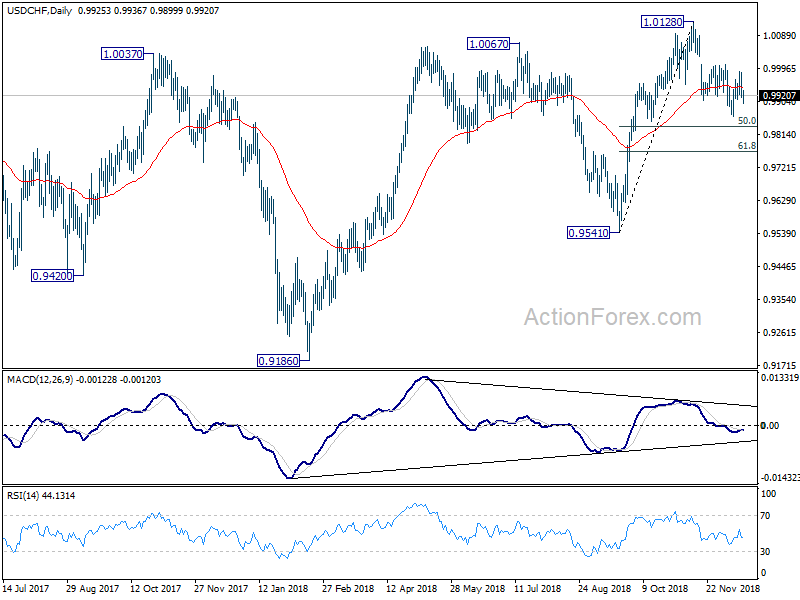
USD/CHF's breach of 0.9911 minor support suggests completion of rebound from 0.9862 at 0.9989. Intraday bias in mildly on the downside for 0.9862 support. At this point, we'd continue to expect strong support from 0.9848 support to bring near term reversal. On the upside, above 0.9989 will turn bias back to the upside. Break of 1.0008 will target a test on 1.0128 high.
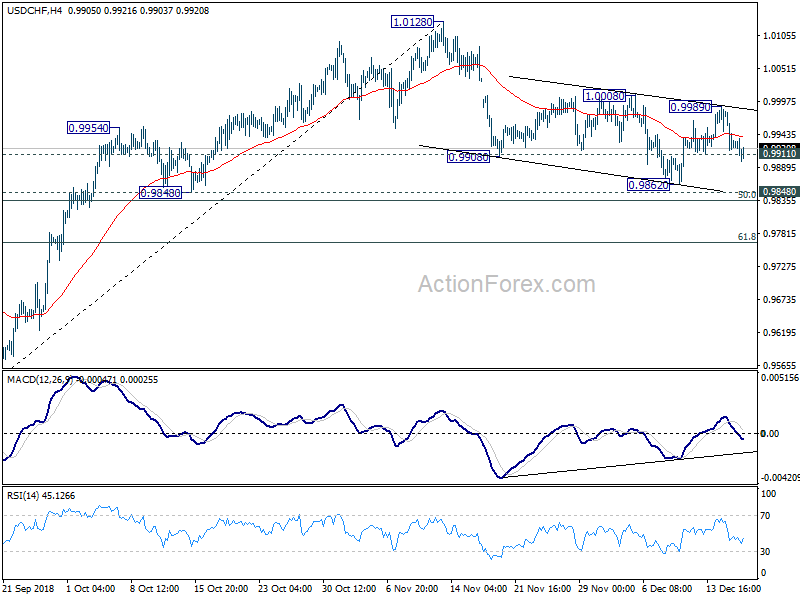
In the bigger picture, current development suggests that the medium term rally from 0.9186 hasn't completed yet. Break of 1.0128 will target 1.0342 key resistance next (2016 high). On the downside, break of 0.9848 support will dampen this bullish view and turn focus back to 0.9541 key support instead.
USD/JPY Mid-Day Outlook
Daily Pivots: (S1) 112.50; (P) 113.01; (R1) 113.35; More..
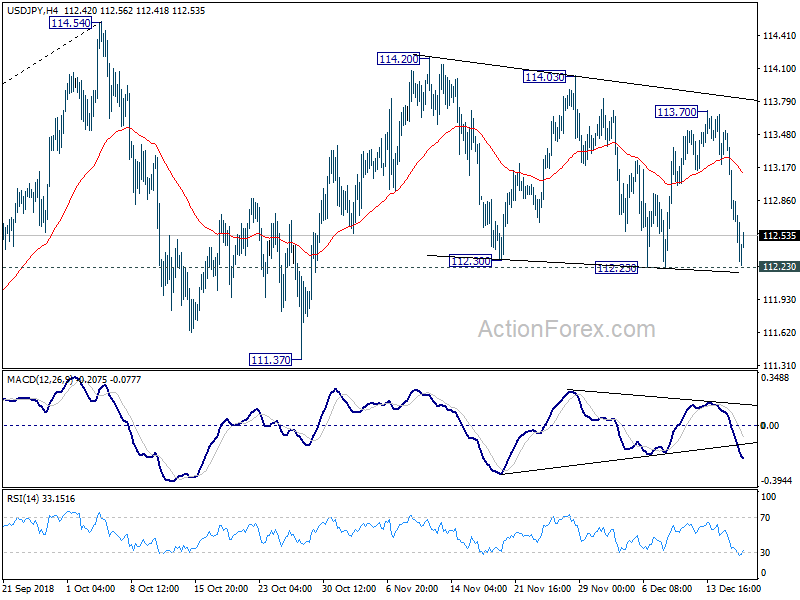
USD/JPY is still holding on to 112.23 support despite today's steep fall. Intraday bias stays neutral at this point. On the downside, break of 112.23 support will extend the corrective pattern from 114.54 with deeper decline to 111.37 and below. On the upside, above 113.70 will target 114.20 resistance first. Break there will resume the rise from 111.37 and target 114.73 key resistance next. Overall, price actions 114.54 are seen as a consolidative pattern. In case of deeper fall, downside should be contained by 38.2% retracement of 104.62 to 114.54 at 110.75 to bring rebound. Larger rise from 104.62 is expected to resume later.
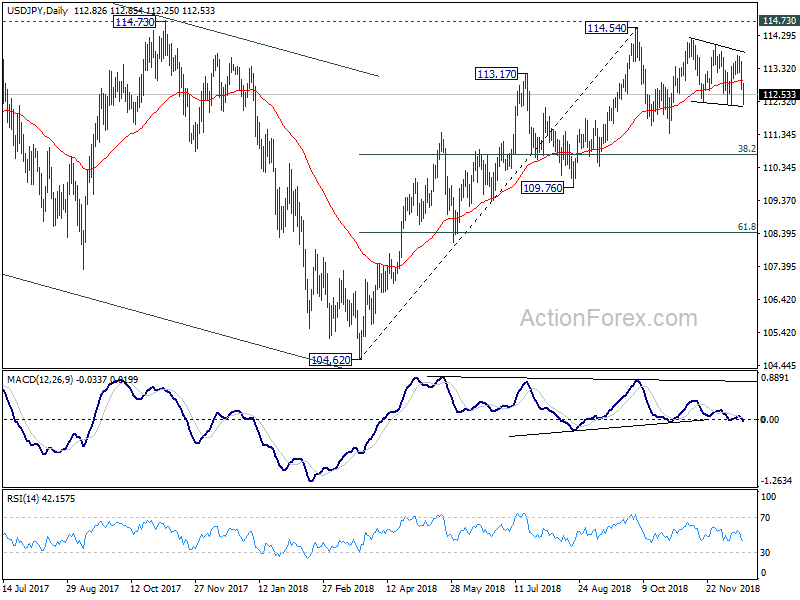
In the bigger picture, corrective fall from 118.65 (2016 high) should have completed with three waves down to 104.62. Decisive break of 114.73 resistance will likely resume whole rally from 98.97 (2016 low) to 100% projection of 98.97 to 118.65 from 104.62 at 124.30, which is reasonably close to 125.85 (2015 high). This will stay as the preferred case as long as 109.76 support holds. However, decisive break of 109.76 will dampen this bullish view and turns outlook mixed again.
EUR/USD Mid-Day Outlook
Daily Pivots: (S1) 1.1313; (P) 1.1336; (R1) 1.1372; More.....
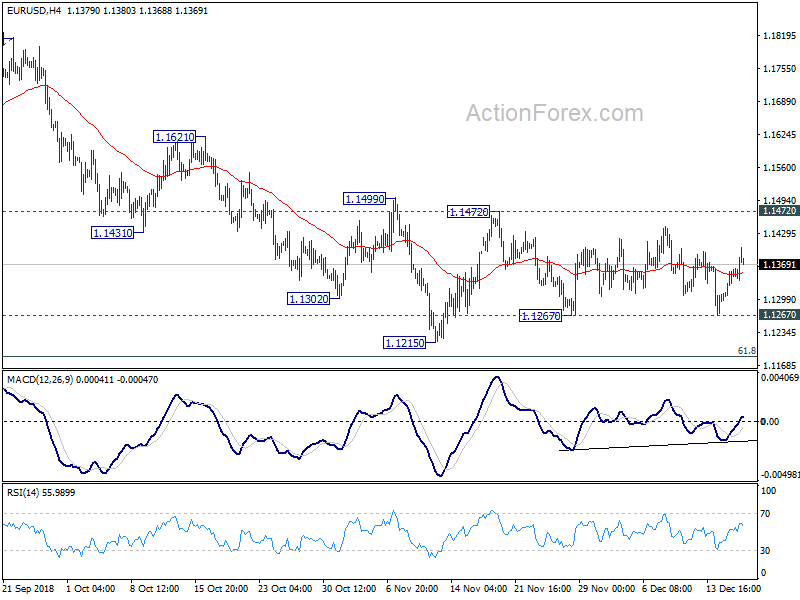
EUR/USD is staying gin range of 1.1267/1472 and intraday bias stays neutral. Also, with 1.1472 resistance intact, near term outlook remains bearish and further decline is expected. On the downside, break of 1.1267 will suggest that larger gall is resuming and should target 1.1251 low next. Decisive break there will confirm this bearish case. EUR/USD should drop through 1.1186 fibonacci level to 61.8% projection of 1.2555 to 1.1300 from 1.1814 at 1.1038 next. However, break of 1.1472 resistance will indicate near term reversal and turn focus back to 1.1814 resistance.
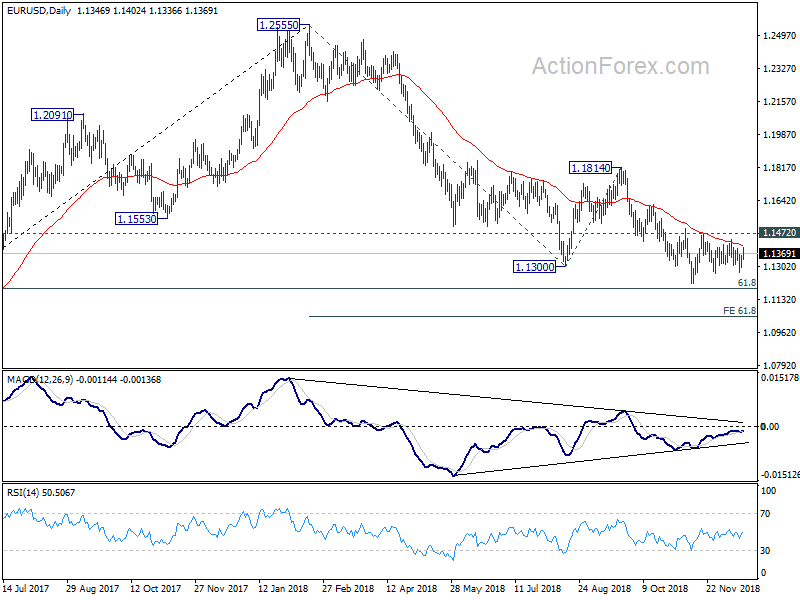
In the bigger picture, as long as 1.1814 resistance holds, down trend down trend from 1.2555 medium term top is still in progress and should target 61.8% retracement of 1.0339 (2017 low) to 1.2555 at 1.1186 next. Sustained break there will pave the way to retest 1.0339. However, break of 1.1814 will confirm completion of such down trend and turn medium term outlook bullish.
US 500 Index Moves above 14-Month Trough; Outlook Switches to Negative
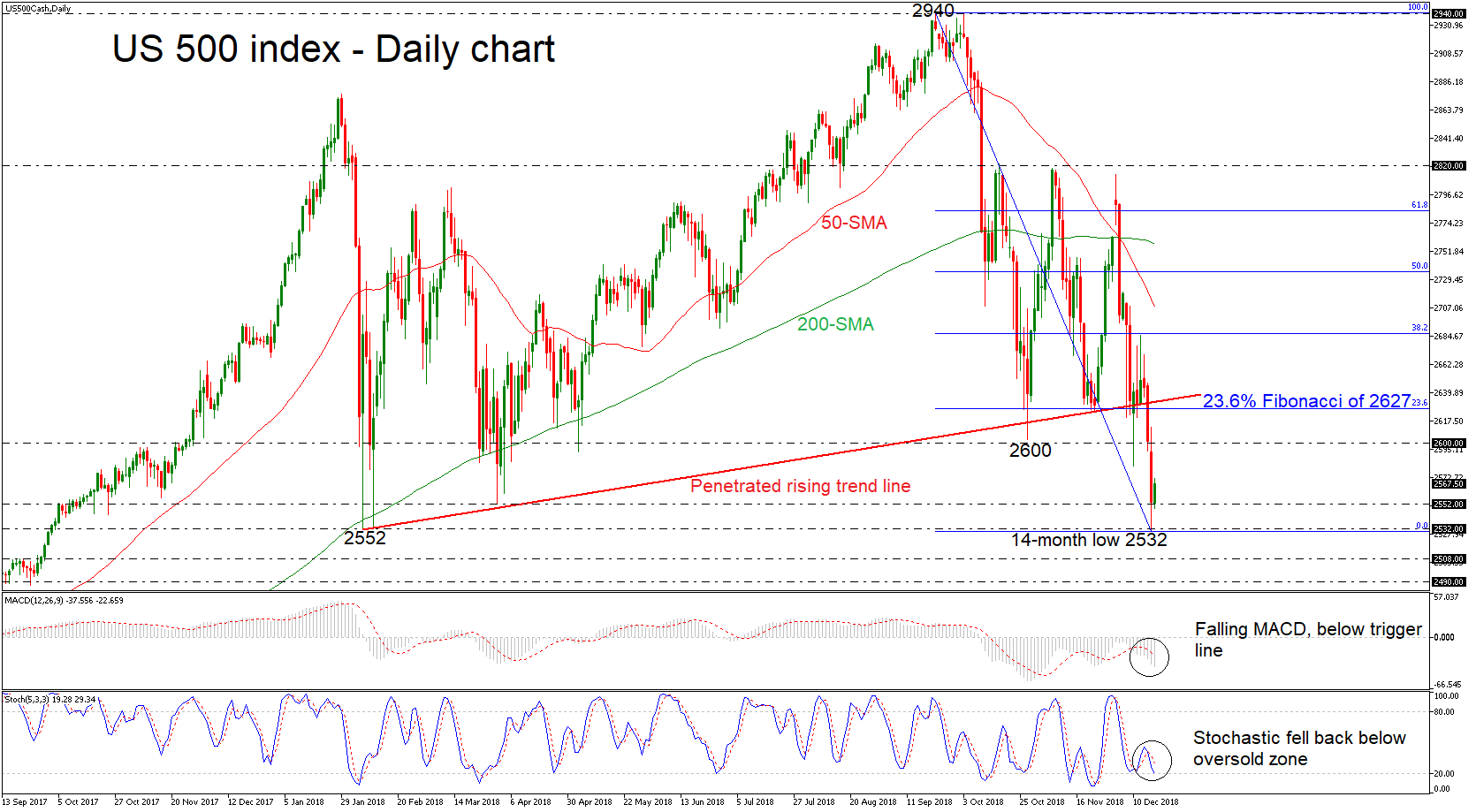
The US 500 index had a bearish start on Monday, with the price breaking a crucial support at 2600 to drop towards a 14-month low of 2529.80 and taking its year-to-date losses to 4.7%. The price has also increased distance below its negatively sloped moving average lines and the ascending trend line, which had been holding since February 6, indicating that the recent downtrend might hold for longer. However, the price is currently regaining some ground and hovers above the multi-month trough.
Momentum indicators are bearish as well as the stochastic oscillator has reversed lower again, while the MACD is strengthening its momentum below the trigger and zero lines.
Additional declines may drive the price towards the aforementioned 14-month bottom of 2532, before the 2580 level comes into view, taken from the highs on September 2017. Beneath the latter, the 2490 could be another level in focus, registered a bit later in September 2017 as well.
In case the index changes its short-term direction to the upside, the bulls will probably challenge the 2600 strong resistance barrier. A break higher, could last until the 23.6% Fibonacci retracement level of the dowleg from 2940 to 2532, around 2627.
Summarizing, in the medium-term, the recent price action switched the bullish outlook to a more negative one after the tumble below the 2600 hurdle and the rising trend line.
GBP/USD Outlook: Pound Benefits from Weaker Dollar but Break above 1.2700 Zone is Needed to Confirm
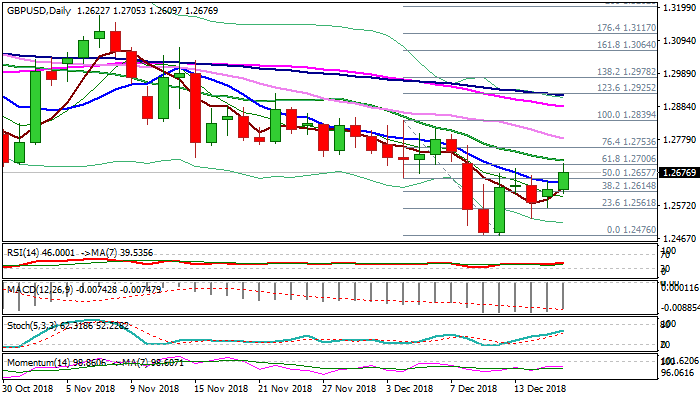
Sterling enters US session at the front foot after hitting one-week high at 1.2705 earlier, with initial positive signals being generated on break above 10SMA (1.2643) and last Thursday's recovery high at 1.2686.
Weaker dollar on expectations of Fed's dovish hike tomorrow keeps pound underpinned, but bulls need to sustain break above 1.2700 (Fibo 61.8% of 1.2839/1.2476) and 20SMA (1.2714) to confirm full retracement of post-parliamentary Brexit vote cancellation fall and signal further recovery.
Close above 10SMA would generate initial positive signal, but weakening momentum on daily chart could upset bulls.
Conversely, failure to close above 10SMA would weaken near-term tone and keep the downside vulnerable.
Res: 1.2700; 1.2713; 1.2782; 1.2810
Sup: 1.2643; 1.2609; 1.2564; 1.2528
GBP/USD Mid-Day Outlook
Daily Pivots: (S1) 1.2574; (P) 1.2611; (R1) 1.2650; More...
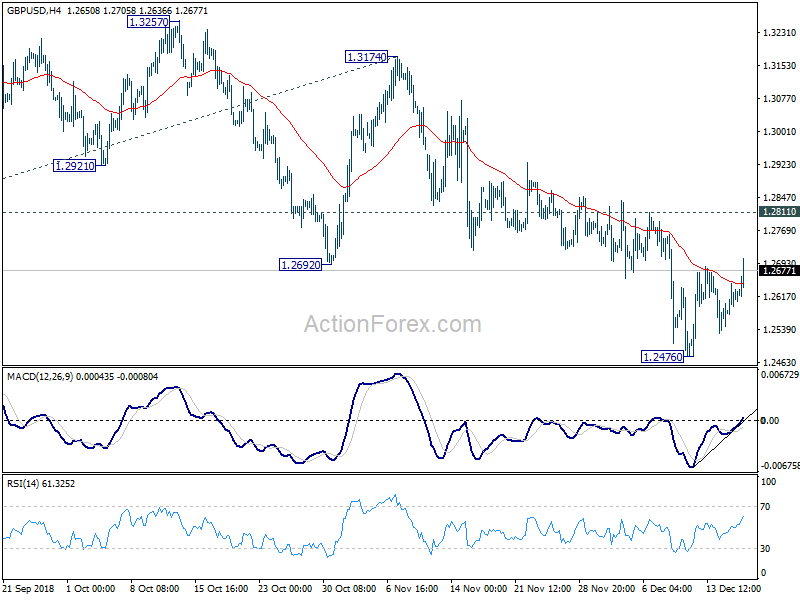
GBP/USD rebounds to as high as 1.2705 today but after all, it's in consolidation from 1.2476. Intraday bias remains neutral for the moment. And even in case of further rise, upside should be limited by 1.2811 resistance to bring fall resumption. On the downside, break of 1.2476 will extend larger down trend from 1.4376 to 61.8% projection of 1.4376 to 1.2661 from 1.3174 at 1.2114. However, firm break of 1.2811 will be an early signal of trend reversal and turn focus back to 1.3174 resistance.
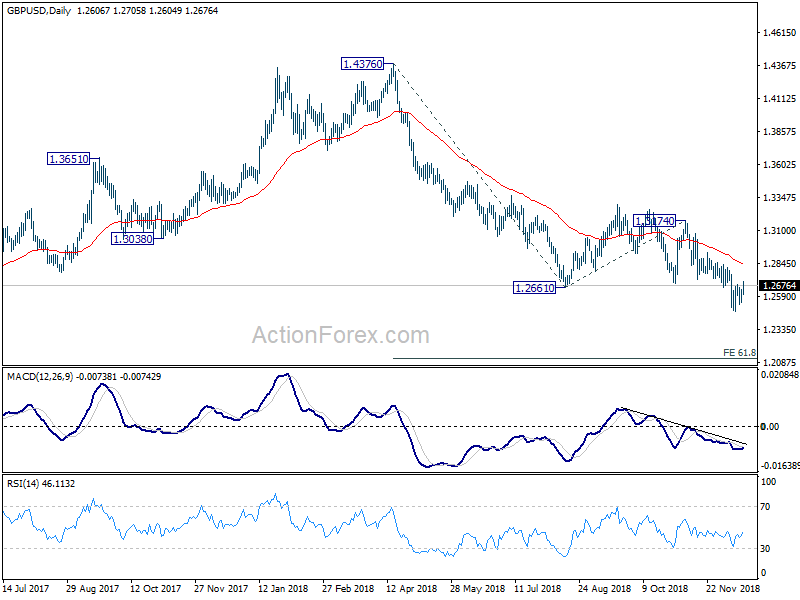
In the bigger picture, whole medium term rebound from 1.1946 (2016 low) should have completed at 1.4376 already, after rejection from 55 month EMA. The structure and momentum of the fall from 1.4376 argues that it's resuming long term down trend from 2.1161 (2007 high). And this will now remain the preferred case as long as 1.3174 structural resistance holds. GBP/USD should now target a test on 1.1946 first. Decisive break there will confirm our bearish view.
Dollar Declines as Trump Urged Fed to Feel the Markets, But Loss Limited as Traders Await Projection Numbers
Dollar selloff takes center stage today as Trump continues with his verbal intervention on Fed policy. But Canadian Dollar is even weakest as down trend in WTI crude oil extends. Swiss Franc is for now the third worst performing one. On the other hand, New Zealand Dollar recovers as is trading as the strongest one. Sterling is the second strongest, followed by Yen, as risk sentiments somewhat stabilized in European session.
In short, Trump tweeted asking asked Fed policy makers to not just go by "meaningless numbers". Instead, they should "feel the market". For now, there is no clear follow through selling in Dollar yet. Traders would are eagerly awaiting Fed to release some numbers of economic projection tomorrow, before committing themselves.
Technically, USD/CHF's break of 0.9911 support is a clear sign of weakness and it's likely heading back to 0.9862 low. But USD/JPY is trading to find some footing around 112.23 support. EUR/USD, GBP/USD, AUD/USD and USD/CAD are bounded in familiar range. EUR/JPY has yet to break 127.61 support and this level will remain a focus in US session.
In other markets, WTI crude oil hit as low as 48.09 today and is now at 49.07. At the time of writing, FTSE is down -0.46%, DAX is up 0.32% and CAC is down -0.17%. Ranges are pretty narrow. German 10 year yield is down for another day, by -0.0171, at 0.243. Italy 10 year yield is up 0.021 at 2.970. Earlier in Asia, Nikkei closed down -1.82%. Singapore Strait Times dropped -2.21%. Hong Kong HSI dropped -1.05%. China Shanghai SSE dropped -0.82%. Japan 10 year JGB yield dropped another -0.0088 to 0.028.
Released in US session, US housing starts rose to 1.26M in November versus expectation of 1.23M. Building permits rose to 1.33M versus expectation of 1.27M. Canada manufacturing sales dropped -0.1% mom in October versus expectation of 0.3% mom.
German Ifo dropped for fourth month, economy faces a lean festive season
Germany Ifo Business Climate dropped for the fourth straight month to 101.0 in December, down fro 102.0 and missed expectation of 101.7. Current Assessment gauge dropped to 104.5, down from 105.5 and missed expectation of 104.9. Expectations gauge dropped to 97.3, down from 98.7 and missed consensus of 98.2.
Ifo President Clemens Fuest noted in the release that "concern is growing among German businesses". And, "the German economy faces a lean festive season." Ifo economist Klaus Wohlrabe said uncertainty had increased again and Brexit was at the top of the agenda. The German economy is cooling but there is no recession in sight.
Italy asked to save EUR 2.5-3B more before getting European Commission approval on 2019 budget
Corriere della Sera daily newspaper reported today that the European Commission has asked Italy to save EUR 2.5 – 3.0B in their 2019 budget before getting approval. However, having cut deficit target from 2.40% to 2.04% of GDP, Italian Economy Minister Giovanni Tria said both Deputy Prime Ministers Matteo Salvini and Luigi Di Maio opposed further cuts.
European Commissioner for Economic and Financial Affairs Pierre Moscovici said today that he's "been working hard, almost day and night … so that Italy will not be sanctioned either:" He added that "we're working non-stop as part of a dialogue so that Italy can carry out the policies it wants, while respecting the rules."
SECO lowers Swiss 2019 growth and inflation forecasts significantly
The State Secretariat for Economic Affairs (SECO) lowered both 2018 and 2019 Swiss growth forecasts significantly. SECO cited that "this is mainly due to weak domestic demand". Also, "In the wake of the decline in international growth, Swiss foreign trade decreased. The appreciation of the Swiss franc in the meantime additionally slowed exports, while domestic demand also failed to stimulate growth. "
For 2018, growth projection is lowered to 2.6%, down from 2.9%. For 2019, growth projection is lowered to 1.5%, down from 2.0%. For 2020, growth is now estimated to be at 1.7%. On inflation, for 2018, CPI is projected to be at 1.0%, unrevised. For 2019, CPI is projected to be at 0.5%, down from prior estimate of 0.8%. For 2020, CPI is projected to pickup to 0.7%.
On more thing to now is that SECO's projection was based on assumption that the three month LIBOR interest rate will climb to -0.5% in 2020.
RBA minutes hint on prospect of dovish shift
Minutes of the December 4 RBA meeting maintained the same tone that "the next move in the cash rate was more likely to be an increase than a decrease". But at the same time "there was no strong case for a near-term adjustment in monetary policy".
For RBA, the "central scenario remained for steady growth in consumption, supported by continued strength in labour market conditions and a gradual pick-up in wages growth". Also, "further falls in the unemployment rate were likely". But it should be emphasized that was based on "expectation that the economy would continue to grow above trend".
Also, the meeting took place before release of Q3 GDP, which showed merely 2.8%. That's clearly lower than RBA's own projection of 2.0%. And 2.8% could merely be described as being around trend, not above trend. Thus there is prospect of a dovish shift in RBA's upcoming forecast in February Monetary Policy Statement.
Japan cabinet office lowered growth and inflation forecast, but consumption offers a bright spot
Japan Cabinet Office lowered fiscal 2018 and 2019 growth forecast notably in the new economic projections. The move was due to impact from natural disaster as well as increasing downside risks from US-China trade war. Inflation forecasts was also revised lower. Though, private consumption is expected to pick up down the road, providing a bright spot.
For fiscal 2018, which ends in March, growth is now expected to grow 0.9%, sharply lower from prior projection of 1.5%. For fiscal 2019, growth is projected to be at 1.3%, also down from prior projection of 1.5%.
On inflation, core CPI is projected to rise 1.0% in fiscal 2018, revised down from prior forecast of 1.1%. For fiscal 2019, core CPI is expected to climb slightly to 1.1%, also revised down from prior estimate of 1.5%.
In other projections, capital expenditure is forecast to rise 3.6% in fiscal 2018, then slow to 2.7% in fiscal 2019. Private consumption is expected to rise 0.7% in fiscal 2018 and accelerate to 1.2% in fiscal 2019.
China Xi pledged reform and open up markets, with no specifics
At the 40th anniversary of market liberalization, Chinese President Xi Jinping used one and a half hour to delivered some high level promises but failed to deliver any specifics. He said "we must, unswervingly, reinforce the development of the state economy while, unswervingly, encouraging, supporting and guiding the development of the non-state economy".
He added that "Every step of reform and opening up is not easy. In the future, we will be inevitably faced with all sorts of risks and challenges, and even unimaginable tempestuous storms." But he also emphasized that "opening brings progress while closure leads to backwardness."
China growth to slow to 6-6.5% next year, with help from loose policy
Du Feilun, director of the Institute of Economic Research at the National Development and Reform Commission (NDRC), said the China's growth would slow to 6.0-6.5% next year, with the help from moderately loose economic policy.
He said there is "immense" short-term pressure on the economy, from domestic challenges and trade war with the US". However, "there is not too much upward pressure on prices, thus it provides a good environment for economic operations and a good space for monetary policy adjustments."
He expected China's aggregate economic policy to be "moderately loose next year to maintain steady growth". But he didn't expect China to return to the "old path" of massive stimulus.
GBP/USD Mid-Day Outlook
Daily Pivots: (S1) 1.2574; (P) 1.2611; (R1) 1.2650; More...
GBP/USD rebounds to as high as 1.2705 today but after all, it's in consolidation from 1.2476. Intraday bias remains neutral for the moment. And even in case of further rise, upside should be limited by 1.2811 resistance to bring fall resumption. On the downside, break of 1.2476 will extend larger down trend from 1.4376 to 61.8% projection of 1.4376 to 1.2661 from 1.3174 at 1.2114. However, firm break of 1.2811 will be an early signal of trend reversal and turn focus back to 1.3174 resistance.
In the bigger picture, whole medium term rebound from 1.1946 (2016 low) should have completed at 1.4376 already, after rejection from 55 month EMA. The structure and momentum of the fall from 1.4376 argues that it's resuming long term down trend from 2.1161 (2007 high). And this will now remain the preferred case as long as 1.3174 structural resistance holds. GBP/USD should now target a test on 1.1946 first. Decisive break there will confirm our bearish view.
Economic Indicators Update
| GMT | Ccy | Events | Actual | Forecast | Previous | Revised |
|---|---|---|---|---|---|---|
| 00:00 | NZD | ANZ Business Confidence Dec | -24.1 | -37.1 | ||
| 00:30 | AUD | RBA Meeting Minutes | ||||
| 09:00 | EUR | German IFO Business Climate Dec | 101 | 101.7 | 102 | |
| 09:00 | EUR | German IFO Current Assessment Dec | 104.7 | 104.9 | 105.4 | 105.5 |
| 09:00 | EUR | German IFO Expectations Dec | 97.3 | 98.2 | 98.7 | |
| 13:30 | CAD | Manufacturing Sales M/M Oct | -0.10% | 0.30% | 0.20% | |
| 13:30 | USD | Housing Starts Nov | 1.26M | 1.23M | 1.23M | 1.22M |
| 13:30 | USD | Building Permits Nov | 1.33M | 1.27M | 1.26M | 1.27M |