

Sample Category Title
Asian business sentiment stays low on trade war concerns
The Thomson Reuters/INSEAD Asian Business Sentiment Index rose to 63 in Q4, up from 58 in Q3 which was a near three year low. While readings above 50 still indicates a positive outlook, the result is still one of the lowest readings in years.
Antonio Fatas from INSEAD noted in the release that "this confirms the reading of the previous quarter: there is more uncertainty, there are increasing concerns about growth," And, "this doesn't mean there is going to be a crisis over the next quarters, but if there is one, this is an indication that it wouldn't be a large surprise to some."
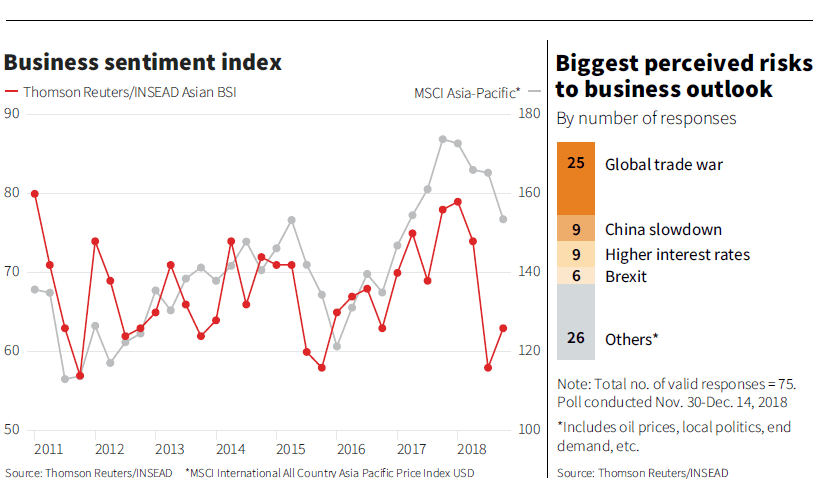
Global trade war is, by some distance, the biggest perceived risks to business outlook. China slowdown and higher interest rates followed and then Brexit. The report also noted that, "the dispute between the world's two biggest economies, threatens businesses throughout the region due to global value chains."
UK to start no-deal Brexit preparation in full
UK Prime Minister Theresa May's spokesman said yesterday that the Cabinet agreed that the government should start no-deal Brexit preparation "in full". He noted "we have now reached the point where we need to ramp up these preparations". And, "we will now set in motion the remaining elements of our no-deal plans".
Additionally, "Cabinet also agreed to recommend businesses now also ensure they are similarly prepared, enacting their own no-deal plans as they judge necessary".
Gold Price In Significant Uptrend, Fed Rate Decision Next
Key Highlights
- Gold price climbed higher recently and broke the $1,240 resistance against the US Dollar.
- There was a break above a major bearish trend line with resistance at $1,242 on the 4-hours chart of XAU/USD.
- The US Housing Starts in Nov 2018 increased from the last revised reading of 1.217M to 1.256M (MoM).
- Today, the Fed Interest Rate Decision will be announced, and the central bank is expected to increase rates from 2.25% to 2.50%.
Gold Price Technical Analysis
After finding a strong buying interest near the $1,232 zone, gold price started a fresh upward move against the US Dollar. The price rallied and broke the $1,240 and $1,244 resistance levels.
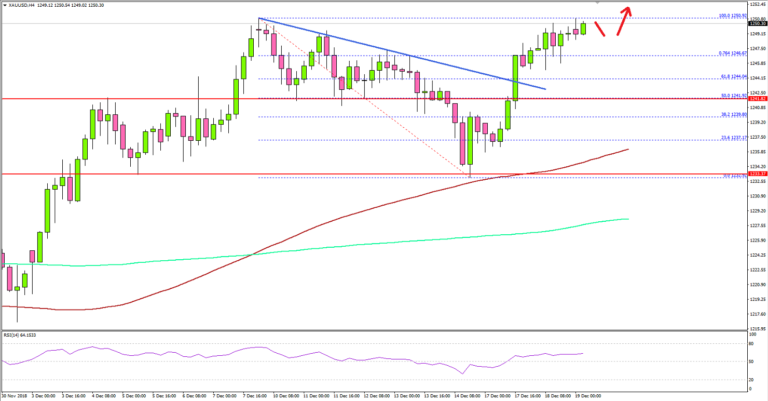
The 4-hour chart of XAU/USD indicates that the price found support near $1,232 and the 100 simple moving average (red, 4-hours). There was a sharp bounce above the 50% Fib retracement level of the last decline from the $1,250 swing high to $1,232 swing low.
Moreover, there was a break above a major bearish trend line with resistance at $1,242. The price even surpassed the 76.4% Fib retracement level of the last decline from the $1,250 swing high to $1,232 swing low, opening the doors for more gains above the $1,250 resistance.
If the current trend remains intact, the price could extend gains towards the $1,255 level and the 1.236 Fib extension level of the last decline.
On the downside, an initial support is near the $1,244 level, below which the price could test the $1,242 support zone. Overall, as long as the price is above the 100 SMA, it remains in an uptrend and it could continue to rise towards $1,255 or $1,260.
However, today’s Fed Interest Rate Decision might impact the market sentiment for gold. Moreover, the current recovery in major pairs like EUR/USD and GBP/USD could face a strong resistance if the fed increases rates from 2.25% to 2.50%. On the other hand, disappointment may perhaps lead to a sharp dollar selling.
Economic Releases to Watch Today
- UK Consumer Price Index Nov 2018 (YoY) – Forecast +2.3%, versus +2.4% previous.
- UK Core Consumer Price Index Nov 2018 (YoY) – Forecast +1.8%, versus +1.9% previous.
- Fed Interest Rate Decision – Forecast 2.50%, versus 2.25% previous.
- Canadian Consumer Price Index Nov 2018 (MoM) – Forecast -0.2%, versus +0.3% previous.
- Canadian Consumer Price Index Nov 2018 (YoY) – Forecast +1.9%, versus +2.4% previous.
GBPJPY Eyes Further Bear Pressure On Correction
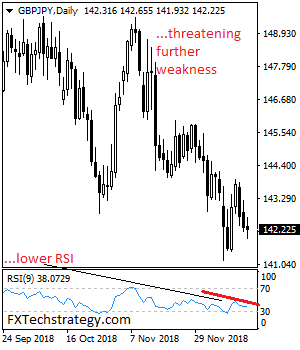
GBPJPY eyes further bear pressure on correction as it targets the 141.50 level. On the downside, support comes in at the 141.00 level where a violation will aim at the 140.50 level. A break below here will target the 140.00 level followed by the 139.50 level. Conversely, resistance is seen at the 142.50 level followed by the 143.00 level. A cut through that level will set the stage for a move further higher towards the 143.50 level. Further out, resistance resides at the 144.00 level. All in all, GBPJPY faces further downside pressure with eyes on key support.
Still Looking For A Silver Lining, Will The FED Suprise ?
Markets
Risk tried hard to recover overnight but struggled in the absence of any positive headlines to drive market action. While investors continued to fret over China’s president Xi on the tape saying that “no one can tell China what to do” and the country will stay with its current ‘policy agenda’. And certainly not at a ringing endorsement for US-China policy harmony. Meanwhile, President Trump shifted away from tweeting about trade and instead focused domestically, urging Fed Chairman Powell “not to make yet another mistake” by raising rates. But he’s not alone in this camp.
The market remained in risk-off territory overnight, but any thought of extending the current equity market sell-off has given way to caution ahead of the Fed. Traders are reducing positions as fears in the rate markets continue to percolate as a bearish chorus of respected investors including Jeffery Gundlach and Stan Druckenmiller are explicitly urging the Fed to consider a pause. While US economic signals are not flashing red but to keep the US economic momentum heading in the right direction, many market participants believe the Fed should provide investors with some breathing room after higher interest rates coupled with tighter liquidly conditions have sent equity markets on a downward spiral since October. The market currently has around 18 basis points priced into Friday. But indeed, what seemed like a sure hike only last week now seems questionable, with pressure mounting on the Fed from all sides.
Again, this is a case of Fund managers wanting their cake and eat it also. The only reason why we’re hearing them bark is due to the sharp sell in equities that started at the end of September. For years all the markets heard from the street was “too much accommodation leads to investor complacency”, “traders are feeding at the trough and living off central bank largesse “with everyone screaming bloody murder that the Fed should let the market do its job. So the current reaction from the street seems highly contradictory to everyone’s stance only six months ago. But when investment fund yields are at stake, everyone wants a voice in the monetary policy equation. None more so than President Trump who continues to gauge his approval rating by the current level of the S&P
What is sure from my chair is the Fed will deliver a 4th rate hike for the year on cue but what is entirely up in the air is which key cardinal point the meeting will shift too.
Oil Markets
Oil continued its losing streak while showing little respect for today’s API inventory data, or Libya force majeure at El Sharara for that matter. Traders have fully digested the swath of price-depressing supply-side news. Cushing inventory build, EIA has shale oil output pegged to top 8 mln bpd by year-end, possible delays in OPEC+ production cuts and the usual assortment of compliance concerns as we all know everyone has their agenda and their domestic priorities.
But indeed, Commodities are not immune to concerns about the global economic outlook either, and this is driving negative sentiment across all asset classes. The recent spate of critical financial data misses across the globe continues to weigh on oil markets with the latest European retailing concerns driving home just how dire things are this holiday season which has caused consumers to hold back on holiday spending.
Brent traded to the lowest levels since October 2017, as oil markets are looking for some help from stabilising equity sentiment which has been fleeting at best overnight. Leading up to the Fed decision oil markets, in the absence of any game-changing OPEC headlines, will likely trade in sympathy with risk while WTI ’prices will mirror their strong correlation with S&P 500.
But we could get some headline risk entering the picture later today Russia will be holding talks with oil producers regarding implementing the production cuts agreed in cooperation. But within this backdrop and to shore up the flagging domestic economy, Saudi Arabia is planning a 7% increase in government spending for 2019 and would probably what to see higher oil prices to pay for this spending.
In summary, the toxic combination for oversupply worries and global growth distress should see oil prices languish into year-end as negative momentum is leading price action while the holiday season is keeping investor money parked on the sideline knowing that the same opportunities will be on offer early January.
Gold Markets
Gold climbed as investors shifted to safe havens amid the most significant US stock tumble since October 2017. Investors are now pivoting to the Federal Reserve’s final policy meeting of 2018 for clues as to the future direction of monetary policy where a dovish expectation has gold parked just below the critical $1250 level as we enter the latter stages of COMEX trade in NY. A less hawkish Fed would trigger weaker USD response and should see Gold flourish.
Currencies
Rupee
The Indian Rupee continues to blossom on the back of “carry trade” appeal and lower oil prices. And its expected the Asia high yielders (IDR and PHP) will continue to shine as the USD is widely expected to soften as the Feds come to the end of this current rate hike cycle. But it was the dovish early warning signals offered up only three weeks ago by the Fed that has triggered inflow into the high yield Asia basket. But more significantly for the much-maligned India capital markets, the strong Rupee is offering a lot of breathing room heading into the year-end.
Malaysian Ringgit
The Malaysian Ringgit has been catching a ride on the Asia FX carry trade momentum, but with oil prices heading south and expected BNM rate cut in 2019 the outlook looks less appealing.
Yuan
They Yuan remains a short-term binary trade very much pegged to the Fed policy outcome, but over the longer run, a weaker domestic economy and negative shifts in the current account suggest the Yuan could struggle beyond the trade narrative.
Yen
The Yen has been the primary beneficially of haven flows this week. While my long-term outlook remains JPY positive on a possible BoJ policy shift. Short term, 112.30 has held well during recent bouts of risk off, so trader was in buying the dip overnight to 112.30 while layering stops below 112.15
Euro
Its all about position reduction ahead of the Fed. But price action suggests the market is close to home on that front.
Australian Dollar
The Aussie is very much in the oversold territory given the weak commodity outlook and waning risk sentiment but if anything short Aussie positions could pare back some risk ahead of the Fed. But it’s hard to argue against the Australian dollar lower given China risk and housing and credit issues domestically.
Eco Data 12/19/18
[php_everywhere instance="1"]
Brexit Strain to Take Shine off UK CPI and Retail Sales Data, as Well as BoE Meeting
A raft economic data are due out of the UK this week ahead of a Bank of England policy decision. Inflation and retail sales figures will be released at 09:30 GMT on Wednesday and Thursday, respectively, to be followed by the BoE announcement at 12:00 GMT on Thursday. But with the UK Parliament in deadlock over Brexit and the European Union refusing to give further ground on the Irish backstop issue, pound traders will likely stay on the sidelines until some clarity is shed on what comes next.
British GDP grew a solid 0.6% during the third quarter from the prior period, outperforming the Eurozone. However, all the indications are the economy is heading towards a sharp slowdown in the final three months of the year. Any negative surprises therefore in this week’s numbers could add to the negative risks for sterling, exaggerating potential downside moves from any unfavourable Brexit-related headlines.
The first set of data to be watched this week are the inflation figures on Wednesday. The UK’s headline CPI rate was unchanged at 2.4% year-on-year in October. It is forecast to moderate to 2.3% in November, which, if confirmed, would make it the lowest since March 2017 and ease the need for the Bank of England to raise interest rates in the coming months. The core rate is also expected to head lower in November, to 1.8%.
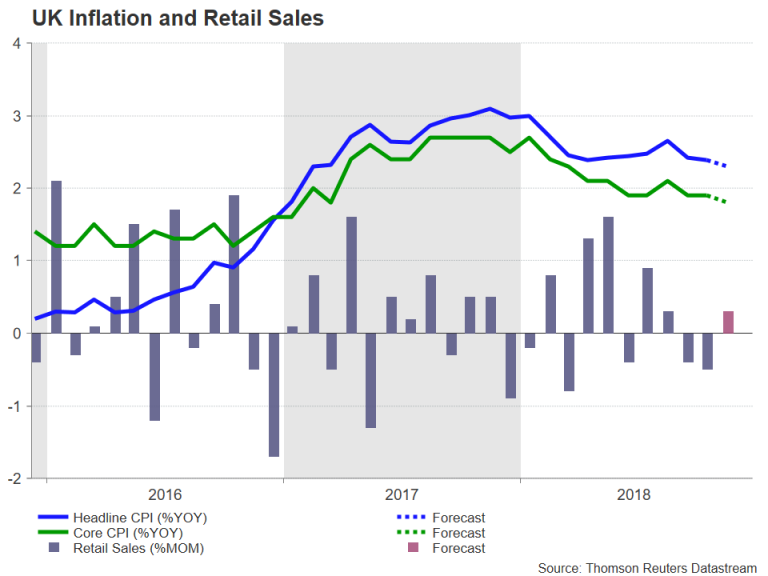
Moving to the retail sales numbers, they are forecast to have risen by 0.3% month-on-month in November, following a 0.5% dip in the prior month. However, on an annual basis, retail sales are expected to have slowed from 2.2% to 1.9%. A stronger figure would suggest consumer spending is holding up well in the current quarter and that fears of a marked deterioration in growth may have been overdone. Similarly, a disappointing performance by retailers would worsen the gloom for the economy.
Finally, on Thursday, the Bank of England is widely anticipated to hold its key rate unchanged at 0.75%. There is no press conference or quarterly inflation report at the December meeting, so the event may fail to see much market reaction. However, with the fate of Theresa May’s hard-negotiated Brexit deal looking uncertain and with the possibility of British businesses being stuck in limbo for longer, the Bank may raise concerns about the outlook in its statement.
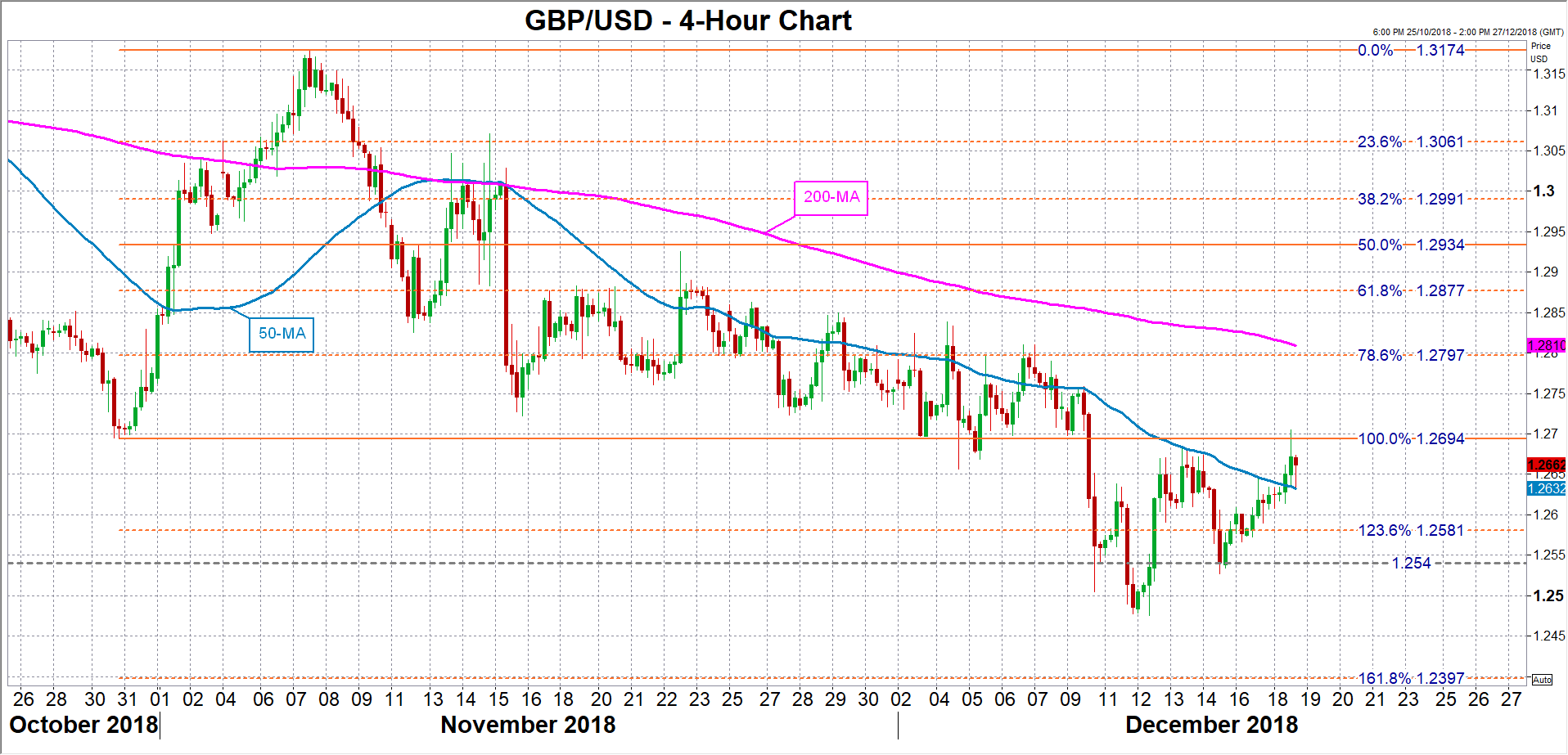
A more cautious statement, along with a broadly unimpressive data, could push sterling towards the recently congested area around $1.2540. A breach of this region would bring prices within scope of last week’s 20-month low of $1.2475. Deeper losses could risk a test of the $1.24 handle, which is just above the 161.8% Fibonacci extension of the October-November upleg from $1.2694 to $1.3174.
It’s worth pointing out though that even as the UK government steps up preparations of a no-deal Brexit, many investors are with the view that lawmakers are likely to block such a move by the May government. Hence, this explains why the pound’s latest sell-off hasn’t been more dramatic.
Alternatively, a surprisingly strong set of numbers and/or a not-so-pessimistic Bank of England could help the pound take further advantage of the current bout of dollar weakness. Sterling could break above immediate resistance around the $1.27 mark, with sharper gains bringing into focus the next psychological level at $1.28, which is just above the 78.6% Fibonacci retracement level. Higher up, further advances could stall at the 61.8% Fibonacci level of $1.2877.
Pound Edges Higher, CPI and Fed Statement Next
GBP/USD is up slightly in the Tuesday session. In North American trade, the pair is trading at 1.2643, up 0.24% on the day. Earlier in the day, the pair punched above the 1.27 line for the first time in a week. On the release front, there are no British events. In the U.S., housing numbers improved in November. Building Permits jumped to 1.33 million, up from 1.27 million in October. Housing starts climbed 1.26 million, compared to 1.23 million a month earlier. Both readings beat their estimates. On Wednesday, the U.K. releases CPI which is expected to edge lower to 2.3%. The markets will be keeping a close eye on the Federal Reserve, which is expected to raise the benchmark rate by a quarter-point.
The markets are predicting that the Federal Reserve will raise interest rates on Wednesday, but this could be the last rate hike until well into 2019. The Fed has already raised rates three times this year, a testament to the strong U.S. economy. Just one week ago. the CME Group had set the odds of rate hike at 80%, but this has fallen to 69%. A key factor in the drop is the latest equity sell-off. The week started poorly, as the S&P fell on Monday to its lowest level since October 2017. Rate hikes are unusual when stock markets are swooning, so traders should be prepared for the Fed to send a dovish message to the markets, along with a quarter-point rate hike. This could send the dollar downwards on Wednesday.
Brexit continues to spook investors and sent the pound on a roller-coaster ride last week, as GDP/USD moved 1 percent on two separate days. The volatility was in response to last week’s dramatic events surrounding Brexit. Prime Minister Theresa May survived an internal non-confidence motion in the Conservative party. However, one-third of Conservative MPs voted against May, leaving the prime minister in a weak position, ahead of a parliamentary vote on Brexit, which will likely be held in January.
The EU has insisted that the withdrawal agreement will not be reopened, and May was unable to extract any concessions from the EU on a whirlwind trip last week. May will have a tough time pushing the deal through parliament, and if she is not successful, Britain could well be on its way to leaving the EU without a deal, which would have a chilling effect on the U.K. economy and the British pound.
Japanese Yen Surges Higher as Risk Appetite Sours
The Japanese yen continues to gain ground this week. In North American trade, USD/JPY is trading at 112.54, down 0.26% on the day. On the release front, U.S. housing numbers improved in November. Building Permits jumped to 1.33 million, up from 1.27 million in October. Housing starts climbed 1.26 million, compared to 1.23 million a month earlier. Both readings beat their estimates. Later in the day, Japan’s trade deficit is expected to continue to widen, with a forecast of JPY -0.31 trillion. Investors will be keeping a close look at the Federal Reserve is expected to raise the benchmark rate by a quarter-point.
The markets are predicting that the Federal Reserve will raise interest rates on Wednesday, but this could be the last rate hike until well into 2019. The Fed has already raised rates three times this year, a testament to the strong U.S. economy. Just one week ago. the CME Group had set the odds of rate hike at 80%, but this has fallen to 69%. A key factor in the drop is the latest equity sell-off. The week started poorly, as the S&P fell on Monday to its lowest level since October 2017. Rate hikes are unusual when stock markets are swooning, so traders should be prepared for the Fed to send a dovish message to the markets, along with a quarter-point rate hike. This could send the dollar downwards on Wednesday.
The BoJ will also set interest rates on Wednesday, and investors will be closely attuned to the tone of the rate statement, which is expected to be dovish, as the global trade war continues to take a toll on the Japanese economy. Japanese Final GDP in Q3 declined 0.6%, the second decline in three quarters. The well-respected Japanese Tankan Manufacturing index remained steady at 19 points in the third quarter. However, recent manufacturing indicators have pointed downwards, pointing to slower activity in the manufacturing sector. This is attributable to slower global economic conditions, which has taken a bite out of Japanese exports and manufacturing. With Japanese exports to the U.S. and China facing higher tariffs, it’s not surprising that recent manufacturing reports have been soft.
Will the Fed be Less Dovish than Markets Expect?
The Fed will announce its policy decision on Wednesday, at 1900 GMT. Markets seem positioned for a “dovish hike”, where the Fed raises rates but lowers its rate-path forecasts and strikes a cautious tone. However, considering just how dovish market pricing for 2019 is, the risks surrounding the dollar seem to be asymmetric, and skewed to the upside.
In the past few weeks, investors have meaningfully pared back their bets for Fed rate hikes in 2019. Yet, the implied probability for a rate increase at this meeting has remained relatively stable, at around 65-70% according to the Fed funds futures. Markets seems to have adopted the view that although the US economy is still healthy, allowing policymakers to raise rates for now, some “cracks” are beginning to show in key sectors like housing, which are set to spill over into slower growth in the rest of the economy next year. Thus, the logic goes, the Fed will probably pause its tightening cycle soon, in the face of a slowing economy.
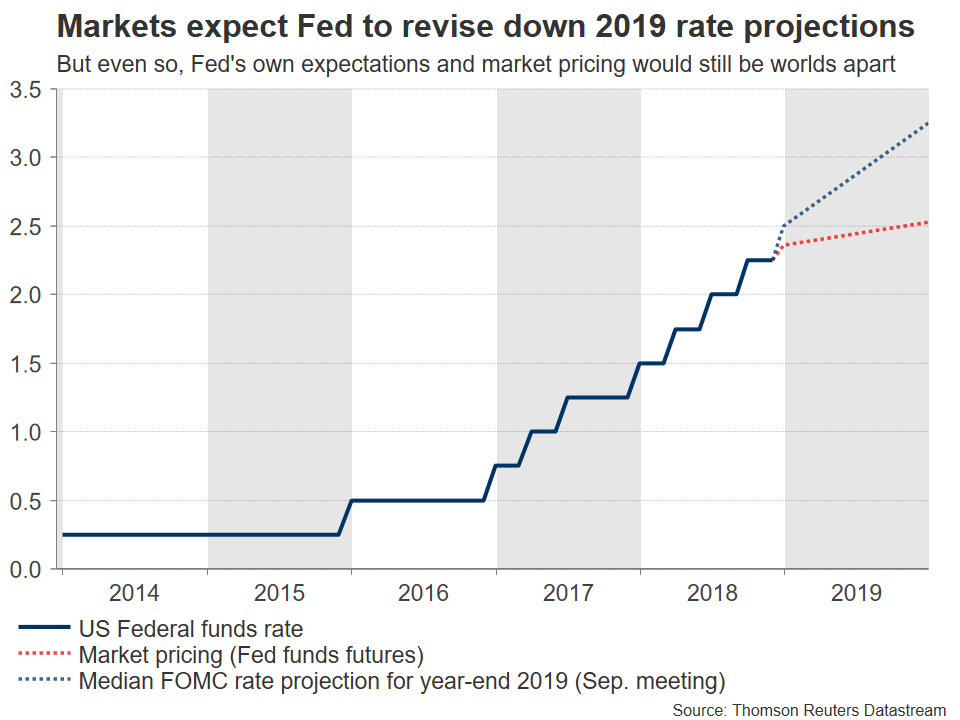
In this context, the central bank is broadly expected by analysts to deliver a “dovish hike” this week, where it raises interest rates but signals increased caution about future hikes, and revises lower its rate projections for 2019 to signal just two regular hikes, from three currently. In fact, looking at market pricing, it’s much more dovish than that; investors assign just a 30% probability for a single rate increase in the whole of next year, assuming one is delivered now.
This repricing was owed mainly to speeches by Fed Chair Powell and Vice Chair Clarida, which were interpreted as having a dovish tilt. Alas, their cautiousness may have been exaggerated, as neither official implied the Fed is ready to hit the pause button. More importantly, recent US economic data remain healthy, hardly warranting a pause. The unemployment rate at 3.7% is below estimates of full employment, wages growth is at cycle highs, inflation continues to hover near 2.0%, forward-looking surveys like the ISM PMIs remain at robust levels, and the Atlanta Fed GDPNow model forecasts Q4 GDP at a strong 3.0%.
In other words, markets may have gotten ahead of themselves in pricing out such a substantial degree of Fed tightening so quickly, and with little concrete evidence a pause is indeed imminent. The quality of recent data simply doesn’t support a pricing this dovish. That doesn’t go to say the Fed won’t revise down its rate projections – it very well might, as all it would take for the “median” projection to be lowered to signal two hikes in 2019 is just one official marking their forecast down. However, even in that case, the Fed’s 2019 view and that of the market would still be worlds apart, so it wouldn’t be a surprise to see Chair Powell push back by reaffirming the Committee’s determination to raise rates further, in an attempt to bring market pricing closer to the Fed’s. Not doing so runs the risk of having to tighten faster than what is baked into asset prices, shocking markets and perhaps the economy in the process.
In terms of the market reaction, the risks surrounding the dollar from this meeting may be asymmetric and skewed to the upside. Given how dovish market pricing is, a downward revision in the Fed’s rate forecasts won’t be much of a surprise, and hence is unlikely to generate a major reaction, with any losses in the greenback being fairly limited. Looking at dollar/yen technically, immediate support to declines could be found around the December lows of 112.20, with a downside break opening the way for a test of 111.35, the October 26 trough.
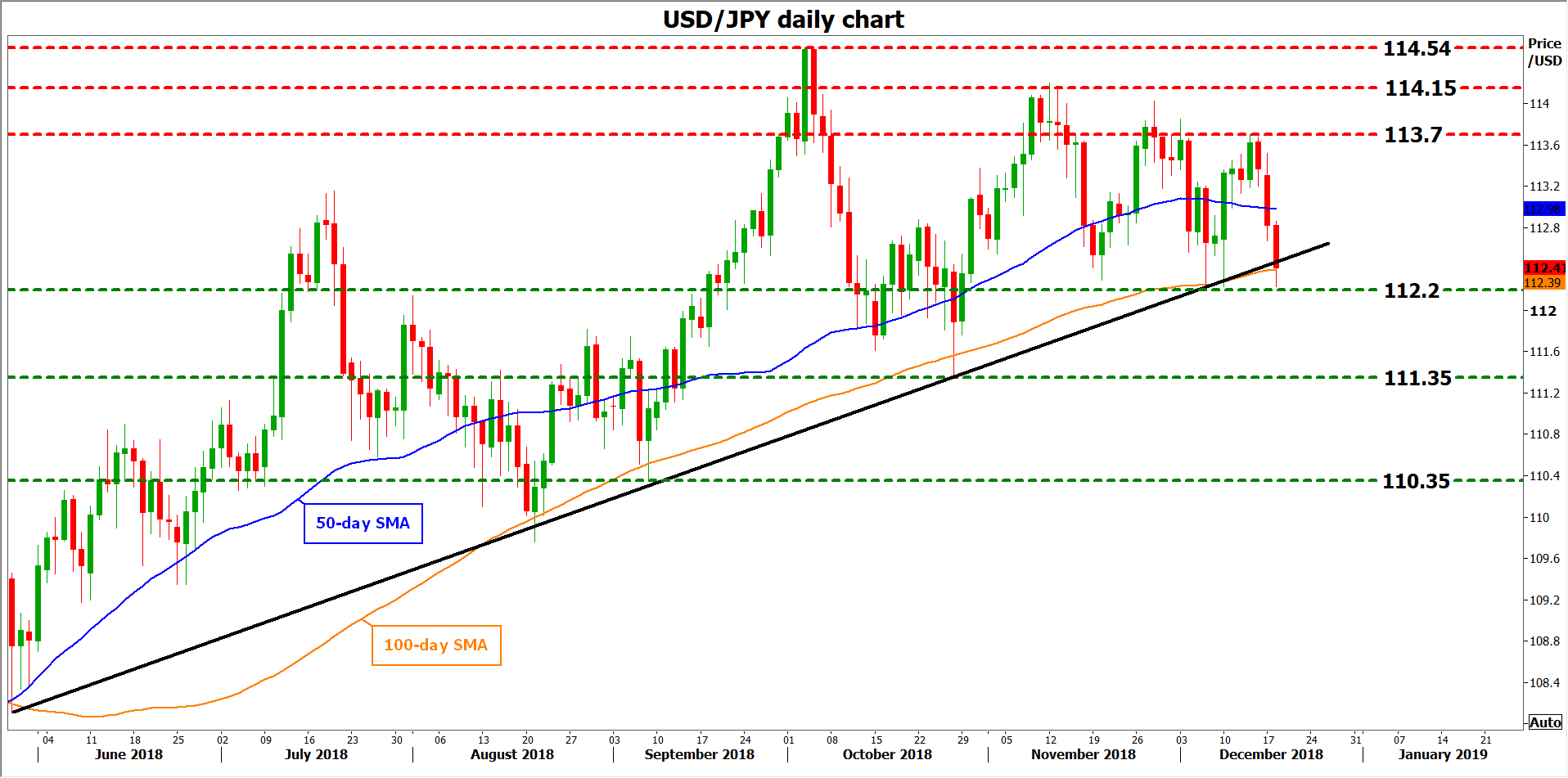
On the other hand, if the projections are kept unchanged or Powell seems unusually confident, it would come as a surprise – and the dollar could therefore soar higher. Initial resistance to advances in dollar/yen may come near the 50-day simple moving average, currently at 112.98. Even higher, the December 13 peak at 113.70 would attract attention, before the 114.15 area comes into view.
Summarizing, investors seem to anticipate an overly dovish Fed, and while the Committee is indeed likely to appear more cautious, it’s unlikely to go as far as signal the broader pause in rate hikes that market pricing currently implies, consequently generating an upside risk for the dollar.