

Sample Category Title
Canadian Dollar Steady ahead of Manufacturing Sales
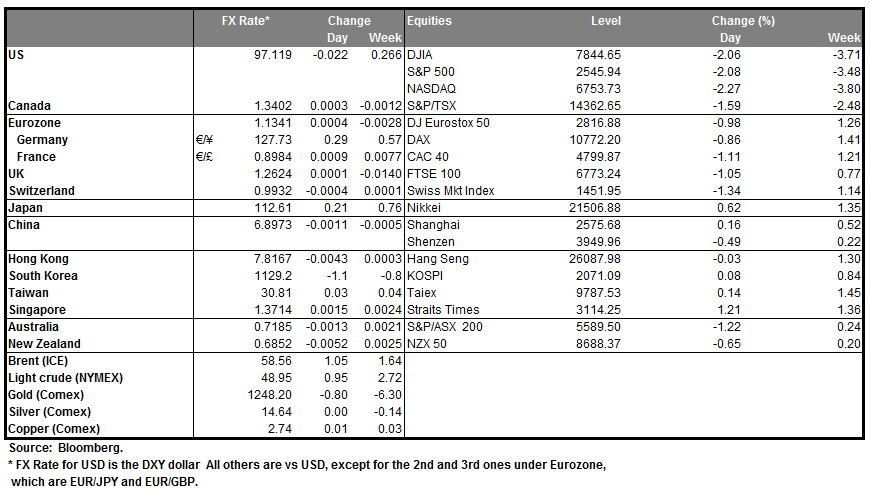
USD/CAD is unchanged in the Tuesday session. Currently, USD/CAD is trading at 1.3400, down 0.08% on the day. On the release front, Canadian manufacturing sales is expected to tick higher to 0.3%. In the U.S, the focus is on construction data. Building permits is expected to edge higher to 1.27 million, and housing starts is forecast to remain unchanged at 1.23 million. On Wednesday, Canada releases CPI. Investors will be keeping a close look at the Federal Reserve is expected to raise the benchmark rate by a quarter-point.
The Federal Reserve is expected to raise interest rates on Wednesday, which would mark the fourth rate hike in 2018. The CME has pegged the odds of a rate hike at 69%, down from 80% just one week ago. A key factor in the drop is the latest equity sell-off. The week started poorly, as the S&P fell on Monday to its lowest level since October 2017. Rate hikes are unusual when stock markets are swooning, so traders should be prepared for the Fed to send a dovish message to the markets, along with a quarter-point rate hike. Next year is likely to be a different story, with the markets expecting only one rate hike.
Canadian inflation has been struggling, with CPI recording two declines in the past three months. Another decline is expected in November, with an estimate of -0.1%. If CPI contracts again, the Canadian dollar could continue to slide. The currency has declined for four straight weeks, dropping 1.8% in that time. Weaker oil prices and a slowdown in the U.S. are weighing on the Canadian economy and the export sector is being hampered by the ongoing U.S-China trade war. The Bank of Canada is expected to respond by scaling back rate hikes. The bank has raised rates three times this year, but stayed on the sidelines at the December meeting. With the Federal Reserve expected to raise rates just once or twice in 2019, there will be less pressure on the BoC to raise rates.
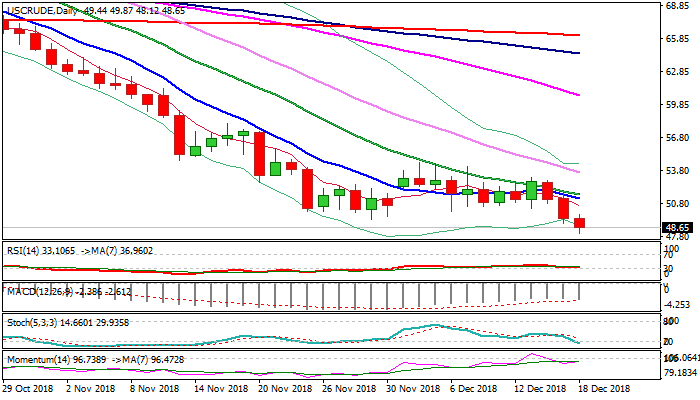
WTI crude oil resumes down trend, heading to 46.54 fibonacci level
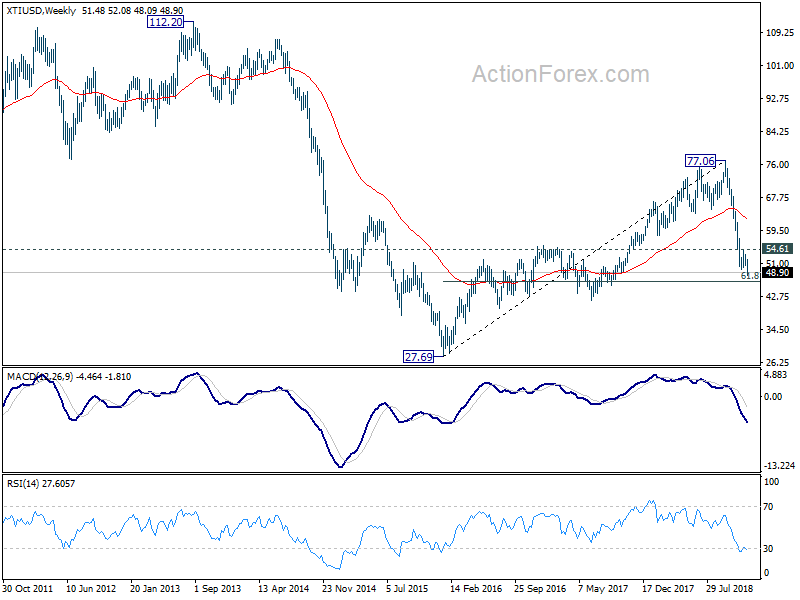
WTI crude oil's down trend from 77.06 resumed this week and drops to as low as 48.09 so far today. Such decline is seen as at least correcting the long term rise from 27.69 (2016 low). Thus, further fall should be seen to 61.8% retracement of 27.69 to 77.06 (2018 high) at 46.54.
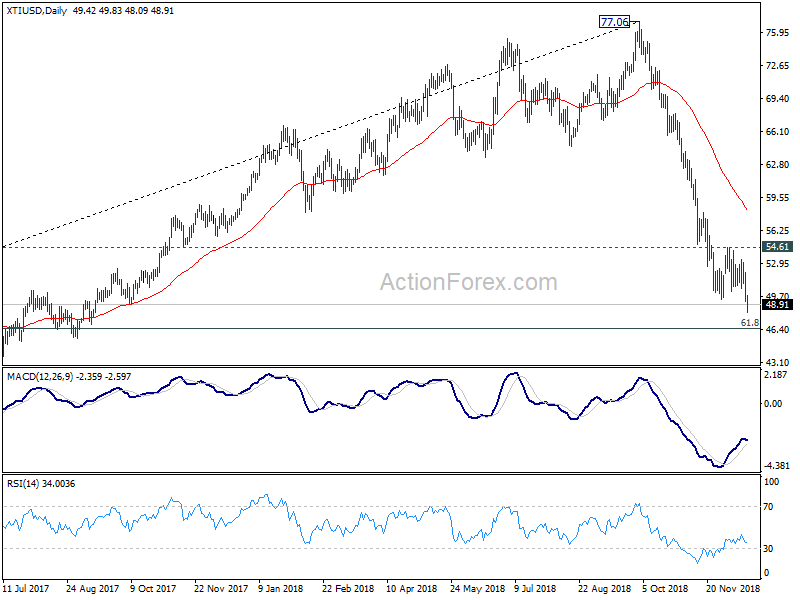
We'd look at the reaction from 46.54, as well as the structure of the subsequent rebound to decide whether fall from 77.06 is an impulsive or corrective move. But in any case, break of 54.61 resistance is needed to be the first sign of near term reversal. Otherwise, outlook will remain bearish even in case of strong recovery.
Into US session: Dollar broadly lower as Trump asks Fed to feel markets rather than read numbers
Risk sentiments stabilized in European markets as major indices are trading mixed. US futures also point to a mild recovery at open. Focus turned to selloff in Dollar today as Trump continued with his verbal intervention on Fed's monetary policy. In, he asked Fed policy makers to abandon "meaningless numbers". Instead, they should "feel the market".
https://twitter.com/realDonaldTrump/status/1075001077576151041
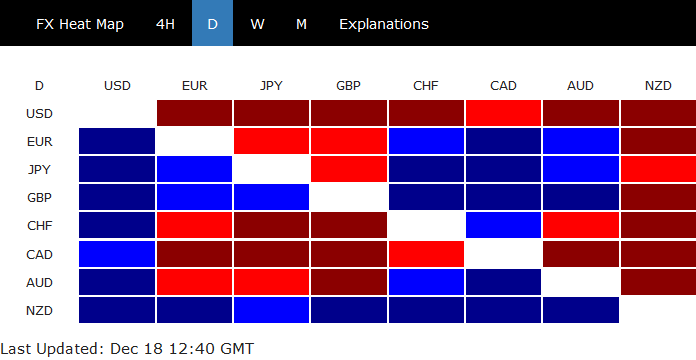
Dollar is currently the weakest one for today. Canadian follows as second weakest as WTI crude oil extends recent decline to as low as 48.09, in spite of Dollar weakness. Swiss Franc is the third weakest. On the other hand, New Zealand Dollar is the strongest one for today, followed by Sterling, and then Yen.
But technically, EUR/USD, GBP/USD AUD/USD and USD/CAD are staying in range. USD/JPY is trying to draw support from 112.23 support. There is not follow through selling in USD/CHF yet after breaching 0.9911. Dollar bears seem refusing to commit yet, as meaningless or not, Fed will release another set of numbers in economic projections tomorrow. They're the ones critical for 2019 rate path.
In European markets, at the time of writing:
- FTSE is down -0.41%
- DAX is up 0.38%
- CAC is down -0.14%.
- German 10 year yield is down -0.0178 at 0.242
- Italian 10 year yield is up 0.004 at 2.953
Earlier in Asia:
- Nikkei closed down -1.82%
- Singapore Strait Times dropped -2.21%
- Hong Kong HSI dropped -1.05%
- China Shanghai SSE dropped -0.82%
- Japan 10 year JGB yield dropped another -0.0088 to 0.028
China growth to slow to 6-6.5% next year, with help from loose policy
Du Feilun, director of the Institute of Economic Research at the National Development and Reform Commission (NDRC), said the China's growth would slow to 6.0-6.5% next year, with the help from moderately loose economic policy.
He said there is "immense" short-term pressure on the economy, from domestic challenges and trade war with the US". However, " there is not too much upward pressure on prices, thus it provides a good environment for economic operations and a good space for monetary policy adjustments."
He expected China's aggregate economic policy to be "moderately loose next year to maintain steady growth". But he didn't expect China to return to the "old path" of massive stimulus.
XAU/USD Outlook: Spot Gold Pressures Key Barriers, Supported by Expectations of Dovish
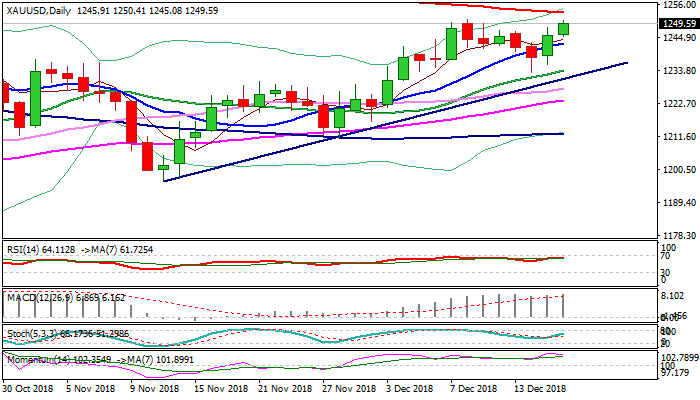
Spot gold retests $1250 barrier (10 Dec high) on Tuesday, in extension of previous day’s rally, signaling full retracement of $1250/1232 corrective phase and possible continuation of larger uptrend from $1196 (13 Nov low).
Bulls eye key barriers just above $1250 – Fibo 61.8% of $1309/$1160 at $1252 and 200SMA at $1253, as sustained break here would generate strong bullish signal.
Fresh advance is supported by expectations of Fed’s dovish tone regarding the pace of rate hikes in 2019, as widely expected raise of interest rate on policy meeting on Wednesday, has been already priced in.
Strong bullish momentum and daily studies in positive configuration, support scenario.
Corrective dips are expected to provide better buying opportunities while holding above rising 10SMA ($1242).
Res: 1250; 1252; 1253; 1260
Sup: 1245; 1242; 1238; 1235
Can The Fed Salvage The Santa Rally?
Can the Fed deliver a late festive surge?
US equity markets are poised to open a little higher on Tuesday, paring losses on another bad day for Wall Street but how long will it last?
There is a lot of pessimism in the markets right now and while the Fed – or more accurately, it's Chairman – may have been the trigger, I wonder whether they may be nothing more than a scapegoat, with his comments being the straw that broke the camel's back. Powell has since dialled back – or clarified - his hawkish views on interest rates and yet, the sell-off continues.
There was no pessimism earlier in the year, despite expectations of a December hike and more next year generally existing. Now we find ourselves in a situation whereby a hike tomorrow is not fully priced in and, if it does happen, no more are priced in for 2019. And still, the sell-off continues. It's for this reason that I wonder whether there's anything the Fed can do tomorrow to salvage the Santa rally that's so far eluded hopeful investors.
Weak sentiment takes its toll on oil
Stocks have not been the only victims of broader market misery this festive season. Oil tumbled on Monday as equities plunged into the red as investors continue to view 2019 as a challenging year for global growth. OPEC may have come to an agreement with its allies to cut production next year and rebalance markets on the back of prices slipping by more than a third since October, but traders are clearly not convinced enough will be done.
A number of different scenarios could threaten the success of the deal including slower global growth, low compliance and higher US production. It may be reasonable to argue that many people doubted the group's efforts last time as well, which by and large was very successful, but the environment has changed and no one seems in any rush to say with confidence that the result will be the same. The global growth situation is a major factor that the group did not have to content with previously, as well.
Gold pushes higher on weaker dollar
Gold is on the rise again having survived attempts to push back below $1,240 at the back end of last week and early this. A combination of risk aversion and a weaker dollar are proving supportive for the yellow metal which has been on a good run since the summer. With the Fed meeting today and tomorrow, after which a decision on interest rates will be announced alongside new economic projections, the greenback could be very volatile which will strongly influence the direction of travel for gold.
A dovish hike seems to be the base expectation in the markets, alongside projections that confirm a slowdown in the US next year. As ever, the dot plot will be central to the reaction, with markets pricing in a 60% chance of no hike next year. I don't think the Fed will pare back its expectations that much, having previously factored in three for next year. The question now is how dovish the central bank will be and how much it will align with markets.
WTI OIL Outlook: Strong Bearish Sentiment Keeps Oil Price Below $50 But Technical Correction May Precede Fresh Extension Lower
WTI oil holds in red for the third straight day and hit new low at $48.12 (the lowest since Sep 2017) on Tuesday, after strong bearish signal was generated on eventual break and close below psychological $50 support on Monday.
Oil prices enjoyed little help from hopes that decision for output cut from main oil producers would stabilize oil market.
Short-lived recovery stalled at $54.50 zone, with subsequent weakness being supported by rising fears of oversupply and fall in global stocks.
Since the production cut will start from next month and Russian and the US output holds near record highs, near-term action sees risk of further weakness.
Repeated close below $50 pivot would open way for extension towards strong support at $45.46 (Fibo 61.8% of $26.04/$76.88, 2019/2018 rally).
Meanwhile, bears may consolidate before continuing lower, as slow stochastic is oversold on daily chart and momentum turns up.
Broken $50 level now acts as solid resistance which should ideally cap, but stronger upticks towards falling 10SMA ($51.29) cannot be ruled out.
Focus turns towards US crude inventories reports due today and Wednesday, which could provide fresh signals.
Res: 49.40, 49.87, 50.00, 50.54
Sup: 48.12, 47.44, 46.22, 45.46
USD Weakens On Possible Cautious Outlook From The Fed
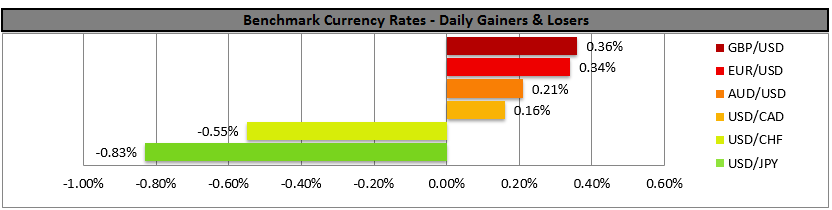
The USD weakened yesterday ahead of the FOMC's interest rate decision on Wednesday, as it may be expecting a more cautious tone for the US economic outlook by the Fed. The Fed is expected to hike rates in its upcoming meeting however all eyes are to be on possible signals about its future rate hike path. Analysts have underscored the possibility of the market expecting a dovish hike and pointed to a possible bearish market for the USD, as long positions are being reduced. The worries about the US outlook, were intensified by signs of a possible economic slowdown in Europe and China, as well as trade war concerns. Analysts also are pointing out that investors may be looking to a speech of Chinese president Xi, for further clues. Volatility for the greenback could continue as the FOMC's interest rate decision, draws near. USD/JPY tumbled yesterday, breaking consecutively the 113.25 (R2) and the 112.72 (R1) support lines (now turned to resistance). We could see the pair dropping further should the USD continue to weaken due to the bearish sentiment of the market. Technically it should be noted that pair's RSI indicator in the 4 hour chart, reached the reading of 30, implying a possibly overcrowded short position. Should the pair continue to be under the market's selling interest, we could see the pair, breaking 112.15 (S1) support line and aim for the 111.65 (S2) support barrier.
GBP gets some support as Theresa May reschedules Brexit vote
The pound got some support yesterday as PM Theresa May rescheduled a vote in parliament about Brexit, for the week beginning 14th of January. Labor party leader Corbyn, proposed a no confidence vote motion on Theresa May, citing her delay in giving parliament a vote on the Brexit deal, however the result is to be uncertain. The pound seems to remain under pressure, despite the four weeks breather for the UK parliament's vote, as the uncertainty surrounding the issue deepens. Analysts point out that there are still more downside risks for the pound, as the March deadline approaches. With Theresa May facing a possible defeat in parliament about Brexit and the EU maintaining a tough position, voices for a second referendum grow. We maintain our view that the pound could remain under pressure as the Brexit uncertainty continues. Cable rose slightly yesterday reflecting the weakening of the USD side, however gains remained in check, due to Brexit uncertainty, as the pair proved to unable to break the 1.2630 (R1) resistance line, after continuous testing. The pair could prove sensitive to any further Brexit headlines, as well as a bearish sentiment for the USD, ahead of the FOMC meeting tomorrow. Should the bulls continue to dictate the pair's direction, we could see it breaking the 1.2630 (R1) resistance line and aim for the 1.2700 (R2) resistance hurdle. Should on the other hand the bears take over, we could see cable breaking the 1.2555(S1) support line and aim for the 1.2485 (S2) support level.
In today's other economic highlights:
During the European session today, we get Germanys Ifo Business Conditions indicator for December and later on New Zealand's milk auction figure. In the American session, from the US we get the number of building permits and housing starts for November, while from Canada, we get the manufacturing sales growth rate for October. Later on New Zealand's current account balance for Q3 will be released and the API weekly crude oil inventories figure is due out and could influence oil prices.
GBP/USD H4
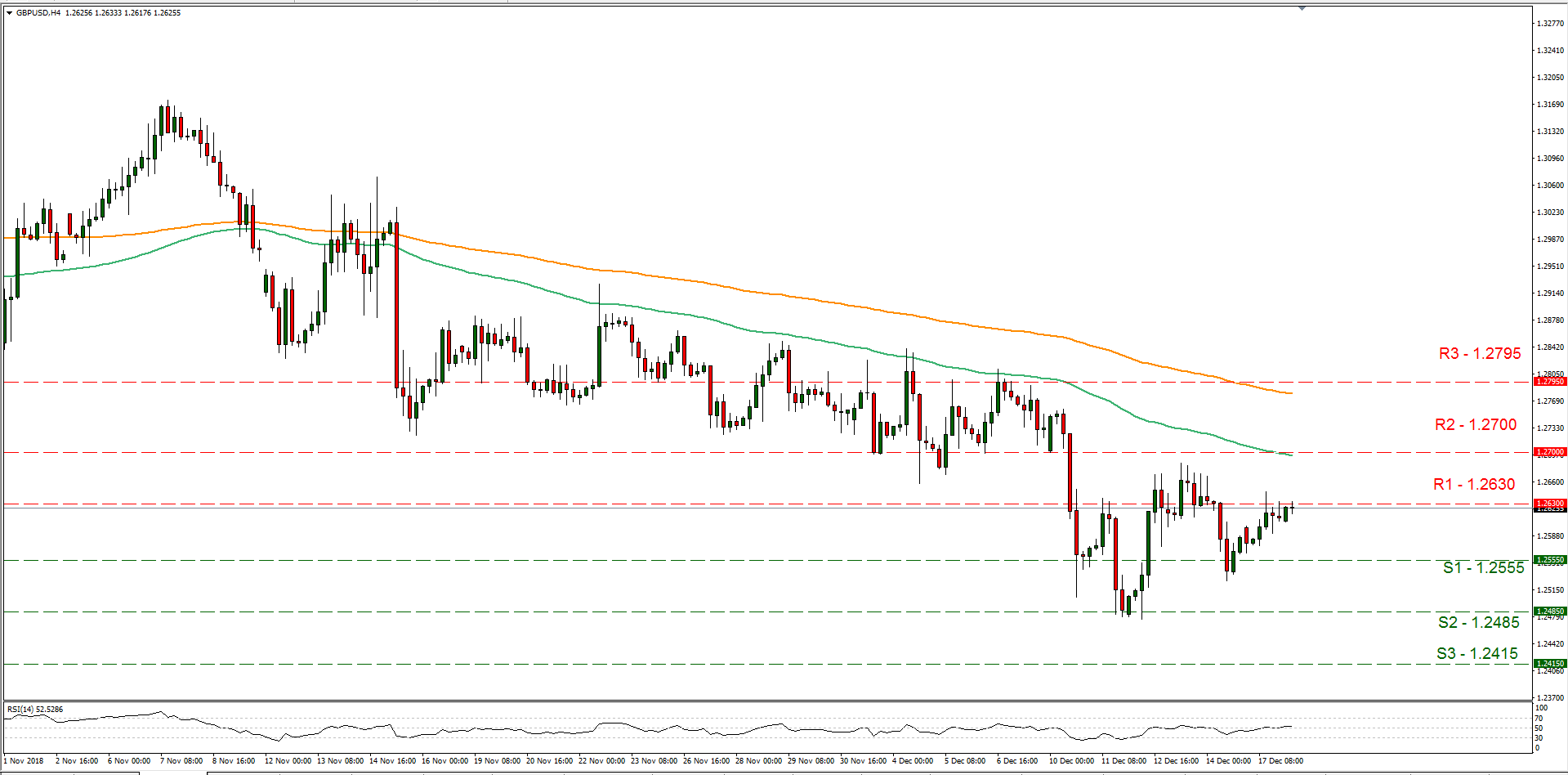
Support: 1.2555 (S1), 1.2485 (S2), 1.2415 (S3)
Resistance: 1.2630 (R1), 1.2700 (R2), 1.2795 (R3)
USD/JPY H4
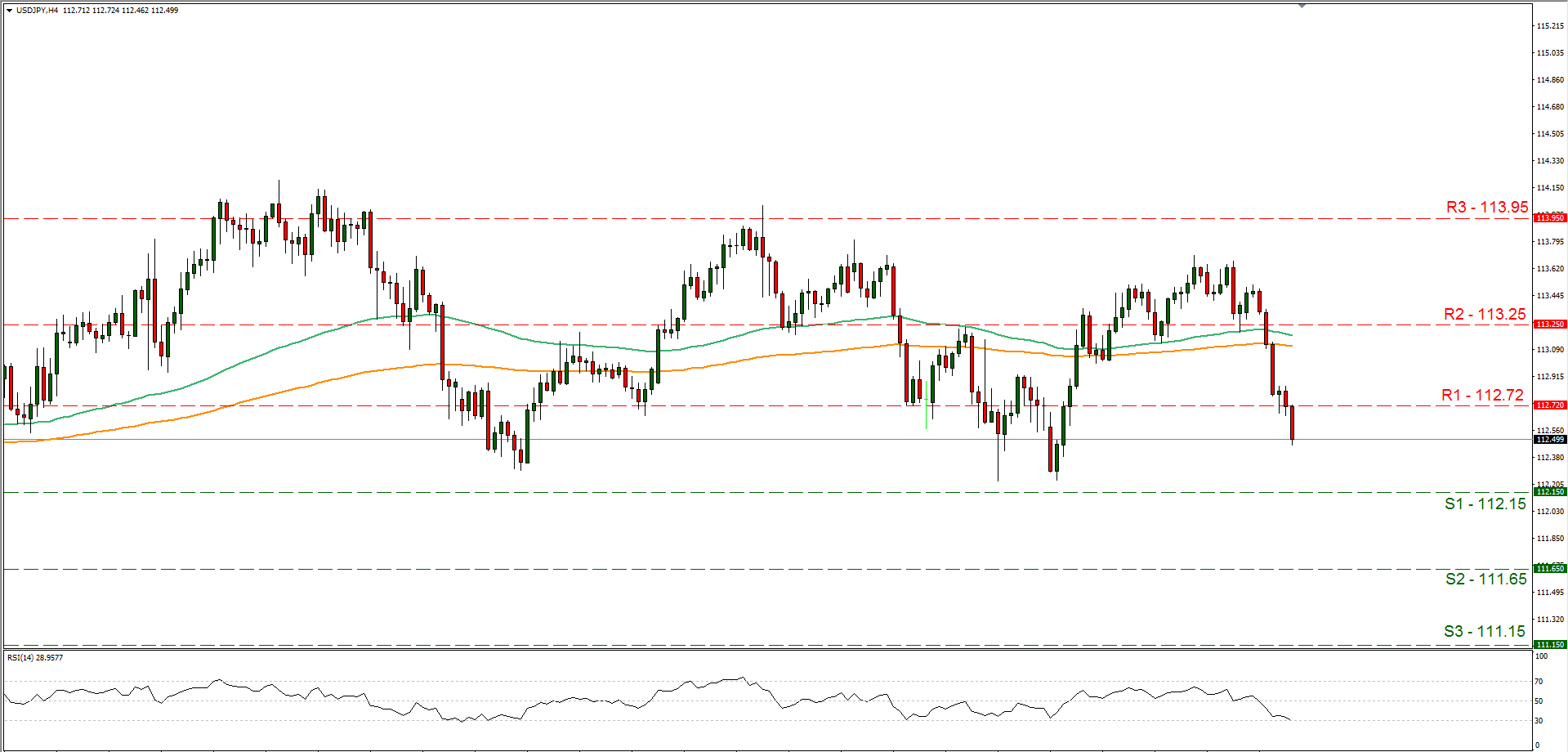
Support: 112.15 (S1), 111.65 (S2), 111.15 (S3)
Resistance: 112.72 (R1), 113.25 (R2), 113.95 (R3)
The Fed Is Able To Stop The Stock Market’s Decline
Key US indices lost more than 2% on Monday, so the S&P500 closed at the lowest levels since November. It is also worth to note the sales prevalence in the last few hours of the American session: with rare exceptions, we have seen such a dynamic since previous month. Primarily, this is due to a reduction in the retail funds position.
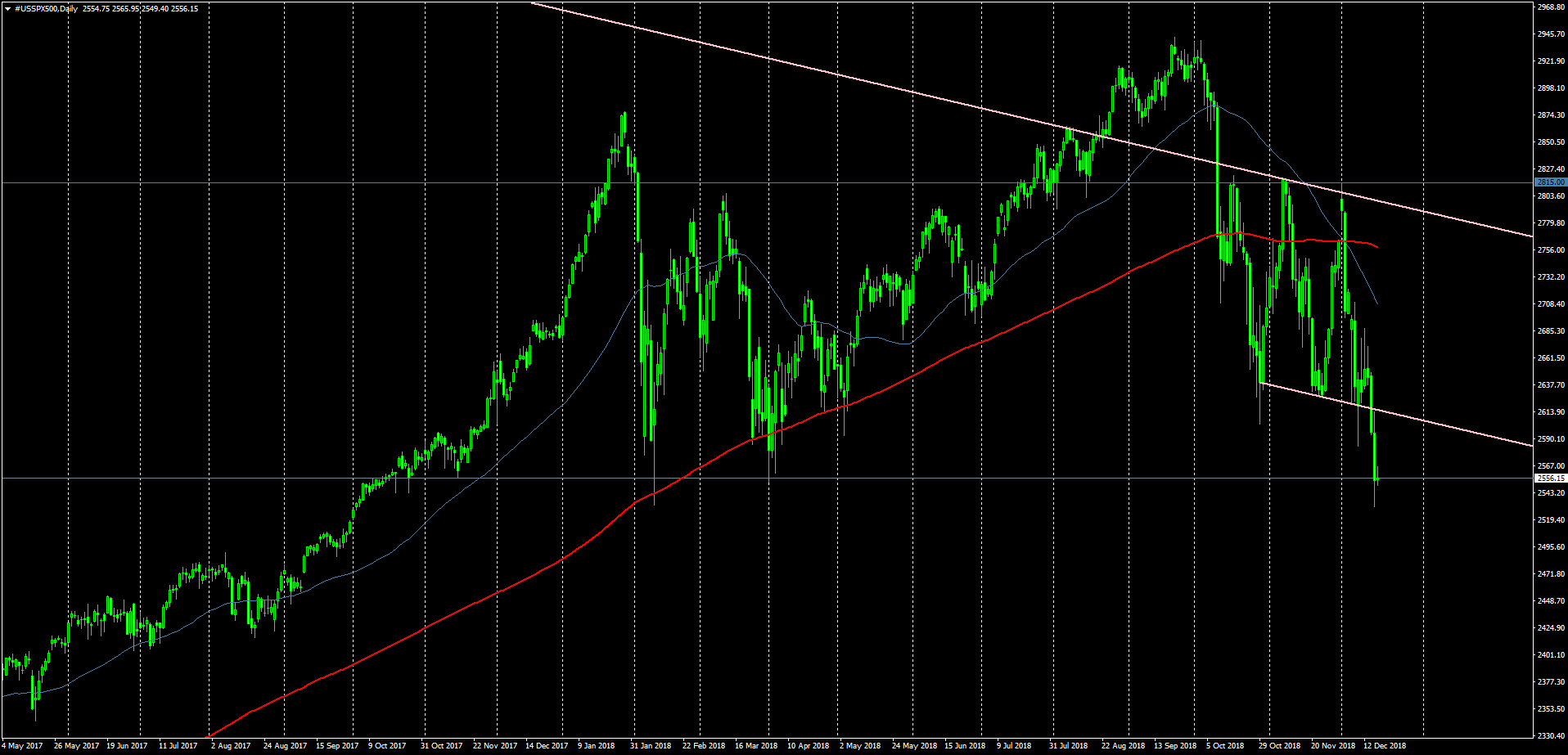
The greatest pressure is experiencing by those stock that dragged the market earlier. So, Amazon lost 4.5% and Nasdaq fell by 15% from peak levels in early October.
This sale increased after drop below important support levels, where stocks were supported on October and November dips. Such anxiety, in our opinion, is caused by worries about the Fed's hawkishness, and is also associated with technical factors.
The FOMC had previously predicted three rate increases in 2019. Available data from the United States suggest that the general background is strong and confident enough for now. However, many US companies are international, and the global economy is quickly losing its shape.
Must mention that three raises are able to additional shaking the ground of global growth, increasing pressure on stocks. Another thing is also true: the softness of the Fed's rhetoric — say, a decrease in the number of increases to 1-2 next year and a willingness to further orient on the situation — can provide some fundamental support to the entire market.
At the same time, the Fed is experiencing a verbal attack by the US Administration, which again and again shows discontent with the announced plans for “growth in three stages.” There is a high chance that Powell will still succumb to this pressure and will make a decision that will unfold the stocks trend for a short time.
Usually, stock market weakening accompanied with a dollar growth, but not this time. Now investors are trying to stay away from US assets, due to the uncertainty around the monetary policy.
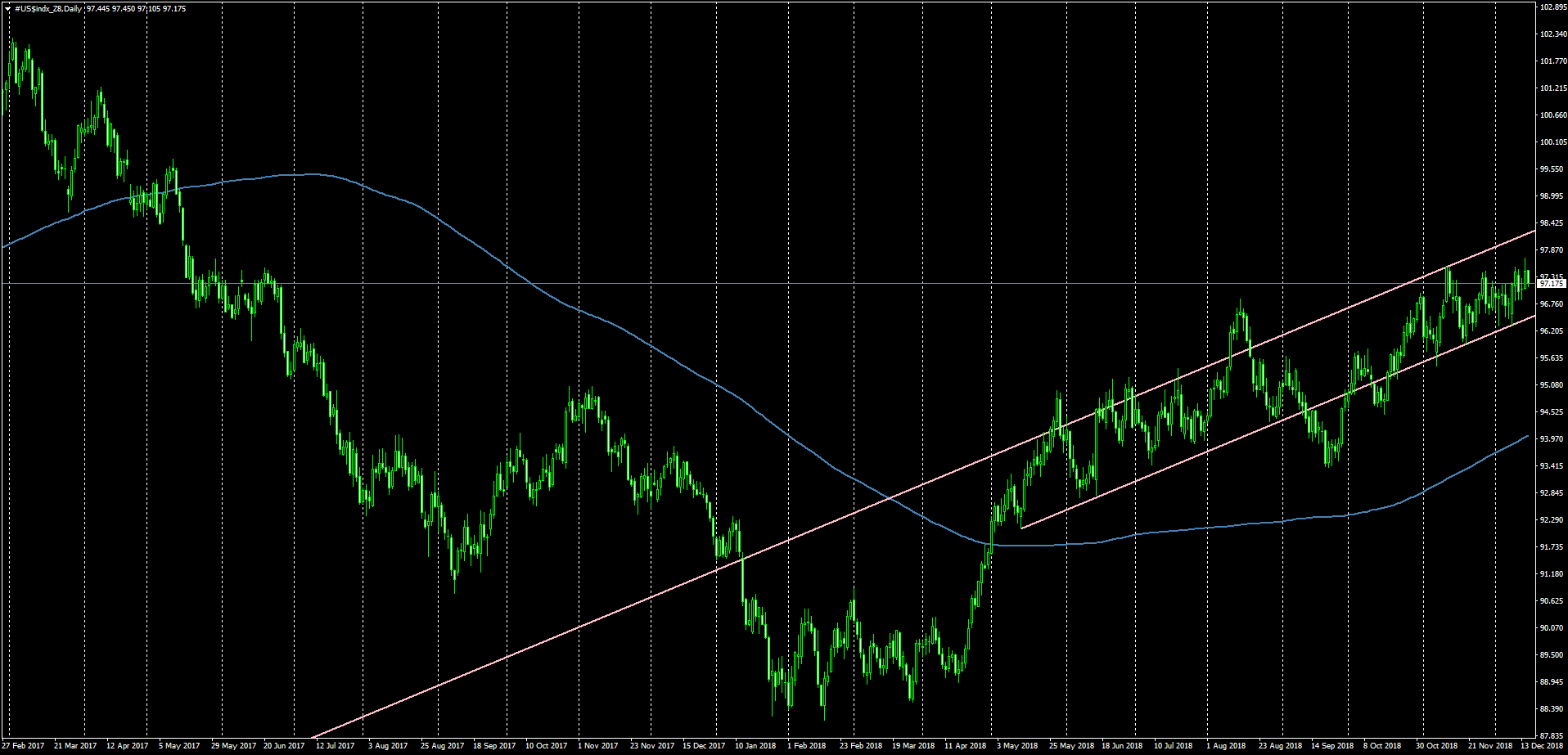
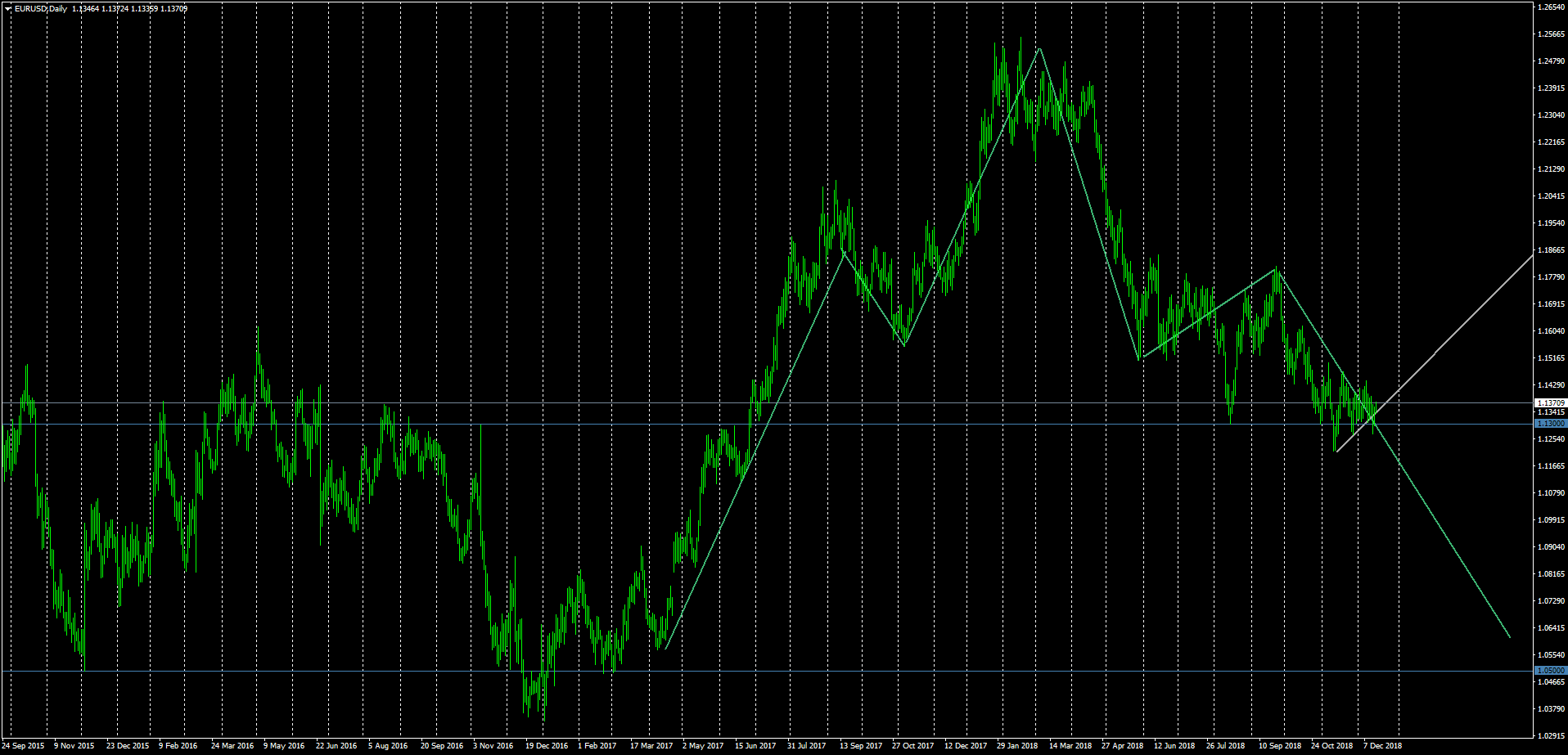
Softening of the Fed's tone will be a negative factor for currency, and this time it is reasonable to expect that if markets perceive a shift in rhetoric as a signal to buy beaten stocks, the dollar will be under pressure, and the growth trend that prevailed in the outgoing year will be replaced by a long-term one with possible weakening DXY down to the 88 levels and rising EURUSD at 1.25 area.
If Powell acts on the fact, guided by the internal data and current world indicators – then the shares will be threatened by the decline extension. Next important support area is on the September 2017th consolidation, with 5% below current levels and at the border of the bear market (-20% off the peak).
The Fed's rigidity, during the stock market falling, can return the demand for the dollar as a defensive asset, aiming it at the 2017 highs (about 6.5% higher than current levels): for EURUSD it will be a direct road to 1.05.
Oil Prices Hit New Lows
Crude prices dropped to fresh lows on Tuesday, in a third-straight session of losses as investors continued to fret over signs of rising U.S. supply. January West Texas Intermediate crude CLF9, -3.23% CLF9, -3.23% dropped 91 cents, or 1.8%, to $48.97 a barrel. If that level holds to the close, it would mark the lowest finish for a front-month contract since Sept. 11, 2017. Oil settled at $49.88 on Monday, the weakest finish since Oct. 9, 2017.
February Brent LCOG9, -3.34% the global benchmark, fell $1, or 1.7%, to $58.69 a barrel. That would mark the lowest close since late September 2017 if prices hold to the close. Brent finished 1.1% lower on Monday to $59.61 a barrel, its lowest since Nov. 30. Kicking off Monday’s losses, commodity data provider Genscape reported that Cushing, Okla., crude inventory rose by 630,000 barrels last week, which analysts said was bigger than expected. And in its monthly Drilling Productivity report, the Energy Information Administration on Monday predicted a rise of 134,000 barrels a day in U.S. shale oil production for January to 8.166 million barrels a day.
Oil has also been under pressure amid a general investor unease over perceived riskier assets such as stocks and commodities such as oil. All three major indexes have been pushed into correction territory, and Monday’s losses — the Dow Jones Industrial Average DJIA, -2.11% retreated over 500 points — extended the worst start to a December since 1980. Bearish momentum has been consuming investors for weeks and much may be riding on a two-day Federal Open Market Committee meeting that begins Tuesday. The Fed is expected to hike interest rates, though there have been loud calls for the central bank to hold back on that move, especially given market volatility.