

Sample Category Title
Aussie Reverses Its Losses In The Asian Session
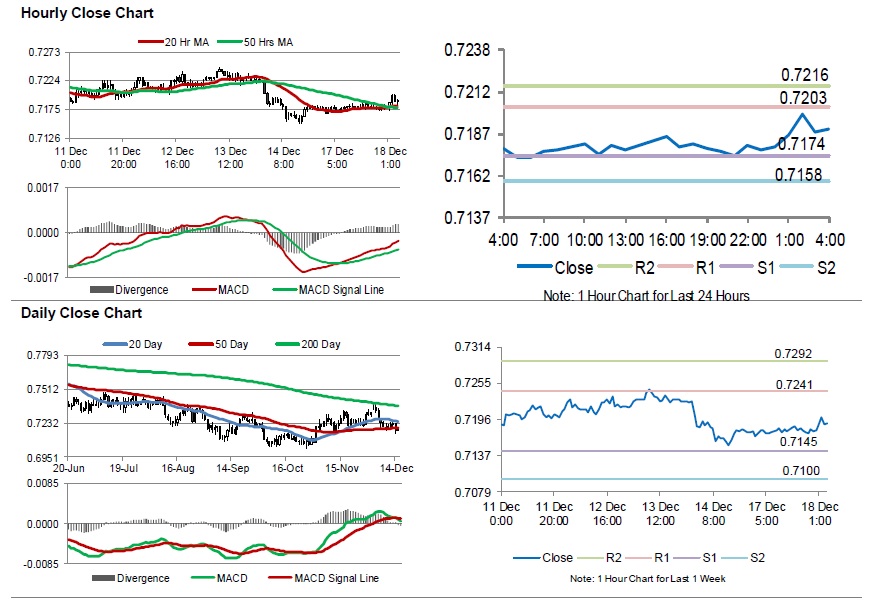
For the 24 hours to 23:00 GMT, the AUD declined 0.01% against the USD and closed at 0.7177.
LME Copper prices declined 0.1% or $8.5/MT to $6095.5/MT. Aluminium prices rose 1.6% or $29.5/MT to $1937.5/MT.
In the Asian session, at GMT0400, the pair is trading at 0.7190, with the AUD trading 0.18% higher against the USD from yesterday’s close.
The minutes of the Reserve Bank of Australia’s (RBA) December monetary policy meeting showed that the next move in the cash rate is more likely to be a rise than a decrease however it believed that there is no strong case for a near-term monetary policy adjustment. Further, the central bank warned that sluggish household consumption and declining real estate values pose key economic risks to the Australian economy..
The pair is expected to find support at 0.7174, and a fall through could take it to the next support level of 0.7158. The pair is expected to find its first resistance at 0.7203, and a rise through could take it to the next resistance level of 0.7216.
Looking ahead, investors would keep an eye on Australia’s Westpac leading index for November, slated to release overnight.
The currency pair is showing convergence with its 20 Hr moving average and trading above its 50 Hr moving average.
Gold: Yellow Metal Extends Its Gains In The Asian Session
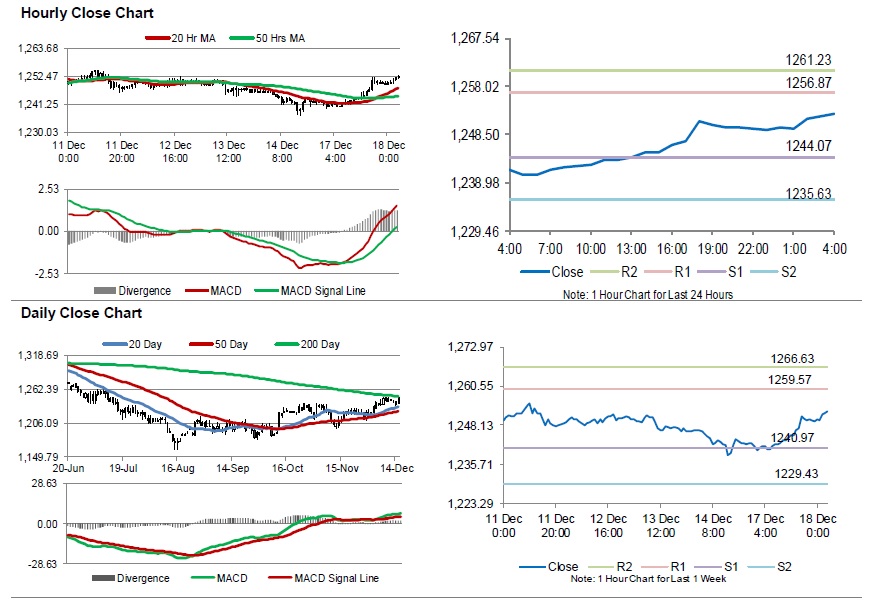
For the 24 hours to 23:00 GMT, Gold rose 0.66% against the USD and closed at USD1249.70 per ounce, amid weakness in the US dollar.
In the Asian session, at GMT0400, the pair is trading at 1252.50, with gold trading 0.22% higher against the USD from yesterday’s close.
The pair is expected to find support at 1244.07, and a fall through could take it to the next support level of 1235.63. The pair is expected to find its first resistance at 1256.87, and a rise through could take it to the next resistance level of 1261.23.
The yellow metal is trading above its 20 Hr and 50 Hr moving averages.
Silver: White Metal Trading On A Stronger Footing This Morning
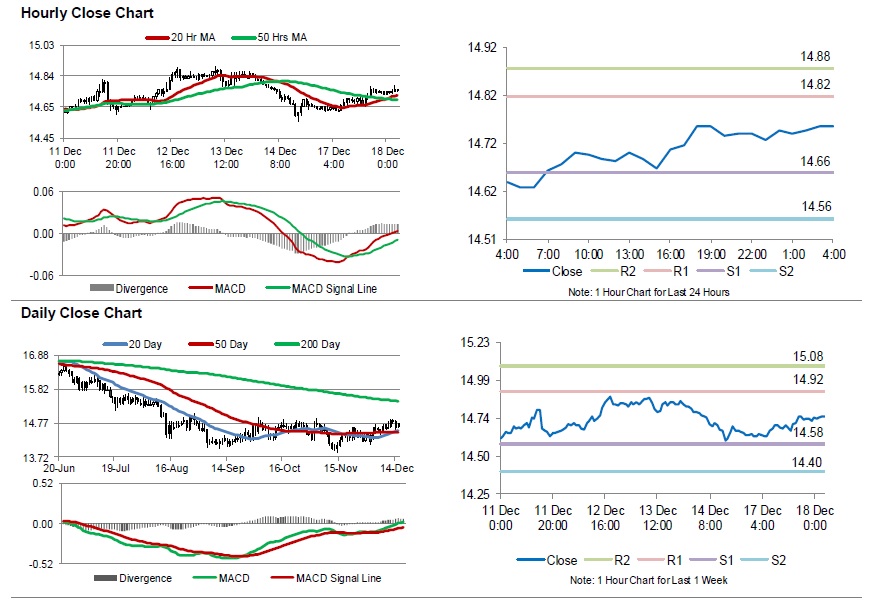
For the 24 hours to 23:00 GMT, Silver rose 0.58% against the USD and closed at USD14.73 per ounce, tracking gains in gold prices.
In the Asian session, at GMT0400, the pair is trading at 14.76, with silver trading 0.20% higher against the USD from yesterday’s close.
The pair is expected to find support at 14.66, and a fall through could take it to the next support level of 14.56. The pair is expected to find its first resistance at 14.82, and a rise through could take it to the next resistance level of 14.88.
The white metal is trading above its 20 Hr and 50 Hr moving averages.
Crude Oil: Oil Trading Lower, Ahead Of API’s Weekly Crude Oil Inventories Data
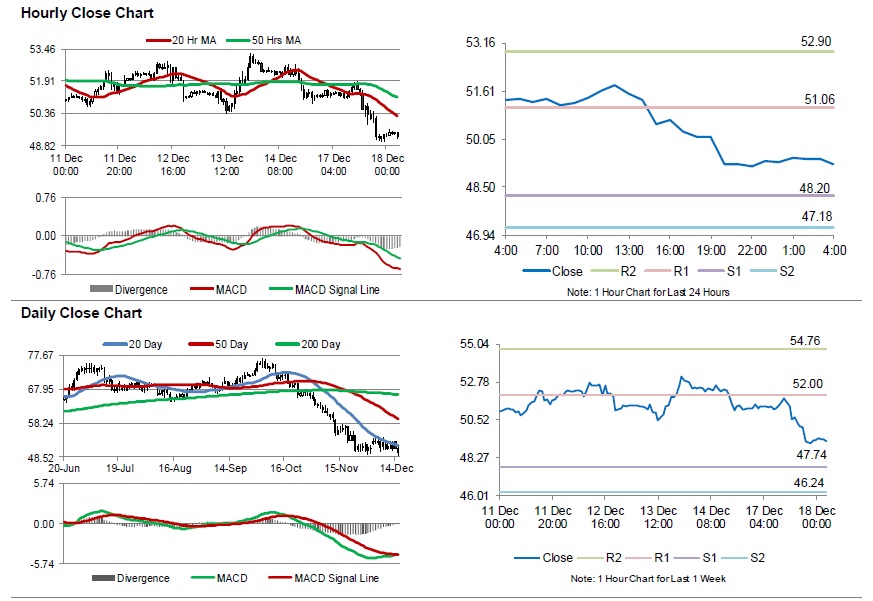
For the 24 hours to 23:00 GMT, Crude Oil declined 3.84% against the USD and closed at USD49.34 per barrel, after data showed a rise in crude inventories at the US storage hub in Cushing, Oklahoma. Further, the Energy Information Administration forecasted that crude-oil production from seven major US shale players will climb by 134,000 barrels a day to 8.166 million barrels a day in January.
In the Asian session, at GMT0400, the pair is trading at 49.23, with oil trading 0.22% lower against the USD from yesterday's close.
The pair is expected to find support at 48.20, and a fall through could take it to the next support level of 47.18. The pair is expected to find its first resistance at 51.06, and a rise through could take it to the next resistance level of 52.90.
Crude oil is trading below its 20 Hr and 50 Hr moving averages.
CADJPY Selloff To Resume
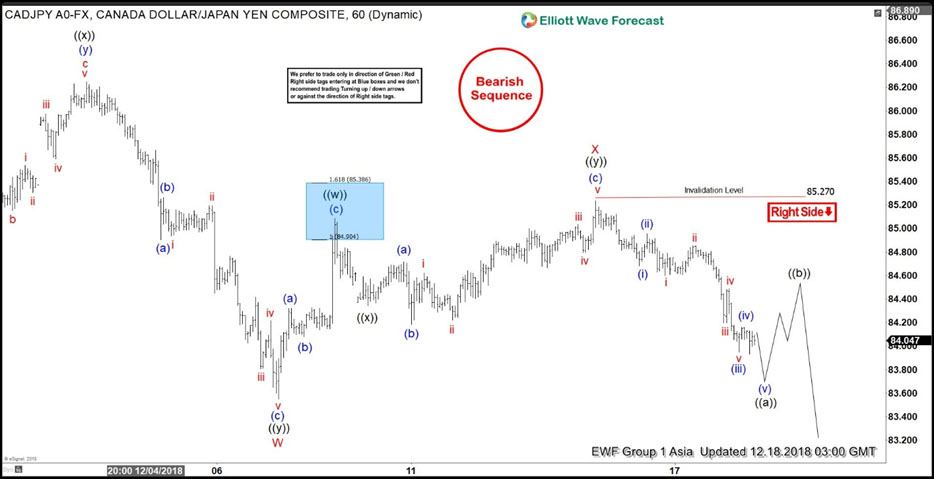
Short Term Elliott Wave view suggests that cycle from 11.8.2018 high (87) ended at 83.55 in Minor wave W and bounce to 85.27 ended Minor wave X. Pair has resumed lower in Minor wave Y, but it needs to break below Minor wave W at 83.55 for confirmation and to avoid double correction in Minor wave X. Internal of Minor wave W unfolded as a double three Elliott Wave structure where Minute wave ((w)) ended at 84.59, Minute wave ((x)) ended at 86.25, and Minute wave ((y)) of W ended at 83.55. Up from there, Minor wave X bounce ended at 85.27. The Internal of Minor wave X also unfolded as a double three Elliott Wave structure. Minute wave ((w)) of X ended at 85.08, Minute wave ((x)) of X ended at 84.34, and Minute wave ((y)) of X ended at 85.27.
Decline from 85.27 is unfolding as a 5 waves Elliott Wave impulse structure. Minutte wave (i) ended at 84.68, Minutte wave (ii) ended at 84.96, Minutte wave (iii) ended at 83.95, and Minutte wave (iv) ended at 84.11. Expect pair to end Minute wave (v) soon, and it should also end Minute wave ((a)) of larger degree zigzag. Afterwards, pair should bounce in Minute wave ((b)) in 3-7-11 swing to correct cycle from 12/14/2018 high before the decline resumes.
CADJPY 1 Hour Elliott Wave Chart
Market Morning Briefing: Aussie Has Bounced From Immediate Support At 0.7150
STOCKS
Apart from Nifty, the other indices are all trading lower and look bearish for the near term.
Dow (23592.98, -2.11%) declined sharply and could come off towards 23000 on a break below 23500. DAX (10772.20, -0.86%) has room towards 10500/400 if it is unable to break above 11000 just now. While the overall trend is down, the index is trading near support levels and is likely to bounce back from here or at the least remain stable for the near term.
The Nikkei (21242.66, -1.23%) seems to have been pulled down on a stronger Yen. Note 21200 is an important 3-day support and while that holds, preference is for a bounce from here back towards 22400 and higher. Break below 21200 would initiate fresh lows seen after Sep’17 levels. Watch price action near current levels.
Shanghai (2573.37, -0.95%) is bearish while below 2650. The 3-day and weekly charts suggest a fall towards 2500 and lower in the longer run.
Nifty (10888.35, +0.77%) has scope of rising towards 11000 while it sustains the rise above 10850.
COMMODITIES
As mentioned yesterday, some volatility has set into the markets. Weakness in the US Dollar has lead to a slight rise in Gold and Silver while Crude prices fell sharply on bearish sentiments after data stated a rise in US inventory levels.
The US crude inventory data showed a rise in inventories by more than 1mln barrels between Dec 11-14th bringing in oversupply tensions as the market sentiment seems to tilt to the downside.
Brent (58.98) and Nymex WTI (49.68) have fallen and are trading lower contrary to our expectation of seeing a bounce mentioned yesterday. Note important supports at 56.50 and 48 on Brent and WTI respectively. Prices May continue to fall to test these support levels before bouncing back from there.
Brent-WTI spread (9.3) has risen sharply. While there is resistance near 10, we could possible see a fall soon from current levels.
Gold (1251.80) has risen contrary to our expectation of testing 1230 first. While the broad trade region is likely to remain in the 1230-1260 region, we could see a test of resistance at 1260 in the next 1-2 sessions.
Silver (14.76) has been falling after testing immediate resistance just below 15. The price could now be headed lower towards 14.25-14.00 in the near term. Price looks bearish for the near term.
Copper (2.7495) is possibly towards the end of the ranged sideways movement between 2.70 and 2.85. No major movement is expected just now while we wait for the price to see a sharp move soon.
FOREX
Although Dollar index (97.08) has seen a fall from levels near 98, it would be important to break below 96.50 to set a bearish trend for the near to medium term. For now while the Dollar trades lower, we could see some strength in the major and EM currencies today. View for at least the next 1-2 sessions looks bearish.
Euro (1.1353) has not been able to sustain a break below 1.13 and while the US Dollar trades weak just now, Euro could test 1.14 or higher in the near term.
Dollar Yen (112.68) has scope to come off towards 112.50/20 within the current fall from where a bounce could be expected. Near term is bearish.
Euro-Yen (127.87) is almost trading at immediate support levels and could soon see a bounce from here back towards 128.50. Failure to sustain above 127.60 could initiate fresh bearishness towards 126.
Pound (1.2621) is within the near term downward channel. While below 1.27, the currency could come off towards 1.2450-1.240 in the near term.
Aussie (0.7186) has bounced from immediate support at 0.7150 and while that holds, we could see a rise towards 0.725in the next few sessions.
Dollar Rupee (71.5550) could come off towards 71.40/20 today on weaker UD Dollar and Crude prices. Although current NDF is trading at 71.60, we may prefer some down-move today.
INTEREST RATES
Overall the global yields are all trading low and look bearish for the near to medium term.The directional trend is down with some small corrective upmoves.
The US yields have fallen and are trading lower just now. Medium term looks bearish. The 5YR (2.68%), 10YR (2.85%) and the 30Yr (3.11%) are down from 2.72%, 2.89% and 3.14% respectively. While the resistance in the very long term is holding for now the US yield could continue to fall. The 5Yr, 10Yr and the 30Yr could fall towards 3%, 2.8% and 2.6% respectively.
The UK-US 10Yr (-1.72%) has broken above long term channel resistance and while that sustains could head higher towards -1.62% levels in the near term. The UK yields have bounced a bit and could soon come off again towards lower levels in the medium term. The 10Yr (1.13%) has resistance near 1.1520% from where a rejection could be see pushing the yield back towards 1.05%.
The Japanese yields look bearish in the near term and are trading low for now. The 10Yr (0.03%) could come off towards 0.021% to -0.005% in the near term.
US stocks in free fall but Fed is not to blame
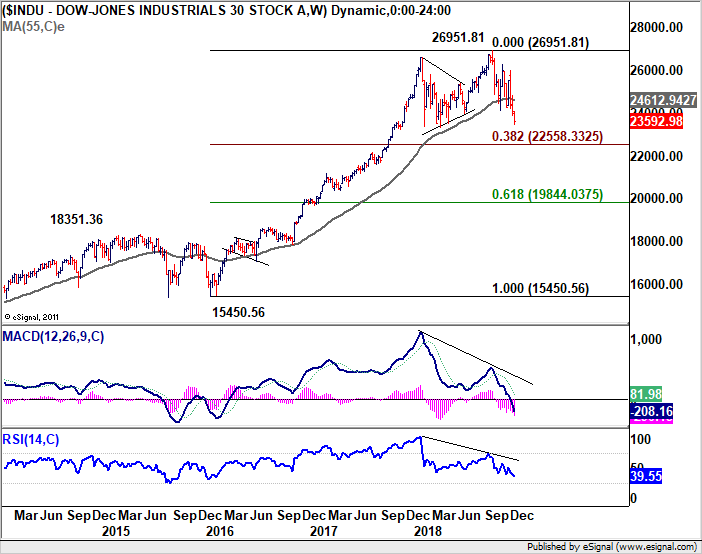
US equities dived for another day overnight and risk aversion spreads to Asia today. DOW dropped -507 pts or -2.11% to 23592.98. S&P 500 declined -54.01 pts or -2.08% to 2545.94. NASDAQ lost -156.93 pts or -2.27% to 6753.73. At the time of writing, Nikkei is down -1.64%, Singapore Strait Times is down -1.81%, Hong Kong HSI is down -0.90% and China Shanghai SSE is down -1.09%.
In bond markets, US 10 year yield dropped -0.034 to 2.857. Yield curve is inverted between 2-year (2.696) and 3-year (2.683). 5-year yield is not far away at 2.692. Japan 10 year JGB yield is down -0.006 at 0.030, after hitting as low as 0.026 earlier today.
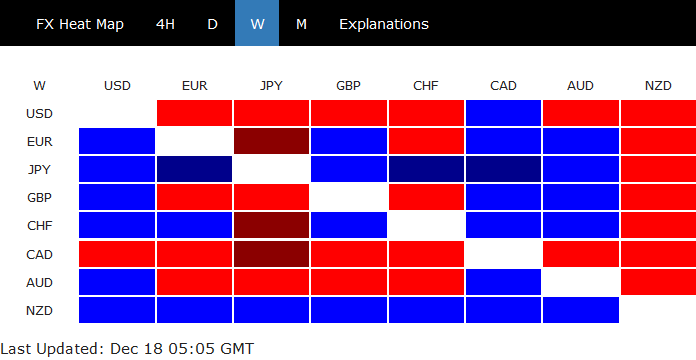
In the currency markets, New Zealand Dollar continues to walk its own path and is the strongest one for the week. Yen follows on risk aversion, then Swiss Franc. Canadian Dollar is the weakest as WTI crude oil is back below 50 as recent decline resumes. Dollar second weakest.
White House trade advisor Peter Navarro said Fed shouldn't raise interest rate, even this week. He said it's "not because the economy's slowing down, but because the economy's growing without inflation". Trump also blast Fed for "even considering yet another interest rate hike". Whether Fed should or shouldn't continue with rate hike is one question, they've got enough seasoned economists there to make their own judgement. But noting that Dollar and yield declined, there is apparently no linkage between Fed's hike to the stock market crash.
Additionally, the relatively small reaction in Hong Kong and China stock markets suggested that US-China trade truce has been sentiment supportive. Instead, the global rush from stocks to bonds, including US, Japan and Germany, suggested that there is deep lying concern over slowdown, which in large part, was due to Trump's tariffs and tariffs threats.
Anyway, DOW is medium term correction that started back at 26951.81. We'd reiterate such correction should head to 38.2% retracement of 15450.56 to 26951.81 at 22558.33 before completion. We'd see the reaction from there before judging how deep the correction would develop into.
RBA Minutes More Cautious on the Australian Economy
The Reserve Bank has nominated downside risks to their outlook for the consumer in the December Board minutes. With the Board meeting pre-dating the September GDP report the growth outlook will need to be revised down. In February we are likely to see a Bank which is more aligned with trend growth than the current forecasts of comfortably above trend.
The minutes of the December monetary policy meeting of the Reserve Bank Board reveal a Board which is less confident about the economy than has been the case in the past.
Of most interest is a more detailed explanation of the prospects for the consumer. In the past, the outlook for the consumer was described as a source of uncertainty. In today’s minutes, the issues around slow income growth, high debt levels and falling house prices are explained as being a combination of factors which are posing downside risks to the outlook for the consumer. This issue is critical to the Bank’s central view because trend growth in consumption is likely to be necessary to sustain strength in the labour market and a gradual pick-up in wages growth. In turn, that combination is expected to lead to further falls in the unemployment rate.
Accordingly, the minutes affirm “members continue to agree that the next move in the cash rate is more likely to be an increase than a decrease”.
However, this statement was made when, according to the minutes, the Bank expected GDP growth in the year to the September quarter to be above 3 per cent. The GDP report, which printed the day after the Board meeting, showed growth of 2.8% - around trend. Growth relative to trend is an important parameter for the Bank. Note in the minutes how falls in the unemployment rate “were likely given the expectation that the economy would continue to grow above trend”.
In our view, the Bank is now likely to revise down its forecast growth in 2018 from 3.5% to 3.0% (just above trend of 2.75%) in the February 2019 Statement on Monetary Policy.
The 2019 forecast should be lower than 2018 given the uncertainty around the housing market and the consumer. The Bank may choose not to reduce 2019 to 2.75% (despite current forecasts having 2019 0.25ppts below 2018) because the Bank seems to be in denial that dwelling investment will contract in 2019 and 2020 - “dwelling investment was expected to remain around this level for at least the following year or so”. A somewhat conflicting indicator of that view can be found in the minutes where “liaison with developers indicated that demand for new detached housing in eastern Australia had eased… and some developers had reported that this decline in demand had become more pronounced. Demand for off-the-plan apartments had declined significantly since mid-2017”.
With a typical lag on detached housing between approval and commencement being about three months, it seems unlikely that the Bank’s forecast on dwelling construction will be justified.
There is considerably more discussion around the state of the housing market with house prices in Sydney now having fallen by 9 per cent since July 2017 and 6 per cent in Melbourne since November 2017. Also note that house prices in Perth and Darwin “had returned to levels seen a decade earlier”. This final observation certainly puts into perspective the assertion from some that housing downturns are short-lived.
As with previous minutes, credit conditions are described as “tighter than they had been for some time” with particular focus on the Royal Commission reducing some lender’s appetite. It is also interesting that this tightening is described as targeted at not only housing but also small business.
On the positive side, investment expectations had lifted; employment growth is holding at 2.5%; and there has been a small pick-up in wage price index growth over the previous two quarters.
Sentiment around the global economy is a little more guarded than we have seen in previous minutes – “there had been some loss of momentum in external demand in all regions”, partly related to trade tensions. China’s efforts to deal with risks in their financial sector remain a consistent theme in the minutes with the contraction in non-bank lending risking credit availability to smaller enterprises. The Board discussed credit conditions in the US noting a modest tightening and high non-financial corporate leverage. With recent developments in the US equity market, no doubt there will be greater attention being given to US financial markets to complement the coverage on China.
Conclusion
The sentiment in these minutes is somewhat less confident about the Australian economy than we have seen in previous minutes, although the outlook for higher rates is once again confirmed. Certainly, at this stage, the Bank cannot be described as having moved to a ‘neutral’ bias. However, taking into account the attention given to the credit; housing; consumer; and external risks, these minutes should be interpreted more ‘dovishly’ than we have seen over the course of 2018.
Readers will be aware that Westpac has consistently called the cash rate on hold since the August 2016 rate cut in its standard 2-3 year forecast horizon. Markets are now closely priced to our current view that rates will be on hold in 2019 and 2020.
However, traders will want to price-in some scenario for “rates activity” . These minutes are more likely to encourage them to price-in lower rates than the alternative.
GBP/USD’s Recovery Could Fail Near 1.2700
Key Highlights
- The British Pound found support near 1.2475 and recently recovered against the US Dollar.
- There are two important bearish trend lines in place with resistance near 1.2700 on the 4-hours chart of GBP/USD.
- The Euro Zone Core CPI declined 0.3% in Nov 2018 (MoM), more than the forecast of -0.2%.
- Today, the US Housing Starts for Nov 2018 will be released, which is forecasted to rise from 1.228M to 1.234M (MoM).
GBPUSD Technical Analysis
The British Pound declined heavily this past week after it broke the 1.2750 support against the US Dollar. The GBP/USD pair traded below the 1.2550 support before buyers appeared near the 1.2475 level.
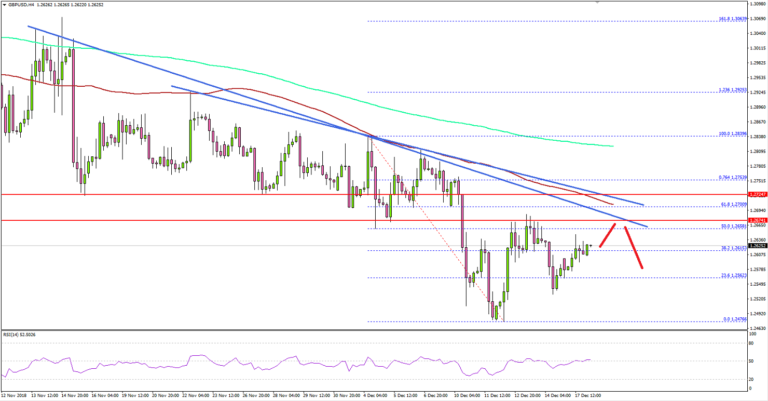
Looking at the 4-hours chart, the pair started a short term recovery from the 1.2475 support. It climbed above the 1.2500, 1.2560 and 1.2600 resistance levels. There was also a break above the 38.2% Fib retracement level of the last decline from the 1.2839 high to 1.2476 low.
However, the pair is facing a solid resistance near the 1.2675 and 1.2700 levels plus the 100 simple moving average (red, 4-hours). More importantly, there are two important bearish trend lines in place with resistance near 1.2700.
Therefore, it won't be easy for buyers to clear the 1.2700 hurdle in the short term. Above 1.2700, the pair is likely to move into a positive zone and it could climb towards 1.2800 or even 1.2850.
On the downside, the 1.2560 level is an initial support, below which there is a risk of more losses towards 1.2500 or 1.2475.
Fundamentally, the Euro Zone CPI figure was released by the Eurostat. The market was looking for a decline of 0.2% in the CPI in Nov 2018 compared with the previous month.
The result was similar to the forecast, but the Core CPI fell 0.3% in Nov 2018, which was more than the market expectation of -0.2%. The Core CPI yearly change was +1.9%, less than the forecast of 2%. The report stated that:
The lowest annual rates were registered in Denmark (0.7%), Ireland (0.8%) and Portugal (0.9%). The highest annual rates were recorded in Estonia, Hungary and Romania (all 3.2%).
EUR/USD recovered recently, but there are many hurdles for buyers on the upside similar to GBP/USD.
Economic Releases to Watch Today
- German IFO Business Climate Index for Dec 2018 – Forecast 101.7, versus 102.0 previous.
- US Housing Starts Nov 2018 (MoM) – Forecast 1.234M, versus 1.228M previous.
- US Building Permits Nov 2018 (MoM) – Forecast 1.265M, versus 1.263M previous.
A Not So ‘Silent Night’ In The Markets
A not so 'Silent Night.'
Indeed twas the week before Xmas and markets were waiting for chaos to break out
Markets
The S&P plummeted to its lowest level since October 2017 in a very objectionable environment for risk: China economic woes Brexit impasse, dovish central banks, continued European political malaise, soft data and Trump legal issues are all taking their toll on investors souls. And trust me the markets have been doing a lot of soul-searching the past 96 hours.
US equity markets followed their European rivals lower after a negative warning from online retailers. Indeed not the time of year one would expect concerns from the retail community. But in reality, the tumultuous run in global equity markets since October does suggest, no matter how good you have been, expect that stocking to be a little less full this year.
Weak data from both China and Europe t reminded us that global growth remains elusive and that 2019 prospects look dispiriting.
But Let last nights US economic data be a stark reminder the US economy is not immune to a slow down. The NY Fed Empire manufacturing index fell to 10.9 vs consensus forecasts of 20.0, which is the lowest level since May 2017. Triggering a USD sell-off in favour of safe havens like CHF and JPY. Gold turned bid as US stocks and yields headed south leaving risk aversion to set the tone for the tone for most of the session. Additionally, we received another humbling reminder that the US housing industry is weakening – the NAHB housing market index, which surveys homebuilders, fell to the lowest level since 2015 in December. Both data prints are providing less than ideal footing for risk.
While we had a great inclination for the rest of the world’s economic woes, but if US economy turns south, we’re in for a world of hurt. After all, it was the US market that was carrying the weight of global risk sentiment on its shoulder.
It’s an extremely bearish environment and while market expectations are for a dovish hike from the Fed (and for the central bank to temporarily pause its rate hike cycle at the beginning of 2019). But the markets aren’t taking any solace in a softer forward-looking Fed as a chorus of ' no rate hike' for December is echoing loudly but likely falling on deaf ears.
Asia markets will be holding on for dear life today with local investors running out of places to hide.
Oil Market
Oil market bears were on the prowl overnight as WTI plummeted to close near $49 per barrel. Whatever semblance of support was building between 50-51 quickly evaporated as traders refocused on a supply glut — a Genscape report showing a build of 630,000 barrels at the Cushing, much higher than expected and adding to the oversupply argument. But there remains high suspicion as to what extent Russia will fill their commitment Russian oil output has been at a record high of 11.42 million barrels per day (bpd) in December so far. But enveloping supply concerns is the increasing likelihood of a protracted economic downturn in China that continues to stoke fears of demand slowdown.
As usual Oil markets are all about the basics of supply and demand, so when excess amount crosses paths with a bearish global growth outlook, it provides an exceedingly bearish signal for oil prices which have only one place to go, and that’s down.
With market struggling for direction Oil prices were very prone to shift in risk aversion, but when global growth concerns trigger risk off it’s hugely negatively impactful for oil prices.
Gold Markets
With investors fleeing equity markets in droves gold remains one of the few places for investors to wait out this storm. Even more so when the move lower on equity market was triggered by softer than expected US economic data, with natural pressures the USD lower as it plays into the dovish Fed narrative.
Currency markets
USD was weighted down by US equity market sell-off which triggered a flight to safety on JPY and CHF as investors are running out of options of where to hide in a severe case of the Monday blues for the greenback.
Euro
Progress on the Italy budget front, the Pound anchoring itself to the 1.2600 have seen bearish bets unwind. But with the Euro unable to make further gains below 1.1275 on a dovish ECB and weak PMI’s and given this is the final trading week of the year, no one is that interested in pushing any bullish are bearish agenda as year-end positions squaring is as likely to trip up a hard-earned trading position as it is to favour one.
Malaysian Ringgit
The prospects of Global central banks, especially the Federal Reserve Board entering a dovish phase in this current cycle is triggering yield appeal ahead of what’s expected to be a dovish leaning Federal Reserve Board all of which suggests the USD dollar will run out of gas in 2019 and make EM FX (Asia especially look attractive)
So, while the weaker global growth storyline weighs on local equity markets currency markets are experiencing some carry trade and bond appeal which is filtering through EM Asia particularly the higher yielder.
The MYR Is not precisely a higher yielder in the sense of INR IDR or PHP. the yield’s still attractive to investors as the economy looks robust supported by oil exports
Speaking of which, oil prices slid overnight with will likely blunt the MYR ambitions today while providing relief to the dual deficit Oil importers IDR and INR which is backed by very lofty yields.
Bitcoin
Bitcoin has made an impressive move overnight after holding the line at significant support levels above the cliff edge $3000 mark. And while its far to early to call the bottom is in, it’s very encouraging to see that BTC investors can celebrate some holiday cheer instead of a lump of coal under the tree as even small wins have been very elusive the past month.
Now only if the Bitcoin community can give the markets some breathing room. Frankly, Crypto’s need an extended period of 'boring times ', the problem is that Bitcoin is never far from the limelight with everyone chiming in 'I told you so ' whether its a 500 dollar bounce higher or lower. If only the community would let the market settle and enjoy these small wins, the space would be so much better off.