Sample Category Title
Gold Moves Higher As Investors Look For Cues
Gold has posted gains in the Monday session. In North American trade, the spot price for one ounce of gold is $1242.52, up 0.32% on the day. In economic news, there are no major U.S releases. The Empire State Manufacturing Index dropped sharply to 10.9, down from 23.3 points in the previous release. This was well short of the estimate of 20.1 points. On Tuesday, the U.S. releases housing starts and building permits.
The U.S. released consumer November spending and inflation numbers last week. Although the numbers are down compared to October, the indicators show that the economy has lost some steam but still remains strong. Retail sales climbed in November, but the gains were muted compared to October. Core retail sales dropped from 0.7% to 0.2%, while retail sales declined to 0.2%, down from 0.8%. Still, retail sales managed to beat the estimate of 0.1%. Lower oil prices have boosted consumer spending, which is expected to look strong in the fourth quarter.
Inflation data has also softened. CPI dropped to 0.0% in November, down from 0.3% a month earlier. This marked the lowest level since May. Core CPI remained pegged at 0.2 percent. The weak readings can be attributed to falling oil prices, which has led to a sharp decline in gasoline prices. On an annualized basis, inflation gained 2.2 percent in November, down from 2.5 percent in October. With inflation still above the Federal Reserve’s target of 2 percent, policymakers have some room to scale back on rate hikes in order to adjust to softer economic conditions.
Eco Data 12/18/18
[php_everywhere instance="1"]
British Pound Takes Breather after Volatile Week
GBP/USD is up slightly in the Monday session. In North American trade, the pair is trading at 1.2610, up 0.18% on the day. On the release front, the Empire State Manufacturing Index dropped sharply to 10.9, down from 23.3 points in the previous release. This was well short of the estimate of 20.1 points. Later in the day, the U.K. releases Rightmove HPI, which is expected to decline by 1.5%. On Tuesday, the U.S. releases housing starts and building permits.
With constant twists and turns in the Brexit saga, traders shouldn’t be surprised that the British pound has responded with volatility. Last week was a roller-coaster for the currency, as GPB/USD moved over 1 percent on two separate days last week. The volatility was in response to last week’s dramatic events surrounding Brexit. Prime Minister Theresa May survived an internal non-confidence motion in the Conservative party. However, one-third of Conservative MPs voted against May, leaving the prime minister in a weak position, ahead of a parliamentary vote on Brexit, which will likely be held in January.
The EU has insisted that the withdrawal agreement will not be reopened, and May was unable to extract any concessions from the EU on a whirlwind trip last week. May will have a tough time pushing the deal through parliament, and if she is not successful, Britain could well be on its way to leaving the EU without a deal, which would have a chilling effect on the U.K. economy and the British pound.
U.S. retail sales climbed in November, but the gains were muted compared to October. Core retail sales dropped from 0.7% to 0.2%, while retail sales declined to 0.2%, down from 0.8%. Still, retail sales managed to beat the estimate of 0.1%. Lower oil prices have boosted consumer spending, which is expected to look strong in the fourth quarter. Inflation has dipped of late, CPI dropped to 0.0% in November, down from 0.3% a month earlier. This marked the lowest level since May. Core CPI remained pegged at 0.2 percent. The weak readings can be attributed to falling oil prices, which has led to a sharp decline in gasoline prices. On an annualized basis, inflation gained 2.2 percent in November, down from 2.5 percent in October.
FOMC Preview: What Do We Expect?
On Wednesday, the Federal Open Market Committee (FOMC) will meet for the final time in 2018, and there is a higher-than-usual degree of uncertainty headed into the meeting as a result of financial market developments, macroeconomic concerns and some mixed messages from the Fed. So what do we expect to occur at the upcoming meeting? First, we expect a 25 basis point increase in the fed funds target range, bringing it up to 2.25%-2.50%, coupled with just a 20bps increase in the interest rate on excess reserves (IOER).1 As it stands now, these moves are broadly anticipated by most financial market participants.
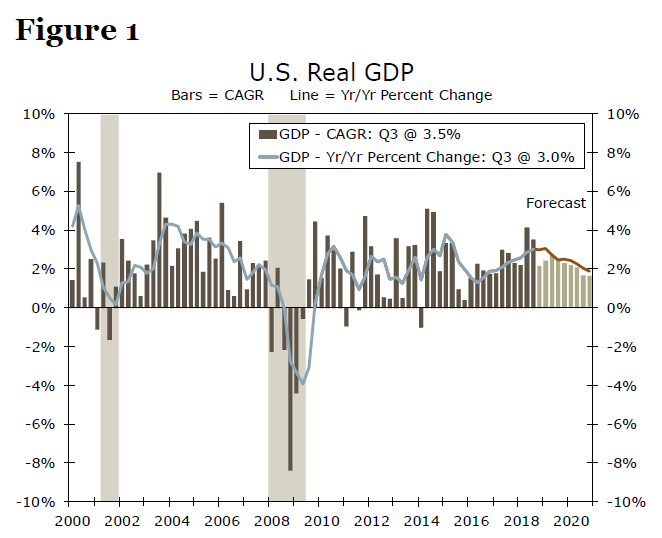
What about our expectations for Fed communication? In the previous FOMC statement, policymakers noted that "economic activity has been rising at a strong rate." It would not surprise us to see this language tempered a bit. We believe real GDP growth in Q4 will be 2.0%-2.5%, down from 4.2% and 3.5% in Q2 and Q3, respectively. Critically, however, we do not expect growth to materially slow below this pace over the next few quarters. Our fed funds forecast for next year is underpinned by a real GDP growth forecast of 2.7% in 2019, with growth a bit stronger in the first half compared to the second half of the year.
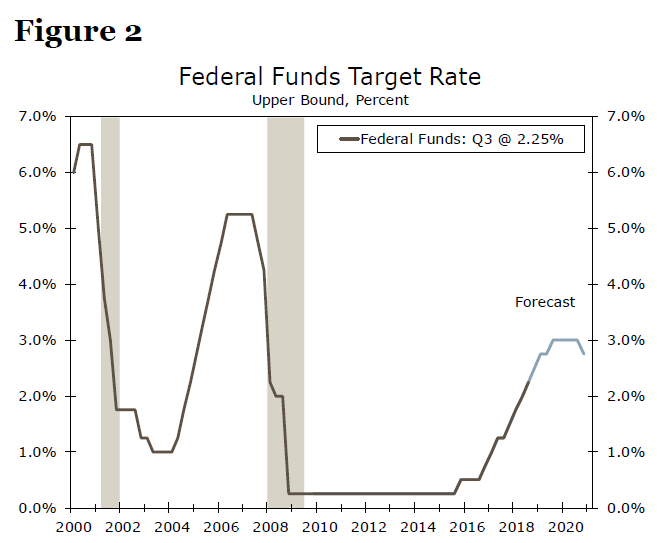
Perhaps the other most noteworthy potential change to the language would be some editing of the phrase "the Committee expects that further gradual increases in the federal funds rate will be consistent with sustained expansion of economic activity." Although we do expect the FOMC to continue hiking, recent commentary from Fed officials signals that they believe they are approaching the neutral rate. With the neutral rate in sight, the Fed may at some point soon turn to language that paints future rate hikes as more data-dependent and less on a pre-charted course back towards neutral. Put another way, continued gradual increases in the fed funds rate are likely, but they will become largely dependent on near-term data now that short-term interest rates have firmly come up from historic lows.
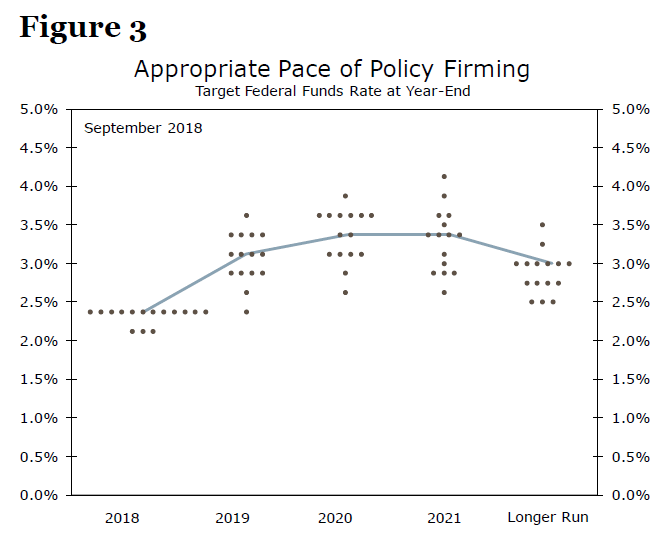
At present, the median dot in the Fed's dot plot signals three more rate hikes in 2019, one in 2020 and zero in 2021. Were this to occur, it would put the fed funds rate about one and half hikes above their median estimate for the long run. We think there's a good chance that the Fed will remove one hike from the dots in the 2019-2020 period to reflect that the outlook for growth and inflation is modestly weaker than it was in September. They could do this by either removing one hike from next year or by taking out the 2020 hike, which would signal no more rate hikes after 2019.
That said, it would not shock us if the Fed leaves the dots as is for the time being. Three hikes for next year remains fewer than some forecasters expect and leaves the Fed the flexibility to go three times next year should conditions warrant it. Removing a third hike now and then reinstating it in the first half of next year is not the end of the world, but that may be a less desirable option than simply waiting to remove the hike until March, when the 2019 outlook will be more clear.
What would surprise us? Any increase in the number of hikes currently projected, or conversely any outlook that removes multiple hikes (e.g. the median dot next year falls from three to one). In our own forecast, we look for two rate hikes next year, in Q1 and Q3, followed by a long pause by the Fed as economic growth converges back towards potential growth and core inflation remains generally well-anchored around 2%.
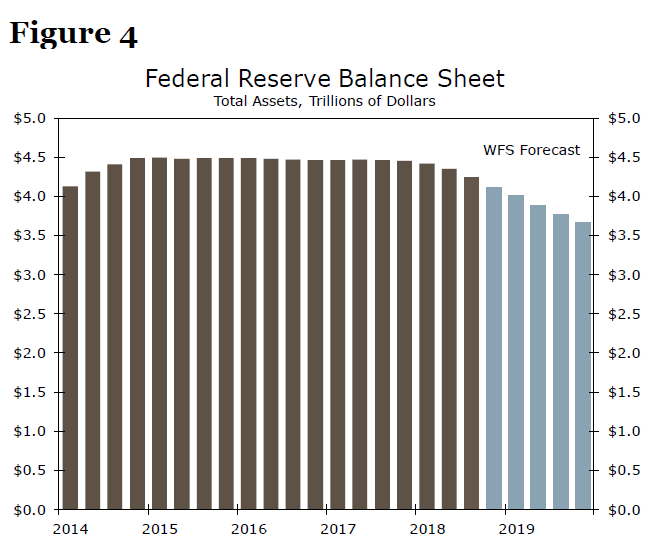
As a final area to keep an eye on, we will be watching the press conference closely for any guidance from Chairman Powell on the balance sheet, IOER and the outlook for a new policy rate at some point. We covered these topics extensively in a recent special report cited above, but in short we continue to look for the Fed's balance sheet reductions to conclude in late 2019/early 2020. The risks to that forecast are probably tilted towards the first half of 2020, but generally speaking we feel fairly confident in the projections we laid out a few months ago in a two part series on the outlook for the balance sheet.2 Still, with numerous questions still unanswered about these topics, we will be looking for additional guidance from the Fed beyond what was received in the November minutes a few weeks ago.
1 For further reading on this IOER move, see Bryon, J.H., Pugliese, M & Kinnaman, A. (November 29, 2018). "Getting Technical: Managing the Fed Funds Rate". Also available upon request.
2 Bryson, J.H., Pugliese, M. and Vaisey, A., "Will the Fed's Balance Sheet Ever Return to 'Normal'? Part I." (August 29, 2018), and Bryson, Jay H., Pugliese, M. and Vaisey, A., "Will the Fed's Balance Sheet Ever Return to 'Normal'? Part II." (September 5, 2018). Also available upon request.
UK May has faithfully and firmly reflected backstop concerns to EU, Brexit deal vote again in week of Jan...
UK Prime Minister Theresa May told MPs that she has "faithfully and firmly" reflected the Commons' concerns about the Irish border backstop to EU. And she described some of the exchanges with EU leaders as being "robust". She added that "but I make no apology for standing up for the interests of this house and for the whole of the United Kingdom.
Nevertheless, May also repeated what the EU has said. That is, EU hoped that the backstop would not be triggered. And even if the backstop was used, it should be temporary. May also mentioned that French President Emmanuel Macron said no one is trying to lock up the UK to the backstop. Though, May also said further discussions will take place with the EU.
On the timing of the vote, May said debate on the Brexit deal with resume in the week beginning Monday January 7. Vote will be held in the following week, that is, the week beginning January 14.
Japanese Yen Improves to 1-Week High
The Japanese yen has gained ground in the Monday session. In North American trade, USD/JPY is trading at 112.93, down 0.40% on the day. It’s a quiet start to the week, with no Japanese events. In the U.S., the Empire State Manufacturing Index dropped sharply to 10.9, down from 23.3 points. This was well short of the estimate of 20.1 points. On Tuesday, the U.S. releases housing starts and building permits. Japan releases trade balance.
The global trade war continues to weigh on the Japanese economy. Japanese Final GDP in Q3 declined 0.6%, the second decline in three quarters. The well-respected Japanese Tankan Manufacturing index remained steady at 19 points in the third quarter. However, recent manufacturing indicators have pointed downwards, pointing to slower activity in the manufacturing sector. This is attributable to slower global economic conditions, which has taken a bite out of Japanese exports and manufacturing. With Japanese exports to the U.S. and China facing higher tariffs, it’s not surprising that recent manufacturing reports have been soft.
As expected, U.S. retail sales were down sharply in November. Core retail sales dropped from 0.7% to 0.2%, while retail sales declined to 0.2%, down from 0.8%. Still, retail sales managed to beat the estimate of 0.1%. Lower oil prices have boosted consumer spending, which is expected to look strong in the fourth quarter. Inflation has dipped of late, CPI dropped to 0.0% in November, down from 0.3% a month earlier. This marked the lowest level since May. Core CPI remained pegged at 0.2 percent. The weak readings can be attributed to falling oil prices, which has led to a sharp decline in gasoline prices. On an annualized basis, inflation gained 2.2 percent in November, down from 2.5 percent in October.
USD/CAD Looks To Extend Medium Term Upside Pressure
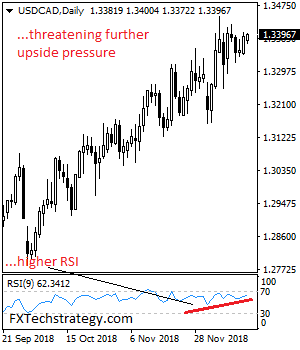
USDCAD looks to extend medium term upside pressure following its higher close the past week. Support comes in at the 1.3350 level where a break will aim at the 1.3300 level. Further down, support comes in at the 1.3250 level where a turn lower may occur. But if further weakness is triggered support comes in at the 1.3200 level. Conversely, resistance lies at the 1.3450 level where a violation will target the 1.3500 level. Further up, resistance resides at the 1.3600 level and then the 1.3650 level. All in all, USDCAD looks to strengthen further medium term.
Sunset Market Commentary
Markets
Global core bonds traded mixed today as risk sentiment soured again in a day characterized by low trading volumes. Asian markets closed mixed and all European equity indices are trading in red. German Bunds and US Treasuries edged little higher but the Bunds paired those gains throughout the day and are currently trading with losses. The Empire Manufacturing confidence for December dropped to 10.9, from 23.3 in November, the lowest since April 2017. US equity markets opened lower as well. The NAHB Housing Market Index could prove interesting as well, as a further decline would confirm the weakening of the US housing markets. President Trump once again shed his light on the Fed’s monetary policy. He finds it “incredible” that the Fed is even considering a new rate hike. Nonetheless, a new hike at the December meeting is widely expected. Focus will be on the new growth-, inflation and policy rate projections and Chairman Powell’s speech afterwards. Up until then, we expect low volume trading. The German yield curve edged higher with changes ranging from +0.6 bps (2-yr) to +1.5 bps (5-yr). The US yield curve moved south, with changes varying between -1.3 bps (30-yr) to -1.9 bps (5-yr).
The dollar initially traded little changed from Friday but gradually reversed part of last week’s ‘gain’ today. Trading was mainly order-driven. EUR/USD hovered in the low 1.13 in Asia and early in Europe. European equities opened with modest losses. Given the big losses in the US on Friday, the open of European equity markets wasn’t too bad. This relative calm maybe slightly eased USD demand but technical considerations probably prevailed. Late in the morning session, EMU headline inflation was unexpectedly downwardly revised to 1.9%. Sentiment on risk also deteriorated again. Still, EUR/USD maintained its cautious upward intraday bias. Dollar softness continued in US trading as the Empire manufacturing survey printed softer than expected. US-German interest rate differentials narrowed against the dollar. EUR/USD is trading in the mid 1.13 area. USD/JPY is also drifting south with intraday selling accelerating after the Empire manufacturing survey. The pair is currently changing hands in the 113 area.
Sterling showed no clear trend today, losing a few ticks against the euro but holding near last week’s close against an overall weakish dollar. The political stalemate on Brexit simply persists. PM May continues to reject all calls for parliament to give its view on alternative options for Brexit, including a second referendum. EUR/GBP is again nearing the 0.90 big figure. Cable (1.1615 area) is holding well off last week’s multi-month low.
News Headlines
The German Bundesbank warned for the country’s dominant car industry to take longer than initially thought to recover from Q3’s slump. The bank said domestic consumers in particular are holding back on car purchases. Export orders remain strong and other sectors do perform well, pointing to a “noticeable” expansion of the German economy in Q4.
The IMF said it could cut further global growth forecasts after it slashed 0.2% points back in October. The US-Sino trade frictions are affecting the global economy, particularly Asian economies, through the confidence channel, the director of the institution’s Asia and Pacific Department said, citing much weaker than expected investments.
Days before the central bank’s key policy meeting, US president Trump lashed out at the Fed again, saying it is “incredible” to “even consider” another rate hike. While Trump calls for flexibility of lower rates to support the US in its trade crusade, the Fed is widely expected to increase rates Wednesday for a fourth time this year.
EUR/USD Mid-Day Outlook
Daily Pivots: (S1) 1.1258; (P) 1.1316; (R1) 1.1362; More.....
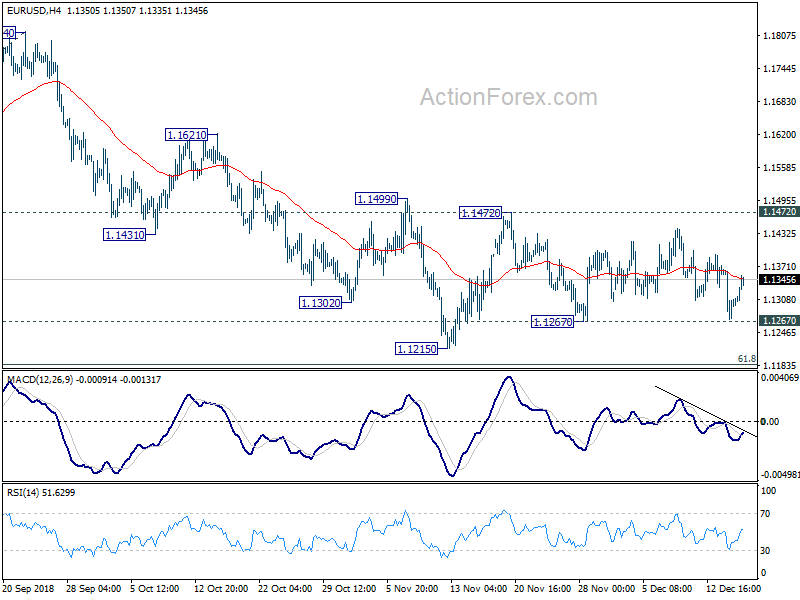
Intraday bias in EUR/USD remains neutral and outlook stays bearish with 1.1472 resistance intact. On the downside, break of 1.1267 will suggest that larger decline is resuming and target 1.1251 low next. Decisive break there will confirm this bearish case. EUR/USD should drop through 1.1186 fibonacci level to 61.8% projection of 1.2555 to 1.1300 from 1.1814 at 1.1038 next.
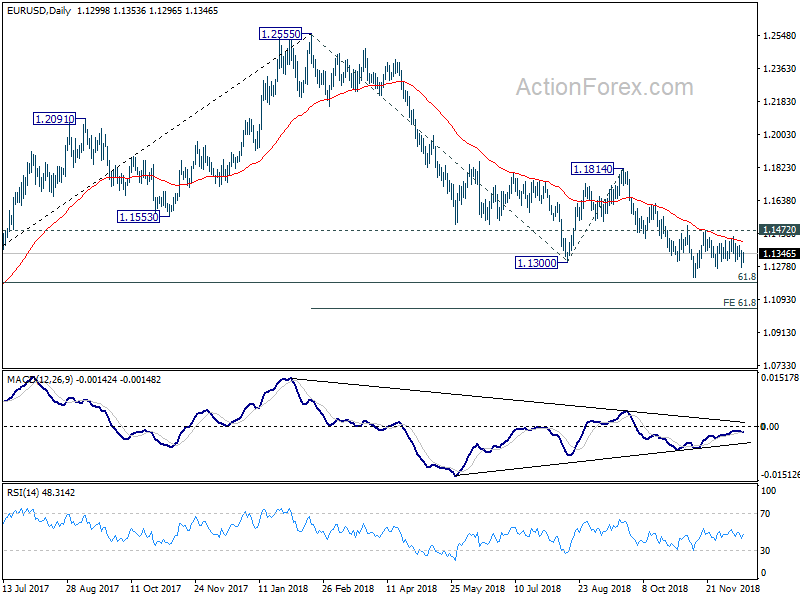
In the bigger picture, as long as 1.1814 resistance holds, down trend down trend from 1.2555 medium term top is still in progress and should target 61.8% retracement of 1.0339 (2017 low) to 1.2555 at 1.1186 next. Sustained break there will pave the way to retest 1.0339. However, break of 1.1814 will confirm completion of such down trend and turn medium term outlook bullish.
GBP/USD Mid-Day Outlook
Daily Pivots: (S1) 1.2519; (P) 1.2597; (R1) 1.2665; More...
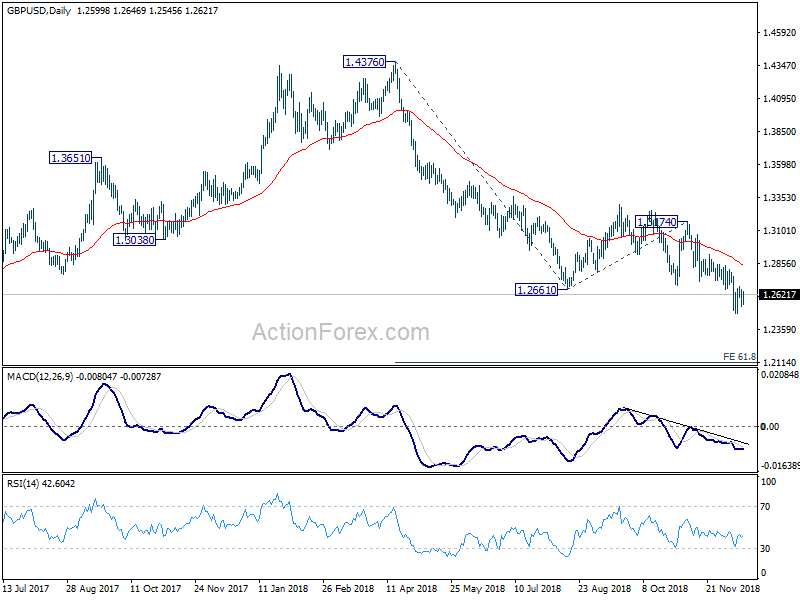
GBP/USD is staying in consolidation from 1.2476 and intraday bias remains neutral. Stronger recovery cannot be ruled out, but upside should be limited by 1.2811 resistance to bring fall resumption. On the downside, break of 1.2476 will extend larger down trend from 1.4376 to 61.8% projection of 1.4376 to 1.2661 from 1.3174 at 1.2114. However, firm break of 1.2811 will be an early signal of trend reversal and turn focus back to 1.3174 resistance.
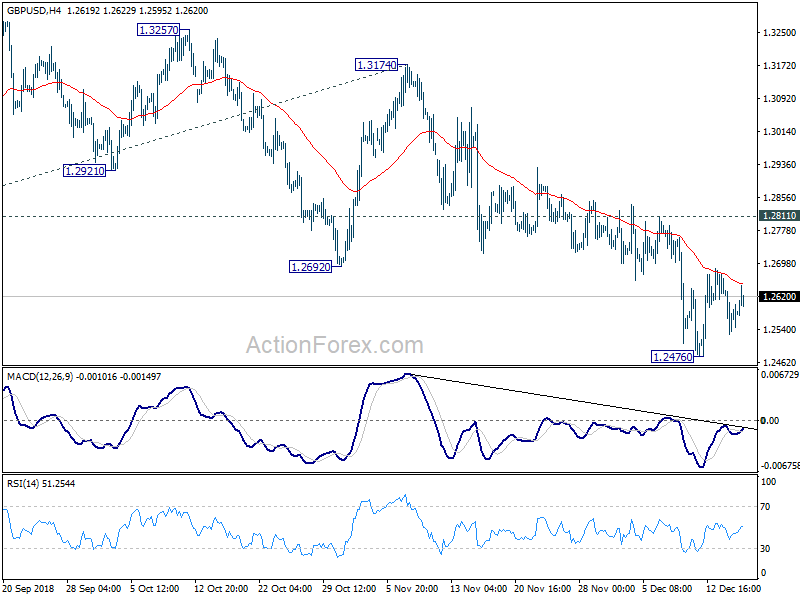
In the bigger picture, whole medium term rebound from 1.1946 (2016 low) should have completed at 1.4376 already, after rejection from 55 month EMA. The structure and momentum of the fall from 1.4376 argues that it's resuming long term down trend from 2.1161 (2007 high). And this will now remain the preferred case as long as 1.3174 structural resistance holds. GBP/USD should now target a test on 1.1946 first. Decisive break there will confirm our bearish view.