Sample Category Title
USD/JPY Mid-Day Outlook
Daily Pivots: (S1) 113.17; (P) 113.42; (R1) 113.64; More..
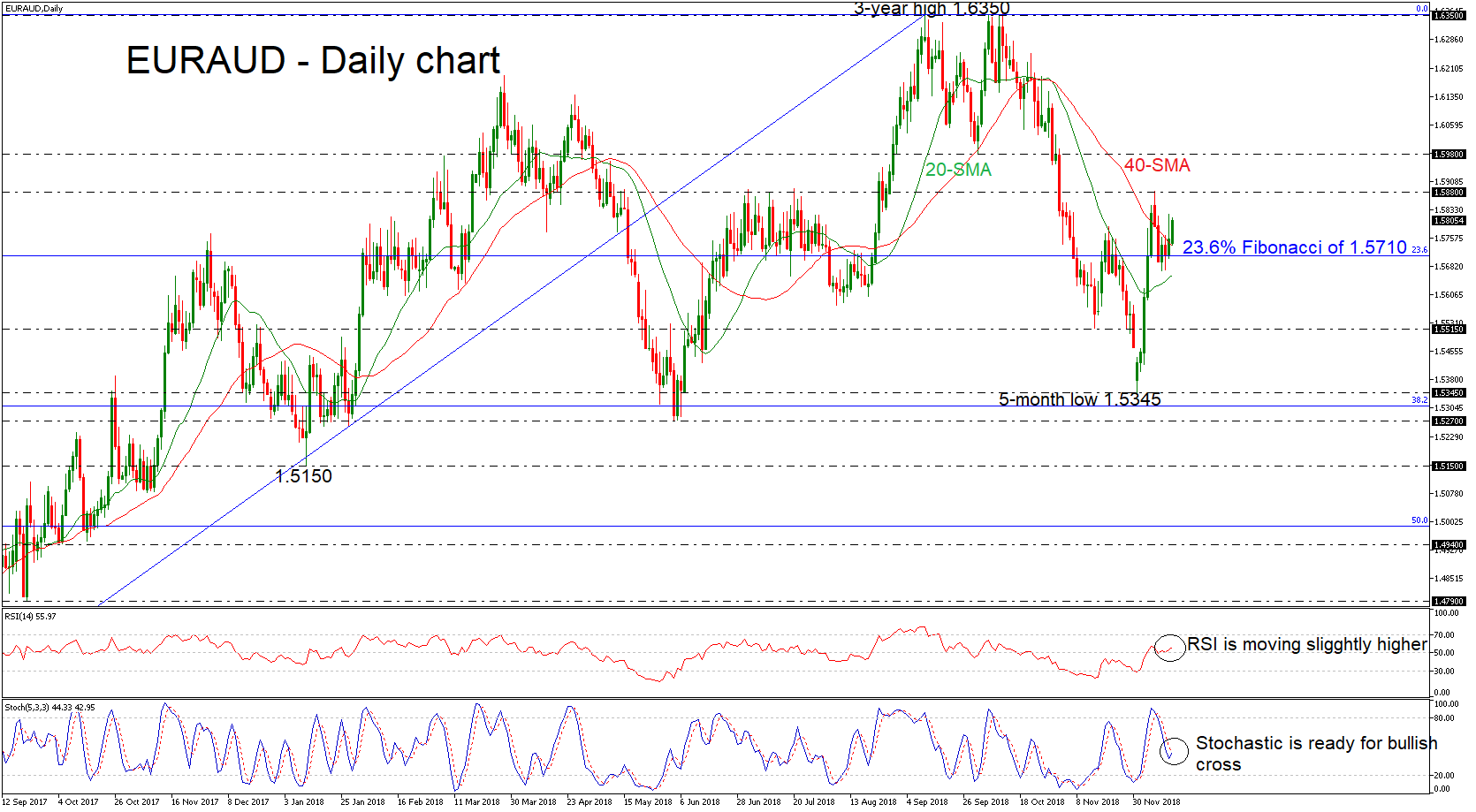
USD/JPY drops notably today but it's staying in range of 112.23/113.70. Intraday bias remains neutral for the moment. On the upside, above 113.70 will target 114.20 resistance first. Break there will resume the rise from 111.37 and target 114.73 key resistance next. However, break of 112.23 support will extend the corrective pattern from 114.54 with another decline. Overall, price actions 114.54 are seen as a consolidative pattern. In case of deeper fall, downside should be contained by 38.2% retracement of 104.62 to 114.54 at 110.75 to bring rebound. Larger rise from 104.62 is expected to resume later.
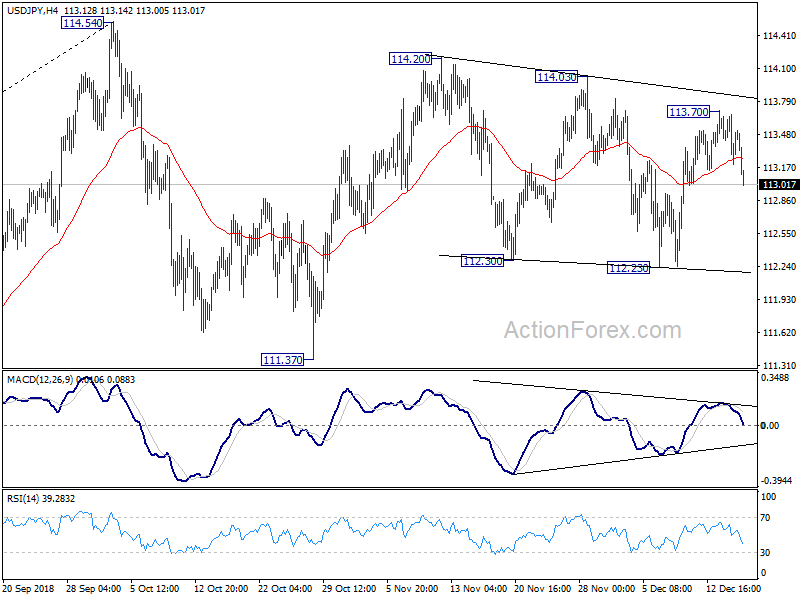
In the bigger picture, corrective fall from 118.65 (2016 high) should have completed with three waves down to 104.62. Decisive break of 114.73 resistance will likely resume whole rally from 98.97 (2016 low) to 100% projection of 98.97 to 118.65 from 104.62 at 124.30, which is reasonably close to 125.85 (2015 high). This will stay as the preferred case as long as 109.76 support holds. However, decisive break of 109.76 will dampen this bullish view and turns outlook mixed again.
EURAUD Regains Ground above SMAs in Near Term
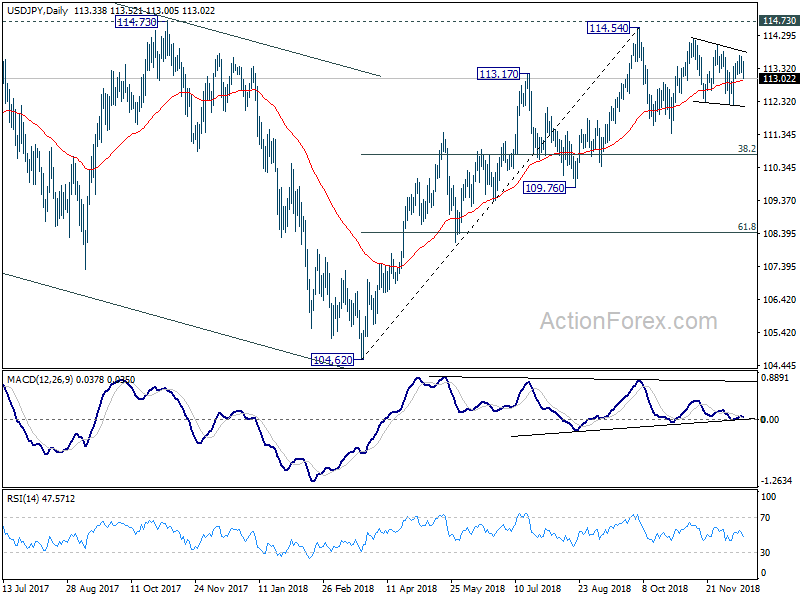
EURAUD is gaining ground on Monday, remaining above the 1.5710 level, the 23.6% Fibonacci retracement level of the upleg from 1.3620 to 1.6350. The advance in the price action is confirmed by the technical indicators. The RSI is heading upwards above the 50 level, while the stochastic oscillator is ready to create a bullish crossover between the %K and %D lines. Also, the 20- and 40-simple moving averages on the daily chart, are in process of posting a positive cross in the next few sessions, if the price continues the upward movement.
The pair surpassed the 40-day SMA and is extending its gains towards the next immediate resistance obstacle of 1.5880, identified by the latest highs in the preceding week. Moving higher, the bulls might find resistance around 1.5980, taken from the inside swing low on October 2.
If the price drops lower, it could retest the 23.6% Fibonacci of 1.5710 before dropping lower towards the 20-day SMA of 1.5658 at the time of writing. Should the pair breach the latter, bearish action may pick up speed towards the 1.5515 support level, while further declines may bring the previous trough of 1.5345 into view.
Concluding and looking at the long-term timeframe, EURAUD is slightly positive creating higher highs and higher lows during this year. However, in the short-term the pair seems to be in a bearish correction mode.
USD/CHF Mid-Day Outlook
Daily Pivots: (S1) 0.9942; (P) 0.9967; (R1) 1.0005; More...
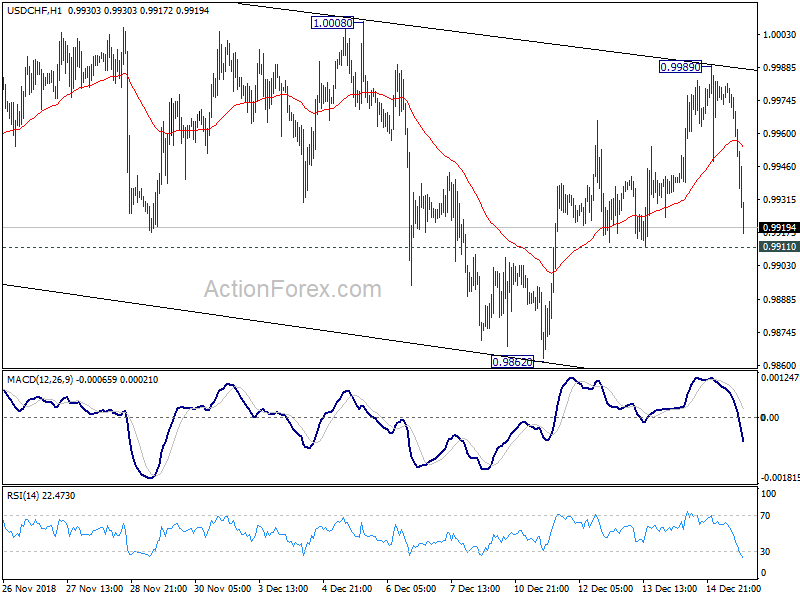
USD/CHF's pull back from 0.9989 accelerates lower today. Focus is back on 0.9911 minor support. Break there will confirm completion of the rebound from 0.9862. Deeper decline would be seen back to 0.9862. For now, price actions from 1.0128 are viewed as a corrective move. We'd expect strong support from 0.9848 support to bring reversal. On the upside, above 0.9989 will turn bias back to the upside. Break of 1.0008 will target a test on 1.0128 high.
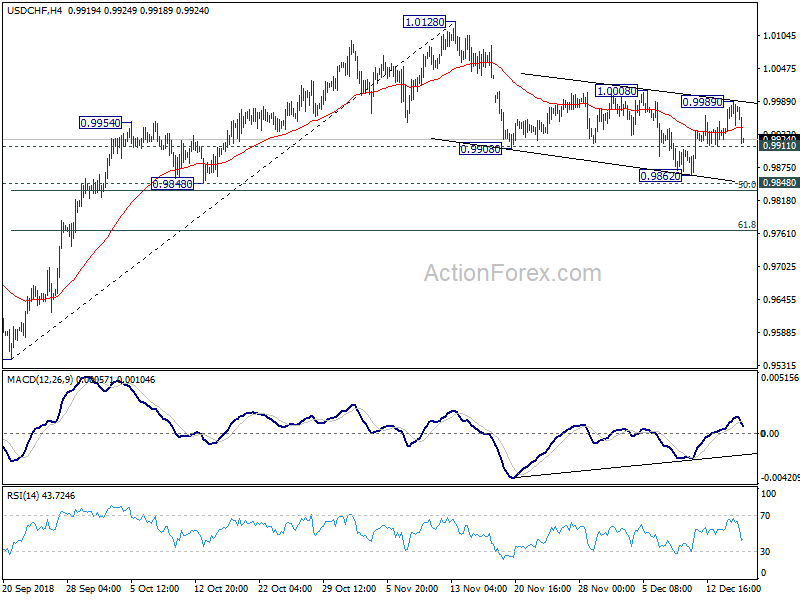
In the bigger picture, current development suggests that the medium term rally from 0.9186 hasn't completed yet. Break of 1.0128 will target 1.0342 key resistance next (2016 high). On the downside, break of 0.9848 support will dampen this bullish view and turn focus back to 0.9541 key support instead.
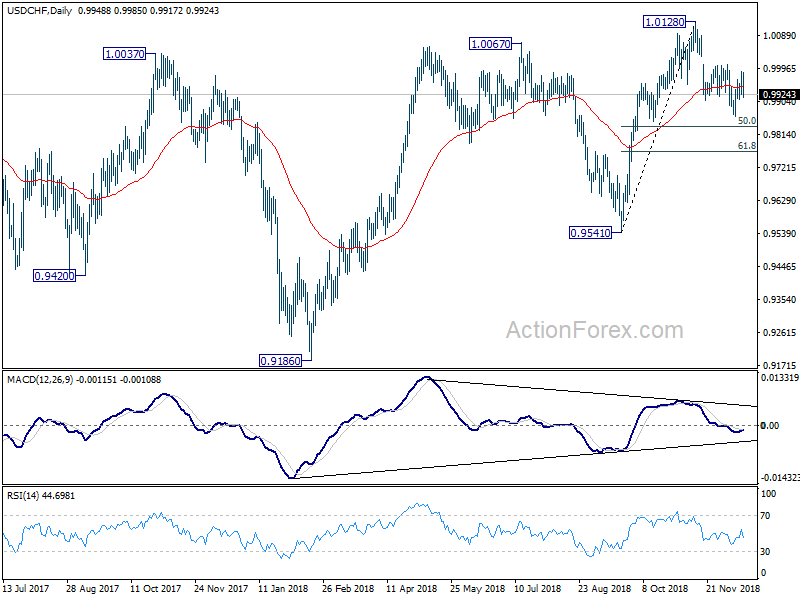
Swiss Franc Leads Europeans Higher, Dollar Softer after Poor Data
European majors are trading generally higher today, as led by Swiss Franc. Euro is also strong but to a lesser extend while Sterling just follows. On the other hand, Dollar is under some selling pressure, in particular after much weaker than expected manufacturing. It's yet another piece of data that points to slow down in the US. But for now, loss in the greenback is still limited, as traders are cautious ahead of FOMC rate decision, statement, and economic projections to be released on Wednesday.
Technically, though, today's sharp fall in USD/CHF suggests that rebound from 0.9862 has possibly completed at 0.9989. 0.9911 minor support is now in focus and break will probably extend the correction from 1.0128 with another taken on 0.9484 key support. Meanwhile, USD/JPY's pull back from 113.70 is also extending lower and on acceleration it would head back to 112.23 support.
In other markets, major European indices are all trading in red at the time of writing. FTSE is down -0.69%, DAX is down -0.94% and CAC is down -0.85%. German 10 year bund yield is up 0.010 at 0.258. Italian 10 year yield is up 0.014 at 2.958. German-Italian spread is now down to 269. Earlier today, Nikkei closed up 0.62%, Singapore Strait Times rose 1.21%. But Hong Kong HSI dropped -0.03% while China Shanghai SSE rose 0.16% only. Japan 10 year JGB yield rose 0.0006 to 0.035.
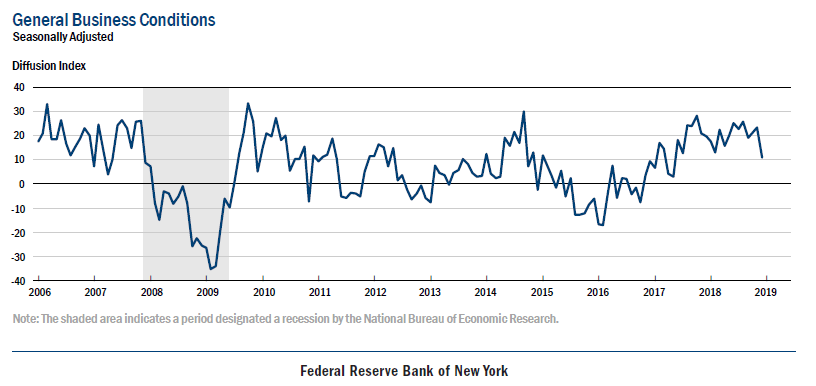
Released in US, Empire State manufacturing index dropped sharply to 10.9 in December, down from 23.3 and missed expectation of 20.1. That's also the lowest level since May 2017. Another point to note is that 6-month forward looking indicator also dropped to 30.6, down fro 33.6. Growth was "noticeably slower than in recent months" with deteriorating optimism.
Eurozone CPI finalized at 1.9%, core at 1.0% in November
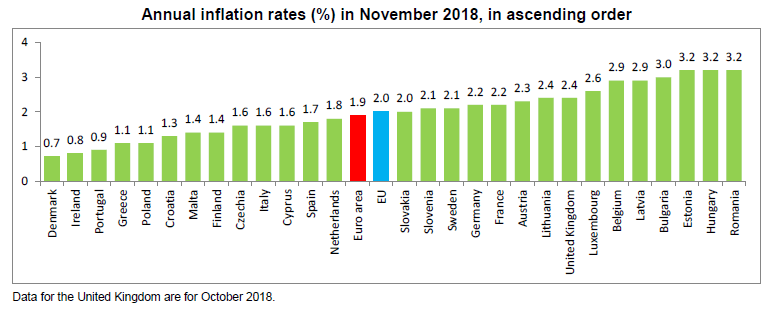
Eurozone CPI was finalized at 1.9% yoy in November, down from 2.2% yoy in October. Nevertheless, it's still notable improvement from 1.5% yoy in November 2017. Forex CPI was finalized at 1.0% yoy. European Union inflation was finalized at 2.0% yoy, down from 2.2% yoy. That compared to 1.8% yoy back in November 2017. Among EU member states, inflation was highest in Romania, Hungary and Estonia at 3.2%. Lowest inflation was recorded in Denmark at 0.7%.
Germany Bundesbank: Noticeable expansion in Q4 despite slow normalization in auto industry
In the latest monthly report, Germany's Bundesbank warned that it may take more time for the auto industry to recovery from its recent "temporary" slump. It noted that "Normalization in the automotive industry may be slower than initially thought," And, "the weak order intake from Germany and the slowdown in registration numbers could be an indication that domestic consumers are currently holding back on purchases". Nevertheless, export orders remained strong and other segments of the economy performed well. In Q4, Bundesbank still expected "noticeable expansion.
Italy coalition government agreed on numbers and contents of 2019 revised budget
In Italy, leaders of the coalition government sounded optimistic that they would eventually avoid disciplinary actions by the EU over its 2019 budget. Leader of the League Matteo Salvini said, after meeting with 5-Star Movement head Luigi Di Maio and Prime Minister Giuseppe Conte, "We have found an agreement on further fiscal reductions that probably will be appreciated by the EU."
Salvini's spokeswoman also said that there is "total agreement between Conte, Salvini and Di Maio on the numbers and contents of the proposal to send to Brussels," regarding 2019 budget plan. And she denied there were tensions within the coalition government and rumors that Prime Minister Giuseppe Conte had threatened to quit. Separately, Di Maio also said the talks with the commission "will allow us to avoid an infraction procedure".
European Commission spokesman said today that "the dialogue continues between the European Commission and Italy concerning its budgetary plan for 2019". And, "the Commission will decide on the next steps on the basis of the outcome of this ongoing dialogue."
US ambassador to WTO: China is incompatible with the open, market-based approach
At the WTO Trade Policy Review of the US, the country's ambassador Dennis Shea complained that China's " state-led, mercantilist approach to the economy and trade" and actions are "incompatible with the open, market-based approach" of the WTO and its members. At the same time, "he further criticized that "the WTO is not well equipped to handle the fundamental challenge posed by China".
He elaborated and said "China pursues an array of non-market industrial policies and other unfair competitive practices aimed at promoting and supporting its domestic industries while simultaneously restricting, taking advantage of, discriminating against, or otherwise creating disadvantages for foreign companies and their goods and services."
And, "from forced technology transfer to the creation and maintenance of severe excess industrial capacity to a heavily skewed playing field in China, the results of China's approach are causing serious harm to the United States and many other WTO Members and their companies and workers."
On the other hand, he hailed that the US "maintains one of the world's most open trade regimes that is firmly based in the rule of law and that is a powerful engine for global growth". The US continues to "seek trade liberalization and will deepen our relationships with countries who share our commitment to fair market competition and reciprocity."
IMF: Global growth a little slower than October forecast due to trade war
IMF Director of Asia and Pacific department Changyong Rhee indicated that US-China trade war is already having an impact on business confidence and investment in Asia. And there could be global growth forecasts downgrades in the next update in January. In particular, he said Japan and South Korea could be among the those hardest hit due to reliance on exports to China.
He noted that "Investment is much weaker than expected. My interpretation is that the confidence channel is already affecting the global economy, particularly Asian economies". And, "we see global growth a little bit slower than we forecast in October." He also added that "Uncertainty is so large … uncertainty means you have upside potential as well as downside risk. At this moment, we believe the downside risk is a little bit higher."
Regarding China, Rhee said "They aren't accelerating (stimulus) yet but taking the foot from the brake for the time being. But that doesn't exclude the possibility that if the trade tension escalates, if growth goes down, they are ready to use stimulus." But at the same time, IMF is concerned with China's medium term goals including deleveraging And Rhee urged that "when they actually try to use stimulus, we hope they can use more fiscal policy rather than credit expansion."
IMF: BoJ should maintain stimulus as side-effects won't outweigh benefits
IMF mission chief for Japan Paul Cashin said BoJ should maintain its massive stimulus program as "the so-called side-effects are not large enough to outweigh the benefits at present:. He added "the only game in town is achieving the target" of 2% inflation. He warned that "Tightening now is not going to help you get there. They're very much committed to reaching the target, and we think that's the right thing to do."
On to the planned sale tax hike, he said "we're not against putting them in and some of the revenue can be used for (tax breaks) but only on a temporary, time-bound basis." He emphasized "equally important is clear communication on what these measures are, when they will begin and what particular tax and subsidies will be involved … because people plan ahead and won't wait until October to make consumption decisions."
USD/CHF Mid-Day Outlook
Daily Pivots: (S1) 0.9942; (P) 0.9967; (R1) 1.0005; More...
USD/CHF's pull back from 0.9989 accelerates lower today. Focus is back on 0.9911 minor support. Break there will confirm completion of the rebound from 0.9862. Deeper decline would be seen back to 0.9862. For now, price actions from 1.0128 are viewed as a corrective move. We'd expect strong support from 0.9848 support to bring reversal. On the upside, above 0.9989 will turn bias back to the upside. Break of 1.0008 will target a test on 1.0128 high.
In the bigger picture, current development suggests that the medium term rally from 0.9186 hasn't completed yet. Break of 1.0128 will target 1.0342 key resistance next (2016 high). On the downside, break of 0.9848 support will dampen this bullish view and turn focus back to 0.9541 key support instead.
Economic Indicators Update
| GMT | Ccy | Events | Actual | Forecast | Previous | Revised |
|---|---|---|---|---|---|---|
| 00:01 | GBP | Rightmove House Prices M/M Dec | -1.50% | -1.70% | ||
| 10:00 | EUR | Eurozone Trade Balance (EUR) Oct | 12.5B | 14.2B | 13.4B | |
| 10:00 | EUR | Eurozone CPI M/M Nov | -0.20% | 0.20% | 0.20% | |
| 10:00 | EUR | Eurozone CPI Y/Y Nov F | 1.90% | 2.00% | 2.00% | |
| 10:00 | EUR | Eurozone CPI Core Y/Y Nov F | 1.00% | 1.00% | 1.00% | |
| 13:30 | CAD | International Securities Transactions (CAD) Oct | 3.98B | 6.20B | 7.70B | |
| 13:30 | USD | Empire State Manufacturing Dec | 10.9 | 20.1 | 23.3 | |
| 15:00 | USD | NAHB Housing Market Index Dec | 61 | 60 | ||
| 21:00 | USD | Net Long-term TIC Flows Oct | 30.8B |
US Empire State manufacturing dropped to 10.9, lowest since May 2017
US Empire State manufacturing index dropped sharply to 10.9 in December, down from 23.3 and missed expectation of 20.1. That's also the lowest level since May 2017. Another point to note is that 6-month forward looking indicator also dropped to 30.6, down fro 33.6. Growth was "noticeably slower than in recent months" with deteriorating optimism.
Dollar drops notably against Swiss Franc and Yen after the release. The sharp decline in USD/CHF today argues that rebound from 0.9862 might be completed at 0.9989 already. As break of 0.9911 will bring retest of 0.9862 low.
EURUSD Remains Cautious
The major currency pair is rather unenthusiastic early in the week. The market managed to recover after the weak statistics published last week: investors’ interest in the USD as a “safe haven” asset went down, but they are still very cautious.
Macroeconomic reports from different European countries made the market move against the Euro.
First of all, the Manufacturing PMI in France decreased up to 49.7 points in December after being 50.8 points the month before. The French Services PMI went from 55.1 points in November to 49.6 points this month. The fact that the indicator broke the psychologically-crucial level of 50 points disturbed market players a lot.
The numbers from Germany didn’t make anybody happy as well. The Manufacturing PMI dropped to 51.5 points, the Services PMI – to 52.5 points.
Macroeconomic reports published by the USA last Friday showed that the Retail Sales added only 0.2% m/m in November after expanding by 1.1% m/m the month before. However, investors barely responded to this reading. Another report, the Capacity Utilization Rate, was 78.5% after being 78.1% in the previous month. And then was another reading, which completely switched attention to the USD: the Industrial Production in the USA increased by 0.6% m/m in November after losing 0.2% m/m in October and against the expected reading of +0.1% m/m.
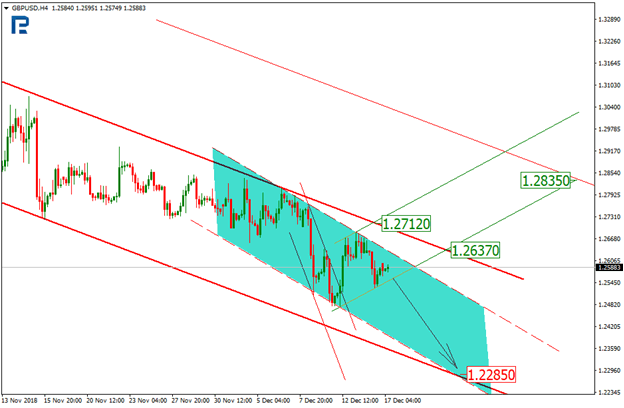
The H4 chart shows that EURUSD has broken the support line of the previous correctional channel and right now is returning to the line to test it from below. The target of this pullback is at 1.1334. If the price breaks this level, it may return into the previous channel and grow towards the resistance line at 1.1412. However, according to the main scenario, the instrument is expected to continue trading downwards steadily. The downside targets are at 1.1230 and 1.1215.
Another Week in the Red for Canadian Dollar
USD/CAD is unchanged in the Monday session. Currently, USD/CAD is trading at 1.3384, down 0.01% on the day. On the release front, there are no major events on the schedule. Canadian Foreign Securities Purchases is expected to dip to C$6.20 billion. In the U.S., the Empire State Manufacturing Index is expected to drop to 20.1 points. On Tuesday, Canada releases manufacturings sales and the U.S publishes building permits and housing starts.
The Canadian dollar continues to struggle. The currency has declined for four straight weeks, dropping 1.8% in that time. Weaker oil prices and a slowdown in the U.S. are weighing on the Canadian economy and the export sector is being hampered by the ongoing U.S-China trade war. The Bank of Canada is expected to respond by scaling back rate hikes. The bank has raised rates three times this year, but stayed on the sidelines at the December meeting. With the Federal Reserve expected to raise rates just once or twice in 2019, there will be less pressure on the BoC to raise rates.
DAX Dips as Eurozone Falls Below 2 Percent
The DAX index has started the week with losses. Currently, the index is at 10,814, down 0.36% on the day. In economic news, eurozone CPI dropped to 1.9%, just shy of the estimate of 2.0%. The eurozone trade surplus narrowed for a second straight month, falling to EUR 12.5 billion. This was short of the estimate of EUR 14.2 billion. On Tuesday, Germany releases Ifo Business Climate.
With the eurozone experiencing a slowdown in the second half of the year, inflation levels are also lower. Final CPI dropped to 1.9%, falling below the 2% level for the first time since May. Final Core CPI declined to 1.0%, down from 1.1% a month earlier. Will the downward spiral continue? At the Thursday policy meeting, the ECB downgraded its growth forecasts for the eurozone – from 2.0% in September to 1.9% in December for 2018, and from 1.8% in September to 1.7% in December in 2019. Mario Draghi added that headline inflation is also expected to drop in the coming months, due to weaker economic conditions.
At the policy meeting, the ECB formally ended its 2.6 trillion euro bond-purchase scheme. The program was implemented in order to kick-start the economy and raise ultra-low inflation levels. At a press conference after the meeting, ECB President Mario Draghi said the stimulus scheme had not only boosted growth in the eurozone, but was “in some cases the only driver of this recovery”. With the bond-purchase program being laid to rest, interest rates will again become the ECB’s primary policy tool. With the eurozone experiencing a slowdown, no raise rate hike is expected until well into 2019.
Into US session: European comeback but upside limited
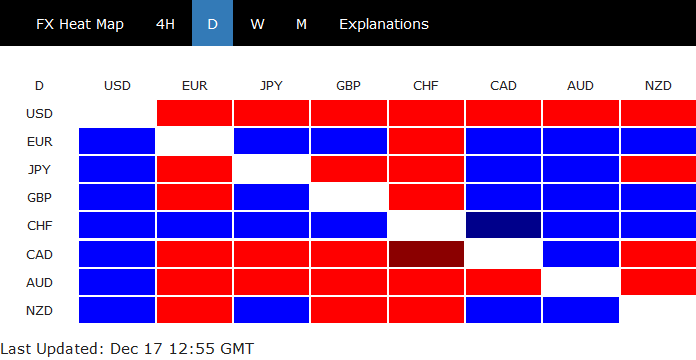
Entering into US session, Dollar is notably the weakest one for today, followed by Australian Dollar and then Canadian Dollar. On the other hand, Swiss Franc is trading as the strongest one, followed by Euro, and then Sterling. European majors are trying to have a come back. Still, note that most major pairs are bounded inside Friday's range. Today's rebound in European majors are seen as corrective for now.
In European markets, at the time of writing:
- FTSE is down -0.41%
- DAX is down -0.50%
- CAC is down -0.64%
- German 10 year bund yield is down -0.0013 at 0.257
- Italian 10 year yield is up 0.007 at 2.951
Earlier in Asia:
- Nikkei closed up 0.62% at 21506.88
- Singapore Strait Times closed up 1.21% at 3114.25
- Hong Kong HSI closed down -0.03% at 26087.87
- China Shanghai SSE rose 0.16% to 2597.97
- Japan 10 year JGB yield closed up 0.0006 at 0.035
Eurozone CPI finalized at 1.9%, core at 1.0% in November
Eurozone CPI was finalized at 1.9% yoy in November, down from 2.2% yoy in October. Nevertheless, it's still notable improvement from 1.5% yoy in November 2017. Forex CPI was finalized at 1.0% yoy.
European Union inflation was finalized at 2.0% yoy, down from 2.2% yoy. That compared to 1.8% yoy back in November 2017. Among EU member states, inflation was highest in Romania, Hungary and Estonia at 3.2%. Lowest inflation was recorded in Denmark at 0.7%.