Sample Category Title
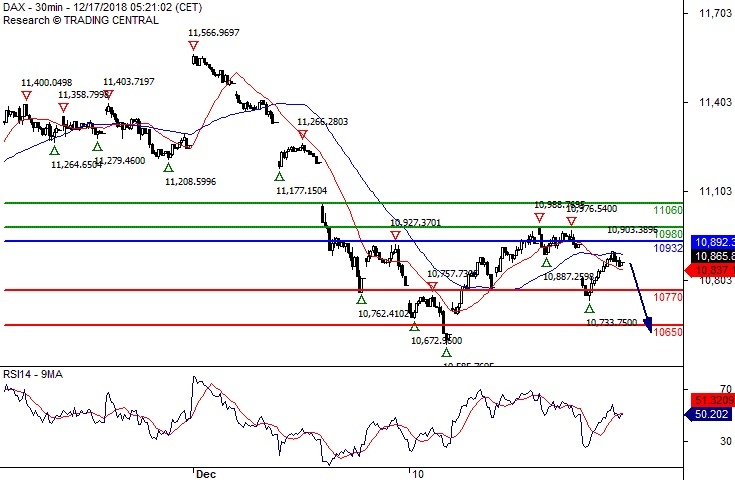
DAX Consolidation In Place
Pivot (invalidation): 10932.00
Our preference Short positions below 10932.00 with targets at 10770.00 & 10650.00 in extension.
Alternative scenario Above 10932.00 look for further upside with 10980.00 & 11060.00 as targets.
Comment As Long as 10932.00 is resistance, look for choppy price action with a bearish bias.
Crude Oil Under Pressure
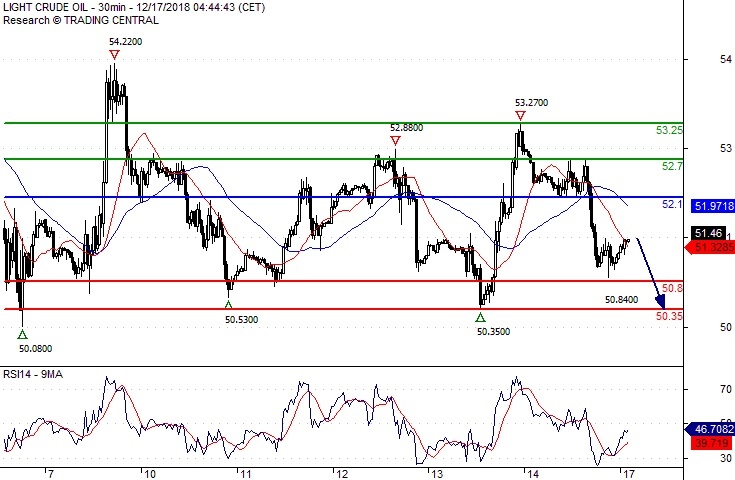
Pivot (invalidation): 52.10
Our preference Short positions below 52.10 with targets at 50.80 & 50.35 in extension.
Alternative scenario Above 52.10 look for further upside with 52.70 & 53.25 as targets.
Comment The RSI is mixed to bearish.
Silver Spot Key Resistance At 14.6300
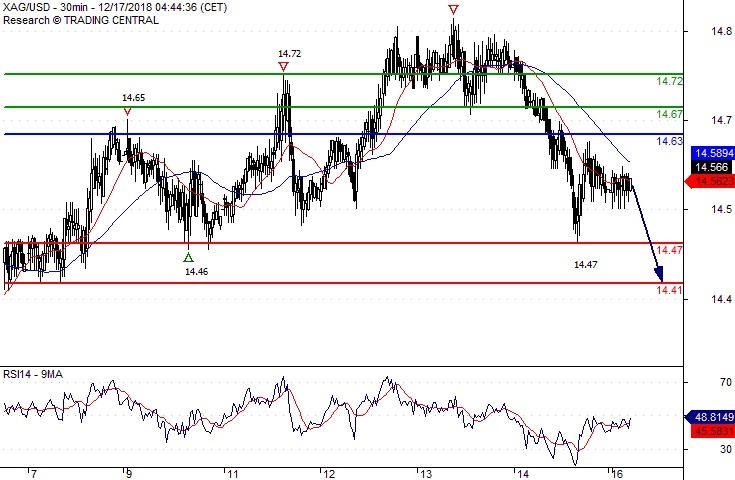
Pivot (invalidation): 14.6300
Our preference Short positions below 14.6300 with targets at 14.4700 & 14.4100 in extension.
Alternative scenario Above 14.6300 look for further upside with 14.6700 & 14.7200 as targets.
Comment The RSI is mixed to bearish.
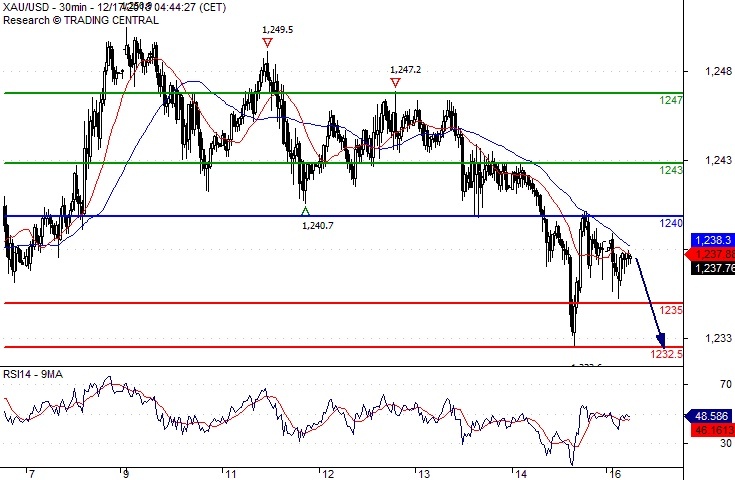
Gold Spot Under Pressure
Pivot (invalidation): 1240.00
Our preference Short positions below 1240.00 with targets at 1235.00 & 1232.50 in extension.
Alternative scenario Above 1240.00 look for further upside with 1243.00 & 1247.00 as targets.
Comment The RSI is mixed to bearish.
Fed: Something’s Gotta Give
- Fed's view contrasts strongly with market thinking
- Inverse yield curve points to end growth/monetary cycle
- 2019 median rate projection key for market reaction
- We expect Fed to remain more hawkish, sticking to 3 hikes next year
The final Fed meeting of the year is expected to deliver a fourth rate hike this year, from 2%‐2.25% to 2.25%‐2.50%. The current state of the US economy warrants this next step in the US central bank's normalization process. Fed chair Powell recently (Dec 6) said he was happy to report that the economy is currently performorming very well overall, with strong job creation and gradually rising wages. The US unemployment rate fell to 3.7%, the lowest level since 1969, and the Fed's preferred inflation gauge, the PCE deflator, fluctuates between 2% Y/Y and 2.3% Y/Y since March. This week's expected rate hike will lift the policy rate close to neutral levels. Fed governors guesstimates about this inherently uncertain concept ranged between 2.5% and 3.5% in the September projections.
Fed forecasts vs market expectations
Unlike the rate hike consensus for Wednesday, there's a lot more uncertainty on how Fed governors think 2019 will look like. The median of Fed governors' September rate forecasts suggested three more rate hikes. The balance of risks shifted throughout the year from stepping up the tightening cycle because of the risk of an overheating economy to slowing down the cycle because of the risk of killing the expansion. However, we don't expect dramatic downgrades in Fed governors' growth/inflation scenario since September and therefore think that the 2019 median rate forecast will remain unchanged (i.e. 3 hikes). Risks are clearly tilted to the dovish side and we think that the Fed will acknowledge augmented downside risks.
The Fed's view contrasts strongly with market pricing. Rate hike expectations peaked in the wake of Fed Chair Powell's October 3 Q&A session with PBS. He said that “interest rates are still accommodative, but we're gradually moving to a place where they'll be neutral – not that they'll be restraining the economy. We may go past neutral. But we're a long way from neutral at this point probably”. The market implied probability of sticking with quarterly rate hikes until June next year peaked above 40%. Currenly, it stands below 15%. Even the probability of a March 2019 rate hike fell below 50%.
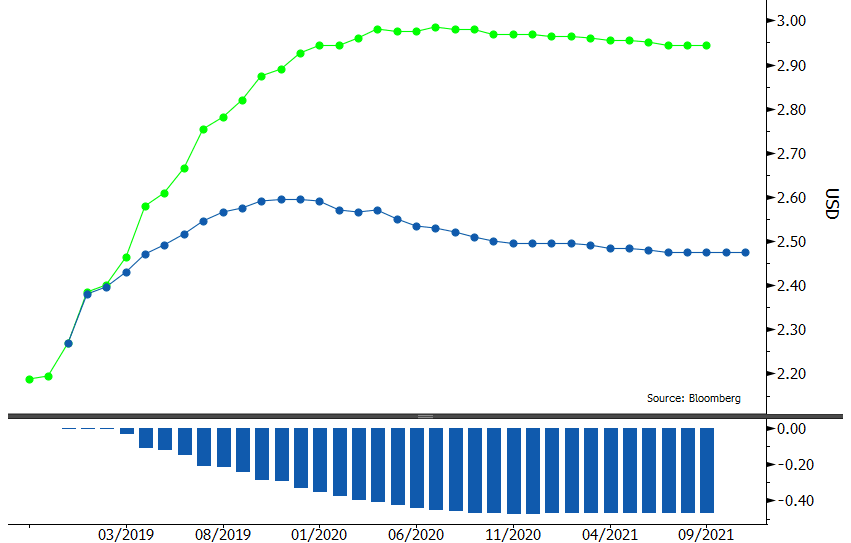
Fed Funds forward curve on Oct 5 (green) and Dec 14 (blue): significant dovish repositioning
This dovish repositioning occurred as Fed governors tried to correct Powell's slip of the tongue which hit riskier assets (stock markets, HY bonds) particularly hard. Additionally, markets fear that the US economy's tailwinds, which caused economic outperformance vs the rest of the word this year, might turn into headwinds next year. Global growth is slowing abroad, the sugar rush of US President Trump's fiscal stimulus is fading away and monetary policy will no longer be accodomative. The real Fed Funds rate turned positive in September for the first time this cycle and the Fed is draining excess liquidity by rolling off its balance sheet. This roll‐off hit maximum speed ($50bn/month) since the start of Q4 2017. There's no indication whatsoever that the Fed is willing to review this roll‐off policy.
The US yield curve inverted between 2y5y and 3y5y. The 2y10y yield spread, often regarded as precursor of a recession in case of inversion, fell to an 11 bps cycle low. The last “false” recession signal from an inverse US yield curve dates back to 1967. The recession then kicks in with an average time lag of about 18 months. It's important to bear in mind that an inverse yield curve doesn't mean an immediate stop to the Fed's tightening cycle. The Fed conducted 4 more 25 bps rate hikes after the yield curve inversion at the end of 2005 with US yields increasing more than 50 bps in a more or less parallel shift across the curve.
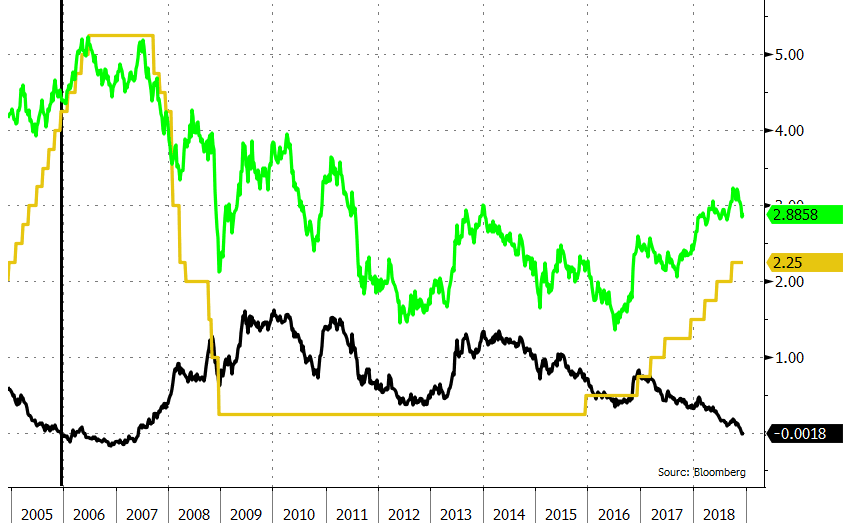
Fed Funds rate (yellow), US 2y5y yield spread (black) and US 10y yield (green)
This strong market signal shouldn't be ignored nor overinterpreted when forecasting next year's Fed policy path. We embrace the idea of a pause in the tightening cycle as policy rates enter neutral territory. Several Fed governors have different opinions, but they reach the same conclusion. Some worry about the eco outlook, some argue that the NAIRU is lower than expected, suggesting more room for growth without inflation spiraling out of control, other stress the symmetric inflation target allowing some overshoot after years of undershooting and a couple suggest that monetary policy changes impact the economy with a 12‐month time lag. All those arguments warrant a pause in the tightening cycle next year. That's why the Fed will probably drop its forward guidance calling for “more gradual rate hikes”. They'll replace it by a more data dependent guidance, leaving space to stop quarterly rate hikes if economic growth e.g. grinds to a halt. Given the current strength of the US economy and taking into account a new reaction function of the Fed, we expect 2019 rate hikes to be front‐ rather than backloaded (higher probability of deteriorating eco data). Bear in mind that every meeting is a live one next year with Chair Powell addressing the press on every occasion.
The rate projections for the 2020‐2021 period risk becoming a self‐destroying spiral for the Fed. We argued before that dropping the dots could be the final chapter in the Fed's revision of its communication strategy. The 2020 median (1 additional hike to 3%‐3.25%) will probably stay unchanged even if the average of projections could fall somewhat. The 2021 median rate projection (unchanged vs 2020) is at risk of declining from 3.25%‐3.5% to 3%‐3.25% and implying a rate cut. In such a scenario, the Fed aligns with the sign from the recent curve inversion and actually indicates that the end of the monetary cycle is nearby.
If the Fed surprises on the dovish side for 2019 (2 hikes instead of 3 hikes), we expect median projections for 2020 and 2021 to decline as well (both from 3.25%‐3.50% to 3%‐ 3.25%).
2019 forecast key for trading
The Fed will remain more hawkish than current market expectations. The 2019 projection is key for short term rates and the dollar. Sticking with three rate hikes will lift the front end of the US yield curve, further inversing the 2y5y part and supporting the dollar. EUR/USD 1.1187/1.1217 is key support. Sticking with this pace of policy normalization might hurt US stock markets though and cause risk aversion. The long end of the US yield curve won't be affected much by monetary policy thinking. The odd thing about the past two month's decline of the US 10‐ yr yield is that it was entirely driven by falling inflation expectations (linked to oil prices). The US 10‐yr real rate is only 8 bps below its cycle peak (1.15%). Tracking activity/inflationary data and risk sentiment might therefore be more important to determine near term moves at the long end of the US curve. If the 2019 dots indicate only 2 rate hikes next year, markets will move in the similar direction, but magnitudes will be smaller and moves might not last. This scenario will benefit risk sentiment in general as well. The two major corrections on US stock markets occurred this year on fears that the Fed might step up the tightening cycle (February & October).
Currencies: Dollar To Maintain Benefit Of The Doubt Ahead Of Fed Meeting
Rates: Equity sell-off eases, but sentiment remains fragile
Global core bonds gained ground on Friday as fear of a global slowdown overshadowed ongoing progress in US-Sino trade talks and strong US data. Today, core bonds opened neutral with a cautious downward bias as the equity sell-off eased in Asia. Only second tier data on the economic calendar today, with investors already eying the Fed meeting of Wednesday.
Currencies: Dollar to maintain benefit of the doubt going into the Fed meeting
The euro suffered from poor EMU PMI’s on Friday. At the same time, the dollar enjoyed strong US retail sales. EUR/USD dropped to the 1.13 area. This morning, the dollar stabilizes. We expect the US currency to remain well bid going into the Fed decision as there is still a big discrepancy between market positioning and (expected) Fed dots.
The Sunrise Headlines
- Wall Street nosedived Friday, registering losses to 2%+. Tech equities underperformed. Asian markets are trading mixed this morning with China underperforming.
- The Australian government presented the strongest budget outlook in a decade. The country expects a budget surplus in 2019/20 of 4.1b Australian dollar compared to 2.2b projected in May. Growth expectations (2018-19) have been lowered however, from 3% to 2.75%
- The Italian government has found an agreement on the “numbers and contents” of the revamped budget it will propose to Brussels, in an attempt to reach a final deal. The initial proposal had been rejected by the EC back in October.
- Demonstrations in Hungary grow as opposition parties, students and trade unions revolted by the thousands on Sunday against PM Viktor Orban’s increasingly authoritarian reign.
- In its Q4 review, the BIS warned for more selloffs as markets are adjusting to a world of monetary tightening against the backdrop of increasing fears for an escalating trade war and world economic growth. Rising inflation, lower-rated US corporate debt and EU banking sector weakness a.o. are listed as challenges.
- The White House’s musical chairs following the midterms continues as Secretary of Interior is set to leave the Trump administration by the end of the year. People familiar hinted Homeland Security’s Nielsen and Commerce Secretary Wilbur Ross could be next on the list.
- Today’s economic calendar contains the US Empire Manufacturing index. The NAHB Housing Market Index is worth eyeballing after last month’s steep decline. The EMU publishes final November inflation data.
Currencies: Dollar To Maintain Benefit Of The Doubt Ahead Of Fed Meeting
USD to keep benefit of the doubt ahead of the Fed
Data favoured euro bears and dollar bulls on Friday. A poor French PMI (49.3) kickstarted a EUR/USD selling-wave. The German and EMU PMI’s confirmed that the poor performance of France wasn’t a country-specific exception. An ongoing risk-off sentiment also didn’t help the single currency. EUR/USD slipped below the 1.13 level. In US trading, the news flow turned further USD positive with strong (core) US retail sales. US yields and the dollar rose modestly after the retail sales, but it wasn’t able to remove market uncertainty on global growth. The rise in US yields and the dollar did run into resistance. EUR/USD closed the day at 1.1306 (from 1.1361). USD/JPY gained a few ticks after the retail sales but any gains soon evaporated as equities were sold again. The pair closed at 113.39 (from 113.3). Asian equities are trading mixed overnight. Australia and Japan are outperforming. China is struggling to prevent further losses. The dollar is trading little changed from Friday evening (EUR/USD 1.1310 area; DXY 97.45 area; USD/JPY gains a few ticks 113.45 area). The eco calendar is only modestly interesting later today. EMU final November CPI is expected to be confirmed at 1.0% (core) and 2.0% headline. In the US, the Empire manufacturing survey and NAHB housing market sentiment are interesting. The manufacturing index is expected to ease from 23.3 to 20.0. NAHB is expected at 61 (from 60) after last month’s steep decline. We have no reason to take a different view from the consensus. Decent US eco data might still be slightly USD supportive going into Wednesday’s Fed policy decision. The Fed policy decision is the key topic for (USD) trading this week. Currently, there is still an immense gap between the (September) Fed dots and market pricing. We still see a good chance of the Dec Fed dots still signalling 3 additional rate hikes next year. Anyway, the risk is for the Fed to remain much more hawkish than the market. Investors will probably take a cautious stance going into the Fed meeting. However, we expect some by default USD bid to persist. If so, EUR/USD could drift further south with 1.1216 (correction low) and 1.1187 (62% retracement) as obvious supports. Sterling entered calmer waters end of last week. EUR/GBP hovered in the upper half of the 0.89 big figure as euro softness (poor EMU PMI’s) and sterling caution kept each other in balance. During the weekend, the PM rejected the idea of a second referendum and will probably continue to do so today. We still avoid sterling long
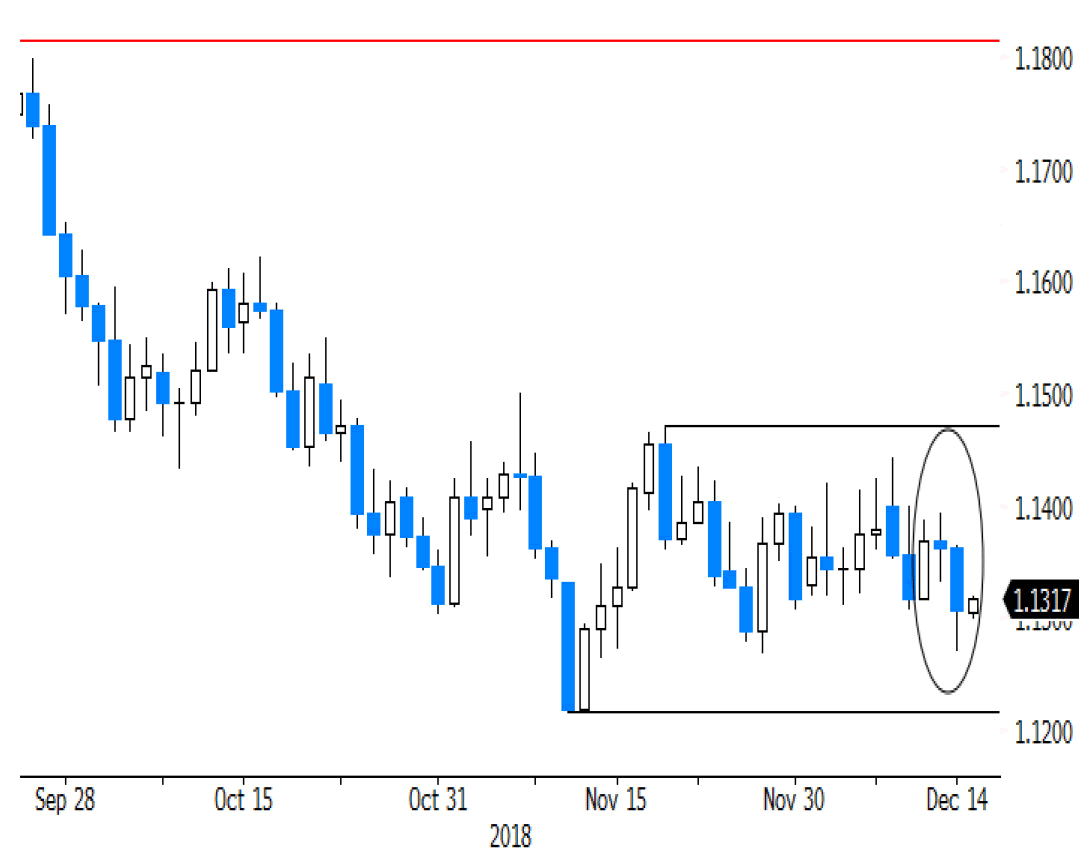
EUR/USD drifting lower in the established range going into the Fed meeting
IMF: Global growth a little slower than October forecast due to trade war
IMF Director of Asia and Pacific department Changyong Rhee indicated that US-China trade war is already having an impact on business confidence and investment in Asia. And there could be global growth forecasts downgrades in the next update in January. In particular, he said Japan and South Korea could be among the those hardest hit due to reliance on exports to China.
He noted that "Investment is much weaker than expected. My interpretation is that the confidence channel is already affecting the global economy, particularly Asian economies". And, "we see global growth a little bit slower than we forecast in October." He also added that "Uncertainty is so large ... uncertainty means you have upside potential as well as downside risk. At this moment, we believe the downside risk is a little bit higher."
Regarding China, Rhee said "They aren't accelerating (stimulus) yet but taking the foot from the brake for the time being. But that doesn't exclude the possibility that if the trade tension escalates, if growth goes down, they are ready to use stimulus." But at the same time, IMF is concerned with China's medium term goals including deleveraging And Rhee urged that "when they actually try to use stimulus, we hope they can use more fiscal policy rather than credit expansion."
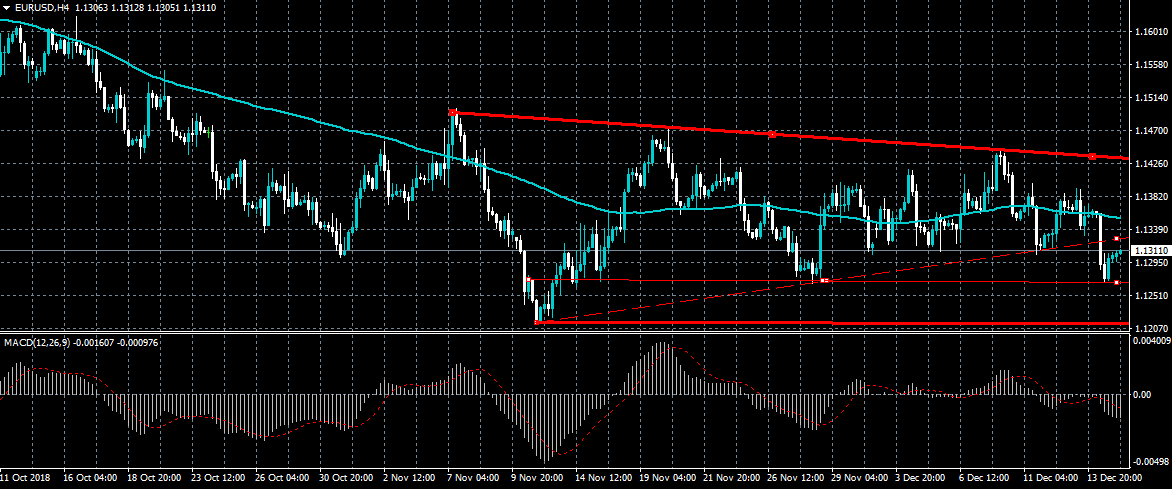
EURUSD Watching 1.1328 Resistance Level
The euro currency has recovered above the 1.1300 level against the US dollar after finding buying interest from the 1.1269 support level. Price is now moving towards key trendline resistance from the well-defined triangle pattern, found at the 1.1328 level. If sellers fail to defend this key technical area, buyers can easily force the EURUSD pair much higher towards the 1.1360 level.
The EURUSD pair is only bullish while trading above the 1.1328 level, key technical resistance is found at the 1.1360 and 1.1400 levels.
If the EURUSD pair trades below the 1.1300 level, sellers may test towards the 1.1269 and 1.1216 support levels.
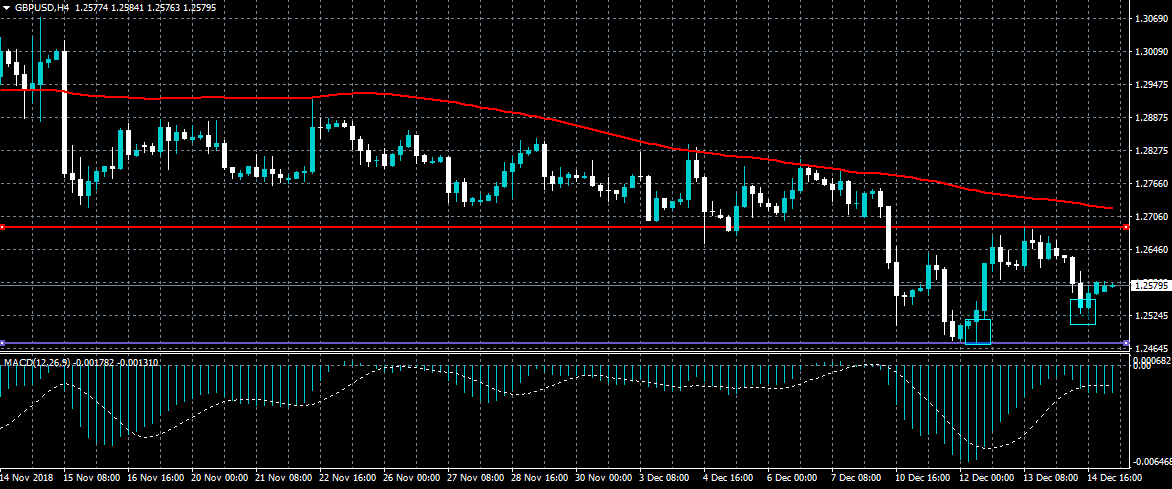
GBPUSD Attempting To Recover
The British pound is attempting to move back above the 1.2600 level against the US dollar after finding strong dip-buying demand from the 1.2528 support level. The recent recovery has created a bullish higher low, as sellers failed to breach the current yearly trading low. If price moves strongly above the 1.2600 level, the formation of a bullish inverted head and shoulders pattern may start to take shape.
If the GBPUSD pair continues to trade below the 1.2600 level, sellers will likely press towards the 1.2550 and 1.2528 support levels.
If the GBPUSD pair trades above the 1.2600 level, key resistance is found at the 1.2657 and 1.2700 levels.
LTCUSD Strong Open To The New Trading Week
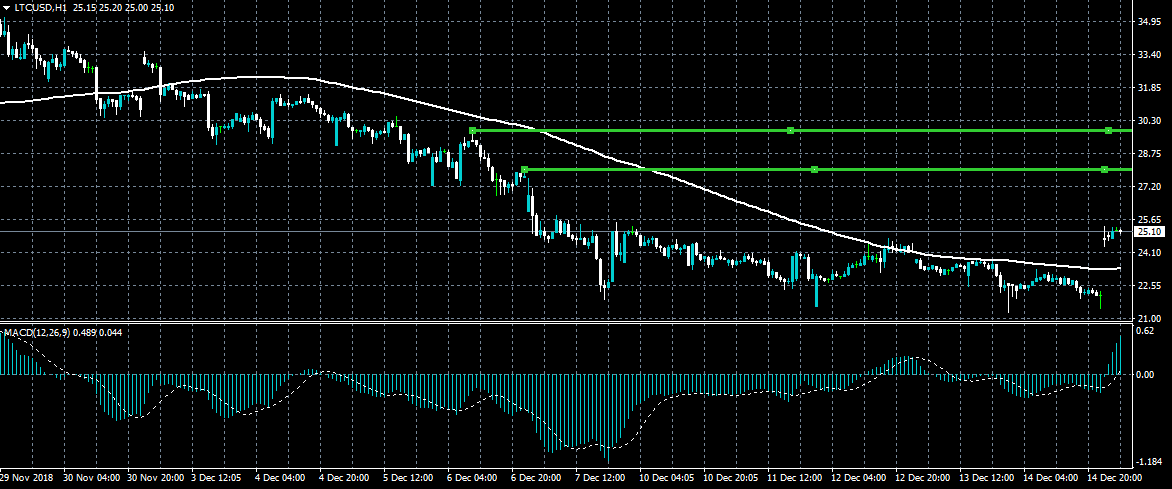
Litecoin has opened the new trading week strongly, with the LTCUSD pair gaining over five per cent intraday and regaining its place as the seventh largest cryptocurrency by market capitalization. The LTCUSD pair is trading around the $25.00 level and has moved above its 100-hour moving average for the first time this month. If bullish momentum continues, the move higher could easily extend towards the $28.00 and $30.00 resistance levels.
The LTCUSD pair is bullish while trading above the $25.00 level, key resistance is found at the $28.00 and the $30.00 levels.
If the LTCUSD pair moves below the $25.00, sellers may test the $24.50 and $23.00 support levels.