Sample Category Title
USD Weakens Ahead Of Fed Meeting And Governmnet Shutdown
The USD weakened slightly in early trading hours as traders focused on the upcoming Fed meeting which will be important for several reasons. Firstly, it will be the final meeting for the year and traders expect a rate hike. Secondly, it comes at a time when volatility has increased as evidenced by the large swings in the market. Thirdly, the Fed seems unclear on the number of hikes that may occur in the coming year. Finally, the meeting comes at a time when the economy is softening. Therefore, traders will want to receive guidance from the Fed. The dollar weakness is also because of the deadlock in Washington as a government shutdown nears.
The euro moved up slightly against major peers ahead of important CPI numbers, which are set to be released today. The numbers are expected to show that CPI rose by an annualized rate of 2.0%, which is in line with October. On a MoM basis, the number is expected to show a contraction of minus 0.2%. This will be lower than October’s rise of 0.2%. The core CPI is expected to remain unchanged at a YoY rate of 1.0%. This data will come as the European Union economy continues to show signs of weakness even as the ECB moves to end the quantitative easing program.
Sterling was relatively unchanged as traders continue to wait for the next moves on Brexit. Last week, Theresa May’s proposals were rubbished by Brussels who said that she came unprepared. This week, traders will also focus on the upcoming Bank of England (BOE) meeting where interest rates are expected to be left unchanged. Traders will also want to know more about the plans of the bank given the current state of Brexit.
EUR/USD
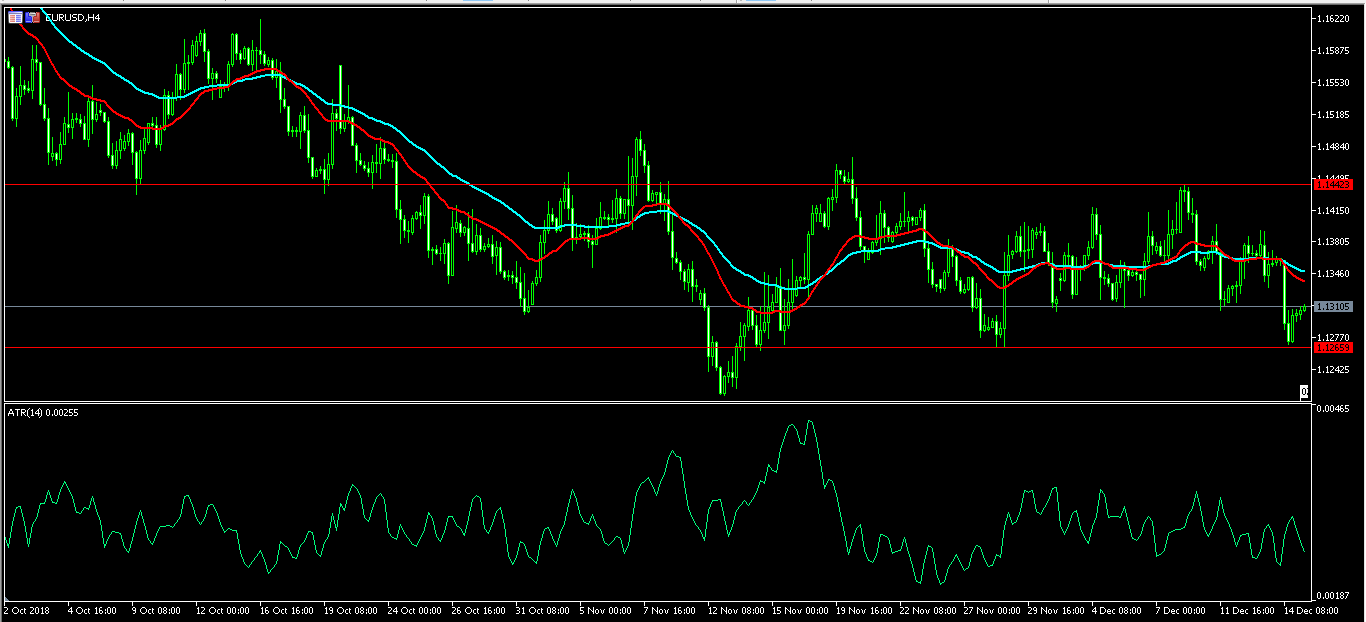
After the sharp decline on Friday, the EUR/USD pair rose slightly in today’s early trading. The pair moved to an intraday high of 1.1315, which is below the 50-day and 25-day EMA. The current horizontal movements could be because of traders’ indecision about upcoming data. Today, there is a likelihood that the pair will remain along the channel shown in the chart below.
GBP/USD
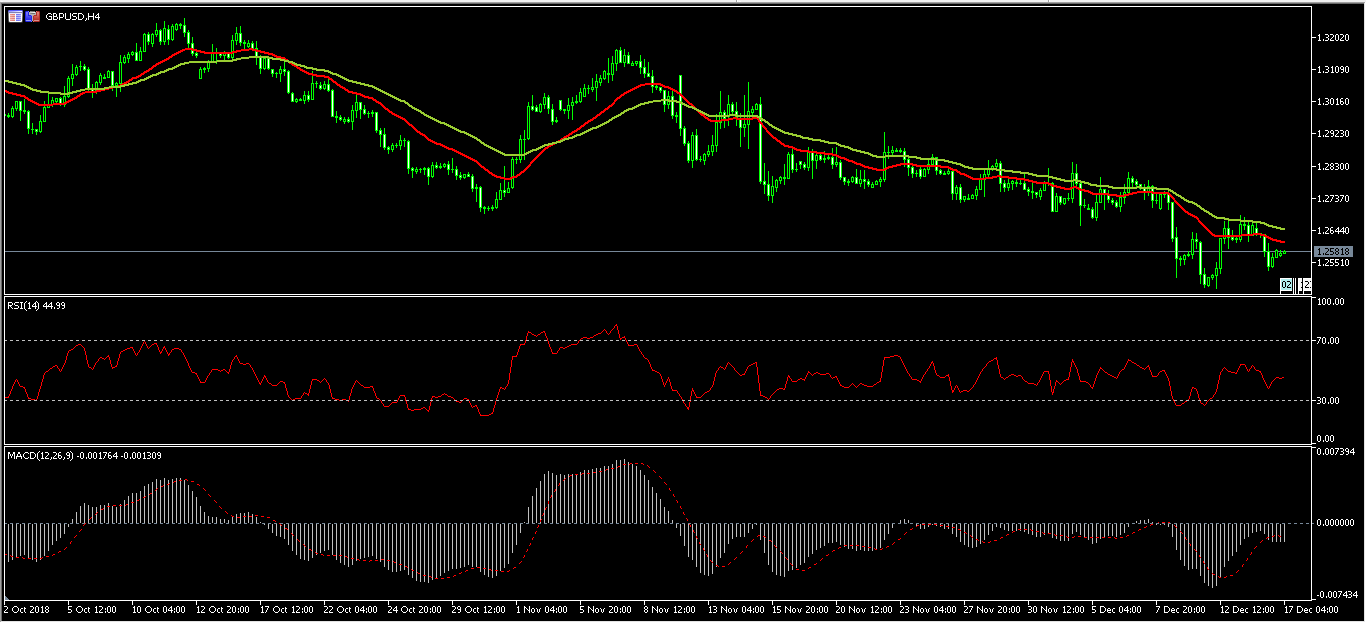
The GBP/USD pair moved slightly higher today as traders waited for the BOE rate decision. It reached an intraday high of 1.2597. On the four-hour chart, the price is below the 50-day and 25-day EMA. The price is also close to the lowest level this year. The RSI is at the 44 level while the MACD is close to the neutral level. Today, with no major news expected, the pair could continue moving slightly higher.
XAU/USD
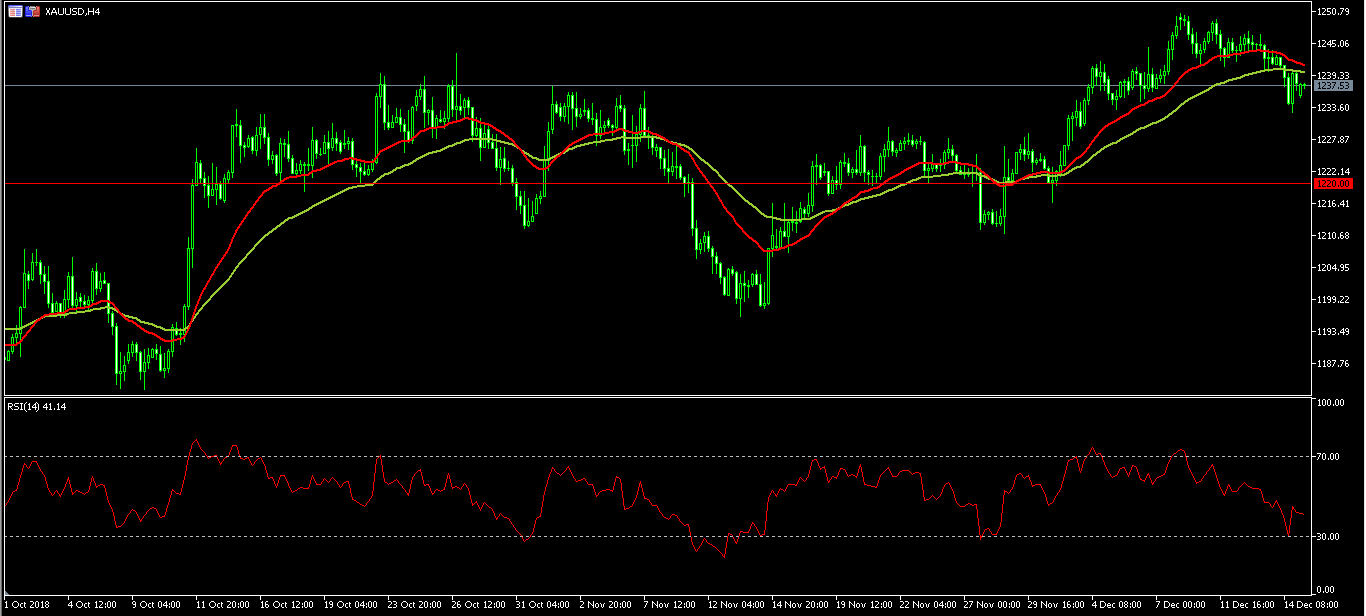
After falling on Friday, the pair moved slightly higher today. It is now trading at 1237, which is higher than Friday’s low of 1232. This price is also lower than last week’s high of 1250. On the four-hour chart, the pair’s price is below the 25-day and 50-day EMA. The RSI has risen from the oversold level of 30 to the current 40. The pair’s movement will likely depend on the Fed decision. A hawkish decision will likely test the 1220 level while a dovish Fed will likely take the pair to the 1280 level.
Fed Likely Hikes Rate in December, Future Path More Dovish
While the majority of market participants (including us) expects the Fed to raise the policy rate, by +25 bps, to 2.25-2.5% at the December meeting, this is far from fully priced in. CME’s Fed funds futures suggest that the market has priced in less than 80% of a rate hike this week. The possible downside surprise is due to recent slowdown in macroeconomic data, stock market turmoil and ongoing uncertainty in US-China trade war.
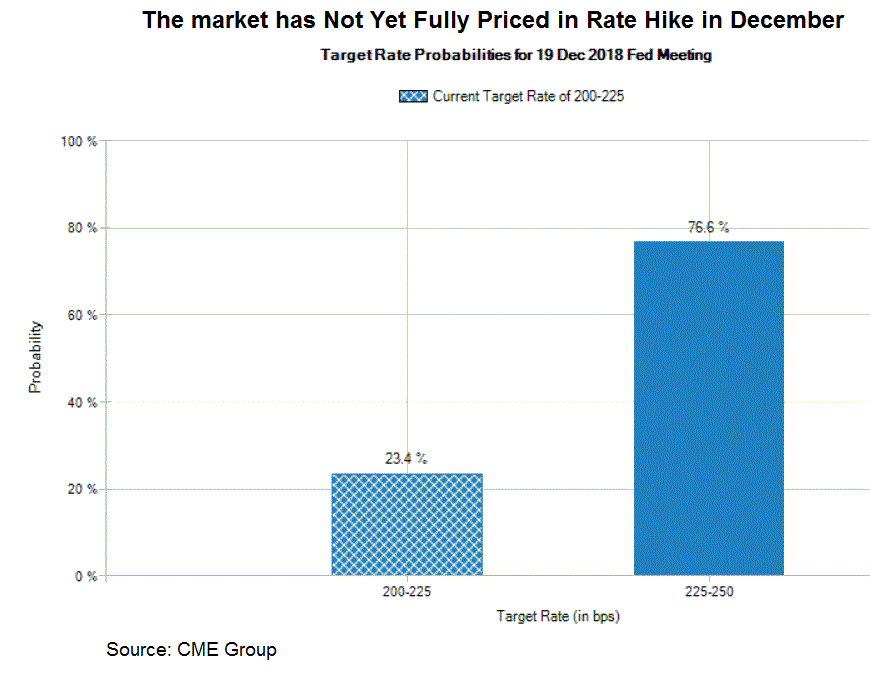
The upcoming meeting is an important one. Besides announcement of the rate decision, the Fed would communicate its outlook on the future interest rate path, release the latest median dot plots and the updated economic projections. We expect dovish tone from the central bank, as indicated by Fed Chair Jerome Powell’s recent comments about neutral rates. We expect the latest dot plots to reveal two more rate hikes in 2019, down from three in September. Meanwhile, the staff would likely downgrade the GDP growth and inflation forecasts.
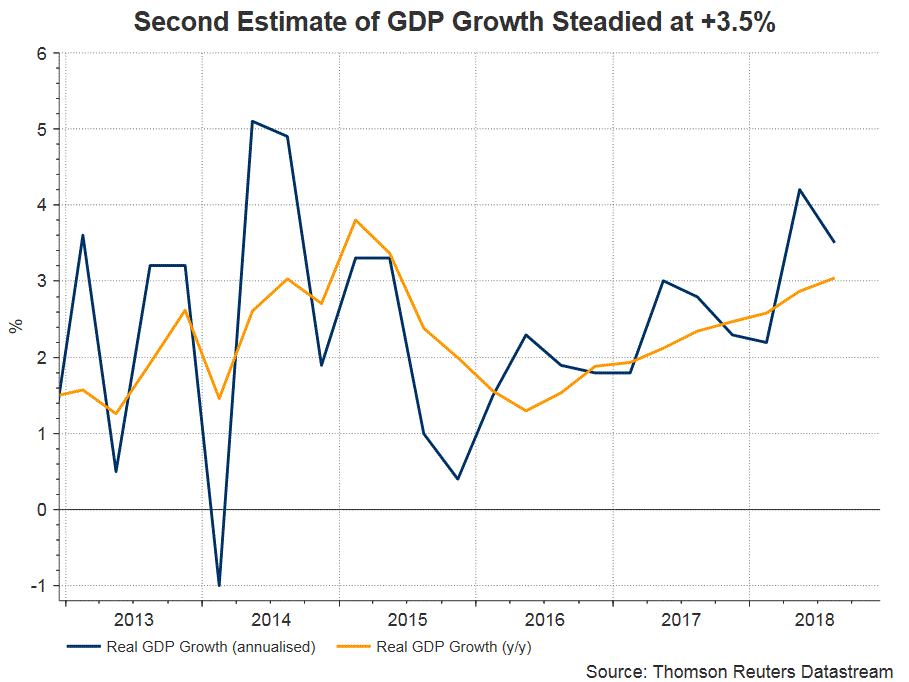
US economy has remained strong. Yet, signs of fatigue have emerged in recent data flow. The second estimate shows that GDP growth was unrevised at +3.5% q/q (annualized) in 3Q18. While marking a slowdown from second quarter’s +4.2%, the growth is still robust, thanks to the aggressive tax reform. Yet, as the impact of fiscal stimulus fades, growth would decelerate more significantly in the final quarter of this year and in 2019.
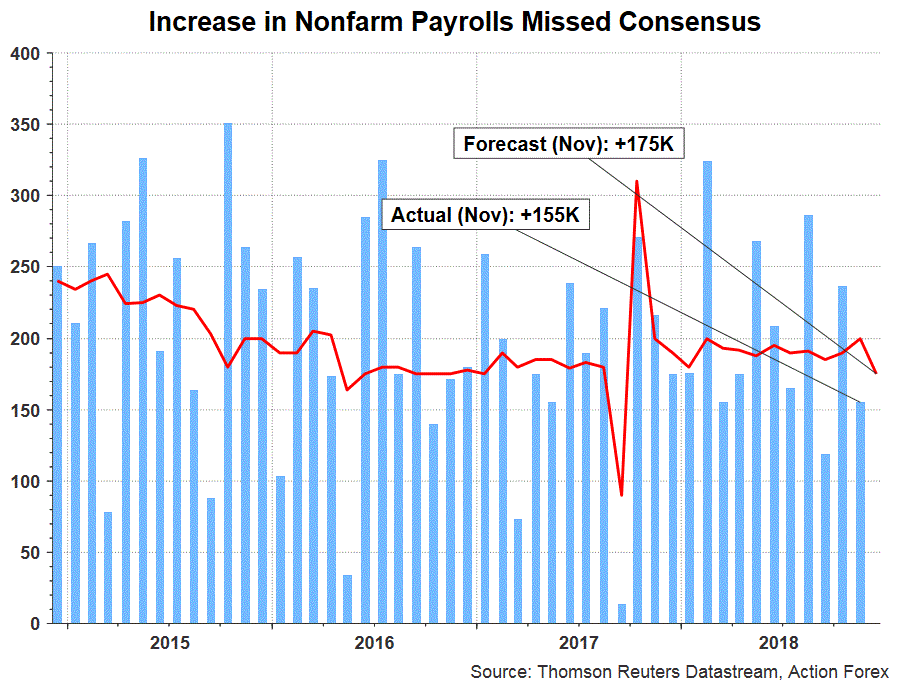
We have already started seeing moderation in several indicators for the fourth quarter. Nonfarm payrolls increased +155K in November, compared with consensus additions of +200K and October’s +237K. The unemployment rate steadied at decades’ low of 3.7%. Average earnings soared +3.1% y/y in December, in line with expectations. Robust wage growth signals the job market is still resilient and the lower-than-expected payroll increase is not too worrisome. Fewer vacancies and higher wage growth are features of an economy at (or beyond) full employment.
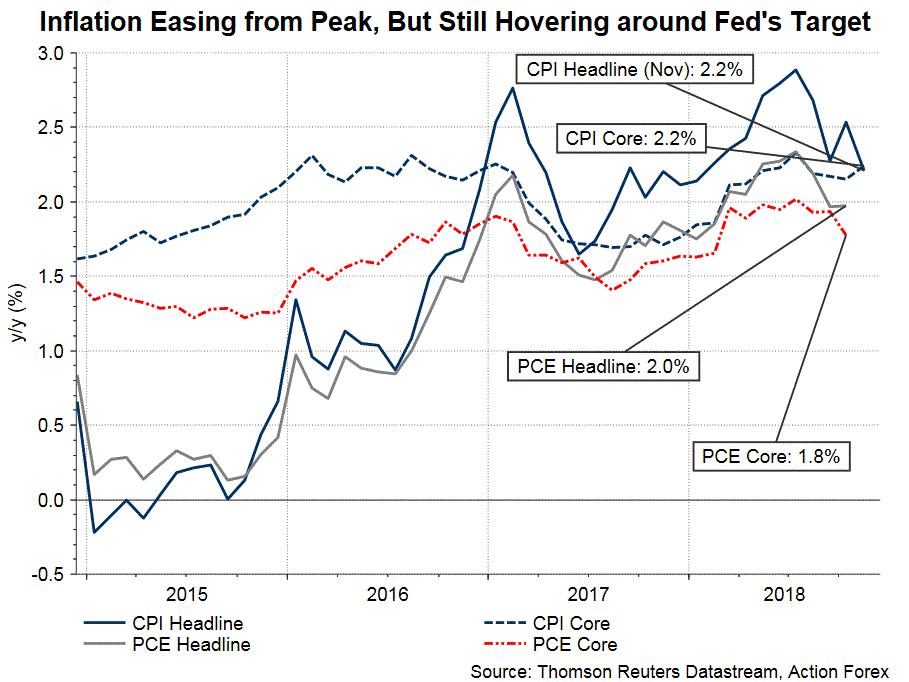
Inflation eased in November, Headline CPI moderated to 2.2% y/y from October’s 2.5%. Yet this had been anticipated by the market. Core CPI edged higher, by +0.1 percentage point, to +2.2% last month. Concerning Fed’s preferred gauge of inflation, PCE steadied at +2% in October, while core PCE slid -0.1 percentage point to +1.8% for the month.
Markit’s manufacturing PMI eased to 53.9 in December, from 55.3 a month ago. The market had anticipated moderation to 55.1. The services PMI also slowed to 53.4, from November’s 54.7. The market had anticipated a flat reading. New home sales slumped -8.9% to 554K units, lower level in more than 2.5 years, in October. Meanwhile, the median new house price in dropped -3.1% y/y to $309,700 in the month. The effect of rate hikes has becoming more evident in the market.
Resilient employment market and inflation hovering at +2% support the Fed to adopt another rate hike in December. Indeed, the November minutes also noted that a rate hike would come “fairly soon”.
The path in 2019 is more uncertain, though. The market was surprised by Powell’s abrupt shift in monetary stance as he noted that “interest rates… remain just below…neutral”. This has led many to expect an end of the current tightening cycle relatively soon. The November minutes, also reveal that the members debated on the change in forward guidance regarding the pledge on “further gradual increases” in the policy rate.
We expect some adjustments to be seen in this regards. The members might simple remove the forward guidance, or change it so as to stress the importance of “data-dependence” on future rate decision. The overall tone of the accompanying should be more dovish, cautioning the slowdowns in the global economy and the volatility in the stock markets. US- China trade war would remain under the spotlight. Although Trump has agreed to postpone raising trade tariff on Chinese products, the conflict has far from being resolved.
In September, the median dot plot shows that the policy rate would increase to 3.125% in 2019 and then to 3.375 in 2020 and 2021. We only need two staff expecting lower rates (each by 25 bps) in the 2019 to change the dot plot to two rate hike from September’s three. Indeed, the market is now expecting two rate hikes next year, while some expect none.
GBP/JPY Daily Outlook
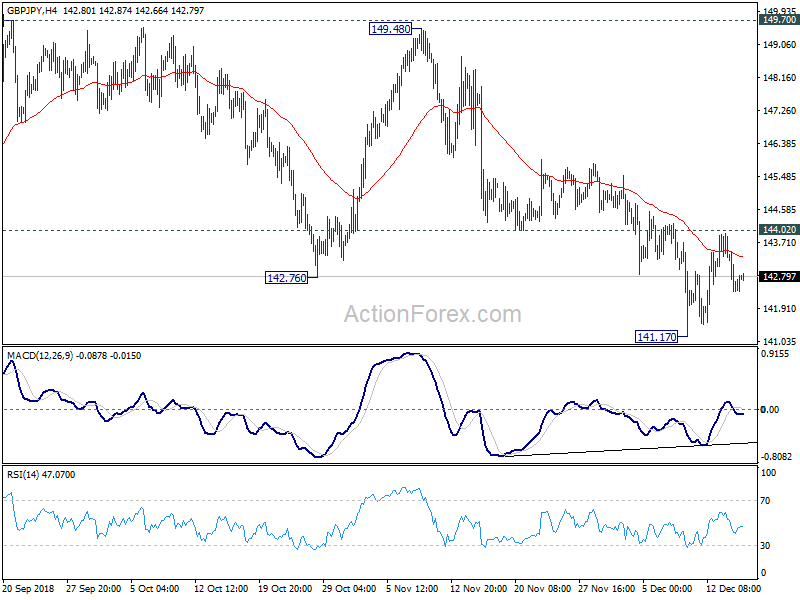
Daily Pivots: (S1) 142.09; (P) 143.01; (R1) 143.63; More...
Intraday bias in GBP/JPY remains neutral for consolidation above 141.17. But after all, near term outlook remain bearish with 144.02 support turned resistance holds. On the downside, below 141.17 will resume the fall from 149.70 and target 139.29/47 key support zone. However, considering bullish convergence condition in 4 hour MACD, decisive break of 144.02 will suggest near term reversal. Stronger rally should then be seen to 55 day EMA (now at 145.08) and above.
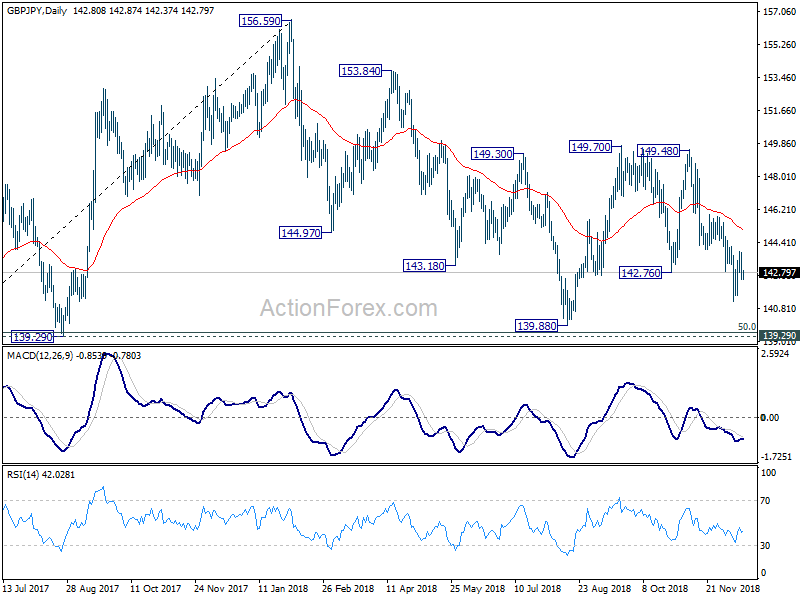
In the bigger picture, as long as 139.29 cluster support (50% retracement of 122.36 to 156.59 at 139.47) holds, up trend from 122.36 (2016 low) could still extend beyond 156.69 high. However, decisive break of 139.29/47 will suggest that such up trend is completed and turn outlook bearish. In that case, next target is 61.8% retracement at 135.43.
EUR/JPY Daily Outlook
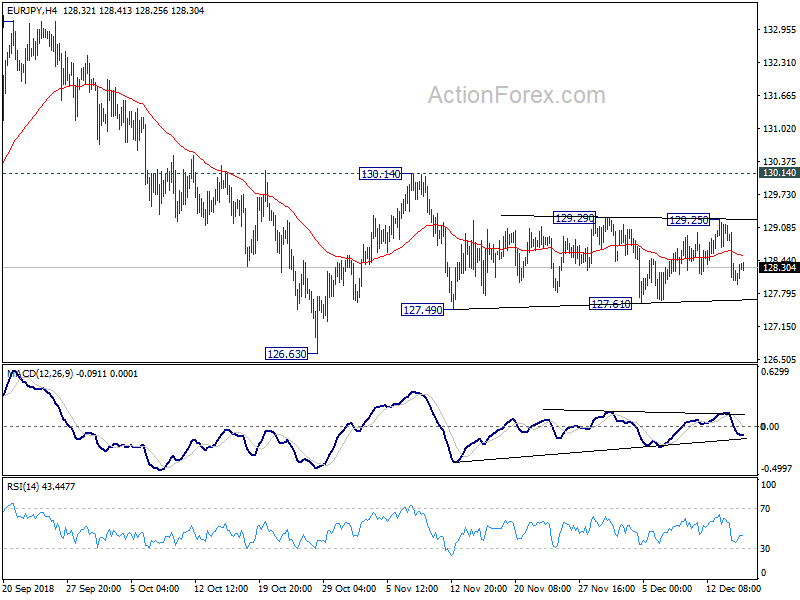
Daily Pivots: (S1) 127.76; (P) 128.44; (R1) 128.91; More....
Intraday bias in EUR/JPY remains neutral for the moment and near term outlook stays cautiously bearish. On the downside, break of 127.49 will target 126.63 support first. Break there will then resume the whole decline from 133.12 to 124.08/89 support zone. And, even in case of another strong recovery, outlook will stay bearish as long as 130.14 resistance holds.
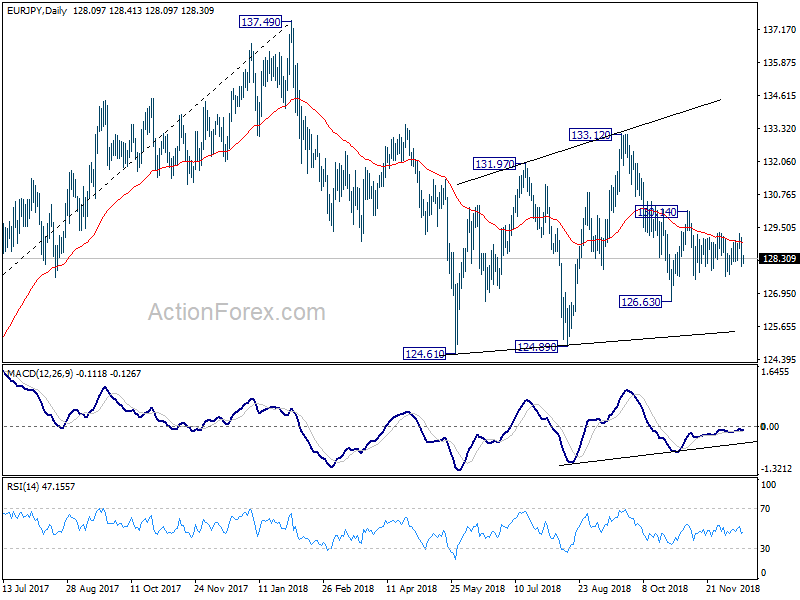
In the bigger picture, as long as 124.08 key resistance turn supported holds, larger up trend from 109.03 (2016 low) could still resume. Firm break of 137.49 structural resistance will target 141.04/149.76 resistance zone next. However, decisive break of 124.08 will argue that such rise from 109.03 has completed and turn outlook bearish. In that case, deeper fall would be seen to 61.8% retracement of 109.03 to 137.49 at 119.90.
US Dollar Index Near Highs As Fed Week Begins
- US dollar not far from highs as Fed poised to hike later in the week
- Risk sentiment under pressure from signs of global slowdown
- Volatile sterling in wait-and-see mode on possible Brexit holiday pause
US dollar keeps most of its gains on robust retail sales
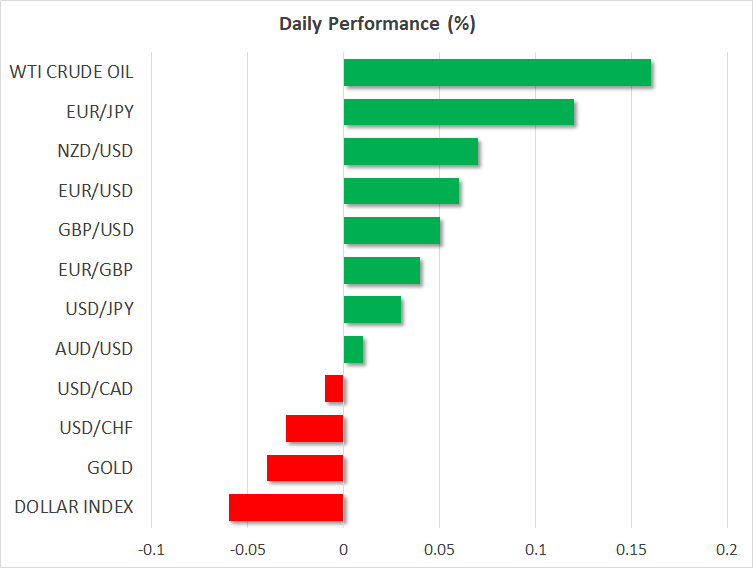
The US dollar was helped by a buoyant November retail sales report on Friday, which were in contrast to weaker-than-expected data and business surveys out of Europe and China. A strong consumer should help the US economy post a strong 4th quarter, which in turn could provide the Fed with some ammo in order to hike rates at least one more time in the beginning of 2019. Otherwise the market is bracing itself for a quarter-point rate hike following the Fed’s 2-day meeting starting this Wednesday, but the focus will be on the forward guidance and whether the Fed will lower its forecast for three additional rate hikes next year.
Trade tensions and signs of slowdown keep away Santa Claus rally
Stocks and generally risk sentiment seem to be depressed heading into year-end. The S&P 500 was down almost 2% on Friday and the index is hovering not far from its lows for the year. This during a traditionally strong season for stocks, as December is more associated with stock market rallies rather than declines. The S&P’s decline during December is a sizeable 5.8%. The depressed risk sentiment is also a factor that is helping the dollar for now, as the greenback is seen as a safe haven. In this environment, the dollar has even managed to stand well against the Japanese yen, which is traditionally one of the most attractive choices in times of market stress. Although risk assets have been under pressure, their declines have been ‘orderly’ more or less, in the sense that despite the much higher volatility, there haven’t been signs of panic. Panic could in turn create conditions for a sharp rebound. For risk sentiment to improve, maybe the market needs to see some real signs that the US and China are resolving some of their differences and less vague rhetoric about just how well the talks are progressing. Maybe hopes for a more dovish Fed are also preventing risk sentiment from deteriorating too much.
Impasse causes sterling to sideline for now
Having made 20-month lows versus the US dollar last week on reports that prime minister May would not risk putting her deal with the EU to the country’s Parliament, sterling has since sidelined. The pound even refused to react much to news that May would keep her job for now as she won her party’s vote of confidence. While the clock to the end of March is ticking, the situation seems to be deadlocked. May’s deal stands little chance to pass through Parliament, while the EU is refusing to make extra concessions in order to help May to get the deal approved. There are various scenarios about how this deadlock could break; ranging from a second referendum, general elections, parliament approving a slightly modified deal under the duress of a no-deal Brexit (seems to be May’s gamble for now) or indeed the no-deal option. Barring big surprises, not much clarity is expected before the New Year. In the absence of fresh concrete developments – despite furious backstage deliberations – sterling could enter into a holding pattern near the present lows. In this context, sterling traders could turn their attention to this week’s important economic events and data such as inflation, retail sales, 3rd quarter GDP and last but not least the Bank of England meeting.
Day ahead: final Eurozone inflation, Empire state manufacturing and US housing index
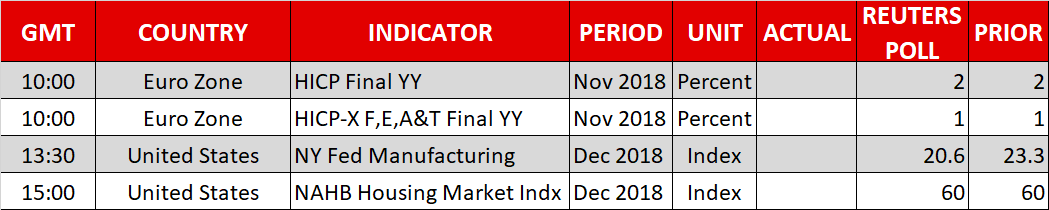
The day ahead is unlikely to provide much excitement for traders as the key release will be final Eurozone inflation for November – usually a confirmation of the preliminary estimates. Headline inflation is expected to be confirmed at 2%, while core inflation, which mainly excludes fuel and energy, should come in half of that at 1%, showing that inflation is not really an issue for the ECB. In the United States, the Empire State manufacturing index is expected to cool a little to 20.6 from 23.3, while the National Association of Home Builders (NAHB) housing market index is expected to hold steady at 60.
EURUSD Edges Marginally Up After Strong Negative Week
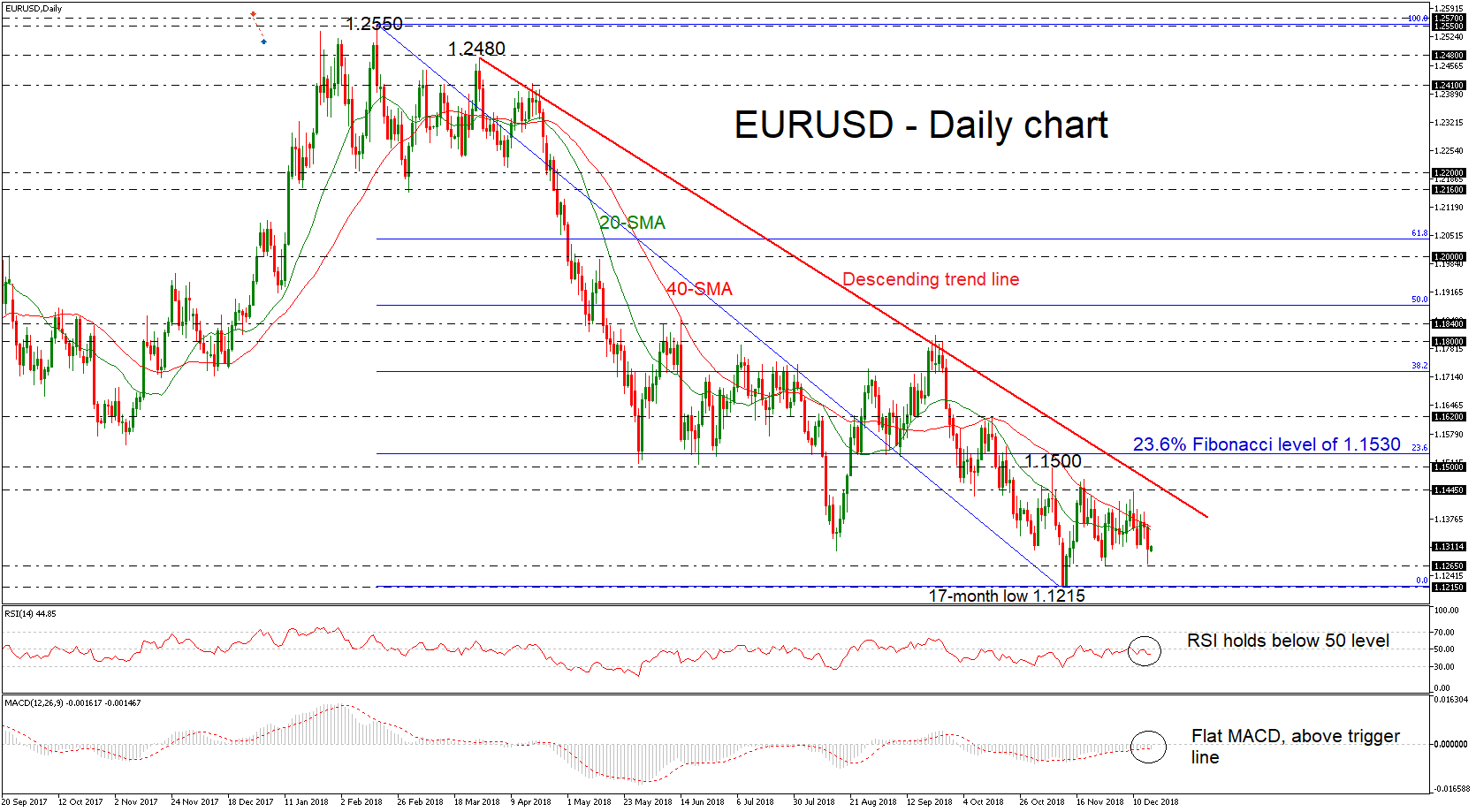
EURUSD finished the previous week in negative territory as it touched once again the 1.1265 support level, remaining below the 20- and 40-simple moving averages (SMAs) in the daily timeframe. The pair continues the negative tendency over the last eight months, increasing distance below its negatively sloped trend line.
Meanwhile, the technical indicators continue to slow down, mirroring the market’s bearish behavior over the past week. The RSI indicator is still moving in the bearish zone, flagging that a downside move could reemerge in the short term. The MACD is flattening above its red signal line but is still moving below the zero line in the near term.
Should the pair experience more negative pressure and drops below the 1.1265 area, the market could meet support at the 17-month low of 1.1215, before the price heads sharply lower towards the 1.1115 mark, identified by the lows on June 2017. In case of steeper declines, the pair could breach this trough, diving to 1.0830, which was reached in May 2017.
On the other side, in case of a climb above the moving averages, the price could challenge the 1.1445 region. More advances could send prices towards the 1.1500 strong psychological level, registered on November 7, which stands near the descending trend line. Slightly above this region, the 23.6% Fibonacci retracement level of the downleg from 1.2550 to 1.1215, around 1.1530 could be next level to focus on.
Concluding, the bearish picture in the long-term looks to persist for a while longer as EURUSD has been developing in a downtrend since March of the current year.
EUR/GBP Daily Outlook
Daily Pivots: (S1) 0.8960; (P) 0.8983; (R1) 0.9006; More...
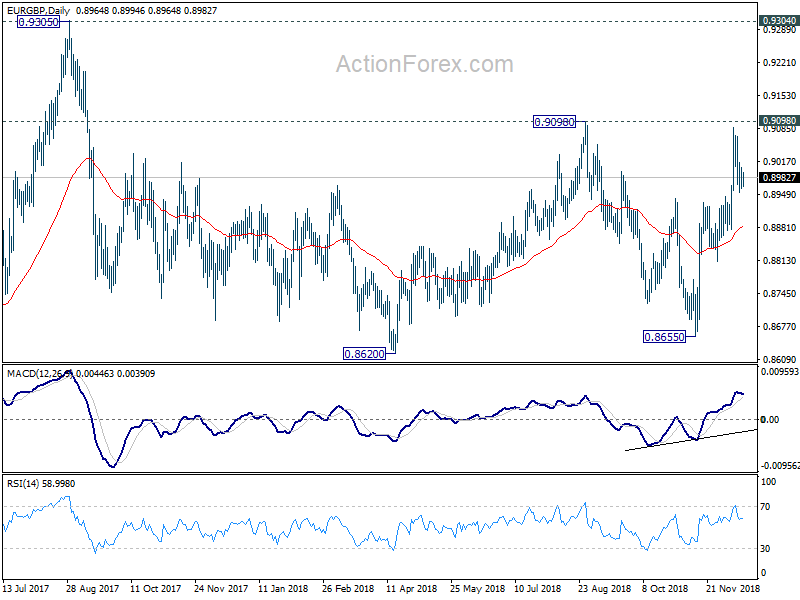
Intraday bias in EUR/GBP remains neutral first. As long as 0.8931 resistance turned support holds, further rally is expected in the cross. On the upside, decisive break of 0.9098 resistance will extend the rally from 0.8655 and target 0.9304 key resistance next. However, considering bearish divergence condition in 4 hour MACD, firm break of 0.8931 will indicate near term reversal and target 0.8810 support and below.
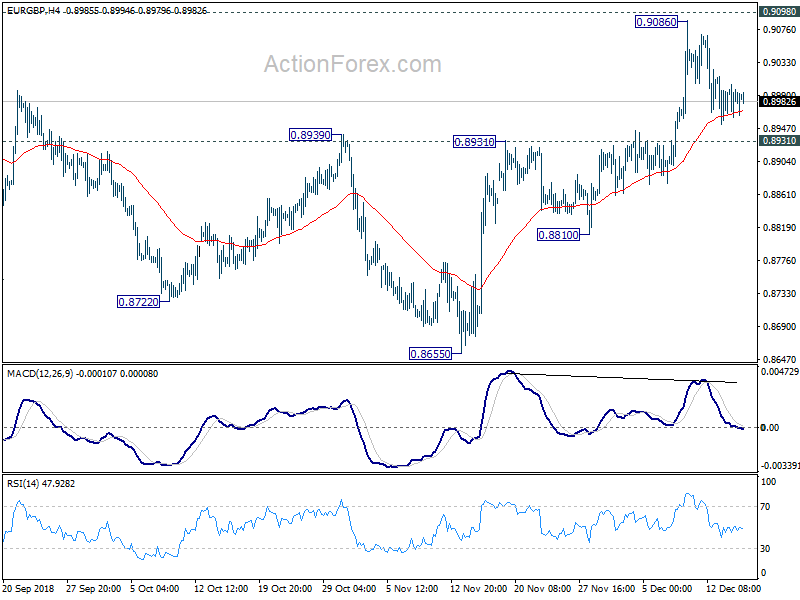
In the bigger picture, EUR/GBP is seen as staying in long term range pattern started at 0.9304 (2016 high). It should be in medium term rising leg for 0.9304. Meanwhile, in case of another fall, down side should be contained by 0.8620/55 support zone to bring rebound.
XAUUSD Intraday Analysis
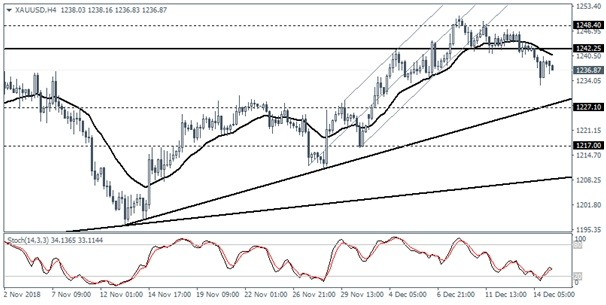
XAUUSD (1236.87): Gold prices slipped below the support at 1242.25 and thus invalidated the bullish flag pattern. The breakdown below the support at 1242.25 signals further declines in the near term. The lower support at 1227.10 remains a key target that could be tested for support. Forming support at this level could keep gold prices still biased to the upside. There is a risk that the precious metal could maintain a sideways range within 1242.25 and 1227.10 in the near term.
GBPUSD Intraday Analysis
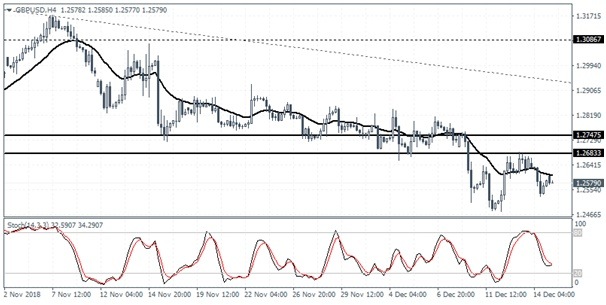
GBPUSD (1.2579): The GBPUSD continues to trade below the recently breached support level of 1.2683. Price action posted a modest rebound which saw a brief retest of the breached support level. We expect a solid retest of this level to establish resistance. The GBPUSD is most likely to trade below this level with the potential to break past the previously established lows of 1.2485. However, the cable could settle into a sideways range in the near term.
EURUSD Intraday Analysis
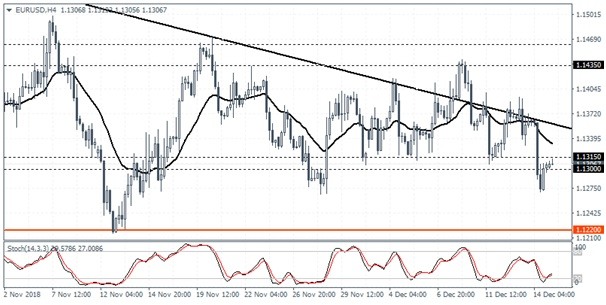
EURUSD (1.1306): The Euro currency was seen trending lower on Friday as the USD posted strong gains. Price action briefly broke past the support level at 1.1315 - 1.1300 only to recover those losses by Friday's close. With the support being breached, the EURUSD is likely to push lower. The previously held lows near 1.12200 remains a key target of interest to the downside. To the upside, a close above the falling trend line will see some upside momentum building up. However, the resistance near 1.1435 remains another key challenge for the Euro.