

Sample Category Title
EURCHF Remains Cautiously Negative In Medium-Term
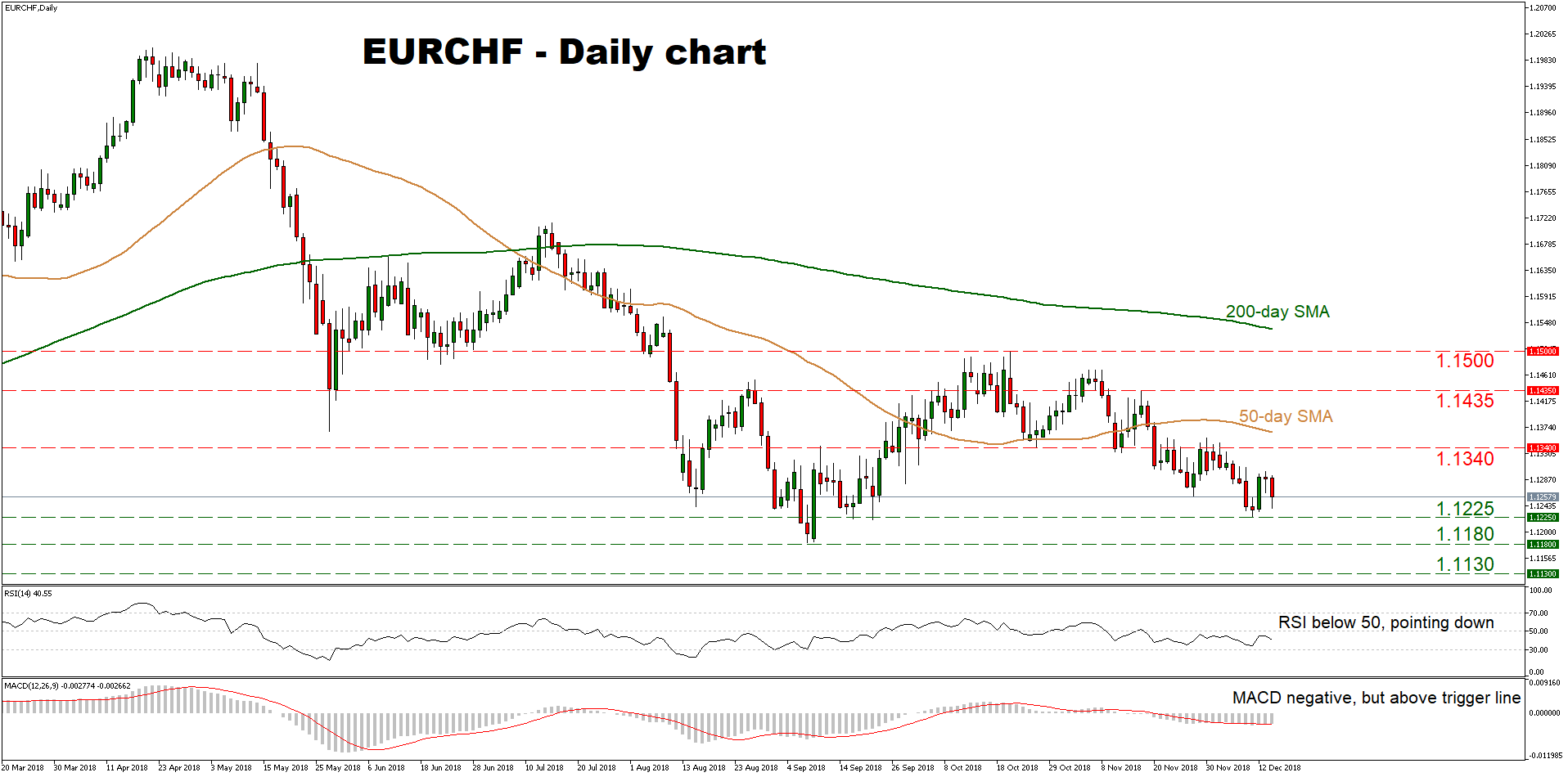
EURCHF remains on a soft footing, trading firmly below both its 50- and 200-day simple moving averages (MAs), which keeps the broader outlook cautiously negative. That said, a decisive break below the August lows of 1.1180 is required to signal that the broader downtrend is back in force.
Short-term oscillators mostly support a negative bias. The RSI is below 50 and pointing lower, though the MACD has just crossed above its red trigger line; a signal that negative momentum may be fading a little.
Further declines could encounter immediate support around 1.2225, the December 11 trough, before the 1½-year low of 1.1180 comes into view. Even lower, the 1.1130 zone would attract attention, marked by the peak of May 2016.
On the other hand, resistance to advances may be found initially at 1.1340, the inside swing low of October 26. The next obstacle to the upside may be the 50-day SMA at 1.1365, where a bullish violation could turn the picture to a more neutral one, setting the stage for a test of 1.1435 – this being the top of November 16.
In short, as long as the pair remains below the 50-day MA the outlook is cautiously negative, with a clear move under 1.1180 needed to turn it firmly bearish.
USD/CAD – Canadian Dollar Edges Lower, US Retail Sales Expected To Slip
The Canadian dollar has ticked lower in the Friday session. Currently, USD/CAD is trading at 1.3389, up 0.24% on the day. On the release front, there are no Canadian events. In the U.S, the spotlight is on consumer spending. Retail sales and core retail sales are expected to drop sharply, with forecasts of 0.2% and 0.1%, respectively.
It has been a rough few weeks for the Canadian dollar. The currency has been under pressure since mid-November, losing 1.1 percent during the time. Weaker oil prices and a cooling U.S. economy have hampered Canada’s economy, and the BoC responded last week by remaining on the sidelines and maintaining interest rates.
In the U.S, weak inflation levels are another sign that the economy is slowing down. CPI dropped to 0.0% in November, down from 0.3% a month earlier. This marked the lowest level since May. Core CPI remained pegged at 0.2 percent. The weak readings can be attributed to falling oil prices, which has led to a sharp decline in gasoline prices. On an annualized basis, inflation gained 2.2 percent in November, down from 2.5 percent in October. With the U.S. economy showing signs of slowing down, and the global trade war taking a bite out of the global economy, inflation could continue to head lower as we head into 2019. This has led to a reassessment at the Federal Reserve of monetary policy. Earlier in the year, the Fed was sending messages that it would raise rates three or four times next year. This has been drastically scaled back, with some analysts predicting only one rate hike in 2019.
USD/CAD Analysis: Likely To Maintain Trendline
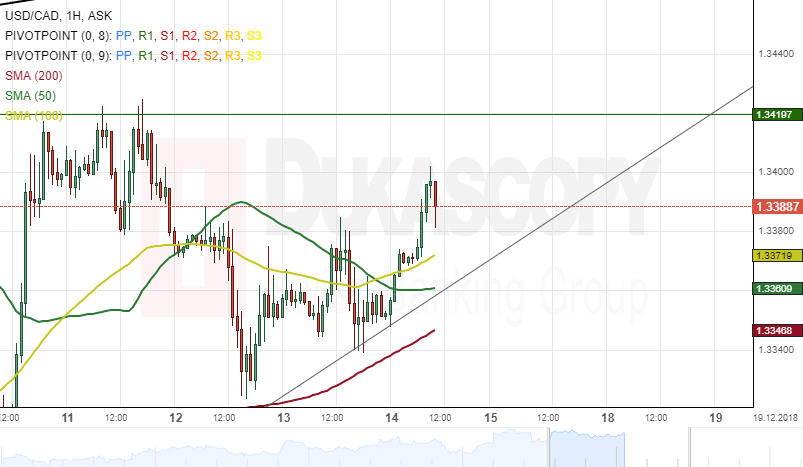
The price movement of the US Dollar against the Canadian Dollar was guided by an ascending trendline. The currency pair tested the lower boundary of the trendline during the end of yesterday's session.
Everything being equal, it is likely that the Greenback maintains the uptrend line today. The short-term target for bullish traders will be near a significant resistance level at 1.3419.
Moreover, the 50-, 100-, and 200-hour simple moving averages are below the current price level.
AUD/USD Analysis: Bears Market
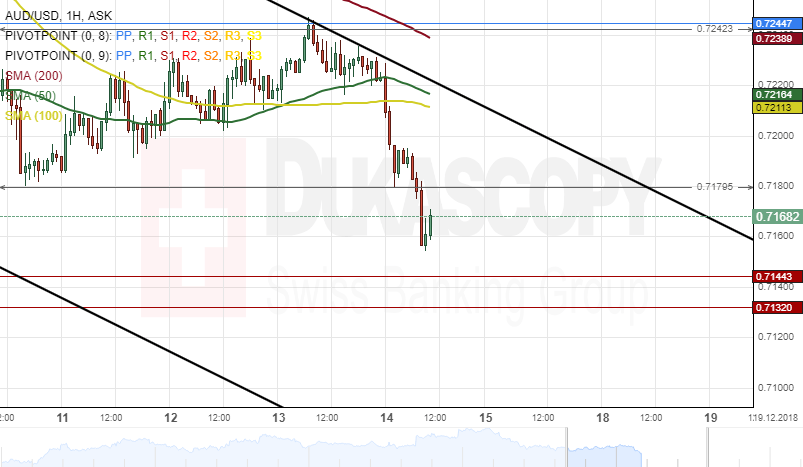
The Australian Dollar has depreciated about 92 base points against the US Dollar since Thursday's session. The currency pair dashed through a one-week trading range during the first part of today's session.
As for the near future, it is likely that the AUD/USD currency pair will continue its bearish momentum. Bearish traders could push the currency exchange rate towards a swing low of 0.7061 today.
However, a traditional weekly and the monthly pivot points at 0.7144 could hinder the exchange rate from falling further south.
EUR/JPY Analysis: Bearish Sentiment Today
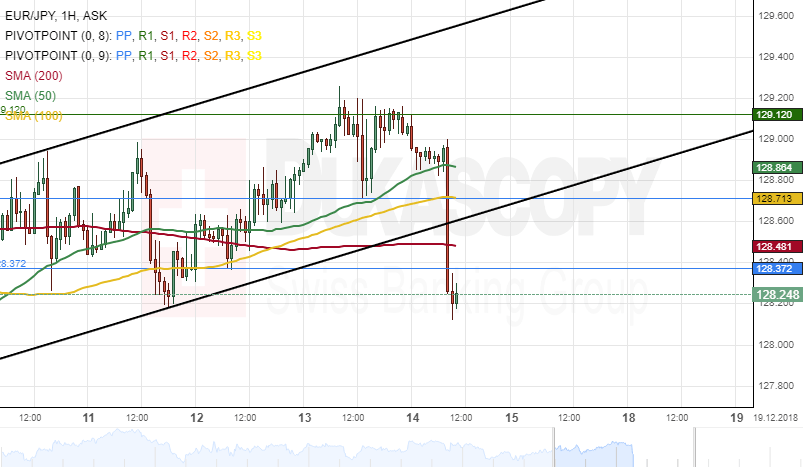
The Eurozone single currency has depreciated about 113 base points against the Japanese Yen since yesterday's trading session. The currency pair breached the lower boundary of an ascending channel pattern at 128.60 during the Asian session on Friday.
Given that a breakout had occurred, it is likely that the EUR/JPY currency exchange rate will continue its decline within this session. The potential downside target will be at a swing low of 127.70.
However, it is expected that the exchange rate makes a brief retracement north towards the 128.60 mark today.
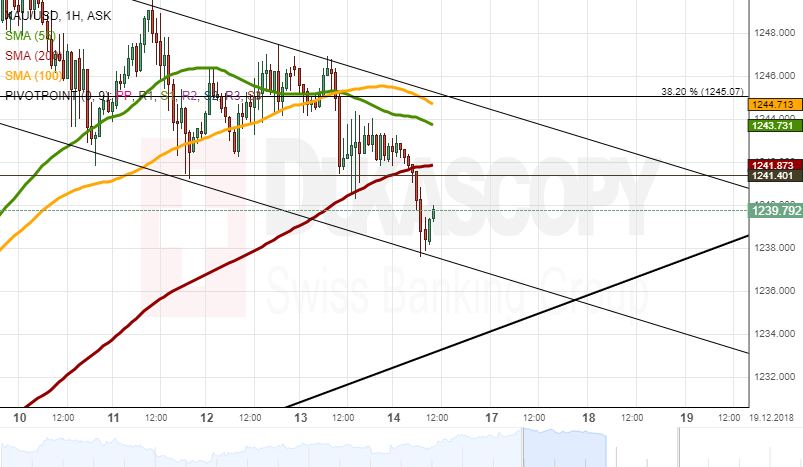
Gold Analysis: Should Touch 1,241.40
The gold charts have been fully reviewed. In general, the situation is pretty simple.
The commodity price is retracing downwards in the borders of a larger pattern. The descent is expected to continue until the end of next week.
Meanwhile, the rate recently encountered the lower trend line of the channel down pattern that is guiding it. Due to that reason it has found strength for a short term surge. Most likely the surge will reach for the 1.241.40 level, where a pivot point is located at
Comments from ECB de Guindos, Vasiliauskas and Nowotny
ECB Vice President Luis de Guindos defended the central bank's decision to ended the asset purchase program this month, without any further stimulus exit said. He said that "We're in a dark room that sometimes gets a bit darker, and when you are in a dark room you have to be very cautious and try to keep your optionality at the maximum level,"
Governing Council member Vitas Vasiliauskas warned of growing risks in 2019. He said "next year the balance of risk is more likely to turn in a negative direction but for the moment, because risks and economic data are quite mixed, yesterday's meeting still described the risk outlook as balanced,"
Another Governing Council member Ewald Nowotny said the central bank should ends the negative deposit rate policy as son as possible. He said, "My personal view is that specifically this rate, that is this phenomenon of negative interest rates, should be reconsidered as soon as economically possible." He added, "It is also a specificity of the ECB. The U.S. never had a negative rate."
DAX Under Pressure Ss German, Eurozone Manufacturing PMIs Dip
The DAX index has lost ground in the Friday session, following the downward trend seen on Thursday. Currently, the index is at 10,793, down 0.15% on the day. In economic news, German and eurozone PMIs lost ground in November, pointing to weaker activity in the services and manufacturing sectors.
Germany continues to produce weak economic readings, weighing on investor confidence. The manufacturing sector continues to struggle, as Manufacturing PMI for November was the latest in a string of soft manufacturing releases. The global trade war has resulted in higher tariffs on German products, putting a damper on German exports and the manufacturing sector. As the largest economy in the eurozone, a slowdown in Germany is bad news for the entire eurozone, which has struggled in the second half of 2018.
There were no dramatic developments at the ECB policy meeting on Thursday. As expected, the ECB maintained interest rates at 0.00% and reiterated that the bank’s bond-purchase scheme would terminate in December. The program was implemented in order to kick-start the economy and raise ultra-low inflation levels. At a press conference after the meeting, ECB President Mario Draghi said the stimulus scheme had not only boosted growth in the eurozone, but was “in some cases the only driver of this recovery”. At the same time, Draghi warned that eurozone growth was weakening. The ECB downgraded its growth forecasts for the eurozone – from 2.0% in September to 1.9% in December for 2018, and from 1.8% in September to 1.7% in December in 2019. Draghi added that headline inflation is also expected to drop in the coming months, due to weaker economic conditions.
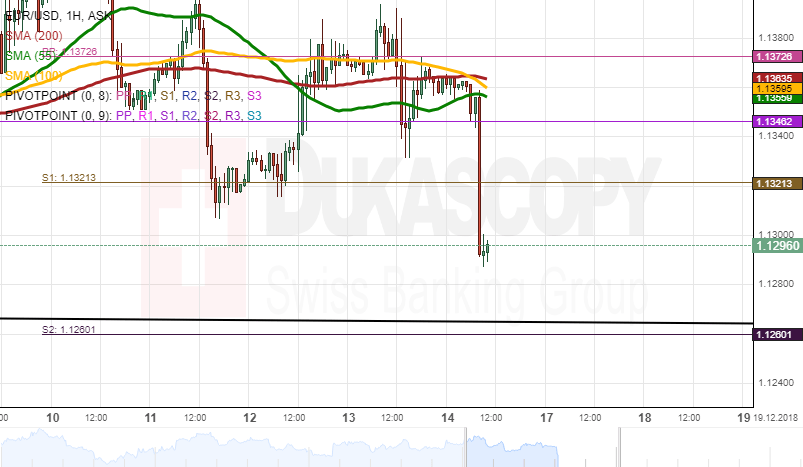
EUR/USD Analysis: Drops Down To 1.13
On Friday, due to a combination of fundamental events and technical level pressure the EUR/USD plummeted down like a brick thrown into a pool. Namely, by the middle of the day's trading the pair was trading below 1.1300.
In regards to the near future, the pair faces no technical support as low as the 1.1260 level, where the medium pattern's trend line is located at. In addition, note that the continuation of Brexit turmoil is set to beat the Euro down.
Meanwhile, after a sharp drop currency exchange rates retrace back upwards or trade sideways consolidating at a certain level.
China announced to suspend retaliatory tariffs on 211 items of US autos and parts for 3 months
China Ministry of Finance announced to suspend retaliation tariffs on US autos and parts for 30 days, as a result of the meeting between Xi and Trump in Argentina.
The statement noted that important consensus was reached between the two heads of state. And in order to implement the consensus, China will suspend the additional tariffs imposed this year on 211 items for three months from January 1 to March 31, 2019.
The lists include 25% tariffs on 28 items in list 1, 25% tariffs on 116 items in list 2, and 5% tariffs on 67 items in list 3.