

Sample Category Title
GBP/USD Analysis: Might Drop To 1.2470
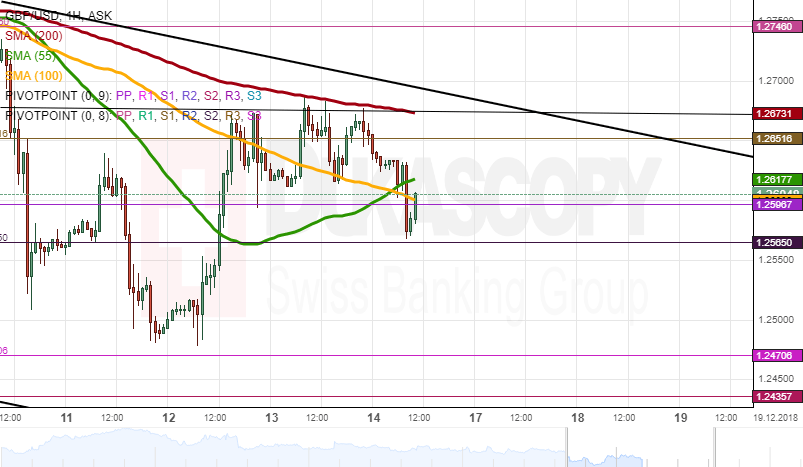
By the middle of Friday's trading session the GBP/USD had continued to decline until it reached the support provided by a pivot point at the 1.2565 level. The rate bounced off this support.
In the near future, it is expected that the rate will continue to decline, as a downwards trend can be observed during the last couple of days. If the rate passes the 1.2565 level, it should plummet down to 1.2470 level.
Although, take into account that Brexit talks rule over technical analysis and any announcement can cause a sudden surge upwards or be the initiator for a decline down to the 1.2470 mark.
USD/JPY Analysis: Might Reach 114.40
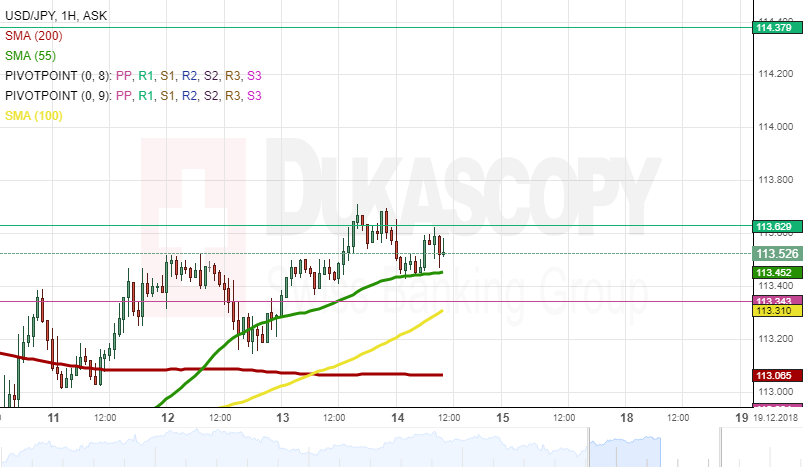
USD/JPY is slowly but steadily continuing its surge upwards. By the middle of Friday the pair had made three attempts to surge above the resistance of a pivot point level at 113.60.
If that level gets broken, the rate will have a free range without any technical resistance levels up to the 114.40 level where the next notable pivot point is located at. Although, take into account that on Monday new weekly pivot points will be calculated and a pivot point might stand in the way of a surge.
Risk-Off Sentiment Is Back
AUD and NZD tumble as Chinese data miss
The Australian and New Zealand dollar plunged on heavy selling pressures amid disappointing economic data from China. The Aussie fell almost 1% to 0.7160 against the greenback, the lowest level since early November, while the Kiwie gave up more 1.10% as it reached $0.6780. Overall, investors fled riskier assets and took shelter into safe haven currencies such as the Japanese. Interestingly, the Swiss franc fell 0.25% against the buck, which suggests that the recent slowdown in Switzerland's economic growth has make the Swissie less attractive.
The last batch of data from the world's second largest economy came on the soft side, suggesting that the downturn is deepening. The ongoing trade war between the US and China is undoubtedly part of the equation though. Chinese retail sales fell short of expectation as they rose only 8.1%y/y in November, missing estimates of 8.8% and down from 8.6% in October. Similarly, industrial production missed forecast as it came in at 5.4%y/y versus 5.9% previous reading and forecast. Overall, it seems that the combination of faltering market confidence, thanks to Donald Trump relentless attacks on China, together with the country's ongoing economic slowdown due to the normalisation process that is underway - i.e. shifting toward a domestic generated growth from an export driven one – has hurt significantly China's industrial sector.
On the bright side, the conflict between Xi Jinping and The Donald has seen appreciable amelioration lately as the 90-day truce gives both side a breath of fresh air. For now, investors would remain nervous against the backdrop of tumultuous financial market conditions and tense geopolitical situation. It is just not the right time to hold risky assets.
Japan's growth slows
Japan's Q3 GDP fell 2.50%, its hardest contraction since June 2014. A sharp drop in October's current account balance supported the gloomy picture. The Bank of Japan's Q4 Tankan data confirms that business is heading downward.
Manufacturers' sentiment was unchanged, following three quarters of declines. Industrials remain largely more upbeat, as the impact of major typhoon Trami and earthquake from September requires the reconstruction of infrastructure in the region. Overall however, trade tensions between the US and China remain, and bilateral discussions with Washington will start as early as January 2019. The Japanese government will aim to safeguard tariffs related to US beef. USD/JPY is currently trading at 113.50, approaching the 113.70 range short-term.
AUD/USD Outlook: Aussie Falls Below Key Supports On Risk-Off Sentiment After Weak Data From China
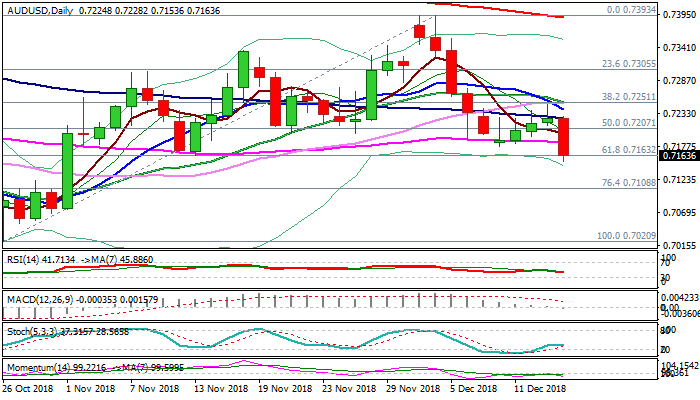
The Australian dollar was sharply lower on Friday, pressured by weaker than expected China's IP and retail sales data that pressured riskier assets. Fresh bears reversed recovery rally of past four days (0.7177/0.7246) and broke below thinning daily cloud which twists on Monday and pivotal Fibo support at 0.7163 (Fibo 61.8% of 0.7020/0.7393) in extension. Near-term structure weakened after today's fall as momentum moved into negative territory and daily MA's turned into negative setup. Today's close below 0.7163 pivot would add to negative outlook for extension of pullback from 0.7393 (04 Dec recovery high) towards next support at 0.7108 (Fibo 76.4%). The pair is on track for the second consecutive bearish weekly close, after last week's weekly bearish engulfing pattern generated strong bearish signal. Broken former low at 0.7177 and 55SMA at 0.7185, mark initial resistances, with stronger upticks expected to remain below falling 100SMA (0.7224) which limited recent recovery.
Res: 0.7177, 0.7185, 0.7224, 0.7239
Sup: 0.7153, 0.7108, 0.7074, 0.7050
Safe Haven Flows Dominate Following Disappoint Chinese And European data
Notes/Observations
- China and European data sparks concerns of a global economic slowdown; safe haven flows dominate
- Major European PMI data disappoints (Misses: Euro Zone, Germany, France (France moved into contraction); market expectations of a delayed ECB rate hike starting to formulate
- China removes auto retaliatory tariffs for 3 months; effective Jan 1st; Move to implement consensus reached between Xi and Trump at the recent G20 meeting in Argentina
Asia:
- Japan Q4 Tankan Large Manufacturing Index: 19 v 18e; Manufacturing Outlook Index: 15 v 17e
- Japan Q4 Tankan Large Non-Manufacturing Index: 24 v 21e; Non- Manufacturing Outlook Index: 20 v 20e
- Japan Dec Preliminary PMI Manufacturing: 52.4 v 52.2 prior
- China Nov Retail Sales Y/Y: 8.1% v 8.8%e (slowest growth since 2003)
- China Nov Industrial Production Y/Y: 5.4% v 5.9%e prior (matched slowest growth rate since early 2016)
- China PBOC again skips its Open market operation (OMO) but injected CNY286B throught its 1 year MLF at unchanged rate of 3.3%
- BoJ cut their JGB purchases in the 5-10-year window by 20b to 430B in its planned QE operation (Note: In the past, BoJ officials have stated that daily bond buying operations were not intended to signal monetary policy changes)
Europe:
- UK PM May reportedly had suggested instead of an expiry date for the Irish backstop she would propose a commencement date for the future relationship to EU27 leaders at the summit
- UK Senior Ministers said urge PM May to quit in the spring as the only way to break Parliament’s deadlock over Brexit. Growing number of Tory ministers now think a promise by PM May to step down within 6 months would persuade Tory Brexiteers and the Northern Ireland DUP party to back her Brexit deal. In exchange a Brexiteer would win the chance to put a leader in charge of future trade talks after a new leadership contest has started
- EU Leaders Statement following EU27 Summit: Trade deal to avoid using the backstop should be in place by Dec 2020 or soon after so that a backstop would only operate for as long as strictly necessary
- EU's Moscovici: talks with Italy Econ Min Tria were 'very constructive'; work is ongoing to quickly reach a compromise
- Italy Econ Min spokesperson: there is a common will to get to a budget agreement with the EC
- ECB policymakers debated changing balance of risk assessment to highlight downside risk
- Bank de France (Central Bank) updated economic forecasts. Cut both 2018 and 2019 GDP growth forecasts from 1.6% to 1.5%
- French government no-confidence motion rejected
Americas:
- Nov Monthly Budget Statement: -$204.9B v -$199.0Be
Macro
- (US) United States: A partial government shutdown looms on December 21 and risks of it happening increased after the very public spat between President Trump and Democrat leaders. Trump said he'd be "proud to shut the government for border security," if there's no funding for the border wall. The government passed a short term continuing resolution last week to fund the government through December 21. Shutdowns typically have very limited economic impact. Most of the key federal departments are already funded until the end of fiscal 2019 anyway.
- (EU) ECB: President Draghi was dovish as expected pointing to downside risks. He also confirmed that TLTROs had been mentioned by some during the meeting, and didn't rule out that there could be new long term loans or other monetary policy measures to keep ample liquidity in the system. It was stressed that the ECB still has sufficient tools to address any possible downturn, despite starting the process of policy normalization later than other central banks. With incoming data much weaker than expected Eurozone money market futures are now pricing in a round 60% probability for the ECB to hike rates next year. That is a marked drop from the 75% probability seen yesterday right after the ECB meeting.
- (DE) Germany: Manufacturing PMI fell to a 33 month low and underlying details point to a slowdown in activity. Manufacturing order books falling for the third straight month and at the fastest rate since November 2014. New export business meanwhile fell for the fourth month running, led by a further decline in manufacturing export orders.
- (FR) France: PMI readings signal so-called contraction, with the manufacturing & services PMI falling back below the 50 level. There were widespread reports of disruption to business, with the largest impact seen in the services sector, which reported the first contraction in activity since June 2016. In the manufacturing sector it was mainly the slowdown in the automobile sector that had an impact.
- (UK) United Kingdom: EU leaders rebuffed PM May last night in Brussels as they re-stated that the terms of the Withdrawal Agreement were not open for renegotiation. It means therefore there will be no legally binding commitment for the UK will not be tied indefinitely to the EU through the Irish border backstop, which was considered essential if she was to stand any chance of getting Parliament to back the deal. The parliamentary vote has to be before the legislated deadline of January 21.
SPEAKERS/FIXED INCOME/FX/COMMODITIES/ERRATUM
Equities
- Indices [Stoxx600 -0.88% at 346.36, FTSE -0.77% at 6,824.73, DAX -0.99% at 10,813.70, CAC-40 -0.82% at 4,856.58, IBEX-35 -1.07% at 8,830.95, FTSE MIB -1.04% at 18,851.50, SMI -1.29% at 8,706.90, S&P 500 Futures -0.92%]
Market Focal Points/Key Themes:
- European Indices trade sharply lower as France Manufacturing PMI slips in to contracts for the first time in 27th months, while Germany sees the lowest reading since early 2016. Weaker China Economic data also pointed to slow down in the economy.
On the corporate front Auto names rebound off the lows after China lifted the 40% retaliatory tariffs back to 15% effective Jan 1st. Autoneum shares fall sharply after cutting its outlook; Santherea drops after planning to proceed with its share placement. Scout24 is a notable riser after exploring a potential sale, while Meyer Burger Tech trades over 10% higher after updating its guidance. Other gainers include Balfour Beatty, Reach and Sthree following positive trading updates, while Cargotec and Low & Bonar are among the decliners after earnings. Looking ahead notable earners include LiteintheBox and Lee Holdings.
Equities
- Consumer discretionary: LVMH Moet Hennessy Louis Vuitton [MC.FR] -2% (acquisition), Cargotec [CGCBV.FI] -8% (profit warning), Scout24 [G24.DE] +16.5% (reportedly considering go-private transaction)
- Materials: ThyssenKrupp [TKA.DE] -1.5% (names CFO)
- Financials: Sydbank [SYDB.DK] +0.5% (to end buyback program)
- Industrials: Balfour Beatty plc [BBY.UK] +3% (trading update), Stabilus [STM.DE] -1.5% (earnings; affirms outlook), Meyer Burger Technology [MBTN.CH] +16.5% (contract awarded)
- Telecom: Deutsche Telekom AG [DTE.DE] -0.5% (comments on Huawei's scandal business impact)
Speakers
- Bank of France Gov Villeroy: Domestic situation remained favorable. President macron's yellow vest measures could boost 2019 GDP (**Reminder: On Dec 13th Bank de France (Central Bank) updated economic forecasts which cut its 2019 GDP growth forecast from 1.6% to 1.5%)
- ECB’s Guindos (Spain): Finalizing EMU reform was an unquestionable objective
- ECB’s Nowotny (Austria): inflation trend is in line with ECB target. Reiterated Council view that ECB policy remains very expansionary. Should reassess deposit rate as soon as possible but added it was unsettling that the markets expected rate hike at different point to guidance. Concerned of market expectations of a delayed rate hike
- ECB's Vasiliauskas (Lithuania) reiterated Council view that economic risks were tilted to the downside (in-line with Draghi press conference)
- Germany Bundesbank updated economic forecasts which cut 2018 GDP from 2.0% to 1.5% and 2019 GDP from 1.9% to 1.6%. It noted that Q3 weakness to be resolved quickly. It maintained 2018 inflation forecast at 1.8% but cut 2019 inflation from 1.7% to 1.4%
- Scotland First Min Sturgeon: PM May's Brexit deal is dead; Parliament should seek a 2nd referendum
- Sweden Parliament rejected Lofven as Prime Minister in vote (3rd attempt to form a govt since the Sept elections)
- Sweden parliamentary Speaker Norlen: Country moving closer to another election. Preparing steps for possible snap election. To continue informal talks with party leaders and announce next steps during week of Dec 17th
- Some at BOJ said to be fine with yields going to zero (**Note: 10-year JGB yield lower by 2.5bps to 0.025% for its largest one-day decline since July and lowest level since July).
- **Reminder: earlier in today's Asian session BoJ announcement related to daily bond buying trimmed its offer to buy 5-10 yr JGBs to ¥430B compared to the prior level of ¥450B
- China might be planning to restart purchase US corn by as early as Jan 2019. Might buy at least 3M tons following soybean purchases
- China Finance Ministry announced that the Govt would lift its retaliatory tariff on US Cars for 3 months from 40% to 15%; effective Jan 1st
Currencies/ Fixed Income
- Safe haven flows benefited the greenback with the USD Index having its best week since Sept. Core bond yields were lower as global equity markets were down 1-1.5%
- European December PMI data disappointed. The data followed a more cautious tone from ECB’s Draghi on Thursday and low lowering of staff projections. EUR/USD back below the 1.13 level. The soft data putting the expected ECB 1st potential rate hike further back beyond the summer of 2019
- back below the 1.26 level as EU Leaders gathered for a 2nd day and stressed that there would be no renegotiations of the Brexit exit agreement. Reports have circulated that Senior UK Ministers urged PM May to quit in the spring as the only way to break Parliament’s deadlock over Brexit.
Economic Data
- (NL) Netherlands Oct Retail Sales Y/Y: +5.2% v -0.7% prior
- (IN) India Nov Wholesale Prices (WPI) Y/Y: 4.6% v 4.6%e
- (DE) Germany Nov Wholesale Price Index M/M: 0.2% v 0.3% prior; Y/Y: 3.5% v 4.0% prior
- (EU) Nov EU27 New Car Registrations: -8.0% v -7.3% prior
- (FI) Finland Nov CPI M/M: 0.0% v 0.2% prior; Y/Y: 1.3% v 1.5% prior
- (FI) Finland Oct GDP Indicator WDA Y/Y: 2.9% v 3.4% prior
- (FI) Finland Oct Current Account: -€0.2B v €0.4B prior
- (CN) Weekly Shanghai copper inventories (SHFE): 122.2K v 123.9K tons prior
- (ES) Spain Nov Final CPI M/M: -0.1% v -0.1%e; Y/Y: 1.7% v 1.7%e
- (ES) Spain Nov Final CPI EU Harmonized M/M: -0.2% v -0.2%e; Y/Y: 1.7% v 1.7%e
- (ES) Spain Nov CPI Core M/M: 0.2% v 0.8% prior; Y/Y: 0.9% v 1.0% prior
- (RU) Russia Narrow Money Supply w/e Dec 7th: 10.22 v 10.12T prior
- (FR) France Dec Preliminary Manufacturing PMI: 49.7 v 50.7e (1st contraction in 27 months, lowest since Sept 2016); Services PMI: 49.6 v 54.8e; Composite PMI: 49.3 v 54.0e
- (DE) Germany Dec Preliminary Manufacturing PMI: 51.5 v 51.7e (48th month of expansion but lowest since Mar 2016); Services PMI: 52.5 v 53.5e; Composite PMI: 52.2 v 52.8e
- (HK) Hong Kong Q3 Industrial Production Y/Y: 1.2% v 1.6% prior
- (HK) Hong Kong Q3 PPI Y/Y: 0.1% v 3.7% prior
- (EU) Euro Zone Manufacturing PMI: 51.4 v 51.8e; Services PMI: 51.4 v 53.4e; Composite PMI: 51.3 v 52.8e
- (IT) Italy Oct Industrial Sales M/M: -0.5% v 0.0% prior; Y/Y: 2.0% v 3.9% prior
- (IT) Italy Oct Industrial Orders M/M: -0.3% v -3.1% prior; Y/Y: 2.0% v -1.0% prior
- (PL) Poland Nov Final CPI M/M: 0.0% v 0.0% prelim; Y/Y: 1.3% v 1.2% prelim
- (CZ) Czech Oct Current Account (CZK): 10.0B v 11.0Be
- (IT) Italy Oct General Government Debt: €2.334T v €2.331T prior
- (EU) Euro Zone Q3 Labour Costs Y/Y: 2.5% v 2.3% prior
- (IT) Italy Nov Final CPI M/M: -0.2% v -0.1% prelim; Y/Y: 1.6% v 1.7% prelim
- (IT) Italy Nov Final CPI EU Harmonized M/M: -0.3% v -0.2% prelim; Y/Y: 1.6% v 1.7% prelim; CPI Ex-Tobacco Index: 102.2 v 102.4 prior
Fixed Income Issuance
- (ZA) South Africa sold total ZAR650M vs. ZAR650M indicated in I/L 2022, 2025 and 2046 bonds
Looking Ahead
- 05:30 (RU) Russia Central Bank (CBR) Interest Rate Decision: Expected to leave 1-Week Key Auction Rate unchanged at 7.50%
- 05:30 (ZA) South Africa to sell I/L bonds
- 05:30 (PL) Poland to sell Bonds (switch auction)
- To offer May, 2021, Apr 2024, May 2024, Apr 2028 and May 2028 bonds
- 06:00 (IE) Ireland Oct Trade Balance: No est v €3.0B prior
- 06:00 (BR) Brazil Oct IBGE Services Sector Volume Y/Y: 1.9%e v 0.5% prior
- 06:00 (UK) DMO to sell €4.5B in 1-month, 3-month and 6-month bills (£1.5B, £1.5B and £1.5 respectively)
- 06:30 (IN) India Weekly Forex Reserves w/e Dec 7th: No est v $393.7B prior
- 06:30 (ES) ECB’s Cos (Spain) in Barcelona
- 06:45 (US) Daily Libor Fixing
- 07:00 (IL) Israel Nov CPI M/M: -0.2%e v +0.3% prior; Y/Y: 1.3%e v 1.2% prior
- 07:00 (IS) Iceland Nov Unemployment Rate: No est v 2.4% prior
- 07:00 (IN) India announces upcoming bill issuance (held on Wed)
- 07:00 (RU) Russia Central Bank (CBR) Gov Nabiullina post rate decision press conference
- 08:00 (PL) Poland Oct Current Account Balance: -€0.5Be v -€0.6B prior; Trade Balance: -€0.3Be v -€0.5B prior; Exports: €19.3Be v €17.7B prior; Imports: €19.8Be v €18.1B prior
- 08:10 (UK) Baltic Dry Bulk Index
- 08:30 (US) Nov Advance Retail Sales M/M: 0.1%e v 0.8% prior; Retail Sales (Ex-Auto) M/M: 0.2%e v 0.7% prior; Retail Sales (Ex-auto/gas): 0.4%e v 0.3% prior; Retail Sales (Control Group): 0.5%e v 0.3% prior
- 08:30 (IT) ECB’s Agrloni (Italy) SSM member) in Roma
- 09:00 (BE) Belgium Oct Trade Balance: No est v -€0.1B prior
- 09:00 (MX) Mexico Oct Gold Production: No est v 6.6K kilograms prior; Silver Production: No est v 306.3K kilograms prior; Copper Production: No est v 37.7K tons prior
- 09:15 (US) Nov Industrial Production M/M: 0.3%e v 0.1% prior; Capacity Utilization: 78.6%e v 78.4% prior; Manufacturing Production: 0.3%e v 0.3% prior
- 09:45 (US) Dec Preliminary Markit Manufacturing PMI: 55.0e v 55.3 prior; Services PMI: 54.6e v 54.7 prior; Composite PMI: No est v 54.7 prior
- 10:00 (US) Oct Business Inventories: 0.6%e v 0.3% prior
- 10:00 (MX) Mexico Central Bank Economist Survey
- 10:00 (CO) Colombia Oct Industrial Production Y/Y: 3.9%e v 2.9% prior
- 10:00 (CO) Colombia Oct Retail Sales Y/Y: 5.5%e v 5.9% prior
- 11:00 (EU) Potential sovereign ratings after European close (Fitch on Denmark , Ireland and Turkey sovereign debt)
- 13:00 (US) Weekly Baker Hughes Rig count data
- 20:30 (CN) China Nov New Home Prices M/M: No est v 1.0% prior
The Analytical Overview Of The Main Currency Pairs
The EUR/USD currency pair
Technical indicators of the currency pair:
Prev Open: 1.13681
Open: 1.13595
% chg. over the last day: -0.04
Day's range: 1.13363 – 1.13649
52 wk range: 1.1214 – 1.2557
The financial market participants are evaluating the results of the ECB meeting. The regulator, as expected, kept the fundamental parameters of the monetary policy at the previous levels. The Bank of Europe is concerned by the risks on the external markets, and therefore adjusted its EU GDP growth prospects for 2018-2019 to the worse. The EUR/USD currency pair is consolidating around 1.13400-1.13650. Positions should be opened from these levels. Important economic reports will be published today.
The Economic News Feed for 14.12.2018:
Manufactuting PMI in Germany (EU) – 10:30 (GMT+2:00);
Several Reports on Business Activity (EU) – 11:00 (GMT+2:00);
Retail Sales Reports (US) – 14:45 (GMT+2:00);
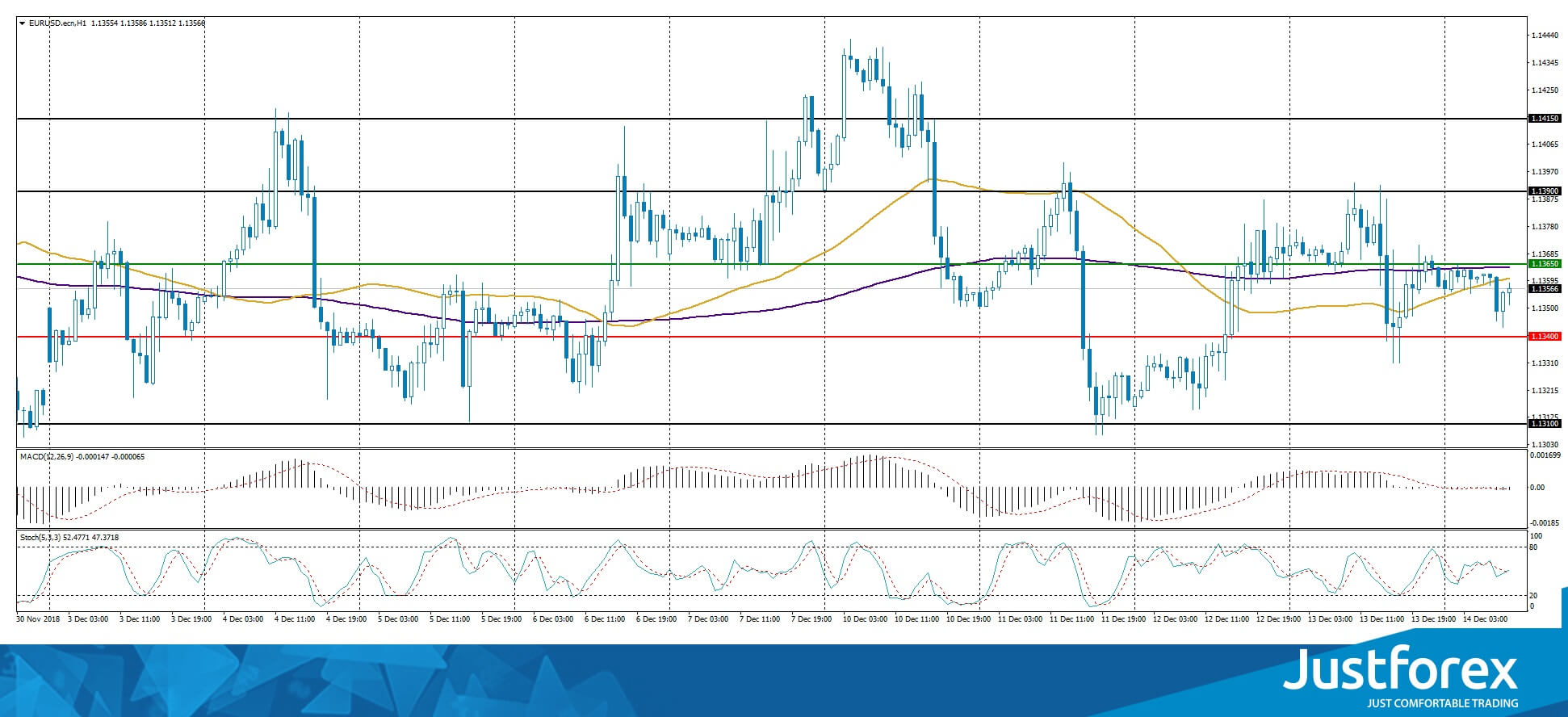
There are no precise signals: 50 MA has crossed 200 MA.
MACD histogram is around 0.
The Stochastic Oscillator is in the neutral zone, the %K line crosses the %D line. There are no signals at the moment.
Trading recommendations
Support levels: 1.13400, 1.13100
Resistance levels: 1.13650, 1.13900, 1.14150
If the price fixes below the support level of 1.13400, you should look into opening short positions. The price will move toward 1.13000-1.12800.
Alternatively, the quotes can grow to 1.13900-1.14150.
The GBP/USD currency pair
Technical indicators of the currency pair:
Prev Open: 1.26245
Open: 1.26325
% chg. over the last day: +0.18
Day's range: 1.25742 – 1.26623
52 wk range: 1.2477 – 1.4378
GBP/USD has stabilized. The pound is trading in a flat. The local support and resistance levels are 1.25800 and 1.26300. The financial market participants are waiting for the relevant data regarding Brexit. The US Retail report is in the spotlight. You should open positions from the key levels.
The News Feed is calm for today.
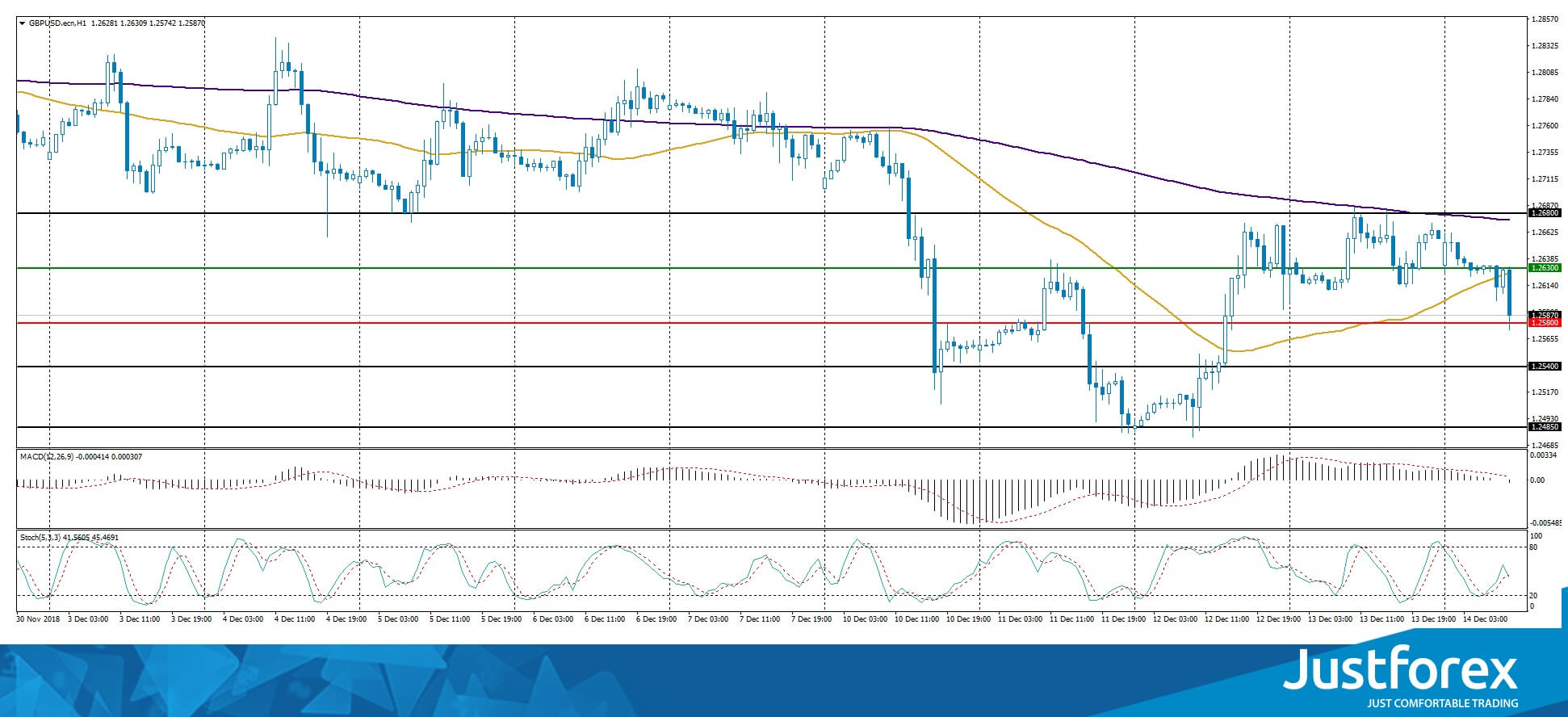
Indicators do not provide signals, the price has crossed 50 MA.
The MACD histogram is around 0.
Stochastic Oscillator is in the neutral zone, the %K line is crossing %D line. There are no signals at the moment.
Trading recommendations
Support levels: 1.25800, 1.25400, 1.24850
Resistance levels: 1.26300, 1.26800
If the price fixes below the round 1.25800, the GBP/USD quotes are expected to fall towards 1.25400-1.25000.
Alternatively they can rise to 1.26750-1.27000.
The USD/CAD currency pair
Technical indicators of the currency pair:
Prev Open: 1.33504
Open: 1.33452
% chg. over the last day: +0.01
Day's range: 1.33452 – 1.33949
52 wk range: 1.2248 – 1.3445
The USD/CAD technical picture remains ambiguous. The CAD keeps trading in a long flat. The key support and resistance levels are 1.33600 and 1.34000 respectively. Important stats from the US are in the spotlight. You should keep an eye on the oil quotes dynamics. Positions should be opened from the key levels.
The News Feed for Canada is calm.
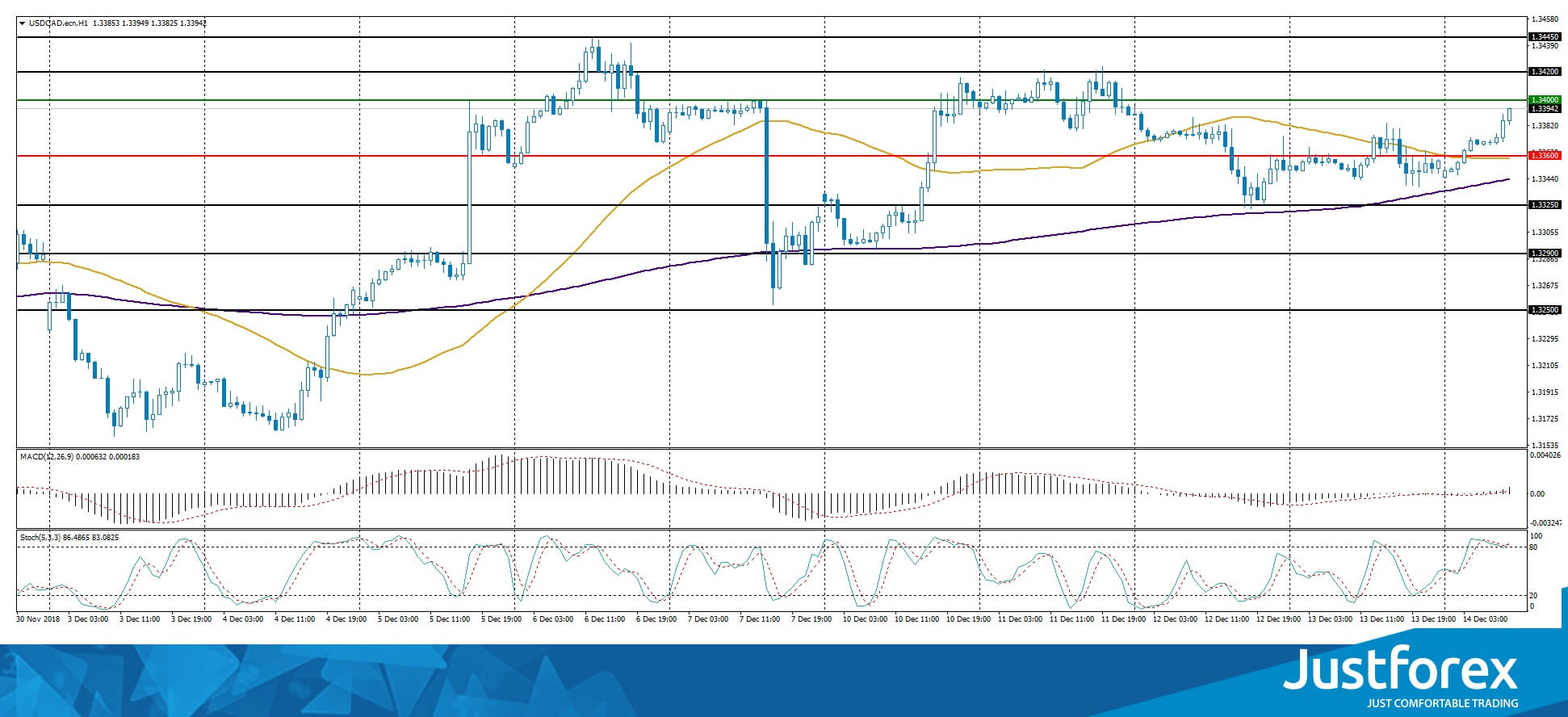
The price has fixed above 50 MA and 200 MA which indicates the power of the buyers.
The MACD histogram moved into the positive zone which indicates a bullish mood.
The Stochastic Oscillator is in the overbought zone, the %К line is crossing the %D line. There are no signals at the moment.
Trading recommendations
Support levels: 1.33600, 1.33250, 1.32900
Resistance levels: 1.34000, 1.34450
If the price fixes above 1.34000, you should consider entering the market with a long order. USD/CAD quotes will grow toward 1.34000-1.34300.
Alternatively, if the price fixes below 1.33600,, we recommend looking for market entry points to open short positions. The movement is tending to 1.33000.
The USD/JPY currency pair
Technical indicators of the currency pair:
Prev Open: 113.277
Open: 113.535
% chg. over the last day: +0.26
Day's range: 113.423 – 113.652
52 wk range: 104.56 – 114.56
USD/JPY has been in a bullish mood for the last week. Right now the quotes are consolidating. The local support and resistance levels are 113.400 and 113.650. A technical correction is highly possible. You should keep an eye on the US economical news feed.
Tankan published a positive report during the Asian trading session.
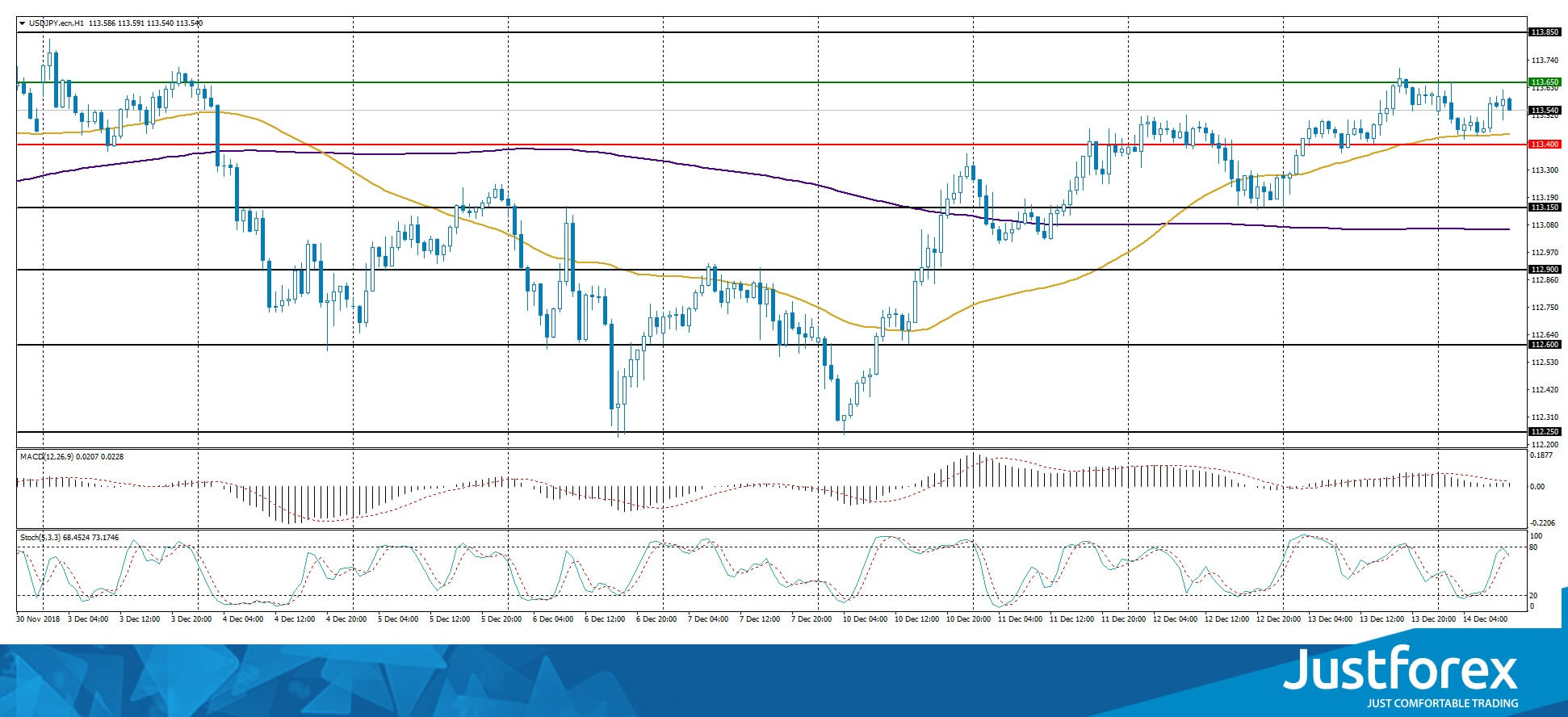
The price has fixed above the 200 MA and 50 MA which points towards a bullish mood.
The MACD histogram is closing in on 0.
The Stochastic Oscillator is in the neutral zone, the %K line crosses the %D line. There are no signals at the moment.
Trading recommendations
Support levels: 113.400, 113.150, 112.900
Resistance levels: 113.650, 113.850
If the price fixes above the support level of 113.650, it is necessary to consider buying USD/JPY. The movement is tending to 114.000.
Alternatively, the USD/JPY quotes can descend toward 113.150-113.000.
Euro Slips As German, Eurozone PMIs Edge Lower
EUR/USD has posted considerable losses in the Friday session. Currently, the pair is trading at 1.1298, down 0.53% on the day. There was disappointment as German and eurozone PMIs lost ground in November, pointing to weaker activity in the services and manufacturing sectors. In the U.S, the focus is on consumer spending. Retail sales and core retail sales are expected to drop sharply, with forecasts of 0.2% and 0.1%, respectively.
Thursday was uneventful for the euro, as there were no surprises from the ECB policy meeting on Thursday. As expected, the ECB maintained interest rates at 0.00% and reiterated that the bank’s bond-purchase scheme would terminate in December. The program was implemented in order to kick-start the economy and raise ultra-low inflation levels. At a press conference after the meeting, ECB President Mario Draghi said the stimulus scheme had not only boosted growth in the eurozone, but was “in some cases the only driver of this recovery”. At the same time, Draghi warned that eurozone growth was weakening. The ECB downgraded its growth forecasts for the eurozone – from 2.0% in September to 1.9% in December for 2018, and from 1.8% in September to 1.7% in December in 2019. Draghi added that headline inflation is also expected to drop in the coming months, due to weaker economic conditions.
In the U.S, weak inflation levels are another sign that the economy is slowing down. CPI dropped to 0.0% in November, down from 0.3% a month earlier. This marked the lowest level since May. Core CPI remained pegged at 0.2 percent. The weak readings can be attributed to falling oil prices, which has led to a sharp decline in gasoline prices. On an annualized basis, inflation gained 2.2 percent in November, down from 2.5 percent in October. With the U.S. economy showing signs of slowing down, and the global trade war taking a bite out of the global economy, inflation could continue to head lower as we head into 2019. This has led to a reassessment at the Federal Reserve of monetary policy. Earlier in the year, the Fed was sending messages that it would raise rates three or four times next year. This has been drastically scaled back, with some analysts predicting only one rate hike in 2019.
Bitcoin Rate Dropped To $ 3,200: What Causes A Decline?
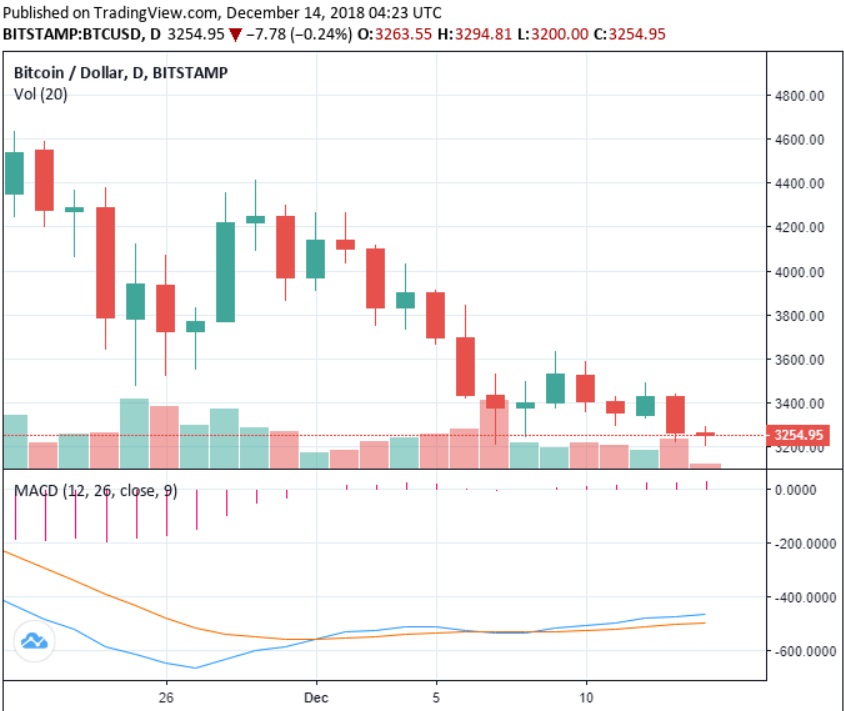
On December 14, following a fairly large sell-off from the $3,400 region, the Bitcoin price dropped to a new yearly low at $3,200. As Bitcoin (BTC) declined in value, other major cryptocurrencies including Ethereum (ETH), Stellar (XLM), and Bitcoin Cash (BCH) experienced large losses against the U.S. dollar, with BCH falling by more than 11 percent.
Within a seven-day period, the Bitcoin Cash price` has fallen from $116 to $89 by more than 25 percent despite dropping nearly half of its value the previous week. Prior to the four percent drop in the value of BTC, a cryptocurrency trader with an online alias “The Crypto Dog” suggested that it may be a risky period to initiate trades on the short-term trend of the dominant cryptocurrency due to its volatility in a low price range.
Over the past six months, the vast majority of major cryptocurrencies and ERC20 tokens have fallen by 50 to 80 percent against BTC, which fell by nearly 85 percent on its own. For Bitcoin to drop by a similar magnitude as Ethereum, for instance, it would have to drop an additional 72 percent from its current price. As Bitcoin struggles and as venture capital firms back away from the cryptocurrency sector amidst falling prices, the asset will likely not be able to initiate a breakout above the $4,000 mark in the upcoming weeks.
This week, Barry Silbert, the founder and CEO of large-scale cryptocurrency-focused venture capital firm Digital Currency Group (DCG) said that venture capital firms have started to pull out from deals with companies in the crypto sector. Silbert said: “We’ve seen half a dozen fundraising deals fall apart over the past month after the lead pulled out. All is not well in crypto VC investor land Good time to remind founders that a signed term sheet does not equal cash in the bank.”
Janet Yellen Fears The Next Financial Crisis
Janet Yellen is worried about the next financial crisis and told a small, intimate audience at an event Wednesday night in Washington, D.C., that her biggest concerns were the potential for reversal of financial safeguards put in place after the crisis and growing corporate debt. One of the most important questions she and her colleagues face, she said, is what monetary policy tools exist to address the next recession. Although interest rates will rise from the zero levels we had for seven years, they are likely to stay relatively low. That means, said Yellen, that monetary policy’s traditional short-term interest rate lever is not available to address a new downturn in the economy.
In response to a question about high levels of corporate debt she said that the issue is similar to what triggered the financial crisis. “You had investors that were reaching for yield and wanted to hold securities that they thought were safe, but that had reasonably high yields. There are a lot of investors in this low interest rate environment who are reaching for yield.”
Yellen is not as worried these loans present a risk to the banking system. However, “if the economy experiences any kind of negative shock where rates go up more than expected there will be a lot of corporate bankruptcies, a lot of distressed credit crunch a lot of downgrading of loans, a lot of investor losses,” said Yellen.
“We spent the next eight years trying to put in place regulations to strengthen the financial system and my view is a lot was accomplished but there is still a lot to do. So I am concerned with monitoring where things stand. And I am eager not to see an unwinding of the regulations. There may be ways they should be adjusted but I think it is important that those regulations serve to reduce the risk of another financial crisis.”
Asia Pinned Down By Gloomy Chinese Data
Asian shares tumbled on Friday after China reported a set of weak data, fanning fresh worries of a slowdown in the world's second-biggest economy and leaving investors fretting over the wider impact of a yet unresolved Sino-U.S. trade dispute. MSCI's broadest index of Asia-Pacific shares outside Japan fell 1.3 percent. Japan's Nikkei, also dragged down by the country's weak tankan sentiment index, dropped 2.0 percent. China's benchmark Shanghai Composite and the blue-chip CSI 300 closed down 1.5 percent and 1.7 percent, respectively, and Hong Kong's Hang Seng was off 1.5 percent.
Financial spread-betters expect London's FTSE Frankfurt's DAX and Paris's CAC to fall between 0.7 and 0.8 percent when they open. China's November retail sales grew at the weakest pace since 2003 and industrial output rose the least in nearly three years as domestic demand softened further, underlining rising risks to the economy as Beijing works to defuse a trade dispute with the United States.
The Chinese yuan weakened 0.15 percent to 6.8888 per dollar in offshore trade following the data. Overnight on Wall Street, the S&P 500 ticked down 0.02 percent to 2,650, not far from its 6-1/2-month closing low of 2,633 touched on Nov. 23, while the Nasdaq Composite dropped 0.39 percent. U.S. corporate earnings due next month could throw a spotlight on the impact from the U.S. tariffs on imports from China, while there is risk of a government shutdown and further political stalemate in a divided U.S. congress, Kuramochi added.