Sample Category Title
GBP/USD Outlook: Optimistic Expectations Push Sterling Higher ahead PM May Confidence
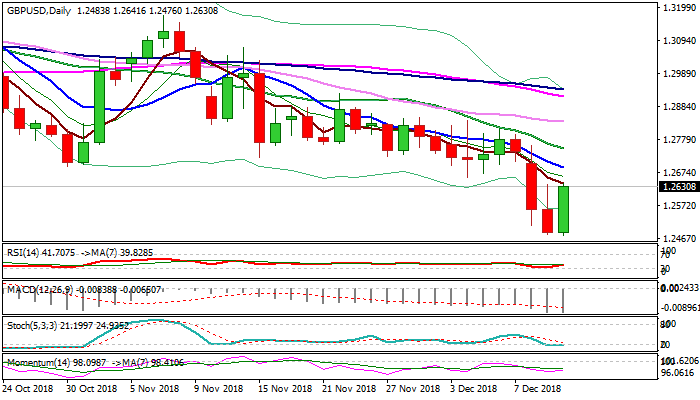
Sterling rose above 1.26 handle against dollar in early US session trading on Wednesday, driven by optimistic expectations that PM May will win confidence vote, triggered by conservative lawmakers and due later today. Political turmoil in the UK increased the pace after parliamentary vote on Brexit plan of PM May was postponed, with the latest news that she will be basically fighting for her job, adding to growing uncertainty. May said she would battle for her premiership with everything she had, as her opponents try to replace her by voting no confidence to the Prime Minister. The pound would advance if May passes today's test and could test pivotal barriers at 1.2689 (falling 10SMA) and 1.2750 (20SMA), violation of which would generate fresh bullish signals. Negative scenario for sterling could be expected if PM May fails on today's vote that could spark fresh bearish acceleration and expose key supports at 1.20 zone. If PM May loses her position, the political situation would become much more turbulent, as her successor would not have time for new negotiations, which could result in two scenarios: no-deal disorderly exit from the EU or possible new vote on Brexit, where the UK citizens would vote again whether the UK will leave the EU or will stay in the union. In any case, high volatility after the vote could be anticipated, regardless to the outcome. The results of today's vote will be announced at 21:00GMT.
Res: 1.2648; 1.2661; 1.2689; 1.2750
Sup: 1.2606; 1.2575; 1.2558; 1.2539
US: Energy Mutes November CPI, but Core Inflation Firm
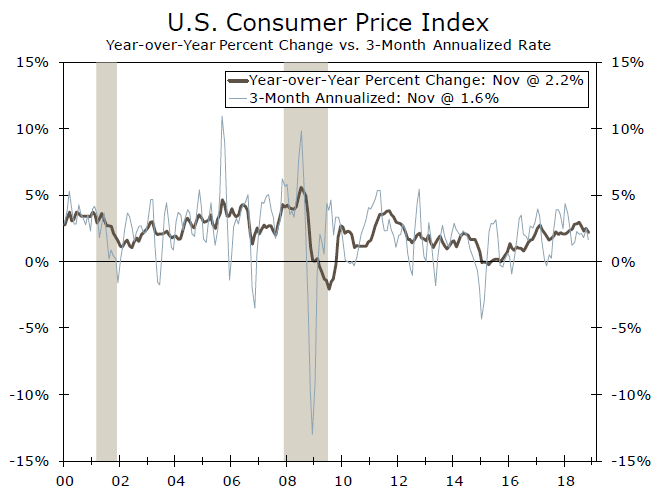
Consumer prices were flat in November as a drop in energy prices offset increases for food and core items. While headline inflation has eased, the core remains consistent with the Fed's inflation goal.
Foot Off the Gas
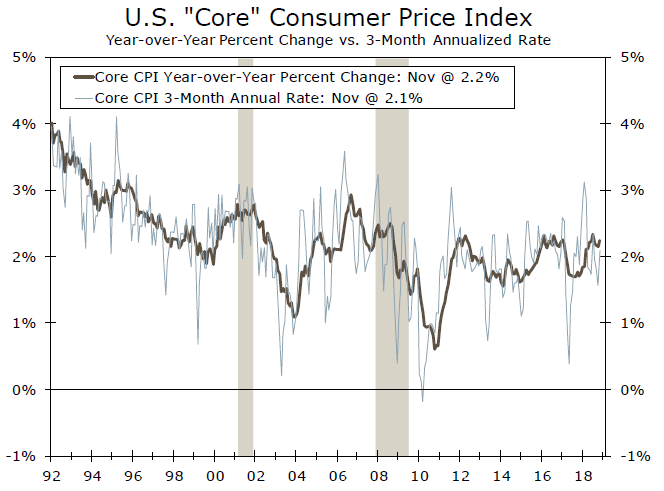
Consumer prices were unchanged in November. The flat reading pushed the year-over-year change to 2.2%, which is down from 2.9% as recently as July. The more benign inflation picture for both November and the most recent 12 months has been due in large part to the pullback in energy costs. November's plunge in oil prices led to a 4.2% drop in gasoline prices. Prices in this category are now up "only" 5% year over year, with further moderation to come as prices have continued to slide through the first half of December.
The overall decline in energy prices was a more modest 2.2% due to a rise in energy services. A roughly 25% rise in natural gas prices sent the cost of utility gas services up, while electricity prices backed up the largest gain in four years with another rise in November.
Meanwhile, food prices rose at both the grocery store (+0.2%) and restaurants (+0.3%). That said, we still do not expect headline inflation to get much help from the food away from home component in the coming months given the recent pressure on agricultural and livestock commodities.
Core Inflation Edges Up
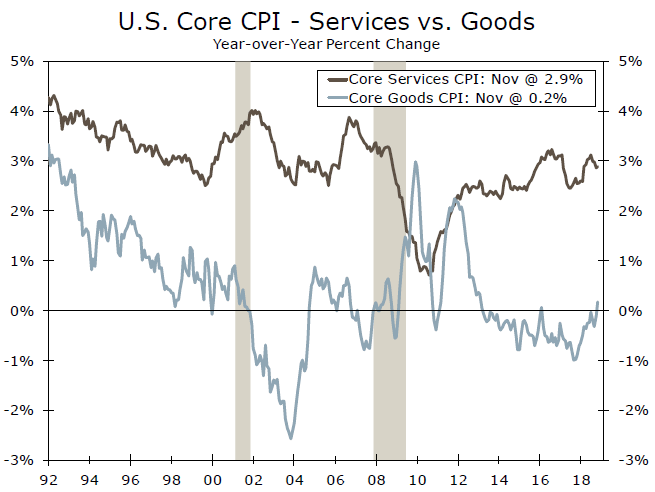
Core inflation rose 0.2% as the underlying trend in inflation remains firm. Core goods prices rose for a second consecutive month (+0.2%), again on the back of used car prices. The oddly large drop for this component in September (-3.0%) has now been fully unwound with another 2%+ gain, and puts the index more in line with the industry's Manheim index. Core goods are now up 0.2% over the past year, the first 12-month gain since 2013.
Core services moved up 0.21%, which was a bit stronger than October but generally in line with the recent trend. A pickup in shelter and medical care costs more than offset softer readings for transportation services.
Consistent With, But Not Blowing Past, the Fed's Target
At 2.2% year over year, the core remains consistent with the Fed's target, as CPI tends to run a few tenths above the core PCE deflator. Recent developments, however, suggest that the overall inflation picture is at little risk of becoming unbridled from the Fed's goal. The dollar's continued strength should help to keep a lid on goods prices even as tariffs have pushed some input costs higher. The slowdown in housing also points to prices in the sizeable shelter component growing a bit more modestly in the coming year. At the same time, the decline in oil prices over the past six weeks has put the brakes on what was already a tenuous recovery in inflation expectations.
Nevertheless, capacity constraints—particularly for labor—and a greater willingness to raise prices mean a marked pullback is unlikely. We expect core CPI to run moderately above 2% in 2019, giving the Fed the green light for some additional tightening.
Sunset Market Commentary
Markets
Global core bonds lost ground as positive risk improvement persists. Asian equities set the tone and opened higher. The release of Huawei’s CFO (on bail) supported fresh hopes of an improvement in US-China relations. European equities opened higher as well. German Bunds finished yesterday’s session higher, despite the risk rebound, and initially proved resilient today as well. The Bund dropped his defense after white smoke appeared from Rome. The Italian government reached an agreement to lower its budget deficit to 2.0%. Tomorrow, they will present the revised budget to the European Commission. We expect the EU not to offer much resistance, especially with France also set to breach EU budget rules. Italian BTP’s rallied on the news, pushing the Italian 10-yr yield below 3.0% for the first time since September. US Treasuries gradually moved lower, as investors cut more safe haven assets. US November CPI was spot on expectations. Right before the US opening bell, the WSJ said China is preparing to increase access for foreign companies, raising hopes on easing trade tensions. US Treasuries fell further on the news. The US yield curve moved higher with changes varying between +1.1 bp (2-yr) and +2.0 bps (5-yr). The German yield curve moves north as well. Changes range from +2.1 bps (2-yr) to +3.3 bps (10-yr).
EUR/USD wasn’t affected much by the latest brexit developments today (see below). Instead, the currency pair treaded water during early European hours before spiking on reports Italy is to propose a 2% deficit target to the EU. That would be in line with the Commission’s demand and pave the way for a final agreement. US CPI data was spot on and had no significant impact on trading. Another encouraging sign from China to resolve the trade tensions with the US was considered dollar positive. EUR/USD retreated slightly from its intraday “Italy high” around 1.136 to 1.135 currently, still up from 1.132 this morning. USD/JPY trades virtually unchanged from yesterday at 113.4.
The chair of the so called 1922 Committee Brady Graham announced this morning he received the 48 Tory letters needed to trigger a vote of no confidence in Theresa May. Members of the Conservative Party decide tonight whether or not to topple her as party leader and, by consequence, as prime minister. It requires a simple majority (158 of 315) to send May packing. Sterling reversed initial losses as soon as several high profile Tories expressed support shortly after the news got public. The BBC later reported that at least 158 Tories have said publicly they will vote in favor of May. Sterling rallied to EUR/GBP 0.899 at the time of writing. A clean break of the 0.90 hurdle proves a tough nut to crack for now. If or when May lives tonight, it’s only to fight another day since the (tweaked?) brexitdeal still needs Parliamentary approval. Investors don’t want to get ahead of things much and stay cautious on sterling.
News Headlines
Swedish centre-left Social Democrats leader Löfven faces a parliamentary vote on his candidacy on Friday. He proposes a minority government with the Green party, but needs some center-right parties to abstain or support his request. It’s the 2nd out of maximum 4 attempts to form a government after Swedish parliament vote against centre-right leader Kristerrson. Market didn’t react to political news, but the SEK did suffer a setback after lower than expected inflation numbers (-0.1% M/M and 2.1% Y/Y) which cast some doubt over a December rate hike.
US CPI inflation printed bang in line with forecasts. Headline inflation slowed from 2.5% Y/Y in October to 2.2% Y/Y in November (0% M/M). Core inflation, which excludes volatile components like energy or food prices rose from 2.1% Y/Y to 2.2% Y/Y (0.2% M/M).
USD/JPY Mid-Day Outlook
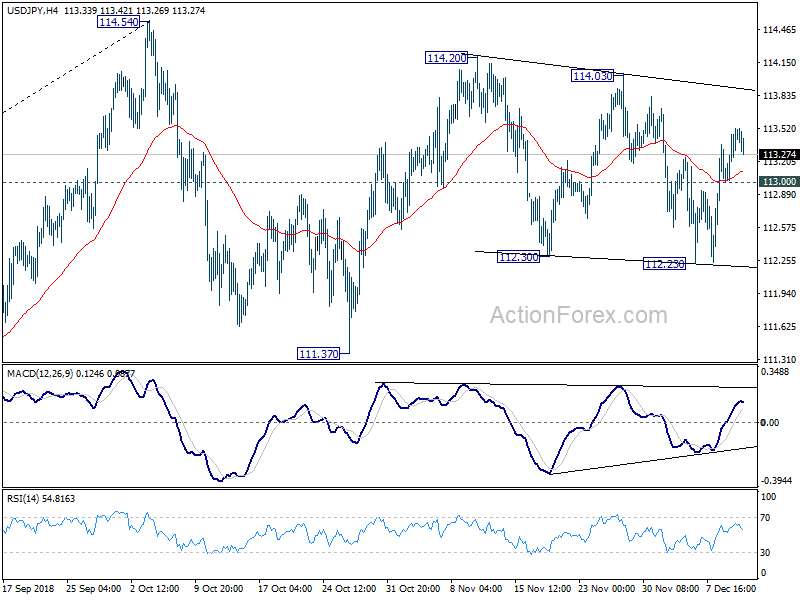
Daily Pivots: (S1) 113.08; (P) 113.28; (R1) 113.58; More..
With 113.00 minor support intact, intraday bias in USD/JPY stays mildly on the upside for 114.03 resistance. Break there should resume the rebound from 111.37 and target 114.54 key resistance next. On the downside, below 113.00 minor support will turn intraday bias neutral first. Further break of 112.23 will extend the consolidation from 114.54 with deeper fall. But after all, downside should be contained by 38.2% retracement of 104.62 to 114.54 at 110.75 to bring rebound. Larger rise from 104.62 is expected to resume later.
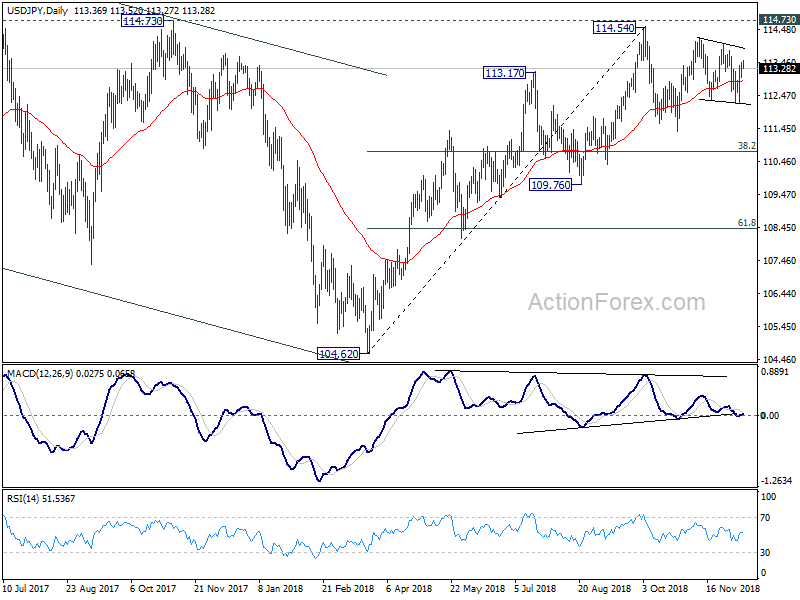
In the bigger picture, corrective fall from 118.65 (2016 high) should have completed with three waves down to 104.62. Decisive break of 114.73 resistance will likely resume whole rally from 98.97 (2016 low) to 100% projection of 98.97 to 118.65 from 104.62 at 124.30, which is reasonably close to 125.85 (2015 high). This will stay as the preferred case as long as 109.76 support holds. However, decisive break of 109.76 will dampen this bullish view and turns outlook mixed again.
USD/CHF Mid-Day Outlook
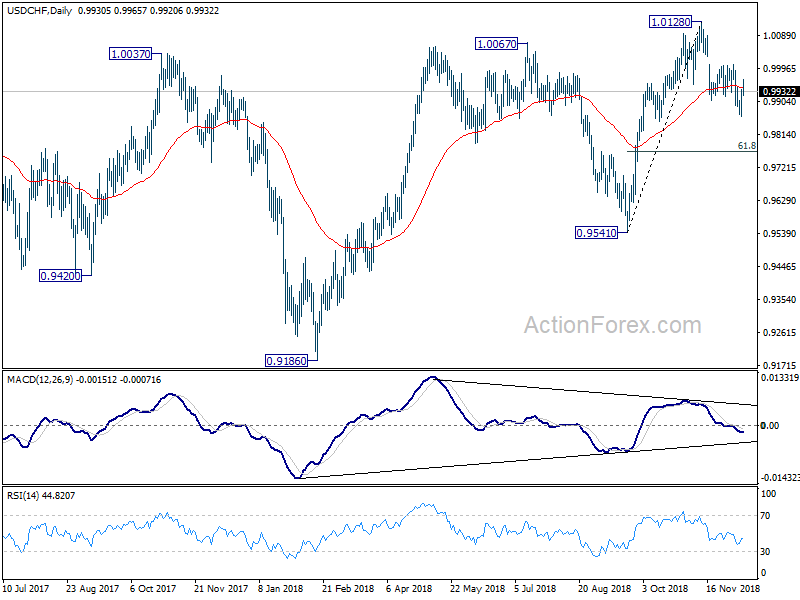
Daily Pivots: (S1) 0.9882; (P) 0.9911; (R1) 0.9959; More...
At this point, intraday bias in USD/CHF remains neutral first. On the upside, break of 1.0008 resistance will indicate that pull back from 1.0128 has completed. Intraday bias would be turned back to the upside for retesting 1.0128 first. On the downside, below 0.9862 will target 0.9848 support first. Sustained break there will confirm near term reversal and target 61.8% retracement of 0.9541 to 1.0128 at 0.9765 and below.
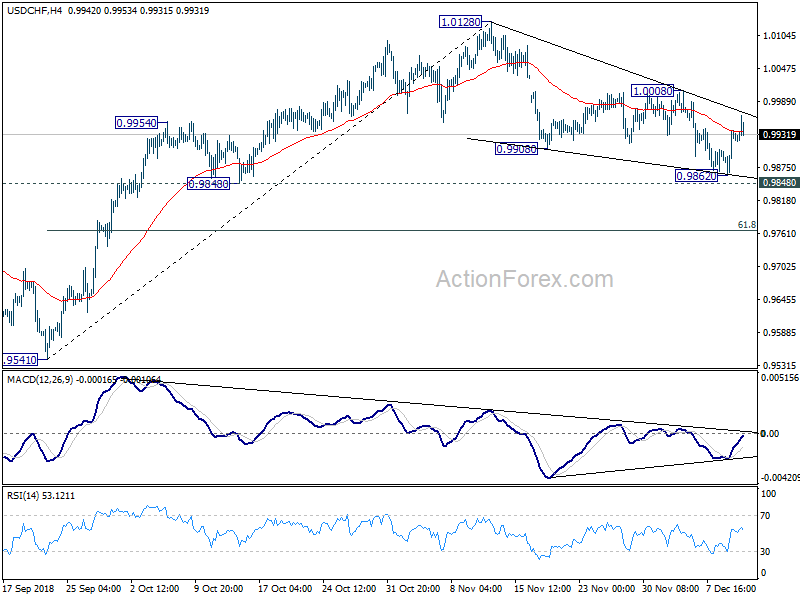
In the bigger picture, rise from 0.9541 could have topped at 1.0128. But as long as 0.9541 support holds, we'd still expect rise from 0.9186 to resume at a later stage. Break of 1.0128 will target 1.0342 key resistance. However, break of 0.9514 will pave the way back to 0.9186 low.
EUR/USD Mid-Day Outlook
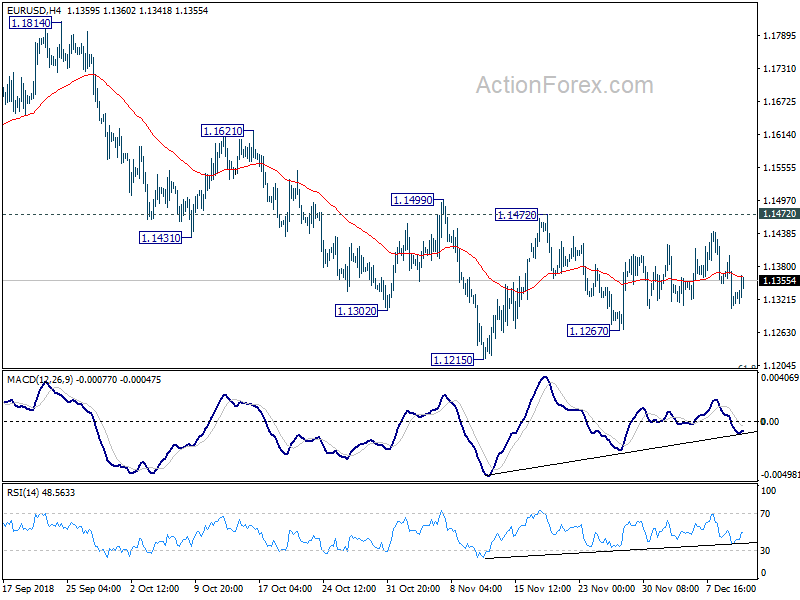
Daily Pivots: (S1) 1.1282; (P) 1.1342; (R1) 1.1377; More.....
EUR/USD is still gyrating in range of 1.1267/1472. Intraday bias stays neutral first. On the downside, break of 1.1267 will target 1.1215 low first. Firm break there will resume larger down trend from 1.2555 for 1.1186 fibonacci level next. However, considering bullish convergence condition in daily MACD, firm break of 1.1472 will be suggest medium term bottoming and turn outlook bullish for 1.1814 resistance instead.
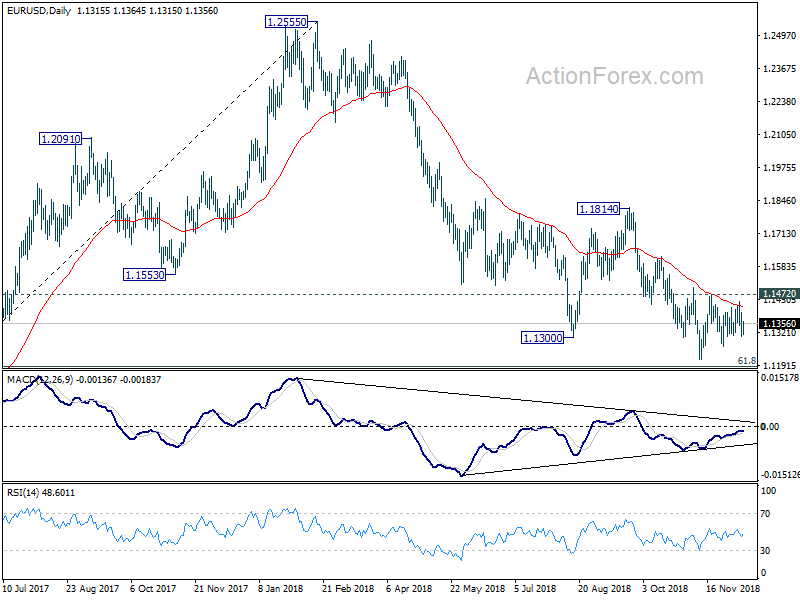
In the bigger picture, as long as 1.1814 resistance holds, down trend down trend from 1.2555 medium term top is still in progress and should target 61.8% retracement of 1.0339 (2017 low) to 1.2555 at 1.1186 next. Sustained break there will pave the way to retest 1.0339. However, break of 1.1814 will confirm completion of such down trend and turn medium term outlook bullish.
CHFJPY Bounces off 38.2% Fibonacci But Bullish Outlook Remains in Play
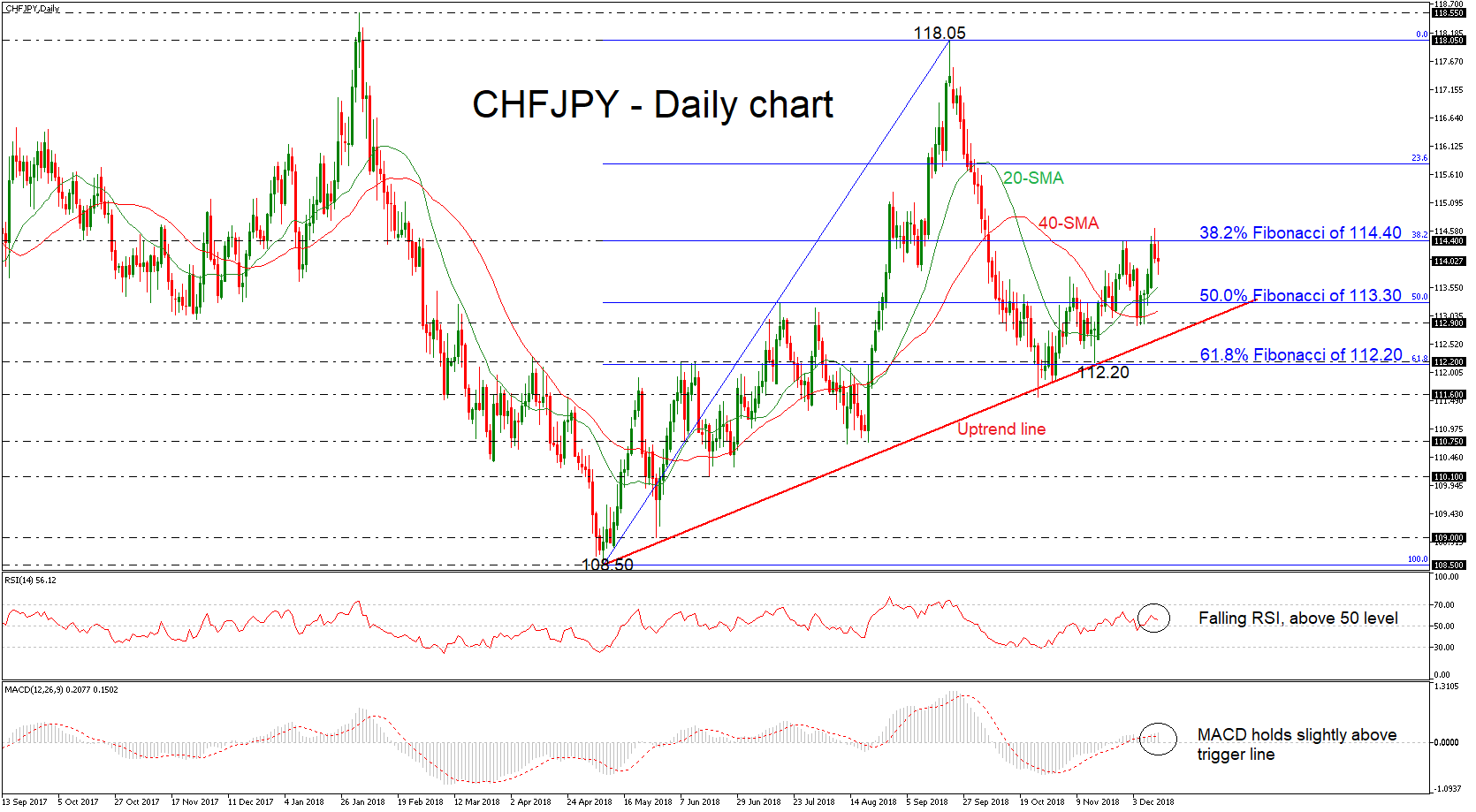
CHFJPY had another bearish start on Wednesday, with the price remaining below the 38.2% Fibonacci retracement level of the upleg from 108.50 to 118.05, around 114.40. Technically, in the daily timeframe, the Relative Strength Index (RSI) is moving south in the positive zone, while the MACD oscillator is losing momentum, despite that it stills stands above the trigger and zero lines.
A further reversal to the downside, could find obstacle near the 20-day simple moving average (SMA) around 113.50 before touching the 50.0% Fibonacci of 113.30. Falling lower, the bears are eagerly awaiting to test the medium-term ascending trend line near 112.90, where a decisive close below this line, could indicate that the rally off 108.50 might be running out of steam, with traders probably looking for support first at the 112.20 mark and then at the 111.60 level.
On the upside, there is immediate resistance around the 114.40 barrier halting further advances. A successful break of this level could retest the obstacle around the 23.6% Fibonacci region of 115.80.
Overall, looking at the long-term timeframe, CHFJPY has been trading in a sideways channel since November 2016 with upper boundary the 118.50 barrier and lower boundary the 108.00 region. However, in the medium-term the price has been creating an ascending movement.
Canadian Dollar Edges Higher as US Inflation Weakens
The Canadian dollar is showing little change in the Wednesday session. Currently, USD/CAD is trading at 1.3355, down 0.27% on the day. On the release front, Canadian Utilization Capacity Rate dropped for a second straight month, coming in at 82.6 percent. This missed the estimate of 85.8 percent. In the U.S., consumer inflation reports softened in November, but matched the estimates. CPI dipped to 0.0 percent and Core CPI fell to 0.2 percent. On Thursday, Canada releases ADP nonfarm payrolls and the U.S. publishes unemployment claims.
Only a few months ago, the booming U.S. economy led to speculation that the Federal Reserve would continue raising rates in 2019, possibly up to four times. Since then, signs of a slowdown in the economy have caused the Fed to reassess its “gradual rate hike” policy, and many analysts are predicting just one rate hike next year. Three rate hikes so far this year have slowed economic growth, as seen by lower GDP readings and a dismal nonfarm payrolls report for November. Still, the Fed is widely expected to raise rates at the policy meeting on December 19, with the CME setting the odds of a hike at 80 percent.
The Bank of Canada remains in caution mode, even after strong employment numbers on Friday. The economy created over 94 thousand jobs, crushing the estimate of 10.1 thousand. As well, the unemployment rate dropped from 5.8 percent to 5.6 percent. However, all is not well with the economy, as GDP declined 0.1% in September, the second decline this year. The bank held interest rates at its policy meeting last week and is expected to do so again in January.
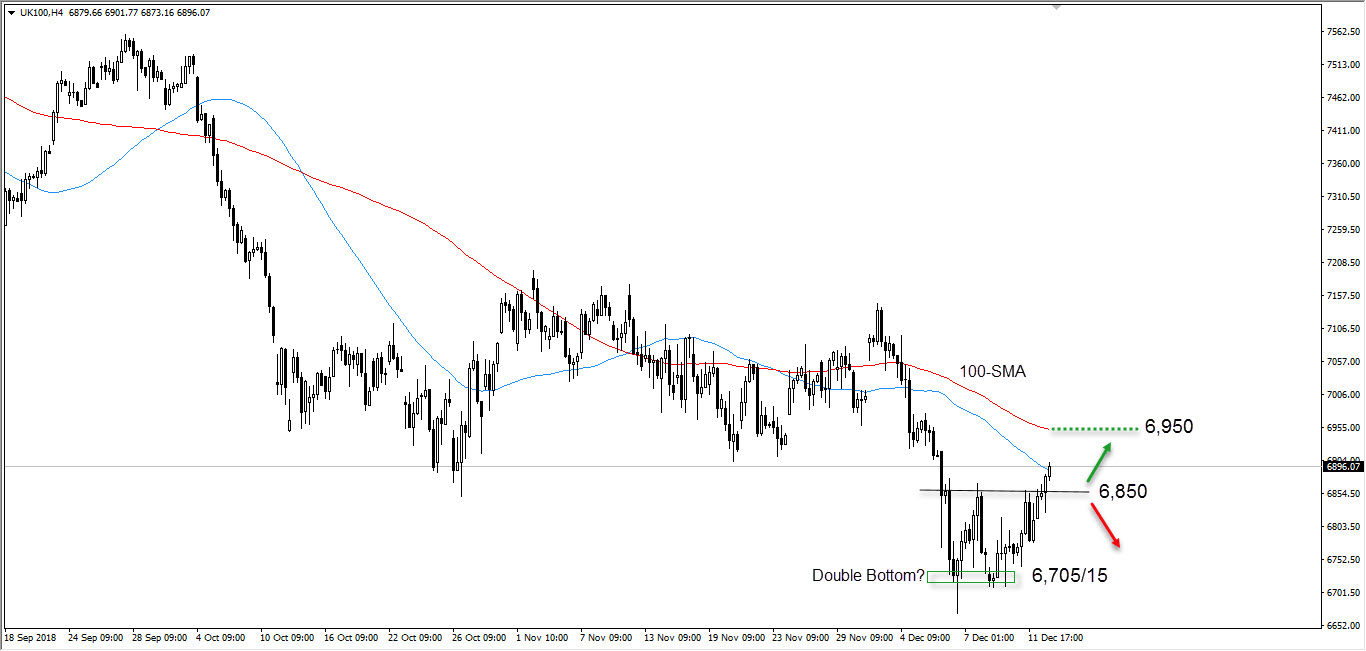
FTSE100 Maintains a Base above 6,850
Yesterday, we saw the rally continue further to remove the major 6,850 barrier (the neckline for the double-bottom reversal pattern) to see a resumption of the bull trend and to turn the spotlight directly on next resistance at 6,950. Support is initially seen at 6,850 ahead of 6,715.
NZD/USD: Extends Bearish Pressure On Price Sell Off
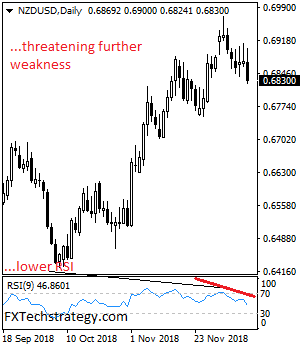
NZDUSD extends bearish pressure on price sell off with more decline expected towards 0.6800 support. Further down, support stands at the 0.6750 level. Further down, the 0.6700 level comes in as the next downside target. Its daily RSI is bearish and pointing lower suggesting further weakness. On the upside, resistance resides at the 0.6850 level where a break will turn attention to the 0.6900 level. A break of here will have to occur to create scope for a move towards the 0.6950 level. Further out, resistance stands at the 0.7000 level. All in all, NZDUSD faces further downside pressure on sell off.