

Sample Category Title
GBP/JPY Could Struggle To Surpass 143.50
Key Highlights
- The British Pound fell significantly and tested the 141.00 support area against the Japanese Yen.
- There are two key bearish trend lines formed with resistance near 143.40-50 on the 4-hours chart of GBP/JPY.
- The UK Claimant Count in Nov 2018 changed 21.9K, more than the 13.2K forecast.
- Today, the US Consumer Price Index for Nov 2018 will be released, which is forecasted to rise 2.2% (YoY).
GBPJPY Technical Analysis
The British Pound declined steadily after it failed to break the 150.00 resistance against the Japanese Yen. The GBP/JPY pair traded below the 146.00 and 144.00 support levels, and it recently tested the 141.00 support area.
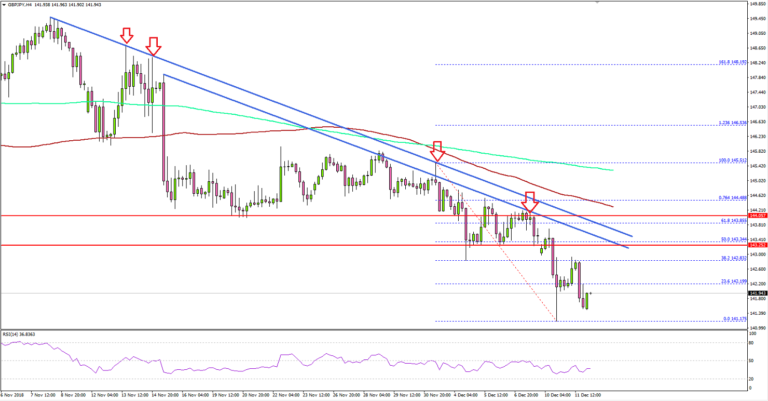
Looking at the 4-hours chart, the pair recently traded below the 143.50 support area and declined towards 141.00. A new monthly low was formed at 141.17 and the pair settled below the 100 simple moving average (red, 4-hours).
Later, there was an upside correction and the pair recovered above 142.00 and the 23.6% Fib retracement level of the recent decline from the 145.51 high to 141.17 low.
However, there is a strong resistance waiting on the upside near the 143.40 level. Moreover, there are two key bearish trend lines formed with resistance near 143.40-50 on the same chart. The 50% Fib retracement level of the recent decline from the 145.51 high to 141.17 low is also near 143.40.
Therefore, the pair is likely to struggle near the 143.40-50 zone, above which there could be a reversal towards 145.00. On the downside, the key supports are 142.00 and 141.00, followed by 140.00.
Fundamentally, the UK Claimant Count Change for Nov 2018 was released by the National Statistics. The market was looking for a change of 13.2K compared to the last 20.2K.
However, the result was disappointing as there was a change of 21.9K and the last reading was revised to 23.2K. The Claimant Count rate climbed from 2.7% to 2.8%, but the unemployment rate remained stable at 4.1%. The report added:
Estimates from the Labour Force Survey show that, between May to July 2018 and August to October 2018, the number of people in work and the number of unemployed people both increased but the number of people aged from 16 to 64 years not working and not seeking nor available to work (economically inactive) decreased..
After a sharp decline, both GBP/USD and GBP/JPY recovered, but there are many barriers for buyers on the upside waiting to protect further gains.
Economic Releases to Watch Today
- US Consumer Price Index Nov 2018 (MoM) – Forecast 0%, versus +0.3% previous.
- US Consumer Price Index Nov 2018 (YoY) – Forecast +2.2%, versus +2.5% previous.
- US Consumer Price Index Ex Food & Energy Nov 2018 (YoY) – Forecast +2.2%, versus +2.1% previous.
Daily Markets Broadcast
Equities mixed after a whippy session yesterday
US indices closed mixed after a volatile day yesterday with initial euphoria that China might soon announce various trade concessions being countered by US President Trump’s threat to shut down the government. Rumours the Conservative MPs had collected enough support to mount a leadership challenge on PM May also weighed on sentiment.
US30USD Daily Chart
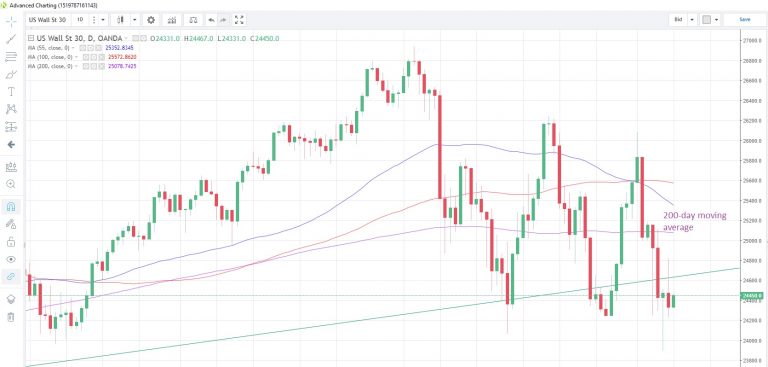
The US30 index closed lower yesterday despite a strong rally earlier in the session. Trade hopes fueled the rally, only to be halted by Trump’s threat to shut down government if border wall funding is not made available. Markets have started positively this morning after Trump said the release of Huawei’s CFO could be part of a broader trade deal with China
The Doji formation mentioned yesterday failed after the index closed lower. The 100-week moving average is at 23,477
US consumer prices are expected to rise 2.2% y/y in November, slower than October’s 2.5% rate, lending support to the notion that the Fed may pause its hiking cycle next year.
DE30EUR Daily Chart
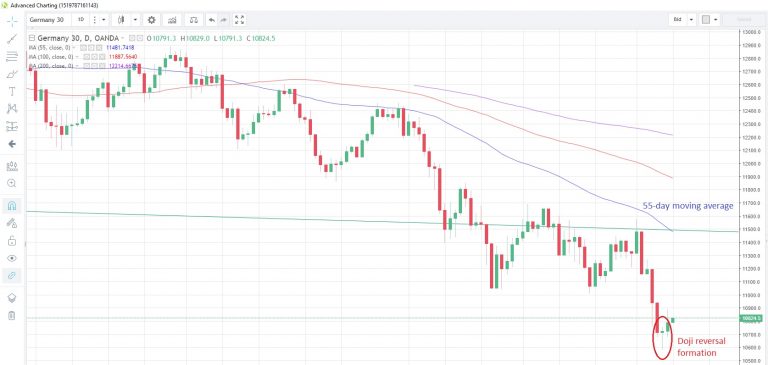
The Germany30 index rose for a second straight day yesterday and looks poised to add to those gains today, given the bullish start by US futures
Doji reversal formation on the charts confirmed with yesterday’s higher close. The 55-day moving average is at 11,482
Euro-zone industrial production is expected to slow to +0.8% y/y in October from +0.9% the previous month.
UK100GBP Daily Chart
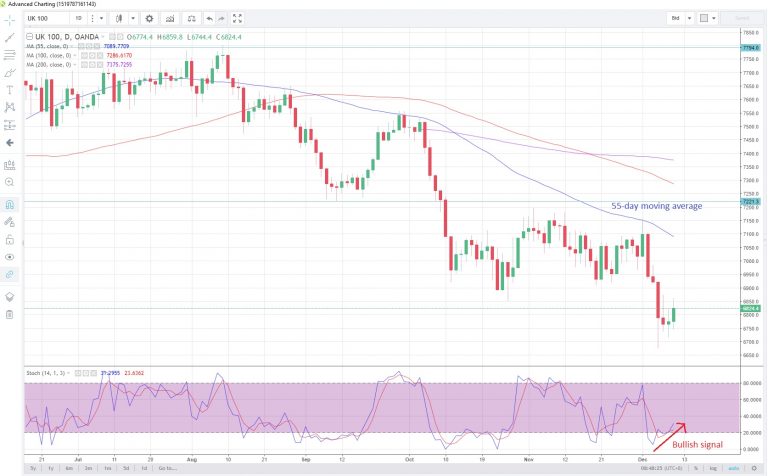
UK shares advanced for a second day yesterday, despite all the political turmoil surrounding Brexit. The pound was the asset class to bear the brunt of negativity
Slow stochastics momentum indicator is above the oversold threshold and rising, which is a bullish signal. The 55-day moving average at 7,090 acts as the first resistance point
Sky News reported that Conservative MPs have gathered the 48 letters required to mount a vote of no confidence in PM May. Should it happen, it could stall the index’s current advance.
Trump: Fed Powell’s a great guy, may intervene in Huawei case for trade deal
In a Reuters interview, Trump toned down his rhetorics against Fed chair Jerome Powell and said he's a "great guy". Though, Trump still disagree to Fed's "foolish" rate hike next week.
Trump said, "Well, I think that would be foolish but what can I say? What can I say? You know, I put a man there. What can I say? If they do that, I'd be disappointed and I think a lot of people would be disappointed." On Powell, Trump said, "I think he's trying to do what he thinks is best. I disagree with him - I think he's a great guy. But, I think he's trying to get it right but I think he's being too aggressive, far too aggressive, actually far too aggressive."
On trade negotiation with China, Trump said the Chines are "back in the market" buying "tremendous amounts of soybeans". He added there maybe another meeting of "top people on both sides". And, if necessary, Trump is open to another meeting with Xi "who I like a lot and get along with very well".
Trump went further and said that he could intervene in the Huawei case if it's good for the trade deal. He said "If I think it's good for the country, if I think it's good for what will be certainly the largest trade deal ever made – which is a very important thing – what's good for national security – I would certainly intervene if I thought it was necessary."
Highlights: Key quotes from the Reuters interview with Trump
Separately, Huawei's top executive Meng Wanzhou, arrested by Canada on December 1 on US request, was granted bail by a Canadian court yesterday.
Will Europe’s Slowdown Restrain the ECB?
Executive Summary
After a standout performance in 2017, economic growth across the Eurozone has decelerated through 2018. Several individual economies saw real GDP contract in Q3, leading market participants to question the strength and duration of the current expansion. We find that while some of the Q3 weakness was likely due to temporary factors, other higher-frequency indicators also point to a more pronounced slowdown. On net, while growth prospects could remain subdued in the near-term, the expansion should remain intact, and we look for rising wages and gains in broader consumer incomes to fuel economic growth in the coming quarters.
In terms of implications for monetary policy, market participants will likely be closely watching this week's European Central Bank (ECB) monetary policy announcement for any effect that the slower pace of growth could have on the ECB's plans to begin rolling back policy accommodation in coming quarters. While we look for the ECB to remain on hold this week, we still look for further monetary policy normalization in 2019, assuming the inflation and growth picture improve in coming months. In this report, we assess the recent economic slowdown and its effects on monetary policy and GDP growth prospects in the year ahead.
Europe's Slowdown: Temporary or Permanent?
Economic growth in the Eurozone has slowed so far in 2018. Looking back at 2017, real GDP growth firmed steadily over the course of the year, with the 2.8% year-over-year gain registered in Q3-2017 the fastest pace since 2011. Compare that to the most recent print in Q3-2018 of 1.6%, and it is clear that growth has come off the boil this year (Figure 1). A closer look at several individual countries reinforces the sluggish pace of growth registered in Q3. For example, economic growth in Germany, the largest economy in the Eurozone, actually contracted in Q3 for the first time in more than four years (Figure 2).
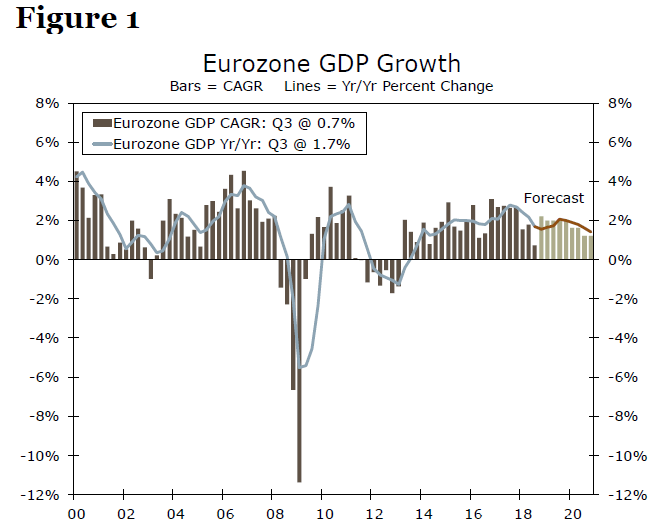
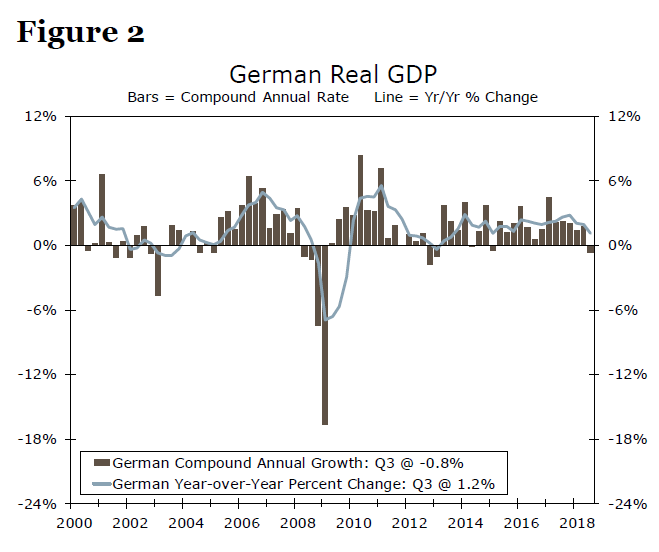
In Italy, GDP also declined 0.1% (not annualized) in Q3 after only modest gains in the first half of the year, as that country also faces ongoing fiscal challenges amid pushback from the E.U. regarding its 2019 budget plans.1 While some of the Q3 weakness is likely due to temporary factors, which we discuss in more detail below, the slowdown in these countries is still likely a bellwether of the broader trend across Europe. Indeed, real GDP in Sweden and Switzerland, albeit smaller economies on the continent, also contracted 0.2% (not annualized) in each country in Q3.
So what are some likely explanations for the recent slowdown, and should we be concerned about longer-term growth prospects across Europe? As mentioned earlier, some of the Q3 weakness is likely due to one-off factors that affected auto purchases in the quarter. Indeed, German new passenger car registrations declined more than 30% in September, while data from other European countries including Italy and Sweden pointed to similar auto weakness over the month. Commentary from the German auto industry cited new emissions tests and fewer working days in the month as driving factors behind September's large drop.2
At the same time, several other higher frequency indicators have also eased over the course of 2018, leading market participants to question if a slower pace of growth might continue in coming quarters. The Eurozone purchasing managers' indices have fallen significantly this year, and are now only modestly in expansion territory (Figure 3). Readings of economic confidence have shown similar declines so far this year. For example, the expectations component of the ZEW survey dropped into negative territory in June and has remained there in recent months, signaling more respondents feel pessimistic than optimistic about the economic growth prospects over the next six months, while investor confidence has also moderated over the same time period (Figure 4).
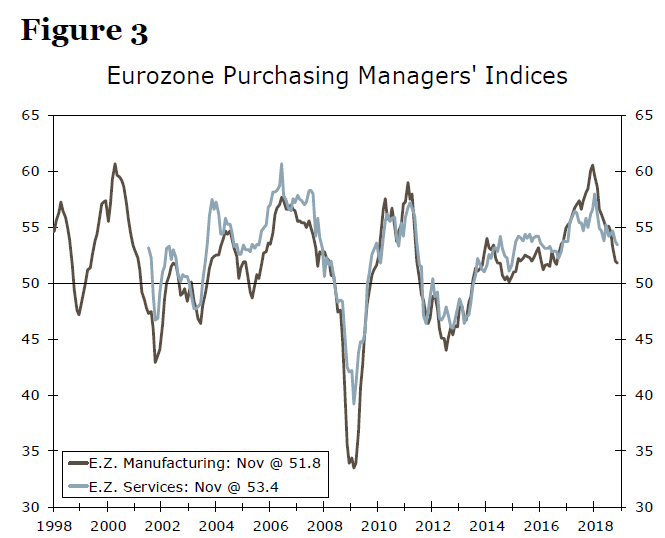
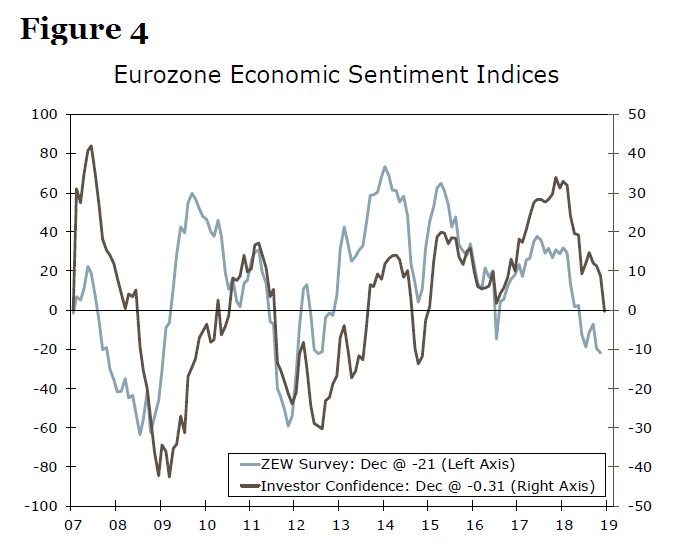
Examining the higher frequency hard data yields largely the same result of a broader slowdown in growth in recent quarters. Industrial production growth has been tepid in 2018, with month-overmonth declines in six of nine months for which data is available this year. These data suggest that businesses could have fewer incentives to ramp up production in the midst of ongoing political and trade uncertainties occurring across the continent. At the same time, external demand has also weakened amid a generally slower global growth environment, and export growth has also decelerated this year.
Turning to the consumer side of the equation, the picture looks a bit more encouraging. The labor market continues to improve, with the unemployment rate currently sitting at a 10-year low of 8.1% in October. At the same time, stronger wage growth has finally begun to materialize. Recentlyreleased data showed that wages rose at their fastest pace of the current expansion in Q3, with compensation per employee up 2.5% year over year. Relatively low inflation has also likely supported consumers' purchasing power, and consumers have likely been buoyed by interest rates that remain at historic lows. While demand-side detail in the Q3 GDP data showed that consumer spending rose at a modest 0.1% pace in the quarter, it appears that consumers are still wellpositioned to support economic growth going forward amid a continued pickup in wages.
What Does the Recent Slowdown Mean for the ECB?
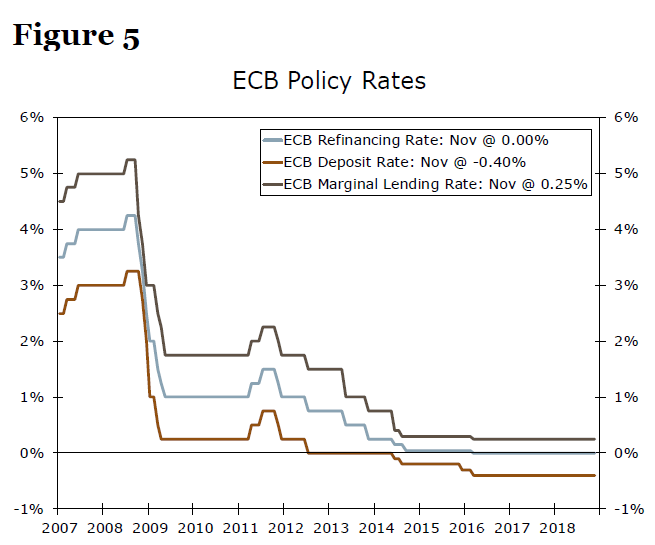
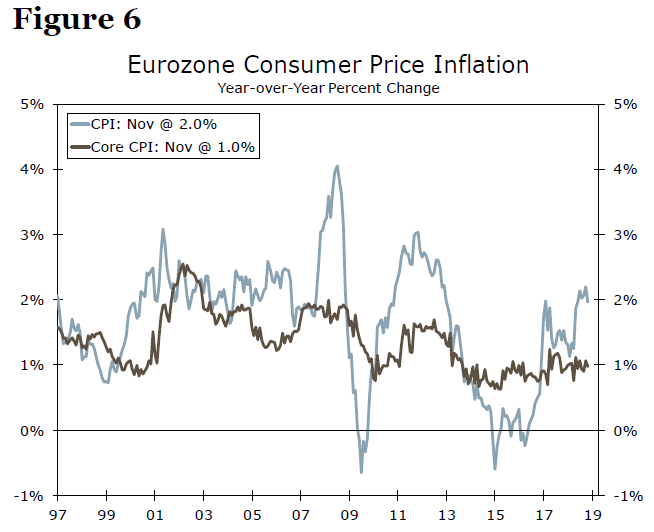
As overall economic growth has slowed so far this year, monetary policy in the Eurozone has remained highly accommodative, with the ECB's deposit rate still in negative territory (Figure 5). The ECB's Governing Council has stated that it intends to wrap up its bond-buying program at the end of the year, but keep rates unchanged through at least the summer of 2019. However, these plans rely on the inflation and growth picture improving in coming months. While the growth outlook looks somewhat murky, price pressures also remain muted and have held the ECB back from a more rapid removal of monetary policy accommodation. To that end, we look for the ECB to remain on hold at its upcoming meeting, as it has already signaled that it plans to leave rates unchanged for the time being, while incoming data have also largely confirmed this stance, in our view. Although headline CPI inflation is actually above the ECB's target of "below, but close to 2%," core inflation has been subdued and stuck near 1% over the past several years, signaling that underlying inflationary pressures have gained little momentum so far in this expansion (Figure 6). At the same time, the sharp drop in global oil prices registered in recent weeks could prove a further drag on headline inflation over the next few months.
In the longer-term however, rising wages and continued above potential economic growth should push up prices, likely prompting the ECB to tighten monetary policy. The Q3 labor compensation data mentioned above should put upward pressure on inflation, and likely re-affirms the ECB's plans to begin slowly normalizing monetary policy, even given the recent soft patch in GDP growth. With these trends in mind, we take the ECB at its word that it will end bond purchases this year, then gradually begin to raise rates in Q3 of next year. We look for two 20-bp rate increases in the deposit rate in Q3 and Q4 2019, such that the deposit rate returns to 0% by the end of 2019. Meanwhile the ECB should also raise its refinancing rate starting in Q4-2019 with a 25-bp hike to 0.25%. However, should the recent slowdown in growth persist for an extended period of time, these plans may take longer to come to fruition.
Conclusion
Real GDP growth in the Eurozone has downshifted so far this year after the more solid pace of growth seen in 2017. Several countries saw outright contractions in output in the third quarter, and while some of the weakness was likely due to temporary factors, the recent stagnation has led many to question the durability of the present expansion. But in our view, the underlying health of the Eurozone economy should display resilience in coming quarters. Consumer spending will likely rebound, buoyed by accelerating wage growth. While the ECB has remained accommodative amid continued sluggish price pressures and the recent growth slowdown, we still look for it to wrap up its bond purchases at the end of this year before beginning to slowly raise rates from the fall of 2019. Price pressures should slowly pick up as labor costs continue to rise and monetary policy becomes tighter after several years of historically low interest rates. The fundamentals of the Eurozone economy should remain intact, in our view, and we look for real GDP to rise 1.9% in 2019 and 1.7% in 2020.
1 Pugliese, M., Nelson, E. and Bennenbroek, N. "What's Next for Italy's Budget?" (November 30, 2018) and Pugliese, M., Nelson, E. and Bennenbroek, N. "Italy Takes Another Step Towards Fiscal Easing," (October 01, 2018).
2 "Expected Downturn on the German Passenger Car Market." (October 2, 2018). German Association of the Automotive Industry.
Australia: Consumer Sentiment Holds the Line
The Westpac Melbourne Institute Index of Consumer Sentiment rose 0.1% to 104.4 in December from 104.3 in November.
The consumer mood continues to hold at cautiously optimistic levels. With another reading above 100, December now marks a full year in which optimists have outnumbered pessimists, a turnaround on 2017 which saw ten out of twelve sentiment updates below the 100 line. That said, the margin is still fairly small with some of the detail in the December update on the soft side. The component indexes show more downbeat views on family finances and longer term economic prospects offset by a solid rise in buyer sentiment.
Given the negative atmospherics around falling house prices in Sydney and Melbourne; falling share markets (the ASX200 now down around 13% from its recent peak in late August and 4.5% since the last survey); ongoing concerns around global trade wars; and political uncertainty, it is reasonable to question why consumer sentiment has held up so well.
There are several significant positives supporting consumers. Firstly, interest rates remain low and fears about rising rates must be subsiding. To this point, the confidence of respondents who hold a mortgage improved by 2.9% in the month to be up by 8.8% over the year. The labour market also remains a source of comfort with the unemployment rate widely reported at a six and a half year low. Finally, a sharp drop in petrol prices has likely provided some additional support over the last month with the average pump price down around 20% since the November survey.
Without a doubt our housing-related indexes show considerable unrest, particularly in NSW and Victoria, while our survey also shows that risk aversion continues to rise.
The ‘finances vs a year ago’ sub-index recorded a 1.9% decline, reversing about half of last month’s surprisingly firm 4.9% gain. The ‘finances, next 12 months’ sub-index also posted a small 0.6% decline following a solid 3.2% gain in November. In both cases, the state detail shows more pronounced monthly declines in NSW and Victoria partially offset by strong gains in the mining states. While some of the weakening in the eastern states may be a sign that the housing downturn is starting to undermine consumer views on their finances, these state measures are still comfortably above their earlier 2018 lows.
Consumers were a touch less optimistic around the economy. The ‘economic outlook, next 12mths’ sub-index rose slightly by 0.1% but the ‘economic outlook, next 5yrs’ sub-index retraced 1.5% – giving up some of the 9.7% jump in November. Both sub-indexes remain well above long run averages. The mix suggests relatively little impact from the disappointing September quarter national accounts update.
The ‘time to buy a major household item’ sub-index rose 3.7%, more than reversing a 3.5% decline in November. While this marks a promising lift in buyer sentiment leading into the Christmas retail peak the lead-in is still less upbeat than a year ago, the sub-index down 1.9% on December 2017. Recall that our survey in November signalled that the Christmas selling season would somewhat underperform the disappointing results of last year.
The Westpac Melbourne Institute Unemployment Expectations Index rose 0.5% in December (recall that higher reads mean more consumers expect unemployment to rise in the year ahead). While this still marks a 5.2% improvement on a year ago, expectations are flattening, suggesting labour market momentum is slowing.
Responses to additional questions on news recall emphasise some of the key themes. News on ‘economic conditions’ had the highest cut through with nearly a third of consumers noting news on this topic (up from 20% in September) and the news viewed much more unfavourably. The next highest recall was for news around ‘interest rates’ (21%); ‘Budget and tax’ (20%); and ‘international conditions’ (14%). Assessments of the news on ‘interest rates’ showed some improvement compared to September while ‘Budget and tax’ news was viewed about the same as three months ago but much less negatively than in December last year. Not surprisingly, there was a sharp deterioration in assessments of news around international conditions.
Markets are Waiting on a Letter
A Canadian court has granted bail to the CFO of Huawei which should temper China’s outcry ( more on this below)
Markets
Risk sentiment tentatively stabilised overnight but by no means is the market out of the woods after another whippy trading session on Wall Street. While markets have been overwhelmed by risk-off sentiment in recent trading sessions, traders were in a much more positive mode today on the back of constructive US-China headlines. Market sentiment was then further supported by positive news on car tariffs. Equities are rallying, led by gains in tech shares and automakers. According to unnamed sources, a proposal to reduce tariffs on cars made in the US to 15% from the current 40% has been submitted to China’s Cabinet to be reviewed in the coming days.
Trump
Also reports that a US government shut down has been averted when funding expires after December 21 are being viewed in a positive light. This news comes after a Presidential tirade in front of the Whitehouse press corp. If Trump’s demands for border funding aren’t met, he is threatening that “I will be the one to shut it down,” Trump said
Brexit
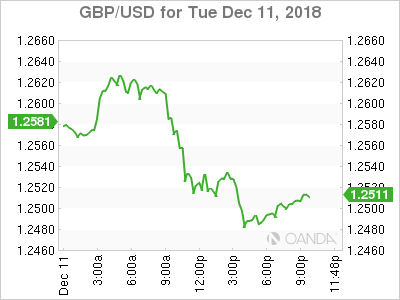
And to prove there is no rest for the weary GBP trader, and Prime Minster May for that fact. UK media is reporting that top government officials are sure PM Theresa May will be subject to an internal leadership challenge imminently as the 48 letters have been reached to trigger a vote. The Pound is trading below 1.25 as this Brexit tennis match is making a Nadal -Federer Wimbledon final look like a walk in the park.
China
Adding to a more friendly Asia market open, as Canadian court has granted bail to the CFO of Huawei which should temper China’s outcry.
However, markets were taking note that the Huawei CFO arrest hasn’t halted US-China trade talks. So this headline should not be interpreted as an absolute game changer on the trade war front.
However, the confluence of small positives in US-China tensions is being viewed through less sceptical lenses. While the headlines suggest that some of the G-20 promises could still be delivered, investors should not get overly complacent.
Chinas outreach will likely not deter the US administration to call out Beijing over Chinas theft of intellectual property rights and for compromising sensitive government and corporate computers Which suggest traders will continue to be better sellers of risk as will likely remain one step forward and two steps back on the trade front.
India
Following the shocking departure of Urjit Patel (amid rumours of a clash with the government over autonomy), India has named Shaktikanta Das as the new RBI Governor, for a term of three years. A controversial figure indeed as he was a crucial figure in the 2016 banknote demonetisation. But given Da’s close connection with India’s government, the market is viewing this as a patronage appointment and will do little to shore market confidence in the RBI as an autonomous central bank. This eyebrow-raising announcement has wiped out overnight gains on Rupee which benefited on a relief rally after a convincing state election victory by the Congress party. USDINR market remains fragile even more so with oil prices edging higher overnight.
Indeed, markets still have an abundance of risk to navigate this week.
Oil Market
In what should be music to OPEC ears, The American Petroleum Institute (API) reported a substantial crude oil inventory drawdown of 10.18 million barrels for the week ending December 7, and well beyond analysts’ expectations which should provide a decent bid to WTI in early Asia markets
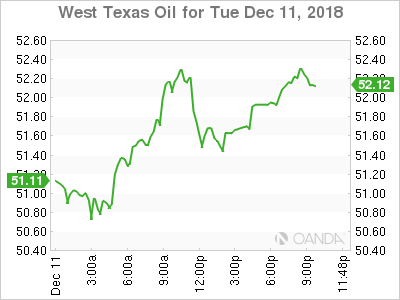
During the NY session, WTI pushed higher towards $52.50, although there doesn’t seem to be a great deal of enthusiasm behind the push higher after risk sentiment stabilised and the recovery in global equity markets on hopes of trade progress between the US and China have helped prices today. Also, there was revived optimism that the OPEC cuts could rebalance markets when traders started digesting how OPEC supply cuts would be implemented after Saudi Arabia said is planning to slash out output to around 10.2 million barrels down 900,000 per day from November while Russia confirmed their commitment to at least 50,000 barrels per day reduction. All the while Libya’s largest oil field remains shuttered.
While the Russia number is hardly eye-popping, I guess on that front; something is better than nothing.
While the markets are in the process of establishing a near-term floor, term upside potential doesn’t look attractive in this overtly risk-off environment.
Gold Market
The stronger USD against EU counterparts and a boost in sentiment for more positive USD-China trade headlines say gold to trade down to 1241 overnight on profit taken. Despite risk sentient extremely shaky, the USD continues to show itself as the primary driver in Oil market sentiment. Still, there’s an abundance of risks to navigate this week suggesting Gold will remain bid towards the near term 1240 resistance levels
Currency Market
European political risk dominated FX markets Tuesday as both EUR And GBP underperformed miserably. Rumours are surfacing that UK PM May’s opposition has enough letters to call a no-confidence vote against her government formally during the looming US
EUR: Euro is trading lower after French President Macrons peace offering to the Yellow vest protester in the form of EUR 100 per month minimum wage bump while abolishing a tax on pensions. The EU fixed income market reacted quite negatively as this will have consequences on France budget.
GBP: The Pound, well we don’t need to waste any more ink on that one
AUD: The Australian dollar received a boost for the China headlines, but Sydney housing market remain some concerns after prices dropped the most in 30 years after peaking in 2017. This brewing housing market crisis is all raising fears that the Australian economy is little more than an asset bubble on top of an iron ore mine
CNH: Trading very sensitive to Huawei headline risk which creating erratic and patchy trading conditions. Update later in the session once the market gets into gear.
MYR. Outflows and de-risking continue to be the name of the game.
US Inflation Data in Focus as Markets Dial Back Rate Hike Expectations
The US dollar has been kept in line as expectations grow for the Federal Reserve to bring down their forecast of rate hikes for next year. Interests rates are expected to head higher, but a recent wrath of weaker economic data and dovish talk has brought expectations for the December 19th meeting from over 79% at the start of the month to 74.0% as of the close on Tuesday.
Current expectations for the Labor Department report is for headline CPI to fall to a flat reading from a prior 0.3% rise. The annual reading is also expected to fall 3/10 of a percentage point to 2.2%. Core inflation on a monthly basis is also expected to remain steady, while the year on year reading is to tick higher to 2.2%. The extended selloff with oil prices will weigh on headline price growth, but will most likely not be seen as a defining easing of price pressures.
- Sir Graham Brady meets with PM May (could find out if he has the 48 letters for the leadership challenge)
- US CPI readings and a 10-year bond auction
- EIA crude oil inventories
Conservatives may have the 48 letters to trigger a leadership challenge
Cable got pounded after reports circulated that the threshold of 48 letters was reached and that confirmation should happen on Wednesday. The rebels need to submit 48 letters to Sir Graham Brady, the 1922 chairman, to trigger a vote of no confidence in Mrs May’s leadership. Sterling extended its decline after news Sir Graham Brady asked to see the Prime Minister on Wednesday. GBP/USD is trading at 1.2481, the lowest level since April 2017.
Prime Minister May’s meeting with German Chancellor Merkel did not yield any concessions. Merkel reiterated that the EU would not reopen the deal. The Prime Minister was also unsuccessful with various leaders on receiving any changes to the Brexit agreement or reassurances that the deal’s controversial backstop arrangement for Norther Ireland was temporary.
Oil rises on Libya’s shutdown and optimism that OPEC + production cut will stabilize prices
West Texas Intermediate rose 2.00 percent on Tuesday. WTI is trading at $52.01 after Libya’s largest oil field remains shutdown and optimism improved that the OPEC and allies production cut that was reached last week will stabilize the oil market. Price is also starting to show signs of a bottom with the $49.41 low made on November 29th. Despite initially giving up all the gains from production cut decision, oil prices continue to respect the $50.00 level. With the US poised to end 2018 as the top oil producer, many will pay close attention to EIA weekly oil inventories report. Last week, crude stockpiles fell by 7.3 million barrels, ending a 10-week streak of increases. Expectations are for stockpiles to fall by 3.0 million barrels.
Bitcoin Mania No Longer Running Wild
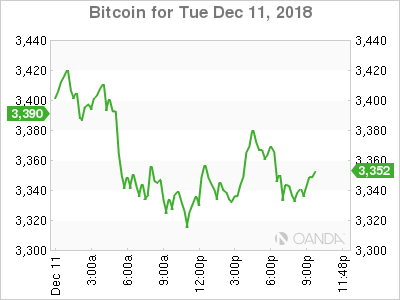
Bitcoin fell 0.63 percent on Tuesday. The cryptocurrency bubble has popped and this latest crash has not shown any signs of slowing down. Over the past couple years, Bitcoin has experienced many crashes over hacking issues, the futures debut which allowed for short selling, but this recent dive is more on concerns it could become worthless.
 Market events to watch this week:
Wednesday, December 12
- 3:00am ZAR Consumer Price Index (CPI)
- 3:30am SEK Consumer Price Index (CPI)
- 08:30am USD Consumer Price Index (CPI)
Thursday, December 13
- 2:00am EUR Germany Consumer Price Index (CPI)
- 2:45am EUR France Consumer Price Index (CPI)
- 3:30am CHF Swiss National Bank (SNB) Interest Rate Decision
- 06:00 TRY Turkey Central Bank (CBRT) Interest Rate Decision
- 07:45am EUR European Central Bank (ECB) Interest Rate Decision
- 9:00pm CNY China Industrial Production
- 9:00pm CNY China Retail Sales
Friday, December 14
- 3:15am EUR France Preliminary PMI readings
- 3:30am EUR Germany Preliminary PMI readings
- 4:00am EUR Euro Zone Preliminary PMI readings
- 8:30am USD Retail Sales m/m
- 9:45am USD Preliminary Markit PMI Readings
*All times EDT
British Pound Under Pressure as May Scrambles to Save Brexit Deal
GBP/USD is lower in the Tuesday session, after sharp losses on Monday. In North American trade, the pair is trading at 1.2529, down 0.30% on the day. On the release front, British employment numbers were mixed. Wage growth climbed to 3.3%, above the estimate of 3.0%. This marked the strongest monthly gain since July 2010. However, unemployment claims rose to 21.9 thousand, much higher than the estimate of 13.2 thousand. In the U.S., PPI came in at 0.1%, above the estimate of 0.0%. Core PPI dropped to 0.3%, but beat the estimate of 0.1%. On Wednesday, the U.S releases CPI reports.
Chaos and uncertainty are some descriptions of the mood in London on Tuesday. In a dramatic turn of events, the May government has deferred the parliament vote over Brexit until an unknown date. The government pulled the plug after it became clear that it would face a massive defeat, which could have crippled the government, possibly costing Prime Minister her job.
Prime Minister May is meeting with European leaders, in a bid to save the listing Brexit agreement. May wants guarantees from the EU that if the backstop arrangement over the Irish border is implemented, the UK will be able to unilaterally withdraw from the arrangement. If May can get the Europeans to agree, the deal will have a better chance of passing through parliament.
The European Union, for its part, has flatly ruled out renegotiating the withdrawal deal. However, both the EU and the British government want to avoid a no-deal scenario, so perhaps the EU will bend in order to help May pass a deal in parliament. The confusion surrounding Brexit sent the British pound sharply lower on Monday.
Only a few months ago, there was talk that the Federal Reserve could hike rates every quarter in 2019. However, signs of a slowdown in the U.S. economy have drastically changed matters, as the Fed is expected to scale back its “gradual rate hike” policy to just one hike next year. Three rate hikes so far this year have slowed economic growth, as seen by lower GDP readings and a dismal nonfarm payrolls report for November. Still, the Fed is widely expected to raise rates at the policy meeting on December 19, with the CME setting the odds of a hike at 80 percent.
Eco Data 12/12/18
[php_everywhere instance="1"]
ECB to End QE But Support Still Needed
The European Central Bank will hold its last policy meeting for the year on Thursday at 1245 GMT and consensus is for policymakers to keep interest rates steady and terminate the quantitative easing program as promised. The Bank will also update its growth and inflation projections in the same day but with economic indicators showing no signs of recovery and political risks still hanging in the background, it would be interesting to see how the ECB will support the bloc from now on.
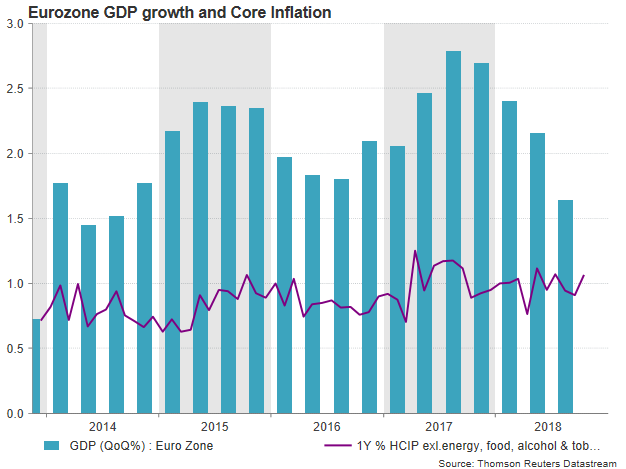
After an upbeat performance in 2017, the Eurozone economy lost significant momentum in 2018, with GDP growth dropping from 2.8% y/y in Q4 2017 to 1.6% y/y in Q3 2018. Specifically, Germany, Eurozone’s powerhouse, saw its worst quarter after more than two years, shrinking by 0.2% q/q in Q3 as environmental restrictions in the automotive industry weighed on the German car business.
Inflation was another weak spot despite the extraordinarily accommodative monetary policy the central bank has used during the past few years. While negative interest rates and the bond buying program should have boosted inflation pressures in theory, the core CPI, which excludes volatile items such as food and energy, did not improve much in the eurozone, holding around 1.0% y/y- far below the 2.0% target the Bank aims to achieve.
Besides data, how could policymakers tighten monetary policy when the political confusion in key economies such as Italy threatens the financial stability in the bloc, while the US trade policy has reduced the appetite for investments? Italy, the third biggest EU economy, holds the second largest debt-to-GDP growth in the eurozone and its proposed spending plans for 2019 are currently not in line with EU rules, as long as the budget points to a deficit target of above 2.0%. A failure to please EU leaders could lead to a collapse of confidence in Italian financial markets which could later spread to the Eurozone. At the same time, the EU is also aware of the significant negative consequences Brexit could cause in the bloc if the negotiations don’t deliver a deal that disrupts financial and trade relations between the UK and the EU as little as possible. Meanwhile another focal point is France, where President Macron is working hard to regain popularity after his proposals for a fuel tax rise brought violent protests and severe property damage in Paris.
While the ECB is confident that economic conditions are strong enough to allow the termination of the asset purchase program, the above risks suggest that a downward revision of growth and/or inflation projections is not unlikely and therefore some support is still needed. ECB officials have previously stated that the Bank will continue to aid through cash reinvestments of maturing bonds for an extended period of time and analysts will likely expect more details on this front on Thursday. Moreover, rumours are flying that a new round of targeted long-term refinancing operations will soon be announced – the program that allows credit institutions to borrow for up to four years based on their loans to households and non-financing corporations. Hence, analysts will be keen to hear whether the ECB is anticipating further weakness and in which way it plans to address any downside pressures. Concerning interest rates, markets are certain that they will remain unchanged at least through the summer of 2019, unless data evidence points to the need for an adjustment.
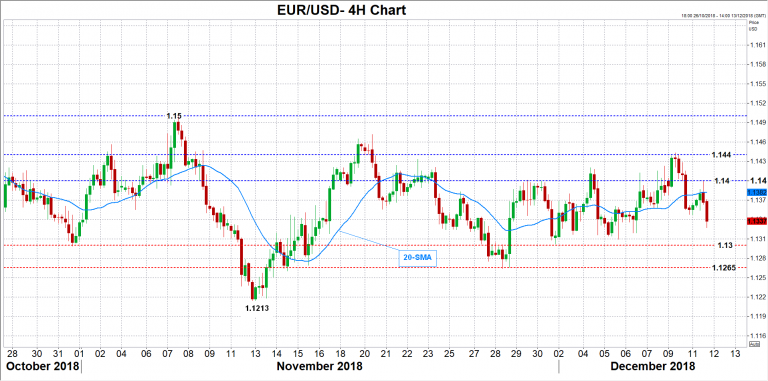
In FX markets, demand for the euro is limited as fears over a potential escalation in EU-Italian political relations and EU-US trade tensions keep funds in safer places. A dovish ECB meeting on Thursday, where policymakers downgrade forecasts and announce specifics on supportive measures, could pull euro/dollar back to the 1.1300 round-level. Below that, support could run down to 1.1265, while stronger bearish actions may also meet a crucial obstacle around the 1.1213 bottom. A violation of the latter could then increase negative momentun towards the 1.1118 barrier.
In the alternative and less likely scenario, in which the ECB appears confident that the economy will remain resilient to rising risks and a tighter labor market will push inflation higher, euro/dollar might revisit the 1.1400 handle. Steeper increases may also retest the area around 1.1440 before the 1.1500 level comes into view.