Sample Category Title
Today’s top mover: EUR/AUD in corrective retreat, further rise expected for near term
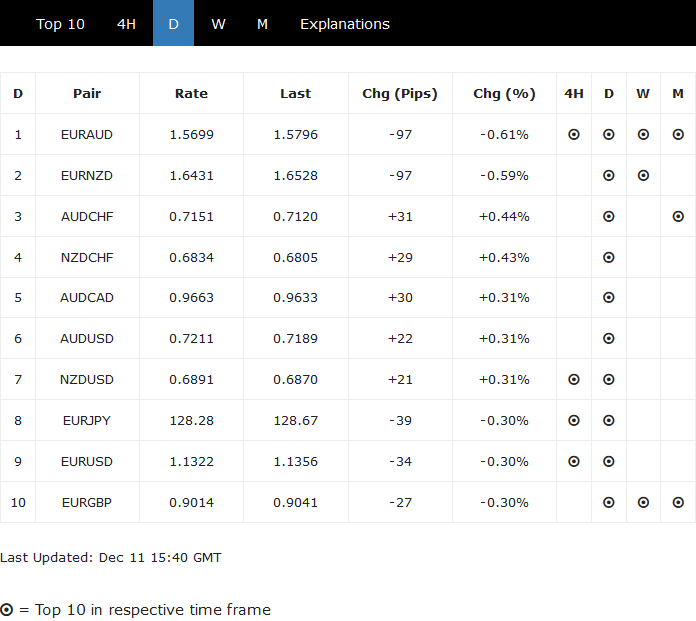
At the time of writing, EUR/AUD is the biggest mover for today, down -97 pips or -0.61%. The selloff is partly due to Aussie's strength on US-China trade optimism. It also lifts US stocks and to a lesser extend Dollar. Focus is back on Euro as Italy might submit revised budget to EU in the next 24-48 hours. Also, traders seem to be repositioning themselves, guarding against dovish ECB press conference on Thursday.
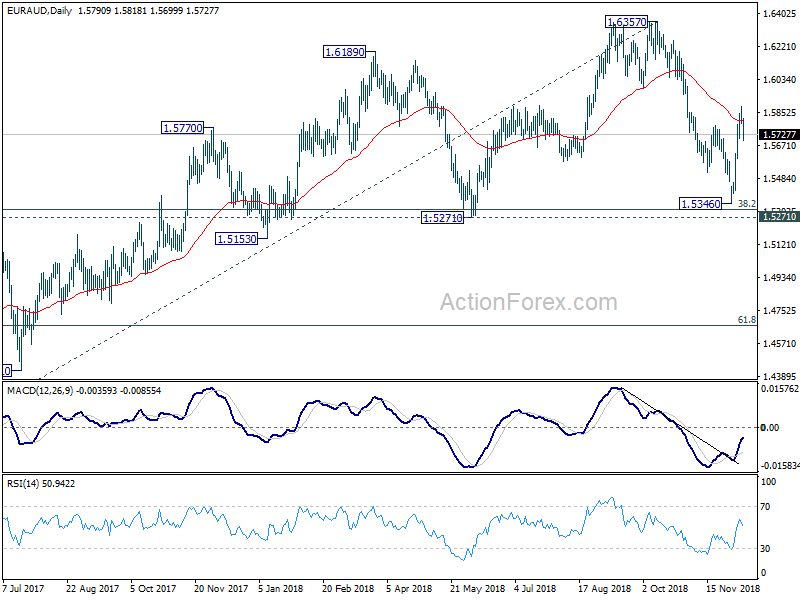
Nevertheless, the fall from 1.5887 is seen as a corrective pull back for now. The cross just had a strong rebound ahead of 1.5271 cluster support (38.2% retracement of 1.3624 to 1.6357 at 1.5313). The development argues that price actions from 1.6357 medium term top are developing into sideway consolidation, rather than a deep correction.
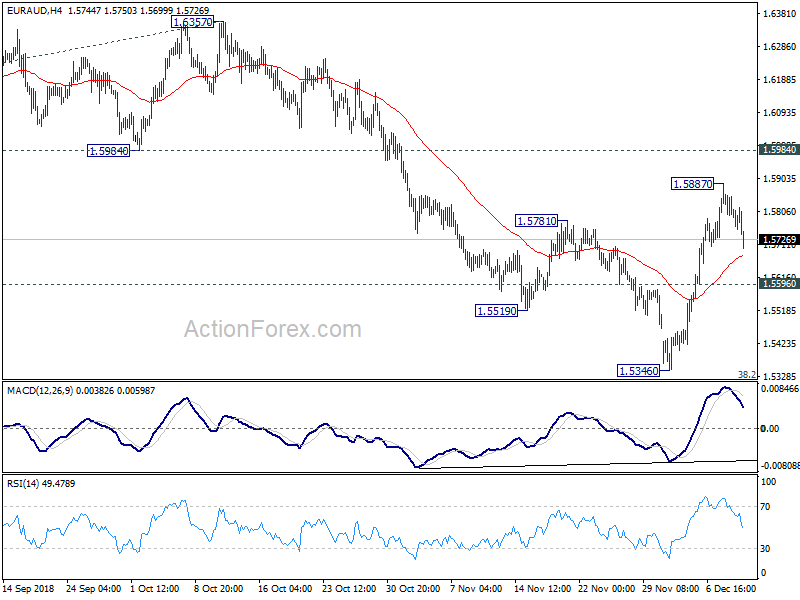
Hence, we'd expect rise from 1.5346 to extend into 1.5984/6357 resistance zone at least, before completion. So current retreat from 1.5887 should be contained by 1.5596 minor support to bring another rise. Nevertheless, break of 1.5596 will dampen this view and turn focus back to 1.5271/5313 zone.
Japanese Yen Shrugs off Soft Manufacturing Data
The Japanese yen is almost unchanged in the Tuesday session, after posting considerable gains on Wednesday. In North American trade, USD/JPY is trading at 113.26, down 0.02% on the day. On the release front, Japanese manufacturing data disappointed. In the U.S., PPI came in at 0.1%, above the estimate of 0.0%. Core PPI dropped to 0.3%, but beat the estimate of 0.1%. On Tuesday, the U.S releases CPI reports.
Japanese indicators continue to have a bad week. The BSI Manufacturing Index slipped to 5.5 in the third quarter, down from 6.5 in the second quarter. Preliminary Machine Tool Orders nosedived, with a reading of -16.5 percent. This was the sharpest decline since July 2016. Earlier this week, Final GDP in the third quarter declined 0.6%. This was the second decline this year. On an annualized basis, the economy declined by 2.5% in Q3, after a gain of 2.8% in the second quarter. This was the worst downturn since 2014.
Of particular concern, the capital expenditure component of GDP fell 2.8%, much weaker than the estimate of 1.6%. This capex slump, which could weigh heavily on growth and inflation, comes at a particularly inopportune time, with the U.S-China trade war in full swing. This has taken a bite out of Japanese exports and the manufacturing sector, as businesses that deal with the U.S or China are facing higher tariffs. A weaker eurozone economy has led to softer European demand for Japanese exports. Making matters worse, domestic demand remains fragile, as nervous consumers continue to hold tightly onto their purse strings.
Former UK PM Major: Revoke Brexit notice now, the clock must be stopped
Former UK Prime Minister John Major urged the current government to revoke Brexit notice to the EU now. He said, "We need to revoke article 50 with immediate effect. The clock, for the moment, must be stopped."
He added, "It's clear we now need the most precious commodity of all: time. Time for serious and profound reflection by both parliament and people. There will be a way through the present morass, there always is."
Also, he said Brexit will weaken UK's position in the world. He argued that "We are a more valued ally for America because of our influence in Europe and we are more valued by Europe because of our close relationship with America." And, "Britain, shorn of both these long-standing allies, will be seen by the world as a mid-sized, middle-ranking power that is no longer super-powered by her alliances."
WTI Oil Outlook: Temporary Base at $50.60 Zone Holds for Now But Upside is Limited
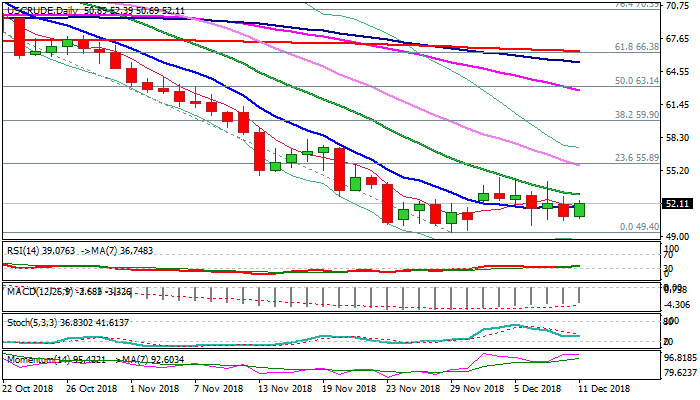
WTI oil price bounced from temporary base at $50.60 zone (lows of past three days) where pullback from recovery high at $54.54 found footstep. Oil came under pressure after recovery attempts stalled and subsequent easing was boosted by fears that agreed production cut by OPEC and other main producers outside the cartel, will not be enough to stabilize oil market, depressed by rising signs of oversupply and lower demand. Shutdown of main Libya's oilfields provide some support and sidelined immediate downside risk, but overall sentiment is still weak and along with bearish daily techs, keeping near-term bias negative. Recovery attempts struggle at 10SMA ($51.72) and repeated daily close below would keep the downside vulnerable of potential retest of psychological $50 support. Sustained break here after short-lived spike to $49.40 (29 Nov) would signal continuation of larger downtrend. Conversely, lift above falling 20SMA ($53.02) would provide relief and open way for test of recent spikes at $54.50 zone, but extension and close above falling 30SMA ($55.74) would generate stronger bullish signal. US API and EIA crude stocks reports, due late today and on Wednesday are in focus and expected to provide fresh signals.
Res: 52.78; 53.02; 54.54; 55.74
Sup: 50.60; 50.00; 49.40; 49.40
US Inflation Data Eyed as Investors Unwind Fed Rate-Hike Bets
The latest US CPI data are due out on Wednesday, at 1330 GMT. Given recent speculation that the Fed will pause its tightening cycle in 2019, these figures may be crucial in shaping market expectations ahead of the Fed’s December meeting and thereby, in determining the dollar’s near-term direction. Any updates in the US-China trade saga can also affect the greenback.
The dollar has been struggling over the past few weeks, amid growing speculation that the Fed is set to pause its rate-hike cycle in 2019 as US economic growth slows, and in the context of a slowing global economy. Even though US economic data are hardly signaling as much, investors have nevertheless become quite confident that a pause will indeed take place.
The Fed is still expected to raise rates by a quarter-point at next week’s meeting, a prospect priced in with a 76% probability according to the Fed funds futures. Looking further out however, expectations are much more pessimistic. Assuming a December increase does take place, then market pricing suggests a mere 50% chance for another hike in the entire of 2019. This is quite some way from the Fed’s latest “dot plot”, which points to 3 hikes for the year. In truth, those projections could well be revised lower to signal 2 hikes in 2019 at next week’s meeting, but even so, the discrepancy between what policymakers and investors anticipate would still be enormous.
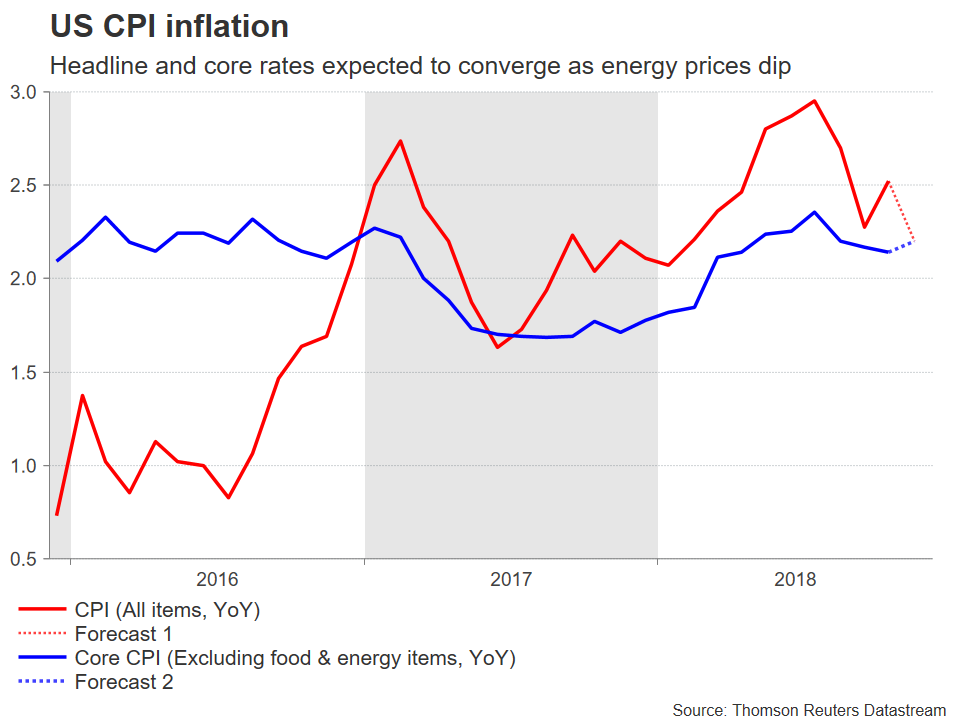
In such conditions, economic data could decide whether the Fed revises lower its own rate forecasts to match the market, or whether it will be investors who adjust their expectations closer to the Fed’s. Turning to this week’s releases, the nation’s CPI rate is forecast to have dipped to 2.2% y/y in November, from 2.5% previously. Yet, the core figure – which excludes volatile food and energy items – is projected to have ticked higher to 2.2% y/y, from 2.1% in October. Thus, most of the softness in the headline print seems owed to the recent dip in energy prices, which typically isn’t that worrisome for the Fed.
Outside of monetary policy, the other key variable for the dollar will be how trade tensions evolve. The greenback has acted as a haven asset amid US-China frictions, gaining when the situation escalates and falling on any de-escalation. In this sense, although the US-China “truce” was a welcome sign, it may not ultimately mean much if China doesn’t compromise on the key issue: forced technology transfer. Until – and if – there are such concessions, an eventual re-escalation remains the most likely scenario. Not to mention the US could announce tariffs on cars at any moment, starting a new standoff with the EU. The implication is that the dollar may still enjoy pockets of strength from trade concerns, even if the Fed does shift to a more cautious stance going forward.
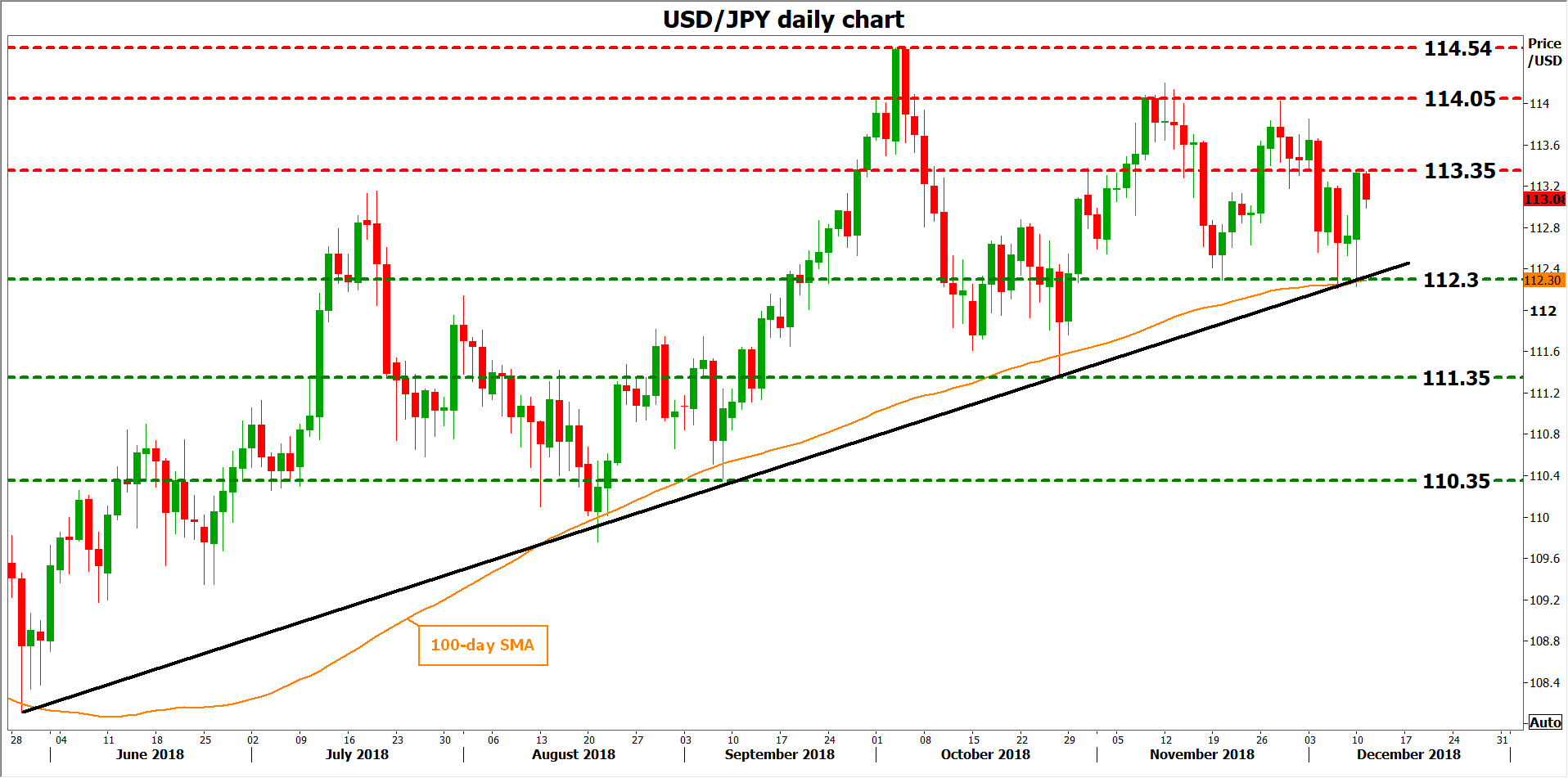
Technically, advances in dollar/yen may meet initial resistance near the December 10 high, at 113.35. An upside break could open the way for the 114.05 territory, defined by the peak of November 27, before the one-year high of 114.54 comes into view.
On the flipside, support to declines could come around the crossroads of the 112.30 area, the uptrend line drawn from the lows of May 29, and the 100-day simple moving average. A bearish violation may see scope for a test of the October 26 low at 111.35, ahead of the September 7 trough at 110.35.
Is S&P500 Going to Rise or Fall? – Elliott Wave Analysis
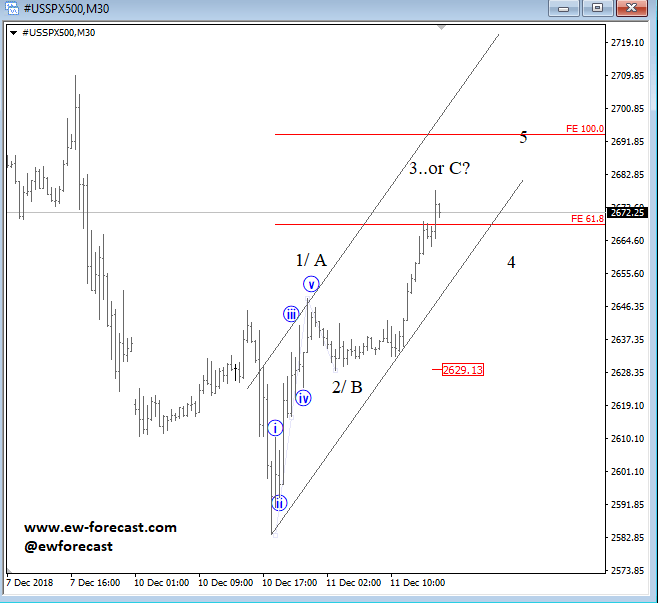
E-mini S&P500 is turning up from very important levels this week, so at this stage, the key to be on the right track is to observe the price action on a lower time frame. Here is a 30min chart of SP500 futures where the rise is only in three waves at the moment, but if this rise continues and unfolds a five wave move then we know where we to go from here; UP! However, if from any reason a fall occurs from current levels back to 2629 level then bearish trend should resume.
S&P500, 30Min
Sunset Market Commentary
Markets
Global core bonds trade mixed. Risk-sentiment improved during US trading yesterday and that vibe continued in Europe today. Equities edged higher and global core bonds moved south. German ZEW expectations surprised on the upside as well. The cautious uptick in sentiment received some tailwind as China signaled goodwill in the trade talks with the US as it considers a US car tariff cut. The German Bund made a counter-intuitive move higher and paired its intraday losses. The German yield curve steepened with changes ranging from -1.6 bps (2-yr) to +1.1 bp (30-yr). The US yield curve edges higher, with changes varying between -1.3 bps (30-yr) to +2.0 bps (2-yr). Meanwhile, French PM Macron promised a series of measures in an effort to calm the ‘gilets jaunes’ that has put France in a deadlock for weeks. Those concessions don’t come cheap, as a French financial journal estimated that extra expenses could mount up to €11bn and a deficit widening to 3.5% in 2019. The French 10-yr yield spread over Germany increases to 45 bps, the largest since last year. The French deficit widening gives the Italian government some more leverage in negotiations with the EU. Italian media reported that the Italian government won’t go lower than a 2.2% budget deficit in 2019, leaving discussions with the EU unresolved. However, the Italian spread over Germany remains stable in the 285-290bps zone.
EUR/USD staged a decent recovery initially. An improved risk climate and a better than expected German ZEW supported the common currency during European trading hours. The currency pair slipped around noon however. We see several reasons, the first one technical is nature as EUR/USD’s reversal took place after the pair touched the 1.14-mark. The move coincided with the trade-weighted dollar clearing the 97-hurdle. Stronger than anticipated headline/core US PPI data also helped the dollar recoup previous losses. Third, Trump said China is cutting its 40% trade-war tariffs on US cars, triggering a relief in the dollar, who had been weighed down by the US/Sino conflict lately. Finally, French and Italian spending plans are potential euro negative. EUR/USD is trading at around 1.134, down from 1.1356 this morning. USD/JPY (113.3) is upwardly oriented in a narrow trading range.
One day after she pulled the brexit vote (scheduled for today), PM May is already on European soil, trying to secure concessions on the deal from EU leaders. One major stumbling block that would have likely resulted in a Parliamentary rejection is the Irish backstop. British MP’s fear there’s no way out of the EU/UK customs union when the backstop is triggered. May now seeks legally binding assurances to avoid being tied indefinitely. EC President Juncker said EU leaders will refuse to renegotiate however. At best there could be some clarifications on the text. A new date for MP’s to cast their ‘meaningful vote’ on the tweaked deal hasn’t been specified yet, though the UK government set January 21 as a deadline. The pending brexit stalemate thus returns to the forefront, preventing a significant sterling recovery from yesterday’s slap. The pound did find some support in a strong labour market report, but remains well above the EUR/GPB 0.90-handle. Cable edges back above the 1.26-mark.
News Headlines
A strong UK labour market report failed to inspire sterling. Employment change increased by 79k 3M/3M in October (vs +25k consensus) with the employment rate rising to the highest level since 1971 (75.7%). Wages increased at the fastest pace since 2008 (3.3%), outpacing UK inflation (2.4%) and increasing UK households’ disposable income.
US eco data printed mixed with higher than expected producer price inflation in November (0.1% M/M for headline and 0.3% M/M for core) and a bigger than feared setback in NFIB small business optimism (104.8 from 107.4). German ZEW investor sentiment declined more than forecast in December (45.3 from 58.2), but the forward looking expectations component rose (-17.5 from -24.1), beating consensus.
EUR/USD Mid-Day Outlook
Daily Pivots: (S1) 1.1323; (P) 1.1383; (R1) 1.1416; More.....
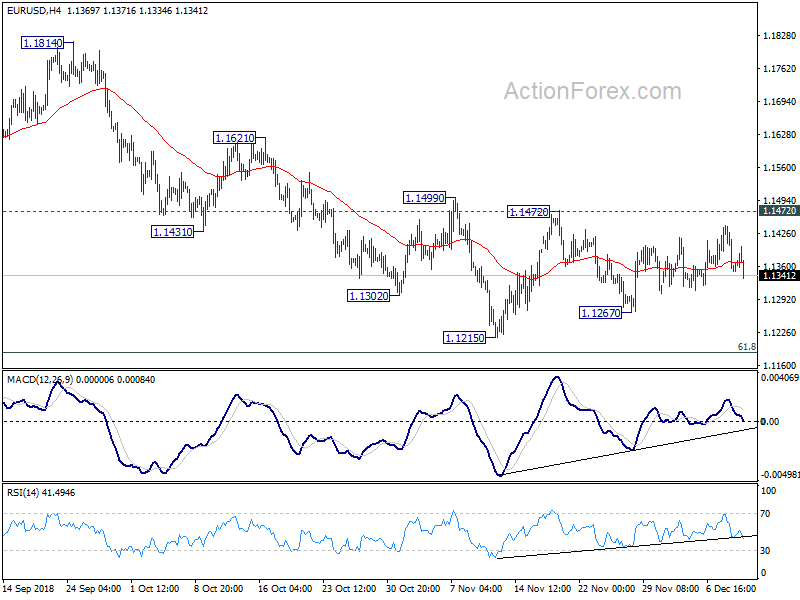
EUR/USD drops further today but it's still staying in range of 1.1267/1472 after all. Intraday bias remains neutral first. On the downside, break of 1.1267 will target 1.1215 low first. Firm break there will resume larger down trend from 1.2555 for 1.1186 fibonacci level next. However, considering bullish convergence condition in daily MACD, firm break of 1.1472 will be suggest medium term bottoming and turn outlook bullish for 1.1814 resistance instead.
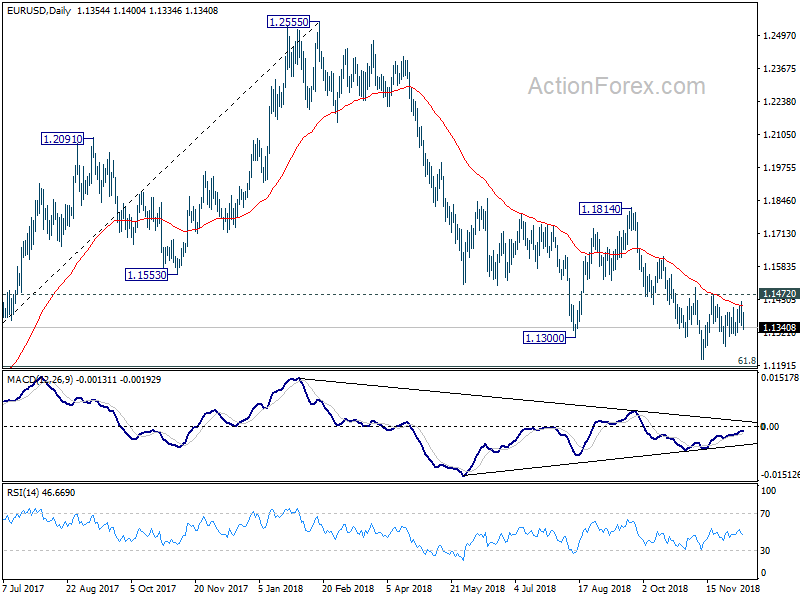
In the bigger picture, as long as 1.1814 resistance holds, down trend down trend from 1.2555 medium term top is still in progress and should target 61.8% retracement of 1.0339 (2017 low) to 1.2555 at 1.1186 next. Sustained break there will pave the way to retest 1.0339. However, break of 1.1814 will confirm completion of such down trend and turn medium term outlook bullish.
GBP/USD Mid-Day Outlook
Daily Pivots: (S1) 1.2458; (P) 1.2609; (R1) 1.2710; More...
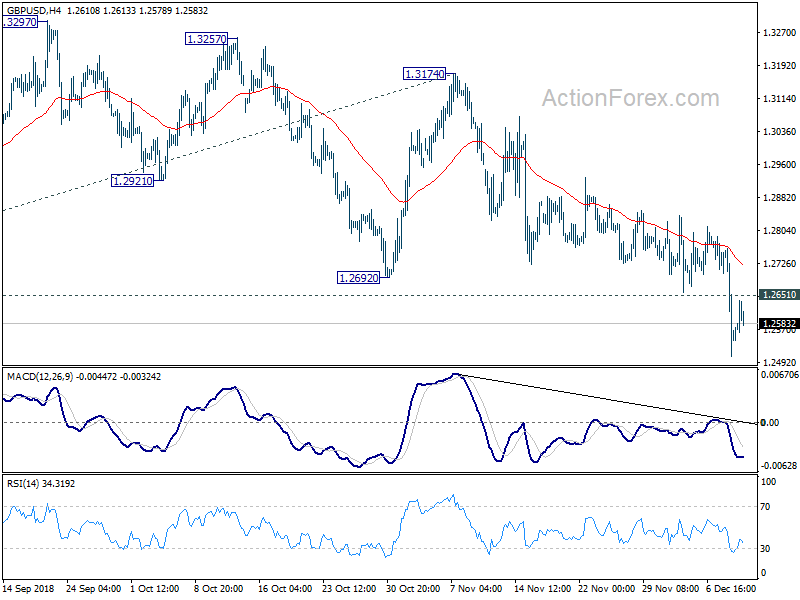
Despite today's recovery, with 1.2651 minor resistance intact, intraday bias remains on the downside. Prior break of 1.2661 support confirmed resumption of down trend from 1.4376. Further fall should be seen to 61.8% projection of 1.4376 to 1.2661 from 1.3174 at 1.2114. On the upside, above 1.2651 minor resistance will turn intraday bias neutral and bring consolidation first, before staging another decline.
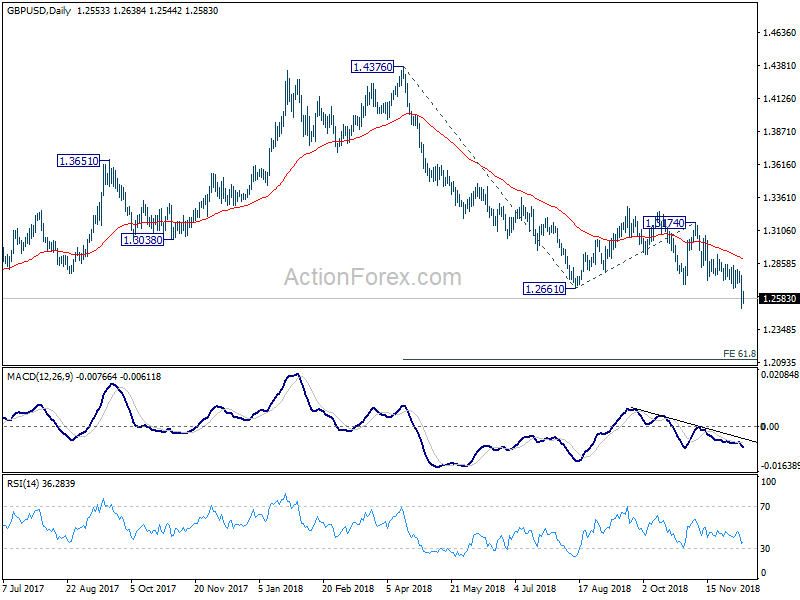
In the bigger picture, whole medium term rebound from 1.1946 (2016 low) should have completed at 1.4376 already, after rejection from 55 month EMA. The structure and momentum of the fall from 1.4376 argues that it's resuming long term down trend from 2.1161 (2007 high). And this will now remain the preferred case as long as 1.3174 structural resistance holds. GBP/USD should now target a test on 1.1946 first. Decisive break there will confirm our bearish view.
USD/CHF Mid-Day Outlook
Daily Pivots: (S1) 0.9876; (P) 0.9895; (R1) 0.9923; More...
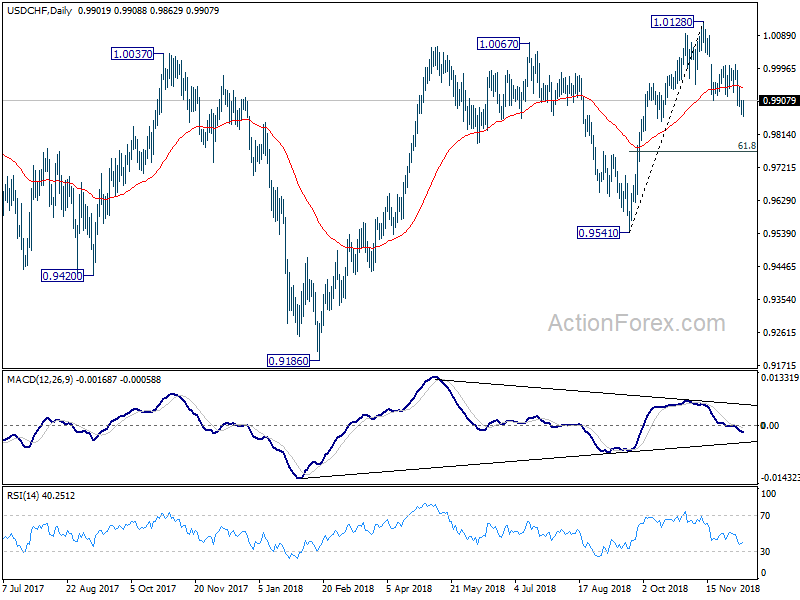
A temporary low is formed at 0.9862 with today's recovery. Intraday bias in USD/CHF is turned neutral first. On the downside, below 0.9862 will target 0.9848 support first. Sustained break there will confirm near term reversal and target 61.8% retracement of 0.9541 to 1.0128 at 0.9765 and below. On the upside, break of 1.0008 resistance will indicate that the pull back from 1.0128 has completed and bring retest of this high.
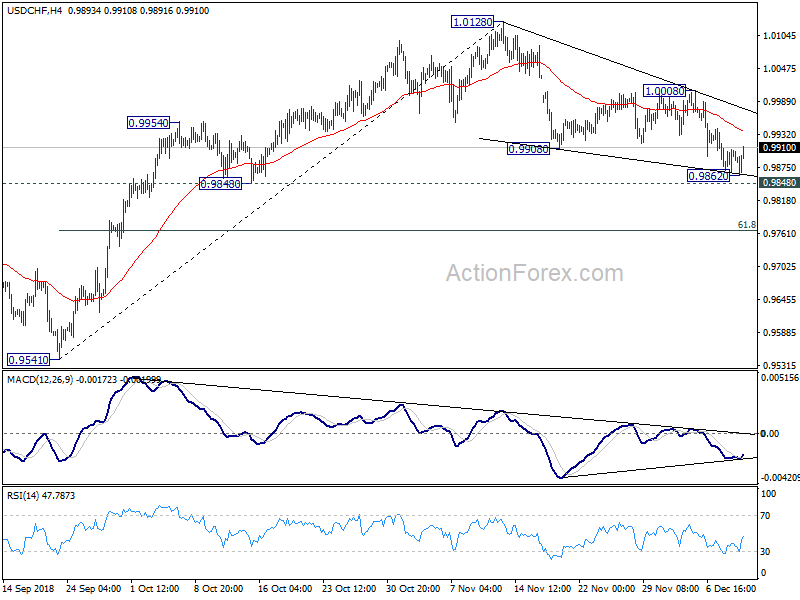
In the bigger picture, rise from 0.9541 could have topped at 1.0128. But as long as 0.9541 support holds, we'd still expect rise from 0.9186 to resume at a later stage. Break of 1.0128 will target 1.0342 key resistance. However, break of 0.9514 will pave the way back to 0.9186 low.