

Sample Category Title
Australia NAB business confidence dropped to 3, house prices dropped -1.5% qoq
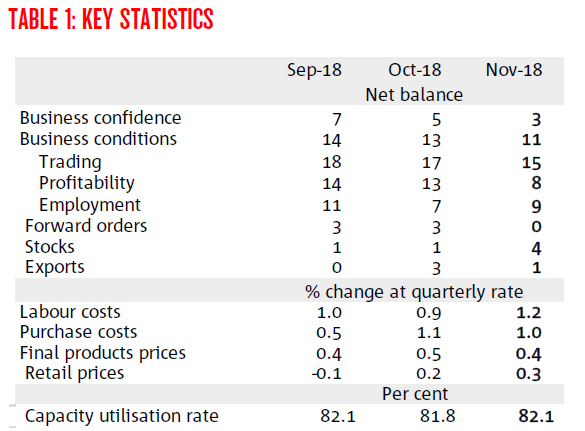
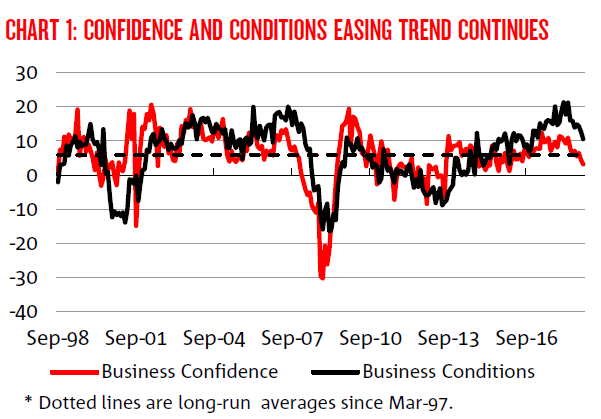
Australia NAB business confidence dropped to 3 in November, down from 5. Business conditions dropped to 11, down from 13.
Alan Oster, NAB Group Chief Economist noted that "the downtrend in conditions has continued in November" and, "this trend suggests that the business sector has lost some momentum since late 2017 and early 2018." He added "confidence is now below average, suggesting that businesses themselves think momentum will slow further".
On falling house prices, though, Oster noted "businesses do not yet suggest they are having a material impact." And, "falling house prices in themselves may have a 'wealth effect' on households but given the prior large run up the impact of the declines to date is unclear".
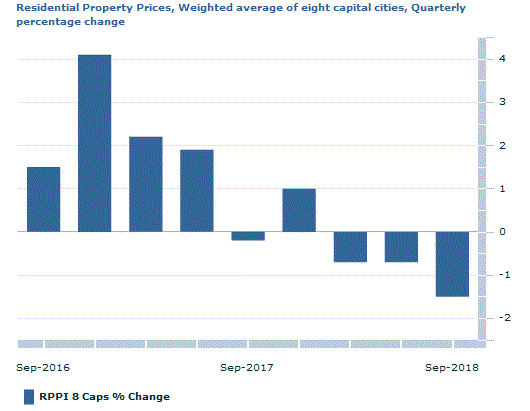
Also from Australia, house price index dropped for the third quarter by -1.5% qoq in Q3, matched expectation. Over the year, house priced dropped -1.9% yoy.
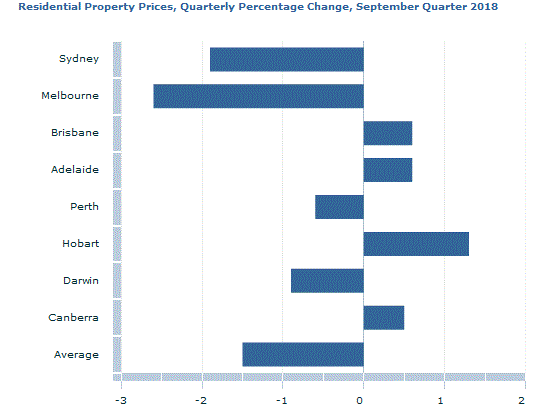
Among the capital cities, Sydney's house prices dropped -1.9% qoq, -4.4% yoy. Melbourne's dropped -2.6% qoq, -1.5% yoy. However, gains was recorded in Hobart (1.3% qoq, 13.0% yoy), Adelaide (0.6% qoq, 2.0% yoy) and Brisbane (0.6% qoq, 1.7% yoy).
Elliott Wave View Expects More Downside In Exxon Mobil (XOM)
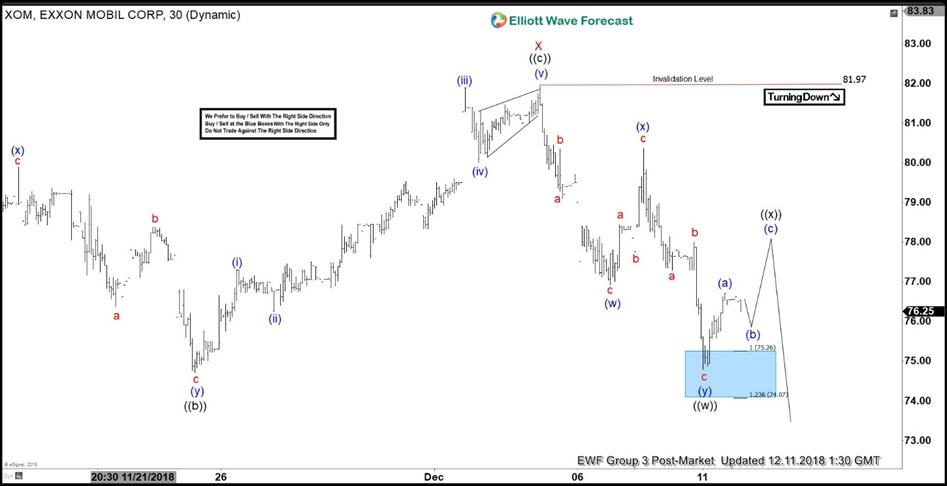
Exxon Mobil (ticker: XOM) has broken below Nov 23 low ($74.7) and opens further downside in the stock with incomplete sequence from Sept 25 high ($87.36). Short Term Elliott Wave view suggests bounce to $81.97 on 12/5 high ended Minor wave X. Decline from there is unfolding as a double three Elliott Wave structure where Minute wave ((w)) ended at $74.8. Internal of wave ((w)) unfolded as another double three Elliott Wave structure of a lesser degree. Minutte wave (w) of ((w)) ended at $76.92, Minutte wave (x) of ((w)) ended at $80.36, and Minutte wave (y) of ((w)) ended at $74.80.
Minute wave ((x)) is in progress to correct cycle from 12/5 high as a zigzag Elliott Wave structure where Minutte wave (a) of ((x)) ended at $76.7. Expect a pullback in Minutte wave (b) and another leg higher to complete Minutte wave (c) of ((x)) and end the zigzag pattern before the stock resumes lower. We expect sellers to appear and rally to fail below $81.97 in 3-7-11 swing for more downside in the stock.
XOM 1 Hour Elliott Wave Chart
Australia: Business Conditions & Confidence, November 2018
Further confirmation of a loss of momentum. Conditions: down 2pts to +11. Confidence: down 2pts to +3.
The NAB business survey provides further confirmation of a loss momentum in the economy during 2018.
In November, the business conditions index fell by 2pts to +11, a reading which remains above average. This continues the downtrend in conditions since April.
Business confidence slipped by 2pts to +3, a slightly below average reading. This is interpreted as suggesting that businesses expect conditions to ease further.
The loss of momentum in business conditions is evident across most states, particularly the eastern states and most notably NSW.
These results are consistent with the unfolding downturn in the housing sector. New home building activity has swung from strong gains over the first half of 2018 to declines, with a small drop in the third quarter - ahead of likely more sizeable falls during 2019, in our view.
In addition, dwelling prices have pulled back following a strong run in Sydney and Melbourne, as well as declining further in Perth.
Business conditions remain weak in the retail sector, at -4 in November, and have eased in the recreational and personal sector.
Business conditions in the construction sector, which are volatile, weakened sharply in November, to a reported -4, down from +19 in October. Most likely this includes an element of noise and a rebound in December is likely in my view.
Conditions in the finance, business &property sectors reportedly rebounded modestly in November, up 3pts to +17, but still remain below levels prevailing earlier in the year.
Forward orders, a lead indicator of domestic demand, weakened, with a flat result in November, down from +3 in October.
Capacity utilisation level edged higher in the month and remains at an above average level.
Both trading conditions and profitability moderated in the month, down 2pts to +15 and down 5pts to +8, respectively.
Employment conditions by contrast rose by 2pts to +9, partially reversing a 4pt decline in October.
The survey suggests that, near-term, this is consistent with monthly job gains in the order of 20k. This would, assuming a flat participation rate, see the unemployment rate gradually decline from the current 6 year low of 5.0%.
It is worth noting that there is the risk that employment conditions ease in the months ahead if the loss of momentum in the economy gathers pace.
Capital expenditure was positive in the month, with a reading of +15. Recall that the official ABS capex survey reported that the non-mining sectors plan to lift investment in the 2018/19 financial year.
US automakers called Japan currency manipulator, Japan FM Aso said your government hasn’t brought the topic up
Japan was fiercely attacked by an US automaker group in a US trade negotiating objectives hearing yesterday. The United Auto Workers representative criticized that the Japanese auto market is largely closed because of non-tariff barriers. Those barriers include Japan-specific regulatory, safety and emissions standards. Also, he said Japan manipulated its currency to push down the value of the Yen.
The UAW representative Desiree Hoffman went further and said "these barriers have created an uneven playing field, so much so that for every car that the U.S. exported to Japan in 2017, Japan sent 100 back". And, "any loosening of the 2.5 percent automotive or 25 percent light truck tariff would further direct Japan's overcapacity to our shores, exacerbating the problem." Hoffman demanded Trump's administration to impost strict import quotas on Japanese vehicles.
Japan Finance Minister Taro Aso responded calmly regarding currency manipulations. He said that "we have agreed with the U.S. side that any questions on currencies will be discussed with the U.S. Treasury Department, and so far it hasn't been brought up."
Market Morning Briefing: Aussie Is Almost Stable But Faces Immediate Support Near Current Levels
STOCKS
Lots of big news yesterday (Urjit Patel's resignation, delay of the UK Brexit vote) and today (Indian state election results). Sentiment is bearish, especially in India. As we said yesterday, our bullish preference is under severe threat of being proven wrong. At the same time, we also note today that the Bulls are putting up a fight, but need to advance more in order to beat back the Bears.
Amid this, however, the Dow (24423.26, +34.31, +0.14%) managed a small gain, surviving a plunge below 24250 and even 24000 to a low of 23881.37. To be sure, a strong rally is needed over today-tomorrow to bring bullishness back into the markets, but the possibility exists. Else, a further dip to 23500 could be on the cards.
Surprisingly also, despite being vulnerable to the downside, the Shanghai (2592, +0.30%) is not seeing immediate selling. Still, bullishness will require a good rise past 2650 to bearish possibility behind.
The Nikkei (21265) is also trading in the green today, bouncing from the crucial level of 21200 mentioned yesterday. A rise past 21500, if seen, would put the Bears on a backfoot.
On the bearish side, the DAX (10622, -1.54%) had broken and closed well below 10700 yesterday and may still be vulnerable to a decline towards 10000.
The Nifty (10488.45, -205.25, -1.92%) had seen a good fall yesterday in line with our warning of fall to 10400. A test of 10200 is also possible today on a combination of the Urjit Patel news and the election results. That said, it would be worthwhile exploring Longs near 10200.
COMMODITIES
Brent (60.22) and WTI (51.20) are stable. Brent is ranged within 64-58 region while WTI is stuck between 50 and 55. On WTI 3-day candles, 50 is an important support and while that holds, medium to long term looks bullish. However, on the weekly there is scope of falling to 48 on a break below 50. This could be the medium term bottom as we do not look at a fall below 48 in the current down move. Brent on the other hand is likely to remain above 58 and eventually move higher in the coming weeks.
Gold (1250.60) is trading at a stable pace. With resistance at 1260 and support at 1240, the price is stuck in the middle of the range and could remain sideways ranged for the week. While Dollar remains strong, stability in Gold could remain intact.
Copper (2.7405) could test 2.70 in the next 1-2 sessions before moving higher towards 2.80/85. Near term looks ranged.
FOREX
News of UK Prime Minister Theresa May to delay her Brexit vote which was to take place today lead to a fall in Pound (1.2574). While the fall below 1.27 continues, we could see a test of 1.24 on the downside. Failure to bounce from 1.24 would make the currency vulnerable to testing 1.22-1.21 in the longer term. For now a bounce from 1.24 can be expected.
Dollar Index (97.10) has risen without sustaining below 96.50. While above 96.0-96.50, there is scope for a rise towards 97.50-98.00 on the upside. Note that 98 is an important resistance and could hold in the longer run, bringing some rejection back towards 96. For now, a rise towards 98 looks likely.
Euro (1.1366) tested 1.1443 yesterday before coming down from there. While above 1.12, there is scope of testing 1.15 on the upside. Ranged move within 1.12-1.15 looks likely in the near term.
Dollar Yen (113.02) is currently trading within the 112-114.50 region and could continue to trade in this region for some more time. While resistance at 114.50 holds strong, there could be a gradual decline in dollar Yen below 112 in the medium term.
Aussie (0.7203) is almost stable but faces immediate support near current levels. A bounce from here is likely to take it higher towards 0.7350. Failure to sustain above 0.7150 could be bearish in the longer run.
Dollar Rupee (71.3475) is likely to rise towards 71.60 today. Above 71.50, upside is open towards 71.80-72.00 for the near term. With the news of RBI Governor Urjit Patel resigning, the markets could see some negative movements today.
INTEREST RATES
The mentioned Support at 2.80% seems to be holding on the US 10Yr (2.84%), which has moved up a wee bit from 2.83%. But, the 2Yr (2.72%) has moved up more than the 10Yr, such that the 10-2 Spread stands at 12bp, down from 14bp on Friday. Continue to watch the Support at 11-10 bp to see whether it continues to hold.
There was a sharp jump in the Indian 10Yr GOI (7.5872%) in the wake of the Urjit Patel resignation, past 7.50%. Now there may be some more room on the upside towards 7.65%. Importantly, the Indo-US 10Yr Spread (4.7274%), has moved up well from above the Support at 4.48% mentioned a few days ago. It might consolidate between 4.50-75% for a while, or try to move higher towards 4.85%.
Chinese VP Liu talked with Lighthizer and Mnuchin on timetable and roadmap of trade negotiations
The Chinese Ministry of Commerce said in a very brief statement about the phone call between Vice Premier Liu He, US Trade Representative Robert Lighthizer and Treasury Secretary Mnuchin earlier today.
It noted that "both sides exchanged views on putting into effect the consensus reached by the two countries' leaders at their meeting, and pushing forward the timetable and roadmap for the next stage of economic and trade consultations work."
The was no further elaboration on the details of the call. But the presence of Mnuchin is a gesture of willingness on both sides for constructive discussions. Mnuchin is seen by many as the most China-dovish member of Trump's cabinet. And he should have likely taken a moderator role between Liu and Lighthizer.
Brexit Monitor: Brexit Clash Postponed To January, At The Earliest
Today has been an eventful day. The day started with the ruling from the European Court of Justice confirming the UK can unilaterally revoke the Article 50 notification (which started the negotiations officially) without any changes to the existing membership terms. In the afternoon, PM Theresa May announced the Brexit vote, which was scheduled to take place tomorrow night, would be postponed. The reason was that May was set to suffer a heavy defeat, as around 420 members of parliament would have rejected the deal according to media reports. During her statement, May said she wanted to get “further assurance” from the EU that the backstop solution to the Irish border issue is only temporary. While some hardliners will think Brexit would still not be hard or clean enough, it may persuade some of the softer hardliners and the supporting party DUP from Northern Ireland to vote in favour.
PM Theresa May did not set a date for the vote. She argued that she needs time to talk to her European peers. Under the EU Withdrawal Act the government must make a statement to the House of Commons no later than 21 January on how to proceed if no deal is reached. The question is whether this has already been reached, as May already has presented a deal although not ratified yet. Close to 21 January seems like the earliest date for a vote, at the time of writing. Donald Tusk tweeted the EU27 leaders will discuss Brexit on Thursday to “discuss how to facilitate UK ratification” but that the EU “will not renegotiate the deal, including the backstop”.
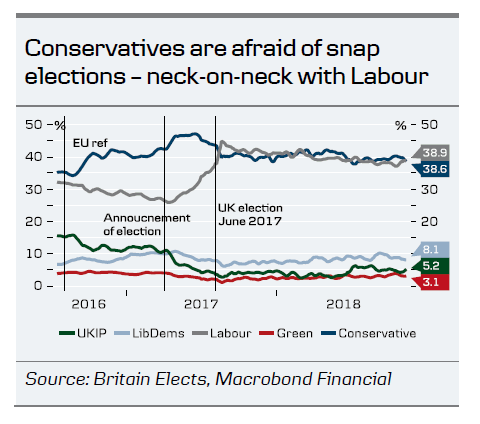
What will happen from here? Well, basically things have not changed much from our preview released on Sunday, as she would have most likely lost the vote anyway. We still have sympathy for the idea that the deal may pass eventually but it is not a high conviction call. It is a big gamble for the hardliners to vote against it, as May’s deal is probably the hardest possible Brexit on the table right now (no majority for no deal Brexit in Parliament). Some Labour MPs will probably also soon realise that the dream of snap elections is dead and that Labour’s official stance on Brexit is unrealistic, as the EU would never accept it. The later the vote in the House of Commons is held, the harder it is for the politicians to reject it, because time would be limited to shift course unless the EU27 extends Article 50. While the probability of a no deal Brexit probably rose again today, the overall probability remains low, in our view, as there is no majority for it in the House of Commons. The probabilities of a Norway-style or second EU referendum have increased.
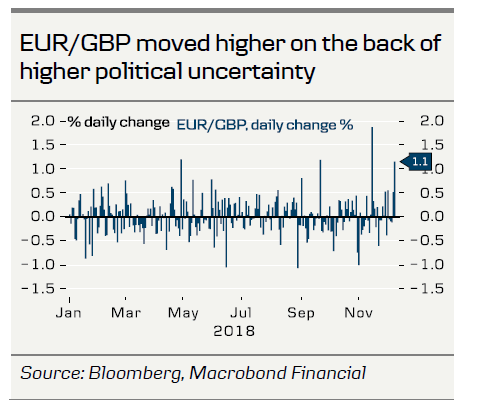
In our main scenario, we still expect a 'decent' Brexit and we maintain the long-held view that EUR/GBP will break lower towards 0.83 when we get more clarification. But as we argued in our preview, Brexit will probably remain unresolved when we enter 2019, which should keep EUR/GBP volatile and range-bound for a prolonged period.
On Sunday, we raised our 1M EUR/GBP forecast to 0.88 (from 0.84 previously) and raised our 3M target to 0.87 (previously 0.83), as the big break lower may not materialise in the coming months. We stress, however, that we see risk skewed to the downside relative to our 3M target in case Brexit is finalised within the next three months. We have kept our 6-12M forecast unchanged at 0.83.
EU Tusk: No Brexit deal renegotiation, including the backstop
UK Prime Minister Theresa May called off Tuesday's Brexit parliamentary vote as her deal would be defeated by a wide margin. Instead, May is going back to the EU for adjustments in the deal, in particular on Irish border backstop. Response from EU is so far rather cold.
European Council president Donald Tusk tweeted that they will discuss Brexit at the Dec 13/14 scheduled EU meeting. But he emphasized that "we will not renegotiate the deal, including the backstop". Though, he said "we are ready to discuss how to facilitate UK ratifications:. Also, "as time is running out, we will also discuss our preparedness for a no-deal scenario."
https://twitter.com/eucopresident/status/1072190546863669248
DOW closed up 0.14% after 619pt swing, yield curve flattens further
US stocks staged a strong reversal overnight again. DOW initially dropped to as low as 23881.47 but closed up 0.14% t0 24423.26. The daily range was as large as 619 pts. S&P 500 dropped to 2583.23 but closed up 0.18% at 2637.72. NASDAQ was indeed the star performer, dipping to 6878.98 but closed up 0.74% at 7020.52. Tech stocks are seen as saving markets with Apple gained 0.66%, Qualcomm gained 2.23%, Facebook gained 3.22%.
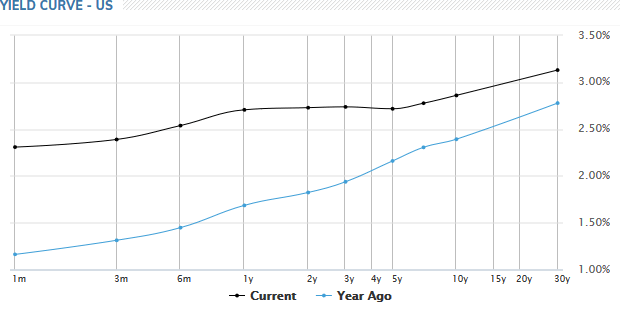
Treasury yield curve continued to flatten with 5-year yield up 0.13 to 2.709. 10-year yield closed up 0.006 at 2.856. 30-year yield dropped -0.014 to 3.129. Yield curve remains inverted between 3-year (2.738) and 5-year (2.709).
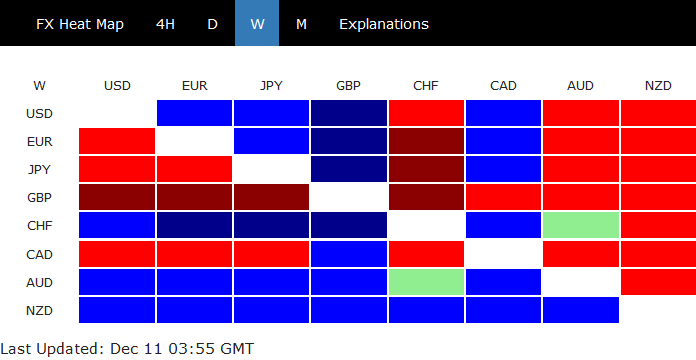
In the currency markets, Sterling remains the weakest one for the week as UK Prime Minister Theresa May conceded and called off Tuesday's Brexit parliamentary vote. Canadian Dollar is the second weakest. New Zealand Dollar, Australian Dollar and Swiss Franc are the strongest ones.
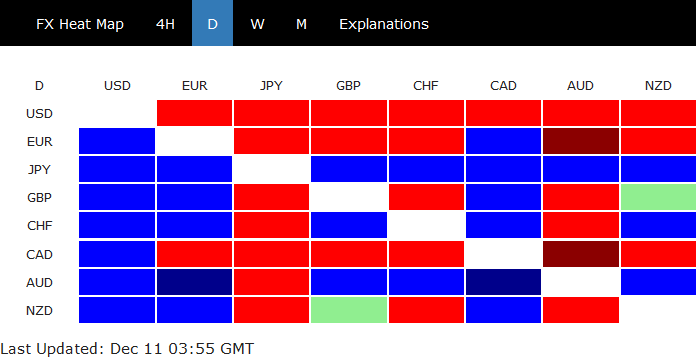
For today, Dollar turns softer, but Canadian stays weak. Aussie is staying firm for now, while Yen is trying to rally.
GBP/USD In Significant Downtrend Below 1.2800
Key Highlights
- The British Pound declined heavily and broke the 1.2660 support against the US Dollar.
- There are two important bearish trend lines formed with resistance near 1.2775 on the 4-hours chart of GBP/USD.
- The UK Industrial Production in Nov 2018 declined 0.6% (MoM), whereas the market was looking for a 0.1% rise.
- Today, the UK Claimant Count figure for Nov 2018 will be released, which is forecasted to post a change of 13.2K.
GBPUSD Technical Analysis
After forming a top near the 1.3180 level, the British Pound started a major decline against the US Dollar. The GBP/USD pair traded below the 1.3000 and 1.2800 support levels to enter a major downtrend.
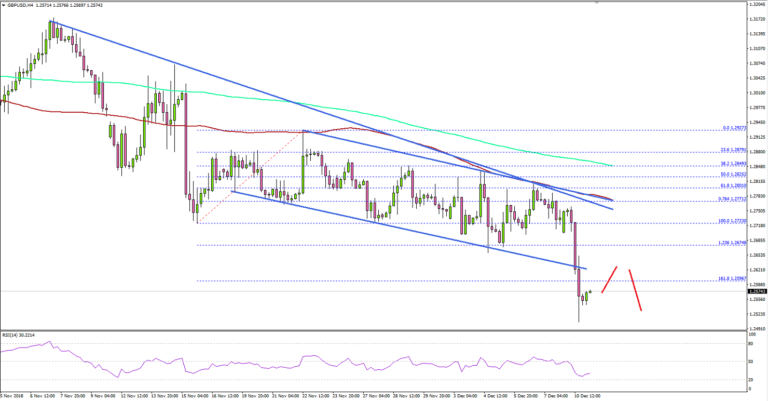
Looking at the 4-hours chart, the last swing low was formed at 1.2723 and later the pair corrected higher. It moved above the 1.2800 and 1.2900 levels, but buyers failed near 1.2930. Later, a fresh decline was initiated and the pair declined steadily below the 1.2800 and 1.2700 support levels.
The decline was such that the pair settled below the 1.2680 support, the 200 simple moving average (green, 4-hours), and the 100 simple moving average (red, 4-hours).
Moreover, there was a break below the 1.618 Fib extension level of the last wave from the 1.2723 low to 1.297 high. Therefore, there is a risk of more losses below the 1.2560 support level in the near term.
On the upside, there is a crucial resistance formed near 1.2750 and the 100 SMA. Besides, there are two important bearish trend lines formed with resistance near 1.2775 on the same chart.
Overall, as long as GBP/USD is trading below the 1.2770 and 1.2800 resistance levels, it remains in a downtrend. Above 1.2800, the pair may bounce back towards 1.3000.
Fundamentally, the UK Industrial Production for Nov 2018 was released by the National Statistics. The market was looking for a 0.1% rise in the UK Industrial Production compared with the previous month.
However, the result was disappointing as there was a 0.6% decline in the production. Looking at the yearly change, there was a 0.8% drop, whereas the market was looking for -0.2%. The report added:
The monthly decrease in manufacturing output of 0.9% was due mainly to weakness from transport equipment, falling by 3.2% and pharmaceutical products, falling by 5.0%; 5 of the 13 manufacturing subsectors increased.
It impacted the British Pound and pushed GBP/USD lower. If buyers fail to hold the 1.2560 support, there could be a sharp decline in the near term.
Economic Releases to Watch Today
- UK Claimant Count Change Nov 2018 – Forecast 13.2K, versus 20.2K previous.
- UK ILO Unemployment Rate Oct 2018 (3M) – Forecast 4.1%, versus 4.1% previous.
- US Producer Price Index Nov 2018 (MoM) – Forecast 0%, versus +0.6% previous.
- US Producer Price Index Nov 2018 (YoY) – Forecast +2.5%, versus +2.9% previous.