Sample Category Title
GBPAUD Eases Below 38.2% Fibonacci; Bearish Correction in Near Term
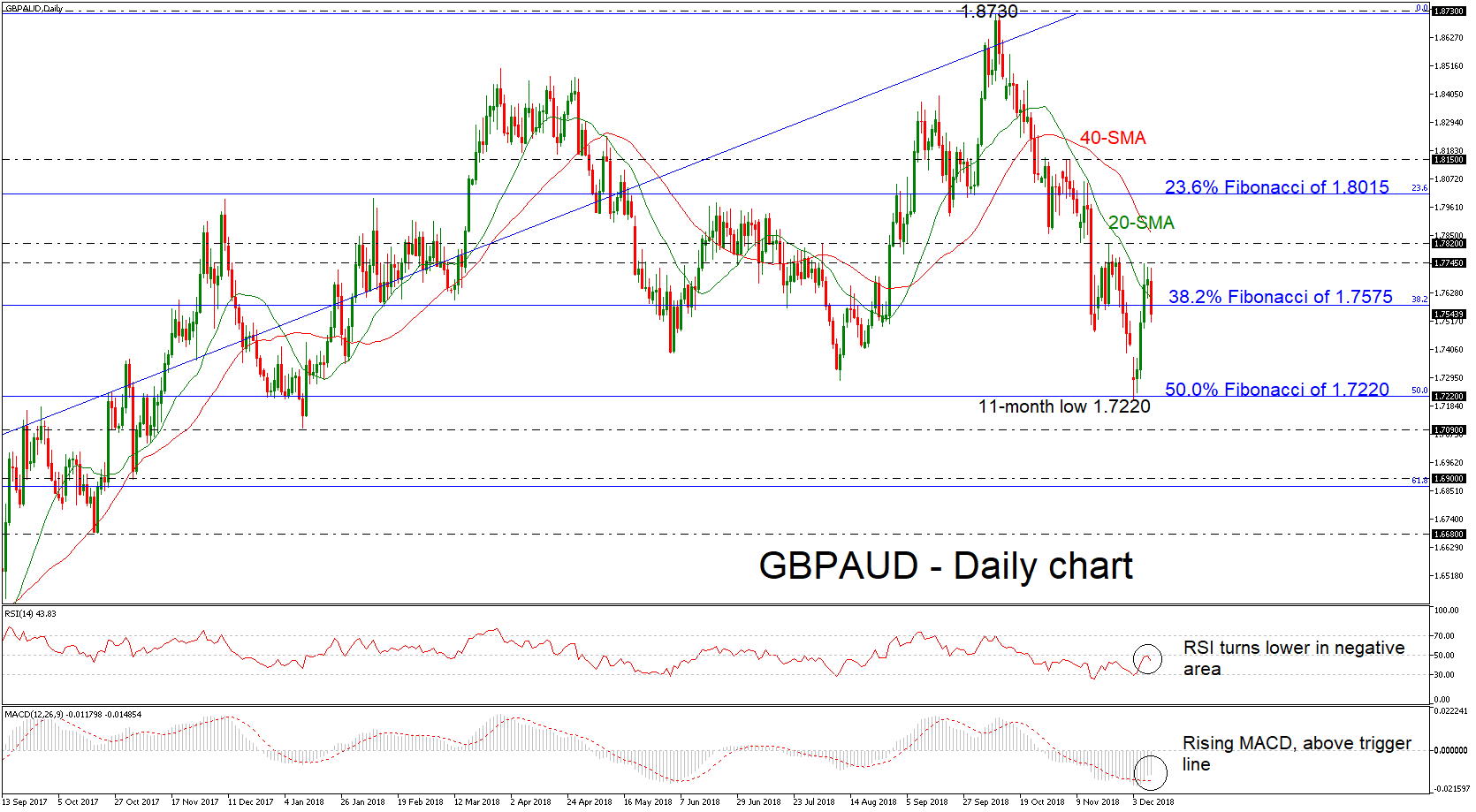
GBPAUD rebounded after touching 11-month lows at 1.1720, near the 50% Fibonacci retracement level of the upleg from 1.5725 to 1.8730 on December 3. A week later though, the pair is reversing lower again, back below the 38.2% Fibonacci, with the RSI suggesting further weakness to come in the short term; the indicator returned to bearish territory after failing to break above its 50 neutral mark. On the other hand, the MACD keeps gaining ground above its red signal line, supporting that the pair may resume upside. Yet as long as the index holds negative, downside movements are more likely.
If the price manages to regain today’s losing ground, the pair could challenge again the 1.7745 obstacle. An upside penetration of this barrier could drive the market until the 1.7820 resistance, registered on November 21. More advances could meet the 23.6% Fibonacci mark of 1.8015.
Alternatively, if the pair continues to lose below the 38.2% Fibonacci of 1.7575, support could be found at the eleven-month low of 1.7220. The next stop for investors to have in mind is the 1.7090 mark, reached on January 11.
To sum up, GBPAUD is in bearish correction mode today, but if it continues this tendency breaking the bottom at 1.7220, the long-term outlook would turn even more bearish.
DAX Steady after Dismal Week for Global Markets
The DAX index is almost unchanged the Monday session. Currently, the index is at 10,730, up 0.04% on the day. On the release front, Germany’s trade surplus fell to EUR 17.3 billion, edging above the estimate of EUR 17.2 billion. The Eurozone Sentix Investor Confidence posted a decline of 0.3, well short of the estimate of 8.4 points. On Tuesday, German ZEW Economic Sentiment is expected to weaken to 25.0 points.
Global markets had a dismal week, as investors continue to fret over global growth prospects and the nagging trade war between the U.S. and China. The DAX plunged 6.47% last week and dropped below the 11,000 level for the first time since December 2016. The French CAC also dropped sharply last week, declining 5.86%. There was some optimism early in the week after President Trump agreed to suspend further tariffs against China for 90 days. However, there are concerns that the two sides will not be able to close the substantial gaps in their positions in just a few weeks.
There was more bad news for investors on Thursday, after a senior Chinese executive, Meng Wanzhou, was arrested in Vancouver for allegedly violating trade sanctions against Iran. Wanzhou faces extradition to the U.S., and China’s indignant response to the arrest could torpedo upcoming trade talks between the two countries. Even if the negotiations get off the ground, they promise to be difficult, which could mean more headwinds for the DAX.
The U.S. ended the week with unexpectedly soft employment numbers. Nonfarm employment change was dismal, plunging from 250 thousand to 155 thousand. This was well off the forecast of 198 thousand. Wage growth remained stuck at 0.2%, missing the estimate of 0.3%. There was better news from the unemployment rate, which remained at a sizzling 3.7%. The data points to slowing growth in the U.S, which could lead to a change in monetary policy. The Federal Reserve minutes from the November meeting indicated that policymakers discussed changing their stance of gradual increases rate increases. The markets are currently looking at one rate hike next year – just a few months ago, there was talk of a rate hike in each quarter of 2019.
Into US session: Sterling dives as May will call off tomorrow’s Brexit vote
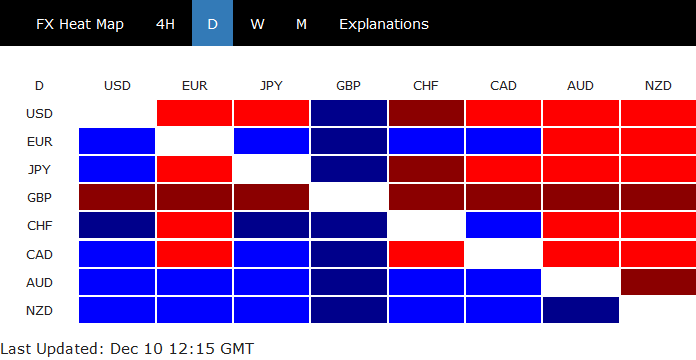
Sterling's selloff finally takes off on news that UK Prime Minister Theresa May is going to call off tomorrow's Brexit parliamentary vote. May is going to formally make a statement at 1530GMT. EUR/GBP breaks through 0.9 handle and is on track to 0.9098 resistance. GBP/JPY also breaks 142.76 support and is heading back to 139.88 low. GBP/USD breached 1.2661 key support but it's hesitating to stay below so far.
Staying in the currency markets, Dollar is following the Pound as second weakest for the time being. Yen is the third weakest. New Zealand Dollar leads Australian Dollar and Euro higher. Euro showed no reaction to terribly bad investor confidence data.
In European markets, at the time of writing:
- FTSE is up 0.20%
- DAX is down -0.46%
- CAC is down -0.53%
- German 10 year yield is up 0.002 at 0.253
- Italian 10 year yield is down -0.032 at 3.099
Earlier in Asia:
- Nikkei dropped -2.12% to 21219.50
- Hong Kong HSI dropped -1.19% to 25752.38
- China Shanghai SSE dropped -0.82% to 2584.58
- Singapore Strait Times dropped -1.24% to 3072.44
- Japan 10 year JGB yield dropped -0.0223 to 0.04
EUR/USD – Euro Gains Ground As German Trade Surplus Beats Estimate
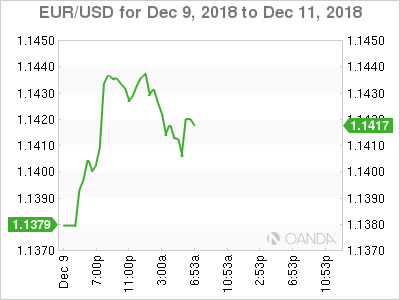
EUR/USD has started the week with gains. In the Monday session, the pair is trading at 1.1418, up 0.34% on the day. There are no major releases out of the eurozone or the United States. Germany’s trade surplus fell to EUR 17.3 billion, edging above the estimate of EUR 17.2 billion. The Eurozone Sentix Investor Confidence posted a decline of 0.3, well short of the estimate of 8.4 points. The sole event in the U.S. is JOLTS Job Openings. The indicator is expected to improve to 7.22 million, after the previous release of 7.01 million. On Tuesday, German ZEW Economic Sentiment is expected to weaken to 25.0 points. In the U.S, the Producer Prices Index is forecast to drop to 0.0%.
The U.S. ended the week with dismal employment numbers, although the euro couldn’t take advantage and was unchanged on Friday. Nonfarm employment change was weaker than expected, plunging from 250 thousand to 155 thousand. This was well off the forecast of 198 thousand. Wage growth remained stuck at 0.2%, missing the estimate of 0.3%. There was better news from the unemployment rate, which remained at a sizzling 3.7%. The data points to slowing growth in the U.S, which could lead to a change in monetary policy. The Federal Reserve minutes from the November meeting indicated that policymakers discussed changing their stance of gradual increases rate increases. The markets are currently looking at one rate hike next year – just a few months ago, there was talk of a rate hike in each quarter of 2019.
Global stock markets had a dismal week, as nervous investors continue to fret over the U.S-China trade war. Although President Trump agreed to suspend further tariffs against China for 90 days. However, there are concerns that the two sides will not be able to close the gaps in their positions in just a few weeks. The markets soured on Thursday, after a senior Chinese executive, Meng Wanzhou, was arrested in Vancouver for allegedly violating trade sanctions against Iran. Wanzhou faces extradition to the U.S., and China’s indignant response to the arrest could torpedo upcoming trade talks between the two countries.
EUR/USD Outlook: Bulls Face Headwinds At Daily Cloud Base, Cluster Of Converged MA’s Underpins And Expected To Contain consolidation
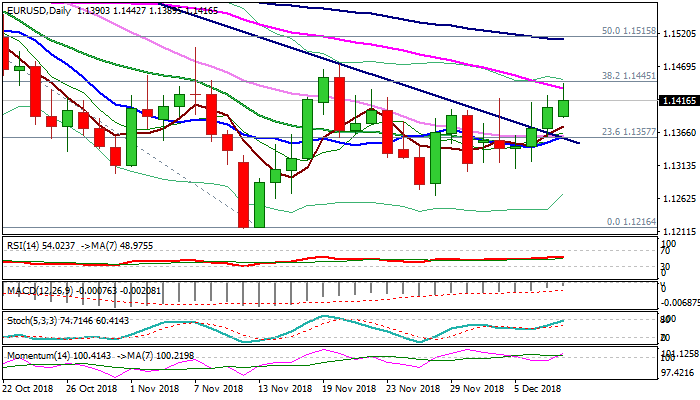
The Euro stands at the front foot on Monday and cracked strong barriers at 1.1435/44 (falling 55SMA / base of falling thick daily cloud / Fibo 38.2% of 1.1815/1.1215 descend).
Fresh bulls emerged after Monday’s gap-lower opening and filled the gap, keeping near-term bullish bias intact.
However, bulls face strong headwinds at 1.1435 barriers and may hold in extended consolidation before final push through the barrier, which would signal stronger bullish acceleration.
Strengthening bullish momentum on daily chart supports scenario.
Converged daily MA’s (10/20/30) at 1.1360 zone are about to form bull-crosses and further underpin the action, with extended dips expected to be contained here and keep bulls in play.
Res: 1.1435, 1.1444, 1.1499, 1.1510
Sup: 1.1389, 1.1360, 1.1320, 1.1305
EUR/JPY Moving Towards Psychological Resistance Level
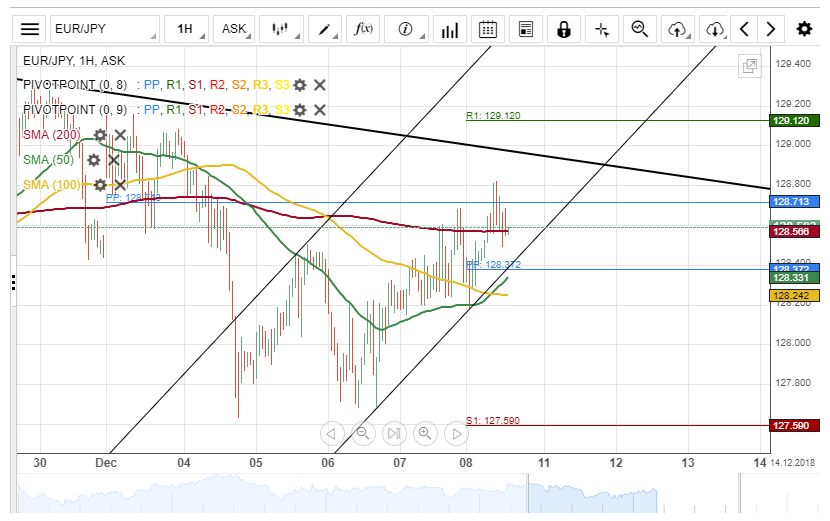
The common European currency appreciated about 54 base points against the Japanese Yen on Monday. The currency pair has reversed a new junior ascending channel pattern.
The exchange rate breached both the 200-hour simple moving average at 128.58 and the monthly pivot point at 128.71 during the morning hours of Monday's trading session.
Everything being equal, it is likely that the EUR/JPY currency exchange rate aim for the upper boundary of a descending trendline at 129.00 during the following trading session.
AUD/USD Downside Risks Still Possible
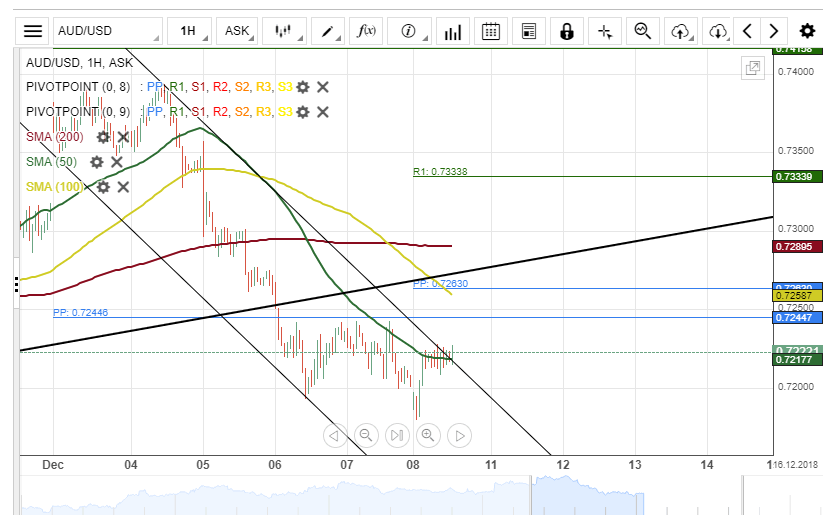
The Australian Dollar was pressured south against the US Dollar on Friday by the 50-hour simple moving average, which was providing resistance for the currency pair at 0.7244.
The exchange was consolidating near the upper boundary of a descending channel pattern at 0.7218 during the first part of Monday's trading session.
Technical indicators suggest that the decline of the currency exchange rate is likely to continue today.
If this decline continues, the potential downside target for bearish traders will be near a support level formed by the monthly S1 at 0.7143.
USD/CAD Consolidates After Decline
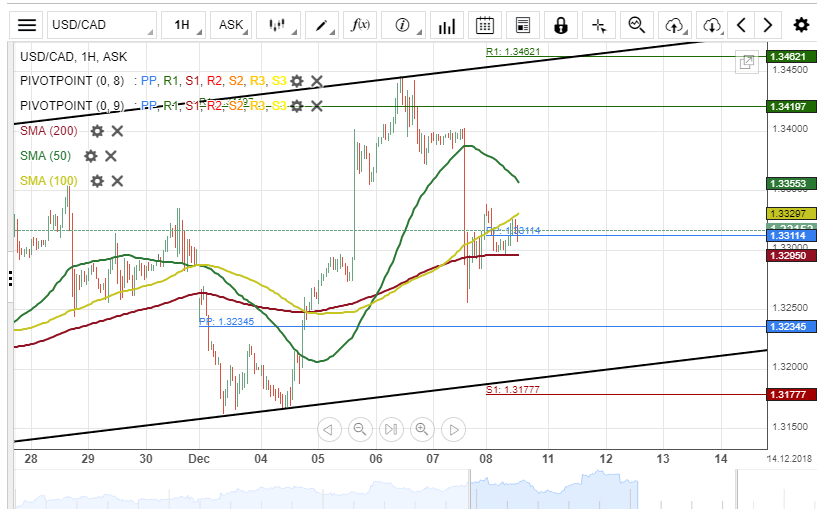
The US Dollar depreciated about 145 base points against the Canadian Dollar on Friday. This sharp declined was as a result of the lower than expected of the US non-farm payroll macroeconomic data released.
The exchange rate was stranded between SMAs during the first half of Monday's trading session. The 100-hour SMA was providing resistance for the pair at 1.3324, while the 200-hour simple moving average was providing support for the rate at 1.3294.
By and large, it is likely the currency exchange rate regains its lost positions within this session. The potential upside target will be near the 50-hour SMA at 1.3363.
NZD/USD Stranded Between SMAs
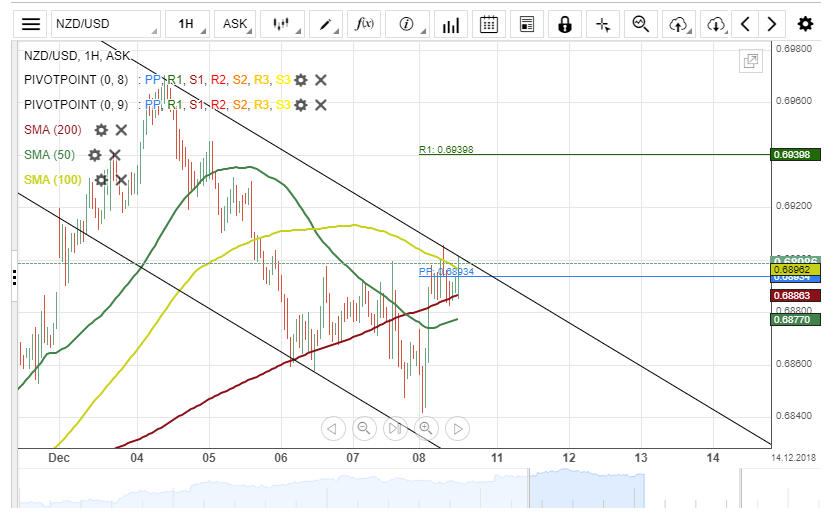
The New Zealand Dollar depreciated about 51 base points against the US Dollar on Friday. The currency pair revealed a new junior descending channel during the end of the previous trading session.
However, today's session begins with a strong bullish momentum, and by the middle of the trading day, the exchange rate has regained 64 base points of its lost positions.
As for the near future, it is likely that the NZD/USD currency exchange rate makes a brief retracement down towards last week swing low of 0.6860 within the following trading hours.
Global Growth And Brexit Fears Dominate Proceedings
Monday December 10: Five things the markets are talking about
**PM MAY SAID TO CANCEL PLANNED TUESDAY’S MEANINGFUL VOTE IN PARLIAMENT**
Global equities remain under pressure, extending last week’s losses amid a potential escalation between the world’s two largest economies, and after signs China’s economy remains under pressure.
Dampening investor sentiment was weak data on China’s slowing economy and news the China had summoned the U.S and Canadian ambassadors to protest the arrest of Huawei CFO. The euro remains better bid on pullbacks and the dollar trades mixed while U.S Treasuries and European sovereign bonds are little changed.
Note: Data on the weekend showed that China’s trade balance slowed as impact of trade tensions starts to show; CPI rose to +2.2% vs. +2.4%e in November while PPI came inline.
Because of the holiday-shortened month, flash PMI’s for December will be released this week. The European Central Bank (ECB) meets Thursday, while tomorrow is the big day in the U.K — Parliament votes on Prime Minister Theresa May’s Brexit plan, which is not expected to pass.
Note: PM May is deciding whether to risk a defeat or to postpone the vote.
Data in Europe this morning showed that investor morale in the eurozone slumped to a four-year low in December as fears about trade conflicts, Italy’s budget row with the E.U and Brexit led to a collapse in sentiment.
Elsewhere, oil prices are steady after Friday’s rally triggered by OPEC and its allies agreeing on production cuts.
On tap: The U.K Parliament will vote on the E.U divorce deal tomorrow. The ECB is set to cap asset purchases at its final policy meeting this year on Thursday, while China industrial production, retail sales data for November is due Friday.
1. Stocks see red
In Japan, stocks tumbled to a six-week low overnight as a deeper-than-expected domestic economic contraction in Q3 and a sharp sell-off last week stateside-depressed investor sentiment. Sino-U.S. trade tensions continue to hurt global stocks and push the Nikkei down -2.1% – the lowest closing level since Oct. 29. The broader Topix fell -1.9%.
Note: Japan’s benchmark index has lost -13.2% from its three decade high in early October. Data overnight showed that Q3 GDP fell -2.5% in the final release compared to the preliminary reading of -1.2%. The downward revision was driven by a drop in private capital expenditures.
Down-under, Aussie shares closed atop of their two-year lows overnight as investors turned risk-averse on concerns over Sino-U.S trade tensions and slowing global growth, with the healthcare and financial indexes recording the biggest losses. The S&P/ASX 200 index closed down -2.3%. In S. Korea, the Kospi closed down -1.06%, pressured by shares of Samsung Electronics which fell -1.8%, hitting its lowest close in 19-months.
In China, stocks ended lower overnight as disappointing November trade and inflation data added to concerns over slowing growth, and as the arrest of the Huawei CFO increased investor worries that the Sino-U.S trade war could escalate. At the close, the Shanghai Composite index was down -0.8%, while the blue-chip CSI300 index was down -1.2%.
In Hong Kong, shares ended lower for a fourth consecutive session on Monday, at the close, the Hang Seng index was down -1.2%, while the China Enterprises index lost -0.9%.
In Europe, regional bourses trade lower across the board, tracking weaker U.S markets on Friday and lower futures this morning as geopolitical tensions continue to weigh.
U.S stocks are set to open in the ‘red’ (-0.4%).
Indices: Stoxx600 -0.88% at 342.42, FTSE -0.47% at 6,746.25, DAX -0.66% at 10,716.38, CAC-40 -0.58% at 4,784.99, IBEX-35 -0.60% at 8,762.35, FTSE MIB -0.50% at 18,648.50, SMI -0.91% at 8,642.50, S&P 500 Futures -0.40%
2. Brent oil rises after OPEC deal, but 2019 outlook weakens
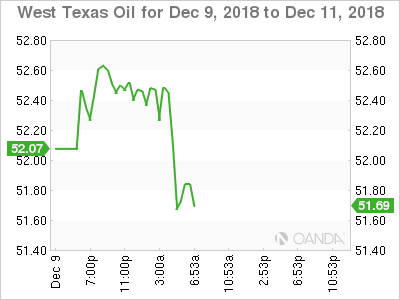
Brent crude futures have rallied overnight after OPEC+ agreed last week to a supply cut from January. Despite this, the price outlook for next year remains weaker on the back of an economic slowdown.
Brent crude oil futures are at +$62.03 per barrel, up +36c, or +0.6%, from Friday’s close.
Prices rallied after OPEC+ (including Russia) on Friday said they would cut oil supply by -1.2M bpd, with an -800K bpd reduction planned by OPEC members and -400K bpd by countries not affiliated with the group.
Also providing a bid to Brent this morning is the shutdown of the +315K bpd El Sharara oilfield in Libya.
U.S West Texas Intermediate (WTI) crude futures are weaker, falling -10cfrom Friday’s close to +$52.51 per barrel, weighed down by surging U.S output – the U.S oil industry is not taking part in the announced cuts.
Note: Oil prices have fallen sharply since in the last two months on signs of an economic slowdown, with Brent losing almost -30% in value.
China, the world’s biggest oil importer, reported November crude imports rose +8.5% y/y, to +10.43M bpd – on track to set yet another annual import record.
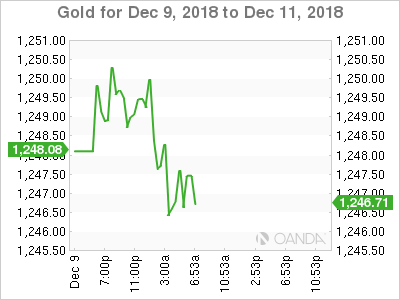
Ahead of the U.S open, gold prices are holding steady atop of their five-month high overnight, supported by Friday’s disappointing U.S jobs report that fuelled speculation that the Fed may stop raising interest rates sooner than expected. Spot gold is at +$1,247.80 per ounce, after hitting its highest since July at +$1,250.55 overnight. U.S gold futures are up +0.2% at +$1,254.6 per ounce.
3. French sovereign yields rally on violent protests
French government bond yields have rallied this morning, pushing the gap over safer German Bunds to its widest in seven-months following more violent anti-government protests in France over the weekend.
The French 10-year bond yield has rallied around +2 bps to +0.71%, a one-week high and almost +7 bps above the five-month lows hit last week.
The gap between 10-year bond yields in France and Germany stood at around +46 bps, its widest since late May when a rout in Italian bonds flowed over into other eurozone bond markets except Germany.
French bonds also underperformed other eurozone peers – the Spanish/French 10-year bond yield gap was at its tightest since October as French yields rose.
Elsewhere, the yield on 10-year Treasuries has climbed +1 bps to +2.85%, the biggest increase in two-weeks. In Germany, the 10-year Bund yield decreased -1 bps to +0.25%, while in the U.K, the 10-year Gilt yield declined -1 bps to +1.254%.
4. Dollar demise remains
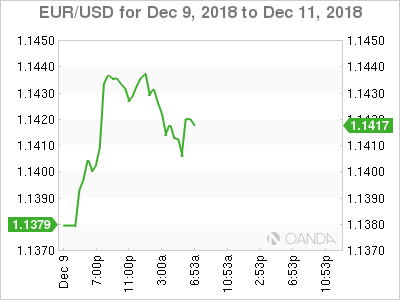
The USD is a tad weaker overnight with political and Fed rate outlook playing a factor.
Note: U.S November CPI data set for release on Wednesday seen as key for pricing the Fed rate path.
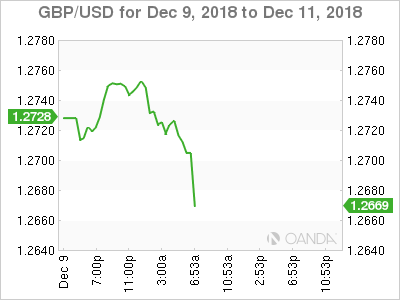
Sterling (£1.2703) remains the markets main focus this week as the U.K Parliament is set to vote on Brexit divorce bill Tuesday, Dec 11 (tomorrow).
PM May is expected to face certain defeat and a leadership challenge could emerge. Analysts noted that many of scenarios remained on the table after tomorrow’s vote. The pound did see a brief rally higher towards £1.2770 area after the European Court of Justice (ECJ) ruling on the reversibility of Article 50 stated that the U.K could unilaterally revoke Brexit ahead of the March 29 deadline.
EUR/USD (€1.1404) is holding above last week’s low of €1.3911 as the market looks ahead to this Thursday’s ECB decision which is expected to deliver a “dovish tightening”. The ECB is also expected to confirm that QE would end this month, but policy would remain accommodative.
5. UK economy slowing
Data this morning from the ONS showed that the U.K. economy expanded +0.4% in the three-months through October, a slower pace of growth than the +0.6% pace recorded in the three-months through September.
Digging deeper, the services sector performed well, but growth suffered as a result of a manufacturing slowdown driven by a slump in domestic demand for autos.
Note: There were few signs of pre-Brexit stockpiling, with imports of food in October lower than average for the past year.
This morning data reinforce market expectations that the U.K economy is slowing as political uncertainty over Brexit intensifies ahead the March’s divorce day.