Sample Category Title
Can OPEC Live Up To Market Expectations Or Will They Trigger More Downside?
Yield curve concerns continue to weigh
We're seeing significant risk aversion in the markets again on Thursday, with Asia trading deep in the red overnight and European pre-market levels painting a pretty grim picture for the day ahead.
Any boost from the Trump/Xi dinner over the weekend lasted barely longer than the main course, with investors instead turning their attention to the US yield curve and what the inversion means for the economy next year and beyond. While I don't think investors are in recession planning mode just yet, they will be monitoring the curve very closely for the foreseeable future so we may be hearing a lot more about them.
Fed Chairman Jerome Powell can probably expect more public bashing from Trump as he continues to weigh in on an area that past Presidents have avoided, out of respect for the central bank's independence. That's unlikely to deter the Fed from hiking again this month though, although we may see a noticeably different outlook from them in terms of tone and rate hike expectations.
Brexit uncertainty grows as May's deal suffers numerous setbacks
Domestic issues continue to cloud the UK outlook and weigh on the currency, as parliament debates Theresa May's Brexit deal following a series of defeats that resulted in her legal advice being published. The advice confirmed people's biggest fears that the country could be locked in the backstop indefinitely until a new agreement superseded it, something that is only partially in the control of the UK.
May now faces a huge uphill battle to get the deal through parliament next week and many – including myself – are already working on the assumption that it fails and May is forced to return to the EU asking for more concessions. There are numerous paths this could then go down in the run up to Christmas - a time when politicians would rather be celebrating with their families rather than talking Brexit – and this fact could weigh heavily on the pound in the coming weeks, although we're yet to see a significant break below 1.27 against the dollar which could be the catalyst for another plunge.
Can OPEC live up to market expectations or will they trigger more downside?
After weeks of speculation and more tumbles in the price of oil, OPEC and its allies will finally meet in Vienna on Thursday to discuss its response to the declines and the shifts in the supply/demand dynamics that have driven it. Record output from some of the world's largest producers – including the US – and a murkier global economic outlook have been two major factors, which has forced the group to consider another round of output cuts, something not all are in agreement on.
A cut of between one and 1.3 million barrels per day is apparently under consideration and there have been positive signals that Saudi Arabia and Russia – the two largest producers at the meeting – could be on board. But after weeks of reports that an agreement is not straight forward, I wonder whether there is a risk that the group under delivers – be it on the size or duration of the cut – and rather than supporting prices, acts as the catalyst for the next decline.
There's plenty more on the agenda today, including an array of US economic data releases after markets were closed on Wednesday in honour of the late President Bush. We'll also get crude inventory numbers although this may be somewhat overshadowed by the OPEC announcement.
OPEC Production Cuts Seem On The Cards
Market movers today
OPEC will meet today to discuss potential production cuts in 2019. A press conference is scheduled for 13:00 CET, which will be monitored closely amid soaring oil price volatility this autumn, see the chart (source: Bloomberg) . The final rounds of speculation indicate an agreement on output cut next year, which could last the whole of 2019, but there seems to be no deal yet on the size of the cut. Furthermore, Libya and Nigeria seem likely to be included in a deal this time around.
If we are right in our call for production cuts in the magnitude of 1.3mb/d for OPEC+, it would erase OPEC+ output gains from this year. It would pave the way further for a short-term rebound in the price on Brent crude above USD70/bbl, which would support oil exporting currencies such as CAD and NOK.
In terms of the economic data calendar, today is rather light, as we await tomorrow's US labour market report, euro area GDP and wage numbers.
However, today the ADP job report is due as well as US initial jobless claims , which could be an indicator of tomorrow's non-farm job report even if the predicting power of the ADP report has been poor lately. Finally, the Brexit debate in the House of Commons will continue and overnight we will get Chinese FX reserves data.
In Scandi markets, the SCB release Swedish house prices.
Selected market news
Risk sentiment remains choppy with Asia trading in the 'red' this morning. The latest souring in risk sentiment relates to renewed trade uncertainty as the CFO of Chinese giant Huawei Technologies, Wanzhou Meng, has been arrested by Canadian authorities on extradition claims from the US. The arrest rekindles questions on the outlook for a US-China trade deal even if constructive comments on both sides of the Pacific calmed markets yesterday. Also contributing to market volatility has been the renewed focus on the US yield curve inversion amid US 10Y Treasury yields falling towards 2.88%.
Souring risk sentiment has weighed on the oil price , which blurs the picture of what is priced into oil markets in terms of an OPEC+ production cut. Meanwhile, added political pressure from US Donald Trump has clearly curbed gains. Yesterday, he tweeted: 'Hopefully, OPEC will be keeping oil flows as is, not restricted. The world does not want to see, or need, higher oil prices '. The added pressure should be seen in light of worsening US-Saudi diplomatic relations following the killing of journalist Khashoggi in October.
As expected, the Bank of Canada left policy rates unchanged at yesterday's 'interim' meeting. Meanwhile, the statement was softer than expected as it emphasised that the latest GDP revisions by Statistics Canada could mean 'there may be additional room for non-inflationary growth'. In other words, capacity utilisation is likely to be lower than the bank previously expected. CAD moved lowered on the announcement as it challenges market pricing of a March hike. The next monetary policy report is due on 9 January.
Euro-Zone’s Service Sector Activity Dropped To A Two-Year Low Level In November
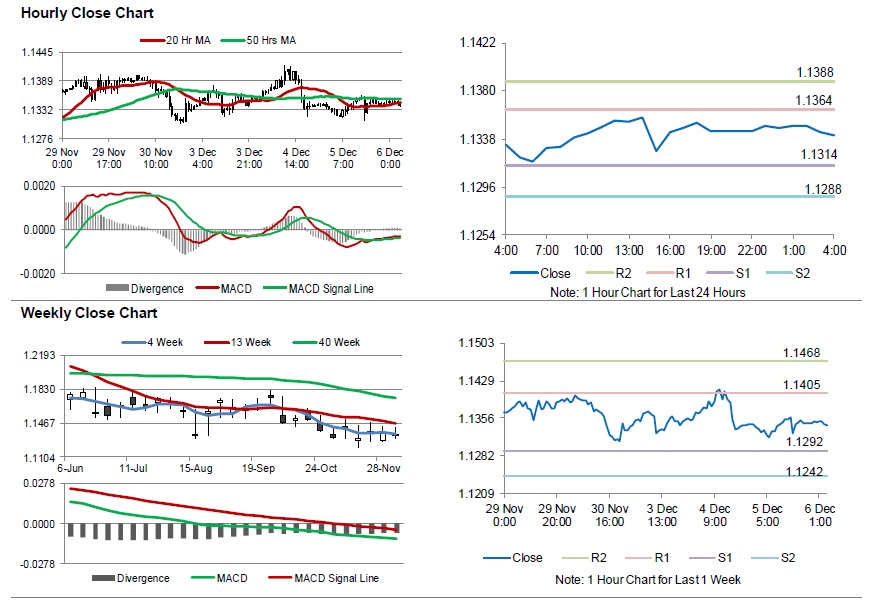
For the 24 hours to 23:00 GMT, the EUR rose 0.05% against the USD and closed at 1.1349.
On economic news the Euro-zone's final services PMI slid to its lowest level in two-years to 53.4 in November, in line with market expectations. The preliminary figures had indicated a drop to 53.10. In the prior month, the PMI had recorded a level of 53.7. On the contrary, the region's seasonally adjusted retail sales rebounded 0.3% on a monthly basis in October, more than market expectations for an advance of 0.2%. In the preceding month, retail sales had recorded a revised fall of 0.5%.
Separately, in Germany, the final Markit services PMI eased to 53.3 in November, hitting its lowest level in six months and confirming the preliminary print. In the previous month, the PMI had recorded a reading of 54.7.
In the US, data showed that the US MBA mortgage applications rose 2.0% on a weekly basis in the week ended 30 November 2018. In the previous week, mortgage applications had registered a gain of 5.5%.
The Federal Reserve's (Fed) latest Beige Book revealed that most districts witnessed a modest or moderate pace of expansion from mid-October through late November. Further, the report stated that labour markets tightened, and consumer spending held steady. On the inflation front, the Beige Book indicated that prices rose at a modest pace in most districts, although a few reported moderate increases. Moreover, the report signalled that the Federal Reserve will only gradually raise interest rates. However, uncertainty about trade remained a concern for manufacturers and farmers.
In the Asian session, at GMT0400, the pair is trading at 1.1341, with the EUR trading 0.07% lower against the USD from yesterday's close.
The pair is expected to find support at 1.1314, and a fall through could take it to the next support level of 1.1288. The pair is expected to find its first resistance at 1.1364, and a rise through could take it to the next resistance level of 1.1388.
Going ahead, traders would keep an eye on the Germany's construction PMI for November and factory orders for October, slated to release in a few hours. Later in the day, the US ADP employment change and Markit services PMI, both for November, will keep investor on their toes. Additionally, the US trade balance data, factory orders and durable goods orders, all for October, will garner significant amount of investors' attention.
The currency pair is showing convergence with its 20 Hr moving average and trading below its 50 Hr moving average.
UK’s Services PMI Surprisingly Dipped To Its Lowest Level In 28-Months In November
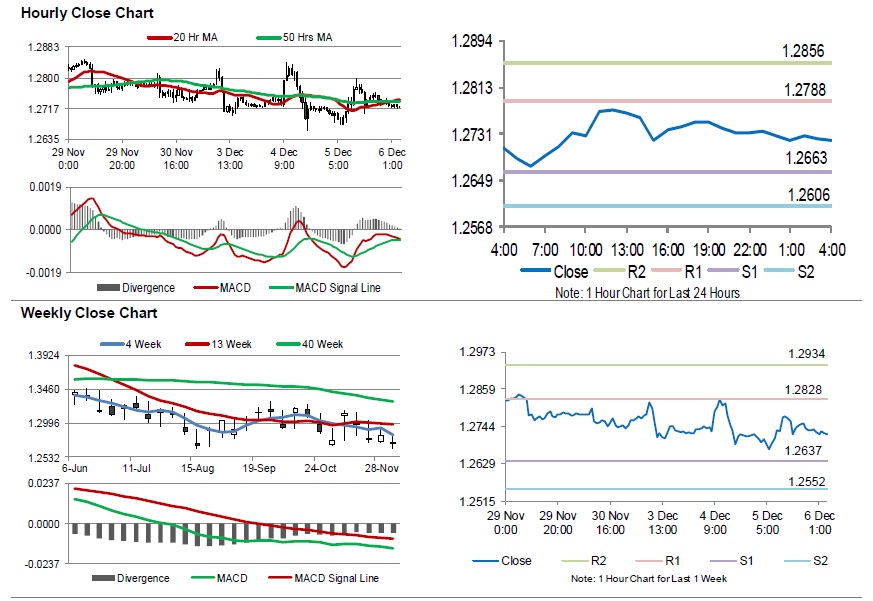
For the 24 hours to 23:00 GMT, the GBP rose 0.17% against the USD and closed at 1.2737, amid rising hopes for averting Brexit.
Macroeconomic data indicated that UK's services PMI unexpectedly fell to its lowest level in 28-months to 50.4 in November, confounding market consensus for a rise to a level of 52.5. The services PMI had recorded a reading of 52.2 in the prior month.
In the Asian session, at GMT0400, the pair is trading at 1.2721, with the GBP trading 0.13% lower against the USD from yesterday's close.
The pair is expected to find support at 1.2663, and a fall through could take it to the next support level of 1.2606. The pair is expected to find its first resistance at 1.2788, and a rise through could take it to the next resistance level of 1.2856.
In absence of key economic releases in the UK today, investor sentiment would be determined by global macroeconomic events.
The currency pair is trading below its 20 Hr and 50 Hr moving averages.
Japanese Yen Trading Higher In The Morning Session
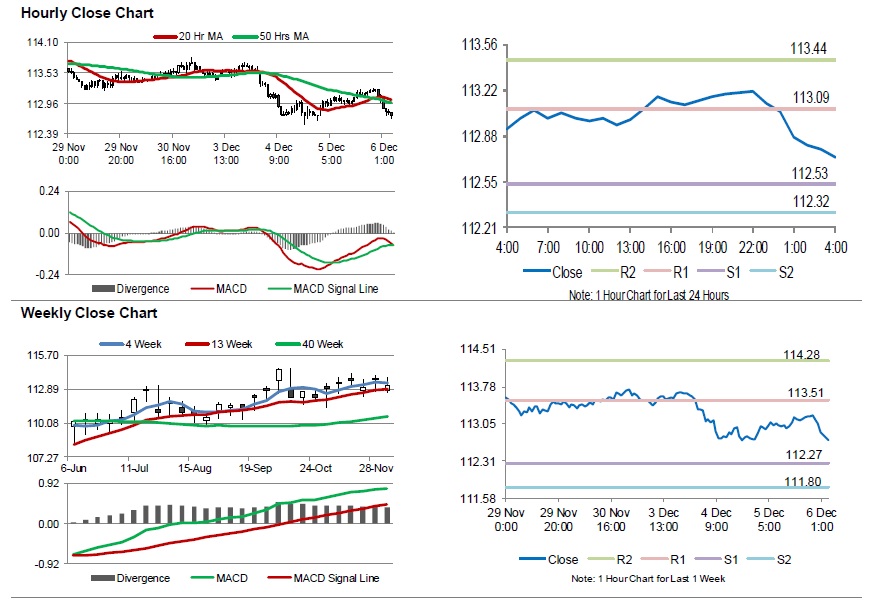
For the 24 hours to 23:00 GMT, the USD rose 0.34% against the JPY and closed at 113.12.
In the Asian session, at GMT0400, the pair is trading at 112.73, with the USD trading 0.34% lower against the JPY from yesterday’s close.
The pair is expected to find support at 112.53, and a fall through could take it to the next support level of 112.32. The pair is expected to find its first resistance at 113.09, and a rise through could take it to the next resistance level of 113.44.
Amid lack of economic releases in Japan today, traders would focus on global macroeconomic events for further direction.
The currency pair is trading below its 20 Hr and 50 Hr moving averages.
Swiss Franc Extends Its Gains In The Asian Session
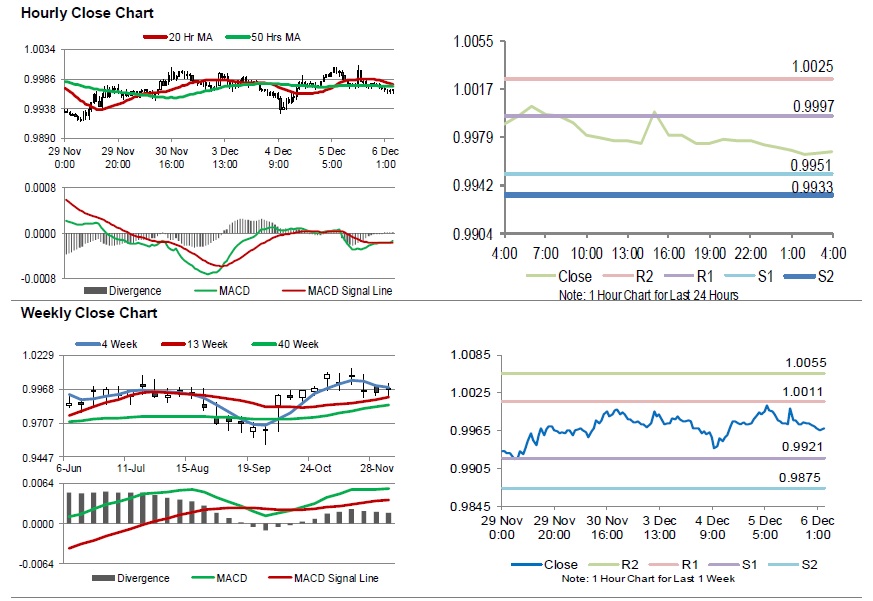
For the 24 hours to 23:00 GMT, the USD slightly declined against the CHF and closed at 0.9973.
In the Asian session, at GMT0400, the pair is trading at 0.9968, with the USD trading 0.05% lower against the CHF from yesterday’s close.
The pair is expected to find support at 0.9951, and a fall through could take it to the next support level of 0.9933. The pair is expected to find its first resistance at 0.9997, and a rise through could take it to the next resistance level of 1.0025.
The currency pair is trading below its 20 Hr and 50 Hr moving averages
The Bank Of Canada Left Its Interest Rate Steady At 1.75%, As Widely Expected
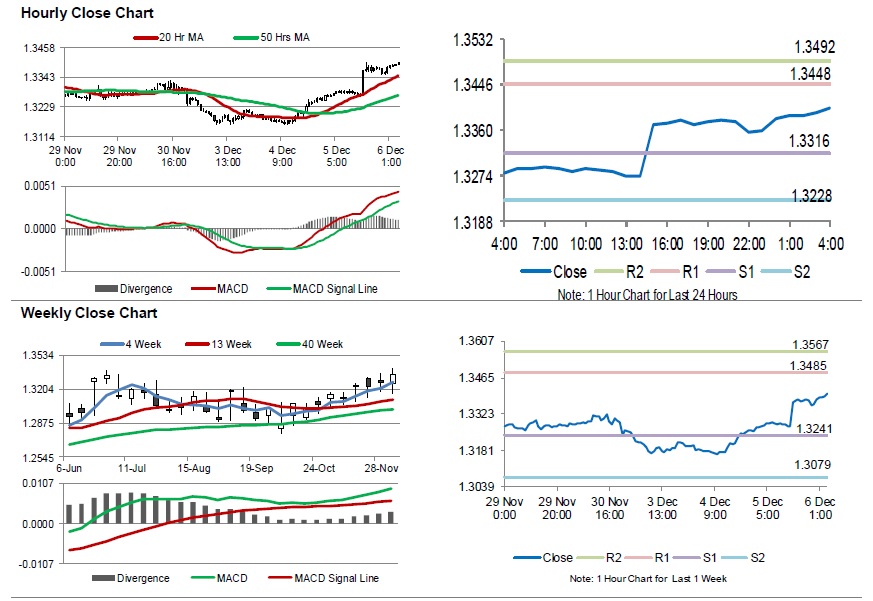
For the 24 hours to 23:00 GMT, the USD rose 0.75% against the CAD and closed at 1.3360.
The Canadian dollar fell against the US dollar, following dovish remarks by the Bank of Canada (BoC) during its monetary policy decision.
The BoC maintained its key interest rate unchanged at 1.75%, as widely expected, amid slowdown in the economic growth momentum. However, the central bank backed away from its October guidance to step up the pace at which it raises interest rates in 2019. As a result, the bank now expects to gradually raise interest rate until it reaches a level between 2.5% and 3.5%.
In the Asian session, at GMT0400, the pair is trading at 1.3404, with the USD trading 0.33% higher against the CAD from yesterday’s close.
The pair is expected to find support at 1.3316, and a fall through could take it to the next support level of 1.3228. The pair is expected to find its first resistance at 1.3448, and a rise through could take it to the next resistance level of 1.3492.
Trading trend in the Loonie today is expected to be determined by Canada’s Ivey purchasing managers index for November and merchandise trade balance data for October, slated to release later in the day.
The currency pair is trading above its 20 Hr and 50 Hr moving averages.
Australia’s Trade Surplus Narrowed In October
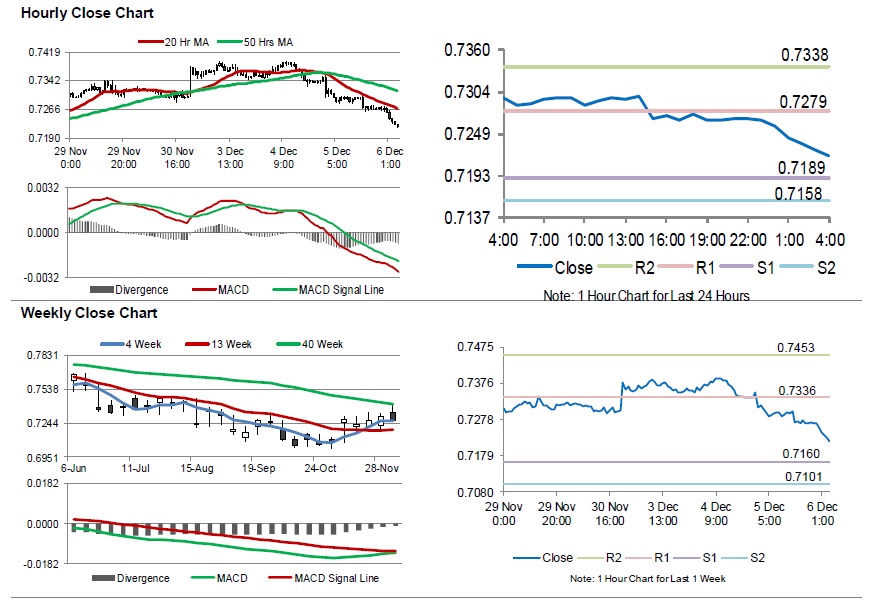
For the 24 hours to 23:00 GMT, the AUD declined 0.97% against the USD and closed at 0.7267.
LME Copper prices declined 1.9% or $116.0/MT to $6162.0/MT. Aluminium prices declined 0.9% or $18.5/MT to $1966.5/MT.
In the Asian session, at GMT0400, the pair is trading at 0.7219, with the AUD trading 0.66% lower against the USD from yesterday's close.
Overnight data showed that Australia's seasonally adjusted trade surplus narrowed to A$2316.0 million in October, more than market expectations for a surplus of A$3000.0 million. The nation had posted a revised surplus of A$2940.0 million in the previous month. Meanwhile, the nation's seasonally adjusted retail sales advanced 0.3% on a monthly basis in October, in line with market anticipation. In the preceding month, retail sales had registered a revised climb of 0.1%.
The pair is expected to find support at 0.7189, and a fall through could take it to the next support level of 0.7158. The pair is expected to find its first resistance at 0.7279, and a rise through could take it to the next resistance level of 0.7338.
The currency pair is trading below its 20 Hr and 50 Hr moving averages.
Gold: Yellow Metal Reverses Its Losses In The Morning Session
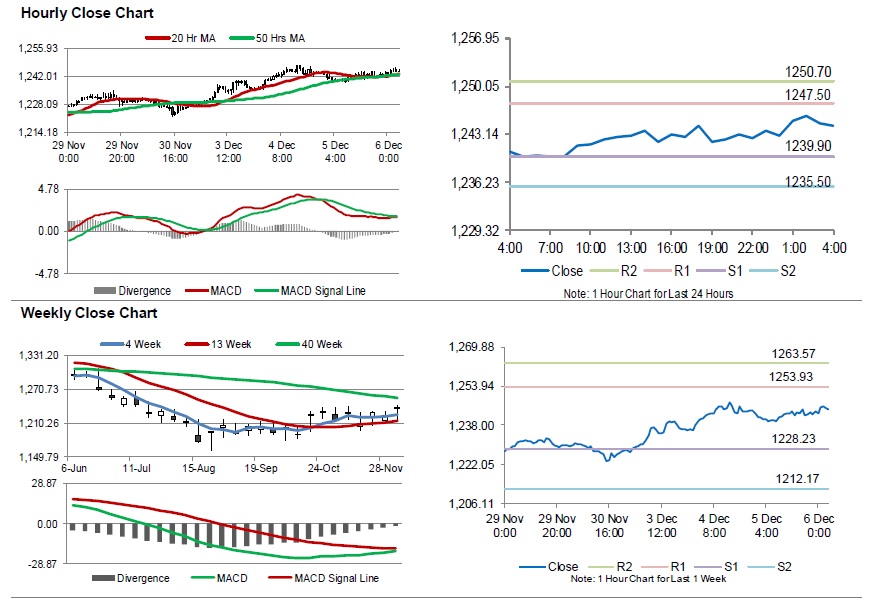
For the 24 hours to 23:00 GMT, Gold declined 0.12% against the USD and closed at USD1242.60 per ounce.
In the Asian session, at GMT0400, the pair is trading at 1244.30, with gold trading 0.14% higher against the USD from yesterday’s close.
The pair is expected to find support at 1239.90, and a fall through could take it to the next support level of 1235.50. The pair is expected to find its first resistance at 1247.50, and a rise through could take it to the next resistance level of 1250.70.
The yellow metal is trading above its 20 Hr and 50 Hr moving averages.
Silver: White Metal Trading A Negative Footing This Morning
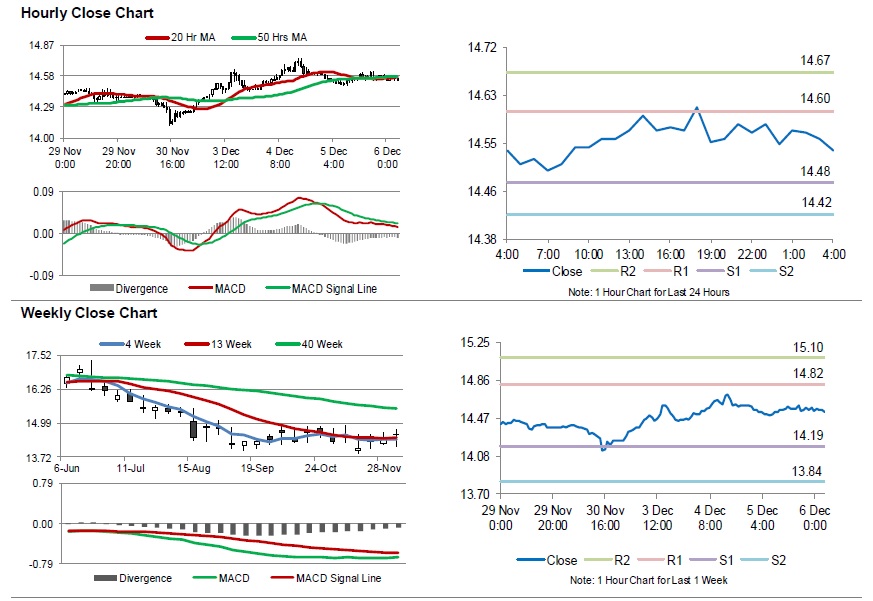
For the 24 hours to 23:00 GMT, Silver declined 0.17% against the USD and closed at USD14.58 per ounce, tracking losses in gold prices.
In the Asian session, at GMT0400, the pair is trading at 14.54, with silver trading 0.31% lower against the USD from yesterday’s close.
The pair is expected to find support at 14.48, and a fall through could take it to the next support level of 14.42. The pair is expected to find its first resistance at 14.60, and a rise through could take it to the next resistance level of 14.68.
The white metal is showing convergence with its 20 Hr and 50 Hr moving averages.