

Sample Category Title
Japan: Further Tweaks to Monetary Policy?
Executive Summary
One key theme heading into 2019 is likely to be monetary policy convergence. We believe central banks of developed economies will continue to remove accommodative monetary policy stances and eventually follow the Federal Reserve's path towards higher interest rates. In July of this year, the Bank of Japan (BoJ) introduced modest adjustments to its monetary policy framework, allowing for a wider trading range for yields on Japanese government bonds (JGB's). While we believe the BoJ will continue with its ultra-loose monetary policy, it is our view the BoJ will make further adjustments towards less accommodative policy earlier than markets are currently anticipating. With Japan's economy steady, along with the central bank's objective to ensure financial stability, we forecast the BoJ to increase its main policy rate to 0% from -0.10% as well as widen the tolerance band to +/- 30bps on 10-year JGB's as early as Q2-2019. We expect modest yen appreciation over the medium-term, although the pace of monetary tightening from other developed central banks will also be an important influence for the path of the yen.
Are More Monetary Policy Adjustments Coming?
Over the past few years, the central bank's JGB holdings have risen substantially as the BoJ engaged in large scale net bond purchases, which peaked at 80 trillion yen per year. In September 2016, the central bank also transitioned to a yield curve control policy, purchasing JGB's in an effort to maintain a 10-year JGB target yield of 0%, which it argued was a strengthening of its previous policy framework.
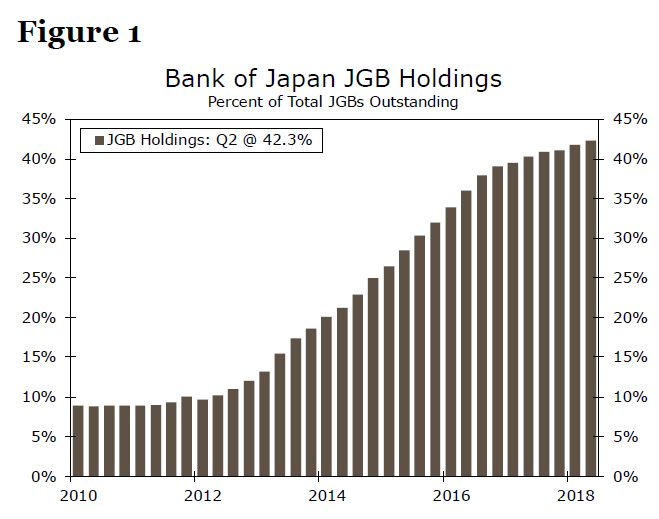
To date, the BoJ has remained largely committed to this policy, although it did widen the tolerance band at the July meeting this year to +/- 20bps, from +/- 10bps previously. Moreover, while the central bank's formal guidance is that it aims to increase outstanding JGB holdings by around 80 trillion yen per year, the fact that its net purchases have been substantially below that suggests it is secondary to yield targeting. That said, the combination of the central bank's large scale net asset purchases and yield curve control policy over several years has seen the BoJ accumulate over 40% of all outstanding JGB's (Figure 1).
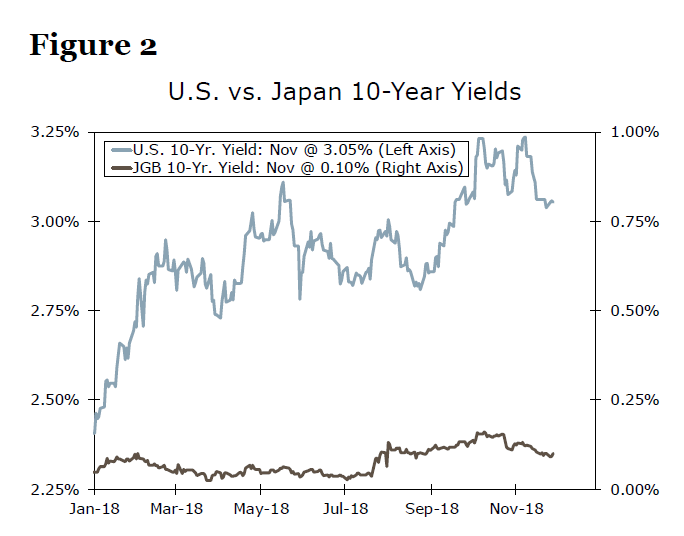
The BoJ's sizeable JGB holdings, in our view, does not help with the functioning of the JGB markets, with the central bank already starting to scale back the amount of JGB's currently being purchased. As global bond yields rise, this has put upward pressure on JGB yields as well. Ten-year JGB yields have already increased close to 6bps this year—not a large amount, but significant in the context of ultra-low Japanese yields—and with central banks likely to continue hiking interest rates in 2019, additional pressure on JGB yields to rise is probable (Figure 2). Due to this increased pressure on yields, the BoJ would likely have to continue its large purchases of JGB's in order to maintain its objective of "around 0% yield" on the 10-year JGB. In an effort to limit the amount of bonds it needs to purchase, we believe the BoJ may choose to widen its tolerance band for JGB yields to +/- 30bps, a further move to less accommodative monetary policy. Moreover, minutes from recent BoJ meetings indicate that policymakers, while fully acknowledging the need for continued monetary policy stimulus, have recognized that due to higher long-term interest rates in major economies, it may be appropriate for the BoJ to widen its tolerance band on JGB's closer to 25bps.
As noted above, the BoJ has been committed to an ultra-loose monetary policy framework since the introduction of economic reforms known as Abenomics. However, Abenomics has produced mixed effects on the Japanese economy. Efforts to boost inflation have been less successful as CPI inflation remains well below the central bank's 2% target rate—conversely, the impact on GDP has been somewhat more effective. Though growth has slowed a bit in 2018, GDP growth in Japan over the past few years has been quite steady relative to previous periods of expansion. The economy experienced growth for eight straight quarters, an expansion not seen since the late 1990s, with GDP growth currently seen as above potential output as estimated by the IMF. This relatively solid growth performance suggests the economy may have some ability to absorb higher policy rates.
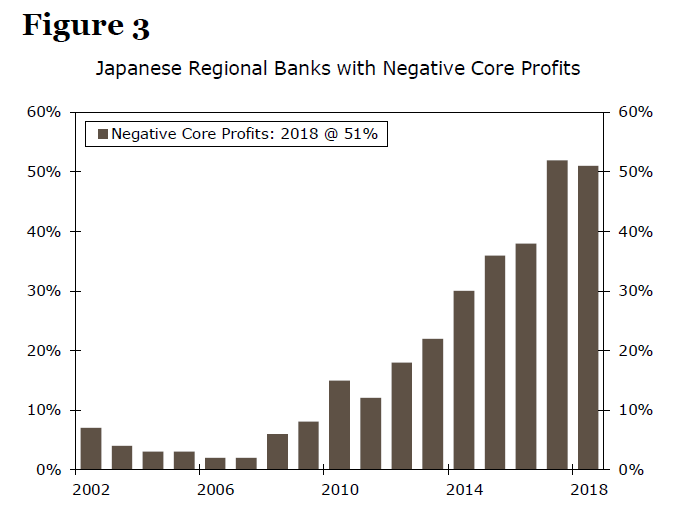
Another likely policy adjustment, in our view, could be a shift in the BoJ's policy rate. One important mandate of the BoJ is to ensure stability across Japan's banking sector. In the context of the banking sector, negative interest rates are having restraining effects on Japan's banks. Since the introduction of negative rates, the share of regional banks with negative profits from core operations (ie: lending and net fee income) has risen substantially to around 50% (Figure 3). A policy rate hike to 0% from -0.10% would likely see less bank cash held at the central bank exposed to negative interest rates, and may alleviate pressure on Japan's banks. This would follow a similar policy adjustment the BoJ made in July also aimed at increasing bank profitability within Japan.
When Will Japan Implement a Higher Consumption Tax?
In addition to our view of monetary policy adjustments, we also believe another increase to Japan's consumption tax is likely to be implemented in Q3-2019. The planned rise in Japan's consumption tax to 10% from 8% was originally intended for October 2015, but has since been delayed twice with the new target date now set for October 2019.
The previous delays back in 2015 and 2017 were largely due to Prime Minister Abe seeking to continue his efforts in stabilizing the Japanese economy. During these periods, Japanese growth was either volatile, or had not shown sufficiently sustained and steady growth, for the government to follow through on a consumption tax increase, while inflation remained relatively subdued. As we note earlier, Japan's economy has since improved a bit and we currently forecast real GDP growth of over 1% this year. As the economic recovery of Japan continues to entrench itself, the economy may finally be able to absorb the negative effects of the increased consumption tax. When compared to the consumption tax hike in 2015, we believe a more moderate impact on growth is likely. The 2019 tax increase represents only a 25% hike (10% from 8%), while the increase in 2015, to 8% from 5%, denoted a 60% surge creating additional headwinds for an already struggling economy.
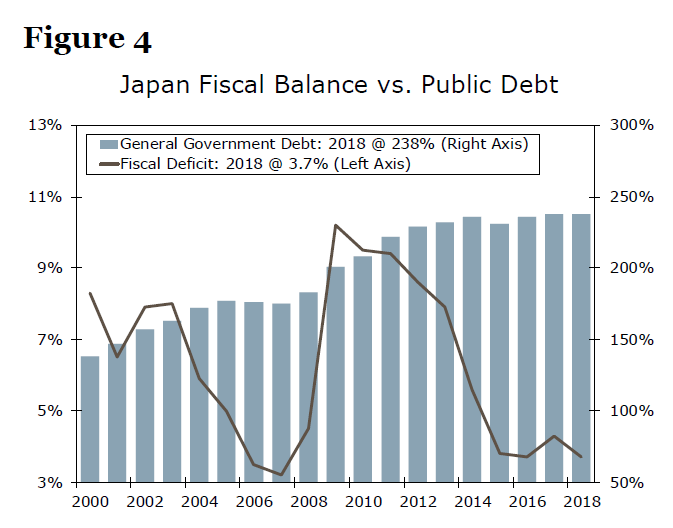
Japan also has a need for fiscal consolidation and, as of now, faces a difficult road towards restoring fiscal health. An increased consumption tax rate could improve Japan's fiscal position and stabilize or even lower Japan's public debt levels. Over the last two decades, Japan's public debt has increased to 240% of GDP, up from 138% in 2000, mostly due to Japan's high social security expenditures as a result of a rapidly aging population (Figure 4). With limited scope to reduce these social security expenses, the government will need to secure new government revenues in order to reduce Japan's debt burden.
Adding to the impetus for a consumption rate hike is the fact that Japan's consumption tax rate is one of the lowest in the world. Japan's consumption tax was introduced in 1989 at a rate of 3%, and despite an increase to 8% in 2015, is one of the lowest among advanced economies. To put this into perspective, the average value added tax (VAT) rate across OECD economies is 19.2%, while only Canada and Switzerland have lower consumption tax rates at 5% and 7.7% respectively. Japan's consumption tax generates revenues of only around 3% of GDP, also one of the lowest among advanced economies. This suggests the government has scope to increase the consumption tax rate closer to international benchmarks.
What is The Potential Impact on The Yen?
As the Federal Reserve and other developed central banks around the world look to hike rates in 2019, interest rate differentials will continue to determine the short-term path of the yen. We currently forecast three rate hikes from the Fed, while we also expect further monetary tightening measures from the Bank of Canada and Bank of England, while the ECB will begin to remove accommodative monetary policy in 2019 as well. Even with less accommodative policy from the BoJ, Japanese yields are likely to remain low, suggesting a subdued performance from the Japanese currency. We do expect some modest appreciation in the yen over the medium-term, although we see this as more a reflection of overall U.S. dollar softness rather than independent yen strength.
BoC Holds Rates Steady, Hints at Downward Revisions to Growth Outlook
Highlights:
- As expected, the overnight rate was held steady at 1.75%. This year’s three rate hikes represent the most significant monetary policy tightening since 2010.
- The BoC hinted at downward revisions to their growth and inflation forecasts, which will be updated in January.
- The statement continued to indicate interest rates will have to rise to a neutral stance to keep inflation on target, but once again gave no timeline for that adjustment.
- The pace of tightening will depend on a number of factors, including households’ adjustment to higher interest rates, trade policy developments, and oil prices.
- Governor Poloz’s economic update speech tomorrow morning will be closely watched for further in-sight on how recent developments are impacting the policy outlook.
Our Take:
What a difference six weeks makes. In late-October, the Bank of Canada raised the overnight rate, dropped their “gradual” guidance and indicated interest rates would need to rise to a neutral stance to keep inflation on target. That had markets pricing in more tightening next year, and even some likelihood of another hike before year end. Fast-forward to today and there was no chance of the BoC lifting rates this morning. A sharp decline in global oil prices, wide discounts on Canadian crude, and a Q3 GDP report that was very soft in its details have all dented the economic outlook as we head into 2019. The BoC acknowledged as much, noting activity in Canada’s energy sector will be “materially weaker” than expected (Alberta’s mandatory production cuts also a factor there), and that the economy might have more room for non-inflationary growth than previously thought due to both GDP revisions and likely slower near-term growth.
It wasn’t all bad—policymakers attributed Q3’s weak business investment to trade uncertainty and remained optimistic on the non-energy capex outlook given USMCA, accelerated depreciation and capacity constraints. And once again there was mention of two-sided risks around trade policy, even if there are signs that trade tensions are “weighing more heavily” on the global economy. But those mitigating factors weren’t enough to keep the Canadian dollar from selling off on today’s announcement. The BoC maintained their tightening bias, still planning to eventually raise rates to a neutral range (2.5-3.5% by their estimate). But they were right to give no timeline for that adjustment. Our forecast assumes two rate increases next year, which would leave monetary policy slightly accommodative. As market pricing indicates, there is a growing risk that tightening doesn’t resume in January as we have been expecting.
Numerous Crosscurrents Are Coming To A Head: OPEC
Markets
With US markets reopening Thursday, attention will fall first on delayed USD data releases, including ADP and ISM services. My view is the USD will be incredibly sensitive to all levels of economic data due to the Fed’s definite shift to data dependency.
After the initial gap lower on the SPX, which is in holiday catch up mode as the Global markets traded lower on Wednesday, on the back of investors fretting about an economic slowdown in the US as implied by the flattening US yield curve. At least for today, I was expecting the “Sell All “cry which has been echoing on the trading floor for a maddening 48 hour to abate after traders have been left battered and bruised.
But we are closely watching the developments in Asia after reports that Canada has arrested the Huawei CFO facing US extradition for allegedly violating Iran sanctions. This headline is quite significant as the US government is attempting to persuade allies to stop using Huawei equipment due to security fears, and this headline could weigh negatively on tech stocks. Recall that over 100 Chinese companies trade limit down when news broke the US urged allies to blacklist Huawei.
Indeed, this breach of Iran sanctions opens the door to further compliance from US allies even more so where the US operates key military bases
As for the rest, numerous crosscurrents are coming to a head and none less significant than the OPEC announcement which will have far-reaching influence across all asset classes
Big Day for Oil markets: decision time for OPEC
The session also brings the much-awaited OPEC outcome, and according to the latest headlines, it suggests OPEC and Russia are closer to agreeing to production cuts. “All of us including Russia agreed there is a need for a reduction,” Oman’s Oil Minister Mohammed bin Hamad Al-Rumhy told reporters after a ministerial committee that groups Saudi Arabia, Russia and several other producers met on Wednesday. This lean despite President Trump’s fixed position for lower Oil price.
So, the possibility that OPEC may follow through with a production cut is helping OIL prices stabilise, but of course, the big question remains by how much and how quick. Given the OPEC situation is self-inflicted, in a sense OPEC rise in production since May has been the most critical factor behind the market surplus, which has occurred, despite declines in Iran and Venezuela so one would assume its easily reversible. But nothing comes easy in oil market these days as the colossal producers’ heads of state in Moscow, Riyadh and Washington jockey for more significant influence over the price of oil
But assuming the G-20 handshake between President Vladimir Putin andCrown Prince Mohammed bin Salmans sealed the deal, what levels are we looking at that may influence the market?
An unlikely cut above 1.5 million barrels per day would be hugely bullish while e OPEC Economic Commission Board, which recently estimated the necessary reduction to balance the market at 1.3 mmb/d, so anything towards 1 mmb/d would suggest Brent Oil prices will remain continually trade below the $65-66 mark
On a no deal proposal with Russia backing down Brent capitulates to $55 triggering an immediate currency reaction where the market will sell CADJPY and or Buy USDNOK
Gold Markets
Gold prices continue to fare well on trade war fears, and despite pulling back from yesterday highs, price action remains resounding bid with familiar points of irritation, Trade, Fed, Brexit, Italy, global growth coming to a head. The US dollar is looking increasing trapped by crosscurrents. While the USD’s safe Have appeal endures, the subtle dovish pivot from the Feds does suggest the dollar could slide into year end. But the USD remains data dependent binary trade
Currency Markets
Bank of Canada: “That’s me in the corner, that’s me in the spotlight.”
USDCAD has traded sharply higher – from 1.3280 towards 1.3400 – as it delivered on dovish expectations. The bank left rates as expected but the statement emphasised uncertainty ahead. Taking their cue from depressed oil prices with Western Canadian Select trading at a $30 discount to its southern neighbour WTI, the signals were flashing for a dovish retort as the BoC was backed into a corner. Not to mention looking at the global economic data in the wake of the horrendous Q 3 Australia GDP coupled with no purposeful rebound in Eurozone data. Which suggests we’re during a definitive global growth slowdown and hardly the environment for countries who depend on the worldwide supply chain and or are reliant on commodity export to be raising interest rates. However, with currency trader’s propensity to book quick profits these days the USD CAD has fallen towards 1.3360 as profit-taking set in ahead of a probable OPEC production cut. Still, I think the Bay street bears are controlling the landscape on this trade
Outside of haven appeal, the USD dollar is a complete data dependent binary trade.
As for the rest of G-10, we’re eying the data over the next few days Confidence, and sentiment data remain strong, bolstered by the substantial labour market While the FED has dialled back the markets misinterpreted hawkish inferences from October given we’re most likely at the end of this monetary policy cycle while factoring global growth slowdown. And despite the market exhibiting extended periods of mental fatigue after getting bushwhacked by President Trump twitter account. And while headlines are causing investors to get overly focused on the US yield curve inversion, given the current state of the US economic data, it doesn’t suggest the economy is about to tank anytime soon. While I’m not overly bullish equities due to a high probability of trade war intensifying, the Fed shift is in no way foreshadowing the impending US or global doom for that matter
But naturally, with the holiday season around the corner trader are keeping exposure tight while keeping directional risk to a minimum
The Malaysian Ringgit
The Ringgit will trade in a tight range today as local traders will be held hostage to OPEC shenanigans and ultimately the expected production supply cut
Gold Rally Takes Breather, U.S Job Numbers Loom
Gold has ticked lower in the Wednesday session. In North American trade, the spot price for one ounce of gold is $1237.47, down 0.10% on the day. In economic news, there are no major events. On Thursday, the focus will be on U.S. employment data, with the release of ADP nonfarm payrolls and unemployment claims. The U.S. will also release ISM Non-Manufacturing PMI.
It's been a good week for gold, which has posted gains of 1.2 percent. The catalyst for higher gold prices has been the response to the weekend meeting between President Trump and Chinese President Xi Jinping at the G-20 summit. Global stock markets climbed sharply after Trump suspended his threat to raise tariffs on Chinese products as of December 1. However, the optimism proved to be short-lived, as investors are asking if the 90-day truce is simply a pause in the trade war between the world's two largest economies. Investor risk appetite softened on Tuesday, and safe-haven gold was in strong demand, as gold touched a high of $1239, its highest level since October 22.
Now that there is a respite in the tariff war, can the U.S. and China narrow their differences in just a few weeks? The U.S. and China, including repeated charges by the U.S. that China is engaged in theft of U.S. intellectual property. The markets have been very sensitive to the trade dispute, and the upcoming negotiations between the U.S. and China, with the likely ups-and-downs, promise to have a significant effect on the direction of USD/JPY.
The ‘tariff truce' between the U.S and China is welcome news after months of an escalating trade war, but the two super-economies remain far apart on a number of issues, including U.S. accusations that China has been stealing U.S. intellectual property. All indications are that reaching a deal will be difficult. The markets have been sensitive to development in the tariff tussle between the countries, and the likely ups-and-downs in the upcoming negotiations will likely affect the movement of gold prices in the coming weeks.
Eco Data 12/6/18
[php_everywhere instance="1"]
USD/CAD – Over 100-Pips Rally on Unchanged BoC, Cracked Key Barrier
The pair surged nearly hundred pips to new over sixteen months high after The Bank of Canada left interest rates unchanged in expected action on today’s rate decision meeting.
The central bank warned that Canadian economy has less momentum in Q4 and that overall inflation rate would ease more than expected in coming months.
Regarding the pace of rate hikes, the central bank pointed at a number of factors that impact and all will be re-assessed ahead of Jan 2019 meeting.
Fresh advance broke above 1.3374 (50% retracement of 1.4688/1.2061) and cracked key barrier at 1.3386 (former 2018 high, posted on 27 Jun), signaling completion of 1.3386/1.2782 corrective phase.
The US dollar moved higher across the board, supporting bullish scenario for USDCAD pair.
Sustained break above 1.3386 would generate bullish signal for continuation of the uptrend from 1.2061 (08 Aug 2017 low) towards targets at 1.3588/98 (Nov/Dec 2016 highs) and 1.3684 (Fibo 61.8% of 1.4688/1.2061) in extension.
Res: 1.3121; 1.3174; 1.3197; 1.3226
Sup: 1.3065; 1.3056; 1.3027; 1.3014
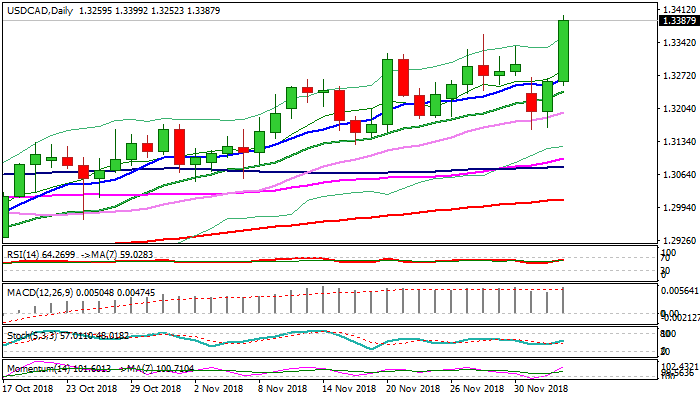
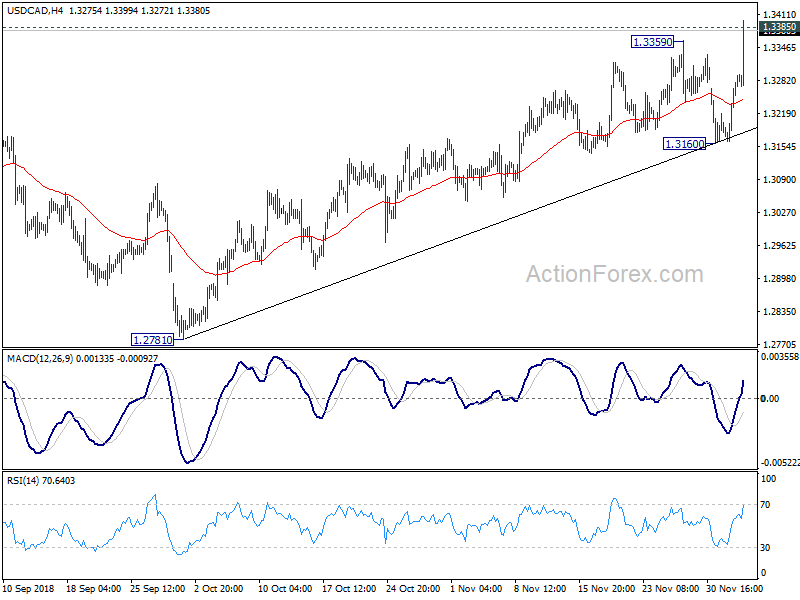
USD/CAD Mid-Day Outlook
Daily Pivots: (S1) 1.3196; (P) 1.3232; (R1) 1.3301; More...
USD/CAD rises sharply after BoC statement and break of 1.3359 resistance confirms resumption of rise from 1.2781. Intraday bias is back on the upside with focus on 1.3385 resistance. Decisive break there will confirm resumption of medium term up trend. Next target is 1.3685 fibonacci level. On the downside, though, break of 1.3160 support will indicate rejection by 1.3385 resistance and turn near term outlook bearish.
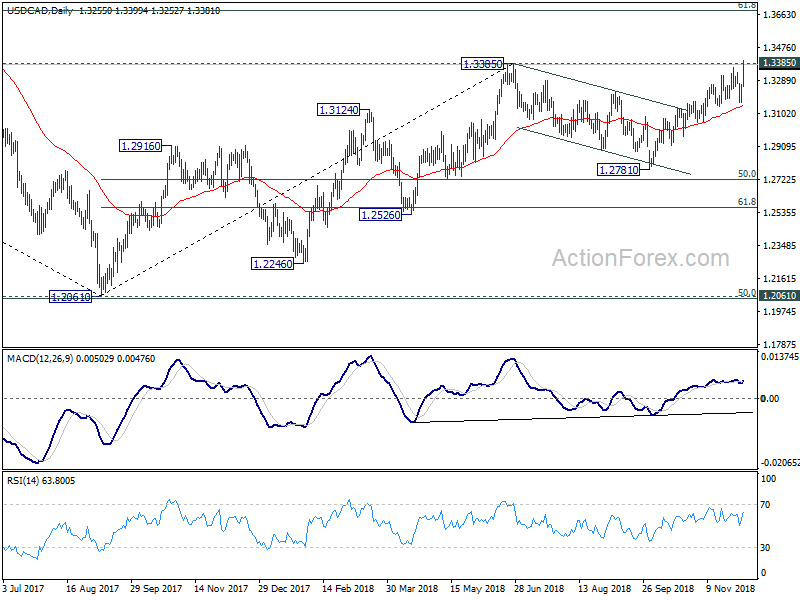
In the bigger picture, up trend from 1.2061 (2017 low) is still in progress decisive break of 1.3385 will pave the way to 61.8% retracement of 1.4689 (2016 high) to 1.2061 at 1.3685. In case correction from 1.3382 extend with another falling leg, downside should be contained by 50% retracement of 1.2061 to 1.3385 at 1.2723 to bring rebound.
BoC: A Hold, Probably a Pause
The Bank of Canada kept its overnight rate unchanged at 1.75% this morning. The decision met both market and economists' expectations. The statement released alongside the decision struck a dovish note.
One of the biggest stories since the Bank's October rate hike is the pricing challenges facing Western Canadian oil producers, and the recent announcement of mandatory production curtailments. Soft commodity prices had already been expected to dampen investment and exports in the Bank's last communique, but recent moves are seen as making the outlook for the sector "materially weaker"
Beyond the energy sector, the Bank also sees softening momentum coming out of the third quarter, and historic revisions from Statistics Canada suggest that 'there may be additional room for non-inflationary growth'. Conversely, tax changes and capacity constraints are still expected to support non-energy investment, and credit/housing markets are seen as stabilizing.
On the inflation front, the data seems to be meeting expectations, as core measures continue to track two per cent, and headline inflation is expected to ease on the back of lower gasoline prices.
The statement again discussed rates getting to 'neutral', but with the important change that the policy rate needs to rise to a neutral range – rather than to a neutral stance as discussed in October. This small language tweak suggests more flexibility around the end-point for the tightening cycle, and reinforces the dovish tone that permeates the statement more generally.
Key Implications
The Bank of Canada's statement this morning brings to mind that famous (apocryphal) Keynes quote: "When events change, I change my mind". The last six weeks have delivered quite a few 'events', and so it should come as no surprise that the tone of the monetary policy communications has taken a more dovish tilt.
Indeed, there is little to dispute in the Bank's characterization of developments and the outlook. As discussed in yesterday's Market Insight, recent events aren't likely to push the Bank off of a tightening path, but they do remove any urgency in getting to a neutral policy rate. We no longer expect the Bank of Canada to hike its policy interest rate in January. Spring 2019 now appears to be the more likely timing, allowing for the Bank to ensure that the growth narrative is back on track.
To be sure, while everything points to a January hike being off the table, the path thereafter is less clear, and a 491 word statement does not give much to work with. With all the moving parts in the Canadian economy at present, tomorrow's speech by Bank of Canada Governor Poloz (with Q+A session and press conference) will carry even more importance than normal. Stay tuned.
Japanese Yen Retracts, Household Spending Next
The Japanese yen has lost ground in the Wednesday session. In North American trade, USD/JPY is trading at 113.15, up 0.33% on the day. There are no data indicators in Japan or the United States. On Thursday, the focus will be on employment data will be in focus, with the release of ADP nonfarm payrolls and unemployment claims. We’ll also get a look at ISM Non-Manufacturing PMI. Japan will release household spending and average cash earnings.
There was initial optimism in the markets after the U.S and China agreed to hold talks on resolving contentious trade issues. Most importantly, President Trump suspended his threat to raise tariffs on Chinese products as of December 1. However, the optimism proved to be short-lived, as investors are asking if the 90-day truce is simply a pause in the trade war between the world’s two largest economies. Risk appetite waned on Tuesday, and investors snapped up the safe-haven yen, which climbed to its highest level since November 20. Can the sides narrow their differences in just a few weeks? The U.S. and China remain far apart on a number of issues, including repeated charges by the U.S. that China is engaged in theft of U.S. intellectual property. The markets have been very sensitive to the trade dispute, and the upcoming negotiations between the U.S. and China, with the likely ups-and-downs, promise to have a significant effect on the direction of USD/JPY.
A detente in the U.S-China trade war cannot come soon enough for the Japanese economy, as key sectors of the economy are showing signs of weakness. Japan’s manufacturing sector slowed down in November, raising concerns about the strength of the economy. Manufacturing PMI slipped to 52.2, down from 52.9 in October. The ongoing global trade war is a primary factor in the weak reading, as Japanese companies which export to the U.S. or China have been hurt by higher tariffs. A weaker eurozone economy has led to softer European demand for Japanese exports. Making matters worse, domestic demand remains fragile, as nervous consumers continue to hold tightly onto their purse strings.
Sunset Market Commentary
Markets
Global core bonds lost ground today. With US markets closed in honor of former President Bush, investor focus was mainly on Europe. Asian and European equities edged lower this morning, though at a slower pace than US equities yesterday. German Bunds already rallied higher during US trading hours, so they opened only marginally higher. There was plenty of economic data today, but generally second-tier in nature. The final Eurozone PMI’s were slightly better than earlier readings, while retail sales were mixed. Both didn’t influence trading today. EU equities recovered slightly throughout the day, leading German Bunds down. Italian BTPs moved higher after Deputy PM signaled that “the climate is changing” in budget talks with the EU. Add slightly stronger than expected Italian PMI’s and you see why Italian assets outperformed. The Italian 2-yr yield drops to 0.59%, the lowest level since July. German Bunds lost marginal ground throughout the day. German yield changes range from +0.3bps (2-yr) to +1.0 bp (10-yr). Peripheral spreads tighten with Greece (-9 bps), Italy (-9 bps) and Spain (-4 bps) outperforming.
FX markets caught their breath after yesterday’s volatile session with US markets closed. European equities still struggle but losses are much more contained compared to the slaughter in the US yesterday. EUR/USD finds itself well bid as risk sentiment gradually improves. The common currency also found early support in slightly better than expected (final) EMU PMI’s. The recovery of Italy’s services PMI back into (yet mildly) expansionary area (> 50) is worth mentioning. At the same time, Italian budget headlines suggest both the government and the EC are slowly but steadily closing in on a compromise. It resulted in a narrowing of the Italian/German spread which in turn helped the euro gradually higher after yesterday’s sudden decline. EUR/USD is changing hands at 1.136 at the time of writing. USD/JPY hovers close to the 113-handle, up from 112.70 this morning.
The pound started on the right foot after being whipsawed yesterday. Markets saw chances of a no-deal Brexit reduced since Parliament won the vote to take control of Brexit if May’s deal is voted down. Sterling even shrugged off the worst (services 50.4, composite 50.7) PMI confidence since the aftermath of the 2016 referendum vote. The publication of the attorney general’s full legal advice held no surprises. He warned – as expected – for an “enduring” backstop risk. Sterling’s move quickly ran into resistance again however. Markets are braced for the second day of the parliamentary debate that started around noon. Brexit headlines/developments pile up so fast it leaves sterling traders completely bewildered. EUR/GBP trades close to 0.89 but without a clear direction. Cable also lost some intraday momentum, filling bids at 1.272. We expect this volatile trading pattern to continue in the next few days.
News Headlines
Rating agency Fitch keeps its global growth forecasts unchanged in 2018 and 2019 with growth peaking at 3.3% this year before sliding to 3.1% in 2019 and 3% in 2020. Trade risks remain a key downside. They expect the Fed to hike policy rates 3 times next year, but interestingly no longer expect an ECB rate hike in 2019.
The Swedish services PMI surged from 56.4 to 62.2 in November, reaching the highest level since December last year. The combination of strong PMI’s adds to bets that the Riksbank will hike interest rate for the first time this cycle at its December 20 policy meeting. EUR/SEK dropped below 10.20, the lowest since June.
The Bank of England showed willingness to lower the counter-cyclical capital buffer from 1% to 0% if the UK economy would suffer a huge setback after Brexit. It took similar action after the June 2016 Brexit vote. Such cut would allow banks to absorb £11bn in losses and to lend as much as £250bn to UK households and businesses.