

Sample Category Title
BoC stands pat but sounds concerned with oil price shock, CAD dives
Canadian Dollar drops sharply after BoC kept overnight rate target unchanged at 1.75% as widely expected. But the central bank sounds rather concerned with recent slump in oil prices. The statement noted that oil prices have "fallen sharply" since the October MPR, "reflecting a combination of geopolitical developments, uncertainty about global growth prospects, and expansion of U.S. shale oil production".
And, "benchmarks for western Canadian oil – both heavy and, more recently, light – have been pulled down even further by transportation constraints and a buildup of inventories".
"In light of these developments and associated cutbacks in production, activity in Canada's energy sector will likely be materially weaker than expected."
The statement also concluded by maintaining tightening bias to move interest rate towards neutral. However, the pace will depend on a number of facts. Added in this statement, "the persistence of the oil price shock, the evolution of business investment, and the Bank's assessment of the economy's capacity will also factor importantly into our decisions about the future stance of monetary policy."
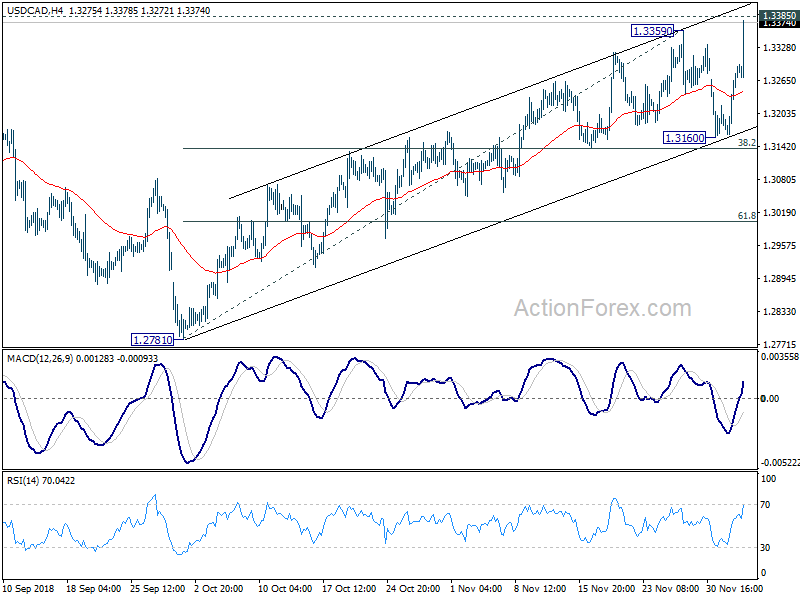
USD/CAD jumps sharply after the release and is set to take on 1.3385 resistance next.
Full statement below.
Bank of Canada maintains overnight rate target at 1 ¾ per cent
The Bank of Canada today maintained its target for the overnight rate at 1 ¾ per cent. The Bank Rate is correspondingly 2 per cent and the deposit rate is 1 ½ per cent.
The global economic expansion is moderating largely as expected, but signs are emerging that trade conflicts are weighing more heavily on global demand. Recent encouraging developments at the G20 meetings are a reminder that there are upside as well as downside risks around trade policy. Growth in major advanced economies has slowed, although activity in the United States remains above potential.
Oil prices have fallen sharply since the October Monetary Policy Report (MPR), reflecting a combination of geopolitical developments, uncertainty about global growth prospects, and expansion of U.S. shale oil production. Benchmarks for western Canadian oil – both heavy and, more recently, light – have been pulled down even further by transportation constraints and a buildup of inventories. In light of these developments and associated cutbacks in production, activity in Canada's energy sector will likely be materially weaker than expected.
The Canadian economy as a whole grew in line with the Bank's projection in the third quarter, although data suggest less momentum going into the fourth quarter. Business investment fell in the third quarter, in large part due to heightened trade uncertainty during the summer. Business investment outside the energy sector is expected to strengthen with the signing of the USMCA, new federal government tax measures, and ongoing capacity constraints. Along with strong foreign demand, this increase in productive capacity should support continued growth in exports.
Household credit and regional housing markets appear to be stabilizing following a significant slowdown in recent quarters. The Bank continues to monitor the impact on both builders and buyers of tighter mortgage rules, regional housing policy changes, and higher interest rates.
Inflation has been evolving as expected and the Bank's core measures are all tracking 2 per cent, consistent with an economy that has been operating close to its capacity. CPI inflation, at 2.4 per cent in October, is just above target but is expected to ease in coming months by more than the Bank had previously forecast, due to lower gasoline prices. Downward historical revisions by Statistics Canada to GDP, together with recent macroeconomic developments, indicate there may be additional room for non-inflationary growth. The Bank will reassess all of these factors in its new projection for the January MPR.
Weighing all of these developments, Governing Council continues to judge that the policy interest rate will need to rise into a neutral range to achieve the inflation target. The appropriate pace of rate increases will depend on a number of factors. These include the effect of higher interest rates on consumption and housing, and global trade policy developments. The persistence of the oil price shock, the evolution of business investment, and the Bank's assessment of the economy's capacity will also factor importantly into our decisions about the future stance of monetary policy.
Information note
The next scheduled date for announcing the overnight rate target is January 9, 2019. The next full update of the Bank's outlook for the economy and inflation, including risks to the projection, will be published in the MPR at the same time.
(BOC) Bank of Canada maintains overnight rate target at 1 ¾ per cent
The Bank of Canada today maintained its target for the overnight rate at 1 ¾ per cent. The Bank Rate is correspondingly 2 per cent and the deposit rate is 1 ½ per cent.
The global economic expansion is moderating largely as expected, but signs are emerging that trade conflicts are weighing more heavily on global demand. Recent encouraging developments at the G20 meetings are a reminder that there are upside as well as downside risks around trade policy. Growth in major advanced economies has slowed, although activity in the United States remains above potential.
Oil prices have fallen sharply since the October Monetary Policy Report (MPR), reflecting a combination of geopolitical developments, uncertainty about global growth prospects, and expansion of U.S. shale oil production. Benchmarks for western Canadian oil – both heavy and, more recently, light – have been pulled down even further by transportation constraints and a buildup of inventories. In light of these developments and associated cutbacks in production, activity in Canada's energy sector will likely be materially weaker than expected.
The Canadian economy as a whole grew in line with the Bank's projection in the third quarter, although data suggest less momentum going into the fourth quarter. Business investment fell in the third quarter, in large part due to heightened trade uncertainty during the summer. Business investment outside the energy sector is expected to strengthen with the signing of the USMCA, new federal government tax measures, and ongoing capacity constraints. Along with strong foreign demand, this increase in productive capacity should support continued growth in exports.
Household credit and regional housing markets appear to be stabilizing following a significant slowdown in recent quarters. The Bank continues to monitor the impact on both builders and buyers of tighter mortgage rules, regional housing policy changes, and higher interest rates.
Inflation has been evolving as expected and the Bank's core measures are all tracking 2 per cent, consistent with an economy that has been operating close to its capacity. CPI inflation, at 2.4 per cent in October, is just above target but is expected to ease in coming months by more than the Bank had previously forecast, due to lower gasoline prices. Downward historical revisions by Statistics Canada to GDP, together with recent macroeconomic developments, indicate there may be additional room for non-inflationary growth. The Bank will reassess all of these factors in its new projection for the January MPR.
Weighing all of these developments, Governing Council continues to judge that the policy interest rate will need to rise into a neutral range to achieve the inflation target. The appropriate pace of rate increases will depend on a number of factors. These include the effect of higher interest rates on consumption and housing, and global trade policy developments. The persistence of the oil price shock, the evolution of business investment, and the Bank's assessment of the economy's capacity will also factor importantly into our decisions about the future stance of monetary policy.
Information note
The next scheduled date for announcing the overnight rate target is January 9, 2019. The next full update of the Bank's outlook for the economy and inflation, including risks to the projection, will be published in the MPR at the same time.
Trump believe China Xi meant what he said during the meeting
Trump expressed his confidence on trade negotiation with China with his tweets again today. He said he believe "President Xi meant every word of what he said at our long and hopefully historic meeting". And, Trump also hailed China's move to criminalise sale of "deadly Fentanyl" to the US.
https://twitter.com/realDonaldTrump/status/1070306739092889601
https://twitter.com/realDonaldTrump/status/1070312880095068160
https://twitter.com/realDonaldTrump/status/1070314629732163586
US 100 Index Pares Losses Below SMAs Bearish Cross
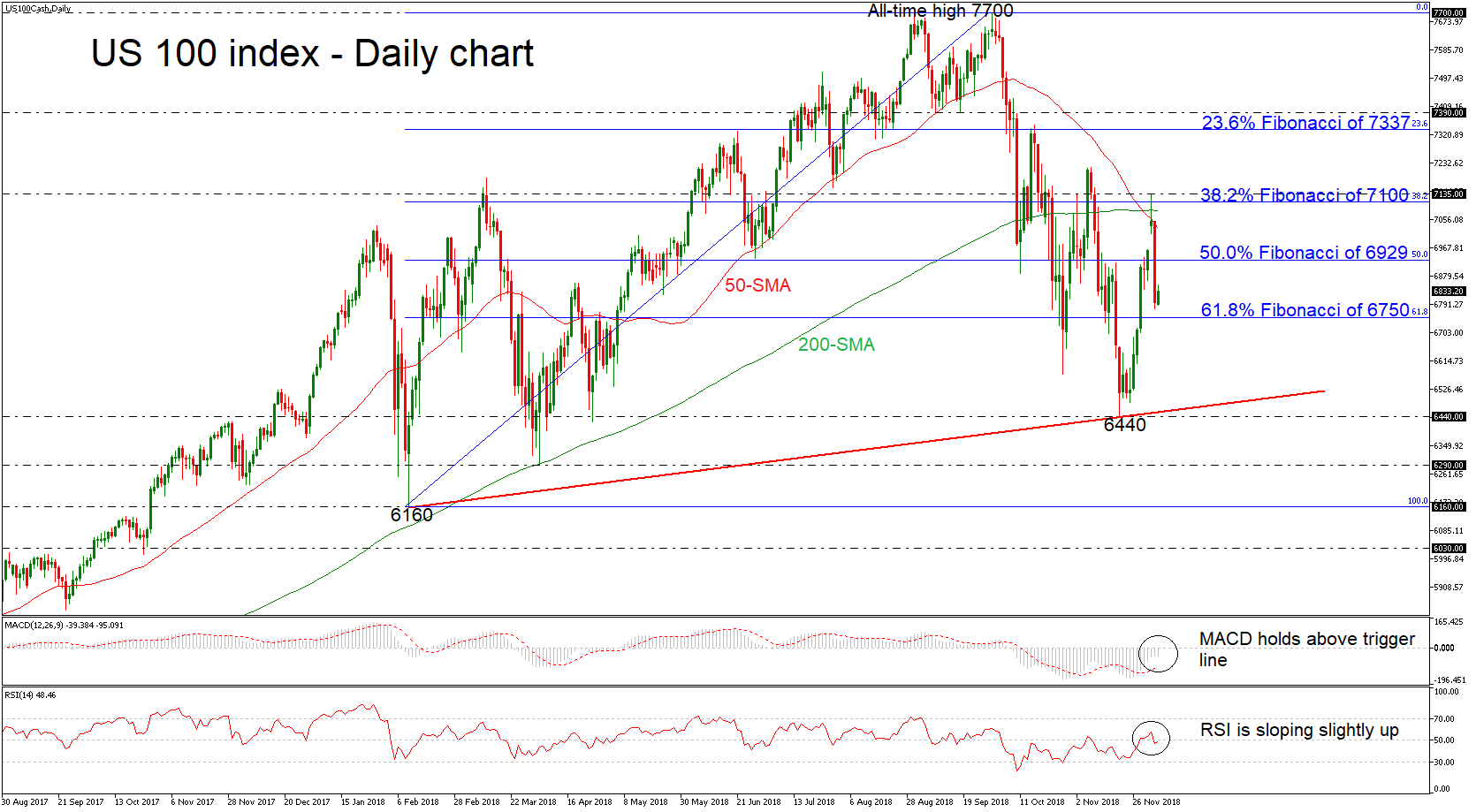
The US 100 index edged aggressively lower in Tuesday’s session as the bears continue to pull the price below the 50- and 200-simple moving averages (SMAs) and the 38.2% Fibonacci retracement level of the upleg from 6160 to 7700, around 7100. Today, the price is paring some losses and momentum indicators point slightly to the upside in the near term. The RSI lies near the neutral threshold of 50 and the MACD oscillator jumped above the trigger line but remains in negative territory.
Should the bearish structure resume, the 61.8% Fibonacci mark of 6750 would be the nearest key support for investors to look for. A drop below this line would reinforce the decline in the short-term. Further down, the 6440 around the ascending trend line would be the next hurdle that could stall steeper losses.
However, if today’s upside movement continues, resistance could initially come from the 50.0% Fibonacci of 6929. Overcoming this barrier, would open the way for the 7135 resistance, which lies in the 38.2% Fibonacci region. A climb above these levels would help ease the downward movement and challenge the 23.6% Fibonacci of 7337.
To summarize, the index is capped by the moving averages, endorsing negative tendency in the near term, however, in the long term the price holds above the nine-month rising trend line.
EUR/USD Outlook: Slight Bid in Early US Trading but Still in Directionless Mode
The Euro ticked higher in Europe and holds slight bid tone at the beginning of US session, which is expected to show lower volumes due to US National Day of Mourning.
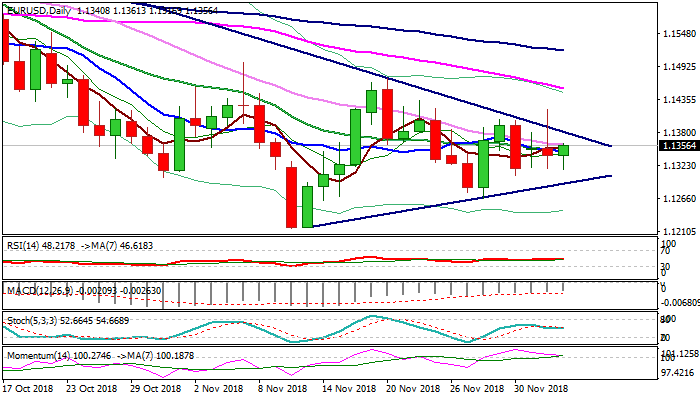
Dips found support at 1.1315 zone for the third consecutive day, with price action holding in narrowing consolidation which requires direction signal on break of either boundary of triangle (trendlines currently lay at 1.1380 and 1.1298).
Flat momentum studies and converged 10/20/30SMA's support directionless mode which extends into third day and confirmed with Doji candles on Mon/Tue.
Bullish signals could be expected on break above triangle resistance line and lift above double-top at 1.1400, which would open way towards falling 55SMA (1.1455) and 20Nov high (1.1472).
Conversely, loss of temporary base at 1.1315 and 30 Nov low at 1.1305, would generate initial bearish signal, confirmation of which would require sustained break below triangle support line.
With no releases from the EU scheduled on Thursday, focus turns towards US data.
US ADP jobs report for November, often seen as indication for more significant US Non-farm payrolls report, and ISM Non-Manufacturing PMI for Nov, will be closely watched for fresh signals.
Also, possible comments about US/China trade issue, from President Trump or his administration, would have a high priority.
Res: 1.1380; 1.1400; 1.1433; 1.1455
Sup: 1.1315; 1.1305; 1.1298; 1.1267
AUDUSD Upside Momentum Stalled, Eyes More Correction
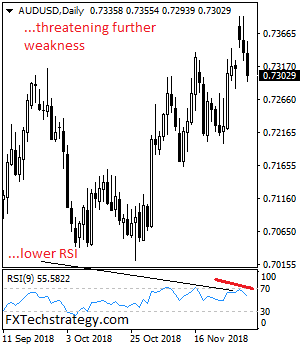
AUDUSD upside momentum stalled with eyes on more weakness in the days ahead. On the upside, resistance lies at the 1.7350 level. A cut through here will turn attention to the 0.7400 level and then the 0.7450 level where a violation will set the stage for a retarget of the 0.7500 level. Support resides at the 0.7250 level where a breach will aim at the 0.7200 level. Below here will set the stage for a run at the 0.7150 level with a cut through here targeting further downside pressure towards the 0.7100 level. Its daily RSI is bearish and pointing lower suggesting further weakness. On the whole, AUDUSD faces further upside threats.
USD/JPY Mid-Day Outlook
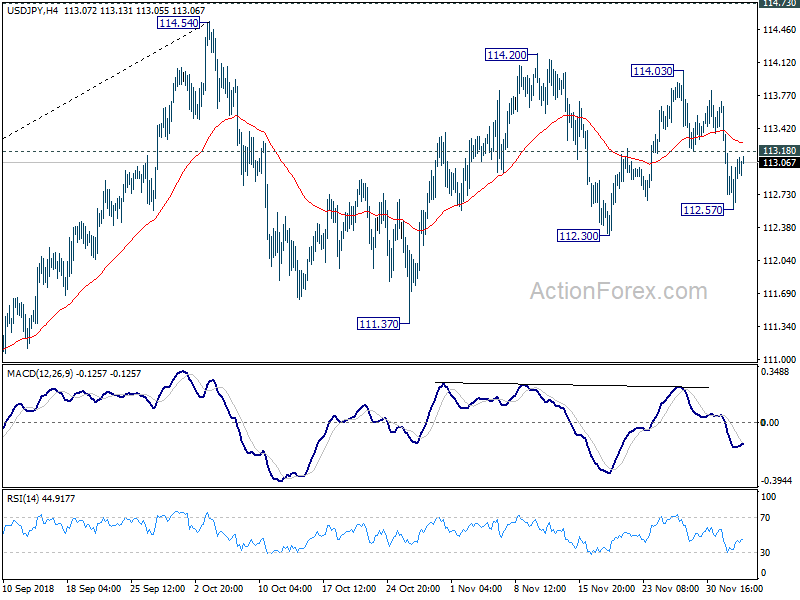
Daily Pivots: (S1) 112.35; (P) 113.01; (R1) 113.44; More..
Intraday bias in USD/JPY is neutral for the moment. Deeper fall is still in favor with 113.18 support turned resistance intact. On the downside, below 112.57 will target 112.30 first. Break will target 111.37 and possibly below. On the upside, above 113.18 will turn bias back to the upside for 114.03 resistance first. Overall, price actions from 114.54 are seen as a consolidation pattern. Hence, even in case of deep decline, downside should be contained by 38.2% retracement of 104.62 to 114.54 at 110.75 to bring rebound. Larger rise from 104.62 is expected to resume later.
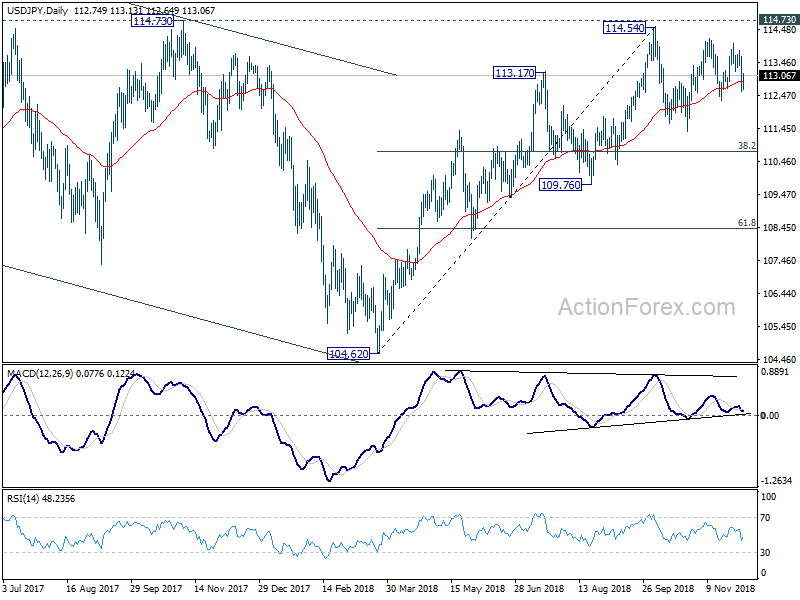
In the bigger picture, corrective fall from 118.65 (2016 high) should have completed with three waves down to 104.62. Decisive break of 114.73 resistance will likely resume whole rally from 98.97 (2016 low) to 100% projection of 98.97 to 118.65 from 104.62 at 124.30, which is reasonably close to 125.85 (2015 high). This will stay as the preferred case as long as 109.76 support holds. However, decisive break of 109.76 will dampen this bullish view and turns outlook mixed again.
USD/CHF Mid-Day Outlook
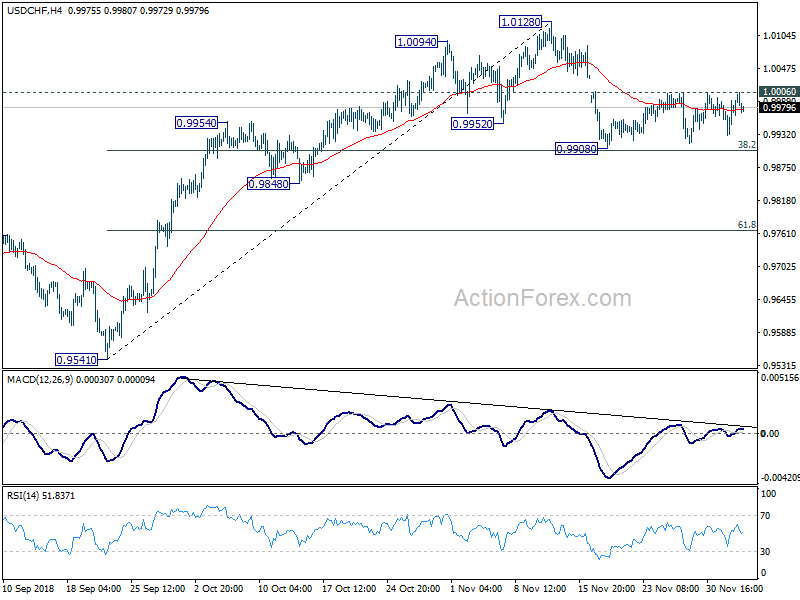
Daily Pivots: (S1) 0.9939; (P) 0.9965; (R1) 1.0000; More...
Intraday bias in USD/CHF remains neutral as it's staying in range of 0.9908/1.0006. On the upside, break of 1.0006 will argue that the pull back from 1.0128 has completed. Intraday bias will be turned back to the upside for retesting 1.1028. On the downside, break of 38.2% retracement of 0.9541 to 1.0128 at 0.9904 will resume the fall from 1.0128 to 0.9848 key support level. Break there will indicate near term reversal and target 61.8% at 0.9765.
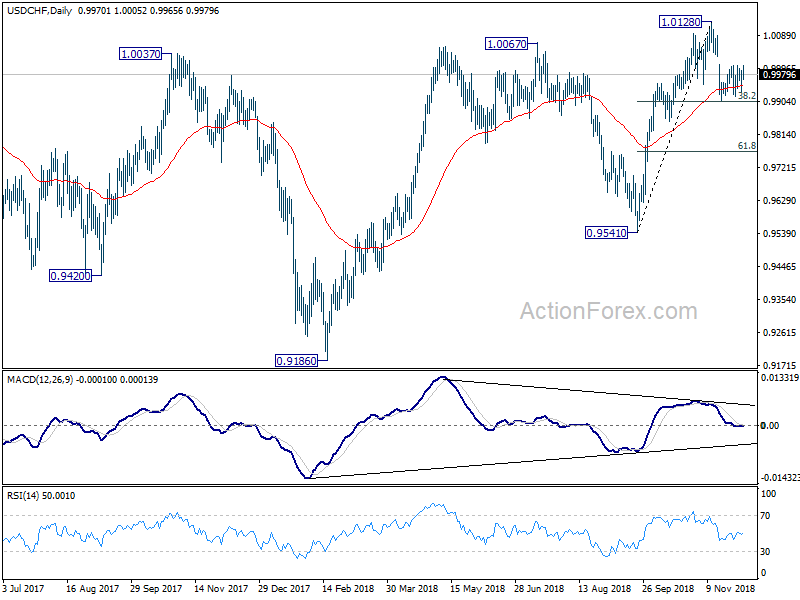
In the bigger picture, rise from 0.9541 could have topped at 1.0128. But as long as 0.9541 support holds, we'd still expect rise from 0.9186 to resume at a later stage. Break of 1.0128 will target 1.0342 key resistance. However, break of 0.9514 will pave the way back to 0.9186 low.
EUR/USD Mid-Day Outlook
Daily Pivots: (S1) 1.1300; (P) 1.1361; (R1) 1.1403; More.....
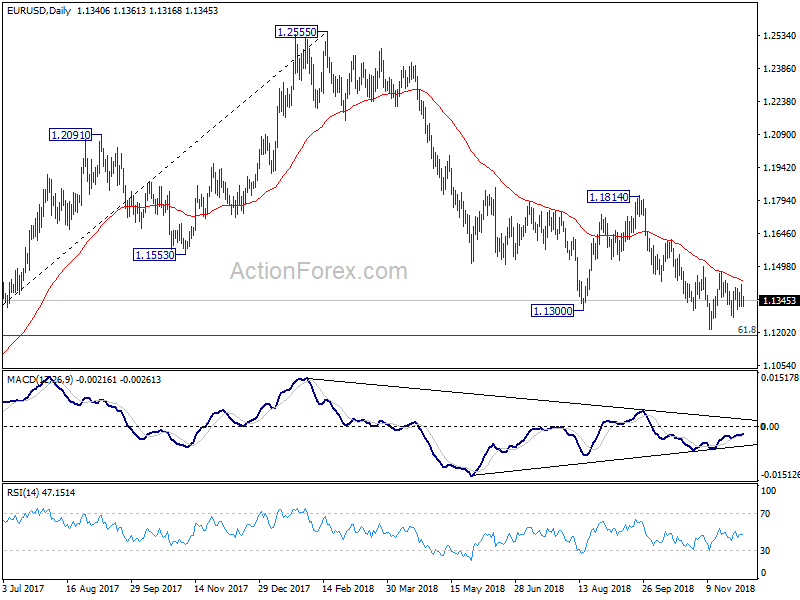
EUR/USD is still bounded in range of 1.1267/1472 and intraday bias stays neutral first. As long as 1.1472 resistance holds, deeper decline is expected in the pair. On the downside, break of 1.1267 will target 1.1215 low first. Firm break there will resume larger down trend from 1.2555 for 1.1186 fibonacci level next. However, considering bullish convergence condition in daily MACD, firm break of 1.1472 will be suggest medium term bottoming and turn outlook bullish for 1.1814 resistance instead.
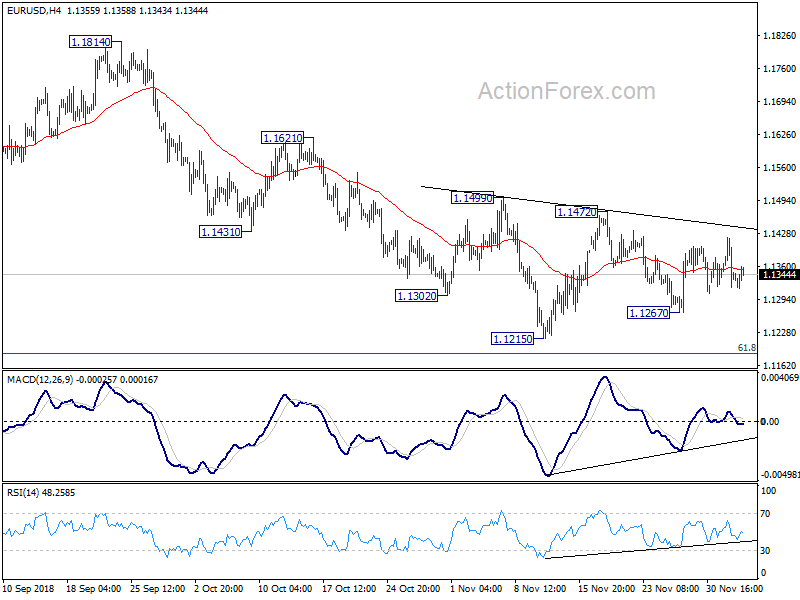
In the bigger picture, as long as 1.1814 resistance holds, down trend down trend from 1.2555 medium term top is still in progress and should target 61.8% retracement of 1.0339 (2017 low) to 1.2555 at 1.1186 next. Sustained break there will pave the way to retest 1.0339. However, break of 1.1814 will confirm completion of such down trend and turn medium term outlook bullish.
Canadian Dollar Steady as BoC Expected to Stand Pat
The Canadian dollar has ticked higher in the Wednesday session, after considerable gains on Tuesday. Currently, USD/CAD is trading at 1.3278, up 0.10% on the day. On the release front, the Bank of Canada will set the benchmark rate at its policy meeting. There are no major events in the United States. On Thursday, it’s a busy day on both sides of the border. Canada releases trade balance and Ivey PMI. In the U.S., employment data will be in focus, with the release of ADP nonfarm payrolls and unemployment claims. We’ll also get a look at ISM Non-Manufacturing PMI.
The Bank of Canada has been busy in 2018, raising interest rates three times. Just a few months ago, there was a strong likelihood that the BoC would end the year with a final rate hike, but economic conditions have changed dramatically and there are a number of factors in favor of the bank staying on the sidelines. The escalating trade war between the U.S. and China has hurt the Canadian export sector, and oil prices have fallen. Domestically, GDP declined 0.2% in September, the first drop since January. As well, the Federal Reserve has hinted that it will reduce the number of rate hikes in 2019, which has eased pressure on the BoC to raise rates.
It’s been a volatile week for the Canadian dollar, which has mirrored movement in the global stock markets. Equities started the week with gains, but this proved to be short-lived, as investor optimism following the Trump-Xi meeting quickly dissipated. At the start of the week, the Canadian dollar jumped after President Trump and Chinese President Xi reached an agreement, whereby the U.S. agreed to suspend further tariffs until March 1. However, investors have sobered since, wondering if the 90-day truce is simply a pause in the trade war between the world’s two largest economies. This has lowered risk appetite, and the Canadian dollar has now given up most of the Monday gains. The U.S. and China remain far apart on a number of issues, including repeated charges by the U.S. that China is engaged in theft of U.S. intellectual property. The markets have been very sensitive to the trade dispute, and the upcoming negotiations between the U.S. and China, with the likely ups-and-downs, promise to have a significant effect on market movement.