Sample Category Title
GBP/USD Mid-Day Outlook
Daily Pivots: (S1) 1.2636; (P) 1.2738; (R1) 1.2817; More...
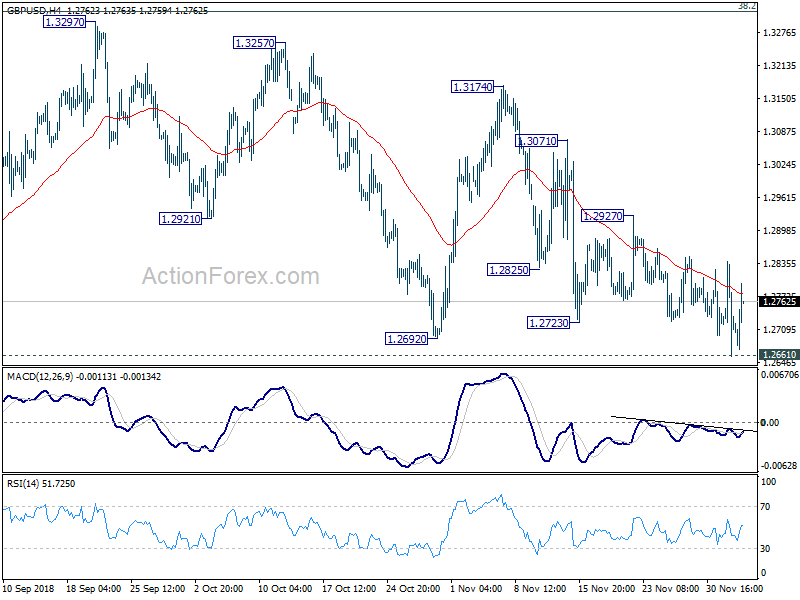
GBP/USD breached 1.2661 briefly but quickly recovered. Intraday bias is turned neutral again. On the downside, sustained break of 1.2661 low will resume larger down trend from 1.4376. Next target will be 1.1946. On the upside, break of 1.2927 will extend the consolidation from 1.26661 with another rise. But even in case of strong rebound, upside should be limited by 1.3316 fibonacci level to bring down trend resumption eventually.
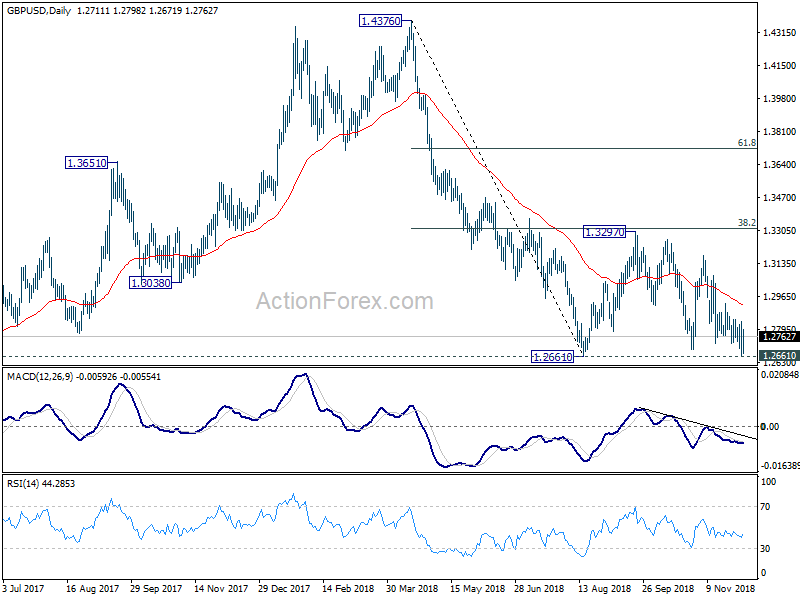
In the bigger picture, whole medium term rebound from 1.1946 (2016 low) should have completed at 1.4376 already, after rejection from 55 month EMA. The structure and momentum of the fall from 1.4376 argues that it's resuming long term down trend. And this will be the preferred case as long as 38.2% retracement of 1.4376 to 1.2661 at 1.3316 holds. However, firm break of 1.3316 would bring stronger rebound to 61.8% retracement at 1.3721. And, the eventual depth of the fall from 1.4376, and the chance of hitting 1.1946 low, will depend on the strength of the interim corrective rebound from 1.2661.
Sterling Rebounds on Brexit Rethinks and Technical Support
Sterling stages a broad based rebound today despite poor PMI services data. The Pound is partly helped by technical support from GBP/USD (at 1.2661) and EUR/GBP (at 0.8939). Additionally, traders are probably reassessing Brexit scenarios. A tricky point is on what would Common's rejection of Prime Minister Theresa May's Brexit deal lead to. One far fetched possibility is UK unilaterally withdrawing Brexit request. The ongoing Brexit debate in the parliament, and speculations ahead of December 11 vote might limit downside of the Pound for the moment.
Meanwhile, Euro follows as the second strongest on positive development in Italy. While nothing concrete has been delivered, it seems that Italy is working "intensely" with European Commission to revise its 2019 budget plan. Words from the coalition government are so far affirmative. German-Italian spread drops to around 280, suggesting acceptance by investors. Australian Dollar is currently the worst performing one after weak GDP data. Yen is the second weakest as there is no intensification in risk aversion.
Technically, most pairs are bounded in rather narrow range without any significant development. EUR/USD is staying in 1.1267/1472. GBP/USD recovers after hitting 1.2661 but upside is limited well below 1.2927 minor resistance. USD/CHF fails 1.0006 resistance again but it's holding above 0.9908. USD/CAD is also holding in range of 1.3160/3359 despite strong rebound.
In other markets, major European indices are trading in red but losses are limited. FTSE is down 1.02%, DAX down -0.68%, CAC down -0.76%. German 10 year yield is up 0.0125 at 0.276. Italian 10 year yield is down -0.629 at 3.086. Earlier today, Nikkei closed down only -0.53% after paring much of earlier losses. Singapore Strait Times dropped -0.37%. Hong Kong HSI and China Shanghai SSE lost -1.62% and -0.61% respectively.
Focus will turn to BoC rate decision. And the central bank is widely expected to keep interest rate unchanged at 1.75%.
UK PMI services dropped to 28-month low, sharp deterioration in service sector growth
UK PMI services dropped notably to 50.4, down from 52.2 and missed expectation of 52.5. That's also the lowest reading in 28 months. Markit noted there is only marginal expansion of overall business activity. Employment growth moderates to four-month low. And, business optimism is weakest since July 2016.
Chris Williamson, Chief Business Economist at IHS Markit, noted in the release that "a sharp deterioration in service sector growth leaves the economy flatlining in November as Brexit concerns intensified". And, the PMI surveys are consistent with merely 0.1% GDP growth in Q3, "thanks to the expansion seen back in October". And he warned that "growth momentum has since been lost and risks are clearly tilted to the downside."
Eurozone PMI composite finalized at lowest since Sep 2016, Germany the center of slowdown
Eurozone PMI services was finalized at 53.4, revised up from 53.1 down slightly from October final of 53.7. PMI composite was finalized at 52.7, down from October's 53.1. That's the lowest level since September 2016.
Among the countries, Germany PMI composite dropped to 52.3, hitting 47 month low. Markit noted that "It was in Germany where the euro area's growth slowdown was centred, with latest data showing the weakest expansion here in nearly four years."
Williamson at Markit noted that the PMIs point to "modest GDP growth of approximately 0.3% in the fourth quarter, suggesting the region remains stuck in a soft-patch." And, "hardest hit has been Italy" suggesting "the economy is on course to contract again in the fourth quarter", Also, "with Germany reporting the weakest growth for nearly four years, the survey raises question marks about the extent to which GDP will rebound in the fourth quarter."
Italy PM Conte will tweak budget without backtracking
Italian Prime Minister Giuseppe Conte was quoted by la Repubblica daily that "if I have the chance to reduce the economic impact of some measures I'm here." He added, "I'm the one who is entitled to speak with the European Commission … and I never halted discussions. Right now if I can recover some funds, tweak the final figure, change a few little things, it doesn't mean I'm backtracking."
European Budget Commissioner Guenther Oettinger repeated the urge for Italy to comply with EU rules. He said in a German radio interview that "We hope that a draft will come today that corresponds to the criteria for all euro countries". But he sounded tough and indicated that even bring down deficit target from the current plan's 2.4% to 2.2% of GDP, that "would be against all the commitments".
BoJ Wakatabe: Inflation only halfway to target, may revert to deflation
BoJ Deputy Governor Masazumi Wakatabe said today that the first characteristic of the current economy is it's being "widespread". And it's "bring about benefits to a wide range of economic entities." And, the second characteristic is that "inflation rate turning positive", "which is different from the case in the mid-2000s".
On outlook, he reiterated the bank's rhetorics that the economy is expected to continue on an "expanding trend". But he also noted various risks including US-China trade friction. On prices, he said CPI is likely to "increase gradually" as the economic expansion continues.
Though, Wakatabe also warned that for now, inflation remained at around 1%, "only halfway" to 2% target. And, "in a case where downward pressure is exerted on the economy again, it may revert to deflation. Thus, it's appropriate to continue with the "large-scale monetary easing".
Australia GDP grew merely 0.3% in Q3, Aussie pressured broadly
Australia GDP grew merely 0.3% qoq in Q3, just half of expectation of 0.6% qoq. That's also a sharp slow down from Q2's 0.90%. On annual basis, GDP growth slowed to 2.8% yoy, well below expectation of 3.4% yoy. In November Monetary Policy Statement, RBA projected GDP growth to be at 3.5% in 2018. And it's now highly likely to miss such projection. Based on the steep slowdown in momentum, it's getting doubtful if 2019 forecast of 3.25% growth would be met. And, RBA might need to revise down its projections in the next MPS in February. But after all, the slowdown will firm up the case for RBA to continue to stand pat throughout 2019, and probably deeper into 2020.
Also from Australia, AiG performance of services index rose to 55.1, up from 51.1. From China, Caixin PMI services rose to 53.8, up from 50.8 and beat expectation of 50.8.
GBP/USD Mid-Day Outlook
Daily Pivots: (S1) 1.2636; (P) 1.2738; (R1) 1.2817; More...
GBP/USD breached 1.2661 briefly but quickly recovered. Intraday bias is turned neutral again. On the downside, sustained break of 1.2661 low will resume larger down trend from 1.4376. Next target will be 1.1946. On the upside, break of 1.2927 will extend the consolidation from 1.26661 with another rise. But even in case of strong rebound, upside should be limited by 1.3316 fibonacci level to bring down trend resumption eventually.
In the bigger picture, whole medium term rebound from 1.1946 (2016 low) should have completed at 1.4376 already, after rejection from 55 month EMA. The structure and momentum of the fall from 1.4376 argues that it's resuming long term down trend. And this will be the preferred case as long as 38.2% retracement of 1.4376 to 1.2661 at 1.3316 holds. However, firm break of 1.3316 would bring stronger rebound to 61.8% retracement at 1.3721. And, the eventual depth of the fall from 1.4376, and the chance of hitting 1.1946 low, will depend on the strength of the interim corrective rebound from 1.2661.
Economic Indicators Update
| GMT | Ccy | Events | Actual | Forecast | Previous | Revised |
|---|---|---|---|---|---|---|
| 21:30 | AUD | AiG Performance of Service Index Nov | 55.1 | 51.1 | ||
| 0:30 | AUD | GDP Q/Q Q3 | 0.30% | 0.60% | 0.90% | |
| 0:30 | AUD | GDP Y/Y Q3 | 2.80% | 3.30% | 3.40% | 3.10% |
| 1:45 | CNY | Caixin PMI Services Nov | 53.8 | 50.8 | 50.8 | |
| 8:45 | EUR | Italy Services PMI Nov | 50.3 | 49.2 | 49.2 | |
| 8:50 | EUR | France Services PMI Nov F | 55.1 | 55 | 55 | |
| 8:55 | EUR | Germany Services PMI Nov F | 53.3 | 53.3 | 53.3 | |
| 9:00 | EUR | Eurozone Services PMI Nov F | 53.4 | 53.1 | 53.1 | |
| 9:30 | GBP | Services PMI Nov | 50.4 | 52.5 | 52.2 | |
| 10:00 | EUR | Eurozone Retail Sales M/M Oct | 0.30% | 0.20% | 0.00% | -0.50% |
| 15:00 | CAD | BoC Rate Decision | 1.75% | 1.75% | ||
| 19:00 | USD | Fed's Beige Book |
The Brexit Trade Which Matters
Yesterday, the United Kingdom experienced an unprecedented moment. Theresa May, the British Prime Minister, suffered a triple defeat. This opened the door for the parliament to prepare for plan B, when her Brexit deal gets voted down in the parliament on December 11, 2018. The prime minister defended her Brexit deal position, the details of which will be published today. May said that it is the best “compromise” Britain can get, but the Parliament believes otherwise. We are now looking at the possibilities of No Brexit or pursue a softer withdrawal which could include staying in the bloc's single market. So, do not be surprised if the debate about another referendum starts to pick up more momentum.
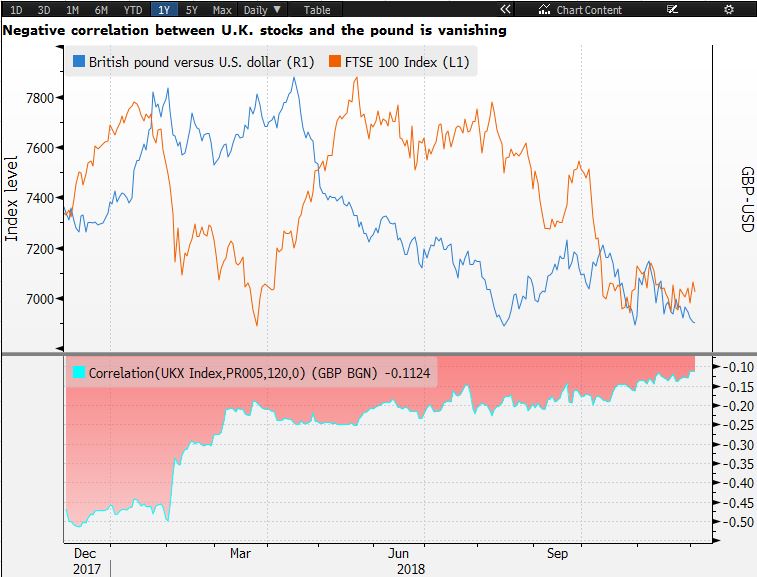
One market trend that worked well since the Brexit referendum is that when the Sterling drops, the UK equity market rallies. This trend has been in play since July 2016. However, this correlation is fading now. What I mean by that is that with the ongoing weakness in the British Pound, we are not seeing any bullish momentum for the FTSE 100 index. The FTSE 100 index has lost its value by nearly -9.77% year-to-date and the Sterling-Dollar is down by 5.71%.
The below chart explains the correlation between the pound and the FTSE index. The lower panel of the chart shows this relationship is diminishing to an extent that we are close enough to say that both Sterling and the FTSE are positively correlated. What this means is that when the pound drops, the FTSE 100 index also falls.
Looking at the daily chart of the Sterling-Dollar pair, it becomes clear the British Pound is in death spiral mode, thanks to Brexit chaos. The force of gravity is pulling it down and the price has broken the critical level of $1.27 against the dollar, currently trading at $1.269 with the doors wide open for the price to touch $1.2492 again.
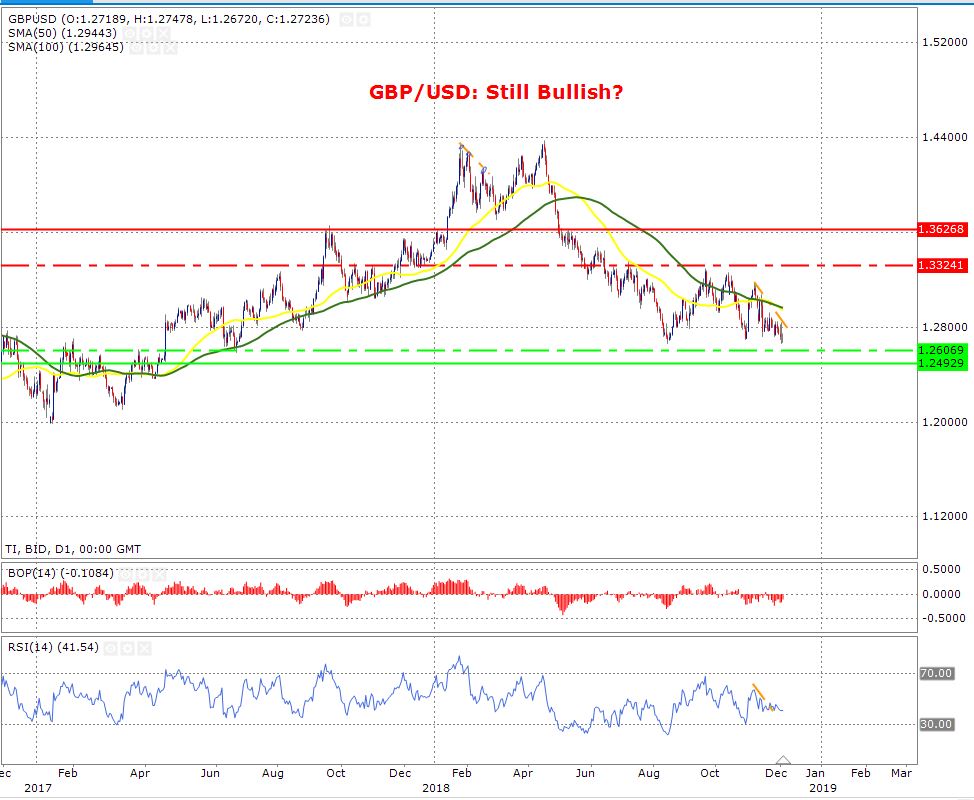
The higher odds of no Brexit deal are increasing the uncertainty among traders. If the UK comes out of the EU with no deal, it would be no short of a catastrophe. The Bank of England and the Treasury have already raised several warnings about this. Just to put things in perspective, the housing sector could see the prices fall as much as 30% and the pound could fall to $1.22 against the dollar.
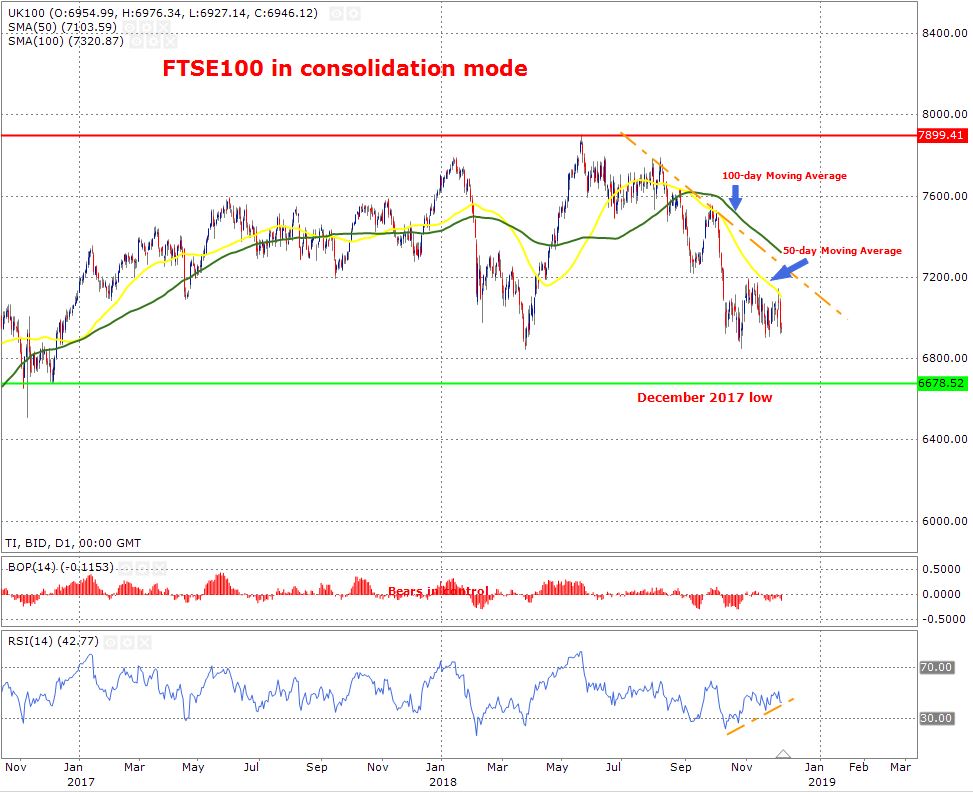
The daily time chart of the FTSE100 shows that the price is in a downtrend. However, the weakness in sterling has helped the index (to some extent) from falling like a rock. The index is in consolidation mode, but in the coming day, the odds are higher that we may see a downward move, which could push the index towards its major support of 6,678.
All in all, the next week is likely to represent opportunities for those who like higher market volatility and for investors who look for value.
DAX Falls to 2-Week Low on Weak German Services PMI, Trade Tensions
The DAX index continues to lose ground this week. Currently, the DAX is at 11,244, down 0.78% since the Tuesday close. On the release front, German and eurozone services PMIs both softened in November. German Final Services PMI dropped to 53.3, matching the estimate. Eurozone Final Services PMI dipped to 53.4, above the estimate of 53.1. Eurozone retail sales posted a gain of 0.3%, marking a 4-month high. This beat the estimate of 0.2%. On Thursday, Germany releases Factory Orders and OPEC members will gather for a meeting in Vienna.
German stock markets started the week with gains, but this proved to be short-lived, as investor optimism following the Trump-Xi meeting quickly dissipated. Earlier on Wednesday, the DAX dropped to its lowest level since November 21, and has declined 2.50% this week. The markets climbed after President Trump and Chinese President Xi reached an agreement, whereby the U.S. agreed to suspend further tariffs until March 1. However, it’s unclear if the reprieve is simply a pause in the trade war between the world’s two largest economies. The sides remain far apart on a number of issues, including repeated charges by the U.S. that China is engaged in theft of U.S. intellectual property. The markets have been very sensitive to the trade dispute, and the upcoming negotiations between the U.S. and China, with the likely ups-and-downs, promise to have a significant effect on market movement.
German Services PMI dropped to its lowest level since April, as the eurozone’s largest economy continues to post weak numbers in the fourth quarter. On Monday, Manufacturing PMI dropped to 51.8 in November, down from 52.2 points in October. This marked a fourth straight downturn and was the lowest reading since April 2016. The global trade war has taken a bite out of German exports and a slowdown in the eurozone economy has dampened manufacturing growth in Germany. Consumer indicators are also pointing downwards – last week, GfK Consumer Climate dipped to an 18-month low. while retail sales fell by 0.3%, its first decline since July. Consumers are holding tighter to the purse strings, which is hurting economic growth. This does not bode well for the eurozone economy, as the German economy is often a bellwether for the rest of the eurozone.
Into US session: Sterling strongest as traders reassess Brexit scenarios
Entering into US session, Sterling is trading as the strongest one for today so far, despite very poor UK PMI services. Technical support is a reason for the Pound's rebound. GBP/USD drew support from 1.2661 key level. EUR/GBP was also rejected by 0.8939 near term resistance. But at the same times, traders are readjusting their positions on reassessment of Brexit vote outcome. A tricky point is, as UK Trade Minister Liam Fox said, if the Commons vote down Prime Minister Theresa May's Brexit deal on December 11, it could eventually lead to UK unilaterally withdrawing Brexit. That is, no Brexit at all. It's far fetched for now, but not totally impossible.
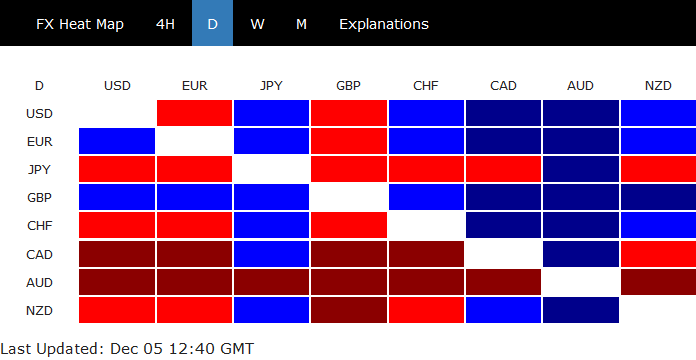
Staying in the forex markets, Euro is trading as the second strongest one. Italian 10 year yield drops quite notably by -0.0769 to 3.072 at the moment. German 10 year yield is up 0.0074 at 0.271. That is, German-Italian spread is now at 280. That's quite a positive development, as helped by continuous news/rumors/rhetorics that suggest Italy is working on its budget to avoid EU disciplinary actions. Dollar is following as the third strongest.
Meanwhile, Australian Dollar is the worst performing one with terrible weak Q3 GDP data as well as risk aversion. Yen is the second weakest for today, (but it stays as the second strongest for the week), as risk aversion doesn't intensify in Asia and Europe. Canadian Dollar is the third as BoC rate decision is awaited.
In Europe, at the time of writing:
- FTSE is down -1.03%
- DAX is down -0.83%
- CAC is down -0.91%
- German 10 year yield is up 0.0074 at 0.271
- Italian 10 year yield is down -0.0769 at 3.072
Earlier in Asia:
- Nikkei closed down -0.53% at 21919.33, after hitting day low at 21755.17
- Singapore Strait times dropped -0.37% to 3155.92, after hitting day low at 3127.70
- Hong Kong HSI dropped -1.62%
- China Shanghai SSE dropped -0.61%
- 10 year JGB year dropped -0.0007 to 0.069
WTI Oil Outlook: Recovery Started to Lose Traction; EIA Report/OPEC in Focus for Fresh Signals
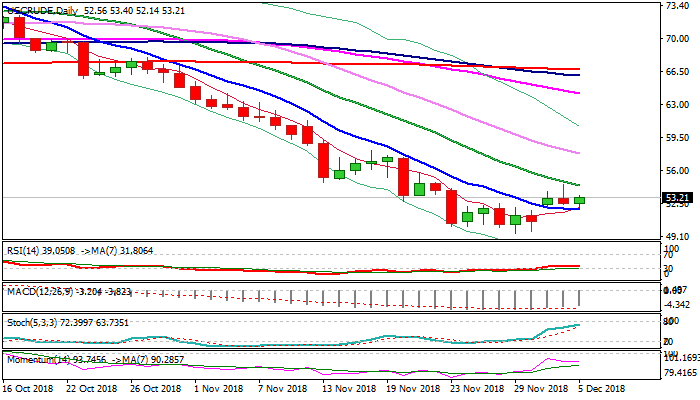
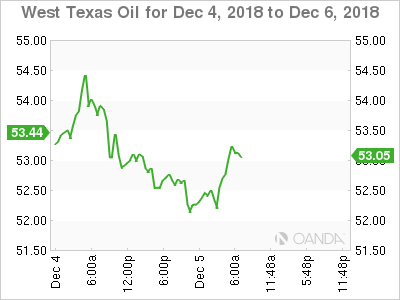
WTI oil price bounced from Asian session low at $52.14, but still hold away from Tuesday's high at $54.54, where near-term recovery was capped by falling 20SMA, with subsequent pullback marking strong rejection.
Tuesday's close in red with long upper shadow on daily candle could be negative signal, as the sentiment was soured by renewed concerns of global growth slowdown and US supply glut.
The API report, released late Tuesday, showed fresh build in US crude stocks by 5.36 mln bls, above previous week's rise by 3.45 mln bls, adding to negative signals.
Focus turns towards release of US EIA crude stocks report which was postponed to Thursday (0.94 mln bls draq f/c vs 3.57 mln bls build previous week) which could provide fresh signal. Another key event, OPEC meeting is due on Thursday, with strong expectations that the cartel and Russia would confirm their decision to start cutting the output in order to stabilize oil market.
Near-term price action is holding between broken 10SMA ($51.90) which marks support and 20SMA ($54.44), marking pivotal barrier.
Bears on daily techs started to lose traction on initial reversal signals, but flat momentum lacks support.
Sustained break above 20SMA would generate bullish signal for further recovery.
Alternatively, loss of 10SMA support would weaken near-term structure, but filling Monday's gap would provide stronger negative signal for renewed probe below cracked psychological $50 support.
Res: 53.40; 54.44; 54.80; 55.83
Sup: 51.90; 51.46; 50.64; 50.00
Euro Drifting as German and Eurozone Services PMI Within Expectations
EUR/USD is almost unchanged in the Wednesday session. Currently, the pair is trading at 1.1338, down 0.05% on the day. On the release front, German and eurozone services PMIs both softened in November. German Final Services PMI dropped to 53.3, matching the estimate. Eurozone Final Services PMI dipped to 53.4, above the estimate of 53.1. Eurozone retail sales posted a gain of 0.3%, marking a 4-month high. This beat the estimate of 0.2%. On Thursday, OPEC members are meeting in Vienna. The US will release ADP nonfarm payrolls, unemployment claims and the ISM Non-Manufacturing PMI.
In France, the ‘yellow vest’ protests are continuing, despite the about-face by the government, which agreed to suspend a controversial fuel tax. The riots have paralyzed Paris, and hotels and restaurants have been particularly affected. The demonstrations began in protest of the fuel tax, but have grown into a massive protest against the Macron government. If the protests continue, French GDP for the fourth quarter could be negatively affected.
German Services PMI dropped to its lowest level since April, as the eurozone’s largest economy continues to post weak numbers in the fourth quarter. On Monday, Manufacturing PMI dropped to 51.8 in November, down from 52.2 points in October. This marked a fourth straight downturn and was the lowest reading since April 2016. The global trade war has taken a bite out of German exports and a slowdown in the eurozone economy has dampened manufacturing growth in Germany. Consumer indicators are also pointing downwards – last week, GfK Consumer Climate dipped to an 18-month low. while retail sales fell by 0.3%, its first decline since July. Consumers are holding tighter to the purse strings, which is hurting economic growth. This does not bode well for the eurozone economy, as the German economy is often a bellwether for the rest of the eurozone.
Risk Sentiment Dealt A Blow As Trump Strikes Again
The previous sense of market euphoria created by the U.S.-China trade truce news last weekend now risks being completely overshadowed by a range of Tweets fired by President Trump yesterday on his social feed.
This has encouraged uncertainty to emerge over the conviction from the U.S. administration over the trade truce and whether a resolution to this long-standing issue will be found. Confusion and uncertainty over what is happening coupled with renewed concerns about the likelihood of slowing global growth has switched the market sentiment creating a poor mood for stocks. Investors are becoming increasingly doubtful over Washington and Beijing securing a deal within the 90-day window, given the sheer lack of detail and conflicting accounts over what both sides actually agreed on.
The tremors created from President Trump’s Twitter outbursts continue to illustrate how financial markets remain extremely sensitive to trade-related newsflow. With Trump warning China via Twitter and stating that America is going to have a “real deal” or “no deal at all” just days after talks, one can’t help but feel a sense of déjà vu that Trump is going to return to his public hard-line stance. Although the Trump Administration has repeatedly blamed the Federal Reserve’s monetary policy tightening for the unfavourable investor mood in stocks, the key culprit behind the selloff witnessed yesterday was clearly the comment made by Trump on trade with China.
Market players who were cautiously optimistic over trade tensions easing are losing patience and this continues to be reflected across global equity markets. Asia closed mostly lower this morning following steep losses on Wall Street overnight. The negative sentiment from Asia has already infected European markets and is seen trickling back down to Wall Street this afternoon.
Sterling braces for another rough session
Investors with an interest in the Pound should securely fasten their seatbelts and safety helmets for a volatile ride ahead of the Parliamentary vote on Brexit next week.
The British Pound was an easy target for sellers yesterday after Theresa May’s government was found in contempt of Parliament for refusing to release key Brexit papers. May’s triple defeats in Parliament are highly discouraging and may intensify fears over her Brexit deal being rejected next week. With every day in the political arena shaping up to be a terrible day for Theresa May, this is poised to weigh heavily on the British Pound.
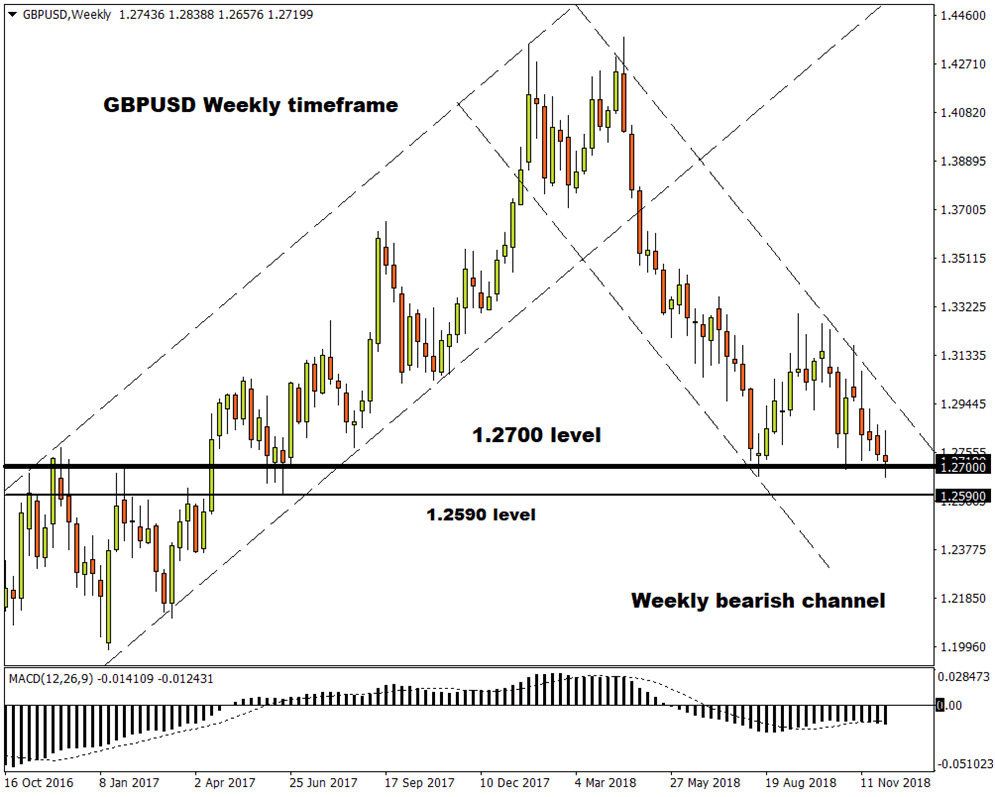
In regards to the technical picture, the GBPUSD fulfils the prerequisites of a bearish trend on the weekly charts as there have been consistently lower lows and lower highs. A solid breakdown and weekly close under 1.2700 should instil bears with enough inspiration to target 1.2590.
Will the OPEC meeting push oil prices higher?
The past few trading weeks have been quite rough for Oil prices amid supply and demand side factors. With Oil finding comfort at such depressed levels, expectations remain elevated over OPEC+ cutting production by roughly over one million barrels per day in an effort to stabilize markets. While a production cut from OPEC+ is seen pushing Oil prices higher in the near term, the medium- to long-term impact remains open to question. Rising production from U.S. Shale, lingering fears of global oversupply and threat of slowing growth hitting demand remain core themes that will continue weighing on Oil markets.
The near-term outlook for WTI Oil will depend on the outcome of tomorrows OPEC meeting. A production cut in line with market expectations is seen pushing WTI Oil back towards $55. Alternatively, if OPEC decides to leave production unchanged, prices are seen sinking back towards $50 as investors exploit oversupply fears to attack
Investors Fret Over Inverse Yield Curves And Global Growth
Wednesday December 5: Five things the markets are talking about
Euro and Asian equities fell overnight, following the stateside rout Tuesday, though declines were contained. Currently, U.S equity futures are a tad better bid after China pledged to start delivering on trade agreements reached with the U.S last weekend in Argentina.
China’s Commerce Ministry said trade negotiations would proceed “based on a timetable” and it will swiftly execute on items where there is consensus.
Since the G20 meeting last weekend, the market has been trying to second-guess the outlook for global growth, with a percentage of the market betting that the Fed will cut interest rates as soon as 2020.
Note: U.S equity and fixed income markets will be closed today in a mark of respect in the passing of President George H. W. Bush.
Elsewhere, sterling has slipped again, reaching a fresh 18-month low of £1.2672. During parliamentary debate on leaving the E.U, which started yesterday, PM Theresa May suffered several defeats. An amendment was passed that granted members of parliament the right to have a say in future Brexit plans should May’s agreement be rejected next week.
In commodities, oil prices come under pressure again as the market waits for tomorrows critical OPEC meeting where production cuts are expected. Saudi Arabia and Russia are set to meet today for a make-or-break preparatory meeting that’s going to set the direction for the oil market.
1. Equities decline contained for now
Stateside yesterday, stocks plummeted more than -3%, led lower by bank and industrial shares, as investors reacted to the inversion of parts of the U.S yield curve with a degree of panic – the 2/5’s spread painted a worrying picture about economic growth.
In Japan, the rout continued overnight with the Nikkei falling to a fresh two-week low. The Nikkei share average dropped -0.5%, while the broader Topix also fell -0.5%.
Down-under, Aussie shares experienced a similar fate; with recession concerns and doubts about the Sino-U.S trade talks unnerved investors. Broad-based losses pushed the benchmark S&P/ASX 200 index down -0.8% at the close. On Tuesday, the index fell -1.0%. In S. Korea, stocks pared deeper declines as investors’ recalibrated expectations from cooling U.S-China trade tensions. The Kospi was -0.6% lower at the close, led by Samsung Electronics, which fell -1.7%.
In China, investor doubts over whether China and the U.S would be able to settle their trade dispute before the 90-day deadline expires shook equity prices. At the close, the blue-chip CSI300 index was down -0.5%, while the Shanghai Composite Index fell -0.6%. In Hong Kong, the Hang Seng index closed -1.6%, while the China Enterprises Index lost -1.4%.
Note: Data overnight showed that China’s services sector grew (53.8 vs. 50.7) at its quickest pace in five-months in November due to an uptick in new orders, although the outlook for businesses over the next year worsened for the third month.
In Europe, regional bourses trade lower across the board following sharp losses in the U.S yesterday and weaker Asian equities. Indices have rebounded off the lows tracking higher U.S futures.
U.S futures are in the ‘black’ (+0.57%).
Indices: Stoxx600 -0.79% at 355.82, FTSE -0.95% at 6,955.72, DAX -0.79 at 11,245.29, CAC-40 -0.84% at 4,971.93, IBEX-35 -0.69% at 8,999.35, FTSE MIB -0.17% at 19,320.50, SMI -0.97% at 9,003.80, S&P 500 Futures +0.57%
2. Oil prices fall on global growth worries and over supply concerns
Oil prices remain under pressure this morning, pulled down by a U.S supply glut and a drop in equity markets.
Brent crude oil futures are at +$61.14 per barrel, down -94c, or -1.5% from yesterday’s close, while U.S West Texas Intermediate (WTI) crude futures are at +$52.44 per barrel, down -81c, or -1.5%.
Oil prices were pressured by yesterday’s API data that showed that U.S crude inventories rose by +5.4M barrels in the week to Nov. 30, to +448M barrels, in a sign that U.S. oil markets are in a growing glut.
Markets attention now turns to tomorrow’s OPEC meeting in Vienna. OPEC+ are working toward a deal to reduce oil output by at least -1.3M bpd. However, Russia’s resistance to a major cut is so far the main stumbling block.
Saudi Arabia has indicated a need for steep reductions in output from January, but has come under pressure from President Trump to help support the world economy with lower oil prices.
The Saudi’s and Russia are expected to meet today in a “make-or-break preparatory meeting” that’s should set the direction for the oil market.
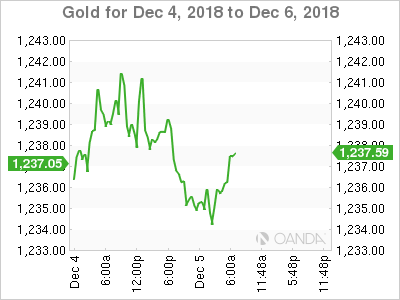
Gold prices are steady in early trading as the ‘big’ dollar trades contained against G10 currency pairs. Spot gold is at +$1,236.85 per ounce. In yesterday’s session, prices touched a peak of +$1,241.86, their highest since Oct. 26. U.S gold futures are down -0.4% at +$1,241.4 per ounce.
3. U.S 10-year Treasury yield falls below 3%
U.S government bond prices continue to rally, pushing the yield on 10-year notes further below +3% as investors continue to scramble into longer-term bonds.
Concerns about trade tensions with China remain, despite the 90-day truce on tariffs. Investors are also less confident about the ability of the Fed to continue to raise interest rates on the path that policy makers had penciled in at their September meeting.
Note: The Fed was forecasting one more rate increase this year (Dec 19 fed funds are pricing an +83% odds for an xmas hike) and three in 2019.
Fed funds futures indicate the probability that the Fed meets its forecast or exceeds it at 10%. That compares with 66% odds that it increases rates two times or less.
The yield on the benchmark 10-year Treasury note fell to a recent +2.928% from +2.990% Monday.
Elsewhere, the German 10-year Bund yield is trading at its lowest level of the year, having fallen to +0.26%, while the U.K’s 10-year Gilt yield has gained +1 bps to +1.287%, the first advance in more than a week.
While a lot of bad news has already been priced in, December 11, the day of the Brexit deal vote in the U.K parliament, may still result in another spike in risk aversion.
4. Dollar contained for now
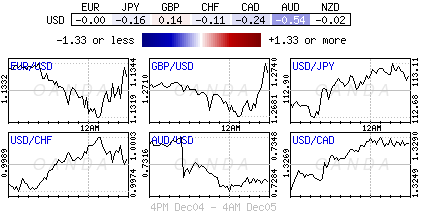
The ‘big’ dollar remains contained in a tight range against G10 currency pairs. The USD is caught in the cross currents of safe-havens flows, as global stock markets remain volatile, and investors’ realignment of Fed rate hike expectations in 2019.
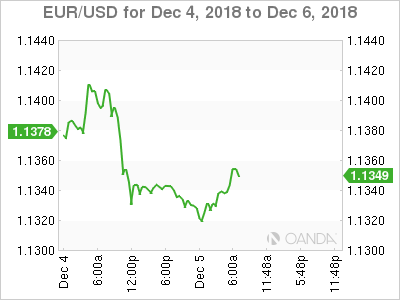
EUR/USD (€1.1339) trades steady despite some upward revisions in the major European Services PMI data – Beats: Euro Zone, France, Spain, and Italy. Miss: UK; In Line: Germany.
GBP/USD (£1.2736) was initially higher as the Grieve amendment was perceived to support the pound on reduced Brexit risk of a ‘no-deal Brexit’. However, a miss in Nov PMI Services data (see below) has taken some of the wind out of sterling’s sails.
The Japanese yen dipped -0.3% to ¥113.07, the biggest decrease in more than a week.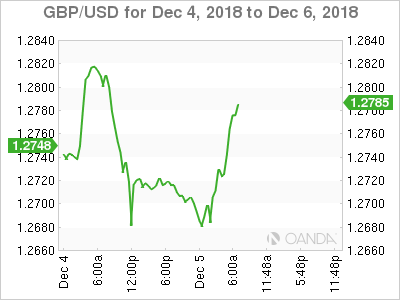
5. U.K service sector growth eases to 28-month low in November
Data this morning showed that the U.K service sector companies experienced another difficult month in November, with both business activity and incoming new work expanding at the weakest rates for almost two-and-a-half years.
IHS Markit/CIPS UK Services PMI Business Activity Index fell to 50.4 in November. This was down from 52.2 in October and the lowest reading since July 2016.
Digging deeper, survey respondents suggested that subdued business and consumer spending had held back growth and that heightened Brexit uncertainty had led to delays with clients’ business investment decisions.
Service providers signalled a slowdown in new business growth for a third consecutive month.
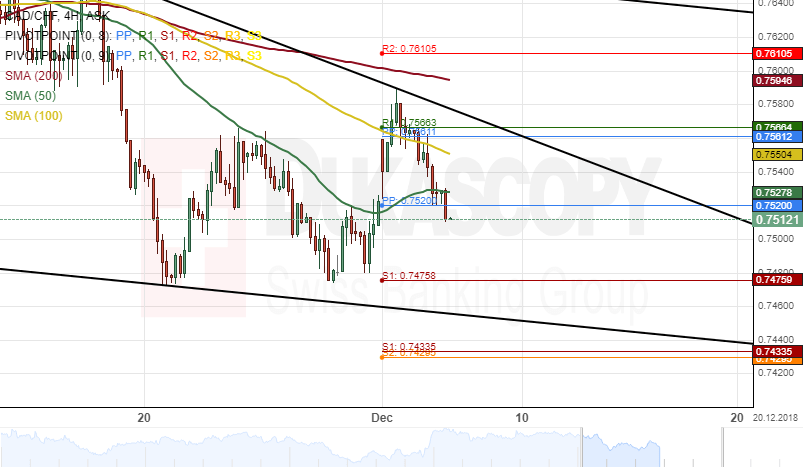
CAD/CHF 4H Chart: Testing Support Level At 0.7520
Following a reversal from the upper boundary of a medium-term ascending channel at 0.7689, The Canadian Dollar has declined massively against the Swiss Franc.
The exchange rate is currently testing a support level formed by a traditional weekly pivot point at 0.7520.
If the currency exchange rate passes the support level, it could aim for November 29 swing low of 0.7475.
However, if the support level as mentioned earlier holds, the CAD/CHF currency pair will target a resistance cluster at 0.7561 today.