Sample Category Title
USD/JPY Analysis: Is Resisted By SMAs
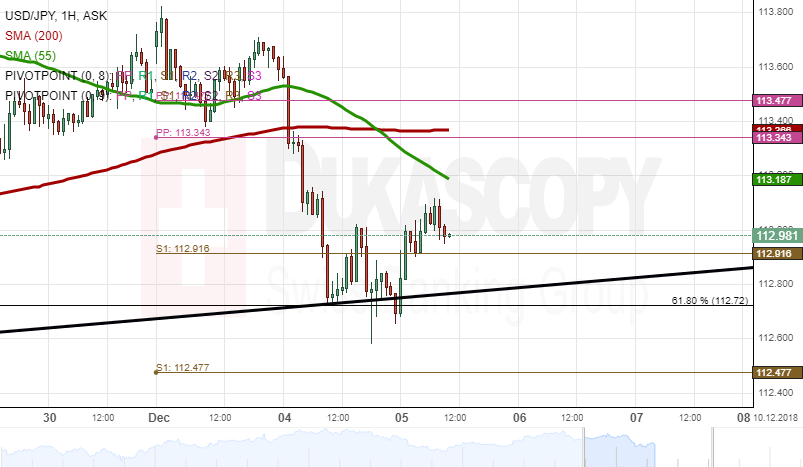
During Tuesday 's trading session, the large pattern line at 112.72 and the 61.80% Fibo stopped the rate from the depreciation to end the trading session at the 112.67 mark. During Wednesday's morning hours, the US Dollar was trading between the monthly pivot point and the weekly S1 at the 112.99 mark.
In regards to the near-term future, most likely, the US Dollar will trade downside to pass through the most of the technical indicator support levels to stay near the 50.00% Fibonacci retracement level at the 112.16 mark.
However, the support levels of the technical indicators could push the rate to break the resistances of the 55-hour and the 200-hour SMA to trade near the 113.60.
XAU/USD Analysis: Will Reach R1 At 1,241.40
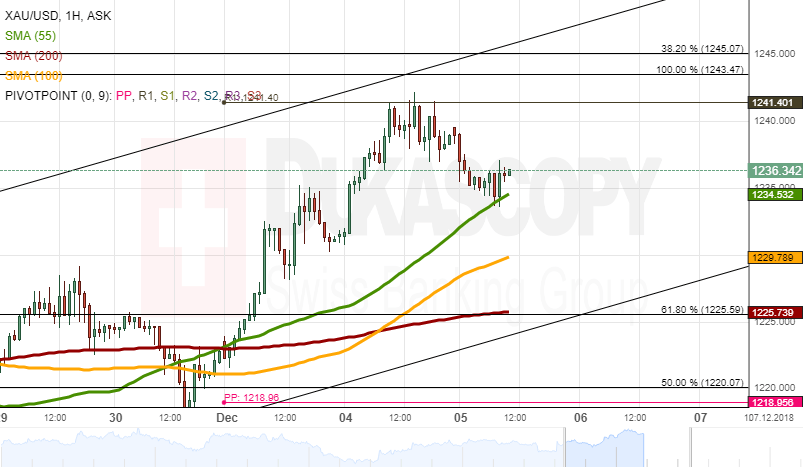
During Tuesday's trading session, the yellow metal was resisted by the monthly R1 at 1,241.40 to end the trading session at the 1,235.43 mark. During Wednesday's morning hours, the yellow metal was supported by the 55-hour simple moving average to trade at the 1,235.90 mark.
In regards to the near-term future, most likely, the yellow metal will trade upwards to meet the monthly R1 at the 1,241.40 mark. In addition, the 55-hour simple moving average will support the surge during the day.
However, the gold could pass through the support of the 55-hour simple moving average to trade sideways at the 1,230.00 level on Wednesday.
Italian Politics Monitor: The Heat Is On
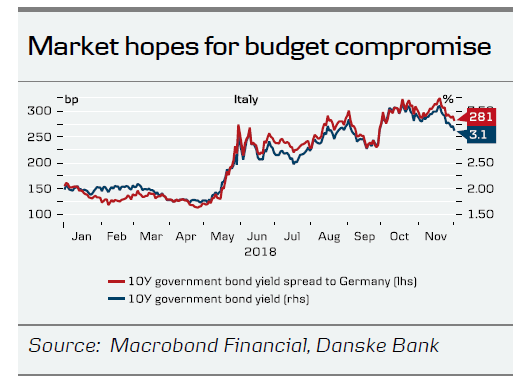
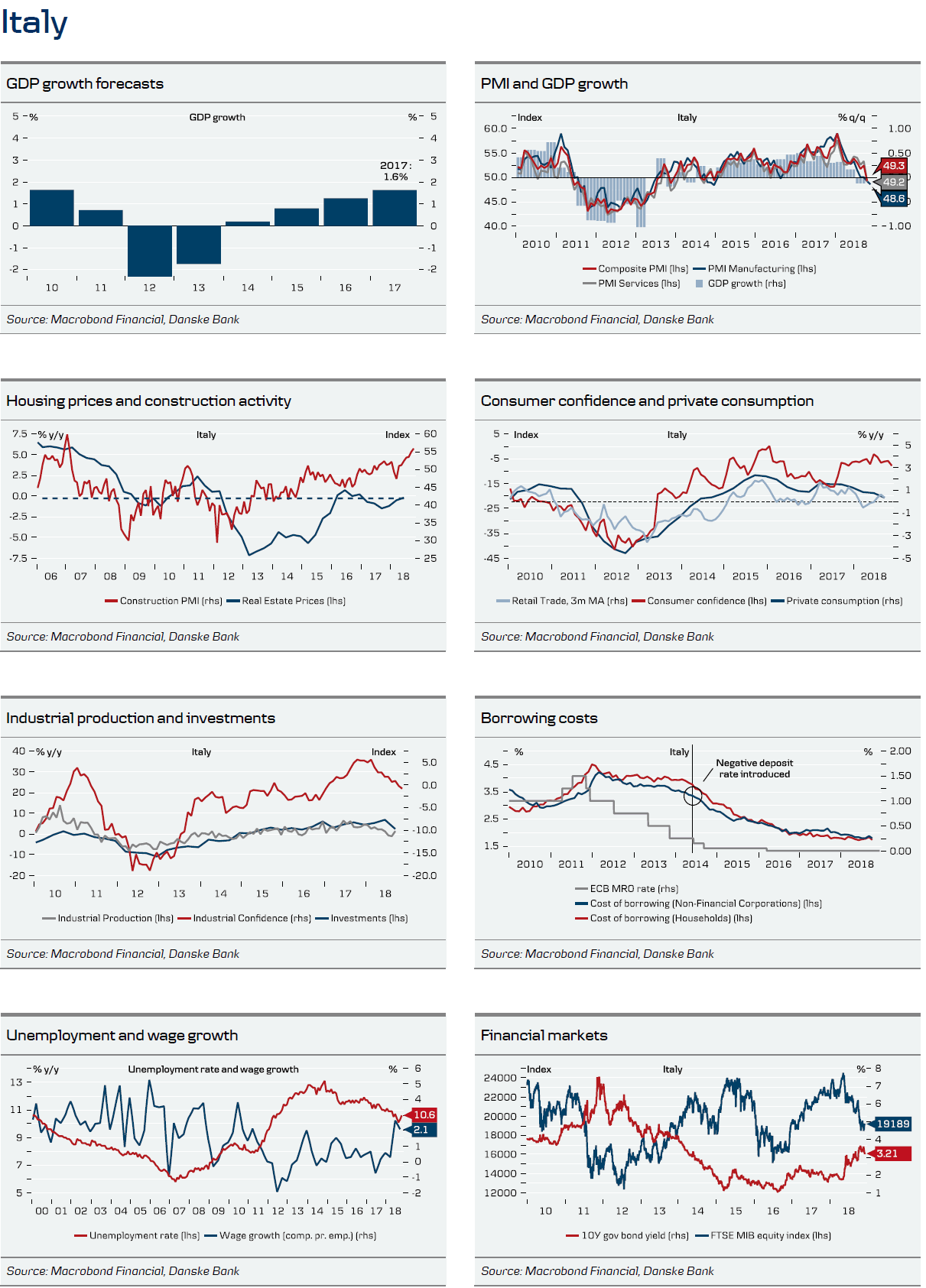
Pressure is mounting on the Italian government to resolve its budget feud with the European Commission (EC), with the economy already contracting in Q3 and shifting public sentiment (a poll showed 68% of Italians in favour of budget adjustments to avoid a clash with the Commission). Over the past few days we have already seen a shift in tone from the Italian officials and Italian government bonds rallied on news that the government is considering lowering its 2019 deficit target to 2-2.2% from currently 2.4% of GDP. So are Italians blinking in the staring contest with the market and the EU?
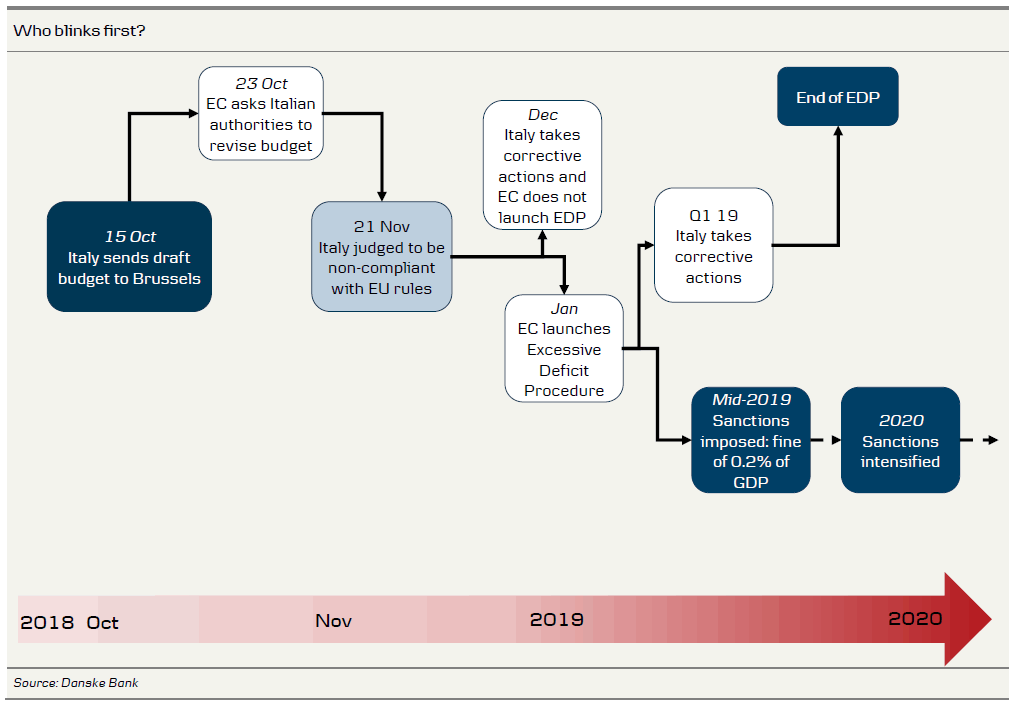
At the time of writing, negotiations between Brussels and Rome are still ongoing, but there are a couple of reasons why we think it is too early to declare the Italian budget crisis over just yet. There remains a significant spending gap to bridge, but both Di Maio and Salvini remain unwilling to scale back their respective flagship policies. The EU is rumoured to have asked for budget cuts totalling EUR12bn (0.7% of GDP), but the Italian leaders have ruled out a deficit level below 2%. As a compromise, some officials have also talked about delaying some of the policy measures (pension reform, citizen income) to mid- 2019, which could save some EUR4-5bn in the budget. However, we think such mere accounting trickery is unlikely to sway the Commission from eventually opening an excessive deficit procedure (EDP). Both EC’s Oettinger and Dombrovskis have over the past few days stressed that ‘substantial corrections’ are needed. While the sky for a budget compromise has brightened as of late – not least because the government seems keen to avoid an EDP – it would in our view require credible commitments and more substantial concessions from Italy than the ones currently discussed (i.e. on pension reform).
That means, we also still see a relatively high likelihood of further confrontation and a formal EDP launched possibly in January 2019. However, we expect the Commission to remain reactive rather than proactive i.e. awaiting the final outcome of the current negotiations before making any definite steps towards formally starting the EDP, not least to avoid stoking eurosceptic sentiment ahead of European parliament elections in May 2019. Once under an EDP, we think it is not unlikely that the Commission will actually impose (non-zero) fines on Italy in case of repeated non-compliance, but we are unlikely to reach that stage before mid-2019 earliest.
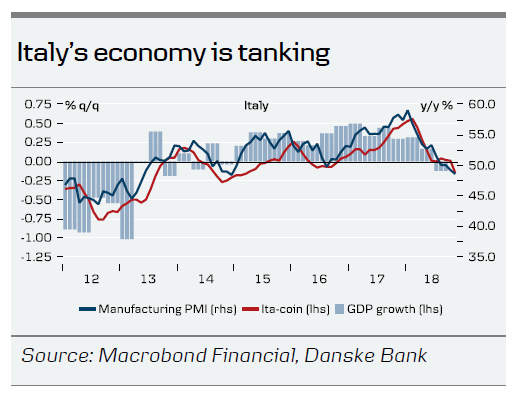
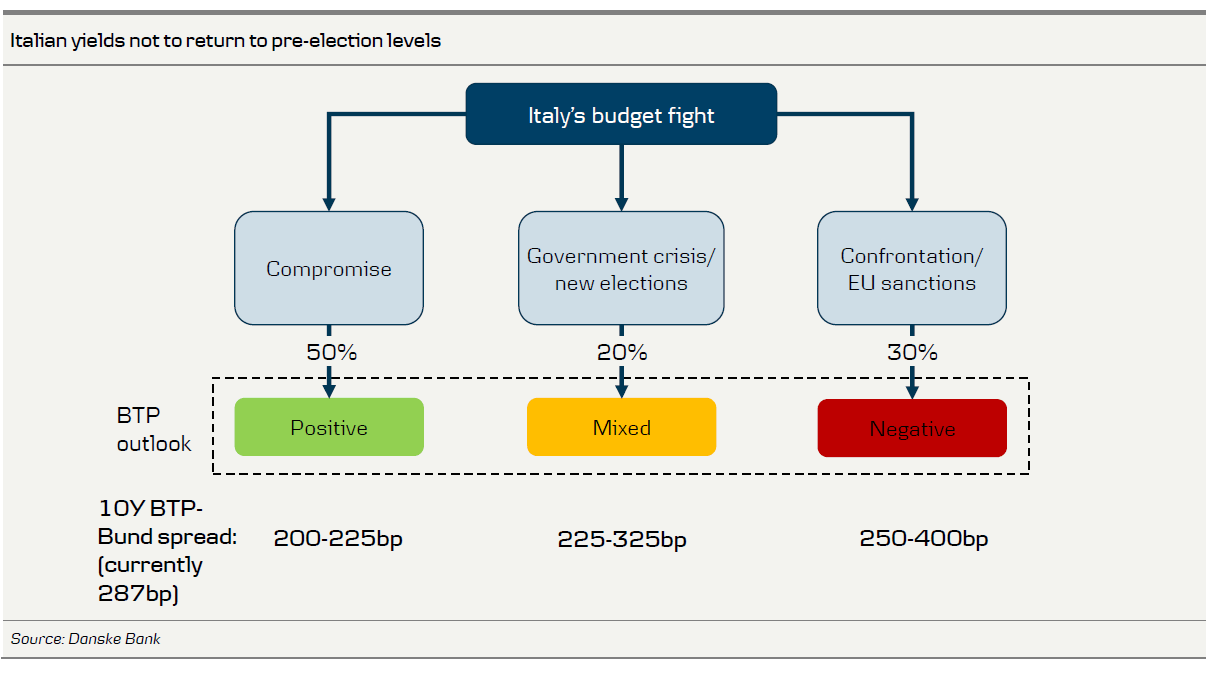
The pressure to reach a solution to the budget feud has clearly increased, with signs of the tanking Italian economy becoming more abundant by the day: GDP contracted by 0.1% q/q in Q3, while both manufacturing PMI and consumer confidence edged down further in November. The government is looking for 1.2% growth this year. To reach that goal, the economy would need to grow 0.7% q/q in Q4, but all recent data shows such a growth spurt – which happened only once in the last decade – is unlikely to materialise. There is still a risk that the repercussions of the budget fight trigger a recession in Italy in 2019 with adverse consequences on the debt dynamics, credit ratings and market sentiment. As long as the stand-off with the EU remains unresolved, we expected Italian yields to remain choppy. However, unless the confrontation intensifies, we see scope for further performance in Italian government bonds near-term, with the 10Y spread gradually falling below 250bp (see scenarios below), but staying above levels observed before the election
Euro Area Macro Monitor: Activity Remains In Hibernation
Key points
- Recent growth weakness spills over to Q4 activity.
- Data-driven ECB looks increasingly challenged in growth and core inflation optimism.
- Italy’s budget fight with the EU moved one step closer to an excessive deficit procedure
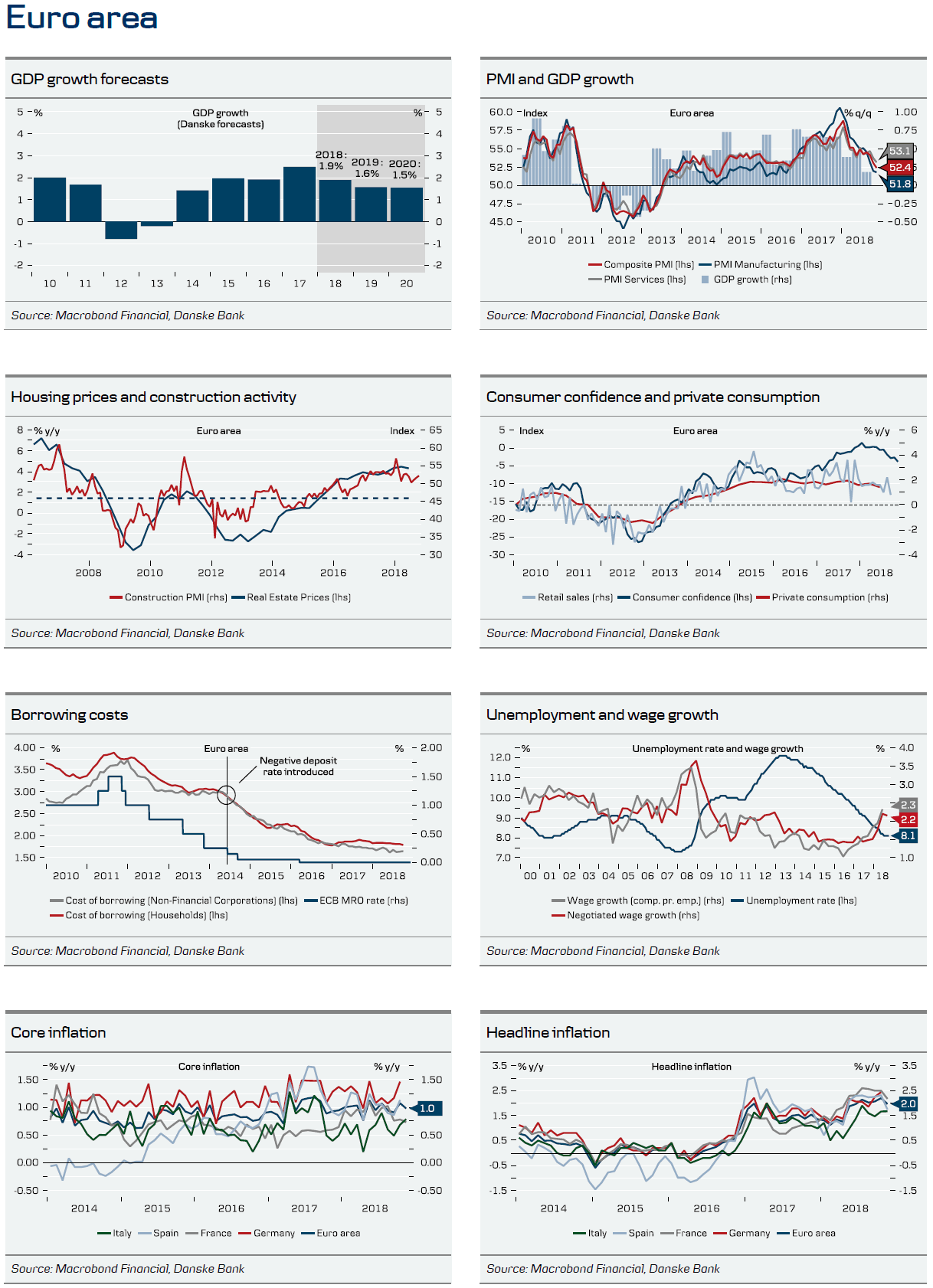
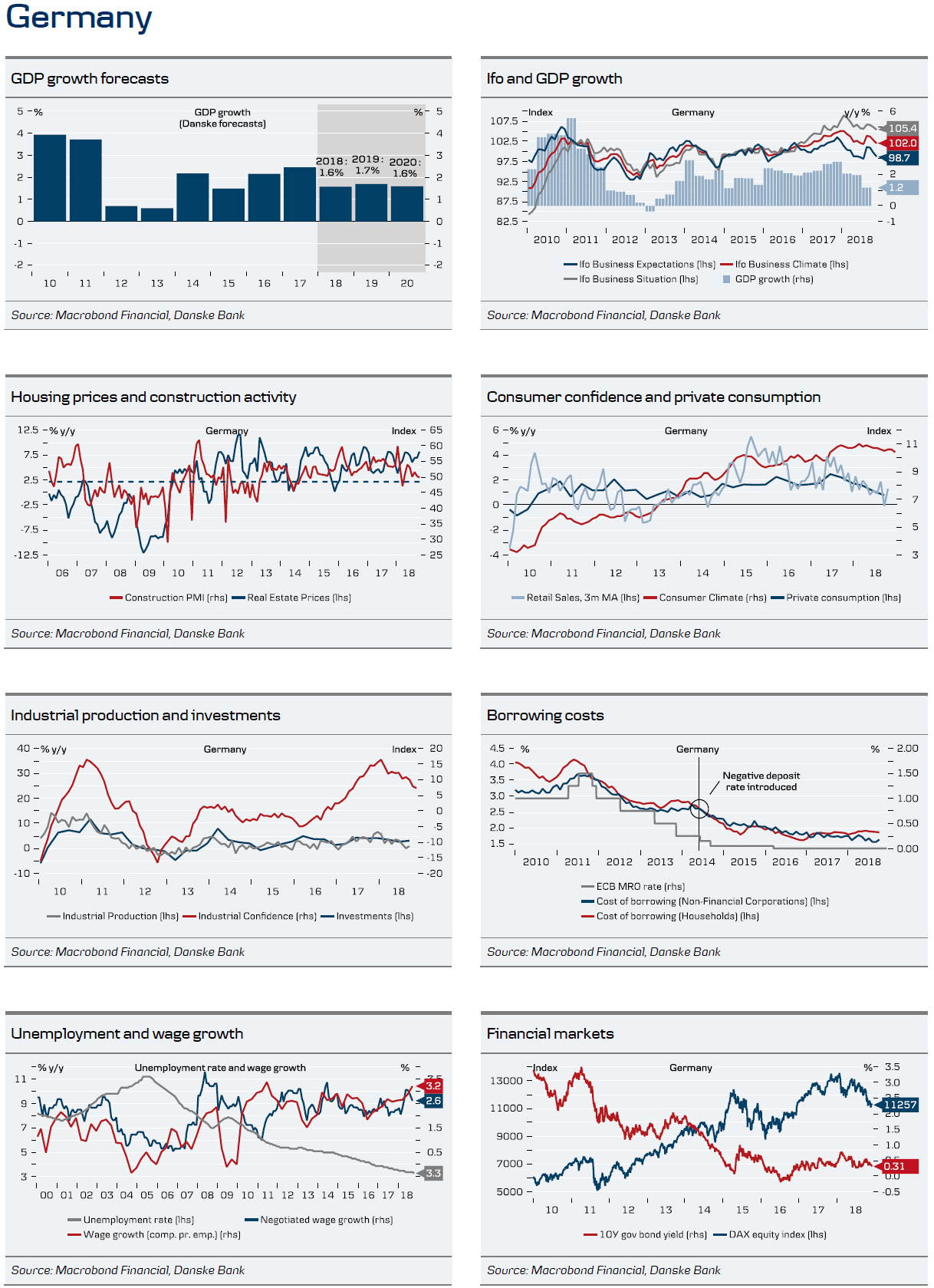
The cyclical divergence between the US and Europe continues, as November euro area PMIs did not signal the rebound in growth momentum that markets were hoping for. Instead, with composite PMI falling to a four-year low, it looks like some of the Q3 euro area growth softness is set to persist in Q4. Manufacturing remains the main area of weakness amid slower global demand, rising political and economic uncertainty, trade war repercussions and persistent sluggish car sales. However, the slowdown is also broadening out to service sector activity, where demand and new business inflows have waned as of late. Although we think darker clouds are on the horizon for the euro area, domestic demand should compensate some of the external headwinds. We expect GDP growth to remain above potential in 2019 at 1.6% and similarly, project the German economy not to be out of steam yet, although growth has probably peaked.
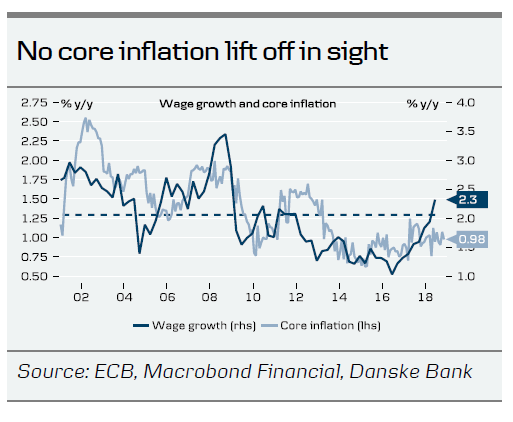
November HICP inflation fell back below 2% for the first time since May this year, as the boost from higher energy prices increasingly starts to wane. A slowdown in headline inflation was widely expected, but core inflation declining back to 1.0% (-0.1pp) in November was a clear disappointment, as higher wages yet have to show up in durably higher services prices. However, we expect a strong Q3 wage growth number to keep ECB's inflation confidence alive. That said, macro data is increasingly challenging the ECB's ‘balanced' growth assessment and its belief in temporary factors being behind the recent slowdown, although we do not expect it to derail the QE exit strategy at the 13 December meeting. A downward revision of the 2018 and 2019 growth and core inflation forecasts looks increasingly warranted.
Italy's budget fight with the EU moved one step closer to an excessive deficit procedure (EDP), after Italy refrained from any meaningful changes in its budget plan. Negotiations between Rome and Brussels continue in the background, but there remains a significant spending gap to bridge with the Italian leaders unwilling to scale back their respective flagship policies. Hence, we still see a high likelihood for further confrontation and a formal EDP launched towards the end of the year or early 2019. Meanwhile signs that the Italian economy is tanking are becoming more abundant by the day: GDP contracted by 0.1% q/q in Q3, while both manufacturing PMI (48.6 – now in contractionary territory) and consumer confidence edged down further in November. The government is looking for growth of 1.2% this year. To reach that goal, the economy would need to grow 0.7% q/q in Q4, but recent data shows such a growth spurt – which also happened only once over the last decade - is unlikely to materialise.
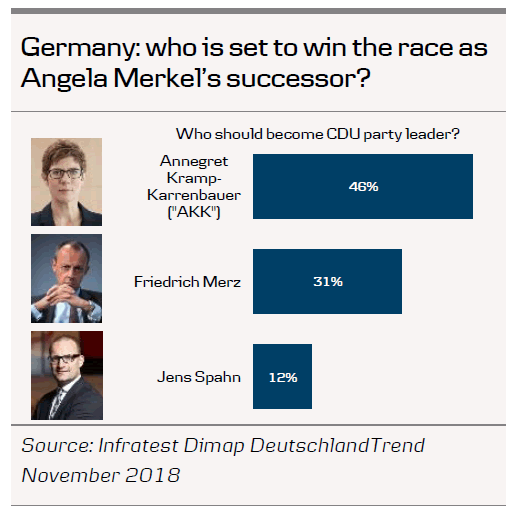
There have been other interesting developments on the European politics front: Germany's Manfred Weber secured the backing of the largest European parliament faction (EPP) as Spitzenkandidat for the job as Commission President, as the contest for EU elections starts gathering momentum. In German politics, ‘mini-Merkel' AKK is increasingly looking like the frontrunner in Merkel's succession race. Progress on EMU reforms remains sluggish, but French and German finance ministers renewed their push for a separate euro area budget to enter force in 2021 and to be discussed at the EU summit in December.

Elliott Wave Analysis: German DAX And GOLD Update
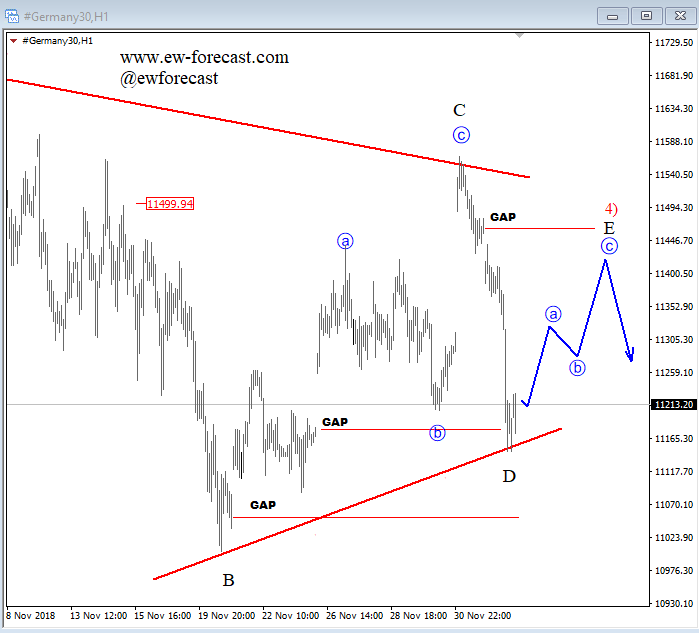
DAX is also turning bearish which means more weakness after current bounce that can be an early stage of a wave E rally. There is a nice gap at 11480 area that can be filled before sellers comes in, when they may try to send index back to November lows as fourth triangle wave would come to an end.
German DAX, 1h
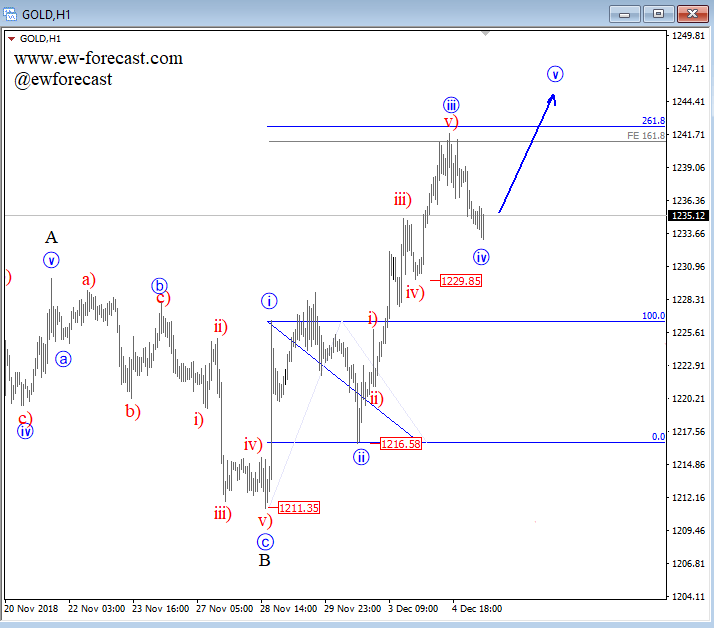
If risk-off is really going to continue then gold may stay in uptrend which makes sense after that extended third wave up, so current set-back is seen as wave four that is already trading at support zone. Ideally new highs will be seen in next 24-48 trading hours with a rise towards 1245/1250 area.
Gold, 1h
EUR/JPY Continuation Only Below 127.60
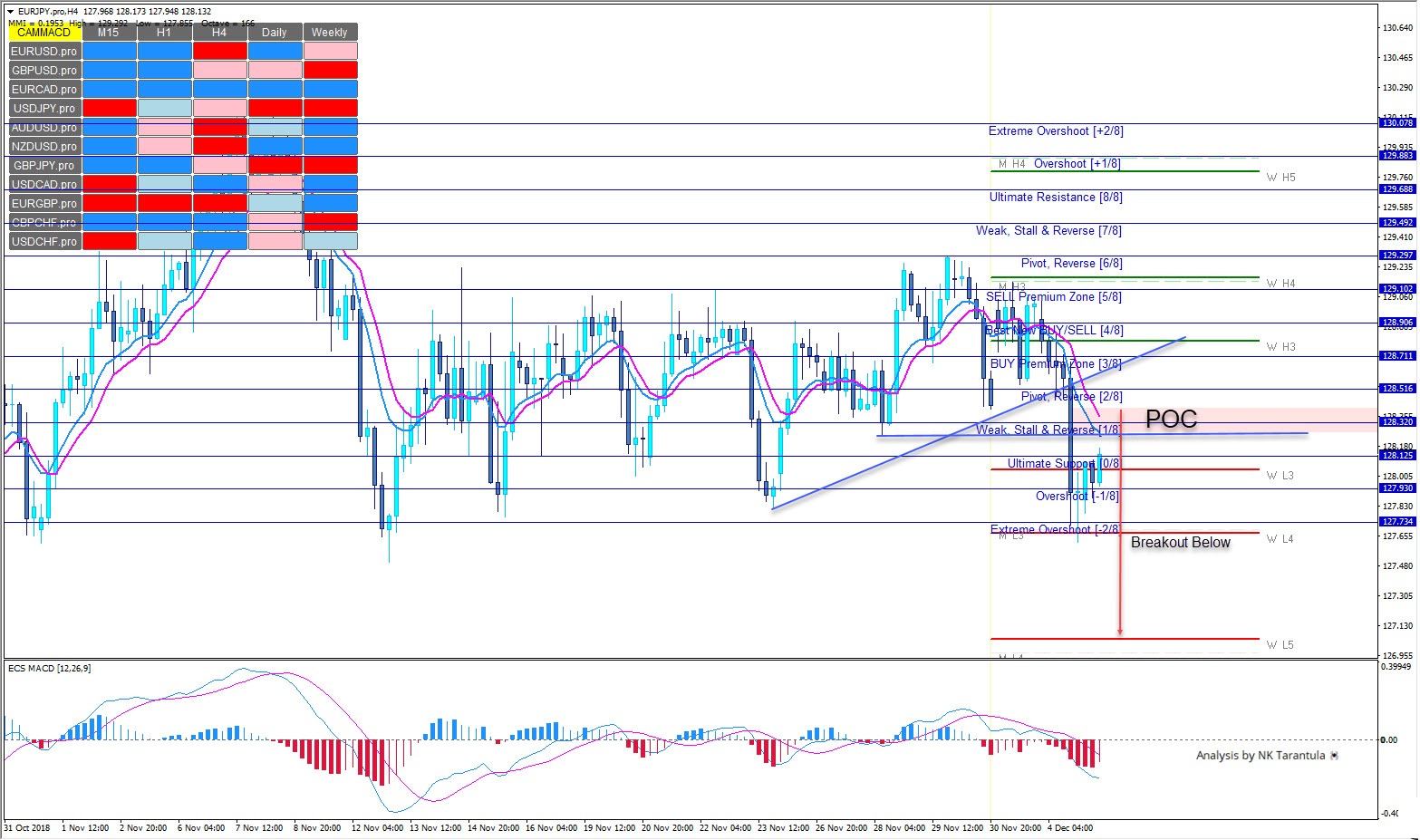
The EUR/JPY has formed a bearish range that we can clearly see on the chart. However the price is bearish and each rally has been effectively sold. 128.30-55 in the POC zone and we might see another rejection should the price retrace. However only below W L4 / -2/8 MM and Camarilla confluence we will see a continuation towards 127.00. For that to happen a 4h needs to close below 127.60.
BTCUSD Continues Bearish Sentiment, Ready To Finish Year In Red
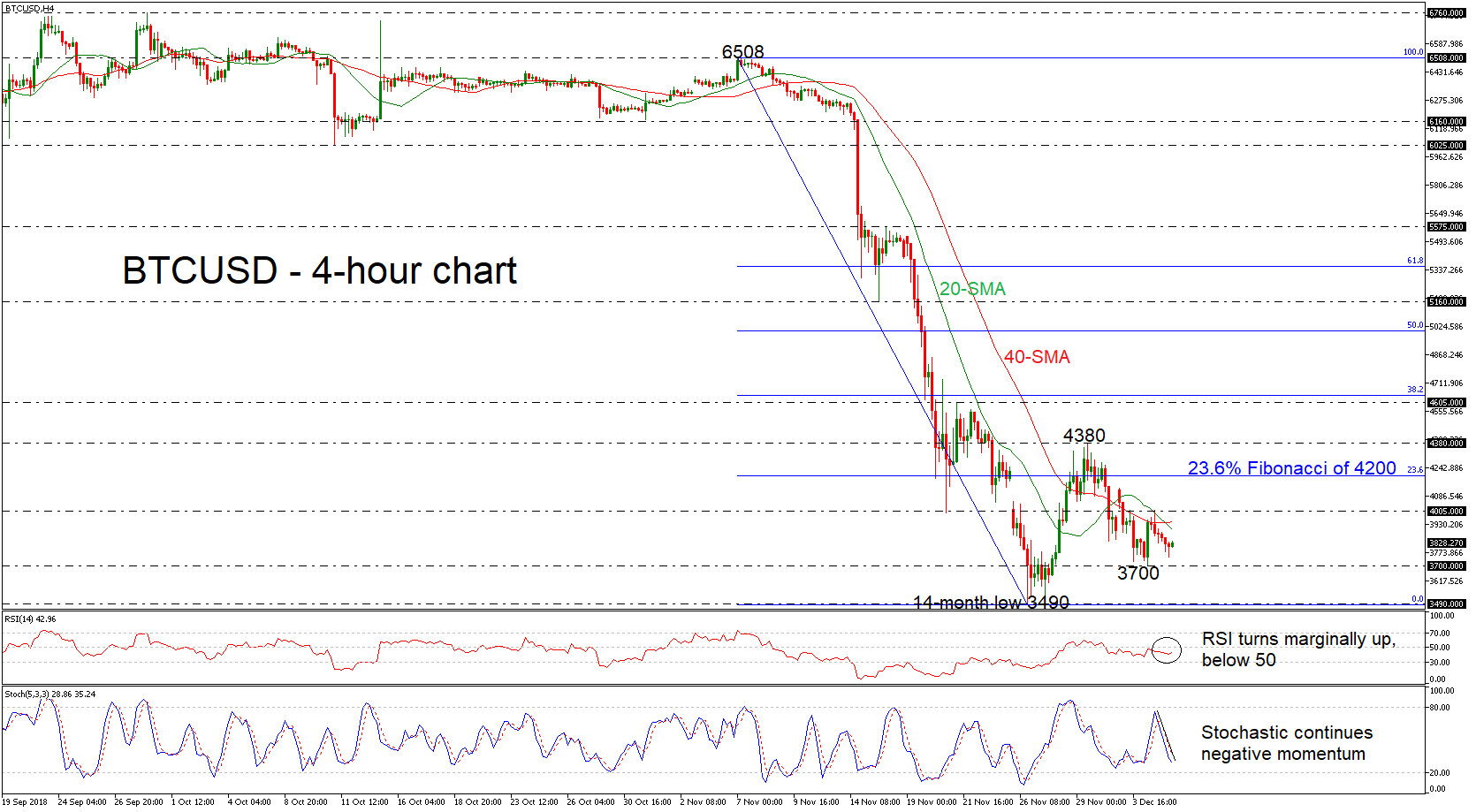
BTCUSD is extending its losses and is currently trading not far above the 14-month low of 3490 hit on November 26. The price fell below the bearish cross between the 20- and 40-simple moving averages in the 4-hour chart. The stochastic oscillator is heading lower towards the oversold territory; however, the RSI indicator is turning slightly higher in the bearish zone.
Should the pair stretch south, the multi-month low of 3490 could provide immediate support before the pair slips lower. A significant step lower could endorse the bearish sentiment, sending the price probably towards 2790, which was a strong barrier back in September 2017.
If the bulls manage to take charge and jump above the moving averages and the 4005 resistance level, then the expectation is for another test of the 23.6% Fibonacci retracement level of the downleg from 6508 to 3490, around 4200.
In the bigger view, the bearish phase remains in play especially after BTCUSD dropped below the 6160 key level.
Asia Swoons On Trade Crunch
Asia swoons on trade crunch
Asian equities tumbled, partially erasing gains from Monday’s euphoria over what seemed to be a trade truce between China and the USA. Hardest hit is the Hong Kong Hang Seng index, -1.62%, while Australian ASX 200 and South Korean Kospi declined by 0.78% and 0.62%. Japanese Nikkei 225 closed in a slight drop of 0.53% due to a relatively stable Yen. European shares are red across the board, led by UK’s FTSE 100 and the French CAC 40. This followed a meltdown in the US yesterday, with the Dow Jones Industrial Average down -3.10%, S&P 500 off 3.24% and Nasdaq sliding 3.80%. Investors are switching towards US treasuries, with 30-year, 10-year and 2-year treasury yields down 2.48%, 1.89%, 0.93%. EUR/USD remains in neutral territory, trading at 1.1343 and approaching 1.1315 short-term.
Pound pounded by Brexit chaos
Ahead of next Tuesday’s vote on Brexit, we expect the British pound to remain under pressure and highly sensitive to headlines. Short-term, we expect EUR/GBP, currently trading at 0.8906, to head along 0.8889.
Parliamentary debate has intensified. Support for Prime Minister May is weakening. An amendment was passed that gives Parliament the final decision over Plan B, should May’s draft agreement be rejected. Most MPs are unwilling to leave the European Union without a deal, but if May’s plan is rejected, time will be short for alternatives. Now on the table are proposals to delay Brexit or even to reverse it. Even insiders are unsure how this will play out.
AUD/USD Outlook: Aussie Extends Pullback On Stronger Greenback / Downbeat Australian GDP Data
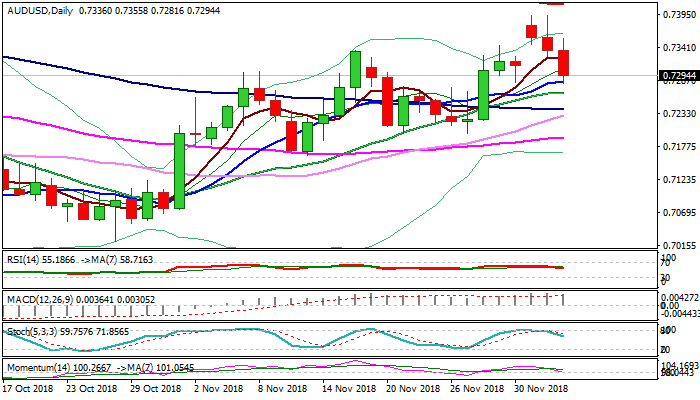
The Australian dollar accelerated lower on Wednesday and hit one-week low at 0.7281 in late Asian trading.
News that Beijing agreed to reduce tariffs on US made cars sent US stocks sharply lower and boosted the US dollar.
Downbeat Australian GDP data (Q3 0.3% q/q vs 0.6% f/c / Q3 2.8% y/y vs 3.3% f/c) added pressure on Aussie dollar, which holds in red for the third straight day.
Double-rejection at 0.7393 (Mon/Tue) and Tuesday’s bearish daily candle with long upper shadow, signaled that bulls were running out of steam.
Today’s fall filled Monday’s gap, adding to negative signals, as indicators on daily chart turned south and bear-leg off 0.7393 double-top cracked rising 10SMA (0.7284).
Over 50% of 0.7199/0.7393 upleg has been retraced so far, with pivotal supports at 0.7273 (Fibo 61.8% of 0.7199/0.7393) and 0.7266 (20SMA) being under pressure.
Close below 20SMA would generate bearish signal for possible extension towards higher base / daily cloud top at 0.7200 zone.
Hopes for fresh upside would remain alive while 20 SMA holds pullback, however, return above thick hourly cloud (spanned between 0.7338 and 0.7371) is needed to confirm scenario.
Res: 0.7305, 0.7355, 0.7393, 0.7414
Sup: 0.7281, 0.7273, 0.7266, 0.7238
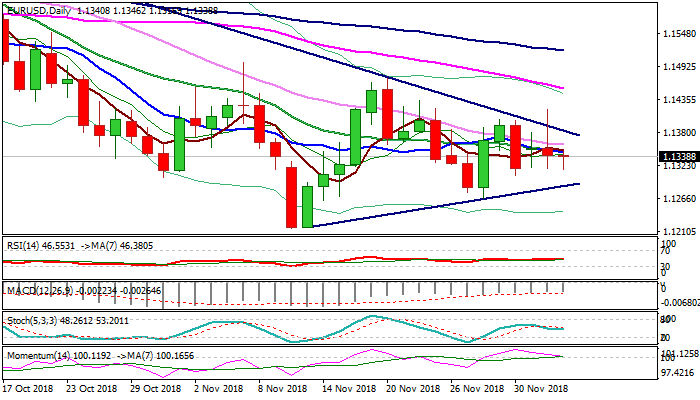
EUR/USD Outlook: The Second Doji Signals Strong Indecision, The Pair Continues To Trade Within The Triangle
The Euro stands at the back foot in early European trading on Wednesday after Tuesday’s rally which probed above trendline resistance was strongly rejected.
The second consecutive Doji candle was left on Tuesday, signaling strong indecision.
Stronger US dollar on optimistic tones from trade issue and uncertainty over Italy’s budget weigh on Euro, while dovish shift from Fed underpins.
German Services PMI came in line with expectations in Nov, while EU Services PMI beat forecast (Nov 53.4 vs 53.1 f/c) but still holds near two-year low and market showed no immediate reaction on data.
Pivotal supports lay at 1.1320/1.1295 zone (lows of last few sessions / trendline support) with sustained break here to confirm bearish bias and risk test of 1.1267 (28 Nov low) and possible extension towards key support at 1.1205 (12/13 Nov lows).
Bullish scenario requires break and close above trendline resistance (1.1380) and tops of 29/30 Nov at 1.1400, to signal further advance.
Res: 1.1348, 1.1358, 1.1380, 1.1400
Sup: 1.1320, 1.1305, 1.1295, 1.1267