Sample Category Title
UK PMI services dropped to 28-month low, sharp deterioration in service sector growth
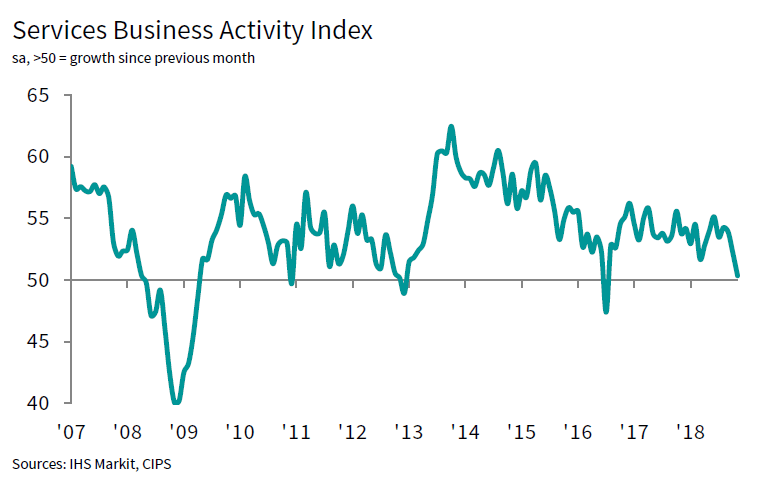
UK PMI services dropped notably to 50.4, down from 52.2 and missed expectation of 52.5. That's also the lowest reading in 28 months. Markit noted there is only marginal expansion of overall business activity. Employment growth moedrates to four-month low. And, business optimism is weakest since July 2016.
Chris Williamson, Chief Business Economist at IHS Markit, which compiles the survey:
"A sharp deterioration in service sector growth leaves the economy flatlining in November as Brexit concerns intensified. Measured across services, manufacturing and construction, the survey results suggest that the pace of economic growth has stalled. With the exception of July 2016, when business slumped in the immediate aftermath of the EU referendum, November saw the worst performance since February 2013.
"The surveys are so far consistent with 0.1% GDP growth in the fourth quarter, thanks to the expansion seen back in October, but growth momentum has since been lost and risks are clearly tilted to the downside.
"A contraction of service sector business activity in November was only avoided by firms working through backorders to an extent not exceeded since 2009. As such, unless demand revives, a slide into economic decline at the turn of the year is a distinct possibility.
"Both the slowdown in current business activity and the deterioration in business optimism were primarily caused by an intensification of anxieties over Brexit. Uncertainty in relation to the withdrawal agreement and the possibility of no deal was often reported to have caused companies and customers to cancel or postpone spending and investment decisions. Clarity in relation to Brexit arrangements is therefore urgently needed to help ensure the current stalling of growth does not translate into a downturn."
Stocks Sink Amid Trade Woes, BoC Decision Eyed
- Trump’s trade posturing sinks stock markets
- Bank of Canada to stand pat (1500 GMT), but may appear a touch more cautious
- Dollar rebounds after Fed’s Williams reiterates “gradual hikes”
- Sterling remains turbulent as Parliamentary debate kicks
Equities sink on Trump’s trade posturing
Wall Street plunged, with the S&P 500 falling by a whopping 3.24% and the tech-heavy Nasdaq Composite nosediving by 3.80%. Meanwhile, defensive assets like the Japanese yen outperformed. The mood was already sour before the US markets opened as investors digested how vague the truce actually was, and the losses accelerated after Trump resumed his posturing versus China. He questioned whether “a REAL deal” is possible, and added: “But if not remember, I am a Tariff Man”.
He did backpedal a little in subsequent tweets after markets closed, indicating he believes there will ultimately be a deal. Coupled with remarks from China’s Ministry of Commerce that the meeting with the US was “very successful”, these may explain why risk sentiment has recovered a little today. Futures tracking the US indices are higher, though note that US markets will remain closed today in mourning of former President George H.W. Bush.
BoC to stand pat, but may adopt a cautious tone amid oil plunge
The Bank of Canada (BoC) will announce its rate decision at 1500 GMT. Markets widely expect policymakers to take no action, so the focus will probably be on any signals regarding the likelihood of a rate increase at the January meeting. In this sense, the BoC’s overall tone – whether confident or not – may hinge on how the officials view the recent plunge in oil, particularly since domestic economic data have been mixed lately. Even accounting for the latest rebound, crude prices are still a stunning 18.5% lower than they were at the BoC’s latest meeting, which paints a bleak picture for Canadian growth and investment going forward.
Should policymakers tweak their guidance in a more cautious direction against this backdrop, the loonie may come under renewed selling interest. The risk, is that the Bank dismisses the collapse in crude as a transitory factor that doesn’t warrant a policy response, in which case the currency could surge.
Greenback rebounds as Fed’s Williams seems upbeat
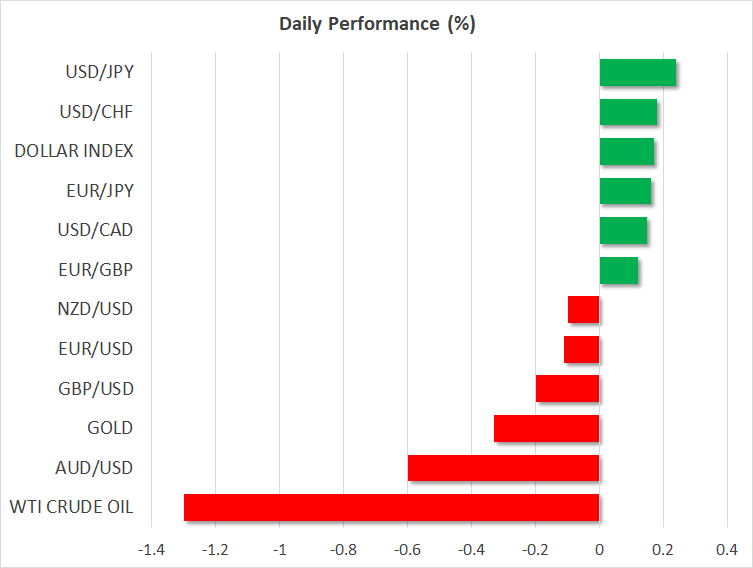
The dollar recovered early losses to close marginally higher versus a basket of six major currencies on Tuesday, aided by upbeat remarks from New York Fed President Williams. He highlighted the strength of the economy and noted that further gradual rate hikes are appropriate. His confidence likely cast some doubt on the theme the Fed will pause its tightening cycle next year. The strange thing is that markets are behaving as if a pause is a done-deal, pricing in only a single hike next year amid signs the US is slowing. Yet, it was only natural the economy would cool as the fiscal stimulus started to fade, and the Fed has refrained from providing any concrete signal a pause is looming. The implication is that if the Fed “stays the course”, then a signficiant repricing of hiking expectations may be in order.
Pound goes for another ride as Brexit turmoil intensifies
Tuesday marked another turbulent session for sterling amid a flurry of Brexit headlines. The currency initially jumped after the European Court of Justice said the UK can unilaterally reverse the Article 50 process. That didn’t last though, and the pound gave back all its gains to close lower, as the Parliamentary debate on the deal kicked off. The government lost three consecutive votes, which in essence granted Parliament greater power to shape Brexit if May’s deal is rejected, something that looks all but certain at this juncture.
The uncertainty is weighing on sterling and may continue to do so in the coming days as the debate rages on. That said, greater Parliamentary control over this process is not necessarily a negative development as far as the pound is concerned. A majority of MPs are relatively moderate and hence, may stir things away from a no-deal Brexit as much as possible. Not to mention that if speculation for a reversal of Brexit gets any wind at all, the currency could explode higher. In terms of UK data, the all-important services PMI for November is due out today.
Eurozone PMI composite finalized at lowest since Sep 2016, Germany the center of slowdown
Eurozone PMI services was finalized at 53.4, revised up from 53.1 down slightly from October final of 53.7. PMI composite was finalized at 52.7, down from October's 53.1. That's the lowest level since September 2016.
Among the countries, Germany PMI composite dropped to 52.3, hitting 47 month low. Markit noted that "It was in Germany where the euro area's growth slowdown was centred, with latest data showing the weakest expansion here in nearly four years."
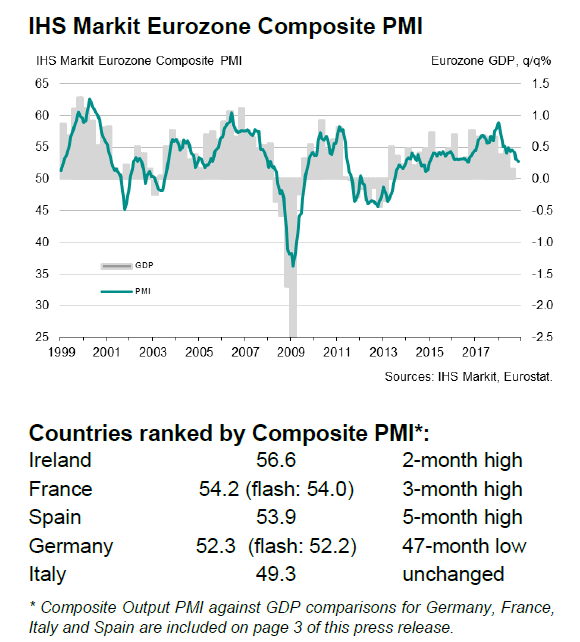
Chris Williamson, Chief Business Economist at IHS Markit said:
"The final eurozone PMI for November came in higher than the flash reading but still only points to modest GDP growth of approximately 0.3% in the fourth quarter, suggesting the region remains stuck in a soft-patch.
"Output and order books are growing at the slowest rates for over two years as a manufacturing-led slowdown showed further signs of spreading to the service sector. The survey responses highlighted intensifying headwinds of Brexit and trade war worries, a struggling autos sector and rising uncertainty regarding the economic and political outlook.
"Business optimism is running at its lowest since late 2014, adding to downside risks for growth as we move into 2019. Furthermore, hiring, which has hitherto shown surprising resilience as firms have hoarded labour despite the slowdown in demand, is now also showing signs of weakness. Employment growth in November was the lowest for almost two years.
"Hardest hit has been Italy, where business activity declined for a second successive month in November, suggesting the economy is on course to contract again in the fourth quarter. However, with Germany reporting the weakest growth for nearly four years, the survey raises question marks about the extent to which GDP will rebound in the fourth quarter. Growth looks more resilient in France and Spain, thanks mainly to robust service sector performances."
Dollar Trading Mixed As US Yields Decline And Global Uncertainty
Rates: US stock market sell-off triggers even more bond gains
US equity markets lost more than 3% in US trading, causing a further bull flattening of the US yield curve with investors fretting about the remaining life span of the economic cycle. US markets are closed today in a day of national mourning. Risk sentiment, which improved overnight, will determine European action in absence of important eco data/events.
Currencies: Dollar trading mixed as US yields decline and global uncertainty
The flattening of the US yield curve intensified the risk-off trade yesterday. Initially, US weakness prevailed put finally a classical risk-off trade developed with USD/JPY, EUR/JPY and EUR/USD declining. The market repositioning might take breather today. The context is ambiguous for EUR/USD, but sustained EUR/USD gains will probably be difficult if global uncertainty persists.
The Sunrise Headlines
- US stock markets plunged yesterday with losses over 3% as bond markets suggest severe growth concerns. Asian equities open in red as well despite China officially echoing Trump's optimism on the trade talks.
- China's Ministry of Commerce is confident that a trade deal with the US will be reached within the 90 day deadline. It is China's first response on Trump's positive remarks after he and China's president Xi Jinping met this weekend.
- UK PM May faced a new blow in Parliament yesterday. It can now potentially decide on UK's ‘plan B' if the current deal is rejected. Her government was also found in contempt of Parliament, as it failed to release its Brexit legal advice.
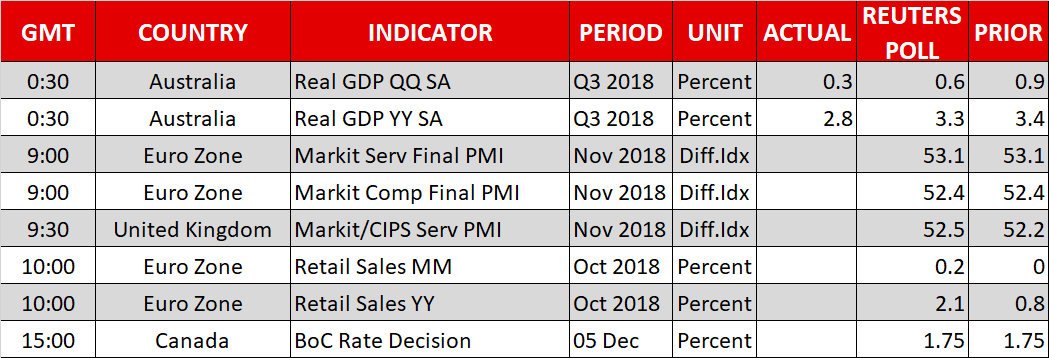
- Australia's Q3 GDP disappointed with 0.3% (QoQ), coming from 0.9% in Q2 and less than the market expectation of 0.6%. GDP drops to 2.8% (YoY) coming from a downwardly revised 3.1% in Q2. The Aussie dollar lost ground on the news.
- China's services sector rebounded in November with the Caixin Services PMI printing 53.8 against 50.8 in October. The Composite PMI also rose to 51.9, up from 50.5. Japanese PMI's are stable after it rebounded in October.
- The Belgian government failed to agree on the UN Migration pact, but PM Michel will go to Marrakesh anyway. He now seeks support in Parliament instead. Majority party NV-A is said to pull the plug out of the government.
- Today's economic calendar contains EMU (final) and UK services PMI's & EMU retail sales. Several ECB members speak on banking supervision. US markets are closed in honour of former President George H.W. Bush
Currencies: Dollar Trading Mixed As US Yields Decline And Global Uncertainty
Dollar trading mixed as global uncertainty mounts
Worries on US/global growth dominated FX trading yesterday, even as there was little concrete news to ‘explain' growing investor uncertainty. Investors also weren't convinced that the truce in the US-China trade dispute will yield a positive outcome. The fattening US yield curve was seen as a harbinger of more difficult economic times ahead. Initially, USD weakness prevailed. Later an acceleration of US equity selling triggered a classic FX risk-off trade, with USD/JPY, EUR/USD and EUR/JPY all trending south. There were no (US) eco data to ‘support' this risk-off trade. EUR/USD closed the session at 1.1343. USD/JPY finished the day at 112.77 (from 113.66). Overnight, sentiment in Asia remains risk-off, but losses are more modest compared to the 3%+ sell-off in the US. The China Caixin PMI's unexpectedly rebounded, but it is far from sure they will be able to remove uncertainty in a sustainable way. Chinese officials held a constructive tone on US-trade relations after last weekend's meeting. Australia Q3 growth unexpectedly eased to 0.3% Q/Q and 2.8% Y/Y (0.6% Q/Q expected). The release, in combination with the risk-off trade, broke recent AUD constructive momentum, pushing AUD/USD below the 0.73 handle. EUR/USD is holding a cautious negative bias (1.1320 area). USD/JPY regains a few ticks (113.05 area). US markets are closed today to honor President Bush. In EMU, the final PMI's will be published. Global sentiment will remain the main driver. At least today, the flattening US yield curve won't stoke further unrest. Still, the context of at the same time global uncertainty and declining US yields (and a flattening yield curve) is ambiguous for EUR/USD. The jury is still out, but it is not evident to see a sustained EUR/USD rebound in case of a profound global risk-off context. In a daily perspective we change our ST bias to neutral. We still assume the 1.12/1.15 trading range to hold. The day-to-day momentum looks slightly more USD constructive.
Sterling gained temporary ground yesterday on headlines that the UK could unilaterally revoke the exit of the EU. Later in the session, the government lost votes in Parliament forcing the government to publish a legal advice on Brexit. Parliament will also get more initiative in case of May's deal being rejected next week. Chance of the Brexit dealing being approved are low, but at the same time, the Parliament's actions might mitigate chance of a hard brexit. However, for now, political visibility remains too low to expect a positive/orderly outcome. We remain cautious on sterling long exposure
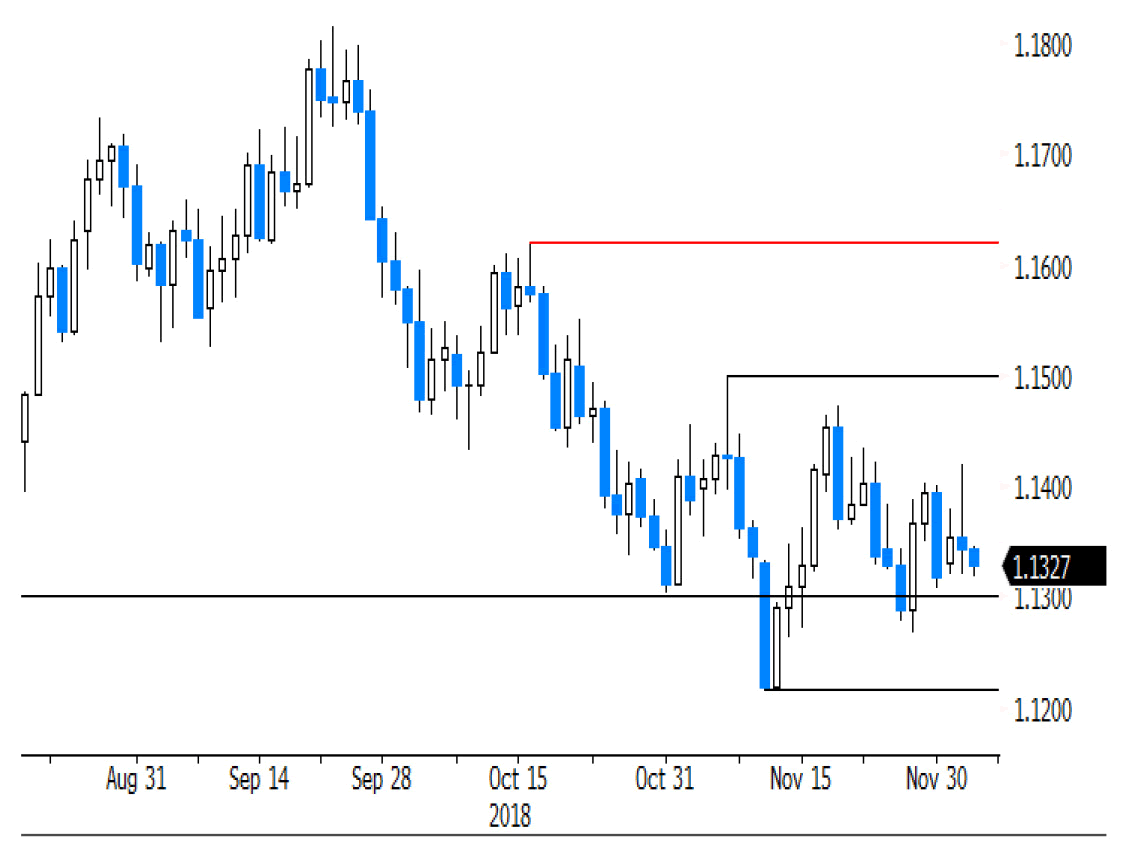
EUR/USD: combination of global uncertainty and lower US yields ambiguous sign for EUR/USD cross rate
XAUUSD Intraday Analysis
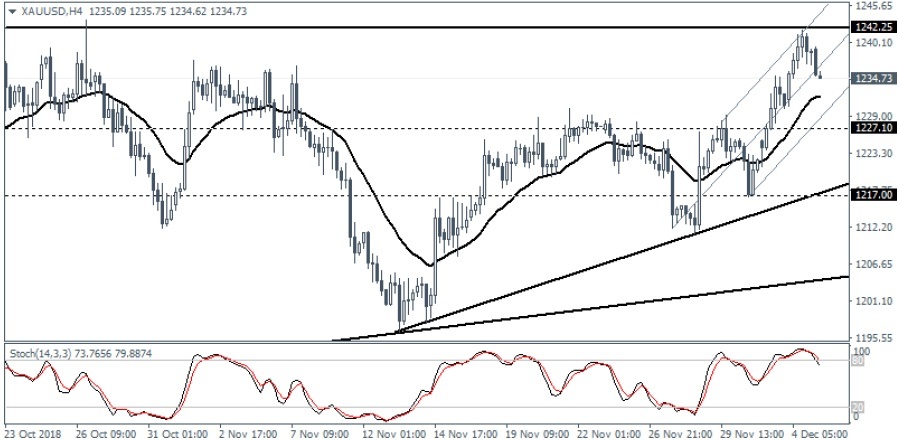
XAUUSD (1234.73): Gold prices posted strong gains as price action briefly touched the 1242.25 level of resistance. However, as price briefly retested this resistance level, we expect to see a firm close near 1242.25. To the downside, we expect the support at 1227.10 to be tested. As a result, it is ideal to look for short positions around the 1242.25 level as gold prices could start a correction lower. Below 1227.10, further declines could push gold prices down to the previous support at 1217.99
GBPUSD Intraday Analysis
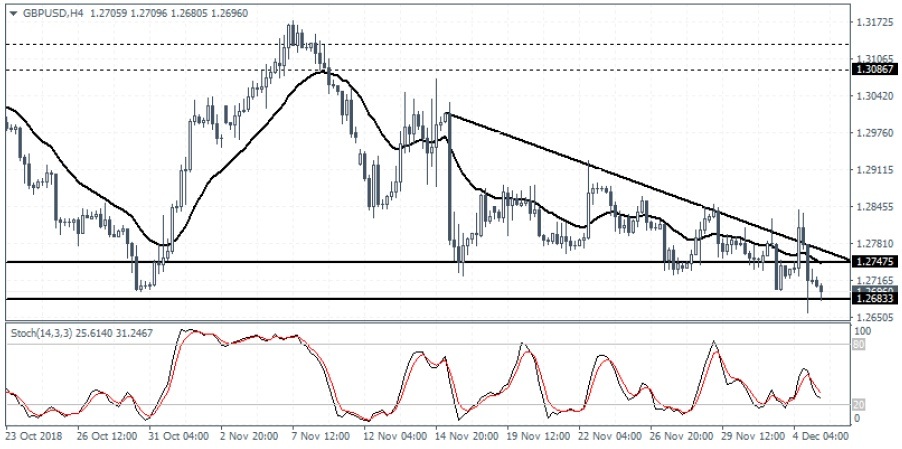
GBPUSD (1.2696): The GBPUSD currency pair turned volatile on Tuesday. The pound sterling briefly attempted to break past the falling trend line but turned lower promptly. This sent the GBPUSD down to the lower support level at 1.2683 level. As this lower support is being tested, there is a risk that the GBPUSD could extend the declines even lower. However, with volatility rising, we could expect to see a strong breakout in either direction. For the moment, this bias is to the downside.
EURUSD Intraday Analysis
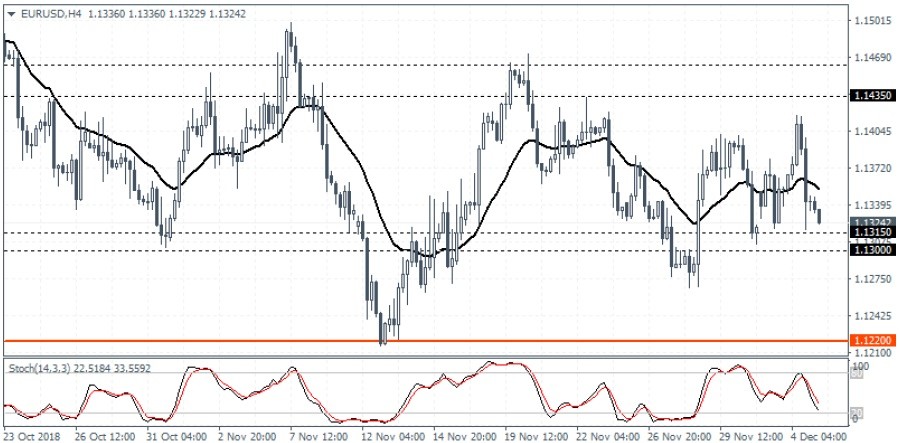
EURUSD (1.1324): The EURUSD continues to consolidate with price action seen extending the declines. The common currency could be seen retesting the support area of 1.1315 - 1.1300 level. We expect a rebound off this level as the ranging price action is maintained. Failure to hold the declines at the support level could, however, push the EURUSD lower. This would open the way for price action to fall back to test the previously established lows at 1.1220.
Australia GDP Slows To 0.3% In Q3 2018
The U.S. Dollar was seen trading a bit volatile on Tuesday. Economic data on the day showed that consumer prices in Switzerland fell 0.3% on the month. This was worse than forecasts of a 0.1% decline. The data comes ahead of next week's quarterly SNB meeting.
In the UK, the pound sterling jumped on initial reports from an EU court official who said that the UK did not require EU's permission to cancel Brexit. However, the gains were quickly erased. Construction PMI data showed a modest increase to 53.4 in November, which came out better than the forecasts of a 52.5 increase.
Producer prices in the Eurozone soared 0.8% on the month in November beating forecasts of a 0.4% increase. Previous month's PPI was also revised higher to show a 0.6% increase.
The NY trading session was relatively quiet. The USD eased amid new concerns that the growth was faltering. President Trump once again ramped up pressure on the U.S. China trade talks reminding about the 90-day truce period. Both nations are set to start negotiations in a few weeks.
Earlier today, Australia's quarterly GDP report showed that the economy expanded 0.3% in the three months ending September. This was lower than the forecast of a 0.6% increase as growth slowed from the second quarter's robust growth of 0.9%.
Looking ahead, the ECB President Mario Draghi is due to speak at an event. His speech comes ahead of next week's ECB monetary policy meeting. The Eurozone's services PMI numbers will be coming out later in the day. Final services PMI for the Eurozone is expected to remain unchanged.
In the UK, services activity is expected to rise modestly to 52.5 from 52.3 in October. Retail sales in the Eurozone is expected to tick higher to 0.2% increase on the month.
The NY trading session will see the Fed Chair giving his annual two-day testimony to Congress. Powell's speech will come under scrutiny after his recent comments about Fed funds rate nearing the neutral level.
Later, the Bank of Canada is expected to hold its monetary policy meeting. No changes are expected to the BoC's interest rate decision.
The U.S. ISM non-manufacturing PMI report is forecast to ease to 59.2 from 60.3 previously.
AUDUSD Stops At 4-Month Highs, Positive Risks Not Faded Yet
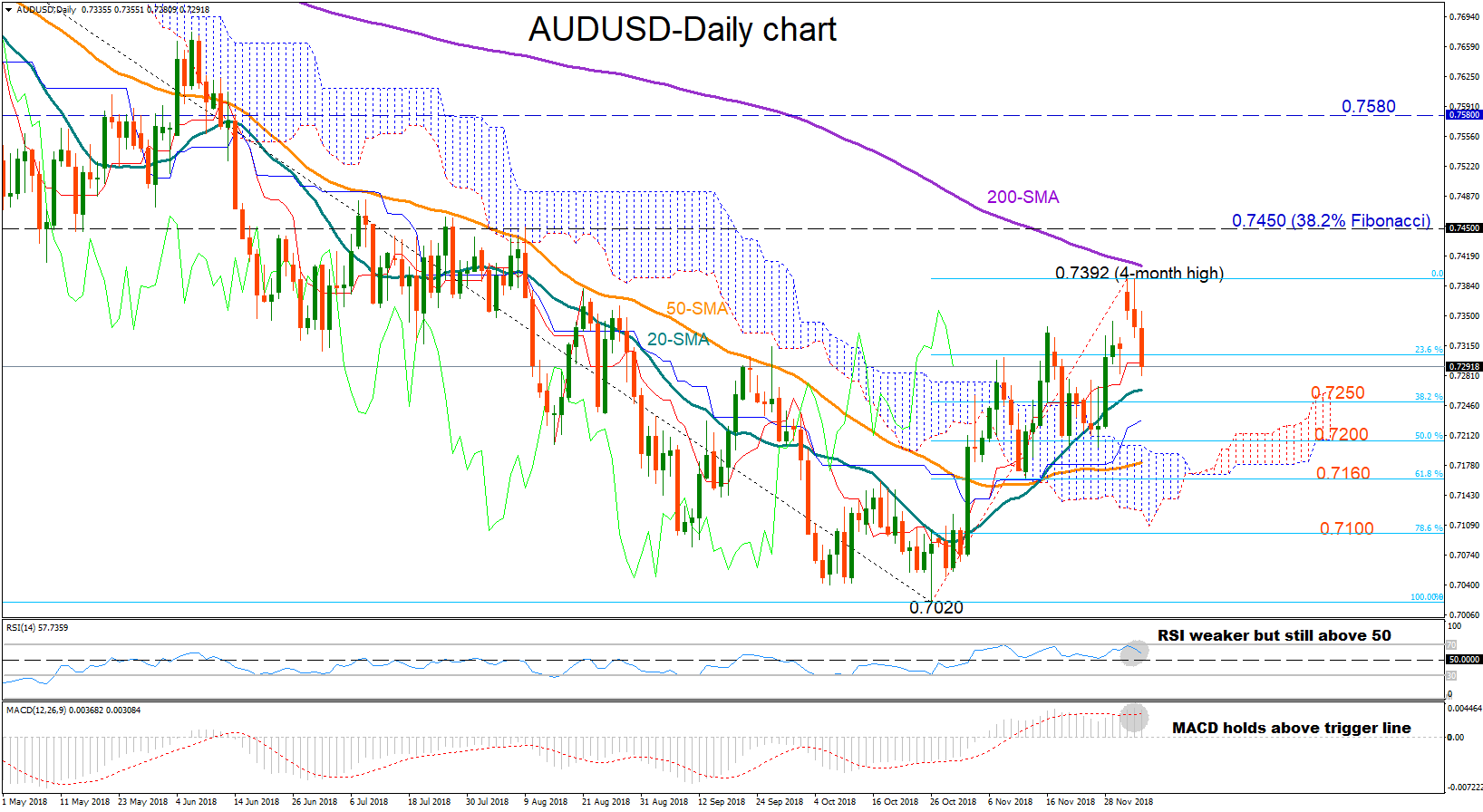
AUDUSD reached overbought levels according to the RSI and reversed lower just before touching the 200-day simple moving average (SMA) on the daily chart, creating a new peak at 0.7392, a four-month high.
While the aforementioned technical indicator continues to slow down, mirroring the market’s bearish behavior over the past three days, the indicator is still moving in bullish territory, flagging that a recovery could reemerge in the short term. The MACD is also holding above its red signal line, which supports the bullish view as well, while the 20-day SMA keeps increasing its distance above the 50-day SMA, suggesting that the recent uptrend is likely to stay in place for now.
In case the pair changes its short-term direction to the upside, the bulls will probably challenge the previous top at 0.7392. A break higher, could last until 0.7450, the 38.2% Fibonacci of the downleg from 0.8135 to 0.7020, which provided both support and resistance in the past. Further up the area around 0.7580 could be another potential obstacle for upward movements.
Alternatively, additional declines may drive the price towards the 38.2% Fibonacci retracement of the rebound from 0.7020 to 0.7392, near 0.7250, before the 50% Fibonacci of 0.7200 comes into view. Beneath the latter, the 61.8% Fibonacci of 0.7160, which rejected the market’s actions recently could be another level in focus ahead of the 0.7100 psychological mark.
Turning to the medium-term picture, the pair switched to neutral mode after the rally off 0.7020. The 50-day SMA looks to be slowly strengthening and given that the 200-day SMA continues to head south, the market’s outlook might improve further in the medium-term. Yet there is still some way to go for the lines to meet each other.
Summarizing, AUDUSD maintains a bullish bias in the short term picture, whereas in the medium-term it holds a neutral profile.
LTCUSD Bearish Bias Still Intact
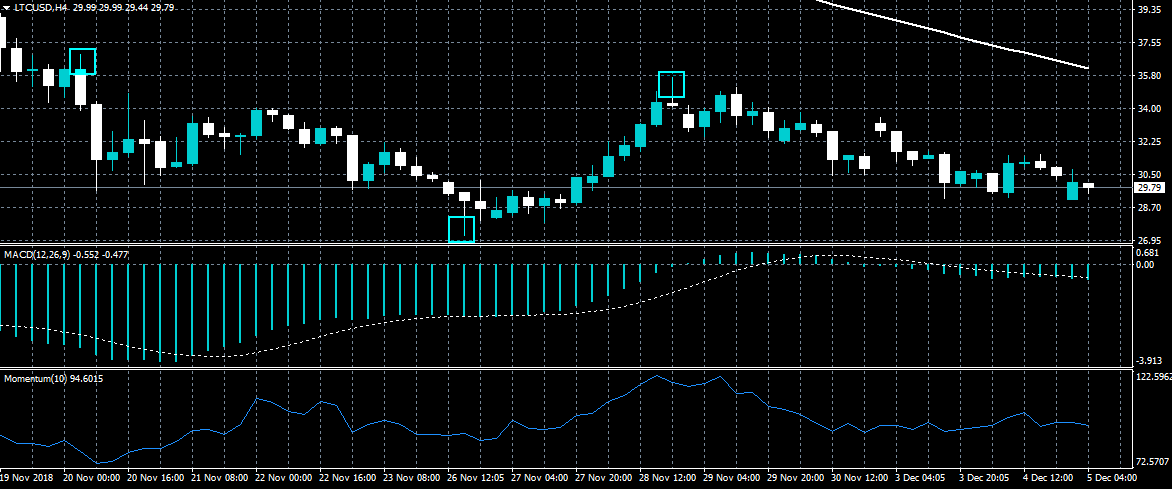
Litecoin remains under downside pressure below the $30.00 level, as the entire cryptocurrency continues to suffer from a lack of buying demand. A bullish inverse head and shoulders pattern is still visible across the lower time frames, although price continues to drift towards the key $27.00 support level. The momentum indicator on the four-hour time frame is also showing a bearish head and pattern may be emerging.
The LTCUSD pair is bearish while trading below the $30.00 level, key support is found at the and $27.20 and $25.00 support levels.
If the LTCUSD pair moves above the $30.00, buyers may test the $35.00 and $40.00 resistance levels.