Sample Category Title
May’s Government Under Trouble
Theresa May has suffered another major loss in getting more odds on her side. Her attempt to sell her Brexit deal to sceptical lawmakers was thrashed before it saw the daylight because opposition party won an emergency debate on whether Theresa May’s government is in contempt of parliament for not producing the legal advice about her legal advice.
These tensions are going to get worse and traders are keeping a close eye on the UK’s economy, equity market and of course the currency. Mark Carney, the governor of the Bank of England will be speaking later and it is highly likely the governor may reinforce the bank’s view of Brexit. The bank clearly sees some strong headwinds for the country and the economic data is supporting their case. It has been reported that the UK’s economy could shrink as much as over 9 percent in the next 15 years.
In the midst of this, there is no surprise to see that the UK’s equity market has suffered some serious loses year to date. The FTSE 100 is down nearly 8.7% so far this year and it can suffer even more losses coming on the 11th December when the Parliament will vote on the current deal which is highly expected to be rejected.
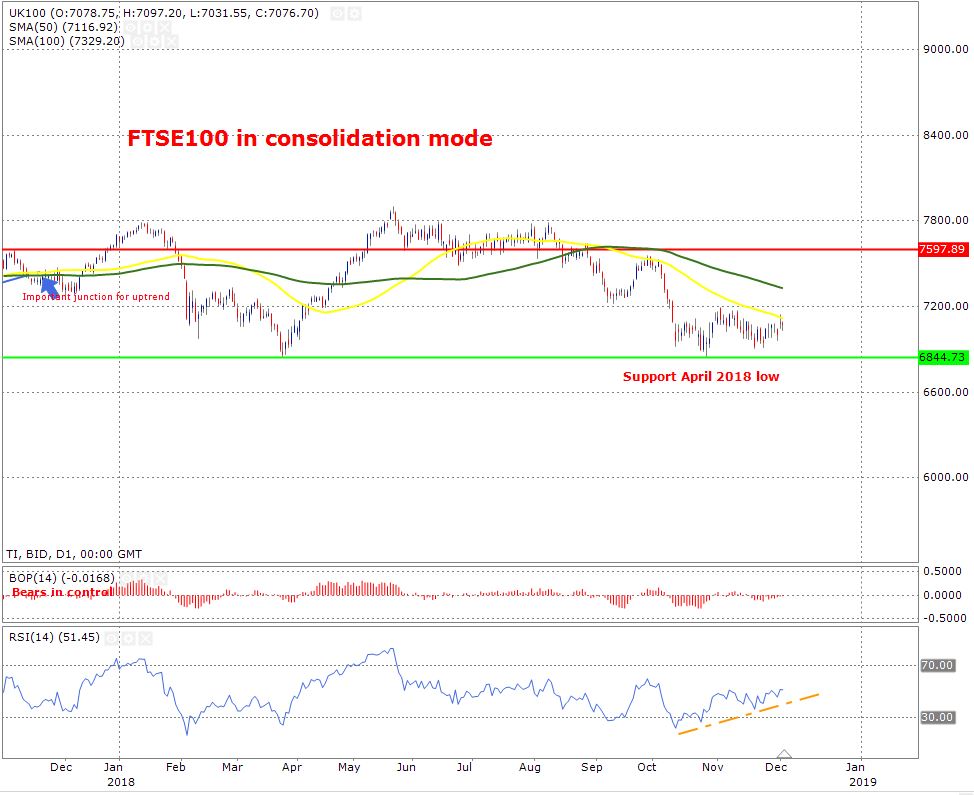
Looking at the daily chart of the FTSE100, one thing becomes clear, the market is consolidating and the overall trend is skewed to the downside. The FTSE price has challenged the 50-day moving average but it has failed to break this to the upside. The RSI is showing some positive momentum but only as long as it stays above the upward trend line.
The USD Index Is In The Red
Financial market participants keep evaluating the results of the G20 summit. The warnings of the trade war are now unfounded due to Donald Trump's and Xi Jinping's agreement not to introduce additional fees during the next 90 days of the truce. The demand for risky assets is up. The USD index (#DX) started to descend.
An array of important economic reports was published in EU, UK, and the US. The Industrial PMI in Germany reached 51.8 instead of the expected 51.6. The Industrial PMI for the UK grew to 53.1 instead of 51.6. The Industrial PMI for the US, published by ISM, reached 59.3 instead of 57.6. The Reserve Bank of Australia today released a resolution regarding the key interest rate, which remained 1.50%.
The prices on oil keep recovering. The WTI futures are trading at 53.70 USD/barrel.
Market Indicators
- The US stock market is showing some aggressive purchases: #SPY (+1,32%), #DIA (+1,26%), #QQQ (+1,75%).
- The 10-year US government bonds yield lowered significantly and now is at 2.95-2.96%.
The Economic News Feed for 04.12.2018:
- Construction PMI (UK) – 11:30 (GMT+2:00).
- Also, keep an eye on the statements made by the Head of the Bank of England Mark Carney.
Death Cross Looms Over S&P500, GBPUSD Is Walking On Thin Ice
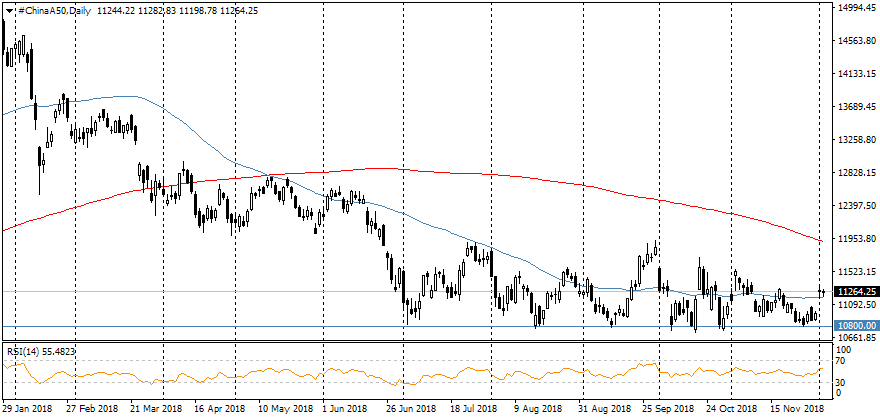
After the initial breakthrough on truce in the trade wars, the U.S. and Chinese indices had lost momentum, and today are performing a moderate decline. On Tuesday morning, Futures on S&P500 are around the 2775, cutting 1.8% gains from Friday down to 0.4%. Shanghai’s China A50 is 1% below peak levels at the start of the Monday’s session.
The Initial optimism is slowly dissipating, and markets are await for the further signals. Today no important data publications are expected, so, players’ attention will switch to technical analysis.
It is interesting that the rebound in stocks on American exchanges was led by fast-growing IT-companies (FAANG), which underwent the most serious corrections in October and November. That may be a signal for a full return of risk appetite from the market participants. 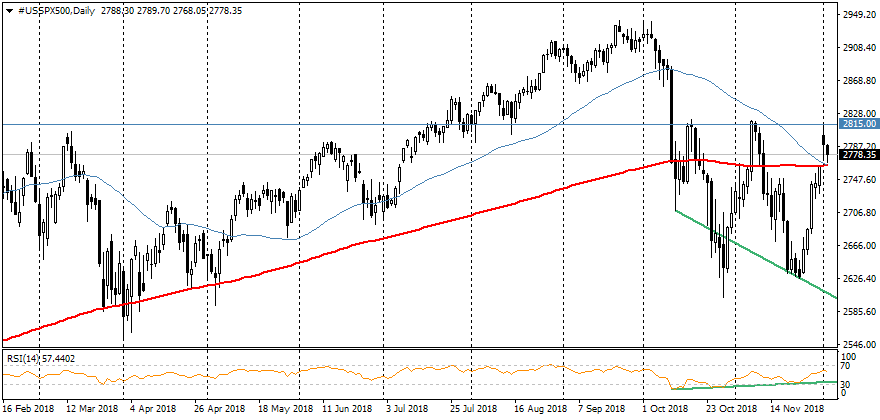
Despite the impressive increase in heavyweights, such as Apple (+3.5%) and Amazon (4.9%), S&P500 yesterday failed to develop its rebound above the previous local highs. The growth of the index above the 2815 level has fast reversed to decline, which could be a harbinger of a new index drawdown to the October-November lows. The Sell signal, according to the technical analysis, can additionally strengthen the S&P500 below 2660 by the end of the day. In this case, we will see the return under the key levels of 200- and 50-day averages, and the so-called “Death Cross”, when MA (50) crosses the MA (200) line from top to bottom. 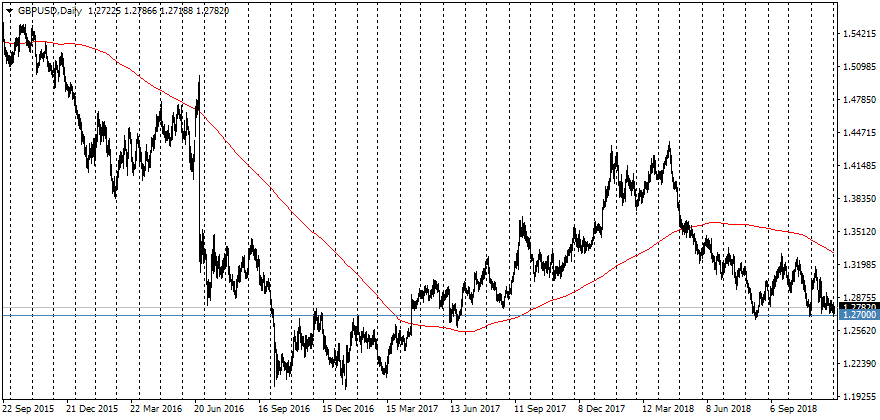
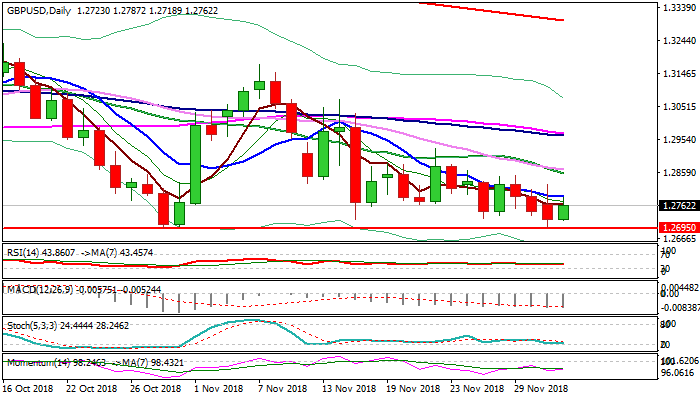
GBP/USD Outlook: Risk Of Eventual Break Through 1.2695 Pivot In Play While 10SMA Caps Upticks
Cable attempts to recover ground and moved higher in early European trading on Tuesday, after strong upside rejection on Monday and subsequent weakness that was contained by key near-term support at 1.2695 (30 Oct low).
Extended consolidation could be expected while 1.2695 support (which guards another pivot at 1.2661, 2018 low) holds, but upside attempts are expected to be limited and ideally capped by falling 10SMA (1.2788).
Overall structure is bearish and favors eventual probe through 1.2695/61 pivots, with firm break lower to generate strong bearish signal for continuation of larger downtrend from 1.4376 (2018 high) and expose next supports at 1.2500 zone. Only break and close above 10SMA would sideline immediate downside risk and likely trigger stronger short squeeze.
Res: 1.2788, 1.2824, 1.2850, 1.2882
Sup: 1.2787, 1.2695, 1.2661, 1.2600
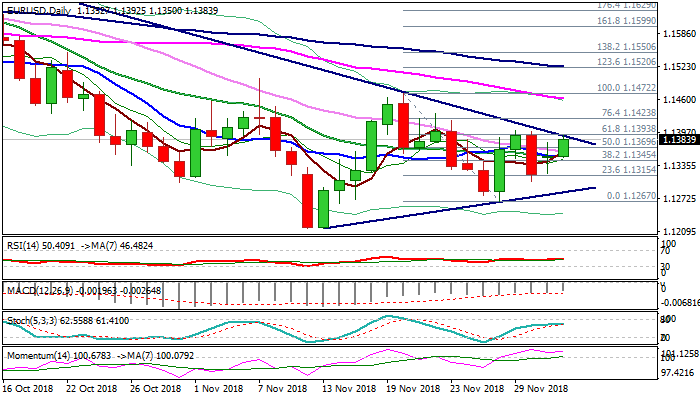
EUR/USD Outlook: The Euro Remains Bid But Still Unable To Break Pivotal Barriers At 1.1400 Zone
The Euro remains bid in early Tuesday's trading and pressures again pivotal 1.1400 resistance zone (Fibo 61.8% of 1.1472/1.1267/trendline resistance/highs of 29/30 Nov), after Monday's action ended in long-legged Doji and signaled indecision.
The dollar stands at the back foot on risk appetite, sparked by trade conflict ceasefire agreement. Fresh advance is positive signal, but the pair is still holding within near-term range and heavy under 1.1400 pivot.
Repeated failure to break higher would keep near-term directionless mode, but would also signal that the downside is still vulnerable. Sideways-moving momentum and slow stochastic support the notion, but bullishly aligned 10,20,30SMA's maintain bid tone.
Break above 1.1400 resistance zone would improve near-term structure and expose next key barriers at 1.1461 (55SMA) and 1.1472 (20 Nov high).
Conversely, initial bearish signal could be expected on rejection at 1.1400 barriers and return below converged 10/20SMA's (1.1353) which would unmask Friday's low at 1.1305 and trendline support at 1.1289, break of which will be bearish.
Res: 1.1393, 1.1400, 1.1433, 1.1444
Sup: 1.1369, 1.1350, 1.1305, 1.1289
Markets Retrace As Trade Optimism Wanes
- Trade optimism fades as markets digest the agreement
- Dollar extends recent pullback
- Oil continues to recover amid speculation for an OPEC cut
- RBA slightly more upbeat, but no policy change in sight
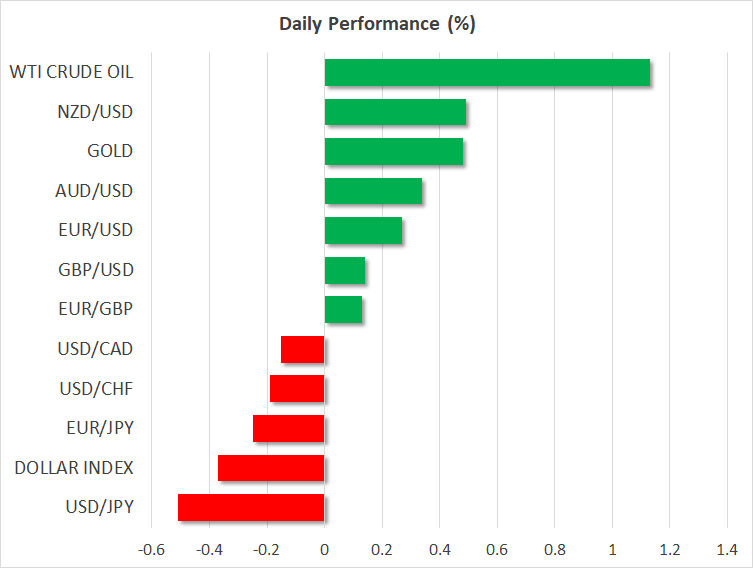
Stocks edge higher on trade relief, but optimism wanes
The boost to global risk appetite following the US-China trade “ceasefire” seems to have been short-lived. Even though US stock markets closed higher, they did surrender a decent part of their gains late in the session, and futures tracking the likes of the S&P 500 are pointing to a notably lower open today. Moreover, Asian equities closed mostly in the red, while the defensive yen is outperforming on Tuesday, all signals that investors took the trade news with a pinch of salt. Perhaps market participants are coming to terms with how vague the accord really was, particularly considering the discrepancies between the US and Chinese statements; all that was agreed was to continue talking, which may not mean that much in the big picture.
Dollar extends pullback, looks to Fed speakers
The greenback remains on the back foot, trading lower against all its major peers today, even despite a robust ISM manufacturing PMI yesterday. The initial catalyst for the dollar’s weakness was the trade truce, which led investors to unwind some of their defensive bets. Interestingly though, the US currency didn’t manage to recover as the trade-related optimism started to fade, mainly because US bond yields also declined amid this reversal in sentiment, diminishing some of the dollar’s carry appeal.
Looking ahead, expectations around monetary policy may become a dominant force for the dollar again. Markets continue to price in just a single quarter-point Fed rate hike next year, which appears overly dovish considering the health of the US economy, even accounting for signs it may be slowing. Anything that alters this pessimistic narrative heading into the December 19 FOMC meeting could help the dollar to regain its footing.
New York Fed President John Williams speaks today, at 1500 GMT.
Oil rebound continues as hopes for an OPEC cut grow
Crude prices are extending their latest rebound, which was fueled by growing speculation OPEC and its allies are set to announce a fresh round of production cuts on Thursday. With investors looking increasingly certain the cartel will take action, the focus now turns to the magnitude of any cut. Market chatter suggests a reduction of the tune of 1-1.5 million barrels per day (bpd). Any signals pointing to a cut near the upper bound of this range may boost crude further, while anything below that range may bring them under renewed selling interest, given that expectations for a sizeable reduction are probably baked into prices already.
While it’s difficult to predict the exact magnitude of a cut, note that a very substantial one that causes prices to surge would most probably infuriate the US administration. Hence, Saudi Arabia – the de-facto OPEC leader – may ultimately opt to avoid that route, and instead deliver a more “middle-of-the-road” reduction simply to stabilize prices.
RBA a touch more upbeat, but no policy change in sight
The Reserve Bank of Australia (RBA) kept its policy rate unchanged overnight. While there were no major changes to the accompanying statement, the overall tone was slightly optimistic. Policymakers highlighted continued progress in the labor market and wage growth, but also noted household consumption remains a source of uncertainty. As usual though, there was nothing to suggest a policy change is imminent. The aussie ticked higher on the news but given the RBA’s overall neutral bias, its direction going forward may hinge mainly on the evolution of risk sentiment, trade tensions, and commodity prices.
Other highlights for today
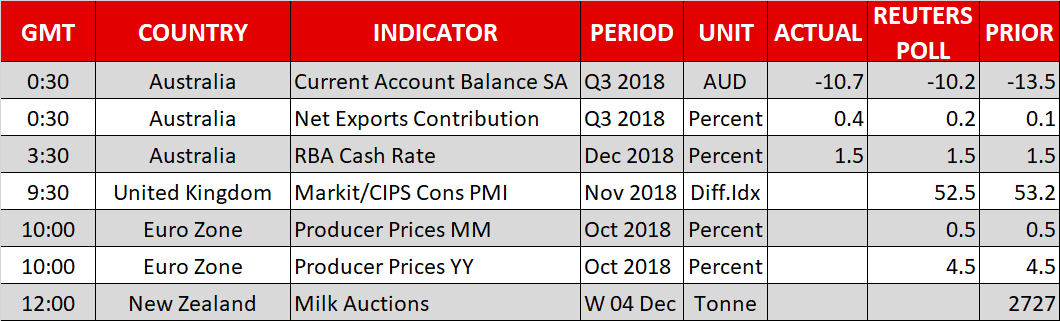
The key release today is the UK construction PMI for November, which is expected to have declined. That may weigh on the pound a little, though the overarching driver for the currency will probably remain the Brexit saga. In this respect, UK lawmakers will begin debating the Brexit deal today.
In New Zealand, the bi-weekly milk auction will be important for the kiwi, which touched a fresh 5-month high versus the dollar earlier today.
As for the speakers, BoE Governor Carney will testify before Parliament at 0915 GMT on the economic impact of Brexit.
GBPUSD Faces Strong Challenge At 1.2693
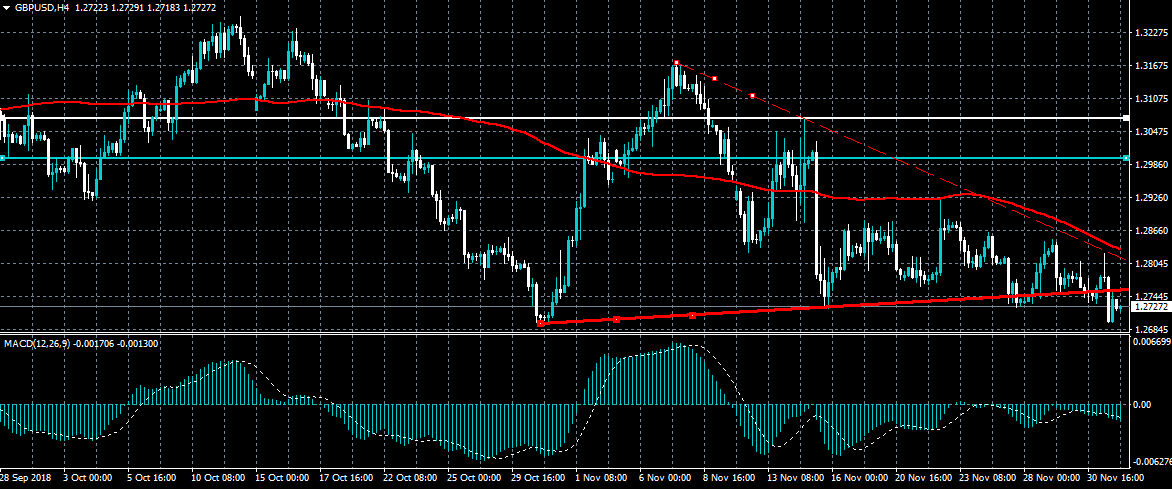
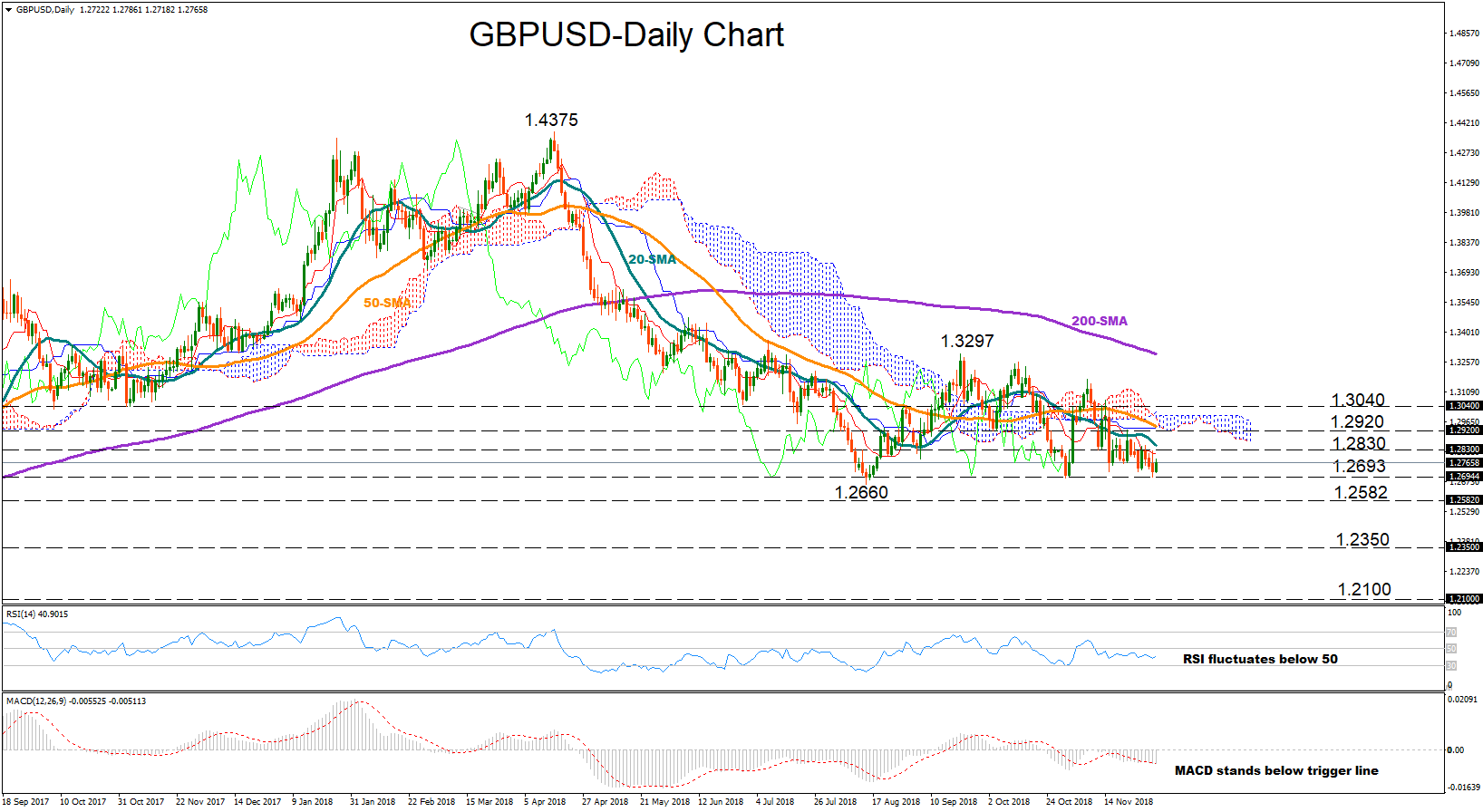
GBPUSD has been under pressure since early November, with bears pushing hard to breach the strong support around 1.2693. In the short term, the bias remains negative as the RSI hovers below its neutral threshold of 50 and the MACD continues to move beneath its red signal line.
Should the price break the floor around 1.2693, and more importantly close under the 1.2660 bottom, the lowest mark registered since June 18, bearish market action may pick up speed towards the older range of 1.2582-1.2345. If that proves a weak obstacle, then the focus will immediately shift down to 1.2100.
Alternatively, a bounce up may stop around 1.2830 where the price paused several times over the past four months, while higher than that, a stronger resistance may appear at 1.2920, near the bottom of the Ichimoku cloud and the 50-day simple moving average (SMA). A steeper rally could also reach an important obstacle at 1.3040.
Turning to the medium-term picture, the neutral profile is still in place as long as the pair trades within the 1.2660-1.3300 range. But with the 50-day MA reversing south far below the 200-day MA, chances for a more bearish outlook are running high.
To summarize, GBPUSD holds a negative bias in the short term, while in the medium term the market is still neutral.
ECJ advocate general said UK can withdraw Brexit unilaterally
European Court of Justice's advocate general said today that UK has the right to withdraw Brexit notice unilaterally, up to the point of formal conclusion of the deal. ECJ usually follow the advocate general's opinions in its final rulings even though they're not binding.
To be more exact, ECJ said "Advocate General (Manuel) Campos Sanchez-Bordona proposes that the Court of Justice should declare that Article 50 ... allows the unilateral revocation of the notification of the intention to withdraw from the EU". And, "That possibility continues to exist until such time as the withdrawal agreement is formally concluded."
EURUSD Watching Monthly Pivot Point
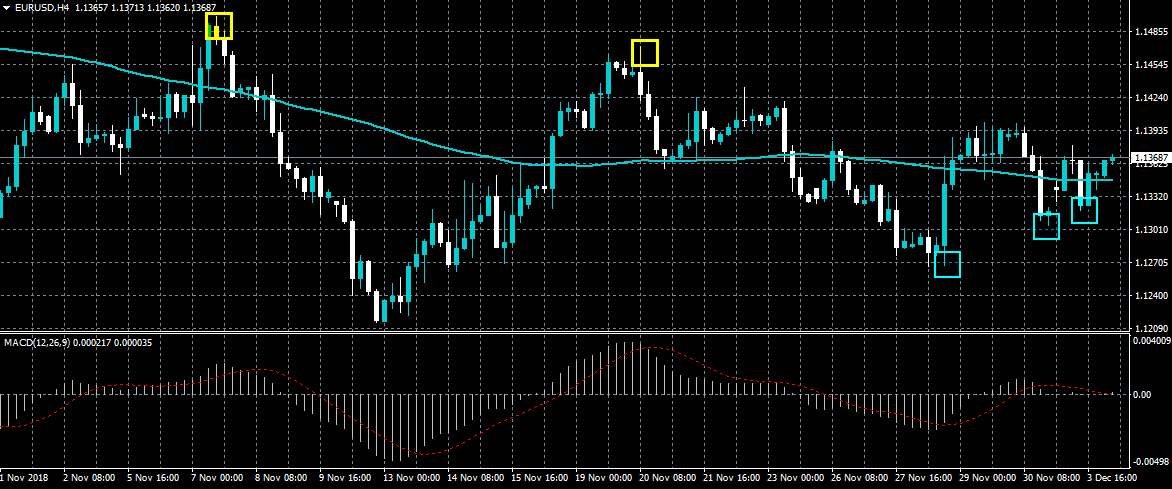
The euro has made another recovery higher against the US dollar, after finding strong dip-buying interest from the 1.1323 support level. The EURUSD continues to create higher price lows and is now trading back above the pairs monthly pivot point, at 1.1345. The short-term outlook for the EURUSD remains neutral until a clear breakout from the 1.1300 to 1.1400 price range has occurred.
The EURUSD pair is only bullish while trading above the 1.1400 level, key technical resistance remains at the 1.1470 and 1.1500 levels.
If the EURUSD pair trades below the 1.1300 level, sellers are increasingly likely to test the 1.1270 and 1.1216 levels.
GBPUSD Intraday Bearish Below The 1.2758 Level
The British pound has moved sharply lower against the US dollar, with price briefly dipping below the important 1.2700 support level. The GBPUSD has also clearly broken under the well-defined wedge pattern, placing heavy technical selling pressure on the pair. It is also worth noting that the price is trading closer to the neckline of a bearish head and shoulders pattern, with a large downside projection.
The GBPUSD pair is strongly bearish while trading below the 1.2758 level, key technical support is found at the 1.2662 and 1.2550 levels.
If the GBPUSD pair trades above the 1.2758 level, key resistance is found at the 1.2800 and 1.2830 levels.