Sample Category Title
WTI OIL Outlook: Recovery Extension Hits Two-Week High On Improved Sentiment, OPEC Meeting In Focus
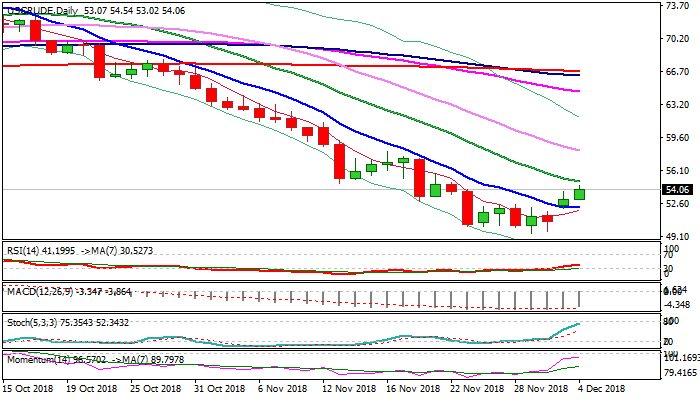
WTI oil rose further on Tuesday and hit new high of nearly two weeks, in extension of recovery which started from Monday's gap-higher weekly opening.
The oil was up 2.5% for the day so far and fresh bullish acceleration pressures pivotal barrier at $54.80 (Fibo 61.8% of $58.14/$49.40 bear-leg, reinforced by falling 20SMA).
Sustained break here would signal further recovery, which could stretch towards the base of rising thick weekly cloud ($57.47) and expose falling 30SMA ($58.27) on break.
Monday's close above 10SMA (which turned sideways) was bullish signal and 10SMA now offers solid support at $52.20.
Improved sentiment on temporarily sidelined concerns about trade war escalation, as well as hopes that world's leading oil producers will cut output, support oil prices.
OPEC is meeting in two days and is expected to announce production cut of over one million barrels per day, in order to stabilize global oil market, shaken by rising US shale oil production and fears of global oversupply which could lead to significantly lower demand.
Res: 54.80, 55.83, 56.08, 57.43
Sup: 53.02, 52.20, 52.11, 51.77
Inverted Yield Curve Curbing Risk Appetite?
Markets back in the red
Well that didn't last long. Day two of the post US/China truce and markets are back in the red and the US yield curve has inverted slightly, potentially taking some of the shine off the weekend's events.
The weekend dinner date between Trump and Xi over the weekend initially drew a positive response, with markets rallying at the prospect of the trade war being paused for a few months and possibly even stopped altogether is talks progress well. This has since drawn plenty of scepticism about just how significant an agreement it was and what can possibly be achieved in the next few months that will prevent further tariffs being imposed.
This may be a little harsh as a deal isn't necessary in the 90 day window, the two sides just need to agree on the parameters of a future deal and what will be included in order to extend the truce and work towards removing tariffs. Whether this will happen is certainly up for debate but I do believe that this is a positive step forward from where we were prior to the meeting and that's the important thing.
Inverted yield curve curbing risk appetite?
I wonder whether today's declines has more to do with the yield curve and investors reading of it. The inversion of the curve which suggests markets are pricing in rate cuts in the coming years may have spooked investors who have previously been very bullish on the US economy. A slowdown next year from the strong growth rates in 2018 is widely expected as the stimulus from tax cuts fades and lower external growth weighs but this possibly suggests the outlook is more gloomy than that.
An inverted yield curve is often associated with the anticipation of a recession which may be why investors are nervous about it but I'm not convinced this is what's going on. The Fed has been tightening policy at a decent rate and if the economy starts to slow then it makes sense that it may cut rates a little to provide some support. This would imply lower levels of growth which naturally is a drag on stocks and may therefore explain some of the selling today.
Oil rallies ahead of OPEC+ but doubts over cut increase
Oil is rallying again today as we get closer to the OPEC+ meeting, at which a possible production cut will be discussed. There has been some confusion about who is supporting the cut and how much will be agreed, with reports even this morning that the decision could be delayed if Russia doesn't agree to cut substantially. Coming in a week in which Qatar has announced it end its 57 year association with OPEC, it does suggest that the cohesion that made the last cut so successful is weakening.
The report suggested that the group is working towards a 1.3 million barrel a day cut in an attempt to offset the oversupply in the market currently, with the US pumping record amounts and offering waivers on Iranian purchases that leaves more oil in the market than expected. A failure to get this agreement over the line could really hit oil prices and threaten the temporary floor they've found around $58 and $50 in Brent and WTI, respectively.
GBP rallies on reports that UK can unilaterally reverse article 50
Sterling is rallying off its lows this morning after an ECJ Advocate General claimed the UK has the right to withdraw its article 50 submission unilaterally. While this isn't legally binding, it is widely believed that this would be the view of the court and lays the groundwork for the UK to do so in the event that another referendum is called, or another path is embarked on that led to such an event like an election.
The reality though is that it doesn't actually really change anything as, had the UK otherwise requested to withdraw its article 50 submission, there is a very good chance that this would have been accepted as the EU never wanted the UK to leave in the first place. I think the rally we've seen on the back of this probably just represents some short covering after a period of weakness and as the currency tests 2018 lows against the dollar.
GBP Currency Gets A Lift From A Non-Binding ECJ Opinion On Article 50
Notes/Observations
- European Court of justice (ECJ) advisers in a non-binding decision stated that the UK could pull Article 50 unilaterally (Insight: Ruling theoretically meant Britain could cancel Brexit negotiations and stay in EU without asking any of other Member States)
- UK Nov Construction PMI beats expectations for its 8th month of expansion (53.4 v 52.5e)
- South Africa moves out of recession as Q3 GDP handily beats expectations
Asia:
- RBA left the Cash Rate Target unchanged at 1.50% unchanged (as expected) for its : 24th straight pause in the current easing cycle: Reiterated stance that low rates were supporting the economy; progress on unemployment and inflation to be gradual; Saw GDP growth averaging ~3.5% over the coming years
Europe:
- Italy budget deficit of 2% said to be not low enough for EU Commission
- Italy PM Conte: NOT working on budget with a deficit below 2% (Note: earlier reports circulated that Italy PM Conte was preparing for 2019 budget deficit between 1.9-2.0%)
- Eurogroup to support EU commission view on Italy's budget; Eurozone Govts to recommend Italy to comply with fiscal rules
- EU Official stated that Germany abandoned its ambitious plans for EU digital tax; would present draft plan to impose a 3% tax on revenues generated by ad sales in the digital economy
- UK Parliamentary Speaker stated that there was arguable case that UK govt committed contempt of parliament over motion for Brexit legal advice
Americas:
- Fed Chair Powell made some unscheduled comments from Yellen award which affirmed call for patience on further rate hikes, economy could shift mid-2019; Productivity picked up but not clear if trend was sustained
- Fed's Kaplan (dove, non-voter): currently focused on not being pre-determined about future rate path. Highly possible US economy looked very differently by mid-2019; wanted to be patient and see how things unfolded
- White House econ adviser Kudlow: cautiously optimistic about reaching US-China deal; Clarifies 90-day timetable for completing US-China trade talks begins Jan 1st (implies deadline for trade deal will be Apr 1st). Did not have a specific agreement on China auto tariffs but expect auto tariffs to drop to zero upon agreement
Energy:
- OPEC key members reportedly determined to agree on new output deal despite Qatar's withdrawal from the group
Macro
- (UK) United Kingdom: A non-binding opinion from the Advocate General of the EU Court of Justice concluded that the U.K. should be allowed to reverse its Article 50 notice. U.K. government officials had asked the court to delay a ruling so as not to interfere with the internal decision making, while EU officials actually would prefer the court to rule against the ability of countries to unilaterally reverse Article 50 notices once they have triggered, arguing that this could open the exit procedure to the risk of abuse by government's trying to exert political pressure. The court ruling is still outstanding, but while there is no legal obligation to follow the assessment of the legal opinion, it usually does. It opens up a whole can of worms. If a member state can invoke article 50 then simply withdraw it unilaterally then Italy (and every other disgruntled member) what is stopping them using it as a threat to extract better terms?
- (IT) Italy: Eurogroup Finance Ministers yesterday issued a statement on public finances that identify the "urgent need to rebuild fiscal buffers, notably in Member States that have not reached their Medium-Term Budget Objectives. It also backs that Commission's assessment that Italy's budget draft constitutes a "particularly serious non-compliance" with the fiscal rules and recommends "Italy to take the necessary measures to be compliant with the SGP (Stability and Growth Pact". Italian press reports this morning suggest that both sides aim to come to an agreement by December 19, with Italian officials reportedly open to cut the deficit target to 2%, which is still likely to be an overshoot of the government's projections that are obviously based on vastly optimistic growth assumptions.
SPEAKERS/FIXED INCOME/FX/COMMODITIES/ERRATUM
Equities
- Indices [Stoxx600 -0.41% at 359.70, FTSE -0.44% at 7,031.79, DAX -0.71% at 11,384.51, CAC-40 -0.66% at 5,020.71, IBEX-35 -0.74% at 9,109.00, FTSE MIB -0.41% at 19,541.50, SMI -0.22% at 9,084.50, S&P 500 Futures -0.48%]
- Market Focal Points/Key Themes: European Indices trade lower across the board fading some of the sharp trade related gains seen yesterday, following declines in Asia and lower US Index futures. Macro developments in Italy and the UK continue to take dominate headlines. On the corporate front European Automakers are fading some of the gains seen yesterday aided by underwhelming US car sales data for November. On the earnings front, Ferguson trades lower on profit taking after Q1 results with IG Group, Zumtobel, Elior, Bpost, Consort Medical and SAS among other names falling after earnings and trading updates. Neopost and Quartix were among the risers after earnings. In other news Cicor Group trades higher after project awards while Kier Group continues its fall out falling a further 10% following its surprise rights issue announced on Friday. In the US, Toll Brothers reported strong Q4 results. Looking ahead notable earners include HD Supply, Dollar General, Autozone and Movado among others.
Equities
- Consumer discretionary: Ryanair [RYA.UK] +1% (agreement with union; load factor), Wizz Air Holdings [WIZZ.UK] -4% (load factor), Ferguson [FERG.UK] -3% (earnings), Elior [ELIOR.FR] -6% (earnings; affirms outlook)
- Consumer staples: Ite Group [ITE.UK] +0.5% (earnings)
- Financials: IG Group [IGG.UK] -2% (trading update)
- Healthcare: Consort Medical [CSRT.UK] -22% (earnings), Celyad [CYAD.BE] -8% (trial update)
- Industrials: Daimler [DAI.DE] -2%, BMW [BMW.DE] -2%, Volkswagen [VOW3.DE] -2.5%, Porsche [PAH3.DE] -2% (Nov car registrations statistics; U.S. cars retail sales), SAS AB [SAS.SE] -6% (earnings), Neopost [NEO.FR] +8% (earnings), bpost [BPOST.BE] -20% (earnings; cautious outlook)
- Technology: Cicor Group [CICN.CH] +10% (projects awarded), Quartix Holdings [QTX.UK] +6.5% (trading update)
Speakers
- Eurogroup Finance ministers commented following meeting
- Eurogroup chief Centeno: had delivered a comprehensive plan to strengthen the Euro. Ministers agreed to keep working on a deposit insurance scheme and report progress in Jun 2019. Euro Area to introduce single LIMB CACS by 2022. Italy should take measures to comply with EU rules. Greece needed to make more progress in areas EU's Moscovici: EU was awaiting more details to evaluate concrete and credible steps by Italy on its 2019 budget. Italy proposals were going in the right direction. Eurogroup supported Greece's decision not to cut pensions in coming years
- France Fin Min: More work was needed to make a Euro Zone budget a reality but budget text was a substantial step
- BOE Gov Carney Treasury select Committee testimony noted that the Brexit scenarios laidout were not what was likely to happen. His takeaway from Brexit analysis was that the banking sector was prepared. Would be uncomfortable not having some flexibility to ensure UK Financial sector is appropriately regulated after Brexit
- BOE Dep Gov Broadbent Treasury select Committee testimony stated that food prices would move higher in a no-deal Brexit scenario due to weaker GBP currency and other factors
- European Court of justice (ECJ) advisers: UK could pull Article 50 unilaterally (non-binding decision). Final ruling would come at a later date (Non-binding opinion which required full ruling from judges)
- Germany Fin Min Scholz: Have made significant progress in negotiations on Euro Zone reforms
- Italy PM Conte stated that deficit reduction was possible of money recovered
- Italy junior Econ Min stated that PM Conte would find convergence with EU over 2019 budget but noted limited margins for negotiations
- Sweden Central Bank (Riksbank) Jansson: Repo Rate could probably be cut slightly lower than -0.50% in an economic downturn. Policy rates now not as effective tool as they once were. Might become necessary to modify monetary policy framework with 2% inflation target that most central banks currently apply. Too early to say whether the 1st potential rate hike would occur in either Dec or Feb
- China reportedly issued a memo to step up punishment of IP violations
- OPEC could delay a decision on production cut if Russia did not agree to a substantial cut in its production (**Reminder: in recent talks Russia had indicated it wants to cut by a maximum of 150K bpd, while Saudi Arabia wanted a more even distribution of the production cuts)
Currencies/Fixed Income
- USD maintained some soft footing as Treasury yields continued to decline and easing trade tensions.
- EUR/USD edging back towards the 1.14 area as US Treasury yields tested 2.95% for a three-month low. Market participants continued to speculate that the Fed would slow the pace of its rate hike. The dollar was also impacted by the temporary truce in the US-China trade conflict as money flowed into riskier currencies versus the safe-haven greenback. The difference in yield between the US 2-year and 10-year tightened to its smallest since July 2007.The 3-5 year curve has already inverted
- GBP was firmer after a European Court of justice (ECJ) adviser stated in a non-binding opinion that the UK could pull its Article 50 unilaterally. Ruling theoretically mean Britain could cancel Brexit negotiations and stay in EU without asking any of other Member Statest
Economic Data
- (BR) Brazil Nov FIPE (Sao Paulo) CPI: 0.2% v 0.2%e
- (FR) France Oct YTD Budget Balance: -€87.0B v -€87.1B prior
- (CZ) Czech Q3 Average Real Monthly Wage Y/Y: 6.0% v 5.8%e
- (ES) Spain Nov Net Unemployment M/M: -1.8K v +52.2K prior
- (CH) Swiss Nov CPI M/M: -0.3% v -0.1%e; Y/Y: 0.9% v 1.0%e; CPI Core Y/Y: 0.2% v 0.4% prior
- (CH) Swiss Nov EU Harmonized CPI M/M: -0.4% v -0.1%e; Y/Y: 1.0% v 1.1%e
- (SE) Sweden Q3 Current Account (SEK): 38.6B v 4.0B prior
- (NO) Norway Nov Region Output Survey (Past 3-months): 1.39 v 1.35 prior; Output Survey (Next 6-Months): 1.49 v 1.46 prior
- (UK) Nov Construction PMI: 53.4 v 52.5e
- (ZA) South Africa Q3 GDP Annualized Q/Q: 2.2% v 1.9%e; Y/Y: 1.1% v 0.5%e
- (EU) Euro Zone Oct PPI M/M: 0.8% v 0.5%e; Y/Y: 4.9% v 4.5%e
- (GR) Greece Q3 Final GDP Q/Q: 1.0%% v 0.4%e; Y/Y: 2.4% v 1.8% prelim
Fixed Income Issuance
- Spain Debt Agency (Tesoro) sold total €4.09B vs. €3.5-4.5B indicated range in 6-month and 12-month Bills
- (ZA) South Africa sold total ZAR2.85B vs. ZAR2.85B in 2026, 2032 and 2048 bonds
- (CH) Switzerland sold CHF464.9M in 3-month Bills; Avg Yield:-1.018% v -0.987% prior
Looking Ahead
- 05.30 (UK) Weekly John Lewis LFL sales data
- 05:30 (EU) ECB allotment in 7-Day Main Refinancing Tender (MRO)
- 05:30 (HU) Hungary Debt Agency (AKK) to sell in 3-month Bills
- 05:30 (BE) Belgium Debt Agency (BDA) to sell Bills
- 05:30 (UK) DMO to sell £2.5B in 1.0% Apr 2024 Gilt
- 06:00 (BR) Brazil Oct Industrial Production M/M: +1.1%e v -1.8% prior; Y/Y: +2.1%e v -2.0% prior
- 06:30 (TR) Turkey Nov Effective Exchange Rate (REER): No est v 69.03 prior
- 06:30 (EU) ESM to sell €2.0B in 3-month bills
- 06:45 (US) Daily Libor Fixing
- 07:45 (US) Weekly Chain Store Sales
- 08:00 (RU) Russia announces weekly OFZ bond auction (held on Wed)
- 08:10 (UK) Baltic Dry Bulk Index
- 08:30 (CA) Canada Q3 Labor Productivity Q/Q: 0.2%e v 0.7% prior
- 08:45 (EU) EU Commission on member draft budgets
- 08:55 (US) Weekly Redbook Retail Sales data
- 09:00 (MX) Mexico Oct Leading Indicators M/M: No est v 0.11 prior
- 09:00 (MX) Mexico Nov Vehicle Domestic Sales: No est v 115.4K prior
- 09:00 (EU) Weekly ECB Forex Reserves
- 09:30 (NZ) Fonterra Global Dairy Trade Auction: Dairy Trade price index: No est v -3.5% prior
- 10:00 (MX) Mexico weekly International Reserves data
- 10:00 (US) Fed's Williams (moderate, voter)
- 10:30 (SE) Sweden Central Bank (Riksbank) Dep Gov Skingsley
- 11:00 (DK) Denmark Nov Foreign Reserves (ISK): No est v 467.6B prior
- 11:00 (NZ) New Zealand Nov QV House Prices Y/Y: No est v 5.4% prior
- 11:30 (US) Treasury to sell 8-Week Bills
- 11:30 (US) Treasury to sell 4-week and 52-week bills
- 13:00 (UK) BOE's Vlieghe - 14:00 (AR) Argentina Oct Industrial Production Y/Y: No est v -11.5% prior; Construction Activity Y/Y: No est v -4.2% prior
- 16:00 (CL) Chile Central Bank (BCCh) Interest Rate Decision: expected to leave Overnight Rate Target unchanged at 2.75%
- 16:30 (US) Weekly API Oil Inventory data
WTI Futures Gain Some Ground, SMAs Create Bullish Crossover
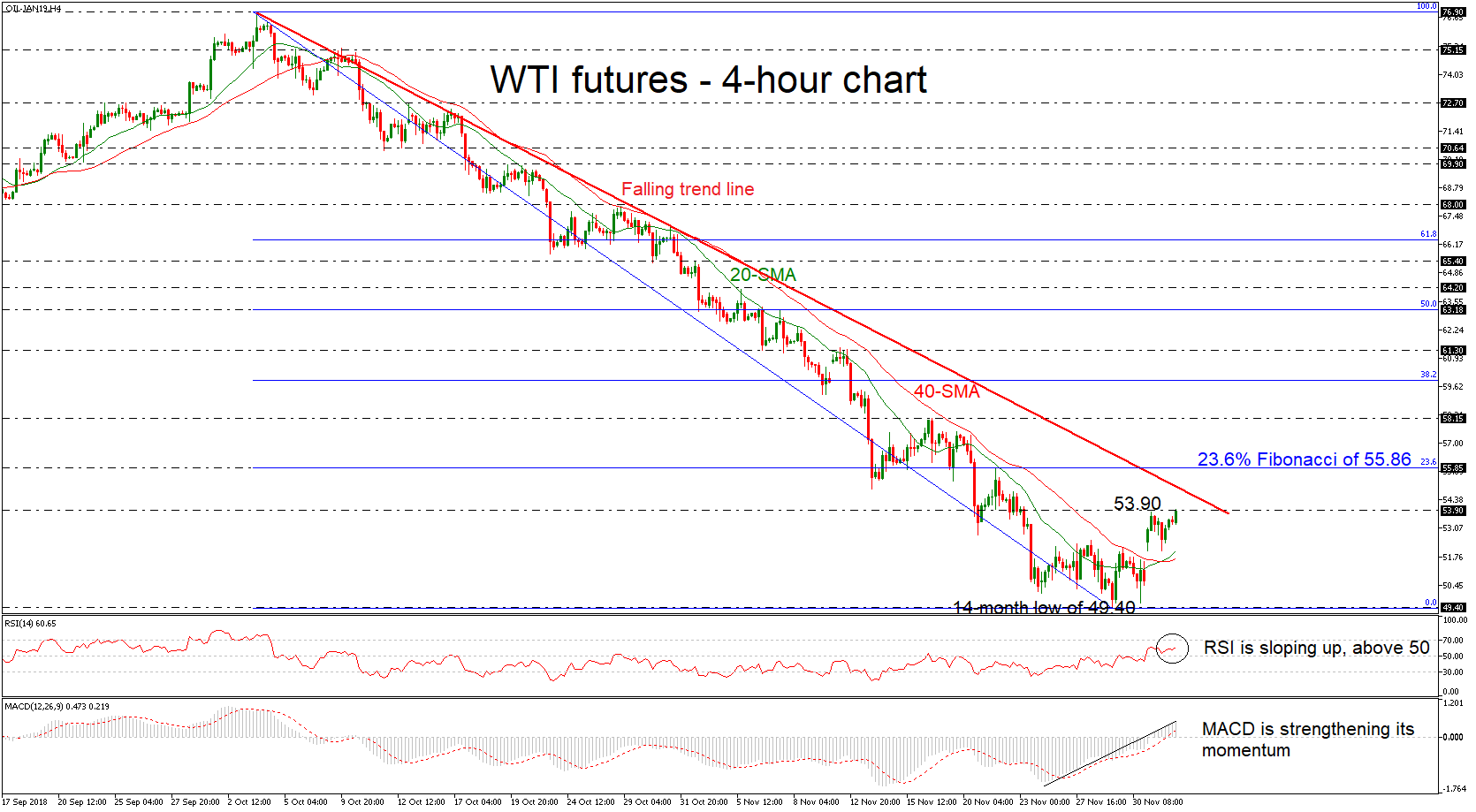
West Texas Intermediate (WTI) crude oil futures are in progress to recover some more ground after the bullish gap that posted yesterday. The price jumped above the positive crossover within the 20- and 40-simple moving averages in the 4-hour chart, approaching the short-term descending trend line. The RSI indicator is pointing up above the 50 level, while the MACD oscillator is strengthening its upside momentum, above the trigger line.
If the price continues to move slightly higher, immediate resistance could come from the falling trend line, around 54.80. A penetration of the diagonal line could shift the bearish bias to a more neutral one, challenging the 23.6% Fibonacci retracement level of the downleg from 76.90 to 49.40, around 55.86. More advances could send oil towards the 58.15 resistance, taken from the peak on November 16.
On the flipside, the price could re-touch the moving averages, which hover near the 52.00 level, while the 14-month low of 49.40, could be another significant stop for investors.
Overall, WTI crude has been developing in a strong bearish tendency after the bounce off the 76.90 resistance, failing to post a significant upside retracement above the downtrend line.
EURAUD Drops To 6-Month Lows, But Downfall Looks Overstretched
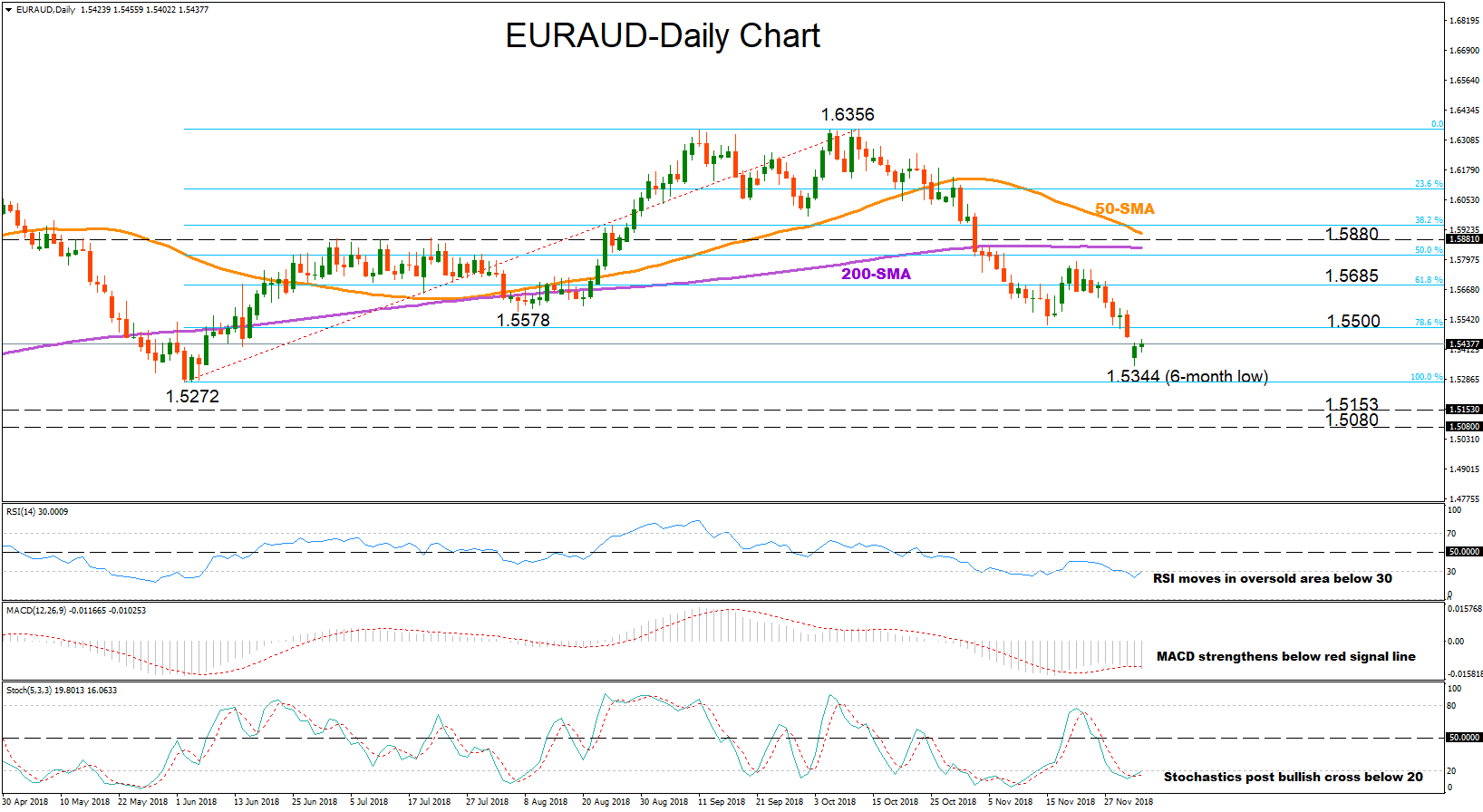
EURAUD opened with a gap down on Monday, extending the steep downfall off 1.6356 to a six-month low of 1.5344. The move painted a more bearish picture for the market, with the MACD suggesting that some weakness is still in storage as the indicator has reversed back below its red signal line. Yet the RSI and the Stochastics signal that the market is oversold, and upside corrections might emerge in the very short term.
On the upside, the pair is expected to find immediate resistance around the 78.6% Fibonacci of the upleg from 1.5272 to 1.6356, near 1.5500 – the area that has restricted both upward and downward movements in the past. Moving higher, bulls might find resistance around 1.5578, taken from the lows on August 7, before continuing up the path to the 61.8% Fibonacci of 1.5685. Traders, however, would be eagerly looking for a close above 1.5880 to confirm that gains are sustainable.
If it falls lower, the pair could retest yesterday’s trough of 1.5344 ahead of the 1.5272 bottom formed in June. Should the pair breach the latter, bearish action may pick up steam towards 1.5153, the low on January 11, while further declines may bring the previous 1.5080 support into view.
In the bigger picture, the pair is in neutral mode, trading within the 1.5272-1.6356 range. However, downside risks seem to be rising as the 50-day simple moving average has already changed direction to the downside to meet the 200-day MA.
Summarizing, EURAUD is bearish and oversold in short term, while in the medium term the pair is neutral.
Swiss Economy Coughs, USD Lower
Swiss inflation eased more than expected
Switzerland's headline inflation missed expectation in November. The consumer price index rose only 0.9%y/y, following an uptick of 1.1% in the previous month, while market participants anticipated an increase of 1%y/y. This is the lowest reading since April 2018, when inflation rose 0.8%y/y. More worryingly, the core gauge that excludes the most volatile components such as energy products eased to 0.2%y/y, compared to forecast of 0.4%.
There are increasing signs that the Swiss economy is suffering from the rise in geopolitical uncertainty. As suggested by the last GDP figures, the slowdown in European growth, and international trade, had a significant impact on the Swiss economy. The gross domestic product fell 0.2%q/q in the third quarter, compared to an expected increase of 0.4% and an improvement 0.7% in the previous one. Against such a back, there is no doubt that the Swiss economy will continue to suffer. In its upcoming Quarterly Bulletin, which will be release on December 12, the Swiss National Bank (SNB) will doubtlessly adjust both its inflation and growth forecast to the downside.
On Tuesday, despite a sell-off in equities the greenback fell across the board, with the Dollar index giving up 0.64%. The Swiss franc was up 0.43%, while the single currency rose 0.55%. Investors are slowing reducing their exposure to the buck amid mounting expectations that the Fed is almost done with its hiking cycle.
Excitement over US-China truce fades
Asian equities lost steam, as optimism over US-China trade softens. Japan's Nikkei 225 is closing at -2.39% while Australian ASX 200 and South Korean Kospi indexes closed at -1.01% and -0.12% respectively. Hong Kong's Hang Seng improved by +0.29% while China mainland CSI 300 gained +0.21%. Investors are realising that US-China relations have a long way to go. Tariffs of 25% on over USD 200 billion of Chinese imports are on the way. Chinese authorities are expected to send its negotiators as early as next week while US Trade Representative Robert Lighthizer is gearing up to represent the White House. On the agenda are: reduction of Chinese auto tariffs against US manufacturers (currently: 40%); purchase of US agricultural products; Chinese industrial subsidies; and intellectual property practices.
Peoples Bank of China Governor Yi Gang confirmed he will support the Chinese economy by further monetary policy easing. This will allow the Chinese Renminbi to recover slightly, which lowers the risk of further capital outflows. USD/CNY has lost 1.72% this week, trading at 6.8408 and approaching 6.8350 short-term.
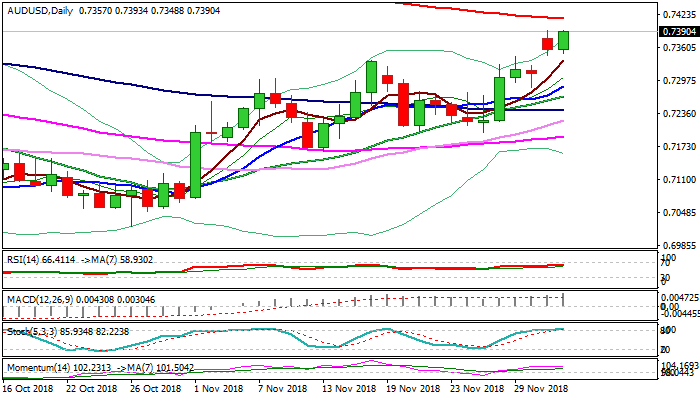
AUD/USD Outlook: Renewed Strength Pressures 200SMA And Could Extend To 0.7445 Fibo Barrier
The Australian dollar rallies on Tuesday, supported by fresh weakness of US dollar, after RBA decision to keep interest rates unchanged at record low, as widely expected, showed little impact.
Fresh strength attacks Monday’s high at 0.7393, where the action after gap-higher opening, was rejected.
The Aussie maintained bullish tone after consolidation, as strong risk appetite boosts the currency.
Strong bullish setup of daily studies adds to positive outlook, as bulls approach falling 200SMA (0.7414) and focus another pivotal barrier at 0.7445 (Fibo 38.2% of 0.8135/0.7019 fall), break of which would generate strong bullish signal for extension of recovery phase from 0.7020 (26 Oct low).
Bulls may show hesitation at 200SMA barrier on overbought techs, but dip-buying strategy would remain favored while Monday’s gap stays intact.
Res: 0.7414, 0.7445, 0.7464, 0.7483
Sup: 0.7348, 0.7335, 0.7325, 0.7287
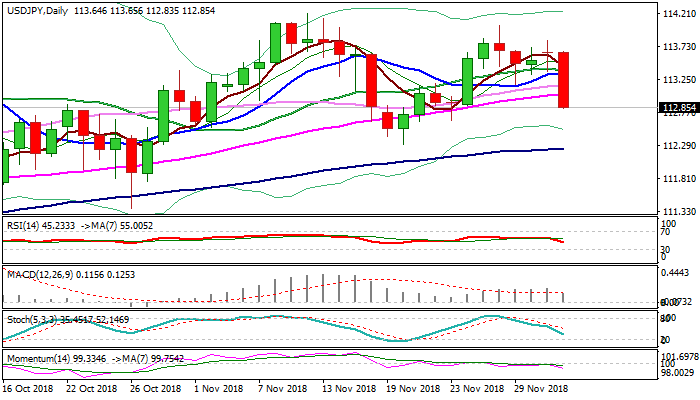
USD/JPY Outlook: Dollar Falls Sharply On Fading Optimism Over US/China Trade Agreement
The dollar was sharply lower in Asia and early Europe on Tuesday (down 0.7% so far) and hit the lowest in more than one week, on surge through pivotal supports at 113.37 and 112.96 (Fibo 38.2% and 61.8% respectively of 112.30/114.03 upleg.
Fall in US Treasuries pulled the dollar lower, as hopes of firmer agreement between the US and China after two presidents agreed to put the conflict on hold, are fading.
The most recent comments from various officials from Trump’s administration, which signaled little optimism over US/China agreement, added to negative outlook.
Fresh weakness generated negative signals on break below Fibo pivots, as well as plethora of daily MA’s, turning near-term structure bearish and increasing risk of further losses.
Bears pressure supports at 112.71 (Fibo 76.4%) and 112.55 (daily cloud top) violation of which would expose key points at 112.30 (20 Nov trough) and 112.16 (daily cloud base).
Rising bearish momentum on daily chart and south-heading indicators support scenario.
Broken MA’s now act as resistances, staring with 55SMA (113.03), then 113.17 (30SMA) and 113.34 (10SMA).
Only break and close above the latter would sideline immediate downside risk.
Res: 113.03, 113.17, 113.34, 113.65
Sup: 112.71, 112.55, 112.30, 112.16
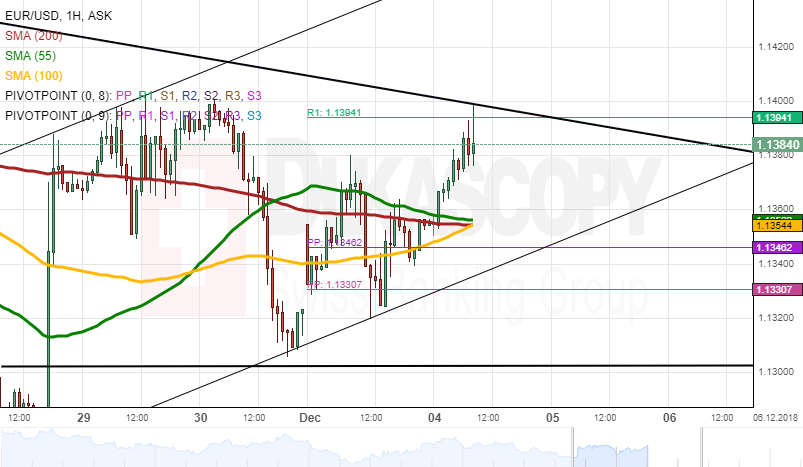
EUR/USD Analysis: Will Break Weekly R1 At 1.1394
During Monday's trading session, the currency exchange pair broke the resistances of the SMAs to end the trading session at 1.1350. On Tuesday morning, the European Single Currency was supported by the simple moving averages to trade at the 1.1374 mark.
In regards to the near-term future, most likely, the European Single Currency will break the upper boundary of the descending medium pattern at 1.1380 level.
However, the weekly R1 at the 1.1394 mark could resist the European Single Currency to push the rate to trade sideways to stay at the 1.1360 level during the trading session on Tuesday.
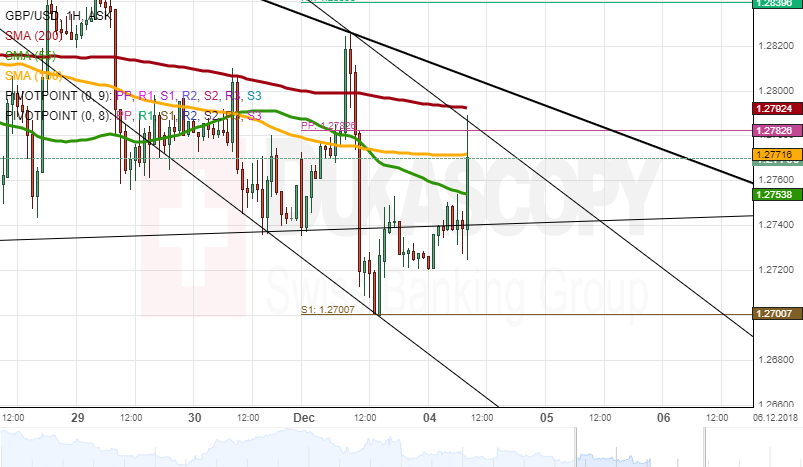
GBP/USD Analysis: Is Resisted By 55-Hour SMA
During Monday's trading session, the currency exchange rate depreciated by 0.82% to end the trading session at the 1.2719 mark. During Tuesday's morning hours, the British Pound was resisted by the 55-hour simple moving average to trade at the 1.2749 mark.
In regards to the near-term future, most likely, the currency exchange rate will trade downside towards the weekly S1 at 1.2700. In addition, today's UK Construction PMI data release at 9:30 GMT could support the downtrend for the currency exchange pair during the day.
On the other side, the data release could push the rate to trade near the weekly PP at the 1.2782 mark.