

Sample Category Title
BOC Preview: Will Poloz Maintain Hawkish Stance?
Bank of Canada is expected to keep its policy rate unchanged at 1.75%, after a rate hike of +25 bps in October. Despite bets of another move this month, we believe policymakers would take a wait- and- see mode to assess the impact of the sharp fall of oil prices on Canada’s economy. Another focus is BOC’s forward guidance, whether Governor Stephen Poloz would stick to his hawkish stance that the policy rate would need to rise to the neutral rate would be closely watched.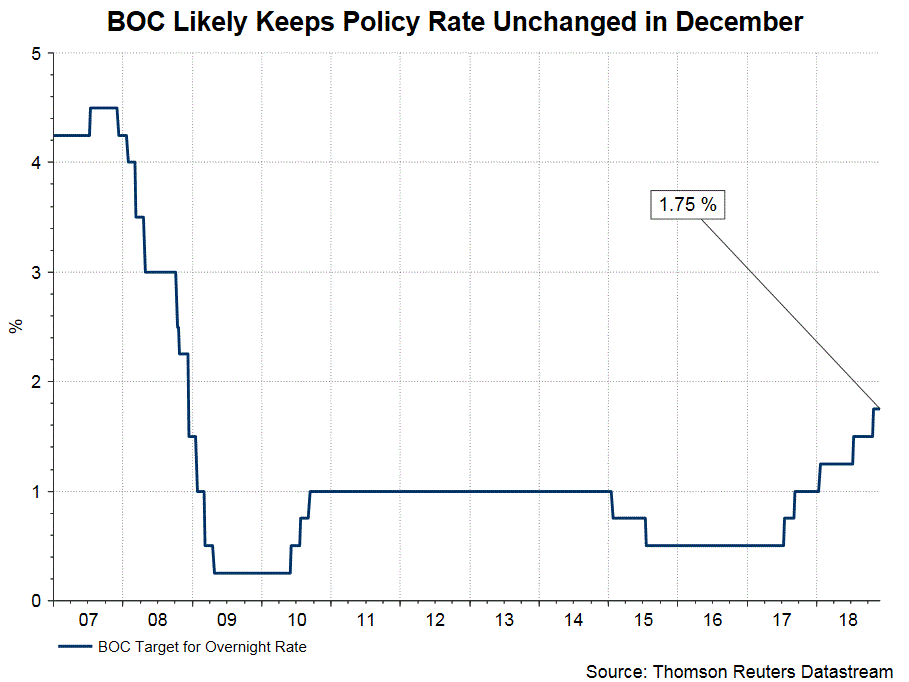
At the October meeting, the central bank turned hawkish, replacing the “gradual” rate hike guidance by the need to increase the policy rate “to a neutral stance to achieve the inflation target”. The stance was maintained as Poloz spoke in London on November 5. Following Fed Chair Jerome Powell’s U-turn on monetary policy, it would be interesting to see if Poloz would act similarly. Indeed, a less hawkish stance in December is not something farfetched. Canada’s GDP growth eased to +2% q/q annualized in 3Q18, from +2.9% a quarter ago. Business investments fell -1.1% while growth in private consumption slowed sharply to +0.7%.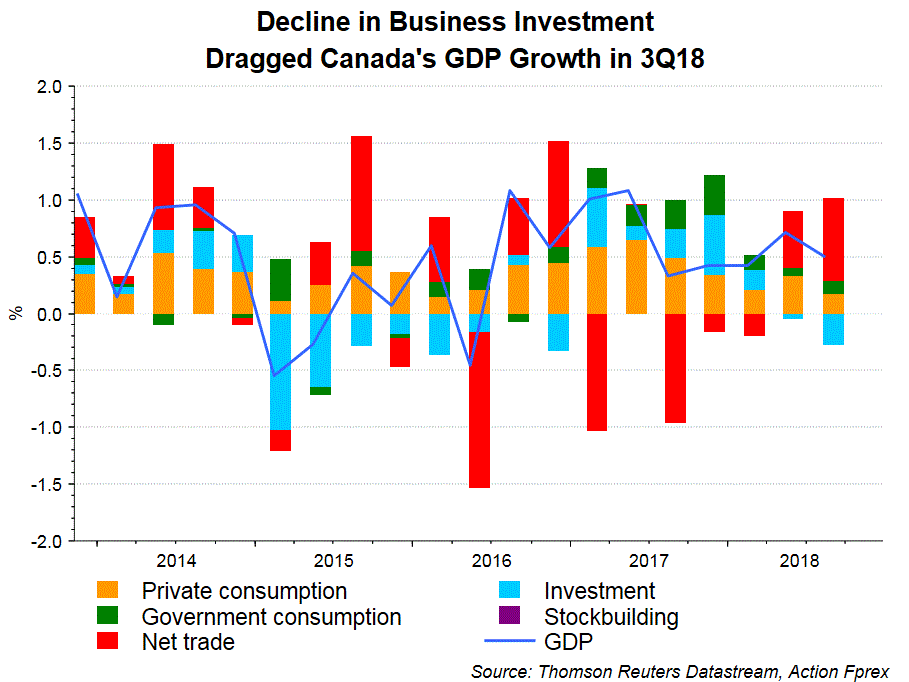
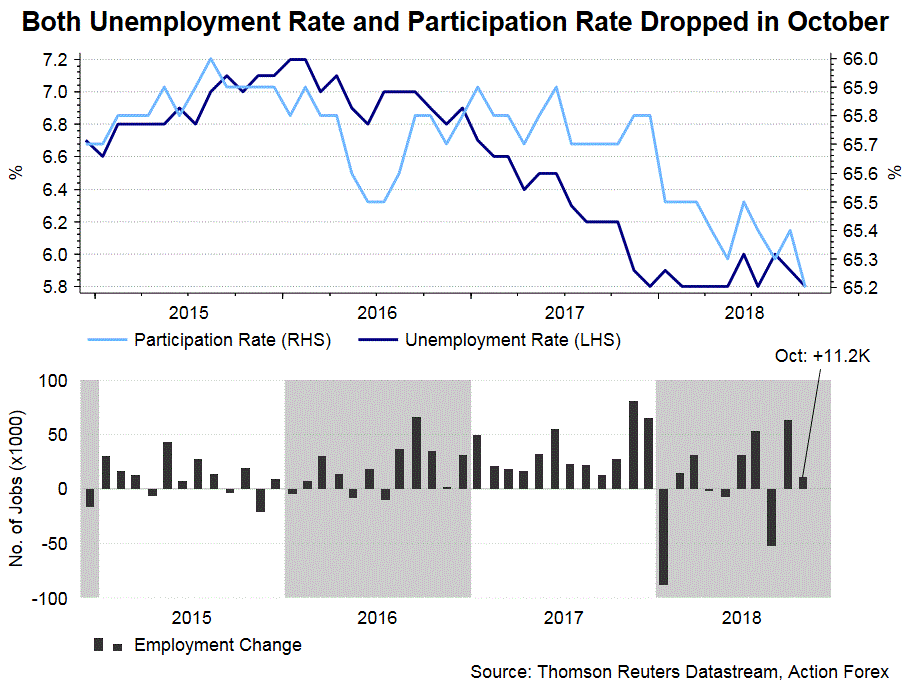
Headline inflation improved to +2.4% y/y in October, from +2.2% a month ago. The average of BOC’s three preferred “core” measures (the trim, median, and common CPI) climbed higher, by +0.1 percentage point, to +2%. The headline reading likely softened in November due to the sharp decline in energy prices. The job market remained strong. The unemployment rate slipped -0.1 percentage point to 5.8% in October, beating consensus of 5.9%. The number of payrolls gained +11.2K, easing from a +63.3K addition in September, but above consensus of +10K.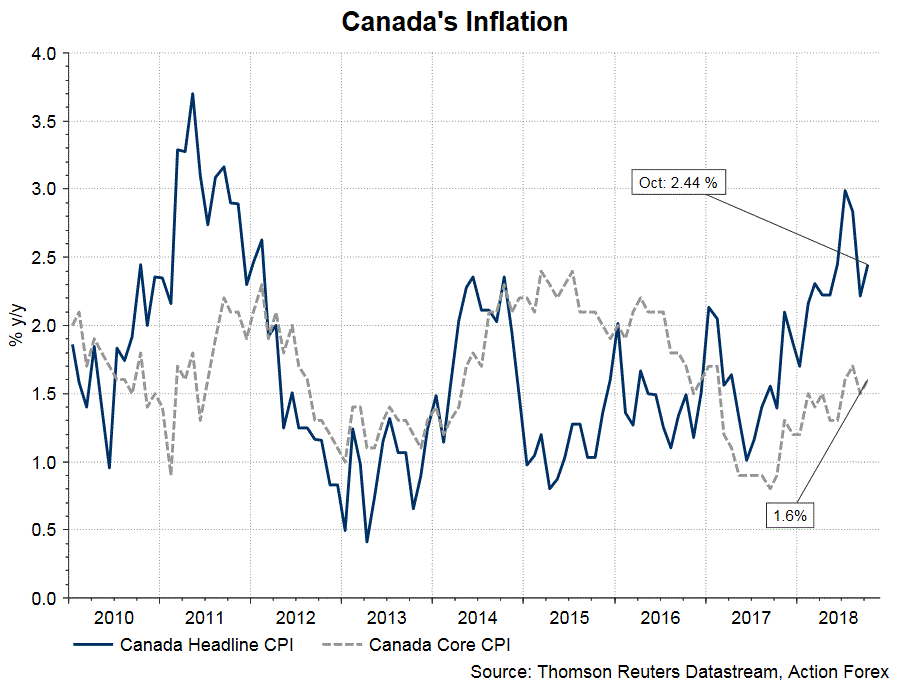
Deal or No Deal: Trade Ceasefire Between U.S. and China Full of Promises
- Over the weekend the U.S. reached a deal with China, promising to delay increasing its 10% tariff to 25% on $200bn in Chinese imports by 90 days. The hope is that the two economic giants can come to some agreement during that period to avoid escalation. Although the G20 statements by both countries lacked specifics on firm commitments, global financial markets welcomed the news with enthusiasm, since the meeting proved a bit more fruitful than many expected.
- Importantly, the agreement in principle serves to alleviate the most pressing concerns regarding the jump in the tariff rate come January 1st, further retaliatory action by China and the U.S., and the potential economic and financial market fallouts. The U.S. comes out the winner, giving up very little while potentially gaining in the near-term from a rebound in exports to China. But, we caution that tariffs remain in play, and so too does uncertainty over the corporate landscape. This is likely to continue to weigh on business investment decisions and lead to bouts of market volatility in the year ahead if a concrete resolution does not occur over that 90-day period.
Details Limited to Promises
- China has reportedly agreed to a number of concessions that opened the window to further dialogue through March of next year. Effective immediately, China has committed to a very substantial, but not yet agreed upon, increase in the amount of agricultural, energy, and other products it imports from the U.S. annually. The goal is to reduce its trade deficit with the U.S. Furthermore, negotiations on structural changes to China's forced technology transfer, intellectual property rights, cyber intrusions and theft, non-tariff barriers, and services and agriculture are to begin immediately. The aim is to have a plan to resolve these issues in place within the next 90 days to avoid an escalation in tariffs to 25%.
- On the foreign policy front, China has agreed to work together with the U.S. and North Korea towards a nuclear free Korean Peninsula.
- Less attention grabbing, but importantly, China agreed to designate fentanyl as a controlled substance. This would expose fentanyl exporters to the U.S. to maximum penalties under Chinese law. The CDC reported recently that drug overdose deaths in the U.S. have rocketed to more than 70,000 in 2017, with deaths resulting from fentanyls surging 45% in 2017 to more than 28,000. The increase in opioid related fatalities over the past few decades have been implicated in reducing average life expectancy in the U.S., and has had negative economic implications since the majority of deaths are occurring in the core working age population of 25-54.
China Extends Previous Commitments to the United States…
- There has been some fanfare regarding China's promise to increase shipments from the U.S. and lower tariffs on U.S. goods. However, China had previously promised similar outcomes to other trade partners in an attempt to court them to its side of the trade spat. And, they appear to have been executing with some precision on this front. The growth-gap between that of Chinese imports from the U.S. versus the rest of the world widened to the largest level since 2003 (Chart 1).
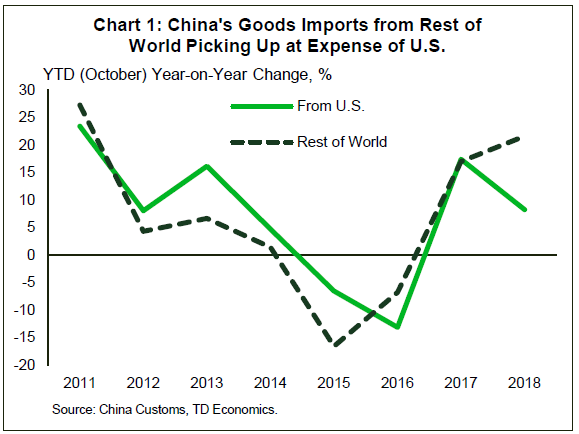
- So, the agreement over the weekend ultimately serves to avoid marginalizing U.S. companies further from China's ambitions to boost imports and reduce its trade imbalance with the world.
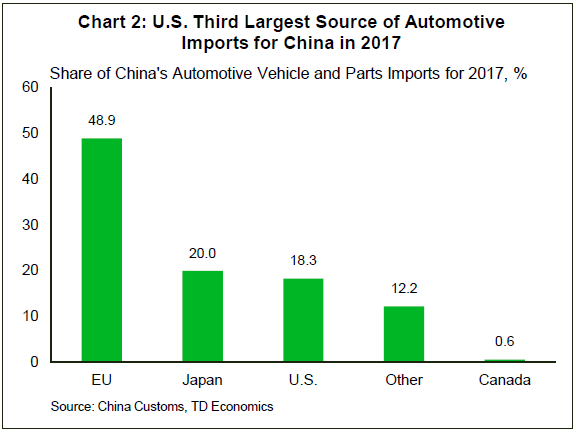
- Of the other concessions agreed to by China, it has also been rumored that auto tariffs will decline substantially. This has two parts. First, China had imposed hefty retaliatory tariffs on the U.S. auto imports following the U.S. administration's 25% tariff on an additional $16bn in Chinese imports this past August. That caused the average tariff rate to jump from 15% to 40%. This is expected to be rolled back to 15%, consistent with Chinese tariffs on other imported autos, and could reduce some to zero according to claims by the U.S. administration. Given that China has a habit of extending duty reductions to WTO member countries, any further reduction in tariffs on autos in the U.S. are likely to also apply to its other trade partners (Chart 2).
- The commitment to increase agricultural imports should help support prices for U.S. agricultural goods that are commonly exported to China, such as soybeans and pork. Indeed, the front contract price for U.S. soybeans is up over 1% today on the news, but is still well below the highs witnessed before the U.S. enacted its first round of tariffs on $34bn in Chinese goods this past July.
- While a step in the right direction, the 90 day window for negotiations may be insufficient time for both parties to resolve issues concerning intellectual property violations, corporate espionage, and the deeper structural issues that advantage China over its competitors. Instead, dialogue is likely to result in a constructive framework for further dialogue, with the threat of an escalation in tariffs hanging over the whole process.
…While the U.S. Administration Capitulates to a Growing Chorus of Domestic Objections to Tariffs
- Financial markets have been quick to react to every headline about tariffs on China. This has been generating additional market volatility on top of that driven by the Federal Reserve's interest rate normalization and the deteriorating global economic backdrop. The dramatic selloff that began in October following the September 24th imposition of a 10% tariff on $200bn in Chinese imports likely partly reflected concerns of further escalation in trade tensions between the U.S. and its trading partners.
- U.S. businesses have been expressing their discontent over tariffs for months now. Survey data show that the tariffs have been causing a run on available supply, resulting in higher prices and causing all sorts of volatility with inventories and supply chains, including component shortages. These concerns were repeated in the Feds monthly Beige Book publications. Moreover, the threat of further escalation is weighing on business sentiment globally, and is likely a factor in the declining growth in global trade volumes, while also threatening to reduce business investment.
- These concerns, and the threat of further escalation, have the Fed now seriously considering the economic implications of the tariffs as it looks to update its economic projections and, more importantly, its interest rate guidance for the December 19th monetary policy meeting.
Not a Major Game Changer for the U.S. or Global Economic Outlook
- Ultimately, the 90 day negotiation window buys the U.S. administration time, but doesn't provide enough of an escape hatch to alleviate the U.S. administration's concerns regarding China's record of business practice malfeasance. As such, the threat of an escalation in tariffs is likely to continue to weigh on business sentiment globally, and could persist as a drag on business investment.
- Our impact estimates suggest that a follow-through of the threat to raise the tariff rate to 25% from 10% could result in a further 0.13 ppt level drag on U.S. GDP growth through 2020. This is the least of concerns, given that financial market volatility risks undermining overall global confidence. Given recent developments, we plan on holding off embedding any direct impacts and observe developments. But, we will still be incorporating some negative drag on growth to account for trade uncertainty that is likely to continue to restrain domestic business investment.
BoE Carney: Brexit worst-case scenarios were low-probability events
BoE Governor Mark Carney testified in the parliament today on the Brexit economic analysis today. Carney said the worst-case scenarios were "low-probability events in the context of Brexit" that BoE has to prepare the banking system for. But he also said "we're already sleeping soundly at night, because we have the financial sector, the core of the financial sector, in a position that it needs to be for a tough scenario."
Carney also defended the analysis and said "There's no exam crisis. We didn't just stay up all night and write a letter to the Treasury Committee. And, "You asked for something that we had, and we brought it, and we gave it to you."
XAU/USD Outlook: The Yellow Metal Extends Recovery On Weak Dollar, Pressures Key Barrier At $1243
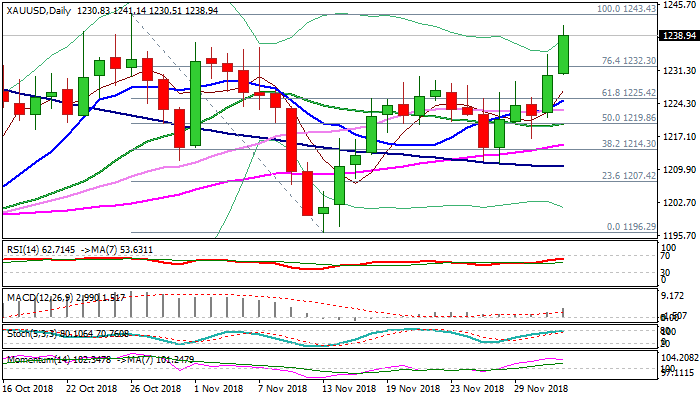
Spot gold maintains firm tone and extends advance into second straight day. Fresh upside was boosted by weaker dollar on fading US/China trade conflict fears, as well as dovish tones from Fed, which signal that widely expected rate hike in December, might be postponed.
The metal rose 1.3% since Monday’s opening, taking out significant barriers at $1232 (Fibo 76.4% of $1243/$1196) and lower platform at $1237 zone (also Fibo 38.2% of $1365/$1160 downtrend).
Bulls eye key barrier at $1243 (26 Oct high) break of which would signal continuation of larger recovery from $1160 (2018 low, posted on 16 Aug) and expose pivotal barrier at $1252 (50% of $1309/$1160 bear leg).
Bullish techs support scenario, however, bulls may show hesitation on approach to $1243 barrier as slow stochastic is entering overbought territory and 14-d momentum turned sideways.
Dips could be seen as positioning for fresh upside and should ideally find ground above broken $1232/30 barriers, now reverted to supports.
Res: 1241, 1243, 1248, 1252
Sup: 1237, 1232, 1230, 1225
Sterling Rises On Get Out Of Jail Card
Tuesday December 4: Five things the markets are talking about
Stocks fell in Asia, are on the back foot in Europe, and looking to open in the red in North America as the market reins in its optimism over any breakthrough in the Sino-U.S trade war. U.S Treasury prices remain better bid, while the ‘mighty’ U.S dollar again underperforms across the board.
The optimism that drove gains for riskier assets yesterday is disintegrating as investors struggle to figure out exactly what was agreed between the U.S and China on trade at the weekend.
Lack of specifics from the Trump administration again has the market worried and unless there is clarity, investors can expect more of the same as we approach the year-end.
Note: China statement said nothing about its commitment to remove U.S auto tariffs, nor was there any mention of a three-month deadline.
In the Treasury market, U.S 3-year yields have backed up above U.S 5’s – an inverted curve – potentially suggesting an end of the Fed’s tightening cycle.
Note: U.S 2/10’s curve remains upwardly sloped.
Elsewhere, crude oil remains better bid ahead of this week’s OPEC+ meeting (Dec 6).
On tap: U.S financial markets will close tomorrow for a national day of mourning to honour former President George Bush. Fed Chair Powell’s testimony to Congress scheduled has been cancelled.
1. Stocks see red
In Japan, the Nikkei dropped overnight with investors selling off exporters and financials, while profit taking continued on cyclical stocks that rallied on Monday. Both the Nikkei and broader Topix fell -2.3%. The index rallied to a two-week high on Monday.
Down-under, Aussie shares closed lower on growing concerns over whether the world’s two largest economies can resolve their trade differences before a three-month deadline. The S&P/ASX 200 index fell -1.01% at close of trade. In S. Korea, the Kospi fell -0.82%, weighed down mostly by the underperforming tech sector.
In China and Hong Kong, stocks lost steam overnight, as investors come to terms with the fact that the relationship between U.S and China has not improved, while China’s economy continues to face downward pressure. The blue-chip CSI300 index rose +0.2%, while the Shanghai Composite Index gained +0.4%. In Hong Kong, the Hang Seng index rallied +0.3%, while the China Enterprises Index gained +0.2%.
In Europe, regional bourses trade lower across the board, fading some of the sharp trade related gains seen yesterday, following declines in Asia and lower U.S index futures.
U.S stocks are set to open in the ‘red’ (-0.48%).
Indices: Stoxx600 -0.41% at 359.70, FTSE -0.44% at 7,031.79, DAX -0.71% at 11,384.51, CAC-40 -0.66% at 5,020.71, IBEX-35 -0.74% at 9,109.00, FTSE MIB -0.41% at 19,541.50, SMI -0.22% at 9,084.50, S&P 500 Futures -0.48%
2. Oil bid on expectations of OPEC-led output cuts
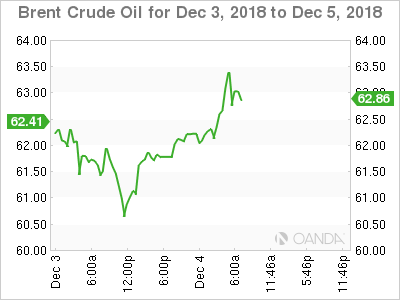
For now, oil prices remain better bid, extending Monday’s gains ahead of expected output cuts by OPEC and a mandated reduction in Canadian supply.
Brent crude oil is up +75c, or +1.2%, at +$62.44 per barrel, while U.S light crude (WTI) is up +65c at +$53.60.
Note: Both benchmarks rallied +4% yesterday after the U.S and China pledged to pause an escalating trade dispute.
OPEC and Russia will meet on Thursday to agree future output. The group is expected to announce production cuts of more than -1M bpd.
Oil also received support from Canada, where Alberta indicated that it would force producers to cut output by -8.7%, or -325Kbpd, to deal with a pipeline bottleneck that has led to crude building up in storage.
Note: Qatar has indicated that they would leave OPEC in January – their oil production is only around +600K bpd, but it is the world’s biggest exporter of liquefied natural gas.
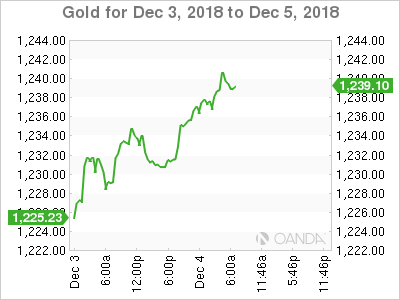
Ahead of the U.S open, gold prices have rallied to a one-month high earlier this morning, supported by a weaker U.S dollar. Spot gold has rallied +0.6% to +$1,238.36 per ounce. Prices touched a peak of +$1,238.83 earlier in the session. U.S gold futures are up +0.3% at +$1,243.4 per ounce.
3. U.S 3/5’s yield curve inverts as appetite for risk increases
A strong appetite for risky assets after last weekend’s Sino-U.S Trade truce has led to a yield-curve inversion in the 3/5’s curve and a weaker U.S dollar.
The 3/5’s spread fell to negative -1.4 bps Monday – the first inversion in a decade.
A better measure for a possible recession, the U.S 2/10’s spread, has fallen to +13 bps, the lowest in years.
There are a couple of way’s to interpret this, first, the underperformance of the longer dated U.S paper vs. the shorter-dated ones shows the shift of money into U.S equities now that trade disputes are put on hold. Second, it also shows that investors are pricing in a less bullish Fed.
Down-under, the Reserve Bank of Australia (RBA) left the Cash Rate Target unchanged at +1.50% as expected – it’s the 24th consecutive pause in the current easing cycle.
Governor Lowe reiterated the central banks stance, that low rates were supporting the economy and that progress on unemployment and inflation to be gradual. He also saw Australian GDP growth averaging ~3.5% over the coming years.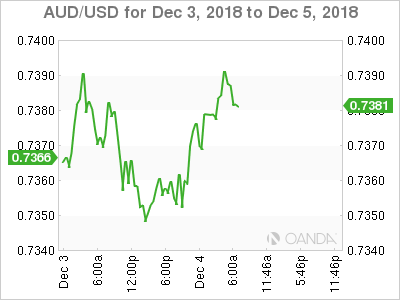
4. Sterling rises on get out of jail card
The pound (£1.2823) has rallied after the European Court of Justice’s (ECJ) advocate general said that the U.K. could still cancel Brexit by revoking Article 50 without the consent of other E.U member states.
The recommendation is significant because it could be a way for the U.K. to avoid a no-deal Brexit, even though such a move would add further uncertainty for the pound.
EUR/USD (€1.1404) has edged back above the psychological €1.14 handle as U.S 10’s yields test below +3% at +2.95% for a three-month low.
Investors continue to speculate that the Fed would slow the pace of its rate hikes further out the curve. The U.S dollar has also been impacted by the ‘temporary’ truce in the Sino-U.S trade dispute as cash flowed into riskier currencies vs. the safe-haven USD.
The Japanese yen has rallied +0.8% to ¥112.78, its strongest increase in a fortnight on the biggest increase in more than five-months.
Elsewhere, South African Q3 GDP jumped +2.2% q/q vs. -0.7% in the comparable period – USD/ZAR has fallen -1% to a four-month low of $13.5419.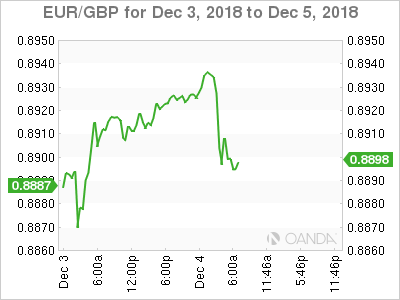
5. U.K construction PMI unexpectedly rises
U.K data this morning showed that the construction sector activity in the U.K economy grew at a faster pace than expected in November.
The final Purchasing Managers’ Index (PMI) came in at 53.4 in November, up from 53.2 seen in October – the market was expecting 52.5.
According to IHS Markit “November data indicates that the U.K construction sector remains in expansion mode, with resilient business activity trends seen for housing, commercial and civil engineering activity. The latest overall rise in construction output was the fastest since July, helped by a stronger contribution to growth from house building activity.”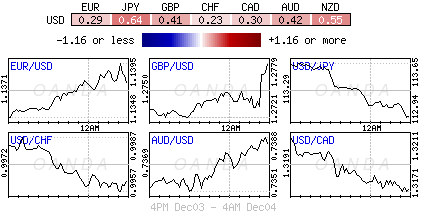
DAX Falters As Optimism Over Tariff Deal Fades
The DAX index has recorded considerable losses in the Tuesday session. Currently, the DAX is at 11,388, down 0.67% since the Monday close. On the release front, Eurozone PPI climbed to 0.8%, above the estimate of 0.5%. On Wednesday, ECB President Mario Draghi will speak at a banking conference in Frankfurt. Germany and the eurozone will release Services PMIs and we’ll also get a look at eurozone retail sales.
The DAX started the week with sharp gains, after the U.S. and China agreed to a truce in the tariff war. At the G-20 summit, President Trump and Chinese President Xi Jinping agreed to suspend any further tariff moves until March 1. Trump had threatened to raise tariffs on all Chinese products from 10 percent to 25 percent on December 1, and news of the suspension between the world’s two largest economies triggered sharp rises in the equity markets. However, the optimism proved to be short-lived, as the DAX ended the Monday session with considerable losses. The downward trend has continued on Tuesday, as investors are concerned that the 90-day reprieve may not lead to a long-term agreement over tariffs. The sides remain far apart on a number of issues, including repeated charges by the U.S. that China is engaged in theft of U.S. intellectual property. The markets have been very sensitive to the trade dispute, and the upcoming negotiations between the U.S. and China, with the likely ups-and-downs, promise to have a significant effect on market movement.
German indicators continue to struggle in the fourth quarter, raising concerns among analysts. Last week, GfK Consumer Climate dipped to an 18-month low and retail sales fell by 0.3%, its first decline since July. Consumers are holding tighter to the purse strings, which is hurting economic growth. The downward trend continued on Monday, as Manufacturing PMI dropped to 51.8 in November, down from 52.2 points in October. This marked a fourth straight downturn and was the lowest reading since April 2016. The global trade war has taken a bite out of German exports and a slowdown in the eurozone economy has dampened manufacturing growth in Germany. This does not bode well for the eurozone economy, as the German economy is often a bellwether for the rest of the eurozone.
EUR/USD – Euro Rally Continues On Strong Inflation Report
EUR/USD has posted gains in the Tuesday session, continuing the upward movement which started the week. Currently, the pair is trading at 1.1408, up 0.47% on the day. On the release front, Eurozone PPI climbed to 0.8%, above the estimate of 0.5%. There are no major releases out of the U.S. On Wednesday, ECB President Mario Draghi will speak at a banking conference in Frankfurt. Germany and the eurozone will release Services PMIs and we’ll also get a look at eurozone retail sales.
The U.S dollar continues to retreat this week, as EUR/USD has climbed 0.80%. The greenback remains under pressure following the G-20 summit on the weekend, where President Trump and Chinese President Xi Jinping held a meeting and agreed to suspend any further tariff moves until March 1. Trump had threatened to raise tariffs on all Chinese products from 10 percent to 25 percent, and news of a ‘cease fire’ between the world’s two largest economies was met with relief by the markets. With a marked increase in risk appetite, the dollar is broadly lower. At the same time, the reprieve is only for 90 days, and market optimism could quickly fade unless the sides make substantial progress in the next several weeks.
German indicators continue to struggle in the fourth quarter, raising concerns among analysts. Last week, GfK Consumer Climate dipped to an 18-month low and retail sales fell by 0.3%, its first decline since July. Consumers are holding tighter to the purse strings, which is hurting economic growth. The downward trend continued on Monday, as Manufacturing PMI dropped to 51.8 in November, down from 52.2 points in October. This marked a fourth straight downturn and was the lowest reading since April 2016. The global trade war has taken a bite out of German exports and a slowdown in the eurozone economy has dampened manufacturing growth in Germany. This does not bode well for the eurozone economy, as the German economy is often a bellwether for the rest of the eurozone.
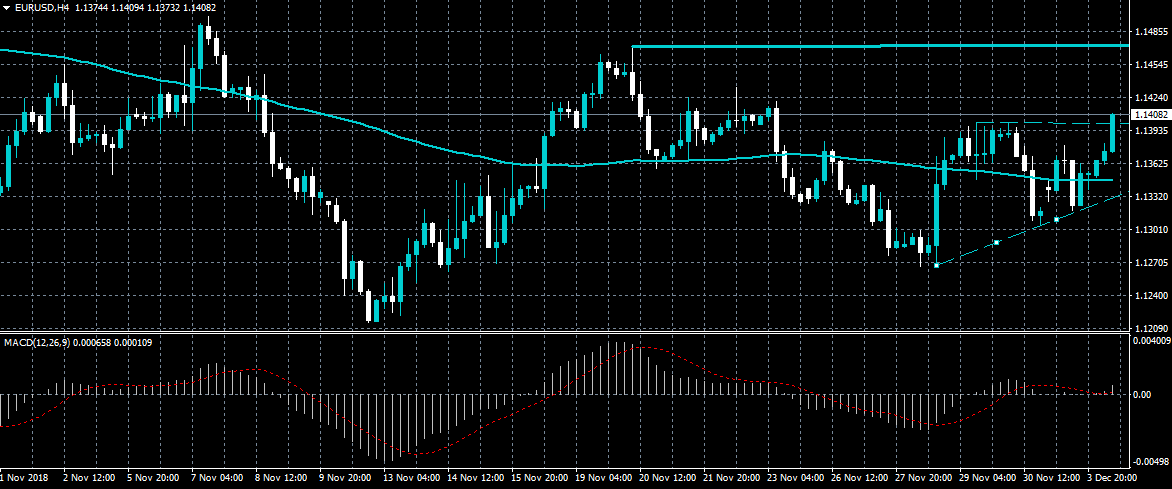
EURUSD Bulls Targeting 1.1470 Level
The euro has surged higher against the US dollar during the European trading session, with bulls breaking above the 1.1400 resistance level. EURUSD buyers will likely target the 1.1470 resistance level, now that price has clearly broken out from the well-defined descending triangle pattern. The 1.1500 resistance level presents the strongest technical hurdle if the 1.1470 level is broken.
The EURUSD pair is strongly bullish while trading above the 1.1400 level, key technical resistance remains at the 1.1470 and 1.1500 levels.
If the EURUSD pair trades below the 1.1400 level, sellers are likely to test the 1.1345 and 1.1322 levels.
USDJPY Breaks Key Trendline Support
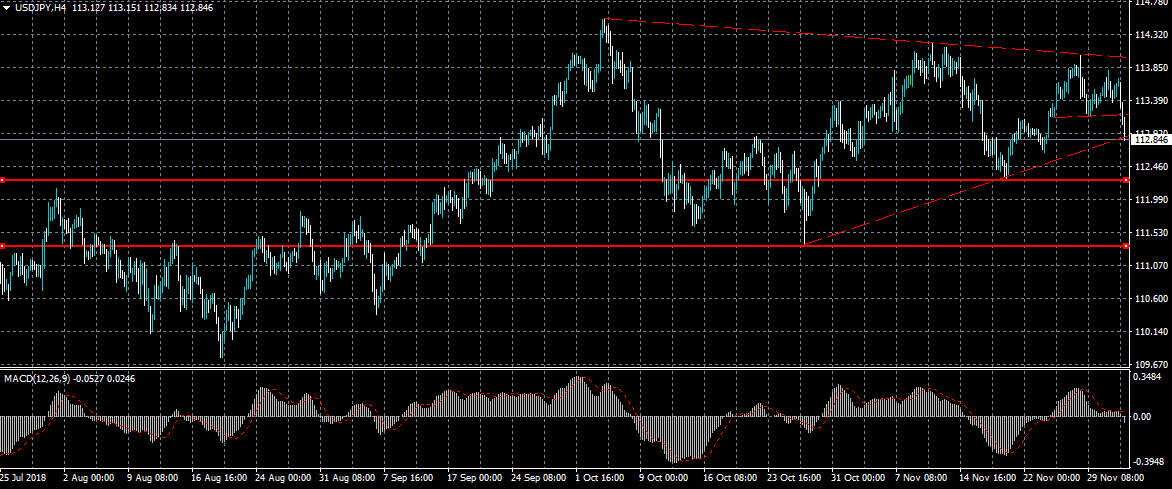
The US dollar has moved sharply lower against the Japanese yen currency, as the greenback comes under heavy selling pressure across the board. The USDJPY pair has now broken below trendline support, with price-action starting to turn heavily bearish. The Moving Average Convergence Divergence indicator on the four-hour time frame is also signaling that further downside is likely.
The USDJPY pair is strongly bearish while trading below the 113.15 level, key support is found at the 112.55 and 112.30 levels.
If the USDJPY pair moves above the 113.15 level, further upside towards the 113.80 and 114.00 levels remains possible.
Loonie Turns Its Gaze To BoC Decision And OPEC Meeting
The Bank of Canada (BoC) will announce its rate decision on Wednesday at 1500 GMT, and expectations are for policymakers to take no action. The loonie will probably be driven by any signals regarding the likelihood of a rate hike at the next meeting, in January. Beyond monetary policy, the outcome of the OPEC gathering on Thursday may also prove crucial for the currency, via its impact on oil prices.
The BoC is widely anticipated to keep interest rates unchanged this week, with the market-implied probability for a rate increase resting at a marginal 3%, according to Canada’s overnight index swaps. Assuming no surprises on the decision itself, the focus will quickly shift to the accompanying statement for any signals on whether a rate hike in January is still on the cards; something currently priced in with a 68% probability.
The past few weeks have been particularly interesting for the loonie. The currency was unable to rally even after the BoC assumed a more confident tone at its October meeting, mainly because oil prices started to collapse at around the same period. Canada is a major oil producing economy, so fluctuations in crude prices have a substantial impact on the loonie. Alas, oil rebounded notably this week, allowing the currency to recover some lost ground. Notice that although still weak, the correlation between the two has strengthened lately, which implies moves in crude are becoming an increasingly important factor for the loonie.
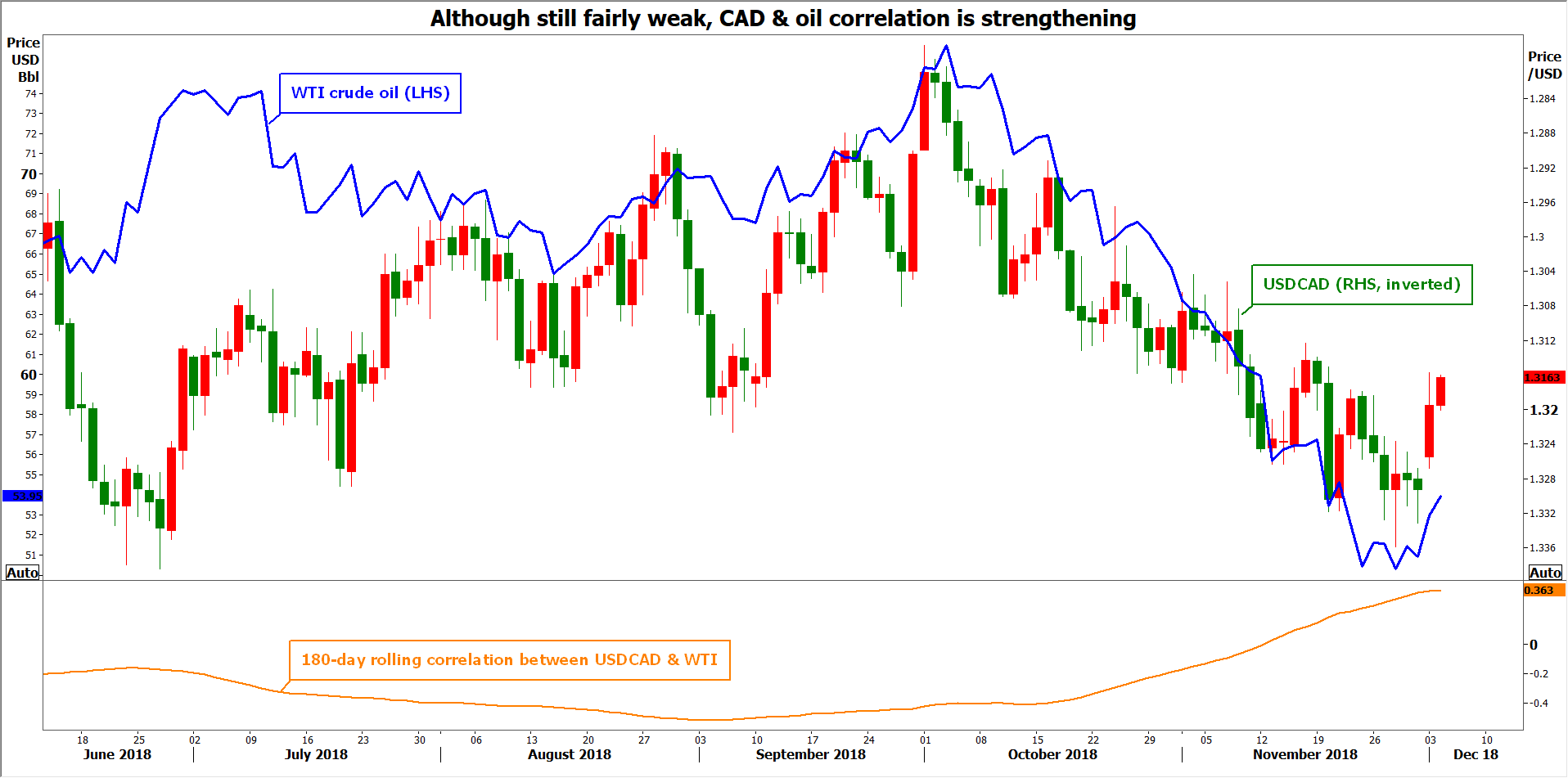
Blending the two together, the BoC’s broader tone – whether confident or not – may hinge largely on how policymakers interpret the recent plunge in oil, especially since economic data have been mixed recently. Even accounting for the latest rebound, crude prices are still a whopping 18.5% lower than they were at the BoC’s latest meeting, which paints a bleak picture for growth and business investment going forward. Hence, the real question is whether the Bank will view crude’s latest breakdown as a transitory factor that will dissipate soon, or as a longer-lasting development that warrants an appropriate policy response.
It’s a close call, but the risks may be tilted towards a slightly more cautious-sounding narrative. Looking at this through the BoC’s eyes, you cannot know whether this shock will ultimately prove transitory or not, so a more measured policy approach – that allows you to slow down if things worsen – is likely prudent at this stage. That being said, the risk is that Governor Poloz and his colleagues may prefer to see what effect this will have on the actual data first, before appearing concerned.
The other key event will be Thursday’s OPEC meeting, where expectations are for a fresh round of production cuts to stabilize prices. The magnitude of any cut will be key; market chatter suggests a reduction of 1-1.5 million barrels per day (bpd). Anything near the upper bound of this range may help oil prices recover further, while anything below it could bring them under renewed selling interest.
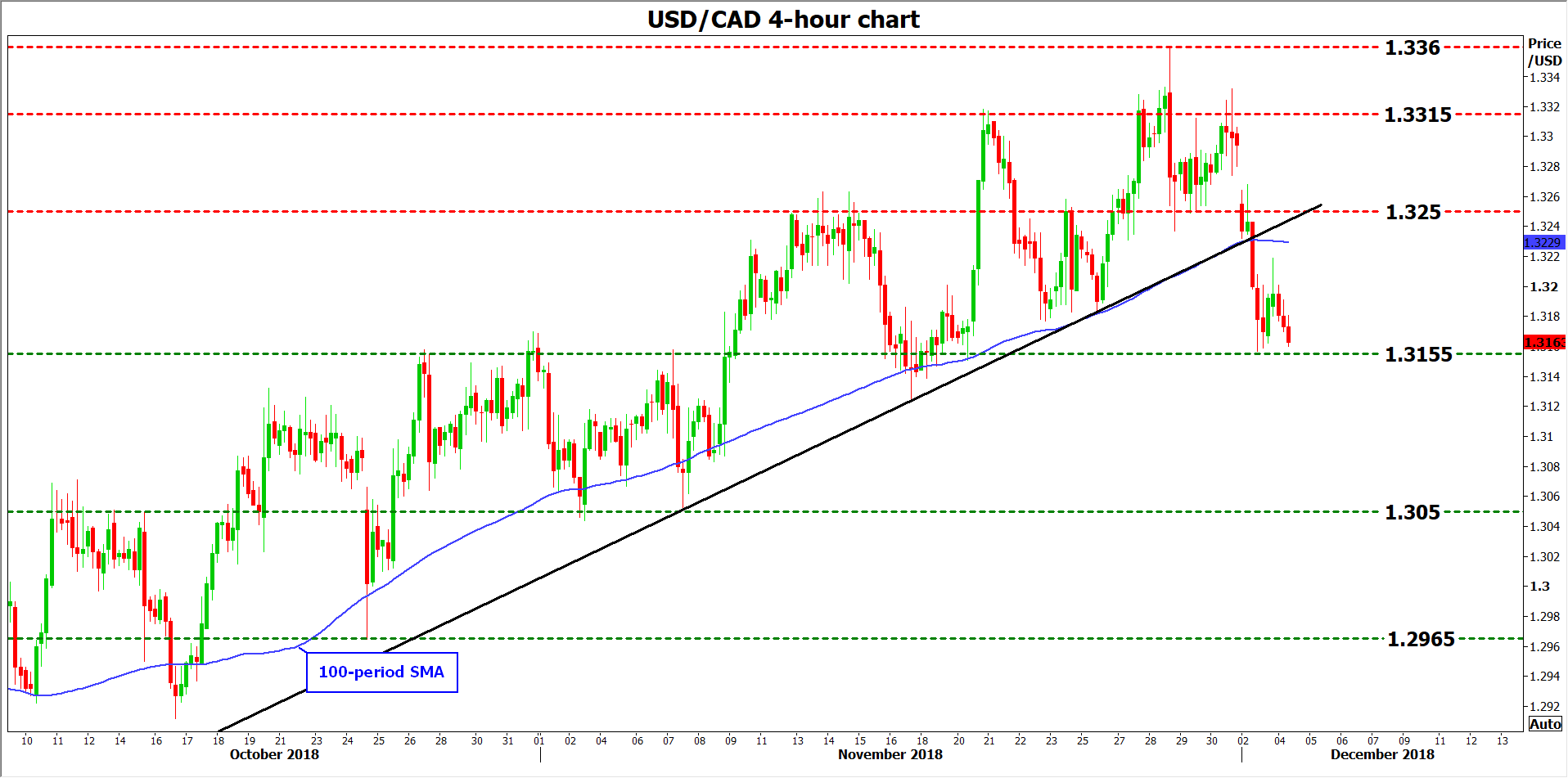
Technically, another wave of declines in dollar/loonie may encounter immediate support near 1.3155, an area defined by the December 3 lows. A downside break could open the way for a test of the November 7 lows at 1.3050, before the October 24 trough of 1.2965 comes into view.
On the flipside, advances in the pair may stall around the 1.3250 zone, marked by the inside swing low of November 29. Even steeper bullish moves could encounter resistance at 1.3315; the territory around this level was congested recently.