

Sample Category Title
Elliott Wave View Favoring More Upside In NIFTY
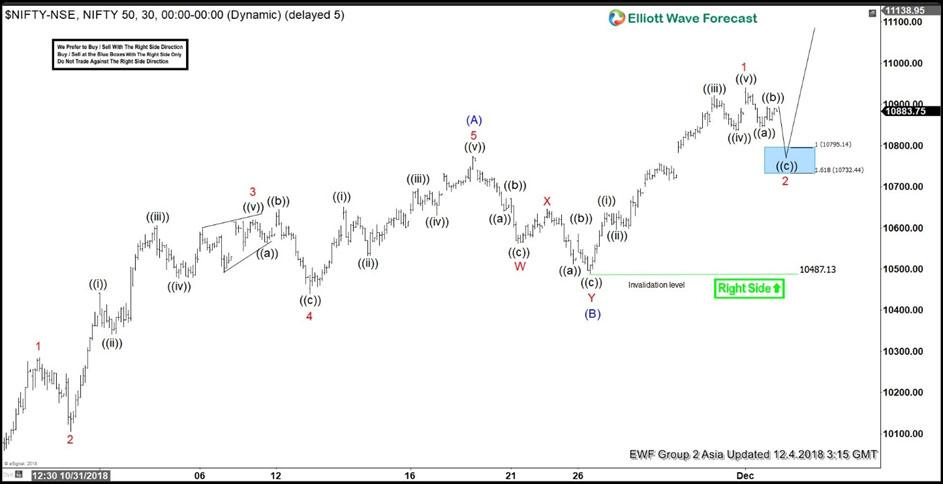
NIFTY is showing an incomplete sequence to the upside in the short term, favoring more upside while above 11/26 low (10487.1). Near term, cycle from 10/26 low (10004) remains in progress as a zigzag Elliott Wave structure. Intermediate Wave (A) ended at 10774.7 as 5 waves impulse Elliott Wave structure and Intermediate wave (B) ended at 10487.13 low.
Internal of wave (A) unfolded as an impulse where Minor wave 1 ended at 10285.1, Minor wave 2 ended at 10105.10, Minor wave 3 ended at 10619.55, Minor wave 4 ended at 10440.55, and Minor wave 5 of (A) ended at 10774.7. Intermediate wave (B) pullback unfolded as a double three Elliott Wave structure where Minor wave W ended at 10562.35, Minor wave X ended at 10646.25 and Minor wave Y of (B) ended at 10487.13.
Up from 10487.13 low, Intermediate wave (C) is in progress as a 5 waves impulse Elliott Wave structure where Minor wave 1 ended at 10941.20. The Index is now correcting cycle from 11/26 low within wave 2 in 3, 7, or 11 swing before the rally resumes. We don’t like selling the pullback and expect to find buyers in 3, 7, or 11 swing for more upside as far as pullback stays above 10487.13 low
NIFTY 1 Hour Elliott Wave Chart
GBP/USD Challenges 1.27 Support Of Triangle Chart Pattern
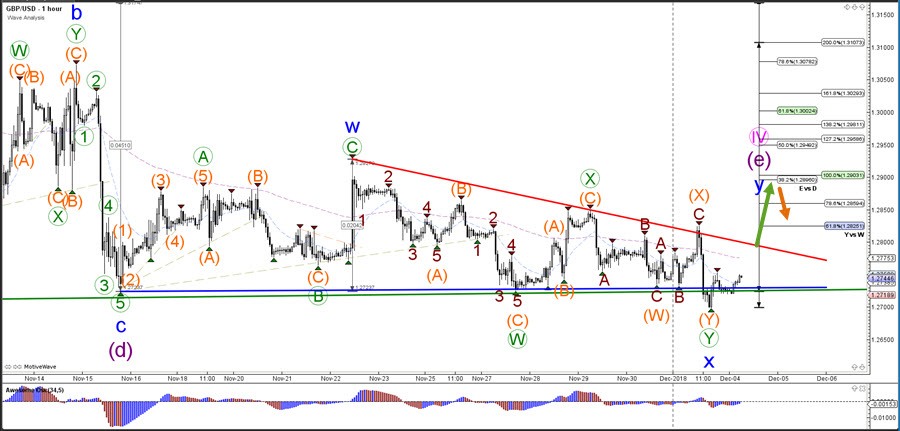
The GBP/USD needs to break above the resistance trend lines (red) to confirm the potential wave Y (blue) correction within the triangle pattern. A bearish break below the support trend lines (green/blue) could indicate a different and bearish wave pattern.
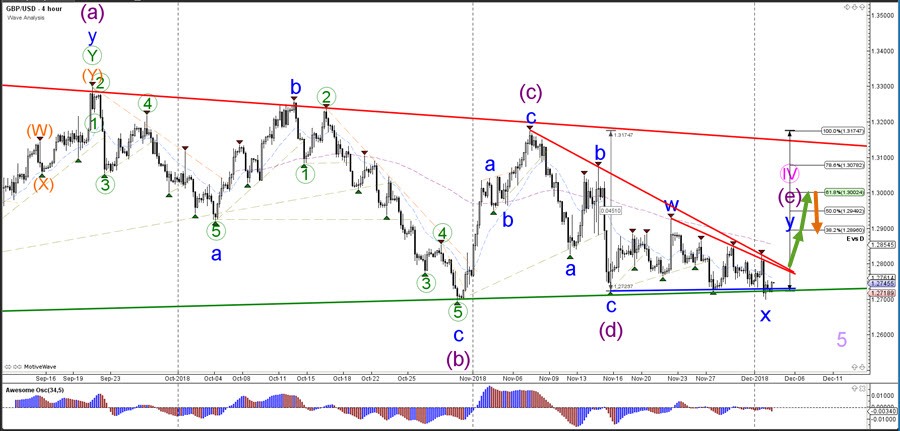
The GBP/USD has been moving up and down between the support and resistance levels of 1.27-1.29 and the sideways price action has created many complex corrections. The chart and wave patterns are indicating that more upside is likely towards the Fibonacci targets.
RBA Keeps Cash Rate on hold; Cites Risks around Trade but Confirms Strong Growth Outlook
The Reserve Bank Board decided to leave the cash rate unchanged at 1.50% at its December board meeting. That makes twenty-six consecutive meetings that rates have been on hold.
As has been the case with most Statements by the Governor in this cycle, there are very limited changes in this Statement.
Clearly, developments in global trade are tempering the Bank’s views on the global economy. In November, the Governor referred to “uncertainty from the direction of international trade policy in the United States”. In this Statement, he is much more explicit noting “there are, however, some signs of a slowdown in global trade partly stemming from ongoing trade tensions”.
The positive growth forecasts of 3 ½ per cent (average over 2018 and 2019) are confirmed. The positive business conditions and rising levels of public infrastructure expenditure are noted. On the other hand, uncertainty around the outlook for household consumption remains an issue.
With the increase in the AUD since the last meeting (trade weighted index up 1 ½ per cent), the sentiment “the Australian dollar remains within the range that it has been in over the past two years on trade-weighted basis” persists. Although in November it was described as being in the lower part of the range.
Since the last board meeting, the Bank has released its November Statement on Monetary Policy (SoMP). In that SoMP, it includes a graph of the wage price index (WPI) and the Bank’s forecasts. A reasonable ‘eyeball’ of the graph points to the official forecast for growth in the wage price index to reach 2 ¾ per cent by end 2020. Note that at the beginning of the three previous rate hike cycles, the WPI was growing in the range of 3 ½ to 4 per cent. That forecast certainly supports the Bank’s observation that the lift in wages growth will be a gradual process. Indeed, a reasonable person might be excused for thinking that even though the rhetoric is for the next move in the cash rate to be up, the Bank expects that event to be a very long way away.
The greatest interest was always going to be in the revised assessment of conditions in the housing market. Despite recent reports of sharp falls in prices in both Sydney and Melbourne, the description of the housing market remains “conditions… have continued to ease”. A stronger description would not have been out of place.
In November, finance conditions were described as “credit conditions are tighter than they have been for some time”. The description in this Statement is “credit conditions for some borrowers are tighter than they have been for some time, with some lenders having a reduced appetite to lend”( arguably a more benign description of credit conditions).
At least the commentary is more cautious on lending growth with the term “growth in credit extended to owner-occupiers… remains robust”, being replaced by a factual assessment that the annualised pace of credit extended to owner-occupiers has eased to 5-6 per cent (that compares with a peak of 8.8% in July 2017). It is also noteworthy that new lending to owner-occupiers fell by around 10 per cent in the two months of August and September 2018.
The final paragraph in the Statement is unchanged, noting that progress towards reducing unemployment and having inflation return to target is expected to be gradual.
Conclusion
Back in early 2017, Westpac predicted that the cash rate would remain on hold through 2017 and 2018. That view was certainly not popular in markets and in consensus forecasts.
The on hold decision today finally justifies that call.
We continue to expect that the cash rate will be on hold through 2019 and 2020.
GBPUSD Sets Up To Weaken Further Towards Key Support
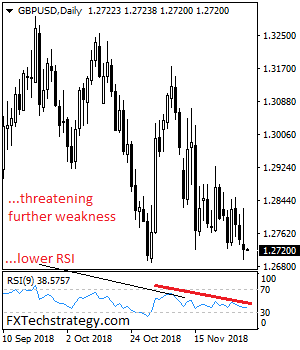
GBPUSD sets up to weaken further with more decline towards its key support located at 1.2661 zone. Support is seen at 1.2800 level. Further down, support comes in at the 1.2750 level where a break will turn focus to the 1.2700 level. Further down, support comes in at the 1.2650 level. Below here will set the stage for more weakness towards the 1.2600 level. On the upside, resistance stands at the 1.2850 with a turn above here allowing for additional strength to build up towards the 1.2900 level. Further out, resistance stands at the 1.2950 level followed by the 1.3000 level. On the whole, GBPUSD faces further downside pressure.
Lighthizer to lead US-China trade talk, strong sign of readiness for progress
The White House has confirmed that Trade Representative Robert Lighthizer will lead the new round of trade talks with China, taking over from Treasury Secretary Steven Mnuchin. This is an important indication that both sides (well mainly China), are ready to put promises into words and then actions. Lighthizer is the only one who knows how to work out a trade agreement. Without him, it's just high level "talks".
White House trade adviser Peter Navarro said that Lighthizer is "the toughest negotiator we've ever had at the USTR and he's going to go chapter and verse and get tariffs down, non-tariff barriers down and end all these structural practices that prevent market access."
Separately, White House economic advisor Larry Kudlow said China is going to work on the reforms promised "immediately". Kudlow acknowledged that "The history here with China promises is not very good. And we know that." However, Kudlow also said "President Xi has never been this involved", which is a positive development to him. And he added, "we expect those tariffs to fall to zero."
Kudlow, Mnuchin and Lighthizer held private meetings in Argentina with China's Vice Premier Liu He. Kudlow said Liu promised that China will act quick on the commitments. And Kudlow added, "They cannot slow walk this, stall this, meander this. Their word: 'immediately.'"
RBA More Concerned about Housing Markets, Disinflation Likely Keeps Policy Rate Unchanged for 2019
As widely expected, RBA left the cash rate unchanged at 1.5% for the 26th consecutive meeting. The accompanying statement contained little new information. Yet, it revealed that the members were dovish about the housing market. Meanwhile, disinflation in Australian economy should likely lead the central bank to keep its monetary policy on hold for the whole of 2019, notwithstanding above- trend economic growth and further decline in unemployment rate.
Policymakers remained upbeat about economic developments, suggesting that the economy is expected to “continue to grow above trend” and “a further reduction in the unemployment rate is likely”. Globally, RBA acknowledged the “signs of a slowdown in global trade, partly stemming from ongoing trade tensions”.
On the housing market in Australia, RBA indicated that property prices in Sydney and Melbourne housing markets “continued to ease” while “credit conditions… are tighter” with “some lenders having a reduced appetite to lend”. It added that the demand for credit by investors in the housing market has “slowed noticeably” with growth in credit extended to owner-occupiers easing “to an annualized pace of 5–6%. The statement also acknowledged the low mortgage rates with strong competition for “borrowers of high credit quality”.
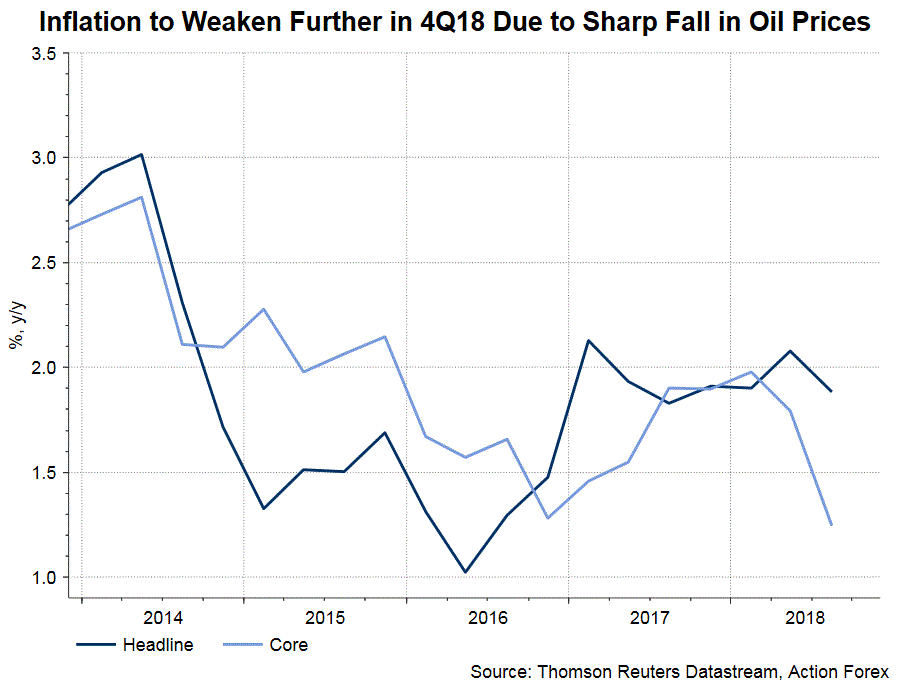
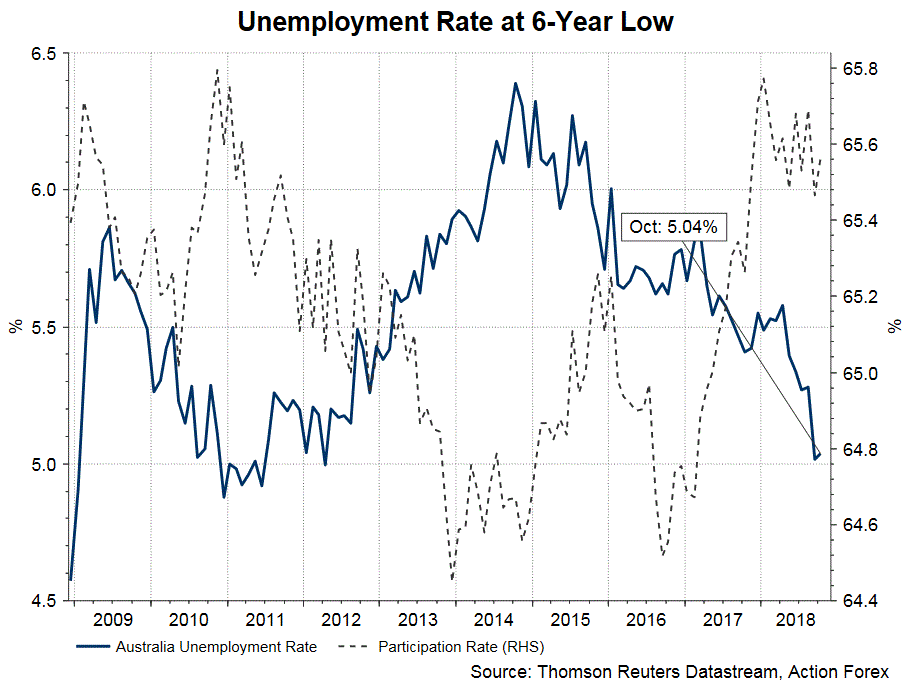
Inflation in Australia has been soft. Headline CPI in 3Q18 eased to +1.9% y/y, while core CPI weakened to +1.2%. Inflation probably weakened further in 4Q18, amidst the sharp fall in oil prices. Meanwhile, although the job market condition appears thriving with the unemployment rate staying at 6-year low of 5% in October, wage growth has been improving only gradually. Indeed, while RBA forecast that strong employment would result in “further lift in wages growth over time”, it believes that growth would be “gradual”. This should prolong the disinflationary situation in Australia and allowing the central bank to keep its powder dry for an extended period of time.
Eurogroup urged Italy to comply to EU budget rules
In a statement released today, the Eurogroup said Italy's 2019 Draft Budget Plan (DBP) was breaking EU rules and urged Italy to rectify it.
It said "The Eurogroup recalls that in its opinion issued on 23 October 2018 the Commission identified a particularly serious non-compliance with the recommendation addressed to Italy by the Council on 13 July 2018 and requested a revised DBP. Italy submitted a revised DBP on 13 November, on which the Commission issued another opinion on 21 November, confirming the existence of a particularly serious non-compliance with the Council recommendation."
And, "we support the Commission assessment and recommend Italy to take the necessary measures to be compliant with the SGP. We also support the ongoing dialogue between the Commission and the Italian authorities."
Also, the Eurogroup noted that five member states' DBP are "deemed to be at risk of non-compliance with the SGP", including Belgium, France, Portugal, Slovenia and Spain.
Fed Powell on longer term economic challenges
Fed chair Jerome Powell said in a speech that Fed has made "great deal of progress towards" a "strong economy and sound financial system". He pointed to unemployment rate at 3.7% and strong job creation. And there are others signs of strength beyond the labor market. He noted the decline in financial hardship, wage gains, increased household wealth, and elevated consumer confidence.
However Powell also pointed to some "longer-term challenges". Those include slow growth in wages for lower-income workers. Also, it's unclear if recent pick up in productivity is a sustainable trend. And, aging population is limiting labor supply growth and potential growth. Decline in economic mobility also reflects the difficulty faced by lower-income Americans in moving up the economic ladder.
Aussie steady after RBA stands pat at 1.50%, reactions muted
Australian Dollar trades mildly firmer against dollar after RBA left cash rate unchanged at 1.50%. But it's overall steady and mixed as reaction to RBA is rather muted. In short, RBA maintained that fall in unemployment rate will eventually lift inflation to target. But again, the central bank expected the progress to be "gradual", implying that there is no urgency to lift interest rate any time soon.
On the economy, the central scenario for GDP growth is to average around 3.5% in 2018 and 2019. Then it would slow to 2020 due to slower growth in export of resources. Outlook for labor market remains "positive". Improvement in the economy should see "some further lift in wages growth" over time, gradually. CPI is expected to pick up over the next couple of years gradually to. And, the central scenario if for inflation to be at 2.25% in 2019 and a bit higher in 2020.
Full statement below.
Statement by Philip Lowe, Governor: Monetary Policy Decision
At its meeting today, the Board decided to leave the cash rate unchanged at 1.50 per cent.
The global economic expansion is continuing and unemployment rates in most advanced economies are low. There are, however, some signs of a slowdown in global trade, partly stemming from ongoing trade tensions. Growth in China has slowed a little, with the authorities easing policy while continuing to pay close attention to the risks in the financial sector. Globally, inflation remains low, although it has increased due to the earlier lift in oil prices and faster wages growth. A further pick-up in core inflation is expected given the tight labour markets and, in the United States, the sizeable fiscal stimulus.
Financial conditions in the advanced economies remain expansionary but have tightened somewhat. Equity prices have declined and credit spreads have moved a little higher. There has also been a broad-based appreciation of the US dollar this year. In Australia, money-market interest rates have declined, after increasing earlier in the year. Standard variable mortgage rates are a little higher than a few months ago and the rates charged to new borrowers for housing are generally lower than for outstanding loans.
The Australian economy is performing well. The central scenario is for GDP growth to average around 3½ per cent over this year and next, before slowing in 2020 due to slower growth in exports of resources. Business conditions are positive and non-mining business investment is expected to increase. Higher levels of public infrastructure investment are also supporting the economy, as is growth in resource exports. One continuing source of uncertainty is the outlook for household consumption. Growth in household income remains low, debt levels are high and some asset prices have declined. The drought has led to difficult conditions in parts of the farm sector.
Australia's terms of trade have increased over the past couple of years and have been stronger than earlier expected. This has helped boost national income. Most commodity prices have, however, declined recently, with oil prices falling significantly. The Australian dollar remains within the range that it has been in over the past two years on a trade-weighted basis.
The outlook for the labour market remains positive. The unemployment rate is 5 per cent, the lowest in six years. With the economy expected to continue to grow above trend, a further reduction in the unemployment rate is likely. The vacancy rate is high and there are reports of skills shortages in some areas. The stronger labour market has led to some pick-up in wages growth, which is a welcome development. The improvement in the economy should see some further lift in wages growth over time, although this is still expected to be a gradual process.
Inflation remains low and stable. Over the past year, CPI inflation was 1.9 per cent and in underlying terms inflation was 1¾ per cent. Inflation is expected to pick up over the next couple of years, with the pick-up likely to be gradual. The central scenario is for inflation to be 2¼ per cent in 2019 and a bit higher in the following year.
Conditions in the Sydney and Melbourne housing markets have continued to ease and nationwide measures of rent inflation remain low. Credit conditions for some borrowers are tighter than they have been for some time, with some lenders having a reduced appetite to lend. The demand for credit by investors in the housing market has slowed noticeably as the dynamics of the housing market have changed. Growth in credit extended to owner-occupiers has eased to an annualised pace of 5–6 per cent. Mortgage rates remain low, with competition strongest for borrowers of high credit quality.
The low level of interest rates is continuing to support the Australian economy. Further progress in reducing unemployment and having inflation return to target is expected, although this progress is likely to be gradual. Taking account of the available information, the Board judged that holding the stance of monetary policy unchanged at this meeting would be consistent with sustainable growth in the economy and achieving the inflation target over time.
US-China Trade Ceasefire: Too Early to be Relieved
We remain cautious over the 90-day ceasefire on US- China trade dispute. Over the weekend, the US agrees to postpone raising tariff on US$200B worth of Chinese goods from 10% to 25%. In return, China would buy significant amount of US goods within agriculture, energy and industry products. Meanwhile, both sides would immediately begin negotiations on “structural changes with respect to forced technology transfer, intellectual property protection, non-tariff barriers, cyber intrusion and cyber theft, services and agriculture”. Our reservation about the truce lies on the fact that the size of China's purchase of US goods is unspecified. Moreover, the concessions China made are related to drug control and a merger deal of two technology companies. These are not the top-prioritized issues in the trade dispute. Indeed, there is no guideline on how to deal with the matters of intellectual property transfer, China’s support on state-owned enterprises and “Made in China 2025”.
While It Makes Economic Sense to Reach a Deal...
With global economic growth has moderated in the second half of this year and will persist in 2019, Trump and Xi understand trade war is detrimental to both sides. China’s economic growth is obviously affected since Trump imposed the first trade tariff in mid-2018. The authority’s economic policy has shifted from deleveraging to growth stimulation. While the Fed has increased interest rates for three times so far this year, PBOC lowered the required reserve ratio for four times. The monetary policy divergence is detrimental to renminbi. USDCNY has risen 6-7% since the beginning of the trade war. Renminbi’s weakness would have been more pronounced if it had been allowed to float freely.
While staying strong, US GDP growth in 3Q18 has shown signs of easing, as the effects of fiscal reform fades. US inflation has also been moderating over the past few months, while still hovering around Fed’s +2% target. Last week, Fed Chair Jerome Powell’s dovish shift, suggesting the policy rate is “just below” neutral, has led the market trim expectations of rate hikes in 2019.
Uncertainty Remains High amidst Hawkish Stance on Both Governments
Both Trump and Xi would hope to reach a deal as soon as possible. Yet, trade is not just an economic issue. More often it is political. It is interesting to see China downplay its concession made for the ceasefire. It merely mentioned in its official statement that it would increase imports from the US according to the people’s demand. It refrained from describing the amount of purchase as “substantial” or “huge”. While US Treasury Secretary Steven Mnuchin noted that China has agreed to eliminate tariffs on imported automobiles, China stayed silent on the matter. Meanwhile, China did not mention in the statement that there is a 90-day negotiation timeline before the tariffs would be raised to 25% if there is no agreement by the end of the period. Deriving its legitimacy to rule from nationalism, the Chinese Communist Party is reluctant to display to the people its weakness in foreign affairs.
Seeking a second term for his presidency, Trump is keen on getting some benefit from the trade deal with China. We expect that Trump to want to get a trade deal done by 2019. Yet, it might not be easy to strike a balance between standing firm and not risking domestic economic growth.