Sample Category Title
GBP/USD Mid-Day Outlook
Daily Pivots: (S1) 1.2721; (P) 1.2766; (R1) 1.2796; More...
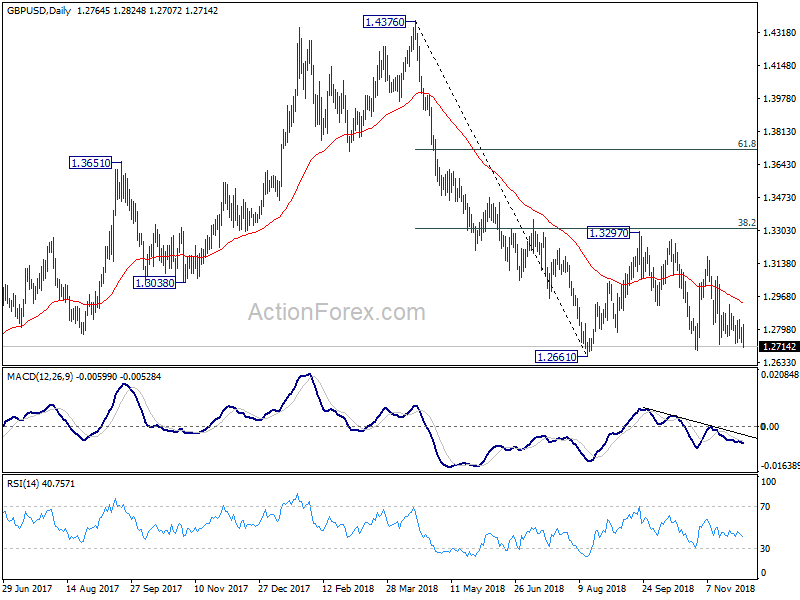
GBP/USD's break of 1.2725 suggests recent fall is resuming. Intraday bias is turned back to the downside for 1.2661 low. Decisive break there will resume larger down trend from 1.4376. On the upside, above 1.2824 minor resistance will turn intraday bias to the upside for rebound. After all, price actions from 1.2661 are viewed as a consolidation pattern. Even in case of strong rebound, upside should be limited by 1.3316 fibonacci level to bring down trend resumption eventually.
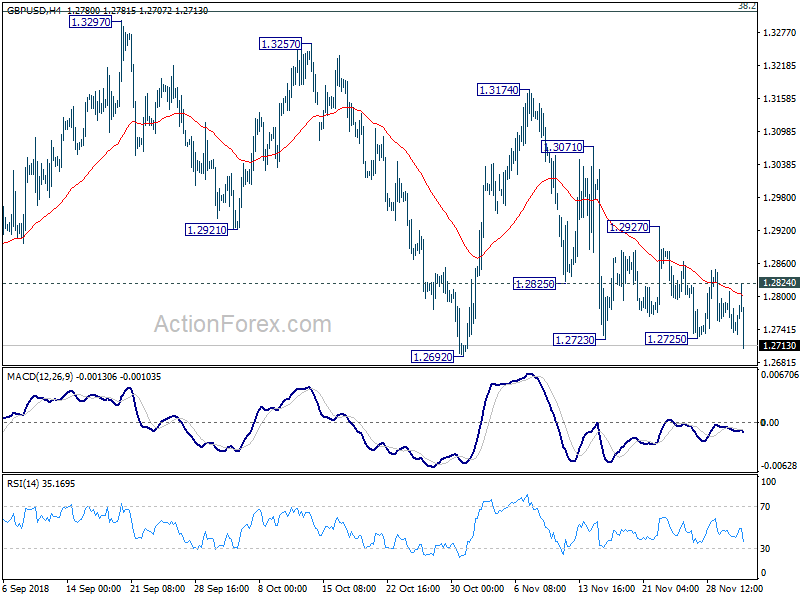
In the bigger picture, whole medium term rebound from 1.1946 (2016 low) should have completed at 1.4376 already, after rejection from 55 month EMA. The structure and momentum of the fall from 1.4376 argues that it's resuming long term down trend. And this will be the preferred case as long as 38.2% retracement of 1.4376 to 1.2661 at 1.3316 holds. However, firm break of 1.3316 would bring stronger rebound to 61.8% retracement at 1.3721. And, the eventual depth of the fall from 1.4376, and the chance of hitting 1.1946 low, will depend on the strength of the interim corrective rebound from 1.2661.
Sentiments Supported by Trade Truce, But Sterling Down on Renewed Brexit Worries
The global financial markets are blessed by strong risk appetite today, as US and China agreed on 90 days ceasefire on trade war. US stock futures point to sharply higher open, following strengthen and European and Asian markets. Australian Dollar, being a close trade partner of both the US and China, and a risk sensitive currency, is the strongest one. Canadian Dollar follows with help from rebound in oil price. Meanwhile, Sterling is the weakest one for today on renewed selloff over Brexit vote worry. For now, it's likely that the Brexit bill will be voted down by the Parliament on December 11. Yen is the second weakest while Dollar is mixed.
In other markets, major European indices are all trading with gains at the time of writing. FTSE is up 1.69%, DAXC is up 2.21% and CAC is up 1.00%. German 10 year yield is up 0.004 at 0.321. Italian 10 year yield is down -0.0495 at 3.164. German-Italian spread continues to narrow away from 300. There is no concrete result in the budget talk between Italy and EU yet. But just like what European Commission Vice President Valdis Dombrovskis said, "it is positive that the tone of discussion has changed". Earlier in Asia, Nikkei closed up 1.00% at 22574.76. China Shanghai SSE rose 2.57% to 2654.8. Hong Kong HSI rose 2.55% to 27182.04. Singapore Strait Times rose 2.34% to 3190.62.
Technically, AUD/USD's rise and EUR/AUD's fall are both in progress. GBP/USD's break of 1.2725 minor support suggests decline resumption for 1.2661 low. 144.02 in GBP/JPY and 0.8939 resistance in EUR/GBP will be watched to see if selloff in pound widens. USD/CAD's break of 1.3187 support today is a strong sign of near term bearish reversal after rejection by 1.3385 resistance.
Fed Clarida: It's a symmetric inflation objective around 2%
Fed Vice Chair Richard Clarida said in a Bloomberg interview that "we have a symmetric objective around 2 percent." And he emphasized that "two percent is not meant to be a ceiling". He added that "we've operated below 2 percent, we could operate somewhat above 2 percent, depending on the shocks." Clarida also said the US economy is in good shape with solid outlook. And, the current monetary policy framework is serving Fed well.
Eurozone PMI manufacturing finalized at 51.8, big four at the bottom
Eurozone PMI manufacturing is finalized at 51.8 in November, revised up from 51.5, down from October's 52.0. It's also the lowest since August 2016. Markit noted that growth of production is only marginal as demand continues to falter. Also, business confidence remains weakest in around six years. And, the euro area's 'big-four' economies posted the lowest manufacturing PMI readings of all countries covered by the survey during November.
Among the countries, Italy PMI manufacturing stayed in contraction and dropped to 48.6, a 47-month low. France PMI manufacturing dropped to 50.8, a 26-month low. Germany PMI manufacturing dropped to 51.8, a 31-month low. Spain PMI manufacturing dropped to 3-month low at 52.6.
Chris Williamson, Chief Business Economist at IHS Markit noted that "manufacturers reported that demand is now falling in Germany, France and Italy, while only modest growth was recorded in Spain." And, "the darker outlook is linked to trade wars and tariffs as well as intensifying political uncertainty and has led to increased risk aversion and a commensurate cutting back on expenditure, notably for investment.
UK PMI manufacturing rose to 53.1, lacklustre picture of manufacturing sector
UK PMI manufacturing rose to 53.1 in November, up from 51.1 and beat expectation of 52.0. Markit noted that trends in output and new orders strengthen slightly. But new export orders decrease for the second month running.
Rob Dobson, Director at IHS Markit. noted that "the November PMI provided a lacklustre picture of the UK manufacturing sector, as ongoing global trade tensions and Brexit uncertainty weighed on current business conditions and dampened the outlook for the year ahead."
Also released in European session, Swiss retail sales rose 0.8% yoy in October. PMI manufacturing rose to 57.7 in November versus expectation of 56.3.
Japan PMI manufacturing finalized at 52.2, momentum tilting towards a slowdown
Japan PMI manufacturing was finalized at 52.2 in November, revised up from 51.8. Markit noted that new orders rise at joint-weakest rate in just over two years. Also production growth moderates and business confidence drops for sixth month running.
Joe Hayes, Economist at IHS Markit noted that "October's bounce-back was indeed a transitory jump". And, "the underlying picture remains subdued, with momentum tilting towards a slowdown." " Subdued sales performances reflected fragile conditions both domestically and abroad. According to firms, weak demand from China and parts of Europe hampered export growth."
Also from Japan, capital spending rose 4.5% in Q3, much lower than expectation of 8.6%.
China Caixin PMI manufacturing rose to 50.2, domestic demand improved, overseas demand subdued
China Caixin PMI rose 0.1 to 50.2 in November, slightly above expectation of 50.1. Markit noted in the release that production is unchanged for the second month running. There is further in crease in total new work, but export trends remains subdued. Meanwhile, input cost inflation softens to seven-month low.
Dr. Zhengsheng Zhong, Director of Macroeconomic Analysis at CEBM Group noted in the release that "Overall, domestic demand across the manufacturing sector improved in November, while overseas demand was still subdued. Production slowed, confidence was relatively stable, capital turnover was improved, and upward pressure on industrial product prices eased. China's economy was weak, but did not show significant signs of deterioration."
AUD shrugs weak manufacturing, building and profits data
The Australian Industry Group Performance of Manufacturing Index dropped sharply by -7 to 51.3 in November. That's the lowest level since October 2017. It's still the twenty-six months of uninterrupted recovery and expansion, longest streak since 2005. Also from Australia, building approvals dropped -1.5% mom in October, below expectation of -1.4% mom. Company operating profits rose 1.9% qoq, below expectation of 2.9% qoq. From New Zealand terms of trade index dropped -0.3% qoq, below 0.1% qoq expectation.
GBP/USD Mid-Day Outlook
Daily Pivots: (S1) 1.2721; (P) 1.2766; (R1) 1.2796; More...
GBP/USD's break of 1.2725 suggests recent fall is resuming. Intraday bias is turned back to the upside for 1.2661 low. Decisive break there will resume larger down trend from 1.4376. On the upside, above 1.2824 minor resistance will turn intraday bias to the upside for rebound. After all, price actions from 1.2661 are viewed as a consolidation pattern. Even in case of strong rebound, upside should be limited by 1.3316 fibonacci level to bring down trend resumption eventually.
In the bigger picture, whole medium term rebound from 1.1946 (2016 low) should have completed at 1.4376 already, after rejection from 55 month EMA. The structure and momentum of the fall from 1.4376 argues that it's resuming long term down trend. And this will be the preferred case as long as 38.2% retracement of 1.4376 to 1.2661 at 1.3316 holds. However, firm break of 1.3316 would bring stronger rebound to 61.8% retracement at 1.3721. And, the eventual depth of the fall from 1.4376, and the chance of hitting 1.1946 low, will depend on the strength of the interim corrective rebound from 1.2661.
Economic Indicators Update
| GMT | Ccy | Events | Actual | Forecast | Previous | Revised |
|---|---|---|---|---|---|---|
| 21:30 | AUD | AiG Performance of Manufacturing Index Nov | 51.3 | 58.3 | ||
| 21:45 | NZD | Terms of Trade Index Q/Q Q3 | -0.30% | 0.10% | 0.60% | 0.40% |
| 23:50 | JPY | Capital Spending Q3 | 4.50% | 8.60% | 12.80% | |
| 0:00 | AUD | TD Securities Inflation M/M Nov | 0.00% | 0.10% | ||
| 0:30 | AUD | Company Operating Profit Q/Q Q3 | 1.90% | 2.90% | 2.00% | 2.40% |
| 0:30 | AUD | Building Approvals M/M Oct | -1.50% | -1.40% | 3.30% | 5.50% |
| 0:30 | JPY | PMI Manufacturing Nov F | 52.2 | 51.8 | 51.8 | |
| 1:45 | CNY | Caixin PMI Manufacturing Nov | 52.6 | 50.1 | 50.1 | |
| 8:15 | CHF | Retail Sales Real Y/Y Oct | 0.80% | -0.70% | -2.70% | |
| 8:30 | CHF | PMI Manufacturing Nov | 57.7 | 56.3 | 57.4 | |
| 8:45 | EUR | Italy Manufacturing PMI Nov | 48.6 | 48.9 | 49.2 | |
| 8:50 | EUR | France Manufacturing PMI Nov F | 50.8 | 50.7 | 50.7 | |
| 8:55 | EUR | Germany Manufacturing PMI Nov F | 51.8 | 51.6 | 51.6 | |
| 9:00 | EUR | Eurozone Manufacturing PMI Nov F | 51.8 | 51.5 | 51.5 | |
| 9:30 | GBP | PMI Manufacturing Nov | 53.1 | 52 | 51.1 | |
| 14:30 | CAD | Manufacturing PMI Nov | 53.9 | |||
| 15:00 | USD | Construction Spending M/M Oct | 0.40% | 0.00% | ||
| 14:45 | USD | Manufacturing PMI Nov F | 55.4 | 55.4 | ||
| 15:00 | USD | ISM Manufacturing Nov | 57.5 | 57.7 | ||
| 15:00 | USD | ISM Prices Paid Nov | 70.5 | 71.6 | ||
| 15:00 | USD | ISM Employment Nov | 56.8 |
Fed Clarida: It’s a symmetric inflation objective around 2%
Fed Vice Chair Richard Clarida said in a Bloomberg interview that "we have a symmetric objective around 2 percent." And he emphasized that "two percent is not meant to be a ceiling". He added that "we've operated below 2 percent, we could operate somewhat above 2 percent, depending on the shocks."
Clarida also said the US economy is in good shape with solid outlook. And, the current monetary policy framework is serving Fed well.
GOLD: Outlook Remains Higher With Eyes On 1,235 Area
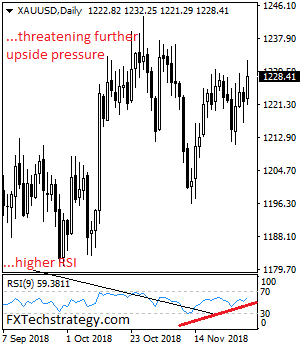
GOLD outlook remains higher with eyes on 1,235.00 area. This is coming on the back of its intra day strength during Monday trading session. On the downside, support comes in at the 1,215.00 level where a break will turn attention to the 1,205.00 level. Further down, a cut through here will open the door for a move lower towards the 1,200.00 level. Below here if seen could trigger further downside pressure targeting the 1,190.00 level. Conversely, resistance resides at the 1,235.00 level where a break will aim at the 1,240.00 level. A turn above there will expose the 1,250.00 level. Further out, resistance stands at the 1,260.00 level. All in all, GOLD looks to strengthen further higher.
DAX Rockets after Tump-Xi Agree to Truce on Tariffs
The DAX index has started the week in style, jumping 2.4% in the Monday session. Currently, the DAX is at 11,532, up 2.46%. Earlier in the day, the index touched 11,568, its highest since November 14. On the release front, German and eurozone manufacturing PMIs both missed their estimates, with both indicators posting readings of 51.8 points.
The G-2o summit was a big success as far as the markets were concerned. Investors paid scant attention to the discussions between world leaders, focusing instead on a weekend dinner meeting between President Trump and Chinese President Xi Jinping. Just last week, Trump had threatened to raise tariffs on $200 billion in Chinese products from 10 percent to 25 percent on January 1. However, the tone was optimistic after the meeting, with China receiving a short reprieve. The sides have agreed to continue talks for another 90 days, and the U.S. tariffs will take effect if no agreement is reached. The markets were clearly relieved that the tariff war has de-escalated, and European markets have jumped on Monday, following the lead of Asian markets. At the same time, the U.S. and China remain far apart on resolving the trade war, and the greenback will likely reverse directions unless the parties make substantial progress in the trade dispute, which has shaken the markets and threatens to derail global growth.
German indicators have been pointing lower, and this worrying trend continued on Monday. Manufacturing PMI dropped to 51.8 in November, down from 52.2 points in October. This marked a fourth straight downturn and was the lowest reading since April 2016. The global trade war has taken a bite out of German exports and a slowdown in the eurozone economy has dampened manufacturing growth in Germany. On Friday, German retail sales fell by 0.3%, its first decline since July. Consumers are holding tighter to the purse strings, which is hurting economic growth. Unsurprisingly, consumer confidence softened in November – the reading of 10.4 points was its lowest level since May 2017.
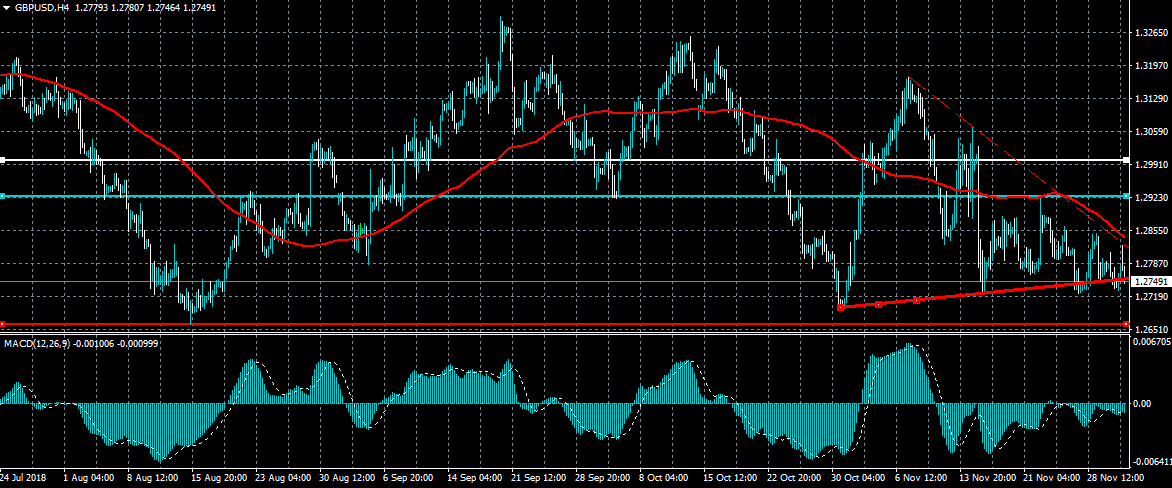
GBPUSD Triangle Resistance Holds
The British pound has moved sharply lower against the US dollar during the European trading session, following a strong technical rejection from trendline resistance. The GBPUSD pair is now probing support from the well-defined triangle pattern across the lower time frames. A sustained breach of key trendline support could trigger losses towards the November trading low.
The GBPUSD pair is strongly bearish while trading below the 1.2750 level, key technical support is found at the 1.2695 and 1.2662 levels.
If the GBPUSD pair trades above the 1.2800 level, key resistance is now found at the 1.2830 and 1.2855 levels
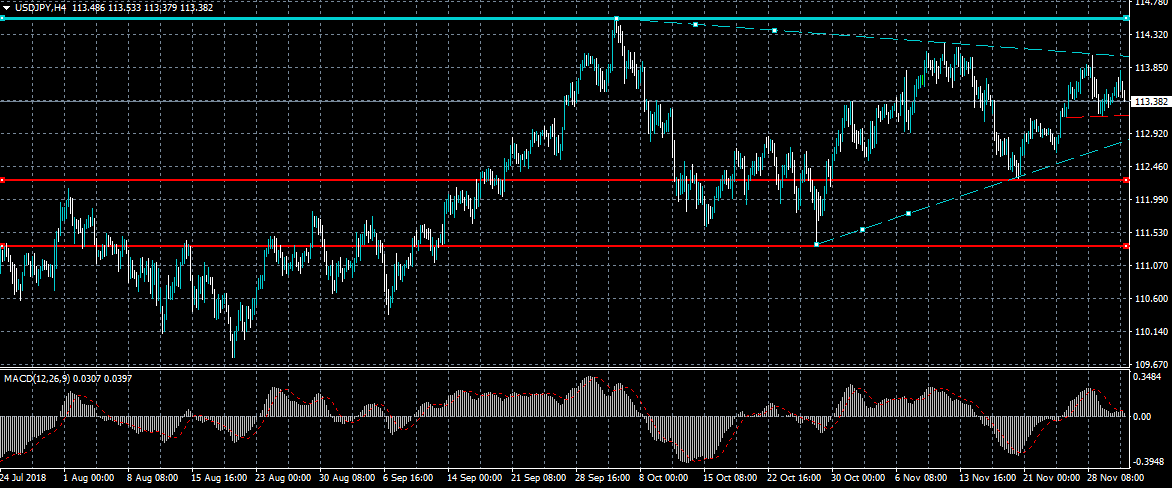
USDJPY Upside Looks Increasingly Weak
The US dollar is starting to weaken against the Japanese yen currency, following another major technical rejection before the 114.00 resistance level. The recent bullish momentum is starting to look increasingly weak, with a major test of key support now the most likely scenario. Traders now look to the release of the ISM Manufacturing Index from the United States economy.
The USDJPY pair is intraday bearish while trading below the 113.15 level, key support is found at the 112.85 and 112.30 levels.
If the USDJPY pair trades above the 114.00 level, key technical resistance is found at the 114.54 and 115.00 levels.
Qatar To Withdraw From OPEC, Oil Surged About 5 Percent
Qatar said on Monday it was quitting OPEC from January 2019 but would attend the oil exporter group’s meeting this week, saying the decision meant Doha could focus on cementing its position as the world’s top liquefied natural gas (LNG) exporter.
Doha, one of the smallest oil producers in the Organization of the Petroleum Exporting Countries, is locked in a diplomatic dispute with the group’s de facto leader Saudi Arabia but said the move to leave OPEC was not driven by politics.
Minister of State for Energy Affairs Saad al-Kaabi told a news conference that Qatar, which he said been a member of OPEC for 57 years, would still attend the group’s meeting on Thursday and Friday this week, and would abide by its commitments.
“Qatar has decided to withdraw its membership from OPEC effective January 2019 and this decision was communicated to OPEC this morning,” the minister said. One OPEC source told Reuters the decision was more symbolic than anything else. “They are not a big producer, but have played a big part in it’s (OPEC) history,” the source said.
Qatar has oil output of only 600,000 barrels per day (bpd), compared with the 11 million bpd produced by Saudi Arabia, the group’s biggest oil producer and world’s biggest exporter. But Doha is an influential player in the global LNG market with annual production of 77 million tonnes per year, based on its huge reserves of the fuel in the Gulf.
Oil prices surged about 5 percent on Monday after the United States and China agreed to a 90-day truce in their trade war, but Brent crude is still trading at around $62 a barrel, well below October’s peak of more than $86.
USDJPY Breaking Lower, S&P500 Turning For A Gap
Stocks also gaped lower, but what is interesting is that despite higher stocks USDJPY is weakening at the moment, which tells us how weak USD really is today. Technically speaking, we see USDJPY breaking out of minor corrective upward channel which suggests a continuation towards 113.00.
USDJPY, 30Min
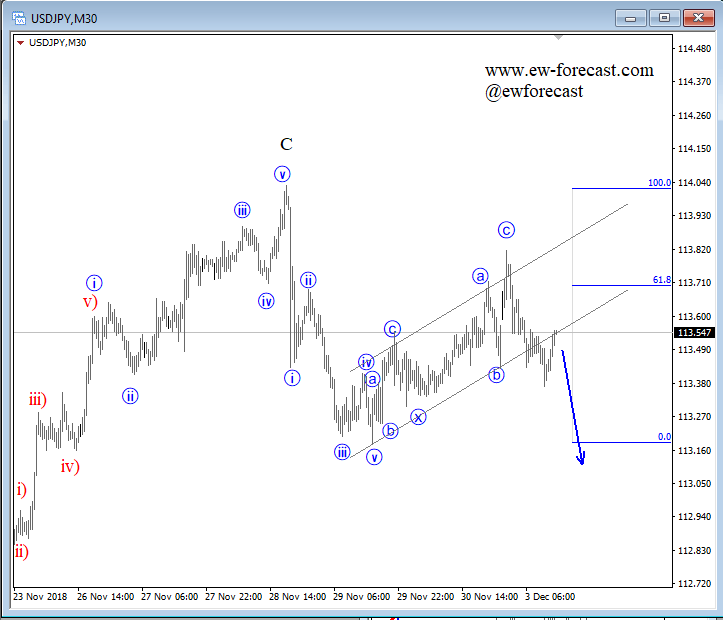
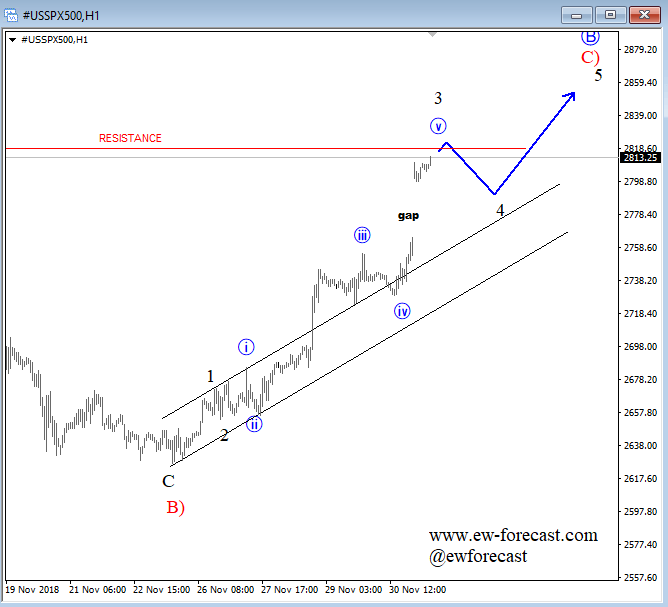
JPY can also move much higher if we consider that stocks can turn south to fill a gap. E-mini S&P500 has it around 2765.
S&P500, 1h
WTI Oil Outlook: Oil Generates Initial Reversal Signal On Monday’s Gap-Higher Open And Lift Above Falling 10SMA
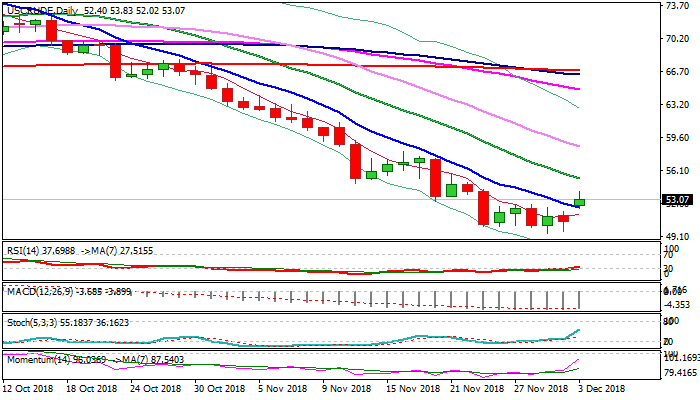
WTI oil jumped near $54 per barrel (the highest since 23 Nov) on Monday, following weekly opening with 176 pips gap-higher.
Improved sentiment on the latest agreement between the US and China to pause tariff hike for 90 days and give time to try to find solution, boosted oil prices.
Initial signal of reversal was generated on Monday's open above falling 10SMA ($52.11) which marked initial breakpoint and now acts as support.
Reduced concerns about lower demand on trade war and global oversupply started to fade, with renewed optimism in the market, offer good support for oil prices, which may extend recovery on rising bullish sentiment.
Another factor that could further boost oil prices is reduction of the output, announced by OPEC and Russia, but needs verification on cartel's meeting due on 6 Dec.
Substantial cut in oil production is needed to sustain recovery, with promising signals coming from OPEC and Russia.
Technical studies are regaining momentum with close above broken 10SMA ($52.11) and 200WMA ($52.31) seen as initial signal.
Further recovery extension and break above falling 20SMA ($55.31) is needed to confirm scenario.
Res: 53.83, 54.80, 55.31, 56.08
Sup: 52.31,52.11, 51.61, 50.44