Sample Category Title
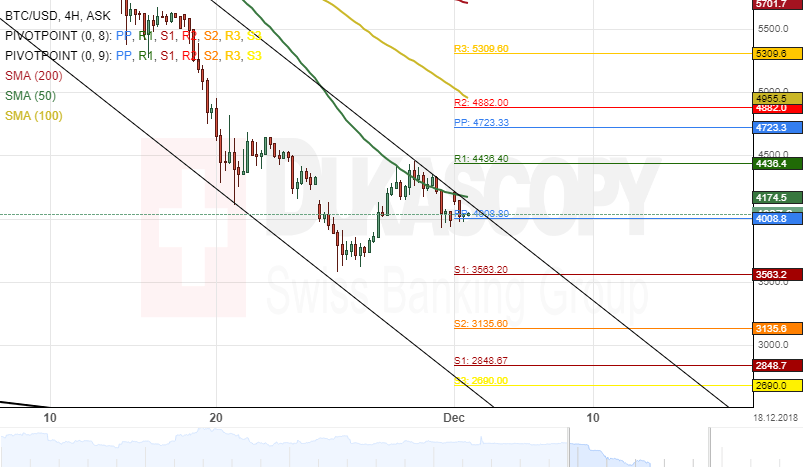
BTC/USD 4H Chart: Decline Continues
The BTC/USD pair has been trading in a junior descending channel pattern is the beginning of November.
From a technical point of view, the bitcoin cryptocurrency is likely to continue its downside momentum. The potential target for the pair will be at the bottom border of the channel pattern at 2848.6.
However, the cryptocurrency needs to surpass support levels formed by the weekly and monthly PPs at 3563.2/3135.6 area. If this support level holds, it is likely that the pair goes upside towards the 50-hour simple moving average at 4182.5.
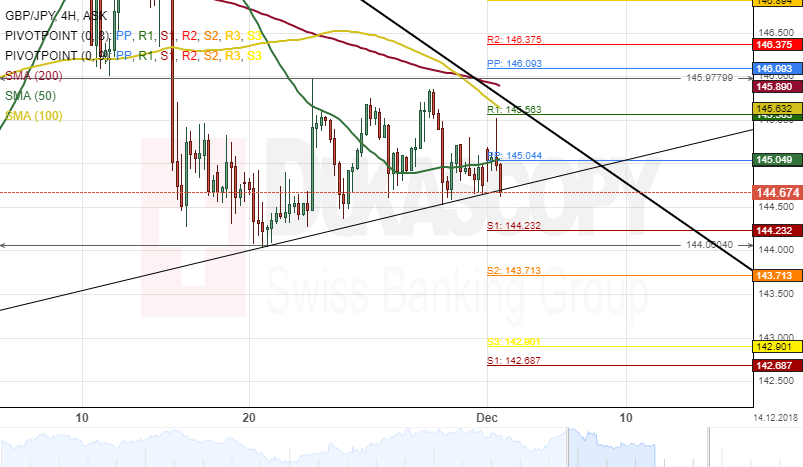
GBP/JPY 4H Chart: Symmetric Triangle Pattern
The British Pound has been trading in a symmetric triangle pattern against the Japanese Yen since the end of October.
The currency pair is trading near the bottom border of the triangle pattern at 145.16 during the morning hours of today's session. From a theoretical point of view, a breakout is likely to occur within this session. A potential downside target will be at October swing low of 142.90.
On the other hand, the GBP/JPY currency exchange rate could reverse from the current price level and aim for a resistance cluster formed by the combination of the 100– and 200-hour SMAs at 145.90.
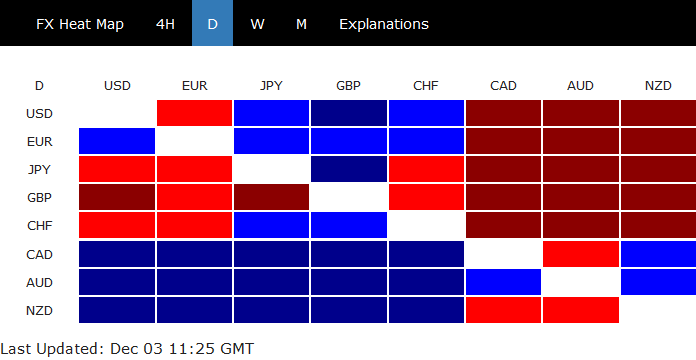
European update: AUD stays strong, Sterling tumbles on Brexit worries
Australian Dollar remains the strongest one today as boosted by US-China trade war ceasefire. And it's still extending rally. RBA rate decision tomorrow is unlikely to alter the Aussie's path. Canadian Dollar follows as the second one on strong rebound in oil price. Kiwi is the third strongest for now.
On the other hand, Sterling is suffering fresh selling as focus is turning to Brexit vote in the parliament on December 11. For now, there is high risk of having the Brexit bill voted down. Swiss Franc and Yen follow as the next weakest on strong risk appetite.
In European markets, for now:
- FTSE is up 2.15%
- DAX is up 2.41%
- CAC is up 1.50%
- German 10 year yield is up 0.006 at 0.323
- Italy 10 year yield is down -0.050 at 3.163. Development is rather positive.
- WTI crude oil hit as high as 53.83 but it's now back at 53.10
Earlier in Asia:
- Nikkei closed up 1.00% at 22574.76
- China Shanghai SSE rose 2.57% to 2654.8
- Hong Kong HSI rose 2.55% to 27182.04
- Singapore Strait Times rose 2.34% to 3190.62
Global Markets Surge On Trade Truce Hopes, Qatar Leaving OPEC Not Particularly Impacting Oil Price
Optimism over the temporary trade truce announced between the United States and China after the G-20 summit in Argentina last weekend has played a massive role in lifting global investor risk appetite at the beginning of the new trading week.
Improved risk appetite is seen throughout a variety of different asset classes across the globe, including a stronger mood for stock markets and a number of emerging market currencies benefiting from added investor appetite towards taking on further exposure towards risk in their portfolios.
Away from improved risk appetite, one of the key takeaways from the market fluctuations on Monday is that there is a resumption of Dollar softness in the market. It has long been documented that alleviated trade tensions would reduce buying demand for the Greenback; further progress towards the easing of trade tensions, coupled with a more downbeat tone from the Federal Reserve regarding interest rate expectations is presenting an interesting opportunity for traders to take-profit from USD buying positions.
EM currencies jump against USD
All of the currencies in the APAC region are trending higher against the Dollar, with the exception of the Indian Rupee that has declined 0.85% at time of writing as a result of local data missing expectations. A similar trend has been noted across the EMEA and it will be monitored whether this rally could extend into Latin America later this afternoon.
The South Korean won, which is often measured as the Asian currency proxy for investor appetite towards risk is higher by more than 0.9% while the Chinese Yuan has advanced by 1%. Both the South African Rand and Mexican Peso are each over 1.7% higher on trade truce optimism.
Rally shows how sensitive global markets are to trade tensions
The rally that we are experiencing across different asset classes goes to show that in spite of the trade tensions between the United States and China being seen as bilateral issues between themselves, being two major global economic powers means this does have huge ramifications for global market optimism.
The downturn in global economic data throughout the second half of the year has pointed out to many that the prolonged trade tensions are having a disruptive influence on the global economy. It would be of benefit to all for these tensions to go away completely.
WTI Oil joins the risk-on trade
WTI Oil jumped as much as 5% in the early hours of Monday trading, which goes a long way towards explaining how global market optimism and previous concerns around the impact of trade tensions can have on demand for commodity markets.
In recent weeks Oil has suffered severely from global economic health concerns stemming from trade tensions leading to lower demand for Oil, and if there is further progression with this issue it would be seen as a potential “buy” for the Oil markets.
The news of Qatar pulling out of OPEC in January 2019 will be seen as a negative headline for the cartel, but I am not heavily convinced this will have high impact on the Oil market. Qatar has already stated that this decision is not linked to the political conflict that led to Qatar being blocked by many of its regional peers in June 2017, but because they prefer to focus on the Gas industry.
It is important to remember that OPEC has gradually lost an increasing amount of its influence on the Oil industry over the past couple of years and is instead trying to co-operate more with outside producers, therefore I wouldn’t expect the news that Qatar is going to leave the cartel to be a big blow for the group as long as relations with Qatar can be maintained.
Will the market rally have the legs to extend into Christmas?
If there is further progression over trade tensions between the United States and China then this has the potential to create a heavy market rally before trading wraps up for 2018. The main question that investors now need answers for is how long can this trade truce rally really last, and is it also possible for further progress in trade talks between the United States and China from this trade truce?
Truce – All Is Good, Oil Rallies 5%, Dollar Down And Yields Higher
Monday December 3: Five things the markets are talking about
Global equities have rallied overnight, alongside U.S Treasury yields, while the ‘big’ dollar trades under pressure after the U.S and China declared a temporary truce in their Sino-U.S trade war.
No progress was made on key differences regarding intellectual property and forced technology transfers. The U.S was promised to see China buying more goods to narrow the trade gap, while China received reprieve on increased tariffs for the time being.
Crude oil has rallied on optimism OPEC+ will address a glut in global supply later this week, while the EUR has found some support on news that the Italian government may accept a lower deficit target.
This week there are three central bank meetings; the Reserve Bank of Australia (Dec 3), the Reserve Bank of India (Dec 5) and Bank of Canada (Dec 5) will hold policy meetings. Market consensus expects the respective policies to remain unchanged.
Elsewhere, there is also a slew of updated economic data including final manufacturing, services and composite PMI’s for last month. Down-under, Australia will deliver Q3 GDP, while on Wednesday Fed chair Powell is expected to testify on “The Economic Outlook” before Congress’s Joint Economic Committee (tentative).
On tap: U.S financial markets will close on Wednesday (Dec 5) for a national day of mourning to honour former President George H.W. Bush.
1. Stocks rally hard
The truce between the world’s two largest economies at the G20 summit in Argentina on the weekend has gone some way in calming investor fears over the state of global growth.
In Japan, the Nikkei surged to a six-week high overnight after the U,S and China suspended the imposition of new tariffs and agreed to try to reach a trade deal within three months. The index share average rallied +1.0%, the highest closing level since Oct. 22. The broader Topix rallied +1.3%.
Down-under, Aussie stocks tracked global gains on the Sino-U.S truce pact. The S&P/ASX 200 index rallied +1.8%, posting its best intraday gain in 15-months. The benchmark index finished -1.6% lower on Friday. In S. Korea, the Kospi closed +1.67% higher, supported by tech giant Samsung and other large caps.
In China, stocks, commodities and the yuan currency surged even as uncertainty remained about the deal. The benchmark Shanghai Composite index closed +2.6% higher and the blue-chip CSI300 index rallied +2.8%. Both posted their best daily gains since Nov. 2.
In Europe, regional indices trade sharply higher following G20 summit agreements. On the corporate front shares of oil and automobile giants trade higher on President Trump’s tweet that China agreed to reduce and eliminate tariffs on U.S made cars.
On Wall Street, futures point to an opening gain of +1.8% for the S&P 500 and +1.9% for the DJ Industrial Average.
Indices: Stoxx600 +1.92% at 364.08, FTSE +2.25% at 7,137.18, DAX +2.61% at 11,550.95, CAC-40 +2.04% at 5,105.39, IBEX-35 +1.72% at 9,234.00, FTSE MIB +2.18% at 19,607.50, SMI +1.68% at 9,152.60, S&P 500 Futures +1.8%
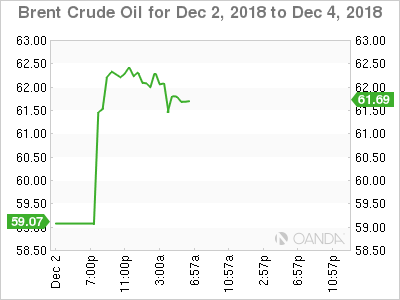
2. Oil surges +5% on trade truce, gold higher
Oil prices jumped by more than +5% after the Sino-U.S 90-day trade truce, and ahead of this week’s OPEC+ meeting (Dec 6), where producers are expected to cut supply.
Brent crude has rallied +5.3% or +$3.14 to a high of $62.60, while U.S light crude oil rose +$2.92 a barrel to a high of +$53.85, up +5.7%, before easing to around +$53.00.
The U.S/China trade war has weighed heavily on global trade and has generated concerns of an economic slowdown. Despite oil not been included in the list of products facing import tariffs, the market sees the positive sentiment of the truce.
Oil also received support from Canada, where Alberta indicated that it would force producers to cut output by -8.7%, or -325Kbpd, to deal with a pipeline bottleneck that has led to crude building up in storage.
OPEC+ will meet on Dec. 6 to decide output policy. The group, along Russia, is expected to announce cuts aimed at reining in a production surplus.
Note: Qatar indicated this morning that they would leave OPEC in January – their oil production is only around +600K bpd, but it is the world’s biggest exporter of liquefied natural gas.
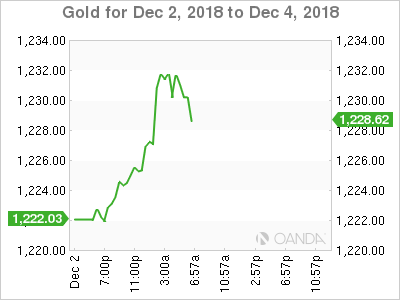
Ahead of the U.S open, gold prices have hit a three-week high on a weaker dollar, as a trade ceasefire between the U.S and China revived investor demand for riskier assets. Spot gold has climbed +0.7% to +$1,230.78 per ounce. U.S gold futures are up +0.8% at +$1,235.2 per ounce.
3. Budget compromise hopes push Italian yields lower
Italy’s borrowing costs fell to their lowest level in two-months earlier this morning after a number of reports that Italy is negotiating with the E.U to reduce its 2019 target for the budget deficit to +2.0% of GDP.
Also, demand for riskier assets, like Italian BTP’s, was supported by the weekend’s Sino-U.S trade truce. That in turn dented safe-haven German debt, with 10-year yields pulling away from their three-month print last week.
Ten-year Italian bond yields fell -6 bps to a two-month low at +3.15%. That narrowed the gap over benchmark German Bund yields to around +279 bps — its’ tightest in two-months.
Elsewhere, Germany’s 10-year Bund yield has backed up +2 bps to +0.33%, the largest advance in a week. The yield on U.S 10-year note has rallied +5 bps to +3.04%, the biggest increase in a month. In The U.K, the 10-year Gilt yield has climbed +2 bps to +1.381%, the first advance in a week.
4. For now, dollar under pressure
The U.S dollar is under pressure following the breakthrough in trade talks between the world’s two largest economies over the weekend as the market opts to take on more risk.
U.S dollar ‘bears’ will remain wary of a sustained breakthrough in trade tensions that could encourage the Fed to deliver more monetary tightening next year.
Sterling briefly traded above £1.28 before fading down -0.37% to £1.2731. The balance of risks for the pound remains skewed to the downside in the near-term, as Brexit uncertainty is set to remain elevated.
Note: U.K Politicians have signed a letter arguing the government was in contempt of parliament for not publishing the AG Cox’s legal advice pertaining to the Brexit agreement.
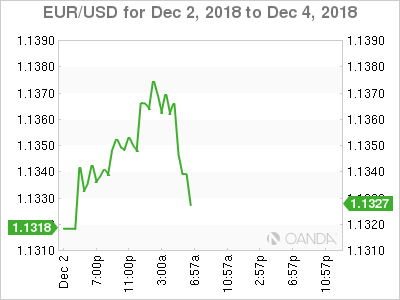
The EUR (€1.1350) trades over +0.2% higher as overall risk-on dominates for now, as well as Italian Budget deficit target compromise is helping to lift the pair. The Japanese yen has climbed +0.1% to ¥113.45, the strongest in more than a week.
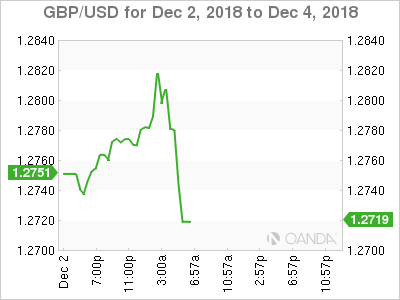
5. U.K man-PMI leaves Brexit driven pound under pressure
The pound stays atop of its intraday lows despite the U.K manufacturing purchasing managers’ survey for November rising to a two-month high of 53.1 from October’s 27-month low of 51.1.
Brexit worries continue to weigh on the currency and with that, economic data takes a backseat in terms of importance.
Presently, the fate of the pound now rests on the U.K vote on Brexit next week (Dec 11) rather than on fundamentals.
IHS Markit stated, “the performance of the sector remained comparatively lacklustre, with the latest PMI reading still among the weakest registered over the past two-and-a-half years.”
Elsewhere, European PMI’s were mixed, France, Spain, Germany among those which beat forecasts, while Italy misses, reaching an almost four-year low.
EUR/USD – Euro Posts Gains As Trump Holds Off On New Chinese Tariffs
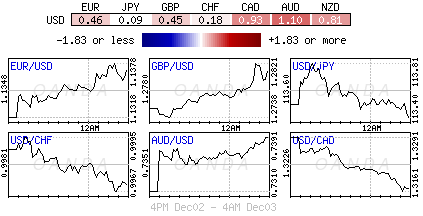
EUR/USD has posted gains in the Monday session. Currently, the pair is trading at 1.1347, up 0.25% on the day. On the release front, German and eurozone manufacturing PMIs both missed their estimates, with both indicators posting readings of 51.8 points. In the U.S, today’s key event is ISM Manufacturing PMI, which is expected to tick lower to 57.7 points. On Tuesday, the eurozone releases PPI, which is expected to remain pegged at 0.5%.
German indicators have been pointing lower, and this worrying trend continued on Monday. Manufacturing PMI dropped to 51.8 in November, down from 52.2 points in October. This marked a fourth straight downturn and was the lowest reading since April 2016. The global trade war has taken a bite out of German exports and a slowdown in the eurozone economy has dampened manufacturing growth in Germany. On Friday, German retail sales fell by 0.3%, its first decline since July. Consumers are holding tighter to the purse strings, which is hurting economic growth. Unsurprisingly, consumer confidence softened in November – the reading of 10.4 points was its lowest level since May 2017.
The G-20 summit ended on the weekend, and there was an audible sigh of relief from the markets after a meeting between President Trump and Chinese President Xi Jinping. Trump suspended his threat to raise tariffs on Chinese products on January 1 from 10 percent to 25 percent. The sides agreed to continues talks for another 90 days, and the U.S. tariffs will take effect if no agreement is reached. The ‘cease fire’ was welcome news for investors, and the increase in risk appetite on Monday has led to broad losses for the U.S. dollar. Still, the U.S. and China remain far apart on a deal, and the greenback will likely reverse directions unless the parties make substantial progress in the trade dispute, which has shaken the markets and threatens to derail global growth.
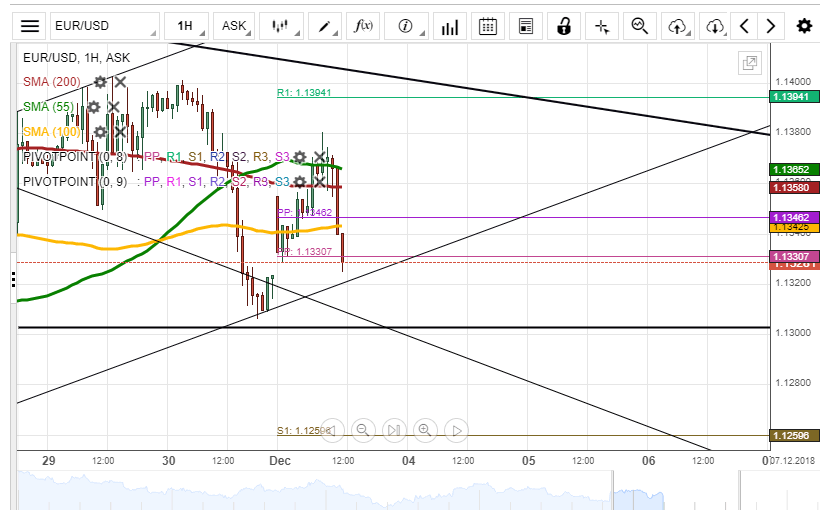
EUR/USD Recovers Itself To Trade At 1.1360
During Friday's trading session, the currency exchange pair depreciated by 0.83% breaking most of the technical indicators to end the trading session at 1.1337. On Monday morning, the European Single Currency surged to the 1.1360 mark.
In regards to the near-term future, most likely, the currency exchange rate will move sideways to trade between the weekly R1 at 1.1394 and the monthly pivot point at 1.1346. The 200-hour simple moving average should support the rate during the trading day on Monday.
On the other side, today's US ISM Manufacturing PMI data release could push the European Single Currency to meet the weekly R1 at 1.1394 mark.
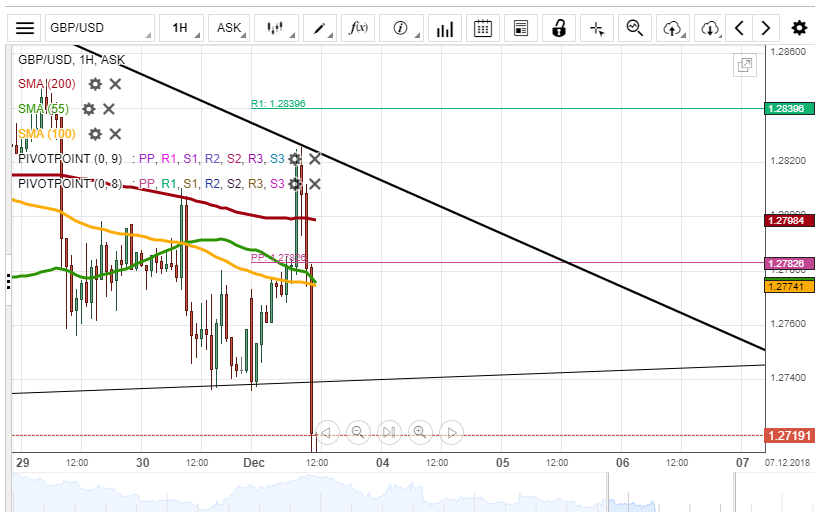
GBP/USD Will Trade Sideways
During Friday's trading session, the currency exchange rate was resisted by the 100-hour SMA to end the trading session at the 1.2745 mark. On Monday morning, the British Pound was trading between the 200-hour and the 100-hour simple moving averages at the 1.2780 mark.
In regards to the near-term future, most likely, the currency exchange rate will trade sideways during the day. It is expected that the 200-hour simple moving average will resist the rate to trade below the weekly pivot point at the 1.2782 mark.
However, the 100-hour simple moving average could support the British Pound to trade above the weekly pivot point at the 1.2780 level on Monday.
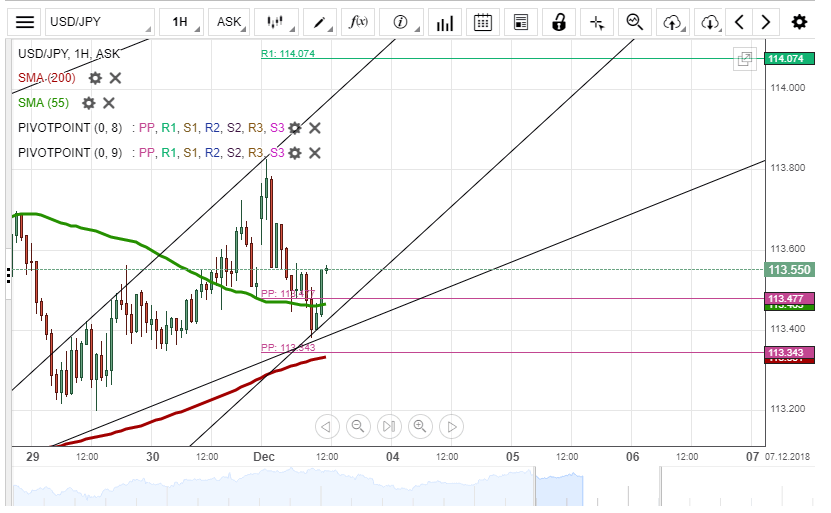
USD/JPY Trades Between Pivot Points
During Friday's trading session, the currency exchange rate passed through the support of the weekly pivot point at 113.47 to end the trading session at the 113.55 mark. On Monday morning, the US Dollar was located between the weekly pivot point and the monthly pivot point at the 113.44 mark.
In regards to the near-term future, most likely the US Dollar will surge towards the weekly R1 at 114.07 due to the supports of the monthly pivot point at 113.34 and the 200-hour simple moving average at 113.32.
However, the US Dollar could be resisted by the resistance levels of the 55-hour SMA and the weekly pivot point at 113.47 to push the rate to trade at 113.00 level.
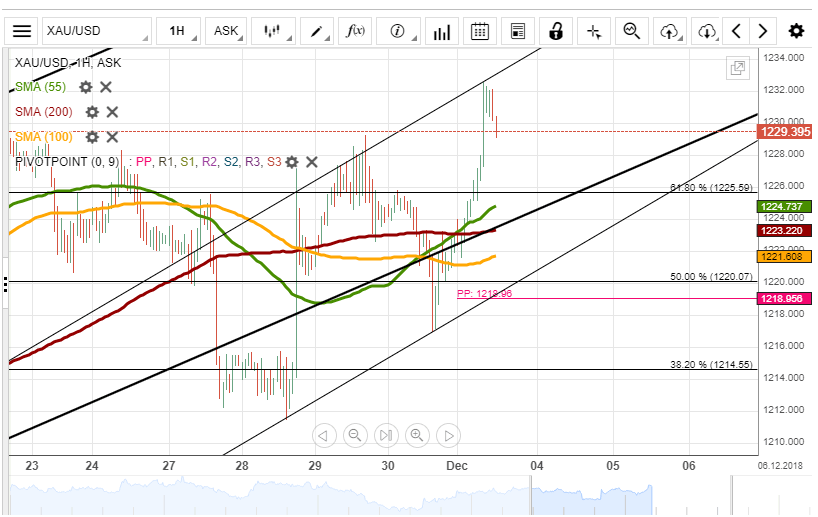
XAU/USD Surges To 1,232.00
During Friday's trading session, the yellow metal depreciated to 1216.88 mark breaking most of the technical indicators. During Monday morning hours, the yellow metal was supported by the 55-hour and the 200-hour simple moving averages to surge to the 1,231.10 mark.
In regards to the near-term future, the yellow metal might continue to surge upwards to trade at 1,234.00 level on Monday. Besides, the 55-hour simple moving average will try to catch up the rate during the day.
However, the gold could depreciate to the 61.80% Fibonacci retracement level at the 1,225.59 mark due to a lack of any support levels near the yellow metal.