

Sample Category Title
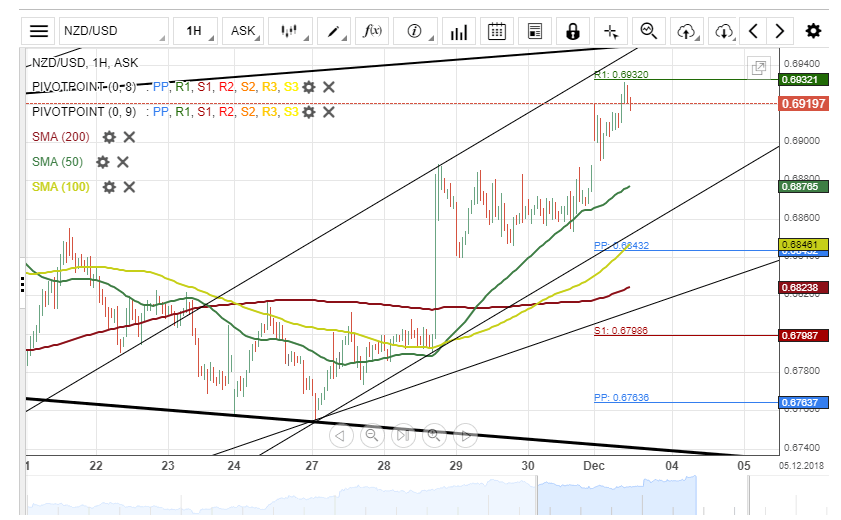
NZD/USD Remains Near Weekly R1 At 0.6874
The New Zealand Dollar traded between a range of 0.6884 and 0.6840 during Friday's session.
The exchange rate dashed through the given trading range during the first half of today's session. Currently, the pair is trading near the traditional weekly R1 at 0.6932.
If the resistance level holds, the currency exchange rate could aim for a support level formed by the 50-hour simple moving average at 0.6874.
On the other hand, if the rate passes the weekly R1, the Kiwi might target the upper boundary of an ascending trendline at 0.6950.
USD/JPY Outlook: Hopes For Fresh Advance Would Remain Alive While Fibo Support At 113.37 Holds
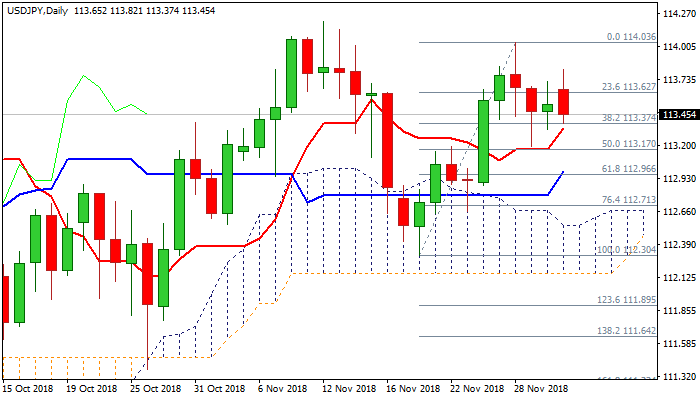
The pair moved lower on fresh risk appetite after trade war was put on hold, with fresh weakness being so far contained by pivotal support at 113.37 (Fibo 38.2% of 112.30/114.03, reinforced by rising daily Tenkan-sen). Daily MA's in bullish setup maintain positive outlook, which requires dips to hold above 113.30/40 support zone, but weak momentum could be limiting factor for fresh advance. Loss of 113.37 handle would risk further easing towards supports at 113.15 (rising 30SMA) and 113.02 (rising 55SMA), close below which will be bearish signal. On the other side, hopes of fresh recovery would remain alive above 113.37 and would look for test of pivotal barrier at 114.03 (28 Nov high) break of which could signal continuation of bull-leg from 112.30 (20 Nov low).
Res: 113.71, 113.82, 114.03, 114.20
Sup: 113.37, 113.15, 113.02, 112.66
Qatar Leaves OPEC, Can Oil Price Still Rally?
Qatar leaving the OPEC isn’t a great news for the oil market. The markets have not reacted to this development yet because this move threatens to fracture the cartel's unity. Basically, Qataris have brought the biggest weapon out and it only means more instability between the Qatari and Saudi relationship. In fact, there may not be any surprise if other counties start to follow the same path and then we have no control over supply or demand as each individual country could just do what they like. This simply means the end of OPEC.
Yes, for now, there is optimism that Saudi Arabia and Russia are committed to keep the supply under control. This has jolted the price of oil higher especially the fact that Canada's largest oil-producing province is curbing the output.
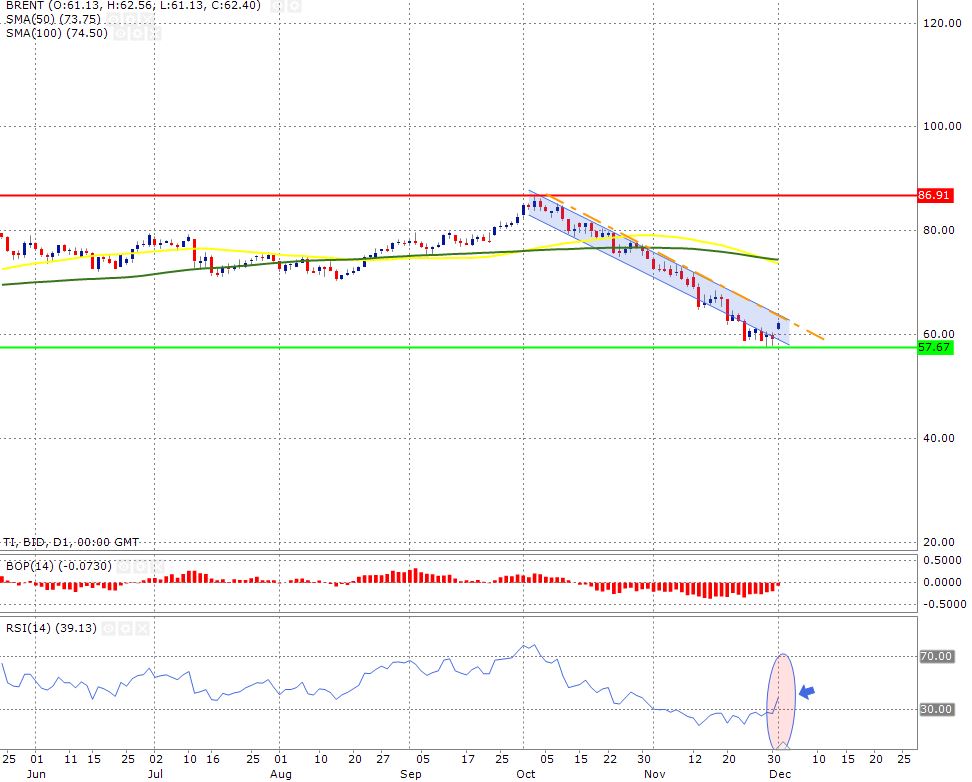
In terms of technical analysis, the price is trading below the downward trend line and this confirms that the trend is still skewed to the downside. However, the bullish signs are merging this is because the Brent price has entered back in into the downward channel after breaking it to the downside.
The RSI has experienced a sharp spike after plunging below the 30-mark and this is another bullish sign.
How Long Stocks Can Rally Due To Trade Truce?
It has been another volatile month for the global stock market as the S&P 500, Nasdaq and Dow have all suffered a bumpy ride. In November, the S&P500 gained nearly 1.79%, the Dow 1.6% and the Nasdaq 0.3%. The 30-day implied volatility for the NASDAQ index has touched a level that has not been seen since 2011.
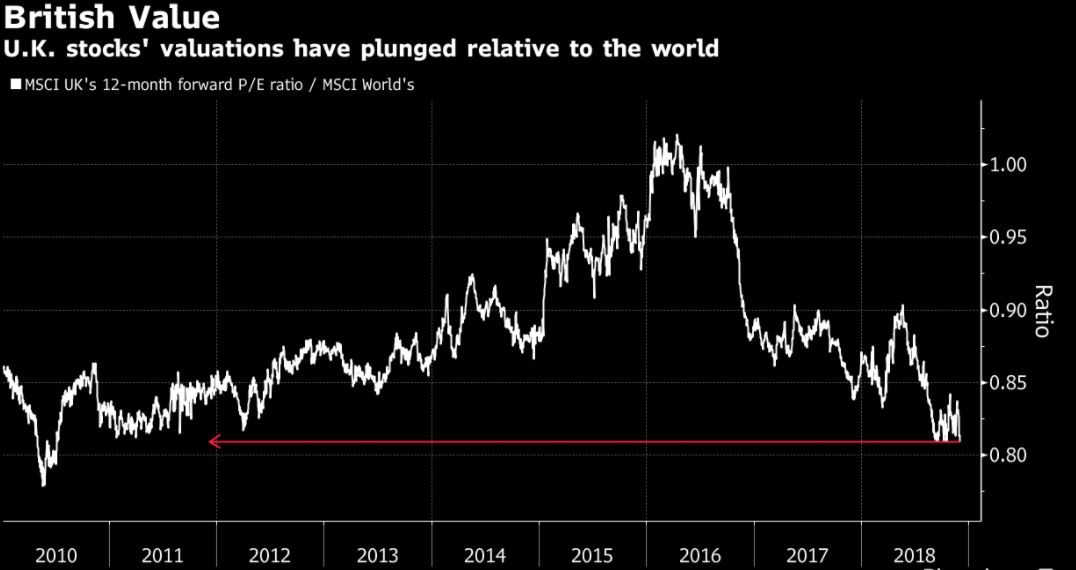
The theme has been pretty much the same but the European markets have suffered some losses during the month of November. The FTSE closed the month with a loss of 2.07%, the DAX index shed another -1.66% and the Euro Stoxx50 suffered damages in the region of -0.67%. In the amidst of Brexit woes, the U.K. stocks are immensely unloved. Putting this into perspective, relatively to the developed world; the market's forward price-to-earnings ratio has touched a level that hasn’t been witnessed since 2010.
In order to find reasons for this volatile month, one doesn’t have to go far to look for the reasons. Over in the U.K, the uncertainty was mainly due to the Brexit related concerns and what the future could be for the U.K.’s economy without the European Union. The fresh estimates are the country’s GDP could shrink by nearly 9 percent over the next 15 years. Of course, the woes of the Italian debt situation amidst the poor economic growth of the Eurozone has only added fuel to this pessimism. Nonetheless, the ECB has made it clear that they are not in the mood to change the sailing path of their monetary policy. The quantity easing program must end and the bank should look at the ways of normalising the interest rate.
But let’s keep our focus on the main agenda - the trade truce, Can it last? How far can the stocks reach from here? These are just some of the questions which need to be answered.
Putting the trade war questions aside for the time being and to begin with a positive aspect; the Fed have acknowledged that they need to listen to the sitting President. Yes, the Fed has changed their hawkish stance towards their monetary policy because of President Trump. Under the current development, the Fed has given the most dovish signal year to date by saying that the interest rates are at their normal level. Remember, during the past few quarters, higher interest rates have been the very reason that kept many sceptical on the sidelines. No one likes a higher interest rate in this market. We are used to an environment which the stock market is supported by the Fed. After all, it was the monetary policy which brought the longest rally in the stock market to date.
Thus, it may be safe to say that the accommodative stance of the Fed is highly likely and is going to bring another all-time high for the stock market. The tech sector which has been brutally beaten up could become the main engine of the upcoming rally.
The second most important reason that could keep the stock markets rallying is the new development over this weekend. The G-20 Summit in Argentina was the most important event and it ended on a positive note. We have seen Bromance between President Trump and President Xi-something which wasn’t expected at all. The cession of hostilities between the countries is a remarkable progress especially when expectations were muted and the risk was tilted to the downside. President Trump agreed to not impose additional25 percent tariffs on $200 billion of imports from China for 90 days. The additional tariffs would have undermined it’s growth prospects and imposed a greater threat to it’s financial system. China, the second biggest economy of the world, also pledged to buy more good from the U.S.
The fact that the talks between the U.S. and China have not broken and the rug hasn't been pulled from under, this is likely to fuel the relief rally in risk assets for this month. Nonetheless, it is important to keep in mind, that the jury is still out and there is no assurance that these short-term gains can shape into long-term gains. Nonetheless, the clock is ticking.
Risk Appetite Has Pushed The Cable Higher
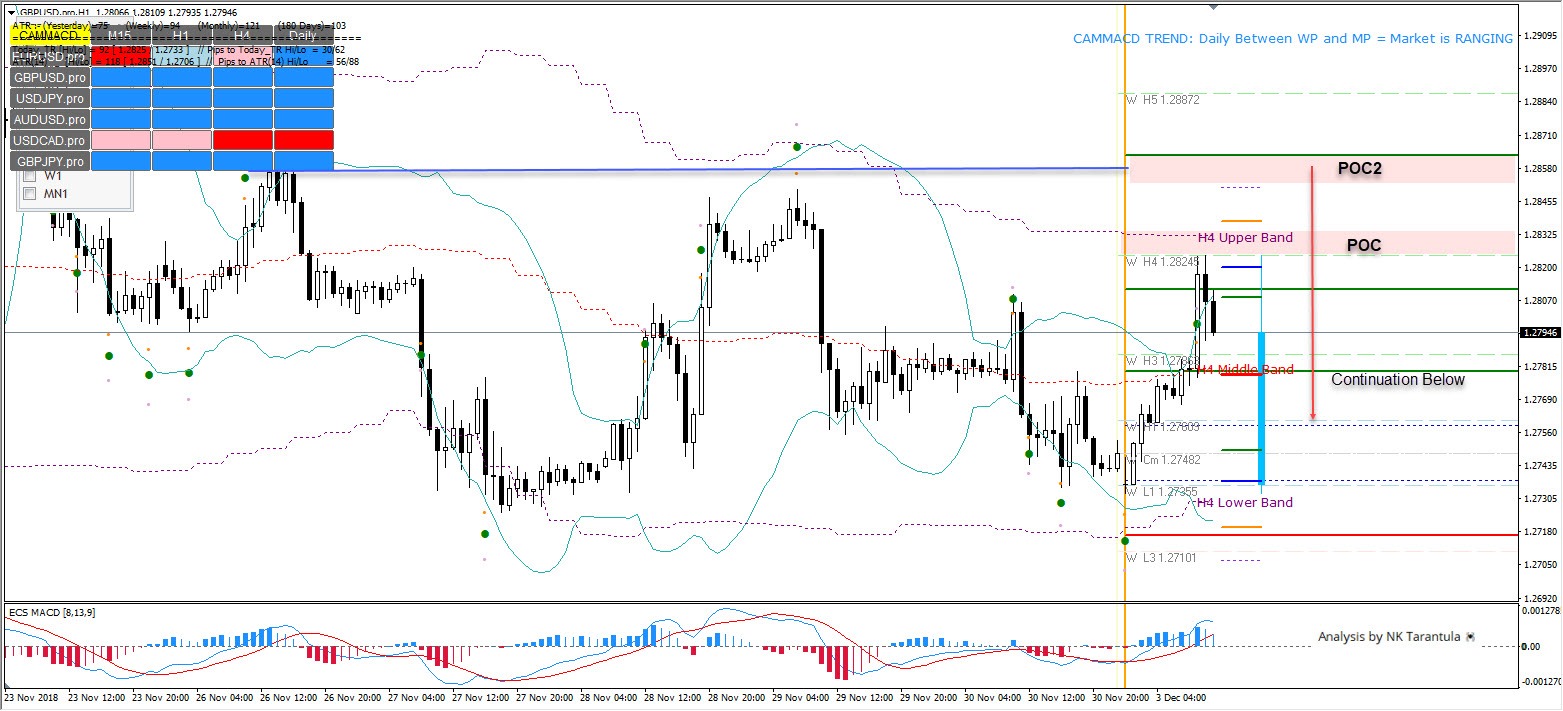
The GBP/USD could reject from 1.2820-30 and 1.2850-60. Those two POC zones are good for sellers as profit taking and fresh selling could happen there within the zones. Targets are 1.2780 and a strong 1h or 4h close below it, could reject the pair further down. That would be counted as a continuation trade towards 1.2730-1.2710. Only a close above 1.2860 will be bullish for the pair targeting 1.2890 zone.
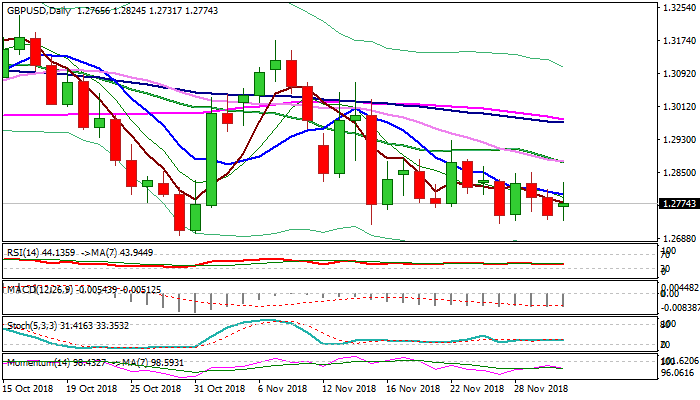
GBP/USD Outlook: Recovery Rally On Trade War Ceasefire Still Away From Key 1.2850 Barrier
Cable ticked above 1.28 handle on fresh risk appetite and retraced the largest part of last Thu/Fri fall on short-covering.
Bounce confirms strong support at 1.2725 zone, but the pair remains within 1.2850/1.2725 congestion which extends into fifth straight day.
Daily techs remain weak and maintain bearish momentum, with formation of 20/30SMA’s bear-cross adding pressure.
Extension of advance is expected to face strong headwinds from key near-term barrier at 1.2850 (congestion top / Fibo 61.8% of 1.2927/1.2725 bear-leg) and failure here would signal extension of directionless near-term mode, with risk to shift lower again.
Break below 1.2725 base would expose key supports at 1.2695 (30 Oct low) and 2018 low at 1.2661(posted on 15 Aug), violation of which would signal continuation of larger downtrend from 2018 high at 1.4376 (17 Apr).
Sustained break above 1.2850 would provide relief and expose pivotal barriers at 1.2875 (20/30SMA) and 1.2895 (Fibo 38.2% of 1.3174/1.2722), violation of which would sideline bears.
Res: 1.2824, 1.2850, 1.2875, 1.2895
Sup: 1.2767, 1.2725, 1.2695, 1.2661
Gold Advances To Fresh 1-Month High, Indicators Signal More Gains
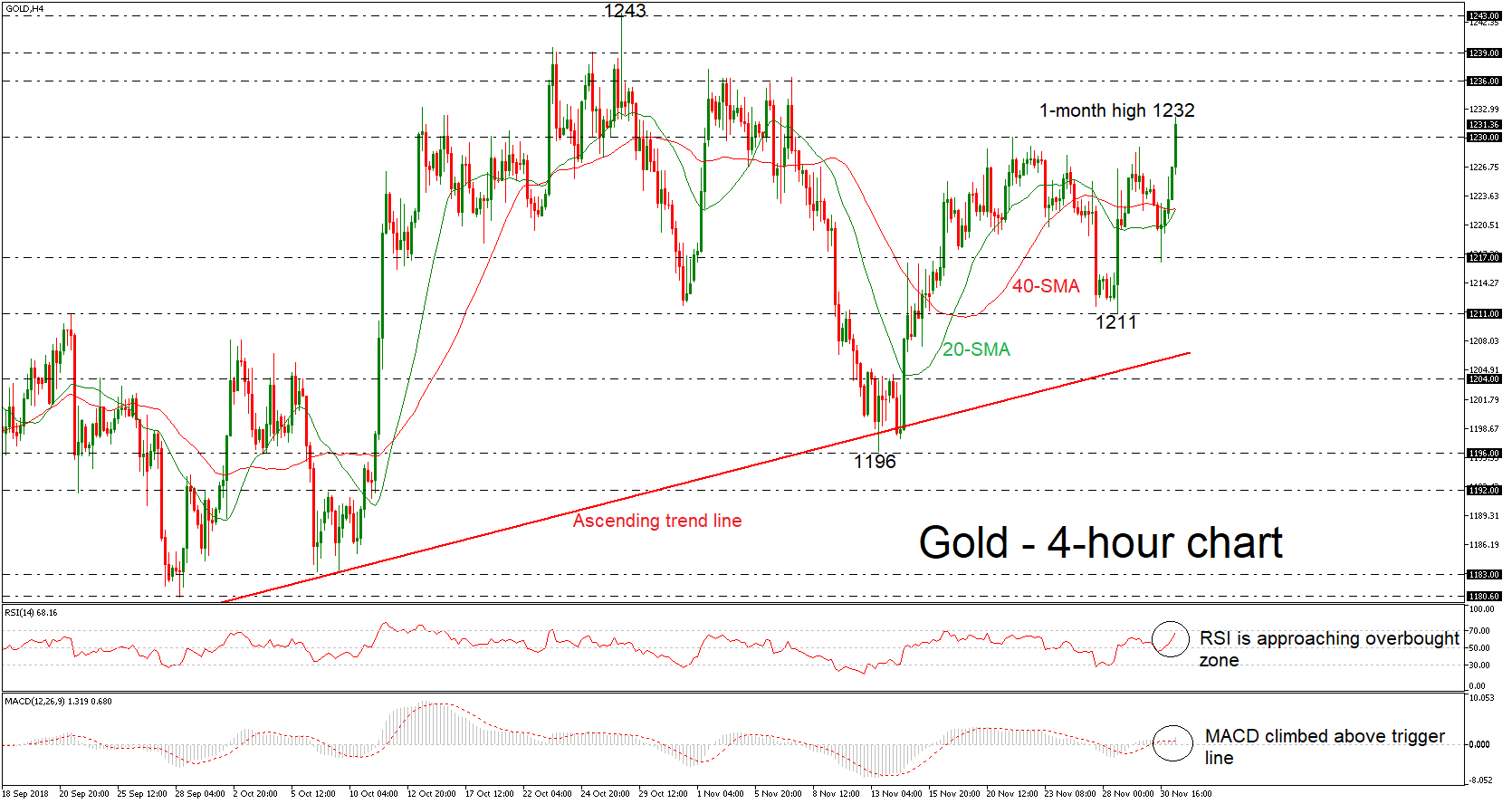
Gold has advanced considerably, jumping to a fresh one-month high of 1232 earlier today. The price successfully surpassed the moving averages, which are ready to post a bullish crossover in the 4-hour chart. Furthermore, the RSI indicator is approaching overbought territory, while the MACD oscillator climbed above the trigger line, both suggesting more gains.
More upside movements could send prices towards the next immediate resistance of 1236, identified by the highs on November 7, while even higher the area around 1239 could attract attention as well. Rising above this region the yellow metal could hit the three-month high of 1243.
On the other side, a bearish tendency would drive prices until the bullish crossover, within the 20- and 40-simple moving averages (SMAs) around 1222, before being able to re-challenge the 1217 support level. If the market fails to hold above these levels, the yellow metal could meet support at 1211, where it bottomed on November 28.
Concluding, gold prices remain above the rising trend line, which has been holding since August 16 and is trying to post significant gains in the short-term.
Risk-On Sentiment Resumes As Trade Storm Eases
- Stocks up, dollar down as trade fears ease
- French President Macron under political pressure but euro heads up
- Brexit risks loom in the background
- Oil surges as Russian President backs production cuts; Qatar to withdraw OPEC membership
Stocks head higher on trade relief
The US President, Donald Trump, and the Chinese leader, Xi Jinping had progressive trade talks during their dinner on the sidelines of the G20 summit on Saturday, with the world’s largest economies deciding to ceasefire the inflamed trade war but only temporarily. Particularly, Trump agreed not to raise tariffs from 10% to 25% on January 1 and avoid any further frictions for the next 90 days, giving room for negotiations to restart immediately, while China is said to have agreed to buy a substantial amount of US products to reduce the trade imbalance.
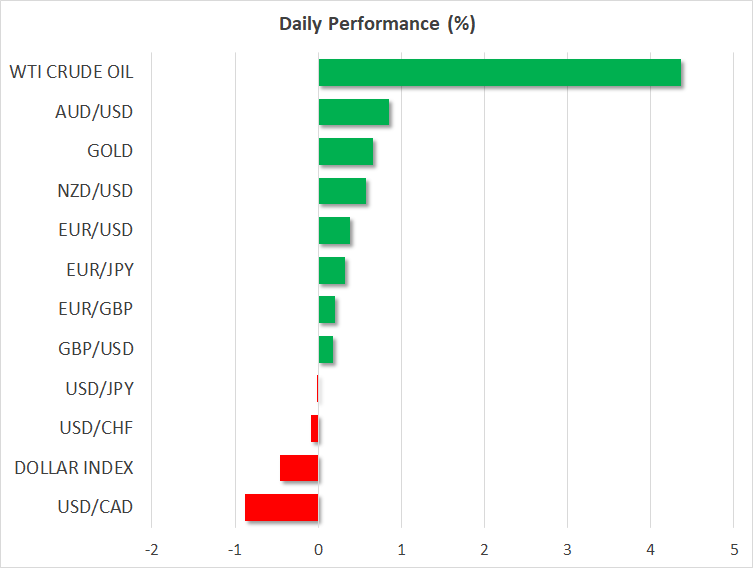
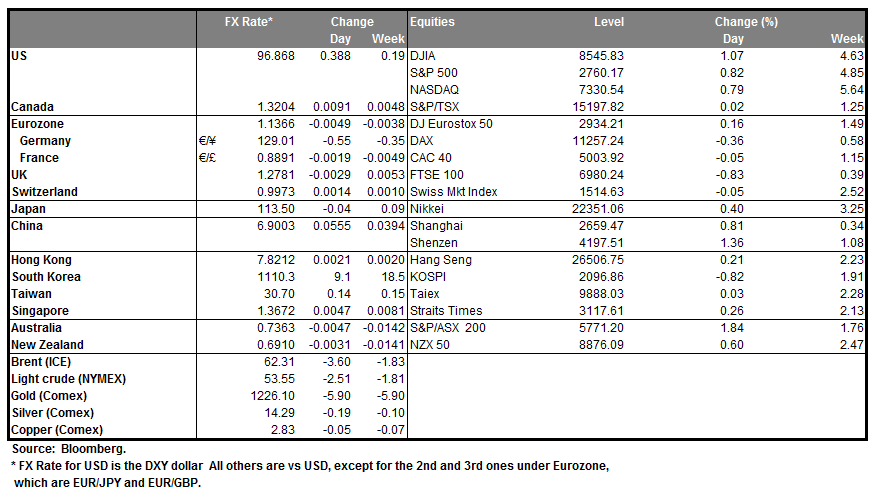
Asian stocks were up by more than 1.0% at the time of writing and US futures were gaining nearly 2.0%, pointing to a strong open later on Monday as risk-on mode returned. Positive trade developments provided a significant boost to the risk-sensitive aussie as well, whereas the safe-haven dollar was underperforming against a basket of six major currencies, pressured by the Fed’s dovish scope on interest rates as well. In commodities, the weakness in the dollar helped gold to recover Friday’s lost ground and rise as high as $1226/ounce (+0.40%).
Apart from trade, US Nonfarm payrolls due on Friday will be the most important event to watch this week as investors are looking for clues that could put the breaks on the Fed’s rate hiking path. Recall that the FOMC meeting minutes released last week indicated that the Bank will raise interest rates in December, but in 2019 monetary policy could be reviewed with more caution.
Macron’s popularity under risk
While the Eurozone is working to resolve its budget differences with Italy, political noise in France seems to be gathering momentum as protests over fuel taxes have grown into a general anger at higher living costs. The French President, Emanuel Macron who managed to beat establishment parties that led the government for more than 30 years and whose party was less than a year old during the 2017 presidential elections, is now facing widespread opposition over his gasoline taxes the past two weeks, with the anti-government “gilets jaunes” protesters causing significant damage in the center of Paris. While national elections are not seen until 2022, questions are now rising about whether Macron could deliver on his agenda including pensions and employment reforms, which would reduce his popularity even further, or break his promises to save his political career. The news did not weigh much on the euro, with euro/dollar winning 0.55% on the day thanks to the trade relief.
May threatens to bring down the government
British lawmakers will be debating May’s Brexit plan this week before a final vote in the Parliament on December 11, which doesn’t look so promising for the UK Prime Minister amid deep divisions over the deal. On Sunday, the UK Prime Minister threatened to dissolve the government If the Parliament does not approve the withdrawal agreement which seems to be the only option left less than four months before the exit date according to EU leaders. On Monday, the Attorney General is set to publish a reduced form of the legal Brexit advice despite calls from Torries for a full version. If May fails to get a Parliamentary approval for her deal next week, she could face a no-confidence vote.
In FX markets, pound/dollar is enjoying buying interest today on the back of a falling dollar, with the pair last seen at 1.2804 (+0.42%).
Oil surges by near 5.0%
After his meeting with the Saudi Arabian Crown Prince, Mohammed bin Salman, at the G20 summit the Russian president announced that OPEC and non-OPEC oil producers will reach a compromise to cut output for 2019 when they meet in Vienna this week. WTI crude oil and the London-based Brent surged by almost 5.0% on the day, crawling up to $53.44 and $62.19 per barrel respectively as the current slowing trade storm increased further confidence in the market.
On Monday, Qatar announced that the country would leave OPEC on January 1, ending a membership of more-than-a-half century, a fact that could disrupt climate at the OPEC meeting on December 6. However, the Energy Minister of Qatar said that the decision is based on a technical and strategic change and not on political reasons.
Other highlights
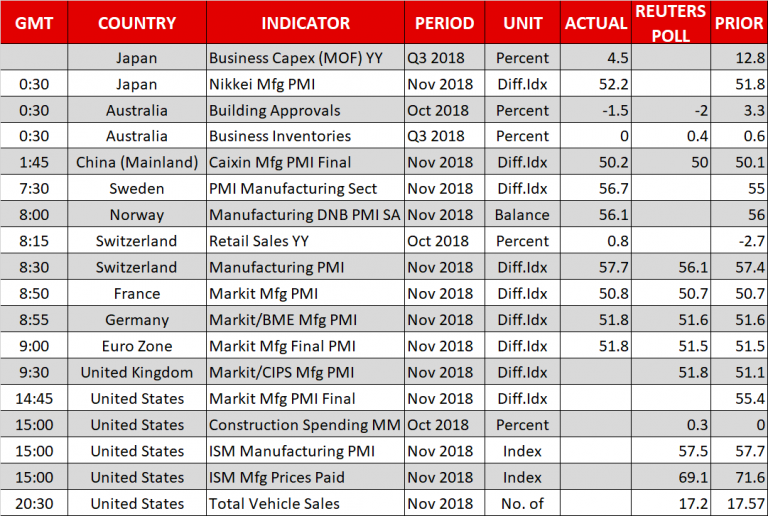
The Institute of Supply Management (ISM) will issue its manufacturing index at 1500 GMT, probably bringing some movement in the dollar, while the UK will see the release of the Markit/CIPS Manufacturing PMI earlier at 0930 GMT.
In terms of public appearances, eurozone finance ministers will be meeting in Brussels (1400 GMT), with the ECB President Mario Draghi and the ECB Executive board member, Benoit Coeure participating in the event as well.
In the UK, Bank of England chief Economist, Andy Haldane will be speaking in the Annual Cambridge Public Lecture at 1730 GMT.
In the US, speeches are expected from Fed Vice-Chair for Supervision Randall Quarles (1300 GMT), New York Fed president John Williams (1415 GMT), Fed board Governor, Lael Brainard (1530 GMT) and Dallas Fed President, Robert Kaplan (1800 GMT).
The Aftermatch Of The G20 Summit
China and the United States agreed to cease additional tariffs for 90 days. Tariffs worth of $200 billion Chinese imports at 10% remain in place for the beginning of the new year, but the two sides agreed to not raise them to 25%. Leaders of the 20 nations agreed to restructure to the World Trade Organization amid growing global trade tensions. On another front, the Saudi Crown Prince was pressed by various important leaders at the meeting, to enact a full investigation into the murder of journalist Jamal Khashoggi. At the same time, the crown prince talked over potential investments and economic partnerships with Indian Prime Minister Narendra Modi and Chinese President Xi Jinping. Moreover, US President Donald Trump cancelled his meeting with Russia's President Vladimir Putin but in the end held a brief talk. It was said, the US opposes Russia's dispute with Ukraine, keeping in mind the recent tensions between them. Further developments of the meeting could create volatility for the USD and safe havens like Gold.
XAU/USD strengthened during Mondays Opening, as it headed towards the 1230.00 (R1) resistance level. The Precious metal still has some distance to cover in order to break the pre mentioned level and it could be influenced by any further headlines regarding the G20 Summit or updates on the trade tensions. Should the bears take over, we could see the shiny metal moving towards the 1,220 (S1) support line and even breach it aiming for the 1210.00 (S2) support barrier. Should on the other hand the bulls take over we could see the metal reaching our 1230.00 (R1) resistance level. If the (R1) is breached then XAU/USD could be moving into a new price range.
Oil prices jump ahead of OPEC meeting
Oil prices surged on Monday ahead of the OPEC meeting this week, which is expected to result in a supply cut. On another front and during the weekend, it was publicized that Iran had tested some new ballistic missiles, creating further tensions between Persia and the US. Oil prices are very sensitive to geopolitical issues and any action taken against Iran could affect Oil prices. In general, further updates on the above matters could significantly increase volatility for Oil Prices.
Crude Oil opened with a positive gap during Monday’s Asian session, indirectly hinting this week could be of crucial importance for the Oil market. The black gold was able to reach are 53.45 (R1) resistance level, even though it barely surpassed it, only to remain very close it later on. If the commodity remains in a bullish momentum we could see it reach the 55.30 (R2) resistance barrier and even breach it aiming even higher. On the opposite, if Oil prices move in a bearish sentiment, the commodity could move to the 50.00 (S1) support level and with that breach, the next level could be our 48.00 (S2) support barrier. However Oil prices could be under strong volatility towards the end of the week as we get closer to the OPEC meeting on the 6th of December.
XAU/USD H4
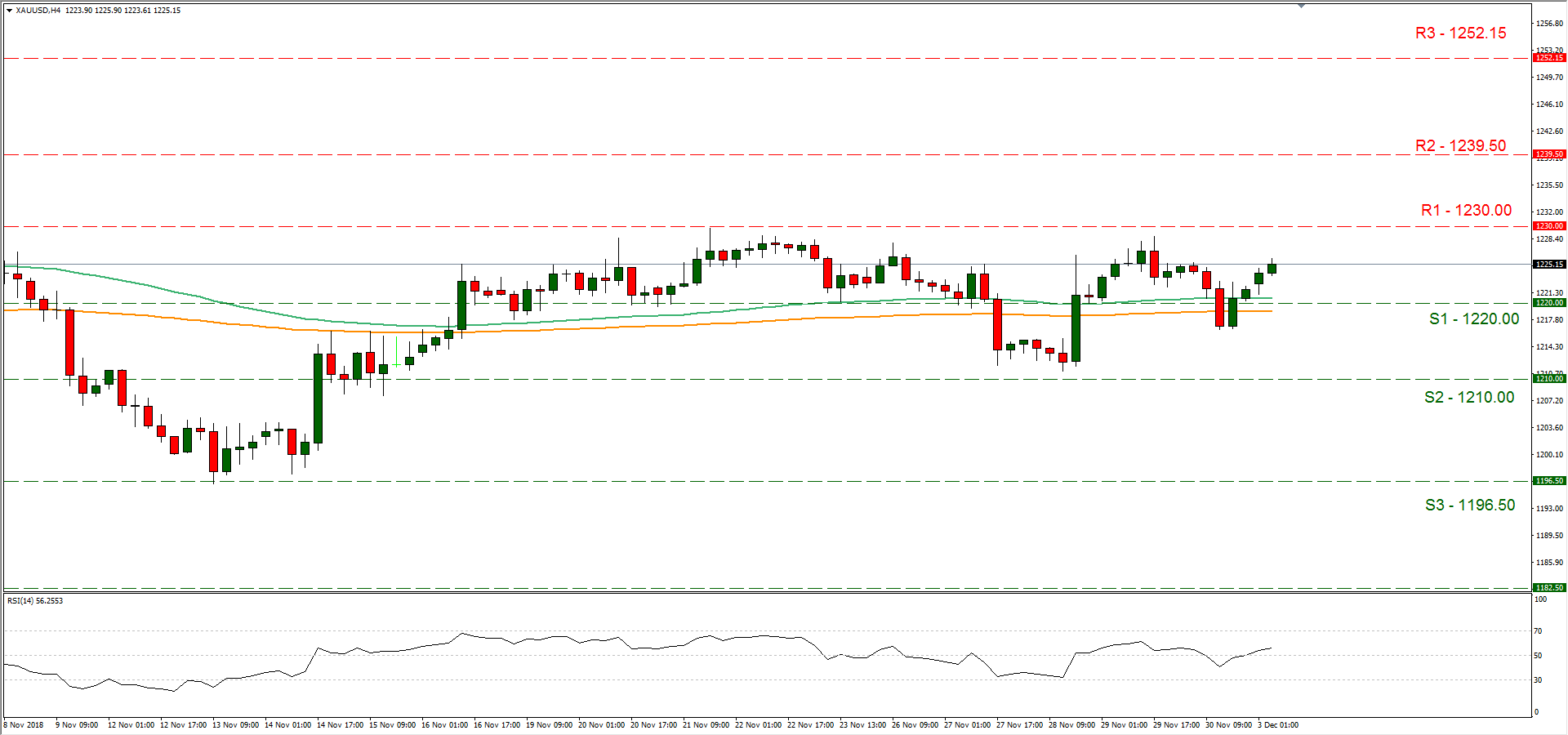
Support: 1220.00(S1), 1210.00 (S2), 1196.50 (S3)
Resistance: 1230.00 (R1), 1239.50 (R2), 1252.15 (R3)
Crude Oil 1 Hour
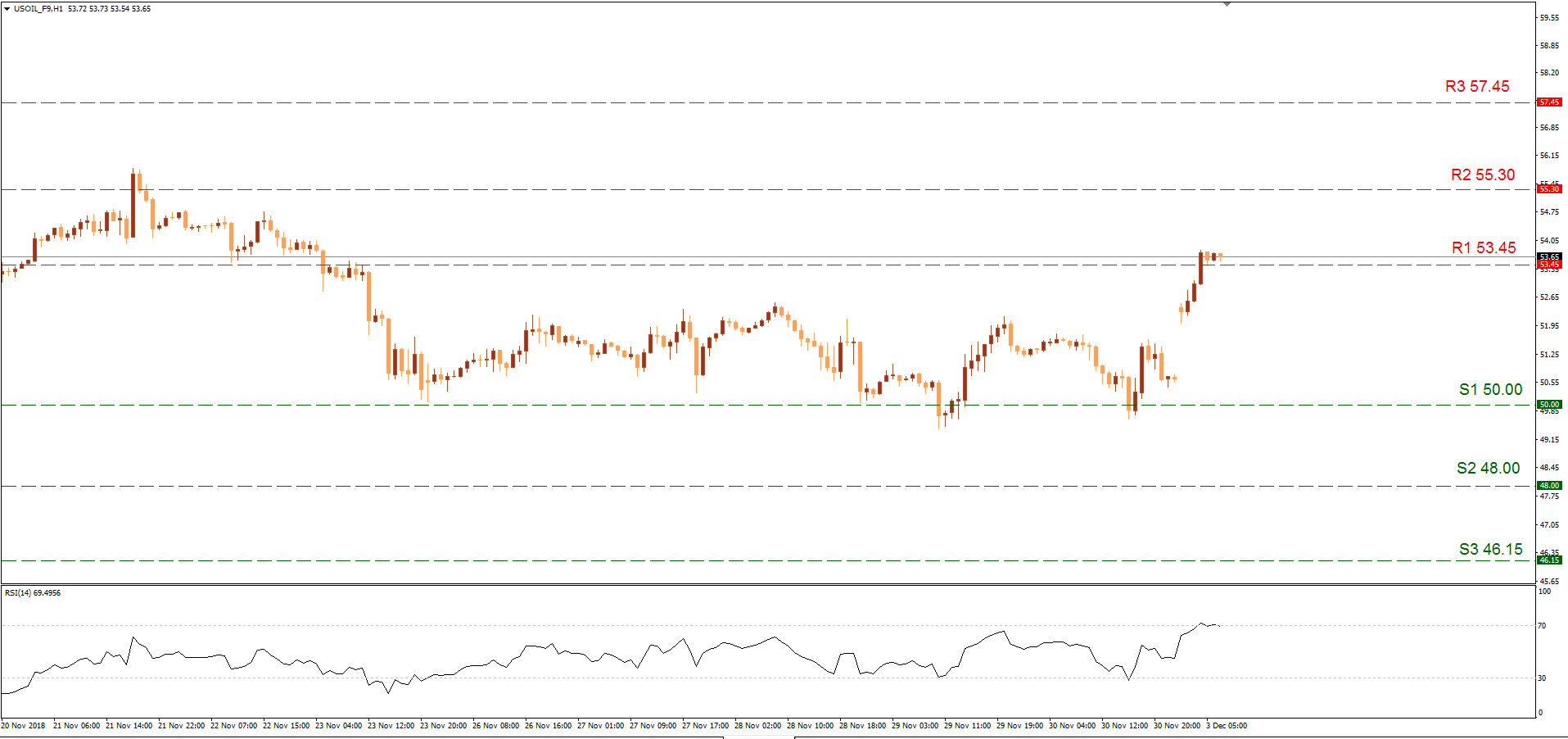
Support: 50.00 (S1), 48.00 (S2), 46.15 (S3)
Resistance: 53.45 (R1), 55.30 (R2), 57.45 (R3)
Investors Are Evaluating The Results Of The G20 Summit
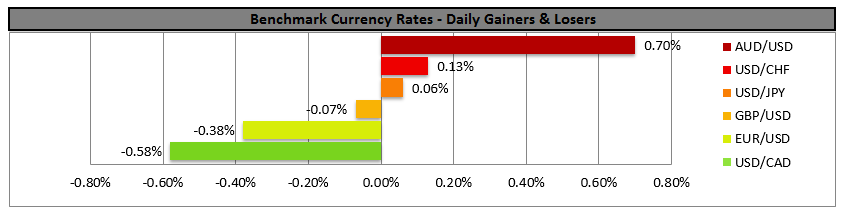
The USD strengthened against the major currencies. A G20 summit happened on Friday. The President of the United States Donald Trump and the leader of the People's Republic of China Xi Jinping met during the summit and agreed to keep the 10% fees on the Chinese wares worth more than 200 billion USD. The officials agreed that China will expand the import of the US wares, including the agricultural products. The USD index (#DX) closed in the green (+0,51%).
Some economic reports were published on Friday by the EU and Canada. According to the preliminary data, the inflation in the EU reached 2%, while the experts were expecting 2.1%. The Canadian GDP growth slowed down by 0.1% instead of growing by the same amount, as had been expected. Today, during the Asian trading session, Caixin published a PMI rating of China which rose to 50.2 in November instead of 50.1.
The oil market is characterized by aggressive purchases. At the moment the WTI futures are testing the 53.55 USD/barrel mark.
Market Indicators
- On Friday the US stock market had seen a lot of purchases: #SPY (+0,62%), #DIA (+0,70%), #QQQ (+0,73%).
- The 10-year US government bonds yield is at 3,03-3,04%.
The Economic News Feed for 03.12.2018:
- Industrial Purchasing Managers' Index (GER) – 10:55 (GMT+2:00);
- Industrial Purchasing Managers' Index (UK) – 11:30 (GMT+2:00);
- Industrial Purchasing Managers' Index by ISM (US) – 17:00 (GMT+2:00);