

Sample Category Title
(RBA) Statement by Philip Lowe, Governor: Monetary Policy Decision
At its meeting today, the Board decided to leave the cash rate unchanged at 1.50 per cent.
The global economic expansion is continuing and unemployment rates in most advanced economies are low. There are, however, some signs of a slowdown in global trade, partly stemming from ongoing trade tensions. Growth in China has slowed a little, with the authorities easing policy while continuing to pay close attention to the risks in the financial sector. Globally, inflation remains low, although it has increased due to the earlier lift in oil prices and faster wages growth. A further pick-up in core inflation is expected given the tight labour markets and, in the United States, the sizeable fiscal stimulus.
Financial conditions in the advanced economies remain expansionary but have tightened somewhat. Equity prices have declined and credit spreads have moved a little higher. There has also been a broad-based appreciation of the US dollar this year. In Australia, money-market interest rates have declined, after increasing earlier in the year. Standard variable mortgage rates are a little higher than a few months ago and the rates charged to new borrowers for housing are generally lower than for outstanding loans.
The Australian economy is performing well. The central scenario is for GDP growth to average around 3½ per cent over this year and next, before slowing in 2020 due to slower growth in exports of resources. Business conditions are positive and non-mining business investment is expected to increase. Higher levels of public infrastructure investment are also supporting the economy, as is growth in resource exports. One continuing source of uncertainty is the outlook for household consumption. Growth in household income remains low, debt levels are high and some asset prices have declined. The drought has led to difficult conditions in parts of the farm sector.
Australia's terms of trade have increased over the past couple of years and have been stronger than earlier expected. This has helped boost national income. Most commodity prices have, however, declined recently, with oil prices falling significantly. The Australian dollar remains within the range that it has been in over the past two years on a trade-weighted basis.
The outlook for the labour market remains positive. The unemployment rate is 5 per cent, the lowest in six years. With the economy expected to continue to grow above trend, a further reduction in the unemployment rate is likely. The vacancy rate is high and there are reports of skills shortages in some areas. The stronger labour market has led to some pick-up in wages growth, which is a welcome development. The improvement in the economy should see some further lift in wages growth over time, although this is still expected to be a gradual process.
Inflation remains low and stable. Over the past year, CPI inflation was 1.9 per cent and in underlying terms inflation was 1¾ per cent. Inflation is expected to pick up over the next couple of years, with the pick-up likely to be gradual. The central scenario is for inflation to be 2¼ per cent in 2019 and a bit higher in the following year.
Conditions in the Sydney and Melbourne housing markets have continued to ease and nationwide measures of rent inflation remain low. Credit conditions for some borrowers are tighter than they have been for some time, with some lenders having a reduced appetite to lend. The demand for credit by investors in the housing market has slowed noticeably as the dynamics of the housing market have changed. Growth in credit extended to owner-occupiers has eased to an annualised pace of 5–6 per cent. Mortgage rates remain low, with competition strongest for borrowers of high credit quality.
The low level of interest rates is continuing to support the Australian economy. Further progress in reducing unemployment and having inflation return to target is expected, although this progress is likely to be gradual. Taking account of the available information, the Board judged that holding the stance of monetary policy unchanged at this meeting would be consistent with sustainable growth in the economy and achieving the inflation target over time.
Market Morning Briefing: Dollar Yen Continues To Trade Below Important Resistance Near 114.00-114.50
STOCKS
The longer term bullish prospect could be playing out in most Equity indices now after the fillip from the Powell, FOMC Minutes and the Trump-Xi truce, but evidence is needed that interim Resistances are broken. Failing that, we cannot rule out a near term corrective dip in most indices, which might give better buying opportunities later.
Even though there was a gap-up open on the Shanghai (2654.80, +2.57%) yesterday, it is yet to break above Resistance at 2670 (wrongly mentioned as 2650 yesterday), which is needed to negate any chances of a fall and confirm chances of a rise towards 2800+.
And, although the Nikkei (22438) rose to a high of 22699 yesterday, it needs to see follow-through buying today to move up to 23000. While the bullish possibility exists some confirmation would be useful.
The Nifty (10883.75, +7.00, +0.06%) has been unable to break above 11000 yet. The corresponding level on the Sensex (36241.00, +0.13%) is 36500. While these hold, we cannot fully rule out a corrective fall from here.
The expected rise to 11600 almost happened on the DAX (11465.46, +208.22, +1.85%) yesterday with a high of 11567, but the market drifted lower by close. That said, with good Support at 11200 now (up from 11000), the long-term outlook is bullish now.
Like the others, the Dow (25826.43, +287.97, +1.13%) moved up to almost 26000 but slipped back to close right on a near-term Resistance. A bit of a dip or consolidation near the current level cannot be ruled out before a further rise past 26000.
COMMODITIES
Crude prices are likely to remain volatile this week with news from the OPEC and US-China worries looms. Major commodities like the Gold and Silver look bullish and could see some decent rise in the near term. Crude prices could rise as well this week.
Brent (62.16) and WTI (53.46) are trading higher. Brent has been trading within the 58-62 region for the last 5-6 sessions and a break above 62 is a decent indication of an upmove for the coming sessions. If Brent manages to sustain above 62, it could soon start moving higher towards 64-66.
WTI (53.46) could head towards 56 while above 52. Near term looks bullish.
Gold (1240.80) is testing resistance near 1240 just now. The earlier resistance near 1230 has now been revised up to 1240. While the current upward momentum continues, Gold price could rise towards 1260 in the near term. View is bullish while above 1240.
Silver (14.52) has also risen well and could head towards 14.75-15.00 in the near term.
Copper (2.8095) has moved up but could face rejection from levels near 2.85/88 in the near term. A sustained rise above 2.88 is needed to initiate fresh upmove towards 2.95-3.00. Else a fall back towards 2.75 is possible from 2.88/90 levels.
FOREX
Watch important supports on the Dollar Index, Pound and Aussie near 96.50, 1.27 and 0.73 while USDJPY and Euro are likely to respective resistances near 114 and 1.14.
Dollar Index (96.82) is within a near term channel uptrend as seen on the daily candles. While trend support near 96.50 holds, Dollar Index continues to remain bullish and could eventually move up towards 97.50-97.75 again in the near term.
Euro (1.1367) continues to trade in the narrow 1.14-1.13 region and this could probably last only for 2-3 sessions more before a break on either side is seen, deciding the further course of direction. Considering the important resistance near 1.1400-1.1450, Euro could have some scope of testing 1.12 on the downside.
Dollar Yen (113.33) continues to trade below important resistance near 114.00-114.50 and while that holds, medium term trend for USDJPY looks bearish with a possible fall from current levels soon taking it down towards 112.
Pound (1.2735) could soon see a bounce towards 1.29 while support near 1.27 holds.
Aussie (0.7357) has clearly broken the near term trend resistance on the 3-day candles and while above 0.7350, Aussie looks bullish towards 0.74-0.75 levels. 0.73 could now act as a decent support level.
Dollar Rupee (70.46) recovered sharply yesterday pulling itself to 70.46 from an intra-day low of 69.86. While above 70, there is scope of testing 70.60 on the upside followed by some range-trade in the 70.60-70.00 region for some time.
INTEREST RATES
Whoosh! Massive dip in US Yields yesterday, especially at the Far end. The 30Yr is down from 3.32% to 3.23%. The US 10Yr (2.95%) has seen a good dip below 3.00% yesterday, but the 2Yr (2.803%) has not yet fully broken below 2.80%. With this, the 10-2Yr Spread has dropped to 15.5bp, below the previous low of 19bp. The 5Yr trades at 2.801%, showing a mild inversion compared to the 2Yr at 2.803%.
The 10Yr can now dip some more towards 2.90-2.86%. This is significant as it quite likely establishes a top for the 10Yr and negates chances of a near-term rally in yields ahead of the FOMC. Now we need to see the 2Yr fall with greater speed to avert the Curve-inversion that is starting to happen all over again.
In India, contrary to expectations of a further dip towards 7.55%, the 10Yr GOI (7.6264%) moved up a bit from 7.60%, perhaps in response to the rise in Crude. However, the longer term trend looks bearish for Yields now and as such 7.70-7.80% could be a potential Resistance to look at. NOTE that the Indo-US Yield Spread (4.588%) is expected to dip towards 4.45% and this too may pull the GOI yield lower, especially since the US yields have dipped yesterday.
GBP/USD Remains In Major Downtrend Below 1.2900
Key Highlights
- The British Pound declined recently and broke the 1.2800 support against the US Dollar.
- There is a crucial bearish trend line in place with resistance near 1.2770 on the 4-hours chart of GBP/USD.
- The UK Manufacturing PMI in Nov 2018 increased from 51.1 to 53.1.
- Today, the UK's Construction PMI for Nov 2018 will be released, which is forecasted to decline from 53.2 to 52.5.
GBPUSD Technical Analysis
During the past few weeks, the British Pound followed a bearish path from the 1.3060 swing high against the US Dollar. The GBP/USD pair recently broke 1.2900 and 1.2800 to enter a major bearish zone.
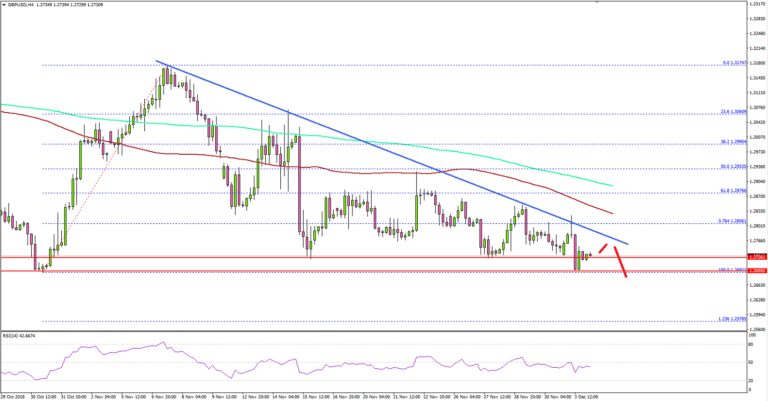
Looking at the 4-hours chart, the pair earlier recovered nicely from the 1.2692 swing low to 1.3174. Later, it failed to stay in a positive zone and started a solid downward move.
The pair declined steadily and formed many swing highs near 1.3060, 1.2940, 1.2840 and 1.2800. The decline was such that the pair is now well below 1.2900 and the 200 simple moving average (green, 4-hours).
Sellers pushed the pair below the 76.4% Fib retracement level of the last wave from the 1.2692 swing low to 1.3174 high. If there is a downside break below the 1.2680-90 zone, the pair could trade towards the 1.2580 level, which is the 1.236 Fib extension level of the last wave from the 1.2692 swing low to 1.3174 high.
On the upside, there is a crucial bearish trend line in place with resistance near 1.2770. However, a proper close above the 1.2900 level and the 100 simple moving average (red, 4-hours) is needed for a solid rebound in the near term.
Fundamentally, the UK Manufacturing PMI for Nov 2018 was recently released by both the Chartered Institute of Purchasing & Supply and the Markit Economics. The market was looking for an increase from 51.1 to 51.8.
The result was better as there was an increase in the UK Manufacturing PMI from the last reading of 51.1 to 53.1. However, it failed to help GBP/USD as the pair remained under pressure below 1.2800.
Economic Releases to Watch Today
- UK's Construction PMI for Nov 2018 – Forecast 52.5, versus 53.2 previous.
- Euro Zone PPI for Oct 2018 (YoY) – Forecast +4.5%, versus +4.5% previous.
- Euro Zone PPI for Oct 2018 (MoM) – Forecast +0.5%, versus +0.5% previous.
- US IBD/TIPP Economic Optimism Index for Dec 2018 (MoM) – Forecast 57.3, versus 56.4 previous.
Daily Markets Broadcast
Wall Street’s G-20 rally stalls
US indices closed higher yesterday, but well of the intra-day peaks. White House economic adviser Kudlow clarified that the 90-day truce starts on January 1. RBA is expected to keep rates at record lows at today’s meeting.
US30USD Daily Chart
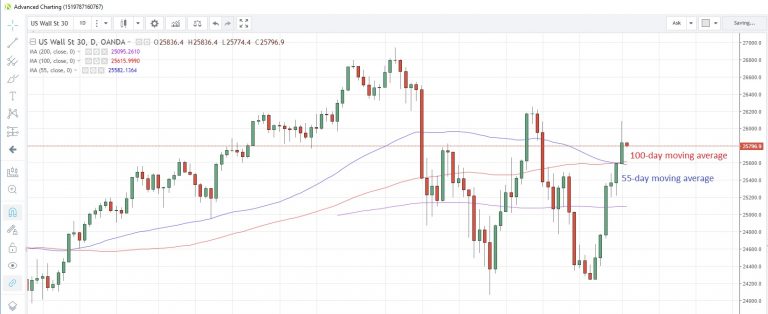
Upside momentum in the US30 index waned as the day progressed yesterday. US futures are in the red this morning, possibly the first down-day in seven days
The index remains above the 100- and 55-day moving averages at 25,615 and at 25,582, respectively
Sentiment indicators populate the data calendar today in the form of the ISM-NY business conditions index and the IBD/TIPP economic optimism index. FOMC member Williams is also scheduled to speak.
DE30EUR Daily Chart
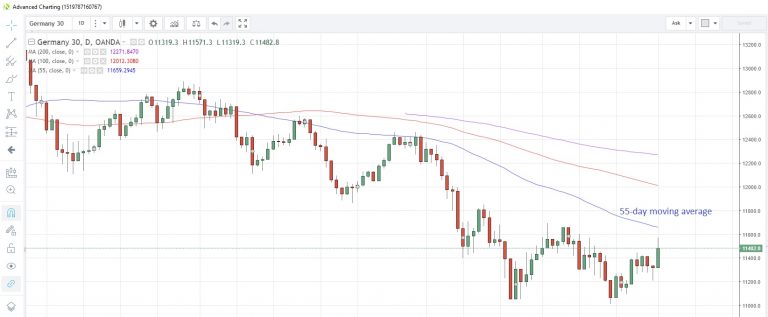
The Germany30 index rose for the first time in three days yesterday amid better sentiment on Wall Street and better news on the Italian budget situation
The index reached its highest level in three weeks. The 55-day moving average at 11,659 still acts as the first possible resistance point
Reports suggest Italy is preparing to accept new lower budget deficit targets in the range of 1.9-2.0%. European PMIs were mixed yesterday. Notably, Italy’s fell to a near 4-year low.
AU200AUD Daily Chart
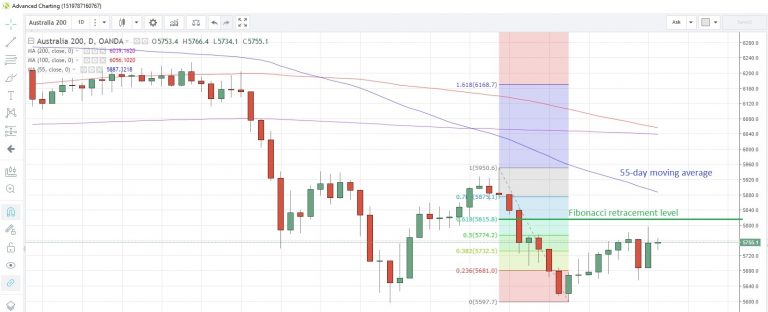
The Australia200 index looks set to advance for a second day ahead of the Reserve Bank of Australia’s rate meeting later today
The 61.8% Fibonacci retracement of the November 12-21 drop is at 5,816. The 55-day moving average is at 5,887
RBA is expected to keep rates at record lows at today’s meeting. The accompanying statement will be scrutinized for any change in tone or language from prior ones.
Post G-20 Binary Trading Events Pretty Much As Scripted
Markets
Most everything played out on a script with US equity markets high reaching ambitions led by the auto sector. And while the great dinner of decade debate will likely rage on for the next 90 days, the bar remains high for a sweeping trade deal, but the markets must also rise to the occasion due to a high level of uncertainty around Fed policy as ushered in by shifting fed narratives while enveloped by soggy global growth developments.
If there was one surprising discrepancy in the playbook, it was the fact US Treasury yields moved lower and even failed to bounce after a solid US ISM manufacturing report. The price action is reflecting the market’s outlook on Fed policy and the incalculable risk uptake on future trade developments.
Oil Markets
What looked like a massive week for oil markets ended up being a colossal day instead.
While the rally in equity markets and a weaker US dollar off the trade war détente provided a fillip for a range of commodities, crude oil traders are impartially more focused on the prospects for production cuts that would rebalance the market for 2019.
While taking bullish cues from an unprecedented Canadian mandated 325,000 bpd reduction in oil sands production beginning in January, the more prominent and pressing issues is the state of negotiation of Saudi Arabia and Russia regarding OPEC+ production plans. was the big catalyst. Traders warmed up quickly to Putin who subsequently announced that both countries agreed to extend their deal to manage oil markets via output cuts into 2019. The Russian President went on to tell reporters over the weekend that “there is no final decision on volumes, but together with Saudi Arabia we [Russia] will do it.”
Besides the apparent relief from the trade truce, it was a combination of multiple bullish signals sent oil prices surging
Currencies
USD and yields also kept a close eye on Fedspeak, but one comment the market latched on to from Clarida’s Bloomberg interview. He said that the Fed’s inflation target is symmetric, and the Fed is using incoming data to estimate r* – further highlighting the Feds move away from calendar guidance to complete data dependency.
Asia FX
Given that EM risky currencies have priced a substantial risk premium related to trade risks. But with a more significant risk premium in Asia and commodity FX, USD Asia FX traded lower on hedge unwind the took e cue from the equity rally and $RMB rebase lower
Commodity currencies
DWhile global growth currencies like the AUD and CAD have been the direct beneficiary of the higher commodity prices bouncing higher with the Loonie benefiting from the outsized move on Oil prices overnight
GBP
However, the headline roulette wheel will be on full spin traders are buckling as Brexit debates on PM May’s deal begin in Commons what will unfold is anyone’s guess as virtually every report has fallen well short of providing any definitive timeline for detailing any or all contingencies leading up the crucial December 11 vote. GBP markets traded calmly in the New York session but like they say. It’s most likely the calm before the storm,
EUR
EUR looks increasingly challenged from a string of weak economic data over the short term. And while the French riots have not elicited any significant market response, it should be a stark reminder that populism is alive an kicking in Euro suggesting the established EU political hierarchy remains under threat
CNH
CNH, any thought of a move to the mystical 7 level by year-end took a shot right to the heart as the 90-day moratorium guarantees the Pboc will keep the Yuan trading in the US administration comfort zone which is probably stable to stronger. However, in addition to the unwind of a colossal trade risk premium, there is a slightly positive turn on Asia going barring any U-turn on this truce
Eco Data 12/4/18
[php_everywhere instance="1"]
U.S. Manufacturing Activity Rebounds in November
The Institute for Supply Management (ISM) manufacturing index rose 1.6 percentage points to 59.3 in November. Markets were expecting a tiny tick down to 57.6 from October's 57.7 value.
With the exception of supplier deliveries, which has declined for two consecutive months, the main subcomponents of the index advanced in the month. New orders rebounded 4.7 points to 62.1, inventories rose 2.2 points to 52.9, and employment rose 1.6 points to 58.4. The rise in production was a bit subdued, rising 0.7 to 60.6.
The trade components of the report remained largely unchanged. New export orders held at 52.2, while imports fell 0.7 to 53.6. These levels remain well below those recorded at the time the U.S. administration levied tariffs on steel and aluminum imports this past March.
Although volatile and not seasonally adjusted, the drop in prices paid index is worth a mention. The index dropped 10.9 points to 60.7 suggesting that prices are still rising but at the slowest pace since June 2017. The reduction reflected declines in some aluminum, steel, and copper commodities, while freight prices were cited as easing as well.
Thirteen of eighteen manufacturing industries reported growth in November. Three industries reported contraction: printing and related support activities, nonmetallic mineral products, and primary metals.
Key Implications
The headline and details of this report confirm that the U.S. manufacturing sector continues to expand at a healthy pace. That said, comments by survey respondents suggest that things may not be as hot as the numbers suggest. Capacity constraints and component shortages remain, as do labor shortages. Import tariffs remain a top concern, with some respondents citing price pressures affecting competitiveness and leading to a build-up in inventory in order to get ahead of potential increase in Chinese import tariffs on January 1st. Although easing freight costs are welcome by many, it appears to be driven by slowing demand and not an improvement in supply, a further sign that perhaps demand is softening.
In addition to concerns about slowing domestic demand, U.S. manufacturers have to contend with weaker foreign demand. Global manufacturing indices released earlier this morning continue to indicate that economic activity has broadly slowed in the last few months, and affirms the recent leg down in prices of commodities, especially oil. Although the deal between the U.S. and China at the G20 meeting this weekend may boost near-term sentiment, weaker foreign demand and the high U.S. dollar are factors that are likely to continue to weigh on demand for U.S. manufactured goods in the months ahead.
Today’s top mover: GBP/AUD breaks 1.7282 support, solidifying medium term bearish reversal
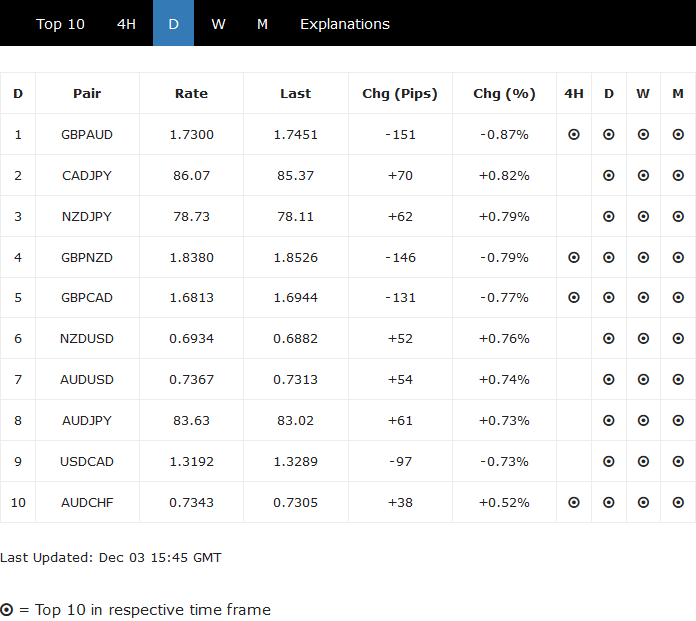
At the time of writing, GBP/AUD is the biggest mover today, down -151 pips or -0.87%. Aussie is clearly boosted by return of risk appetite on US-China trade truce. Meanwhile, focus has now turned back to Brexit worries. It's still generally pessimistic on the chance of getting Brexit bill through the parliamentary vote on December 11.
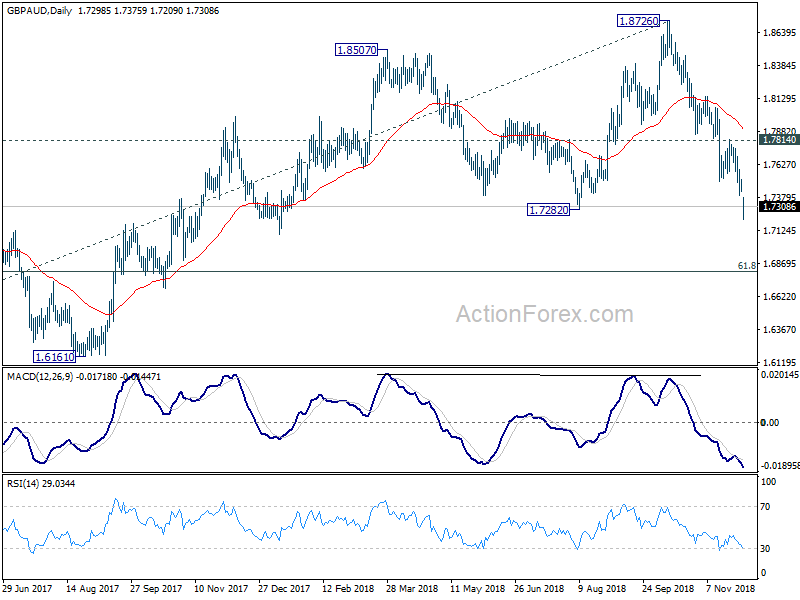
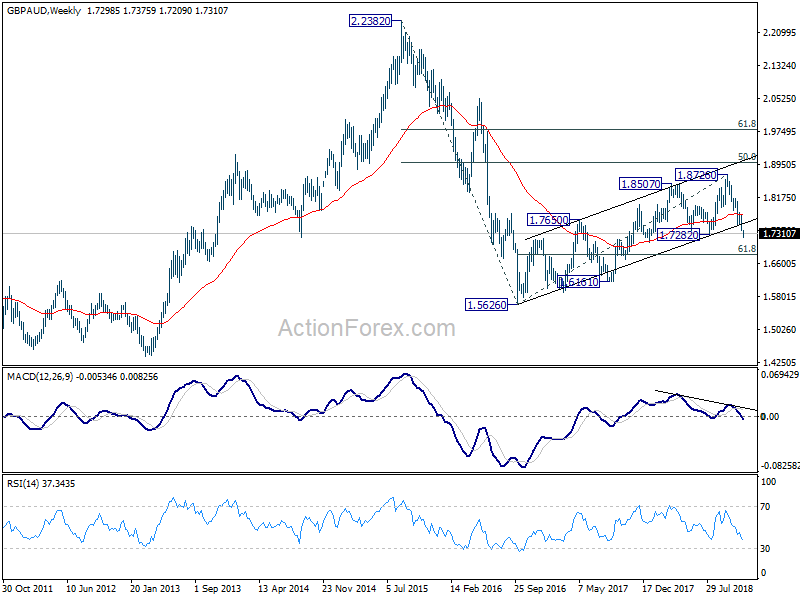
The development in GBP/AUD is so far pretty much in line with the bearish outlook as described in a prior quick note. Break of 1.7282 support today add to the case that whole "corrective" up trend from 1.5626 (2016 low) has completed at 1.8726 on after missing 50% retracement of 2.2382 to 1.5626 at 1.9004, on bearish divergence condition in weekly MACD.
Near term outlook will now stay bearish as long as 1.7814 resistance holds, even in case of strong recovery. Next downside target is 61.8% retracement of 1.5626 to 1.8726 at 1.6810. Sustained break there will pave the way to retest 1.5626 low in medium term.
Trade Wars Armistice Counted Against USD
The currency market started December against the USD. On Monday morning, the major currency pair is trading upwards as investors have no interest in the American currency as a “safe haven” asset. It happened after G20 summit, where the USA and China decided to take a break in their “trade wars”.
The parties agreed on the following: they will stop increasing import duties starting January 1st 2019 for three months in order to resume negotiations on a new trade agreement. Over this period of time, Washington shall postpone introducing additional 25% import duties on Chinese goods and “freeze“ this idea. China, in its turn, is obliged to buy a large volume of US-manufactured goods, including agricultural and commodity products.
Frankly speaking, it the same old soup just reheated, this time not in trading, but in politics. Most likely, the USA will start to put pressure on China to make the future trade agreement more profitable for Americans. There are reasons to believe that China might not like this and the Chinese government will use these three months to stimulate the country’s economy along with domestic demand and improve the banking sector in order to be ready for further “trade wars”.
However, at the moment investors aren’t interested in such distant prospects. The point is that there is a “spur-of-the-moment” thing: euphoria and rebound.
Under such conditions, investors’ interest in “safe haven” assets is reducing, thus making the USD fall.
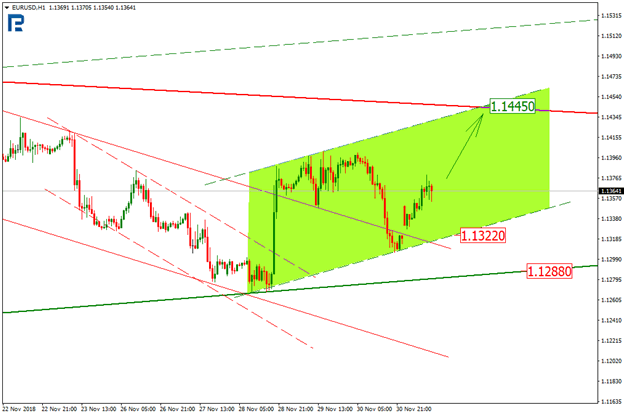
Looking at EURUSD movements over the last month, one can see a convergent trading range, which means that the correction to the upside continues. The previous local downtrend corrected the quick rising impulse, thus “counterweighing” the market. It seems that the current ascending impulse is heading towards the resistance level and 1.1445. In other words, this correctional movement to the upside is not over yet. At the same time, the pair may start a short-term decline towards the local support at 1.1322 and break it. In this case, the instrument may continue falling towards the key support at 1.1288. However, according to the main scenario, EURUSD is expected to move upwards to reach the Triangle’s upside border.
Fed Quarles: Utility of neutral rate becomes less
Fed Vice Chair Randal Quarles said Fed is "data dependent" but "not reacting to every wavering of the needle across the dial". And he emphasized that "we have described in all the communications tools a path that is pretty clear". Fed is "following a strategy and taking account of data over time as it comes in and in response to significant changes in direction."
Meanwhile, Quarles also said discussions regarding Fed's rate path have put too much emphasis on netural rate. And, "its utility as the central organizing thought around how you are conducting monetary policy becomes less."