Sample Category Title
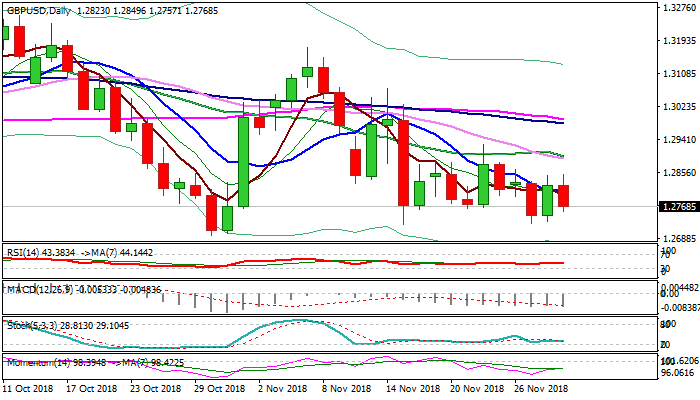
GBP/USD Outlook: Positive Impact From Dovish Powell Fades As Pound Falls On Latest PM May’s Comments
Cable was sharply lower on comments from UK PM May who confirmed that the deal with EU is the final one and the UK is leaving the union in March, as scheduled.
May also pointed to comments on the second vote as attempts to frustrate Brexit process.
The latest comments soured pound's sentiment and fresh weakness retraced over 61.8% of Wednesday's rally, neutralizing positive impact from weaker dollar on Fed's Powell dovish stance.
Larger bears are returning to full power after initial bullish signal was generated on Wednesday's close above 10SMA (1.2810).
Bearish daily studies add to negative outlook, with strong supports at 1.2722/32 zone (15/27/28 Nov lows) coming under pressure and break would unmask key supports at 1.2695 (30 Oct) and 1.2661 (2018 low).
Initial resistance is provided by 10SMA (1.2810) which should ideally cap and maintain bearish bias.
Highs of Wed/Tue (1.2849/47) mark next pivots, violation of which would provide relief, but sustained break above1.2895 (Fibo 38.2% of 1.3174/1.2722 / converged 20/30SMA's) is needed to neutralize bears and confirm double-bottom (1.2722/25).
Brexit remains pound's key driver and focus turns towards 11 Dec when the UK parliament is going to vote on Brexit plan.
Res: 1.2810, 1.2849, 1.2863, 1.2895
Sup: 1.2757, 1.2722, 1.2695, 1.2661
NZDUSD Hovers Near 5-Month Peak, Has More Room To Run
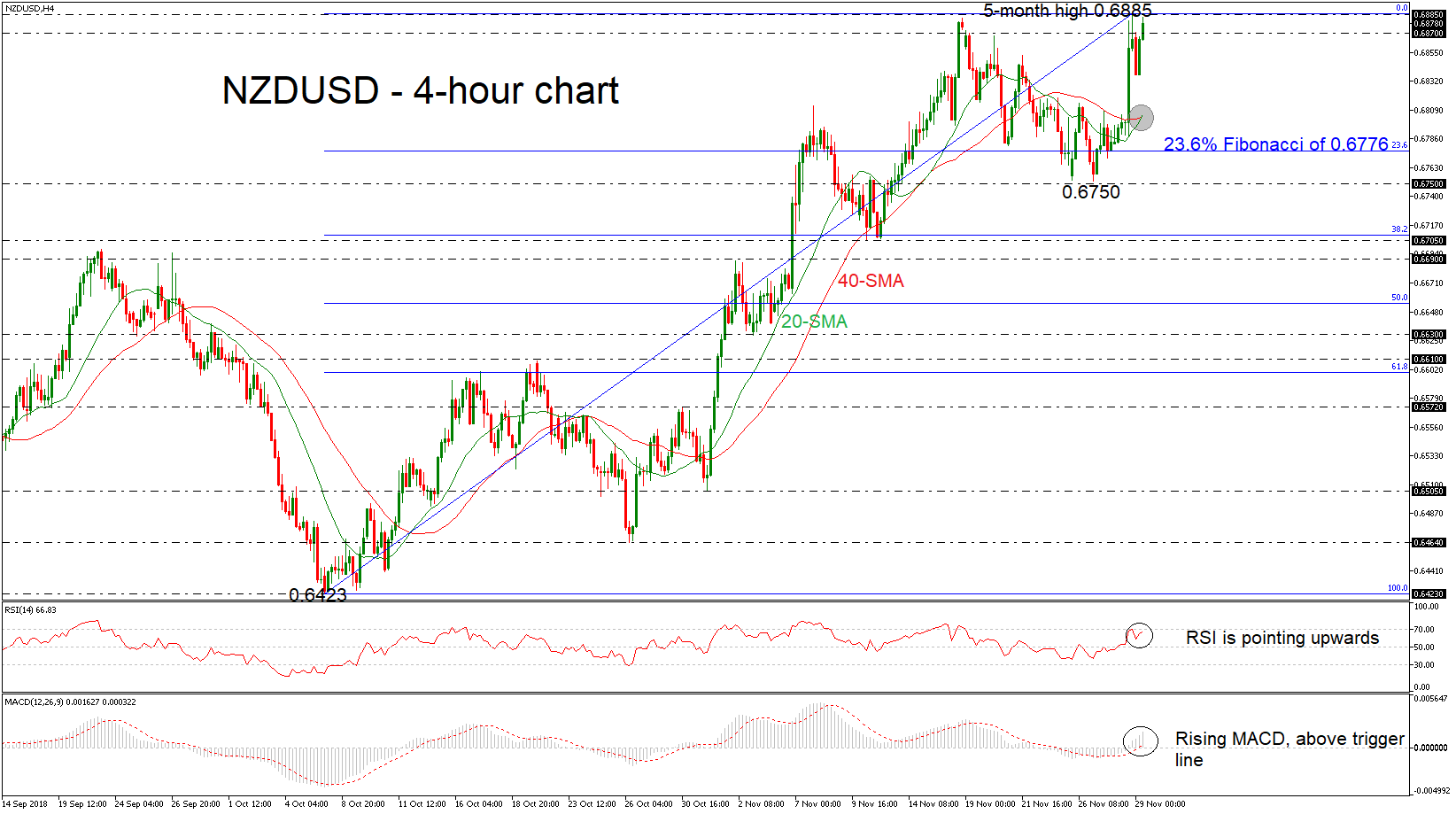
NZDUSD advanced strongly yesterday, driving the market towards a fresh five-month high around 0.6885. Currently, the pair holds slightly below this peak, but the 20- and 40-simple moving averages are confirming the upside momentum as they recorded a bullish crossover in the 4-hour chart. Moreover, the RSI indicator is moving higher, approaching the overbought zone and the MACD oscillator is strengthening its movement above the trigger and zero lines.
If the bulls continue to have control, the price could surpass the five-month peak and head towards the next immediate resistance of 0.6920, identified by the high on June 25. A potential upside violation of this region could open the door for the inside swing bottom of 0.6955, reached on June 1. Even higher, the next psychological level is coming from the 0.7000 resistance.
In case of declines in the pair, an immediate support area may come from the moving averages crossover near 0.6800. If the sellers manage to push below that hurdle, that would mark a drop towards the 23.6% Fibonacci retracement level of the upward movement from 0.6423 to 0.6885, around the 0.6776 support.
Overall, the short-term outlook appears bullish following the considerable move up in recent sessions.
$10 Drop Per Barrel Translates Into 1.5%-5% Decline Of GDP
For some it's a blessing, for others it spells trouble ahead, but one way or another, the oil price drop will have an effect on emerging markets. After hitting a nearly four-year high above $86 a barrel in early October, Brent crude, LCOF9, -0.17% dropped like a stone, trading temporarily below $60 per barrel, as worries over growing output and global demand took their toll. Brent, the global benchmark, and West Texas Intermediate crude CLF9, +0.24% its U.S. counterpart are both down more than 30% from their early-October peaks. Crude rebounded Monday, but was back down, in part thanks to a stronger U.S. dollar DXY, -0.10% on Tuesday.
Turkey, for example, is a net oil importer (and is also still buying oil from Iran), and a cheaper price of the black gold will help Ankara's balance of payments. Similarly, the likes of South Africa and India, also net importers, but with smaller current account deficits, they will likely see the cheaper oil price boost their terms of trade and support their GDP growth.
In hard numbers, every $10 per barrel drop in the oil price, boosts the income of oil importing emerging economies by roughly 0.5%-0.7% of GDP, according to Capital Economics. This is particularly exciting as investors didn't have the best economic outlook for the above three countries just a few weeks back, due in part to rising oil prices.
On the other end of the spectrum are oil exporters, like Russia and the Gulf states, for which the $10 drop per barrel translates into a decline worth something in the range of 1.5%-5% of GDP, with the Gulf states hit harder, Capital Economics said. While that's not great, these oil producers run large current account surpluses, and the oil price would have to fall a whole lot more to change that. Russia is also struggling with U.S. sanctions, which have led to weakness in the ruble USDRUB, -0.2791% and in the stock market MOEX, +0.00% The iShares MSCI Russia ETF ERUS, +2.80% is down 2.5% in the year-to-date.
Forex Technical Analysis: EUR/USD, USD/JPY, GBP/USD
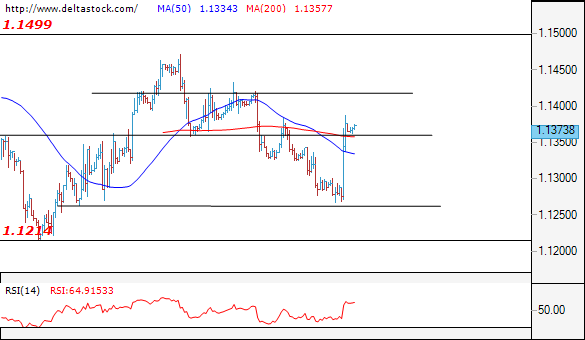
EUR/USD
Current level - 1.1373
Attempt to break the resistance at 1.1380, with a possible subsequent test of the critical 1.1415 level before any consolidation or selling pressure back to 1.1300 area, within the third part of the consolidation pattern above 1.1210 low. A break through 1.1210 will clearly state, that the general downtrend has kicked in and a massive sell-off will challenge 1.0850. Starting from 29th of November until 31st of December, the daily analyses will be published by our dealing department.
| Resistance | Support | ||
| intraday | intraweek | intraday | intraweek |
| 1.1415 | 1.1500 | 1.1350 | 1.1100 |
| 1.1450 | 1.1620 | 1.1260 | 1.0850 |
USD/JPY
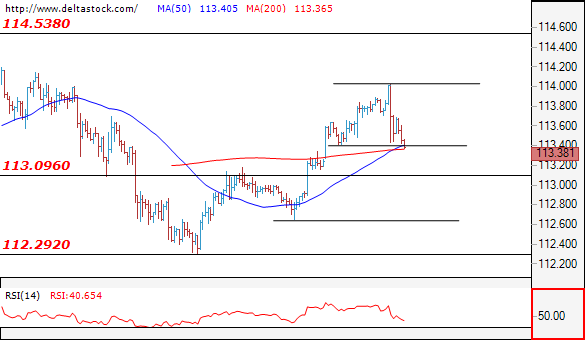
Current level - 113.38
The uptrend has lost some momentum at the price is at the support level of 113.40, coming close to the next key support at 113.10. Coming closer to the dinamic projection of teh 114.50 and 114.20 peaks creates condtions for a final swing back to 112.60, before breaking beyond 114.50, towards 120.00 sentiment area.
| Resistance | Support | ||
| intraday | intraweek | intraday | intraweek |
| 113.90 | 114.50 | 113.70 | 113.10 |
| 114.50 | 116.20 | 113.40 | 112.30 |
GBP/USD
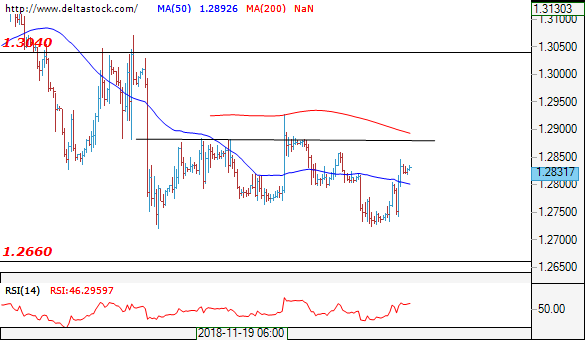
Current level - 1.2831
Still trading below the 1.2860 resistance, possible re-testing of the 1.2690-1.2700 area. While above 1.2660 lows, I favor a final wave to 1.3040 to complete the prolonged consolidation and the gather steam for a massive slide towards 1.2000 area.
| Resistance | Support | ||
| intraday | intraweek | intraday | intraweek |
| 1.2800 | 1.3250 | 1.2760 | 1.2660 |
| 1.2930 | 1.3440 | 1.2660 | 1.2340 |
Swiss GDP contracted -0.2% in Q3, growth cycle suddenly interrupted
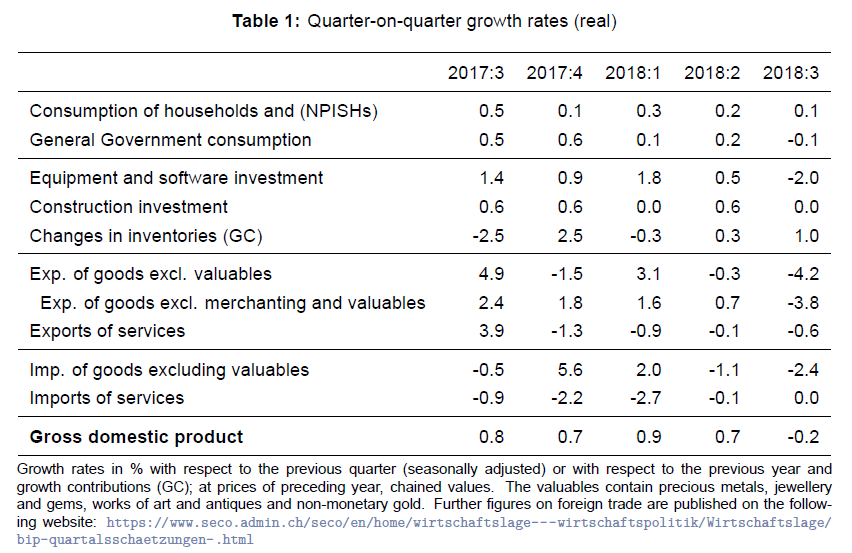
Swiss GDP unexpectedly contracted -0.2% qoq in Q3, much worse than expectation of 0.5% qoq expansion. The one and a half year strong continuous growth was "suddenly interrupted". And |Swiss is following the "significant economic downturn" as seen in other European countries, "in particular Germany.
SECO also noted that GDP contract was due to "both the industrial and service sectors". On the expenditure side, "domestic demand and foreign trade" had a negative impact. Looking at the details, export of goods were particular serious, down -4.2%. Import of goods excluding valuables also dropped -2.4%.
Aussie Eyes Chinese PMIs And Trump-Xi Meeting
Chinese official PMI data for November are due on Friday at 0100 GMT. Aussie traders will be eyeing the numbers given Australia’s China-dependency, which has rendered the currency a liquid proxy for Chinese “plays”. More pivotal for the Aussie though is likely to be the outcome of the Trump-Xi weekend meeting on trade at the G20 summit.
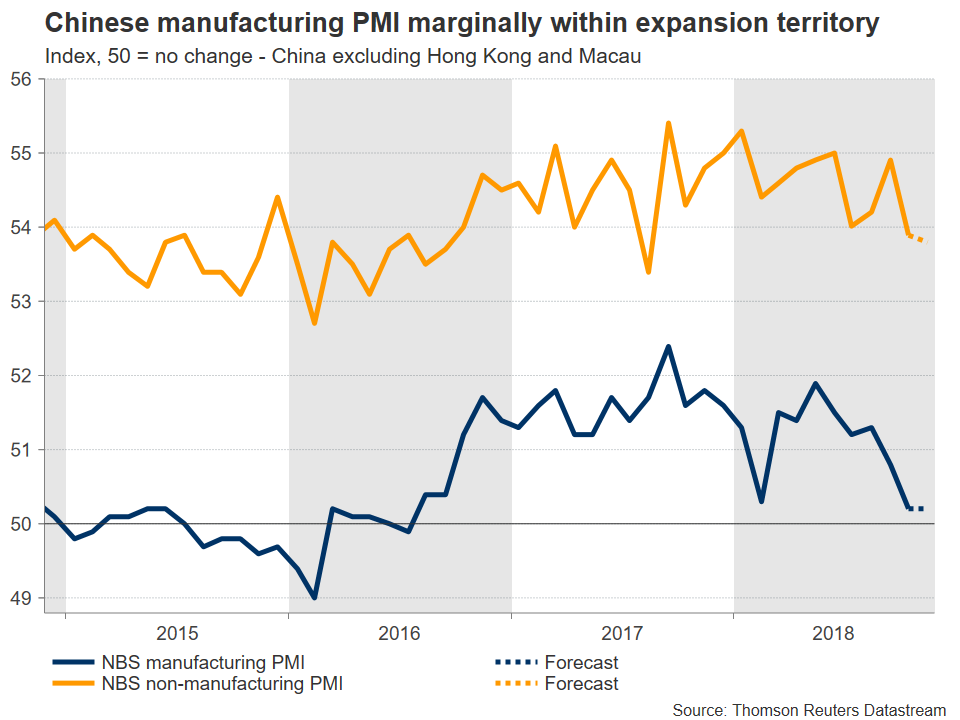
The manufacturing PMI, which is expected to attract the lion’s share of attention on Friday, is projected to remain at 50.2 in November, its lowest since July 2016. On the positive side of the spectrum, if the number comes in line with forecasts, the reading would exceed the 50 level that distinguishes sectoral expansion from contraction for the 28th straight month. Meanwhile, the non-manufacturing (services) PMI for the same month is anticipated to fall a tick to 53.8, which would put it at its lowest since August 2017.
In the big picture, Chinese economic data have been pointing to a slowdown in recent months, which has spurred actions from officials on both the fiscal and monetary policy fronts to prop up the economy. Deleveraging efforts to contain risks stemming from excessive credit availability and the intensifying trade row with the US were seen as factors posing downside risks to the economy. Relating to the latter, a key meeting between presidents Trump and Xi will take place on Saturday evening in Argentina, where the G20 summit will be taking place during the weekend.
There have been mixed signals by Trump as regards his intentions. On the one hand he makes remarks fueling optimism for a trade deal with China. On the other, his administration plans to proceed with a tariff hike to 25% starting January on Chinese goods that have been previously taxed at 10%, while signaling willingness to implement fresh duties on effectively all remaining imports that have so far escaped his levies.
This dichotomy may be part of Trump’s negotiating tactics, or it might reflect the opposing views within his administration: the Mnuchin camp advocates for a deal that would appease the markets, whereas the Lighthizer-Navarro camp is pushing for a hawkish stance. Which of these two camps will manage to get into Trump’s ear on trade may determine the outcome of Saturday’s dinner with Xi Jinping.
In FX markets, the Aussie will be in focus after Friday’s releases, but more importantly in the aftermath of the dinner between the leaders of the world’s two largest economies. Given the latter will take place over the weekend, the Australian currency may open with a gap on Monday.
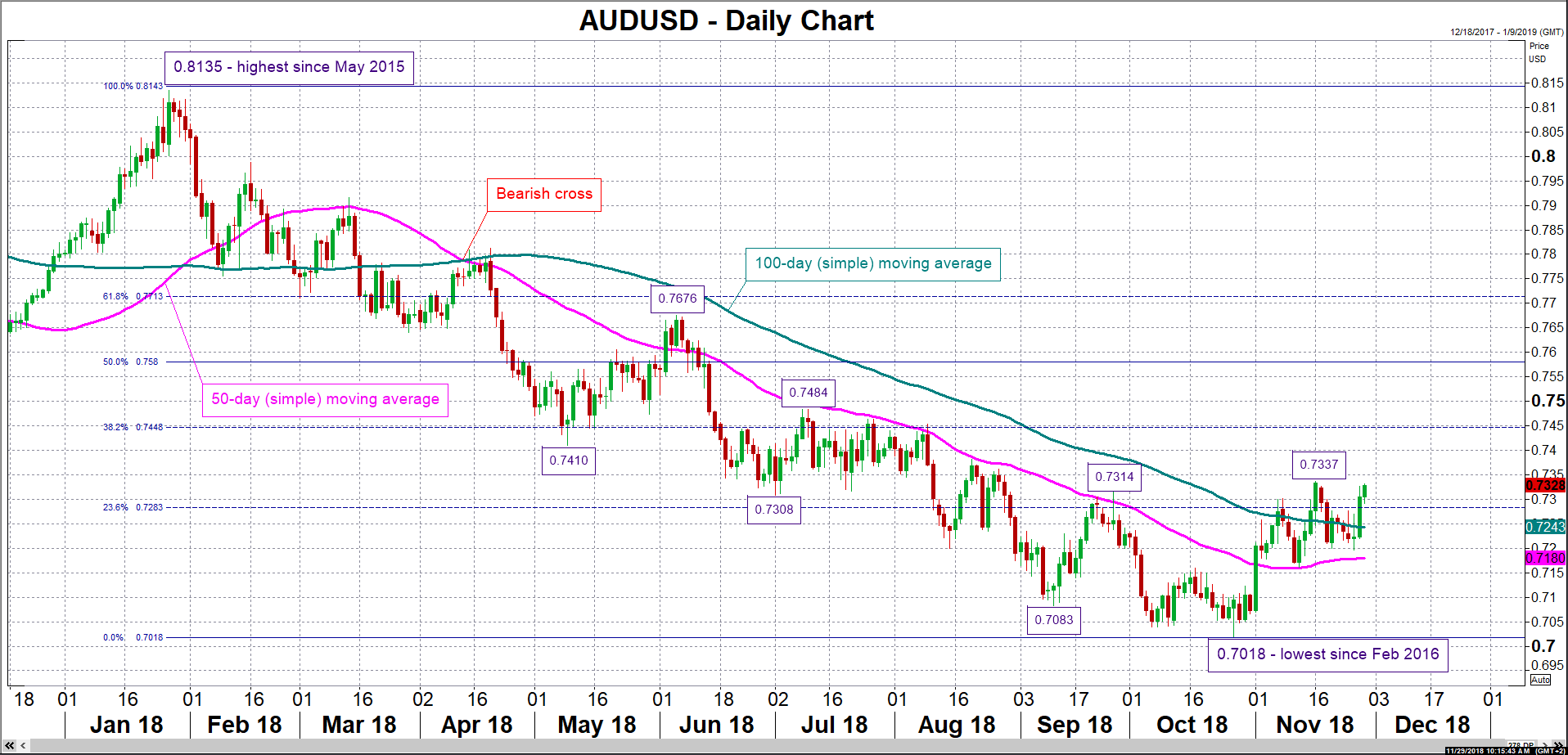
A rising AUDUSD may meet initial resistance around the pair’s highest since late August of 0.7337 recorded around mid-November. Higher, a barrier to gains could occur around 0.7448, the 38.2% Fibonacci retracement level of the downleg from 0.8135 to 0.7018. This, given that the area encapsulating the 0.74 handle, which was congested between late June to early August, is broken first. Steeper gains would bring the 0.7484 peak within scope. On the downside, support could come around the 23.6% Fibonacci retracement mark at 0.7283. Even lower, the attention would turn to the current level of the 100-day moving average line at 0.7243 and then to the 50-day MA at 0.7180.
Also in terms of market reaction, yuan movements will also be generating interest, to state the obvious. At 6.9390, the offshore yuan (USDCNH) is currently trading relatively close to its weakest since January 2017 of 6.9803, touched in early November. Besides currency markets, equities are also expected to react to both the Chinese figures and to a larger extent the trade talks. Trade discussions have the capacity to drive overall sentiment, though one company of particular interest that has been in the eye of the of the storm in recent weeks is Apple.
Lastly, Caixin’s PMI prints on the Chinese manufacturing and services sectors will be hitting the markets on Monday and Wednesday correspondingly. These focus on small and medium size businesses, with Friday’s official data being broader in nature.
EUR/USD Outlook: Initial Reversal Signal Needs Confirmation On Break Above 1.1472, Fed Minutes Would Provide More Clues
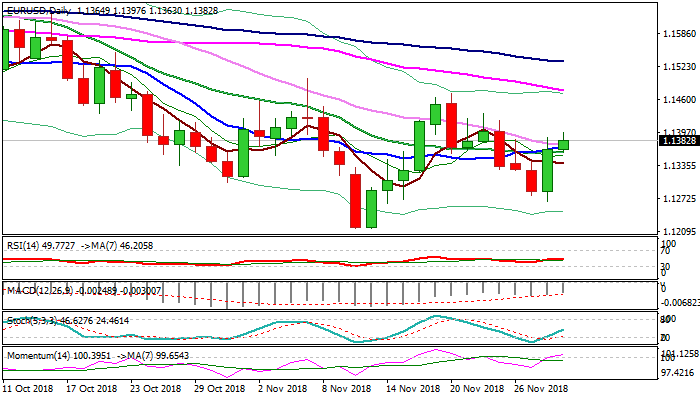
The Euro hit one week high at 1.1397 in early European trading on Thursday, in extension of previous day's over 100 pips rally after dovish comments from Fed chief Powell changed sentiment. The greenback was sold across the board following Powell's shift in policy outlook which much softer compared to hawkish tone in October. Powell described current US interest rates levels as being just below neutral (2.5% - 3.5%) that diverges from comments in October, when he said rates were long way from neutral. Markets took Powell's comments as a tip that the interest rate cycle is close to its end and turned into riskier assets. Fresh risk-on mode supports the Euro, with focus turning towards release of minutes of Fed's last policy meeting, due later today, for more clues about Fed's tightening path. Expectations that Fed would pause rate hike cycle are increasing as fears of global growth slowdown, falling stocks and strong fall in oil prices would have negative impact on inflation. Improved daily techs (10,20,30SMA's turned to bullish configuration and bullish momentum is rising) support for further advance. Today's extension higher cracked pivotal barrier at 1.1393 (Fibo 61.8% of 1.1472/1.1267), close above which would generate fresh bullish signal. The notion is also supported by Wednesday's bullish outside day pattern. Bulls eye targets at 1.1433 (22 Nov high) and 1.1472 (20 Nov high/falling 55SMA). Sustained break above 1.1472 is needed to sideline broader bears and generate stronger reversal signal. Broken 20SMA marks initial support at 1.1360 while return and close below 1.1345 (base of thick 4-hr cloud / broken Fibo 38.2% of 1.1472/1.1267) would soften near-term tone.
Res: 1.1397, 1.1433, 1.1472, 1.1500
Sup: 1.1360, 1.1345, 1.1300, 1.1267
Powell Sinks Dollar, But Mind The Fed Minutes
- Dollar drops as Powell appears 'dovish'. However, markets may have overreacted, hence today's Fed minutes (1900 GMT) could be crucial
- Equities and commodity-linked currencies lifted by Powell's remarks
- Pound capitalizes on dollar's pullback and signs voters may support May's deal
Dollar drops as Powell appears 'cautious', but Fed minutes crucial
Fed Chair Powell's speech yesterday was widely perceived as dovish. The comment that grabbed most attention was that rates 'remain just below the broad range of estimates that would be neutral for the economy'. The implication is that if rates are just below neutral, the Fed won't raise them much further from here. Consequently, the dollar fell sharply as investors priced out rate increases in 2019; markets now expect the Fed to hike rates a single time next year, versus the three 25bps hikes penciled in by the central bank itself.
While his remarks do seem cautious at first glance, a closer look might reveal otherwise. He specifically said rates are near the 'range' of estimates for neutral; this is a rather wide range, and the comment is simply an acknowledgement of reality. Moreover, while he noted he's paying 'close attention' to the data, he made it clear he expects solid US growth, low unemployment, and near-target inflation. Overall, his comments were hardly those of a central banker attempting to signal he might hit the pause button on hikes before long.
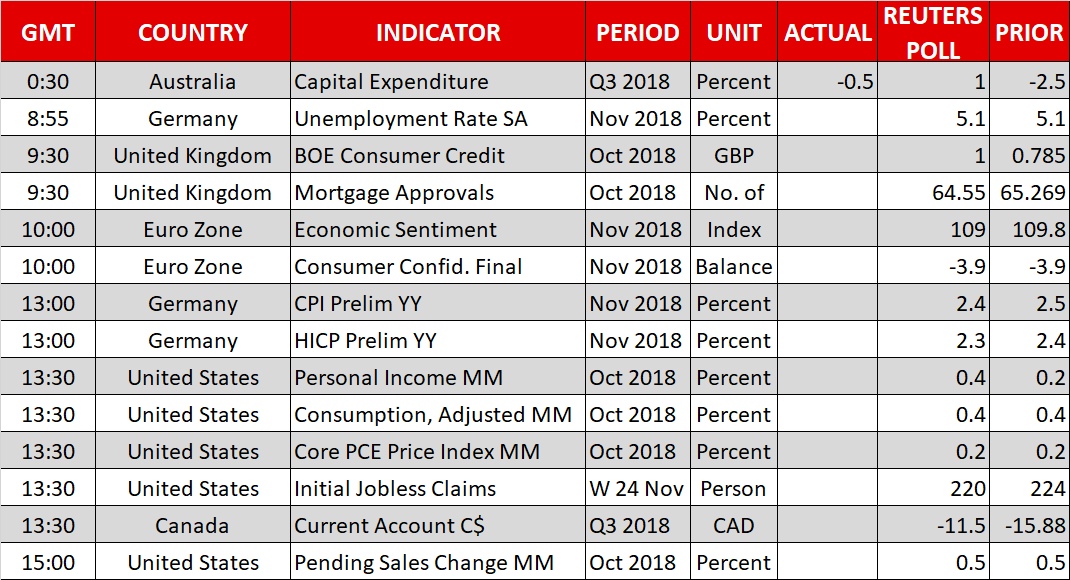
Hence, the current pricing for just one quarter-point hike next year may be somewhat of an overreaction on the part of investors, which runs the risk of being corrected later today in case the latest Fed minutes due at 1900 GMT strike a more balanced tone. Ahead of the minutes at 1330 GMT, the core PCE price index for October will be released alongside personal consumption and income data – these may also be crucial for the dollar. Meanwhile, regional Fed Presidents Mester, Evans, Harker, Kashkari, Kaplan, and Rosengren will participate in a panel at 1930 GMT.
Equities soar alongside commodity currencies; focus still on trade
Stock markets liked Powell's dovish-perceived comments, with US indices like the S&P 500 (+2.30%) and Nasdaq Composite (+2.95%) posting meaningful gains. Speculation for lower interest rates for longer is typically a blessing for stocks, as investors bet that companies' borrowing costs will remain minimal, boosting profitability.
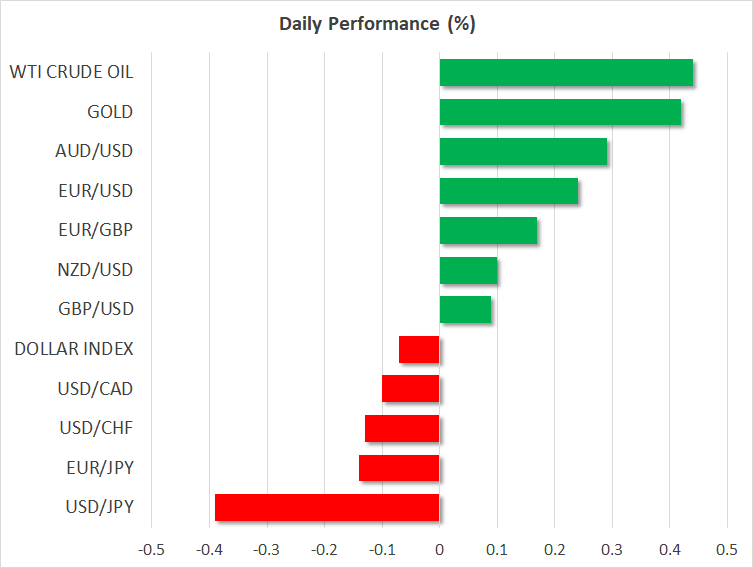
The aussie and kiwi outperformed in this risk-on environment, with kiwi/dollar touching a 5-month high. Meanwhile, gold rose on the back of a weaker dollar, but still trades within a triangle. The upcoming US data today could also impact these assets via the risk sentiment channel, but note that how trade discussions play out may prove more important. In this respect, China's President Xi Jinping said yesterday his nation will make efforts to open its markets and protect intellectual property, perhaps laying the groundwork for a 'ceasefire' when he meets Trump this week.
Pound rebounds amid signs 'Brexit tide' may be turning
An opinion poll that flew largely under the radar yesterday showed that support for May's deal among voters is above 50%, suggesting the PM's recent efforts to 'sell' her agreement may be bearing fruit. While a single opinion poll doesn't mean much, if public support for the accord continues to rise, Parliament risks a major backlash in rejecting it – underscoring that May could ultimately manage to turn the tide. Sterling/dollar rebounded to cross back above 1.2800, not least due to dollar weakness. Any further signs the Parliamentary vote may be closer than markets currently anticipate could be a game changer for the currency's near-term prospects.
Other highlights
Ahead of the US data today, Germany's preliminary inflation data for November are due out at 1300 GMT. The nation's EU-harmonized CPI rate is projected to tick down to 2.3% in yearly terms, from 2.4% previously. The regional German CPIs will be released ahead of the nationwide print, so any moves in the euro may occur before the official release time.
As for other public appearances, the BoC's Wilkins will deliver remarks at 1500 GMT and the ECB's Villeroy de Galhau at 1700 GMT.
Investors Are Evaluating The Statements By The Head Of The Federal Reserve
The USD is weakened against the basket of major currencies after the US published weak economic stats, as well as the statements by the head of the Federal Reserve. For example, GDP increased in the third quarter by 3.5% instead of the expected 3.6%. The sales of the new real estate in October also lowered to 544K instead of the 583K. The USD index (#DX) closed in the red (-0,62%).
Jerome Powell, the head of the Federal Reserve, unexpectedly stated that the key interest rates are "somewhat lower" than the neutral level. This means that the official has changed his position regarding the interest rate since back in October he stated that it had been far from the neutral level. According to him, the further course of the monetary policy is still undetermined and will depend on the macroeconomic indicators. You should keep an eye on the FOMC minutes once they are published.
Prices on oil are lowering while the US oil reserves are growing. The WTI futures are testing the 50.55 USD/barrel mark.
Market Indicators
- Yesterday the US stock market was showing agressive purchases: #SPY (+2,30%), #DIA (+2,56%), #QQQ (+3,22%).
- The 10-year US government bonds yield is lowering. At the moment it is at 3.01-3.02%.
The Economic News Feed for 29.11.2018:
- Unemployment Change in Germany (EU) – 10:55 (GMT+2:00);
- Pending Home Sales (US) – 17:00 (GMT+2:00);
- FOMC Minutes Release (US) – 21:00 (GMT+2:00).
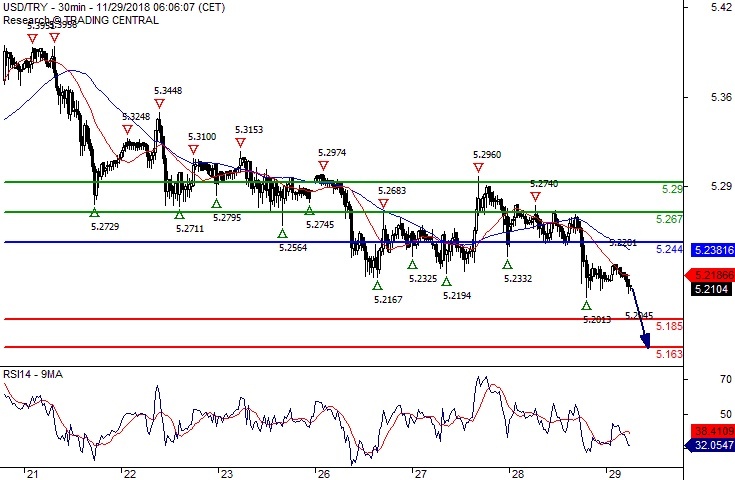
USD/TRY The Downside Prevails
Pivot (invalidation): 5.2440
Our preference Short positions below 5.2440 with targets at 5.1850 & 5.1630 in extension.
Alternative scenario Above 5.2440 look for further upside with 5.2670 & 5.2900 as targets.
Comment As Long as 5.2440 is resistance, likely decline to 5.1850.