

Sample Category Title
Dollar Rebound Attempt Capped by Weaker Core Inflation, Yen Gains ahead of G20
After yesterday selloff triggered by Fed Chair Jerome Powell, Dollar turns mixed today. It did try to regain some grounds in early European session. But the attempt falters after weaker than expected inflation reading from the US. Focus will now turn to minutes of the November FOMC meeting. It's important to see whether it's a consensus that interest now is now "just below" or "long way from " neutral.
Staying in the currency markets, Australian Dollar is so far the strongest one for today. The break of 0.7314 key resistance in AUD/USD suggests medium term bullish reversal. But AUD/USD has yet to pick up momentum above 0.7314 to confirm. Yen is the second strongest one for today, followed by Euro. Meanwhile, Sterling is the weakest one, followed by Swiss Franc. The Swiss is firstly weighed down by surprised GDP contraction. Also, rebound in emerging market currencies, like Turkish Lira, on Dollar weakness also reduced safe haven demand for Franc. Canadian Dollar is mixed as WTI crude oil broken below 50 but quickly recovered.
Technically, Aussie's strength is worth a watch today. 0.7314 in AUD/USD is a level to watch. Also, we'll see if if EUR/AUD could sustain below 1.5519 support to confirm decline resumption. Sterling is another one to watch. GBP/USD might head back to 1.2725 temporary low. Also, EUR/GBP is eying 0.8939 resistance and GBP/JPY is heading back to 144.02 support. Break of these levels could prompt deeper selloff in the Pound.
In other markets, major European indices are trading all in black at the time of writing. FTSE is up 0.68%, DAX up 0.36% and CAC up 0.57%. German 10 year yield is down -0.0238 at 0.329. Italian 10 year yield is down -0.036 at 3.225. German-Italian spread stays below 300. Earlier in Asia, Nikkei closed up 0.39% while Singapore Strait Times rose 0.48%. However, Hong Kong HSI dropped -0.87% while Shanghai SSE dropped -1.32%.
One more thing to note is that 10 year JGB yield dropped -0.0195 to 0.081, a level we haven't seen for some time. Japanese yield fell while Yen is rising. China and Hong stocks closed lower. These argue that traders are turning defensive ahead of the Trump-Xi meeting at G20 this weekend.
Dollar back under pressure as core PCE inflation slowed, jobless claims rose
Dollar is back under some mild pressure in early US session after mixed economic data. Inflation data missed expectations. Headline PCE was unchanged at 2.0% yoy in October versus consensus of 2.1%. Core PCE even slowed to 1.8% yoy, down from 2.0% yoy and missed consensus of 1.9% yoy. Though, personal income rose 0.5% while spending rose 0.6%. Both were above expectations.
Initial jobless claims rose 10k to 234k in the week ended November 24, above expectation of 221k. Four-week moving average of initial claims rose 4.75k to 223.25k. Continuing claims rose 50k to 1.71M in the week ended November 17. Four-week moving average of continuing claims rose 19.75k to 1.668M.
USTR seeks auto tariffs equalization from China
Just days ahead of the Trump-Xi meeting, the US Trade Representative Robert Lighthizer issued another statement regarding China's auto tariffs today. Is it setting the stage for Trump to claim victory on some Chinese concessions?
The statement noted, "As the President has repeatedly noted, China's aggressive, State-directed industrial policies are causing severe harm to U.S. workers and manufacturers. We are continuing to raise these issues with China. As of yet, China has not come to the table with proposals for meaningful reform."
"China's policies are especially egregious with respect to automobile tariffs. Currently, China imposes a tariff of 40 percent on U.S. automobiles. This is more than double the rate of 15 percent that China imposes on its other trading partners, and approximately one and a half times higher than the 27.5 percent tariff that the United States currently applies to Chinese-produced automobiles. At the President's direction, I will examine all available tools to equalize the tariffs applied to automobiles."
Eurozone business climate improved, economic confidence dropped less than expected
Eurozone (EA19) business climate improved to 1.09 in November, up from 1.01 and beat expectation of 0.96. Eurozone economic confidence dropped to 109.5, down from 109.7 but beat expectation of 109.0. Industrial confidence rose to 3.4, up from 3.0 and beat expectation of 2.3. Services confidence was unchanged at 13.3, above expectation of 13.0. Consumer confidence was finalized at -3.9.
Also release in European session, German CPI slowed to 2.3% yoy in November, down from 2.5% yoy but beat expectation of 2.2% yoy. German unemployment dropped -16k in November. Unemployment rate dropped 0.1% to 5.0% in October. French GDP rose 0.4% qoq in Q3, unrevised. UK mortgage approvals rose 1k to 67k in October. UK M4 money supply rose 0.7% mom in October.
EU Barnier: The Brexit deal on table is the only deal possible
EU chief Brexit negotiator Michel Barnier told the EU parliament today that given the "high degree of complexity of all the issues surrounding the UK's withdrawal, the orderly withdrawal treaty that is on the table is the only deal possible". And he added that "this is now the moment of ratification".
Barnier also said "It's not a question of winners and losers because Brexit is a lose-lose. There is no added value". And "I am convinced we will be able to work together for a real and unprecedented partnership."
Separately, UK Prime Minister Theresa May continued her brainwashing rhetorics today. She said told a parliamentary committed, "the timetable is such that actually some people would need to take some practical steps in relation to no deal if the parliament were to vote down the deal on the 11th of December."
Swiss GDP contracted -0.2% in Q3, growth cycle suddenly interrupted
Swiss GDP unexpectedly contracted -0.2% qoq in Q3, much worse than expectation of 0.5% qoq expansion. The one and a half year strong continuous growth was "suddenly interrupted". And |Swiss is following the "significant economic downturn" as seen in other European countries, "in particular Germany.
SECO also noted that GDP contract was due to "both the industrial and service sectors". On the expenditure side, "domestic demand and foreign trade" had a negative impact. Looking at the details, export of goods were particular serious, down -4.2%. Import of goods excluding valuables also dropped -2.4%.
BoJ Masai: Best to sustain current ultra-loose monetary policy
Bank of Japan board member Takako Masai said price growth remained weak in Japan even though growth was solid. And, "as such, the best approach would be to sustain the current ultra-loose monetary policy. With that "the positive momentum is not disrupted," regarding inflation moving back to 2% target.
She also noted that "Monetary easing can stimulate the economy. On the other hand, prolonged low rates could have adverse effects on bond market functions and financial institutions' profits". Thus, "in guiding monetary policy, the BOJ must thoroughly scrutinize the costs and benefits of its policy from various perspectives."
On BoJ's move to allow 10-year JGB yield to move from -0.1% to 0.1%, she that "Such flexible measures the BOJ took will help sustain sound market functions."
Released in Asian session, Japan retail sales rose 3.5% yoy in October versus expectation of 2.7% yoy. New Zealand ANZ business confidence was unchanged at -37.1 in November. Australia private capital expenditure dropped -0.5% in Q3, below expectation of 2.0%.
USD/CHF Mid-Day Outlook
Daily Pivots: (S1) 0.9905; (P) 0.9956; (R1) 0.9986; More...
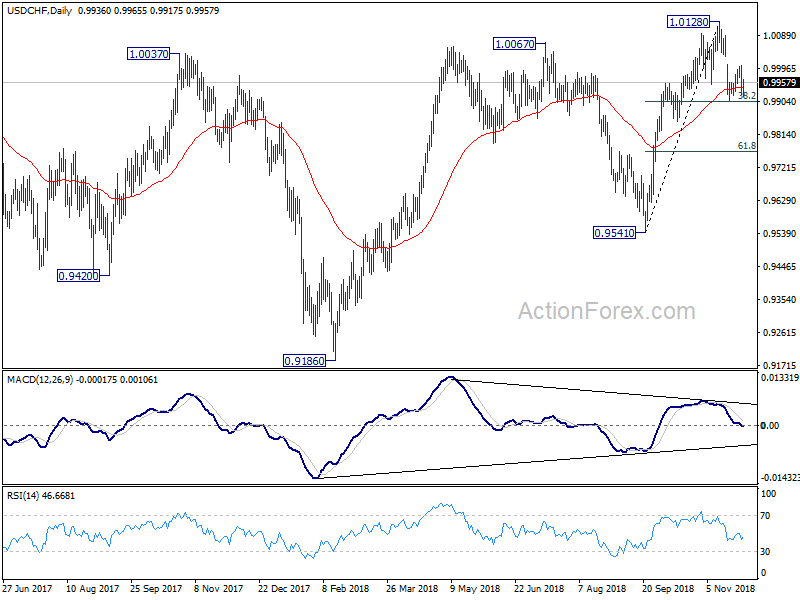
USD/CHF recovers ahead of 0.9908 support and intraday bias remains neutral at this point. On the downside, break of 38.2% retracement of 0.9541 to 1.0128 at 0.9904 will resume the fall from 1.0128 to 0.9848 key support level. Break there will indicate near term reversal and target 61.8% at 0.9765. On the upside, break of 1.0006 will argue that the pull back from 1.0128 has completed. Intraday bias will be turned back to the upside for retesting 1.1028.
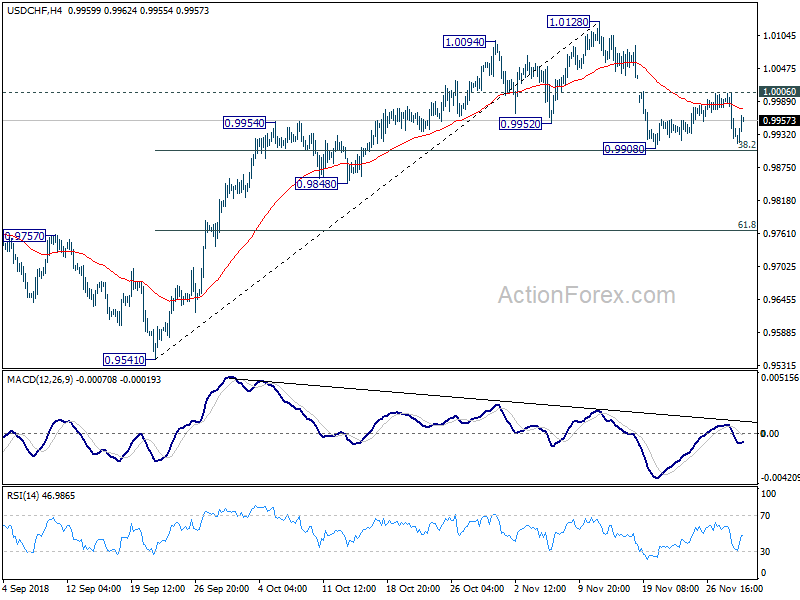
In the bigger picture, rise from 0.9541 could have topped at 1.0128. But as long as 0.9541 support holds, we'd still expect rise from 0.9186 to resume at a later stage. Break of 1.0128 will target 1.0342 key resistance. However, break of 0.9514 will pave the way back to 0.9186 low.
Economic Indicators Update
| GMT | Ccy | Events | Actual | Forecast | Previous | Revised |
|---|---|---|---|---|---|---|
| 23:50 | JPY | Retail Trade Y/Y Oct | 3.50% | 2.70% | 2.10% | 2.20% |
| 00:00 | NZD | ANZ Business Confidence Nov | -37.1 | -37.1 | ||
| 00:30 | AUD | Private Capital Expenditure Q3 | -0.50% | 2.00% | -2.50% | -0.90% |
| 06:45 | CHF | GDP Q/Q Q3 | -0.20% | 0.50% | 0.70% | |
| 07:45 | EUR | French GDP Q/Q Q3 P | 0.40% | 0.40% | 0.40% | |
| 08:55 | EUR | German Unemployment Change Nov | -16K | -10K | -11K | |
| 08:55 | EUR | German Unemployment Claims Rate s.a. Nov | 5.00% | 5.00% | 5.10% | |
| 09:30 | GBP | Mortgage Approvals Oct | 67K | 65K | 65K | 66K |
| 09:30 | GBP | Money Supply M4 M/M Oct | 0.70% | 0.30% | -0.30% | |
| 10:00 | EUR | Eurozone Business Climate Indicator Nov | 1.09 | 0.96 | 1.01 | |
| 10:00 | EUR | Eurozone Economic Confidence Nov | 109.5 | 109 | 109.8 | 109.7 |
| 10:00 | EUR | Eurozone Industrial Confidence Nov | 3.4 | 2.3 | 3 | |
| 10:00 | EUR | Eurozone Services Confidence Nov | 13.3 | 13 | 13.6 | 13.3 |
| 10:00 | EUR | Eurozone Consumer Confidence Nov F | -3.9 | -3.9 | -3.9 | |
| 13:00 | EUR | German CPI M/M Nov P | 0.10% | 0.00% | 0.20% | |
| 13:00 | EUR | German CPI Y/Y Nov P | 2.30% | 2.20% | 2.50% | |
| 13:30 | CAD | Current Account Balance (CAD) Q3 | -10.3B | -11.9B | -15.9B | -16.7B |
| 13:30 | USD | Personal Income Oct | 0.50% | 0.40% | 0.20% | |
| 13:30 | USD | Personal Spending Oct | 0.60% | 0.40% | 0.40% | 0.20% |
| 13:30 | USD | PCE Deflator M/M Oct | 0.20% | 0.20% | 0.10% | |
| 13:30 | USD | PCE Deflator Y/Y Oct | 2.00% | 2.10% | 2.00% | |
| 13:30 | USD | PCE Core M/M Oct | 0.10% | 0.20% | 0.20% | |
| 13:30 | USD | PCE Core Y/Y Oct | 1.80% | 1.90% | 2.00% | |
| 13:30 | USD | Initial Jobless Claims (NOV 24) | 234K | 221K | 224K | |
| 15:00 | USD | Pending Home Sales M/M Oct | 0.80% | 0.50% | ||
| 15:30 | USD | Natural Gas Storage | -76B | -134B | ||
| 19:00 | USD | FOMC Minutes |
Dollar back under pressure as core PCE inflation slowed, jobless claims rose
Dollar is back under some mild pressure in early US session after mixed economic data. Inflation data missed expectations. Headline PCE was unchanged at 2.0% yoy in October versus consensus of 2.1%. Core PCE even slowed to 1.8% yoy, down from 2.0% yoy and missed consensus of 1.9% yoy. Though, personal income rose 0.5% while spending rose 0.6%. Both were above expectations.
Initial jobless claims rose 10k to 234k in the week ended November 24, above expectation of 221k. Four-week moving average of initial claims rose 4.75k to 223.25k. Continuing claims rose 50k to 1.71M in the week ended November 17. Four-week moving average of continuing claims rose 19.75k to 1.668M.
Canadian Dollar Unchanged, Current Account Next
The Canadian dollar is unchanged in the Thursday session. Currently, USD/CAD is trading at 1.3276, down 0.01% on the day. In economic news, Canada’s current account deficit is expected to drop sharply to C$11.9 billion. In the U.S., Core PCE Price Index and Personal Spending are expected to post gains of 0.2% and 0.4%, respectively. Unemployment claims are forecast to drop to 221 thousand and the Federal Reserve releases the minutes of its November policy meeting. On Friday, Canada releases GDP and the Raw Materials Price Index, while the U.S. will publish Chicago PMI. As well, the G-20 begins a two-day summit in Argentina.
The U.S. dollar was broadly lower on Wednesday, and the Canadian dollar managed to record slight gains as well. The catalyst was a surprise from the Federal Reserve. Jerome Powell, chair of the Fed, caught the markets off guard when he said that the current benchmark rate of 2-2.5 percent is “just below” the neutral range. This is in sharp contrast to Powell’s remarks just last month, when he said that rates were “a long way from neutral”. Powell’s hasty U-turn is likely due to the change in U.S. economic conditions in recent weeks – GDP has been slowing, the stock markets are down and oil prices have fallen. The Fed may have decided that this required an easing up on rate hikes in 2019, and Powell delivered this message to the markets. Only a few months ago, there was talk of ‘a rate hike each quarter’ in 2019, but now, some analysts are predicting only one or two hikes next year. Despite Powell’s dovish remarks, the odds of a December rate have not diminished, which stand at 79%, according to the CME Group.
G-20 leaders will gather on Friday, but the markets don’t have much interest in the summit’s agenda. Instead, all eyes will be focused on an expected meeting between President Trump and Chinese President Xi Jinping. An exchange of tariffs between the U.S. and China has taken a bite out of the economies of both and could dampen global economic activity. President Trump has taken a tough line on China ahead of the summit, threatening to raise the tariffs from 10 percent to 25 percent on $250 billion worth of Chinese goods. Will Trump carry out his threat? If so, the Canadian dollar could fall sharply. At the same time, the unpredictable Trump is known to prefer to reach a deal whenever possible, so his sharp rhetoric could be some grandstanding ahead of his crucial meeting with Xi. If the two leaders can “agree to disagree” and continue talking, risk appetite will improve and the Canadian dollar could move higher.
Powell Revives Risk Appetite ahead of G20 Summit, Oil Slips to Yearly Low
Global equity bulls were instilled with a renewed sense of inspiration on Thursday after dovish remarks from Federal Reserve Chair Jerome Powell boosted risk appetite.
Asian stocks closed mostly higher amid the positive market mood with European shares currently taking their cue from the rally in Asia. Powell’s surprise dovish comments are likely to offer investors a short-term distraction ahead of the highly anticipated G20 summit. However, overall market sentiment continues to hang on the outcome of trade talks between President Trump and his Chinese counterpart President Xi.
Although a US-China trade deal breakthrough seems quite unlikely, any sign of both sides expressing some interest for further discussion could be a welcome development for financial markets.
Dollar dethroned by Powell
The Dollar was booted off its throne on Wednesday evening after dovish comments from Powell prompted investors to re-evaluate rate hike expectations.
Powell’s statement that interest rates are “just below” the neutral range came as a surprise which immediately fueled speculation of the Fed taking a pause in interest rate hikes next year. With investors likely to scale back on US rate hike expectations beyond December, this is good news for global stocks but very bad news for King Dollar. It is worth noting that one of the primary drivers behind the Dollar’s incredible appreciation in recent months was speculation of higher rates. Dollar bulls could be running out of steam as Investors are expecting only one more interest rate increase in 2019, as opposed to the three predicted by the Fed’s projection in September.
Attention will be directed towards the minutes from the Fed’s November meeting which will most likely reinforce expectations of a rate hike in December. Market players will be looking for additional clues on the Fed’s rate hiking path for 2019. If the minutes are presented with a similar dovish tone as Powell’s speech, the Dollar could be in trouble.
Another day, another yearly low for Oil
Oil prices quietly depreciated to a fresh yearly low on Thursday as investors re-assessed OPEC’s ability to decisively cut production to eliminate excess supply in global markets.
Comments from Russian President Vladimir Putin stating how Russia is comfortable with the current level of Oil prices at around $60 compounded downside pressures with Brent Crude trading around $58.00 as of time of writing. With fears over excessive supply and worries about falling demand the primary themes weighing on Oil markets, the outlook for Brent Crude and WTI remains bearish.
Gold shines as Dollar weakens
Gold is shining proudly today as the Dollar continues to weaken on Powell’s dovish remarks.
The price action seen today simply highlights how Gold’s direction remains dictated by the Dollar’s performance and speculation around US interest rates. With the Dollar possibly weakening further in the near term, the yellow metal has the potential to break above the $1,228 resistance level. A daily close above this point may encourage an incline towards $1,240.
The Ambiguity In Powell’s Words Has Triggered The Dollar To Plummet
The dollar was significantly affected by the words of the Fed Chairman on Wednesday. The dollar index has dropped by 0.9%, in response to Powell's comments that the Federal funds rate is “just below” the neutral level. These words were perceived as dovish compared to what the Fed Chairman commented in early October.
The weakening of the US Dollar is favourable for the stock market. The dollar's decrease and the expectations of a softer approach from the Fed, have triggered a 2.3%-2.5% increase in key U.S. indices.
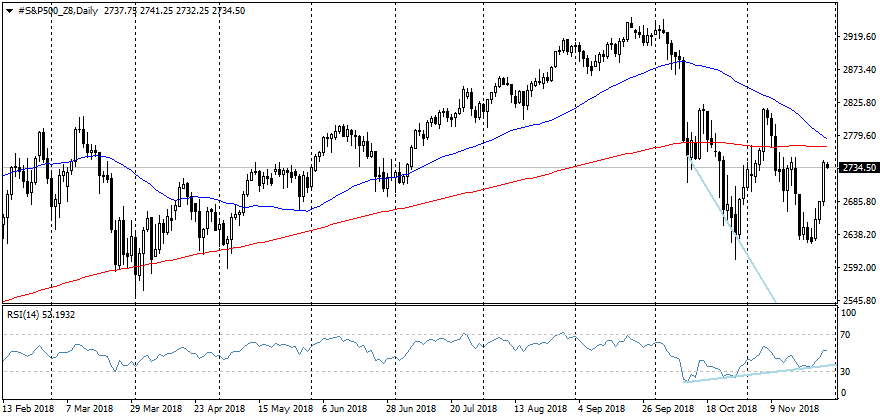
Earlier in October, Powell had warned the market that the Fed could raise the rates above the neutral level, which would push stock indices lower, increase demand for the dollar and trigger a sharp decline for Crude Oil. The shift of the Central Bank's stance has caused the dollar to plummet overnight, and it might as well have a serious impact on the future prospects of the dollar, initiating a prolonged decline.
In the recent weeks, the Fed had given a few signals about a change in their sentiment and FOMC talks more about 2-3 rate increases in 2019, compared to 4 in 2018.
However, what's more important, is how the markets will perceive this message, rather than the message itself. In October, market participants perceived the tone of Powell as too hawkish.
The same goes for yesterday's comments as well. It was stated that the current rate of 2.00%-2.25% is barely lower than the neutral level, which is defined as a range of 2.5%-3.5%. Nevertheless, it is only a new fact, and does not in any case cancels out the comments made in October that the rate during the current policy tightening may go above the neutral level.
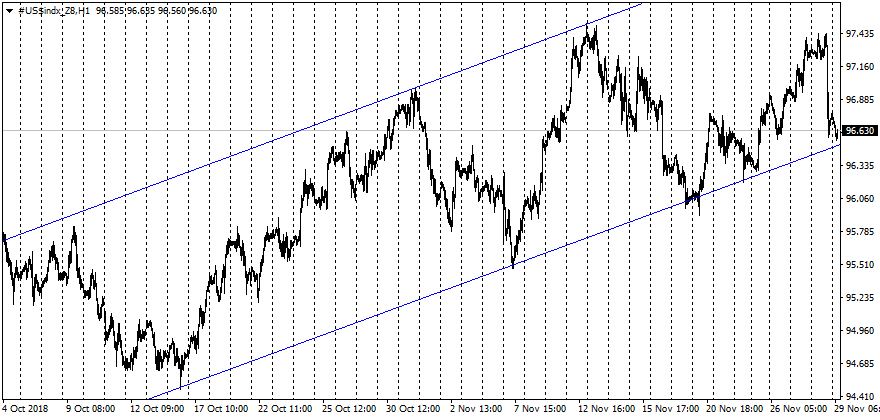
Most likely, the markets saw what they wanted to see, and they have started selling the dollar from its local highs. The market's turbulent reaction to the news, has triggered the dollar to approach the end of its growth trend. The USDX's drop below 96.50 can definitively mark the beginning of a downward reversal. This is also confirmed by technical analysis, in which we highlighted the divergence between the price chart and the technical indicator RSI.
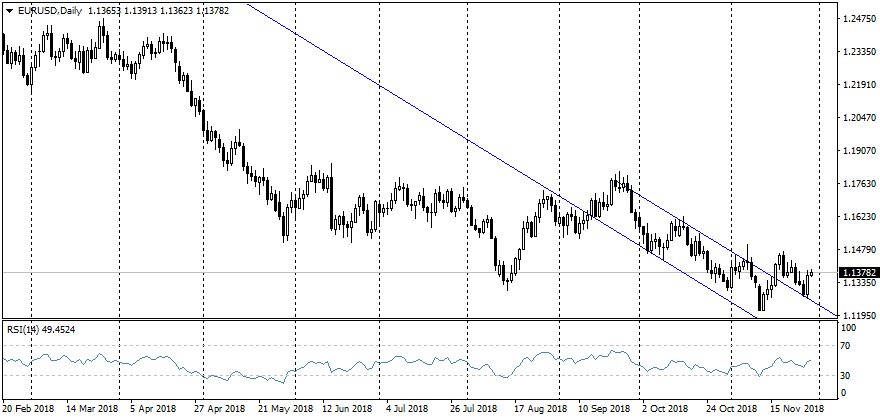
It has also already been noted, that the EURUSD and the GBPUSD may have instigated a reversal. The downward trend of the euro has slowed down, and the EURUSD pair is out of the downward channel. The British pound receives support from buyers on the dips, in the area of 1.27 dollar.
USTR seeks auto tariffs equalization from China
Just days ahead of the Trump-Xi meeting, the US Trade Representative Robert Lighthizer issued another statement regarding China's auto tariffs today. Is it setting the stage for Trump to claim victory on some Chinese concessions? Or, Trump said yesterday that GM's plant closures prompted him to study auto tariffs. At the same time, is he thinking about selling more cars to China to "equalize" the imports from EU and Japan?
The statement noted, "As the President has repeatedly noted, China's aggressive, State-directed industrial policies are causing severe harm to U.S. workers and manufacturers. We are continuing to raise these issues with China. As of yet, China has not come to the table with proposals for meaningful reform."
"China's policies are especially egregious with respect to automobile tariffs. Currently, China imposes a tariff of 40 percent on U.S. automobiles. This is more than double the rate of 15 percent that China imposes on its other trading partners, and approximately one and a half times higher than the 27.5 percent tariff that the United States currently applies to Chinese-produced automobiles. At the President's direction, I will examine all available tools to equalize the tariffs applied to automobiles."
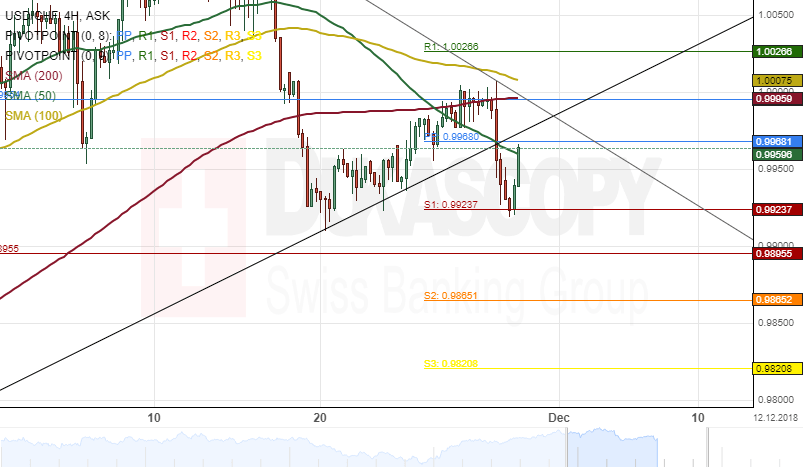
USD/CHF 4H Chart: Breakout Occurs
The US Dollar has been moving in an ascending channel pattern against the Swiss Franc since mid-September. The currency pair reversed from its lower boundary at 0.9550 on September 21 and followed by a bullish sentiment.
The exchange rate broke the channel pattern at the end of yesterday's trading session.
Given that a breakout had occurred through the bottom border of the two months ascending channel, it is likely that the currency exchange rate will continue its downward movement during the following trading sessions.
The potential target for the USD/CHF currency pair will be at 0.9706.
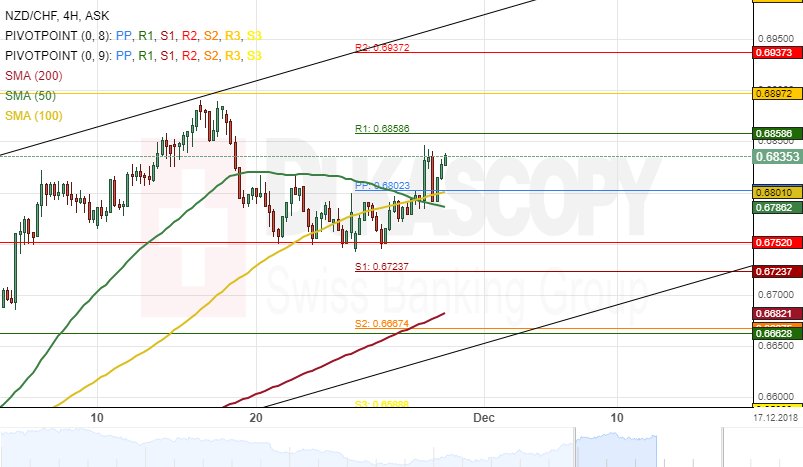
NZD/CHF 4H Chart: Targets At 0.6937
The New Zealand Dollar has increased its trading range massively against the Swiss Franc. This bullish momentum began after the currency pair reversed from the bottom border of a dominant descending channel at 0.6300.
A strong support cluster set by the weekly PP and the combination of the 50– and 100-hour SMAs at 0.6813 was providing support for the exchange rate during the morning hours of Thursday's session.
If this support cluster holds, the currency exchange rate will aim for the upper boundary of the given channel at 0.6937 during the following sessions.
However, the monthly R3 at 0.6897 could prevent this move from happening today.
FOMC Minutes To Guide Asset Classes Next Move
Thursday November 29: Five things the markets are talking about
Global equities have been better bid overnight after a surprisingly ‘dovish’ tone from Fed chairman Powell supported sentiment ahead of this weekend’s G-20 meeting in Argentina. The ‘big’ dollar has slipped along with U.S Treasury yields.
Yesterday, Mr. Powell said there is “no pre-set policy path” as far as future interest-rate increases are concerned, adding, “the bank’s decisions will be shaped by new economic data.”
Note: Futures pricing suggests the Fed is nearing a pause and show the market pricing for just +25 bps, the equivalent of one Fed rate hike in 2019.
Today’s FOMC minutes (02:00 pm) is expected to confirm expectations for another rate increase in December despite Powell’s dovish speech.
The market is also trying to position itself ahead of a meeting between the U.S and Chinese leaders on the weekend. Many are expecting an easing of tensions rather than any express agreement that involves major concessions from either side.
Elsewhere, crude oil has managed to recover some of yesterday’s losses after an unexpectedly large increase in U.S crude inventories, while gold prices have edged a tad higher.
1. Stocks see the light
Asian stocks mostly rallied overnight, tracking Wall Street higher, after Fed chair Powell suggested they might be nearing an end to its three-year rate tightening cycle.
Japan’s Nikkei share index rose +0.4%, but gains were trimmed by concerns over the outcome of a meeting between Presidents Trump and Xi Jinping on the sidelines of the G20 summit. The broader Topix also advanced +0.4%.
Down-under, Aussie shares closed at a two-week high overnight. Broad-based gains pushed the S&P/ASX 200 index +0.6% higher at the close of trade. Both metals and mining stocks rallied +1.3% to dominate the gains. In S. Korea, the Kospi closed up +0.28%, extending its gains into a fourth session.
Note: South Korea’s central bank is expected to raise rates at its monetary policy meeting tomorrow.
In China, stocks fell on weaker investment sentiment ahead of this weekend’s Sino-U.S trade talks. At the close, the Shanghai Composite index was -1.4% lower, while the blue-chip CSI300 index was down -1.3%. In Hong Kong it was a similar story. The Hang Seng index closed down -0.9%, while the China Enterprises Index lost -0.5%.
In Europe, regional bourses trade higher across the board, although off the earlier highs. In the U.K, banking names trade slightly higher after passing the BoE’s stress test.
U.S stocks are set to open in the ‘red’ (-0.2%).
Indices: Stoxx600 +0.30% at 358.60, FTSE +0.55% at 7,042.75, DAX +0.38% at 11,341.42, CAC-40 +0.58% at 5,012.16, IBEX-35 +0.12% at 9,114.00, FTSE MIB +0.04% at 19,122.50, SMI +0.80% at 8,969.50, S&P 500 Futures -0.30%
2. Oil prices firm ahead of G20, gold higher
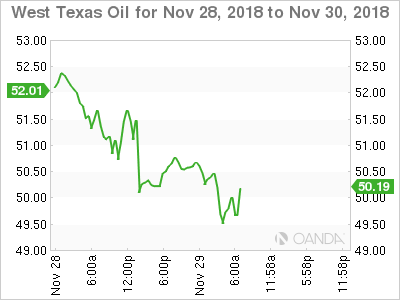
Oil prices have edged higher this morning on investor optimism that trade talks at the G20 could help the global economy and improve demand. However, gains are somewhat capped after yesterday’s U.S crude inventories hit their highest in 12-months.
Brent crude has gained +6c, or +0.1% to +$58.82 a barrel, having dropped -2.4% yesterday. U.S crude futures have rallied +20c, or +0.4% to +$50.49 per barrel. Yesterday’s session closed out down -2.5% at +$50.29 a barrel.
Nevertheless, rising supplies are keeping a lid on prices. According to the EIA yesterday, U.S crude inventories for the week to Nov. 23 added +3.6M barrels to the most in a year at +450M barrels.
OPEC and non-OPEC members will meet in Vienna, Austria next week (Dec. 6) to discuss a new round of production cuts of -1M to -1.4M bpd and possibly more.
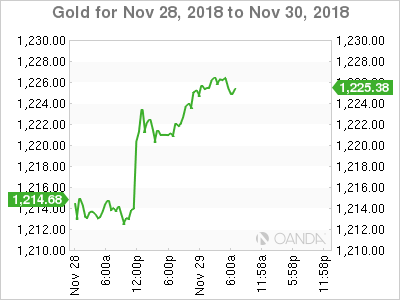
Ahead of the U.S open, gold prices have firmed overnight as the ‘big’ dollar falters after Fed Chair Powell comments. Spot gold is up +0.3% at +$1,224.13 per ounce, while U.S gold futures are little changed at +$1,223.2 per ounce.
Note: Spot prices climbed about +0.6% on Wednesday, their biggest one-day percentage gain in a fortnight.
3. Sovereign yields fall on Fed comments
It’s no surprise to see sovereign yields come under pressure after Fed Powell’s ‘dovish’ comments yesterday.
In Europe, government borrowing costs have fallen to their lowest level in over two-months this morning, following U.S Treasury yields lower.
Powell’s comments triggered a rally in equities and pushed the U.S Treasury 10-year bond yield as low as +3.01%, its lowest level since mid-September and well away from this month’s high of +3.25%.
Elsewhere, Germany’s 10-year Bund yield has hit a three-month low of +0.328% this morning, down -2.5 bps. French and Dutch government bond yields have also dipped to new lows since early September at +0.716% and +0.472% respectively, down about -2 bps each on the day.
Italy’s five-year bond yield has dipped -4 bps to +2.36% and the 10-year yield was lower -1.5 bps at +3.25% and the spread over Bunds is at +294 bps.
 4. Dollar finds traction difficult
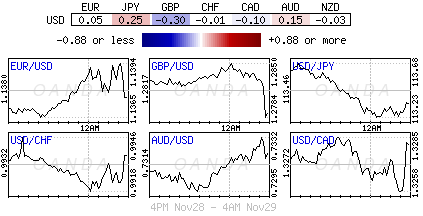
The ‘big’ dollar is finding it difficult to find meaningful traction, especially now that U.S 10’s trade atop of the psychological +3%.
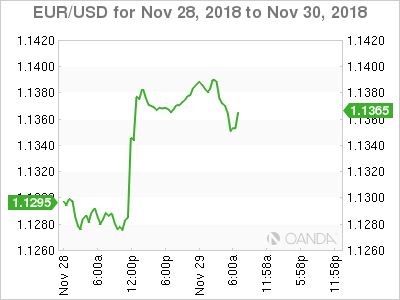
In Europe, softer growth and inflation data is failing to push the EUR (€1.1352) currency lower, but did dent any upside momentum for the time being.
Note: France Q3 GDP y/y reading was revised lower in its second reading, while Spain misses expectations for its Nov CPI and various German States saw lower readings compared to October.
GBP/USD (£1.2764) saw all of its early gains evaporate, as futures dealers pushed back their call for the next BoE rate hike by a few months into May 2020 over concerns that the upcoming Brexit vote would not pass parliament (Dec 11).
Note: The BoE did present its on “Brexit Scenarios” yesterday and noted that the GBP currency could fall -15% in disruptive and -25% in disorderly Brexit.
Finally, a surprise contraction in Sweden Q3 GDP (-0.2%) has some dealers pricing out a December rate hike by the Riksbank. EUR/SEK was higher by +0.3% at €10.30.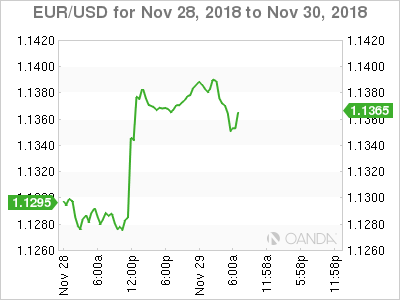
5. Eurozone business confidence steadied in November
Data this morning showed that business confidence across the eurozone steadied this month. The release suggests that regional economies are perhaps levelling off after a yearlong slowdown.
The Economic Sentiment Indicator for the eurozone fell to 109.5 in November from 109.7 in October. Digging deeper, the decline in the measure was due to weakening consumer confidence. Sentiment in the services and construction sectors was unchanged m/m, while manufacturers and retailers became slightly more upbeat.
There are a few outliers, the main exception being Italy, where the government’s standoff with Brussels over its proposed budget has raised borrowing costs for businesses.
Elsewhere, French businesses appeared untroubled fuel tax demonstrations, while others took the possibility that the U.K could leave the E.U in 2019 without a new trade agreement in their stride.
DAX Slips As Nervous Investors Eye G-20
The DAX index has posted losses in the Thursday session. Currently, the DAX is trading at 11,314, down 0.54% on the day. On the release front, German Preliminary CPI is expected to post a gain of 0.2%, unchanged from the previous release. German unemployment change came in at -16 thousand, better than the forecast of -10 thousand. Later in the day, the ECB releases its semi-annual financial stability report. On Friday, the eurozone releases CPI Flash Estimate and G-20 leaders gather in Argentina.
Investors will be glued to the upcoming G-20 summit in Argentina. President Trump is expected to meet on the sidelines with Chinese President Xi Jinping with the two leaders sure to discuss the full-blown trade war between the world’s two largest economies. President Trump has taken a tough line ahead of the summit, threatening to raise the tariffs from 10 percent to 25 percent on $250 billion worth of Chinese goods. If Trump makes good on his threat, we could see a sharp downturn in the stock markets. However, the unpredictable Trump is known to prefer to reach a deal whenever possible, so his sharp rhetoric could be some grandstanding ahead of his crucial meeting with Xi. If the two leaders can “agree to disagree” and continue talking, risk appetite will improve and the stock markets would likely climb.
German confidence indicators slowed in November, and that could be bad news for the German and eurozone economies. GfK consumer climate dropped to 10.4 points, its weakest level since May 2017. Earlier in the week, Ifo Business Climate dropped to 102.3, missing the forecast of 102.0 points. This marked a 4-month low. The ongoing U.S-China trade war has hurt the German export sector, as German companies that export to both the U.S. and China are now facing higher tariffs. Germany’s economy posted a rare decline in the third quarter, with a contraction of 0.2%. Another problem is lower eurozone growth, as weak economic activity in the third quarter appears to be the story in the fourth quarter. As well, the looming departure of Britain from the European Union and the crisis over the Italian budget have weighed on business and consumer confidence levels in Germany.