

Sample Category Title
Market Morning Briefing: Aussie Is Trading At Resistance Near 0.732 On Daily Candles
STOCKS
Going into the meeting with Xi, the charts suggest that Trump is going to drive a hard bargain. The Shanghai (2567.44, -32.49, -1.32%), which we have been calling a "loss leader" for a while now, fell a decent bit yesterday, enhancing the strength of Resistance at 2650 and increasing the chances of a medium-term fall towards 2500-2450.
The Dow (25338.84, -27.59, -0.11%) saw consolidative trade between 25203-25479 yesterday, within a near-term rally that targets 25750-60. The relative outperformance of the Dow vis-a-vis the Shanghai since 22nd November is what suggests that Trump is not going to relent in the near term.
Meanwhile, the DAX (11298.23, -0.01%) consolidated (as expected) between 11400-200 but has potential to rise towards 11600+.
The Nikkei (22274, +0.05%) may also have to consolidate a bit before it finds the strength to break above 22500 and become more bullish.
In India, the Nifty (10858.70, +129.85, +1.21%) posted a good rise yesterday, closing well above 10800. It may well test 11000 over today-Monday and then enter into a bit of a sideways consolidation before an eventual break above 11000. Overall, India is outperforming the USA and China just now.
COMMODITIES
Gold, Copper and Silver show some bullish signs for the coming week. Crude prices recovered a bit yesterday after news stated expectation of Russia to likely agree on production cuts with the OPEC countries next week.
Brent (60.03) and WTI (51.50) look weak for the near term.
Brent (60.03) has scope of testing 56 on the downside which is the 200-Week MA as seen on the line chart. While this holds, we could possibly see a near term bottom in place with a decent rise back towards 65 and higher.
WTI (51.50) has support near 47.50-48.0 region as seen on the 3-day line chart which is likely to hold and push the price back towards 55 and higher.
Gold (1230.30) is trading at crucial level just now. A break above 1230, if seen would take it gradually higher towards 1240/50 next week. Fresh upmove could be seen on a sustained break above 1230.
Silver (14.39) has risen from levels just above 14 and while the rise continues, Silver could manage a break above 14.5 and target a rise towards 14.75 in the near term.
Copper (2.7945) is likely to move above immediate resistance at 2.80 and head towards upper levels of 2.85 in the near term.
FOREX
Dollar Index might be bearish towards 96.50-00 in the near term. USDINR could re-test 69.70 today, before bouncing back again towards 70.20.
Dollar Index (96.75) could possibly test support at 96.50 on daily candles by Monday. The dip next week could even extend till support on weekly candles at 96.20-00, after which it could bounce from there.
Euro (1.1396) is trading just below resistance on daily candles near 1.14. There seems to be some room for a rise till 1.15 next week on daily line chart. The 13 weeks MA at 1.1493 could provide some resistance in the next 1-2 weeks.
Dollar Yen (113.35) is likely to test immediate support on daily candles at 113 by early next week. If 113 breaks, then there is lower support near 112.25-00, which could restrict the downside for the next 1-2 weeks.
Pound (1.2783) came off from resistance at 1.285 on daily candles yesterday and could possibly move lower in the next couple of sessions towards 1.272-1.270 (seen as support on daily candles). If it doesn’t break below 1.27 next week, then we could see ranging between 1.295-1.270 for another couple of weeks.
Aussie (0.7320) is trading at resistance near 0.732 on daily candles. The 8 weeks MA at 0.7204 has held well this week and suggests chances of further bullishness in the near term. A dip, if it happens, might be restricted till support near 0.725 on daily candles.
Euro-Yen (129.18) : The 21 weeks MA at 129.32 needs to be watched – a week close today above that could indicate chances of bullishness towards 130 in the next week.
Dollar Rupee (69.845): After the sharp fall seen yesterday, Dollar Rupee could re-test 69.70 today, before bouncing back again towards 70.20. Failure to sustain above 69.70 could open up chances of 69.50/40 which looks less likely for today.
INTEREST RATES
After Powell's speech the day before, the Fed Minutes suggested that while a Dec hike is a done deal, further rate hikes are not on a "pre-set path". This suggests the Fed might be open to take cognisance of the decline in Crude in November and may therefore be open to the idea of fewer rate hikes.
Still, the US 2Yr (2.81%) continues to hold above 2.80% for now, lthough the 10Yr (3.03%) has dipped a bit from 3.05-06% the day before. The 10-2Yr Spread is down to 22bp again. The 5-2Yr Spread is only 3bp, with the 5Yr coming down to 2.84%. We really need to see the 2Yr dip below 2.80% so that the Yield Curve can steepen a wee bit.
The German 10Yr (0.32%) has important Support at 0.30%, with potential to move up towards 0.50% in the medium term. Should that happen, the German-US 10Yr Spread (currently -2.71%) could move up towards -2.65% or even -2.60%. Whether that will pull the Euro (1.1399) past 1.1400 will be interesting to see.
The Indian 10Yr GOI (7.6082%) seems to be falling vertically and may well test 7.55% soon enough.
FOMC to Press on; the Australian Investment Outlook Brightens
This week, the FOMC and Brexit have been the focus globally. On the domestic front, investment partials were received ahead of next week’s Q3 GDP report.
Beginning offshore, comments by Chair Powell were taken as dovish by the market, the US 10-year touching the 3.00% level having started the week at 3.04%. Since then however, the 10-year has come back to 3.03%, leaving it effectively unchanged for the week. While Chair Powell did reference the federal funds rate as being “just below” estimates of neutral, context is key. ‘Estimates of neutral’ here refers to the 100bp range from 2.5% to 3.5% put forward by FOMC members, hence attaining a neutral stance could mean one hike or five. We expect that the total number of hikes to come is likely nearer the top of that range than the bottom. Our forecast is for four more, from December 2018 to September 2019. As per the FOMC’s own view, this forecast rests on the strength of underlying momentum in their economy, driven by the consumer. There are, of course, risks to this view. Chief among them are household wealth and sentiment and, for the business sector, the uncertainty created by US trade policy.
For the UK, in stark contrast to the US, the uncertainty felt by the market this week is a true reflection of current conditions. The only positive is that the date of the UK Parliament vote on the draft agreement has now been set, 11 December. Other than this announcement, headlines have carried dire predictions of the economic effect on the UK economy should a no deal Brexit occur, while numerous political interests have continued voicing their displeasure with the draft agreement and process. These are clearly troubling times for the UK, and this uncertainty will remain a threat for some time yet.
While in Europe, it is also worth covering President Draghi’s appearance before the EU Parliament’s Economic Committee. His remarks again highlighted their confidence in the Euro Area’s underlying momentum, albeit while recognising that the data received since his last appearance had been weaker than anticipated. In terms of their forecasts, one has to expect that the December ECB forecast update will see modest downward revisions; however, with regards to core inflation, their expectation of an uptrend remains intact, and with it their plans to end asset purchases at December. Whether the anticipated rate hikes past summer 2019 come to pass will depend on if the current growth slowdown leaves momentum above or below trend in 2019. We argue for the former, and hence continue to see the deposit rate inching towards zero from late-2019.
Coming back to Australia, we received two opposing updates on investment for Q3 this week.
The construction work done release reported broad-based weakness across all components, with total activity down 2.8%. While we expect residential investment to continue declining over the coming year, the Q3 weakness in non-residential construction is likely just a temporary blip given the considerable pipeline of work that remains in place for the sector. This is also the case for infrastructure investment, which is receiving material support from state government spending – particularly in NSW and Victoria.
In the CAPEX survey however, offsetting strength in equipment investment was seen, +2.2%. In the quarter, manufacturing provided the strength, while services was flat and mining declined. Important for the outlook, not only was the Q3 print an upside surprise, but so too were expectations for the 2018/19 financial year. Estimate 4 points to a 3–4% gain for investment in the current financial year, up from –1% at estimate 3. Also worthy of note, the sectoral mix of investment intentions was positive, with services and manufacturing leading the way. Our core view on investment remains for a modest gain in non-mining investment, spurred by the needs of a growing population.
Looking ahead to the GDP report next week, we anticipate a 0.7% increase in the quarter, leaving annual growth at 3.4%. To this view, based on the above investment data, risks are tilted to the downside. For all the detail of our forecast, see the GDP preview in our weekly. Further updates on components of Q3 GDP will be received next Monday and Tuesday ahead of GDP on Wednesday.
Finally for the week, the RBNZ has released their latest Financial Stability Report. As expected, the RBNZ eased its loan-to-value limits on mortgage lending after price and credit growth slowed to be broadly in line with income growth. However, it was also announced that banks will be required to hold more capital. Our NZ team note that the latter is a preliminary decision with a consultation paper to follow.
Northern Exposure: FOMC to Press on with Hikes, Cautiously
A December hike should be expected; we see a further three hikes thereafter, to September 2019.
The past week has seen the FOMC highlight the Committee’s central view for the economy as well as the key risks they see via a number of high-profile speeches and the November minutes.
Beginning with their central view on the economy, Vice Chair Clarida made clear that US economic momentum remains “robust, as indicated by strong growth in gross domestic product (GDP) and a job market that has been surprising on the upside for nearly two years”. Chair Powell further added that the FOMC is now close to fulfilling its objective of “maximum employment”, highlighting the structural strength of their economy.
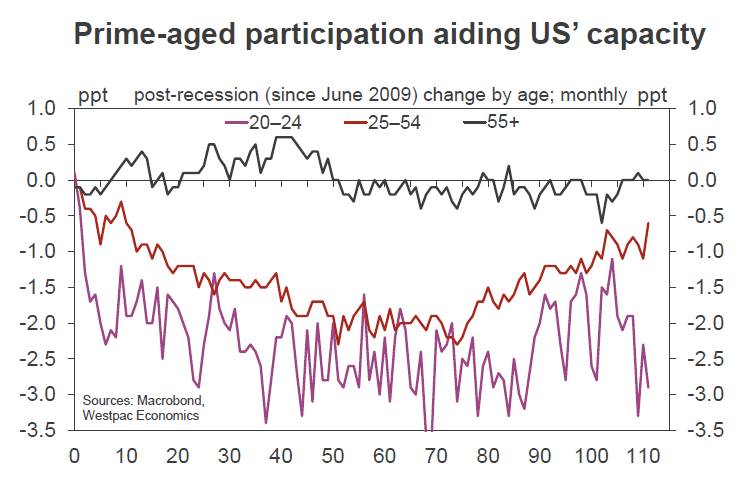
On the Committee’s other objective of “price stability”, which in practice means PCE inflation of around 2.0%yr, there was however little evidence that these central figures of the FOMC perceive a threat. Rather, Vice Chair Clarida highlighted that, based on consumer and market inflation expectations, the risks for inflation versus target remain skewed to the downside. Here the recent sharp decline in the price of oil is a factor, but so are two structural themes: rising prime-aged participation and a long-awaited lift in productivity – aiding aggregate supply.
As per the November minutes, it is then not surprising that the preference of the vast majority of the Committee remains repeatedly tightening policy over the coming year, albeit in a gradual, data-dependent manner. This caveat recognises policy has a lagged effect on the economy, as highlighted by Chair Powell in his speech, and that neutral is an uncertain concept.
Both Chair Powell and Vice Chair Clarida characterised the current stance of policy as “just below” FOMC members estimates of neutral – a 100bps range, from 2.5% to 3.5%. Returning policy to a neutral setting could therefore mean one rate hike or five – depending on the durability of current momentum.
We continue to hold that the number of rate hikes from here is likely to be towards the top end of that range. We see four hikes from December 2018 to September 2019. This would result in a peak federal funds rate of 3.125%, a touch above the longer-run neutral rate projected by the FOMC, but below the 3.4% peak that their September forecasts signalled for 2021.
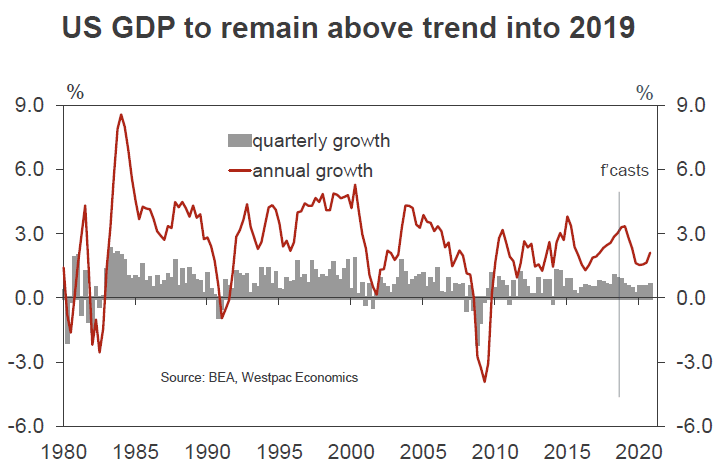
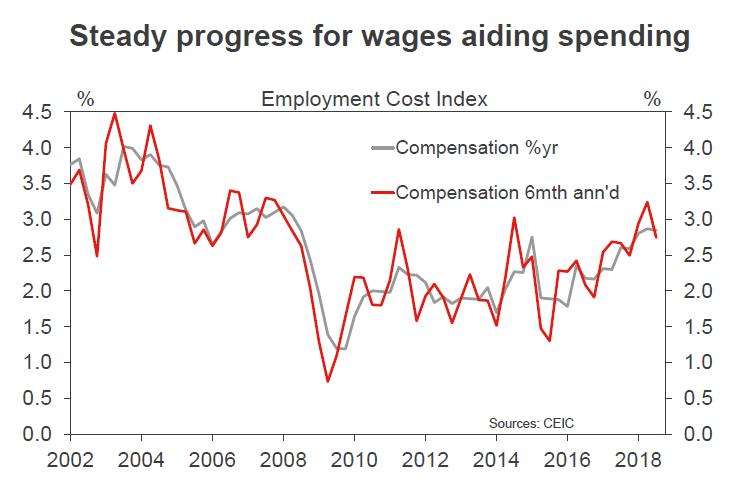
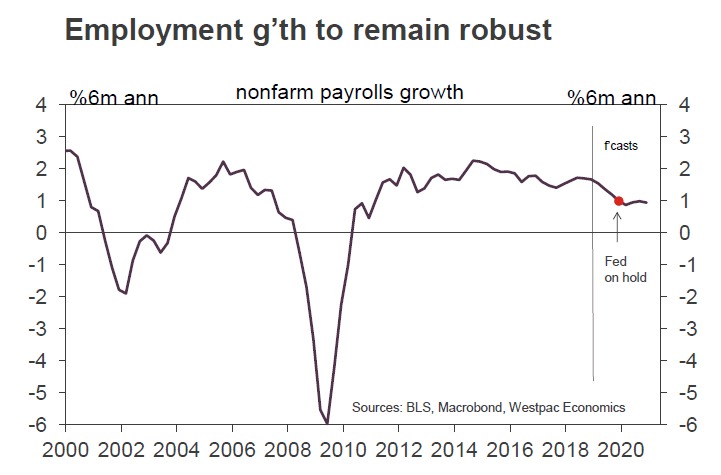
Justifying this view, while we believe business and residential investment will weaken further, the consumer is expected to remain robust, holding GDP and employment growth above trend till at least mid-2019. Given the significance of the consumer to US growth, the key risks for the outlook are around wealth and sentiment.
On this front, notable in Chair Powell’s address was the view that financial valuations for major asset classes do not excessively exceed historical benchmarks. He went on to emphasise that spending was not endangered by mere market volatility, but instead by “Large, sustained declines in equity prices” which, as yet, have not been seen. Further, to our mind, for main street America, the housing market is the key asset class, and here price growth is continuing at a multiple of income growth.
The other major risks to keep in mind are the ebbing of fiscal expansion and trade policy uncertainty. On fiscal policy, while it is true that the boost to discretionary incomes from 2018’s tax cuts is fading, the current extraordinary level of fiscal expenditure will persist till late-2019, supporting activity and sentiment.
Over the coming year then, trade policy is the greater risk. Not only does it seem that the tariffs introduced to date have curbed investment growth, but as per the November meeting minutes and recent communications by President Trump, there is further downside risk. This is true both with respect to the scale and effect of this policy. How it affects business investment and employment will remain the FOMC’s focus.
FOMC Minutes Signals Rate Hike “Fairly Soon”, Policy Outlook Masked by Tariff and Debts
The FOMC minutes for the November revealed that the members still considered a rate hike in December is appropriate. Yet, they debated on the change in forward guidance regarding the pledge on “further gradual increases” in the policy rate. Some judged that the policy rate is near to the neutral level, while some suggested stressing the importance of incoming data on monetary policy decision. The members in general were upbeat on the economic developments. Yet, they were concerned about the negative impacts of Trump’s imposition of trade tariff on the economy, as well as the “volatility in equity markets was accompanied by a rise in risk spreads on corporate debt”.
December Rate Hike is Done Deal
According to the minutes, “Consistent with their judgment that a gradual approach to policy normalization remained appropriate, almost all participants expressed the view that another increase in the target range for the federal funds rate was likely to be warranted fairly soon if incoming information on the labor market and inflation was in line with or stronger than their current expectations”.
G20 summit this weekend and OPEC meeting on December 6 should unlikely cause a dramatic shift in the monetary policy stance. Next Friday’s comes the US employment report for November. Non-farm payroll growth and wage growth would be closely watched. This would be followed by inflation report on December 12. Slight downside surprises should not affect the December rate hike. Yet, they might lead to a more cautious Fed on considering rate hikes in 2019 and 2020.
Change in Forward Guidance
As suggested in the minutes, the members noted that the forward guidance “might need to be revised at coming meetings, particularly the language referring to the Committee’s expectations for “further gradual increases” in the target range for the Fed funds rate”. “Many participants” suggested that a change of language with “greater emphasis on the evaluation of incoming data in assessing the economic and policy outlook” should begin in the upcoming meeting. This change would help “convey the Committee’s flexible approach in responding to changing economic circumstances”.
Neutral Rate
The minutes suggested that “a couple of participants noted that the federal funds rate might currently be near its neutral level and that further increases in the federal funds rate could unduly slow the expansion of economic activity and put downward pressure on inflation and inflation expectations”. As we mentioned in the previous report, the current Fed funds rate target (2-2.25%) is not really ”just below” or “near” the median neutral rate projected by Fed staff in September. Yet, as neutral rate is not a fixed number and can move according to economic developments. We would want to see if any downward shift on the median neutral rate at the December meeting.
FOMC Minutes – Flexible is the New Gradual
In the minutes from the FOMC meeting earlier this month, committee members remained upbeat on the U.S. economic outlook. Labor market and consumer spending were highlighted as two areas of strength, while a slowdown in residential and most recently business investment were noted as soft spots. Based on incoming data, participants indicated that their view of the economic outlook was little changed, with above-trend growth expected to continue in the near-term.
A few participants indicated that uncertainty has increased recently and financial conditions have tightened. Despite this, risks to the outlook were still seen as balanced. On the downside, trade developments, appreciation of the U.S. dollar and high level of debt in nonfinancial business sector were referenced, but this was offset by high consumer confidence, still-accommodative financial conditions, and the potential for a greater-than-anticipated impact from fiscal stimulus.
Nearly all participants agreed that another increase in the fed funds rate "was likely due fairly soon" as long as the incoming data continues to evolve in line with expectations. Looking beyond the near-term, a few participants expressed uncertainty about the timing of future increases. Echoing Chairman Powell's remarks yesterday, a couple of participants "noted that the federal funds rate may be near its neutral level" and further increases may "unduly slow" economic activity.
Participants discussed potential changes to the post-meeting statement, particularly the reference the "further gradual increases" in the fed funds rate. Many participants felt that it may be appropriate to place greater emphasis on incoming economic data in the statement in order to convey the Committee's flexible approach in determining the future course of monetary policy.
Key Implications
As far as economic outlook is concerned, these minutes were largely uneventful, however, the FOMC minutes contained a few interesting tidbits of information with respect to views on monetary policy. In particular, the Fed is clearly laying out the groundwork for a more flexible path of monetary policy. This means that data will be paramount in determining the future course of the fed funds rate, particularly in an environment of increased uncertainty.
Perhaps echoing the discussion that took place during the FOMC last meeting, in yesterday's speech, Chairman Powell's characterized the current level of the fed fund rate as "just below the broad range of estimates of the level that would be neutral" – a more dovish assessment than the one in his October remarks that the rate was "a long way from neutral." His comments prompted a considerable market reaction, with bond yields falling as investors adjusted their expectations to fewer rate hikes in 2019.
Markets may have overreacted to Powell's statement given that the current fed funds rate is, in fact, only slightly below the bottom of the range of FOMC members estimates (even as it is a fair bit further away from the median estimate). Nonetheless, we do see downside risk to that median estimate (last published in September). A hike in December is still very much in the cards, as confirmed by the November minutes, but, with PCE inflation running at just 1.8% year-on-year and FOMC forecasts for inflation likely to be revised down in the next Summary of Economic Projections accompanying the December announcement, the Fed does have the flexibility to proceed with more caution next year.
USD/JPY Could Correct Lower In Short Term
Key Highlights
- The US Dollar failed again to break the 114.00 resistance area against the Japanese Yen.
- There is a key bearish trend line formed with resistance at 114.00 on the 4-hours chart of USD/JPY.
- The Tokyo Consumer Price Index increased 0.8% (YoY) in Nov 2018, less than the market forecast of 1.0%.
- Today in the US, the Chicago Purchasing Manager’s Index for Nov 2018 will be released, which is forecasted to decline from 58.4 to 58.0.
USDJPY Technical Analysis
The US Dollar gained bullish momentum this past week and traded above 113.40 against the Japanese Yen. However, the USD/JPY pair failed again to break the 114.00 resistance area and corrected lower recently.
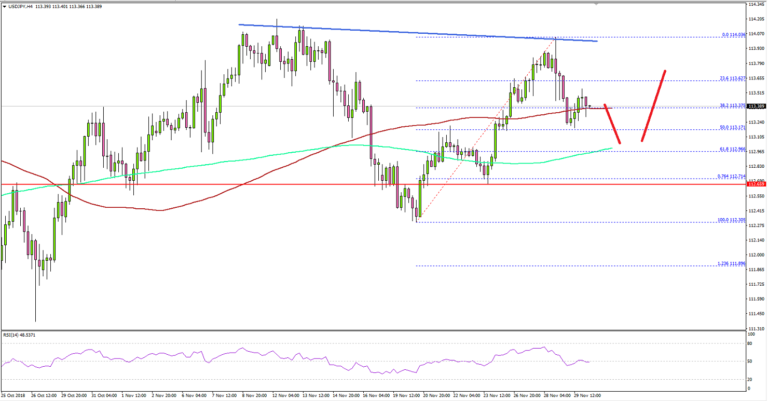
Looking at the 4-hours chart, the pair traded as high as 114.03 and later started a short term downside correction. It traded below the 113.60 support and the 23.6% Fib retracement level of the last wave from the 112.30 low to 114.03 high.
The pair also broke the 100 simple moving average (red, 4-hours) and tested the 113.20 support. The pair remained under pressure below the 113.60 level and it seems like it could decline further.
The next major support is near 112.95 and the 61.8% Fib retracement level of the last wave from the 112.30 low to 114.03 high, which coincides with the 200 simple moving average (green, 4-hours).
On the upside, an initial resistance is near 113.80 followed by 113.85. More importantly, there is key bearish trend line formed with resistance at 114.00. Therefore, a successful close above 114.00 could open the doors for a larger upward move towards 115.00 in the near term.
Fundamentally, the US Personal Income figure for Oct 2018 was released by the Bureau of Economic Analysis, Department of Commerce. The market was looking for an increase of 0.4% in the personal income compared with the previous month.
The result was positive as there was a rise in the personal income by 0.5%, which was also a lot more than the last +0.2%.
In the short term, there could be losses in the US Dollar, but USD/JPY is likely to bounce back after a minor downside correction.
Economic Releases to Watch Today
- Euro Zone CPI for Nov 2018 (YoY) (Prelim) – Forecast +2.0%, versus +2.2% previous.
- Euro Zone Core CPI for Nov 2018 (YoY) (Prelim) – Forecast +1.1%, versus +1.1% previous.
- Chicago Purchasing Manager’s Index for Nov 2018 – Forecast 58.0, versus 58.4 previous.
Lingering Uncertainties
The FOMC
There wasn’t much reaction to the FOMC minutes but one thing that is apparent the Fed dovish adjustments are a bit more than the market expected. But the main takeaway is that quarterly hikes are not the new normal which means the markets, and the USD will be hypersensitive to data and Fed speak even more so in 2019 where the Fed will give press conferences every meeting.
Its clear as day the FOMC are making an unambiguous dovish transformation to complete data dependency. And while the USD newfound sensitivity to data could be construed as negative since the greenback does not have the Fed to anchor itself to, external drivers will now come to the fore where rapid stagnation in economic data amidst the rise in political risk could lead to downside policy adjustment in the UK and EU. So even if the Fed is nearing the end of their rate hike cycle, a nasty Brexit or even a sustained slowdown in China could still leave the USD in a commanding position. Not to mention if the US economy continues to fire on all cylinder in early 2019, the market may be more susceptible to a hawkish Fed surprise
Markets
But for today, the reality is Global markets are in a standoff amid ongoing trade uncertainties. While sentiment leaned more optimistic on headlines suggesting US-China pursue a new trade ” architecture “, without knowing what that architecture entails and not sure what Saturday G20 dinner will bring, markets are still driving blindfold.
But it was a noisy morning New York session as the markets were getting tugged every which way as uncertainties around trade, fed policy and energy sector came to a head.
The Fed has thankfully put their cards on the table, but I can’t help but think investor sentiment is one of misplaced optimism when it comes to trade. Ultimately given the vast divide in political and economic ideologies between both global super economics, the trade and tariff concern are probably something that is going to persist through 2019 if not longer.
At least one good thing came out of today. the Fed’s new direction is clear as a bell
Oil market
Oil prices rebounded through most of the day, from news the Russians may be willing to cut production in cooperation with OPEC, a day after President Vladimir Putin said Russia was “absolutely fine” with crude oil at $60 per barrel. Which predictably triggered a rip higher in crude but of course that leaves the markets still wonder how quick and how much. Indeed this back and forth debate remains the most significant speculative catalyst for oil markets
At mid-afternoon NY the reality check of sorts set in after the Energy Information Administration EIA suggested that continued shale resource development helped push U.S. crude oil and natural gas reserves to new record highs in 2017. With traders already anticipating a 1.0 mmbpd cut, which is arguably priced in. It will probably take a much deeper cut to jolt the market into a short covering rally. Otherwise, the market falls prey to the prevailing bearish sentiment that will continue to drive prices lower on the premise the reduction might not be sufficient enough to draw down surplus supplies.
But with all options on the table for December 6 – from no production cuts to as much as a joint 1.4mn cut, let the game begin!!
Gold market
It does feel we are building a significant base on the dovish Fed pivot, but theirs’s huge element unpredictably around this weekend Xi- Trump summit which suggests markets will trade in relatively tight ranges into the weekend.
Asian Currencies
Asia duration is in demand, and the high yielders are outperforming well as there nothing like a passive Fed and a struggling dollar to awaken dormant carry traders. But the reality we have seen this shift in carrying demand since Powell sent out some early warning signals last week that the Feds were considering a pause. When there is a widespread dollar capitulation, it’s not unusual to some outsized move as foreign portfolio investment demand ratchets higher triggering stop losses.
The Malaysian Ringgit
With oil prices basing risk sentiment stabilising and a dovish Fed pivot, the MYR rallied overnight on the back of bond demand. With the Feds new dovish transformation, this could take near-term pressure off the dreaded 4.20 level.
The Yuan
RMB lagged the regional momentum but its a function of trader keeping risk very tight and directional risk close to home.
Eco Data 11/30/18
[php_everywhere instance="1"]
Today’s top mover: CHF/JPY, safe haven of different nature
The top mover report has been rather hard to write this week. Primary reaction is that the forex markets are generally in consolidation mode, indecisive. Right now CHF/JPY is the top mover but the picture could change in an hour. Nevertheless, it's a pair that's worth some discussion.
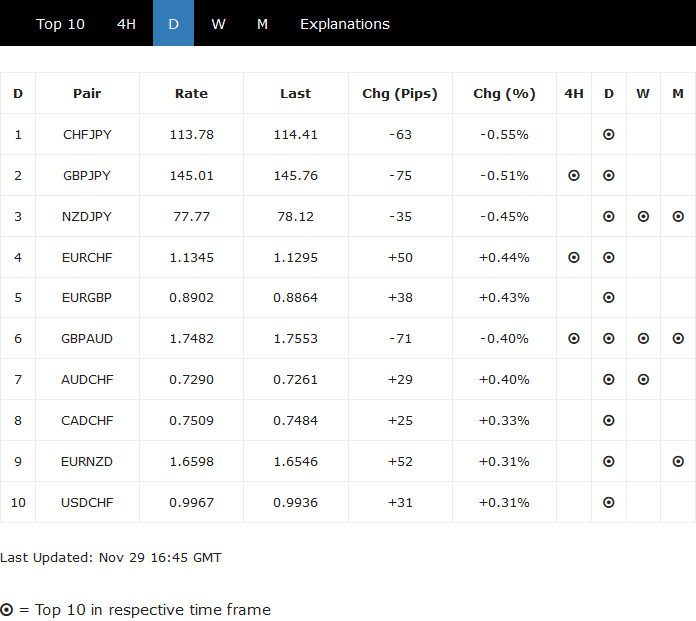
We've pointed out in various occasions that while both CHF and JPY are safe haven currencies, there are some fundamental differences in the way they react, at least this year. Yen is more sensitive to yields, spread with US, EU etc. Plus, it's more sensitive to Asian markets. On the other hand, Swiss Franc is more sensitive to emerging market risks.
For example, today's fall in USD/TRY, thanks to Powell, could be a reason for weakness in the Franc. For Yen, Nikkei closed up 0.69% today. JGB yields dropped to 0.09. But Chinese stocks closed down -1.32%. Yen's strength is probably more due to position adjustment ahead of the main event of Trump-Xi meeting, as well as month end.
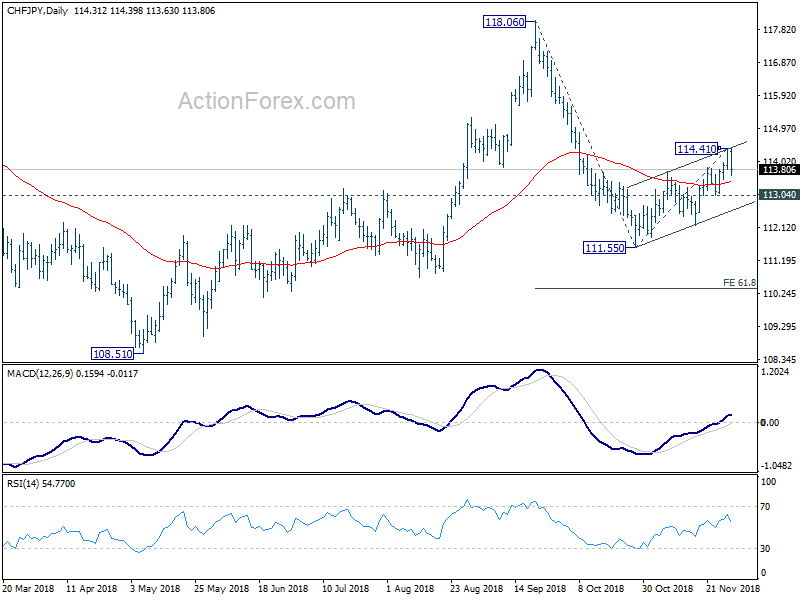
Anyway, it does look like CHF/JPY's corrective rise from 111.55 has completed with three waves up to 114.41. It came after hitting 100% projection of 111.55 to 113.74 from 112.19 at 114.38, as well as the near term channel resistance.
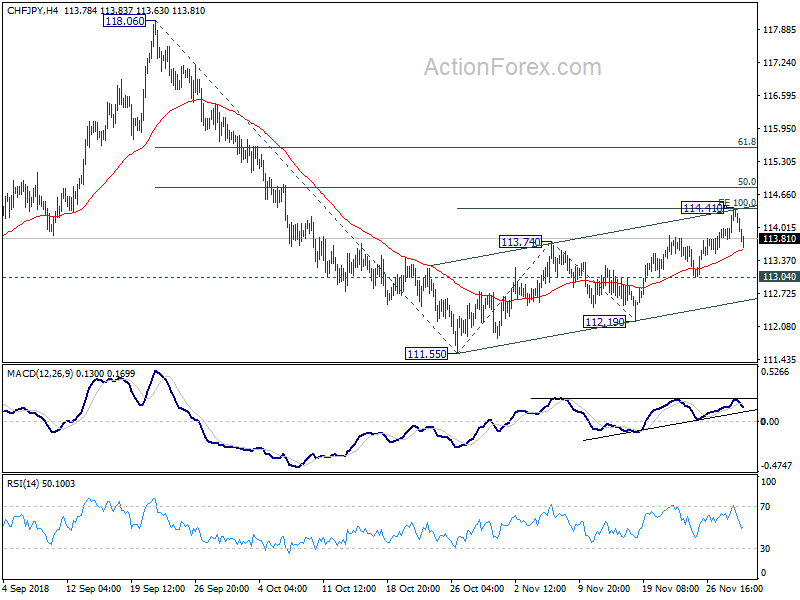
Focus is back on 113.04 support for the near term. Firm break there will raise the chance of resuming whole decline from 118.06 through 111.55 low to 61.8% projection of 118.06 to 111.55 from 114.41 at 110.38.
Fed Powell bowing down to dictatorship political pressure. Fed slowing or even pausing after December's hike. There would less drain from the emerging markets. Swiss Franc will benefit more than Yen. It's a possible scenario. Let's see how it plays out.
Trump tries to sound hardline ahead of meeting with Xi
Ahead of the highly anticipated meeting with China's Xi, Trump tried to sound hardline in his comments on the trade negotiations today.
He told reporters that "I think we're very close to doing something with China but I don't know that I want to do it." And, "because what we have right now is billions and billions of dollars coming into the United States in the form of tariffs or taxes, so I really don't know." Also, "I will tell you that I think China wants to make a deal, I'm hoping to make it a deal but, frankly, I like the deal we have right now."
The question is, who was Trump talking to? His own base? Republicans? Democrats? Or Xi?
Separately, the WSJ reported that the US and China are exploring a trade pact that would halt further tariffs. But it's uncertain if it's real or fake.