

Sample Category Title
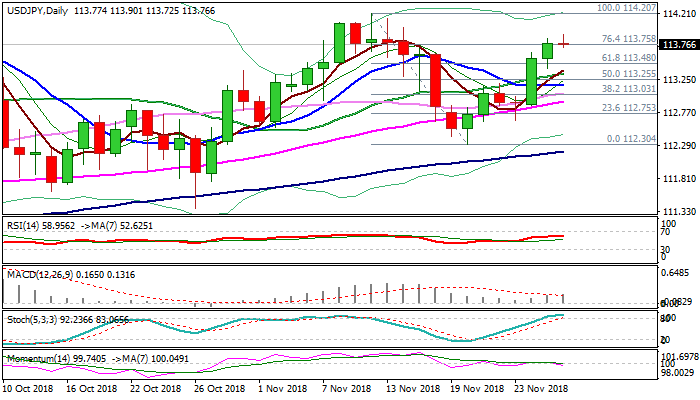
USDJPY Outlook: The Downside Remains Vulnerable While 0.7270/80 Zone Pivots Cap
The Aussie dollar holds bid tone on Wednesday, despite stronger greenback and downbeat Australian data released earlier today (Q3 Construction work done -2.8% vs 0.9% f/c).
The pair holds above top of falling thick daily cloud which marks significant support at 0.7211, with strengthening momentum and north-turning slow stochastic on daily chart, being supportive for further recovery.
On the other side, strong upside rejections in past two days that left daily candles with long upper shadows, suggest that recovery attempts are lacking strength and keep the downside vulnerable.
Selling upticks into 0.7270 zone (Mon/Tue highs, reinforced by daily Tenkan-sen) remains favored for renewed attack at cloud base.
Sustained break into daily cloud would generate bearish signal, which would require confirmation on break below 0.7178 (55SMA / 50% of 0.7020/0.7335 rally). Conversely, close above 0.7270/80 barriers would neutralize bearish threats and shift focus higher.
Res: 0.7242; 0.7253; 0.7276; 0.7300
Sup: 0.7222; 0.7211; 0.7199; 0.7187
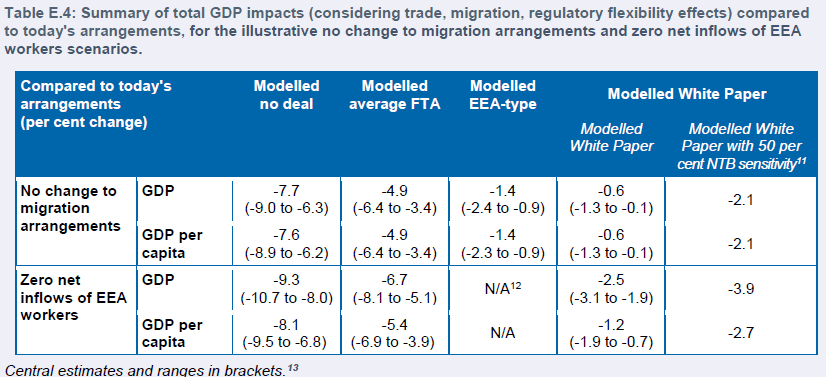
UK government Brexit scenario analysis, from -10.7% GDP contraction to -0.1% in 15 years.
The UK Government released a series of five papers on Brexit today. The most anticipated in the one on long term economic analysis of Brexit. In short, according the government, in 15 years by 2034 after Brexit:
- GDP could contract as much as -10.7% in case of no-deal Brexit with zero net inflow of EEA workers
- GDP would contract just -1.4% if it's modelled after EEA-type (European Economic Area) of deal, that is, Norway kind of deal.
- Under Prime Minister Theresa's Plan, GDP would contract only -0.6% if there is no change in migration arrangement. Or, in the best case scenario, GDP could just contract -0.1%.
The EU Exit: Long-term economic analysis report here. And, all five papers here.
In the parliament, Prime Minister Theresa May hailed her own plan and said “What the analysis shows, it does show that this deal that we have negotiated is the best deal for our jobs and our economy which delivers on the results of the referendum.”
The Yuan And The Chinese Market Are In High Risk
Despite weakly start, the US stock indices have increased by 0.3%-0.4% on Tuesday, showing signs of a rebound. The meeting of the leaders of the USA and China in the upcoming weekend has sparked a positive market sentiment. However, we believe that one should not heavily rely on this meeting’s outcome.
None of the parties has expressed desire to retreat from its positions in the sake of settling the trade disputes. Trump talked tough on the trade tariffs issue and has thus stated that it is highly unlikely that the U.S. would refrain from imposing higher tariffs in 2019.
Neither the United States, nor China, have yet fully felt the effect of the tariffs that have already been imposed. The tariffs imposed aimed to reduce foreign trade imbalances, but businesses, on the contrary, sought to increase purchases during the year in order to avoid another increase in tariffs. So far, the foreign trade deficit between USA and China is close to record highs. Today, U.S. trade in goods data for October will be released, which is expected to increase the deficit. These indicators may be used by the American side in order to consolidate its bargaining position.
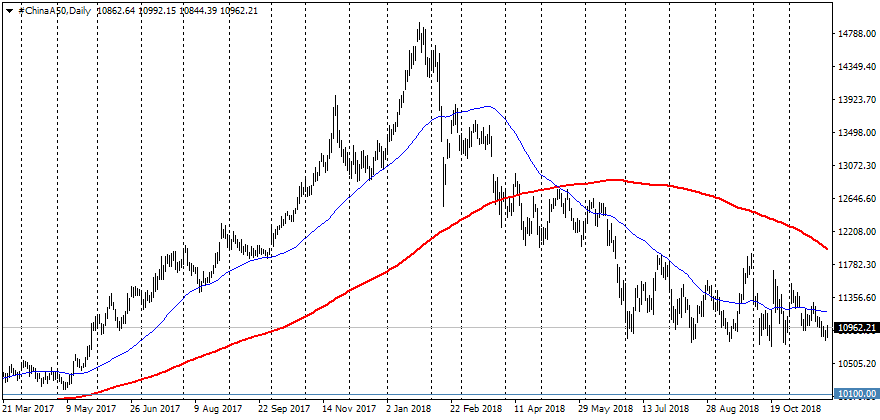
There has been market nervousness in regards to the upcoming meeting, and the dollar has returned around 6.95 yean, which is considered high for the current month. The stock index of the 50 blue chips (FTSE China A50) has added 1.3% on Wednesday morning, but still remains at multi-month lows. The dollar is growing for the fourth consecutive trading session while the dollar index has returned to 16-month highs.
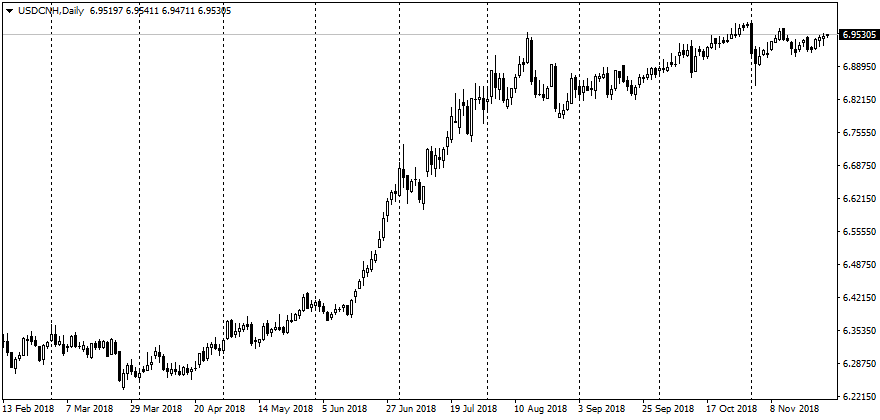
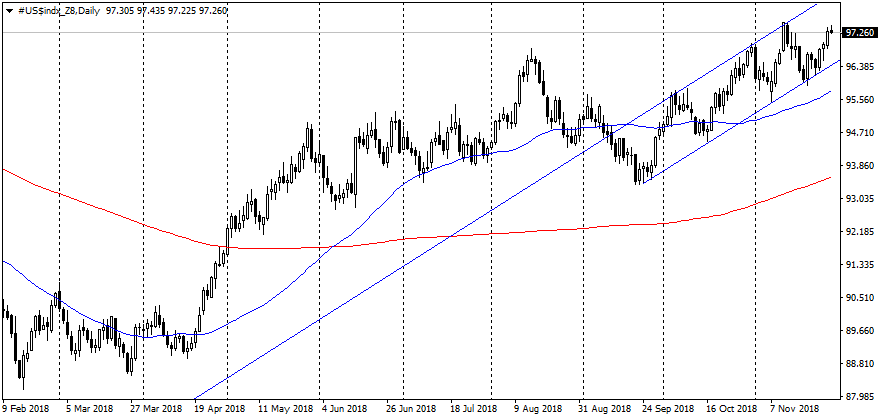
In all the three cases, the proximity to extremes attracts the attention of market players, and if there is a clear signal, it may be the beginning of a significant rally.
It is more probable, in our opinion, that the current growth trend on the dollar is a safe-haven investment while further uncertainty regarding the trade tariffs will remain in place.
In this case, a breakthrough from the dollar index’s resistance area, around 97.50, can send the DXY to the round level of 100.
In the likely case that China A50 index falls below 10800, and if the parties do not find a mutual agreement, the index may quickly roll back to the area of 10000-10100, which was the lower border of consolidation in early 2017.
For the yuan, a negotiation failure between President Trump and Xi may serve as a starting point for further weakening. Weakening the yuan may be the easiest way to safe the economy from a rapid weakening. In fact, the weakening of the yuan since April is 11%, which is comparable to the current 10% tariffs.
Gold Decline Stalls At The 50% Fibonacci, Near Oversold Levels
Gold bears entered the market on Tuesday, driving the precious metal to two-week lows. The 50% Fibonacci retracement level of the upleg from 1,196 to 1,230, at 1213 is currently acting as a barrier to steeper declines on the four-hour chart.
The MACD though warns that bearish actions may break this wall as the indicator seems to have already started a new bearish phase below its red signal line. Yet the RSI suggests that the market is very close to its oversold area, suggesting that upside corrections cannot be ruled out either.
On the downside and below the 1,211 trough, traders could look for support around the 61.8% Fibonacci of 1,209 before attention turns to the 1,203 mark. Below that, the way could open towards the 1,196 bottom, where any decisive leg lower would where any decisive leg lower would resume the bearish pattern off 1,243.
Alternatively, a bounce higher could pause around the 38.2% Fibonacci of 1,217, while gains above that obstacle could increase until the 23.6% fibonacci of 1,222. A move above the 1,230 top may bring more buying interest for gold.
Despite the recent sell-off, the precious metal remains neutral in the bigger picture, trading sideways between 1,243 and 1,196.
To sum up, gold is in bearish mode in the short-term timeframe, while overall it continues to move sideways.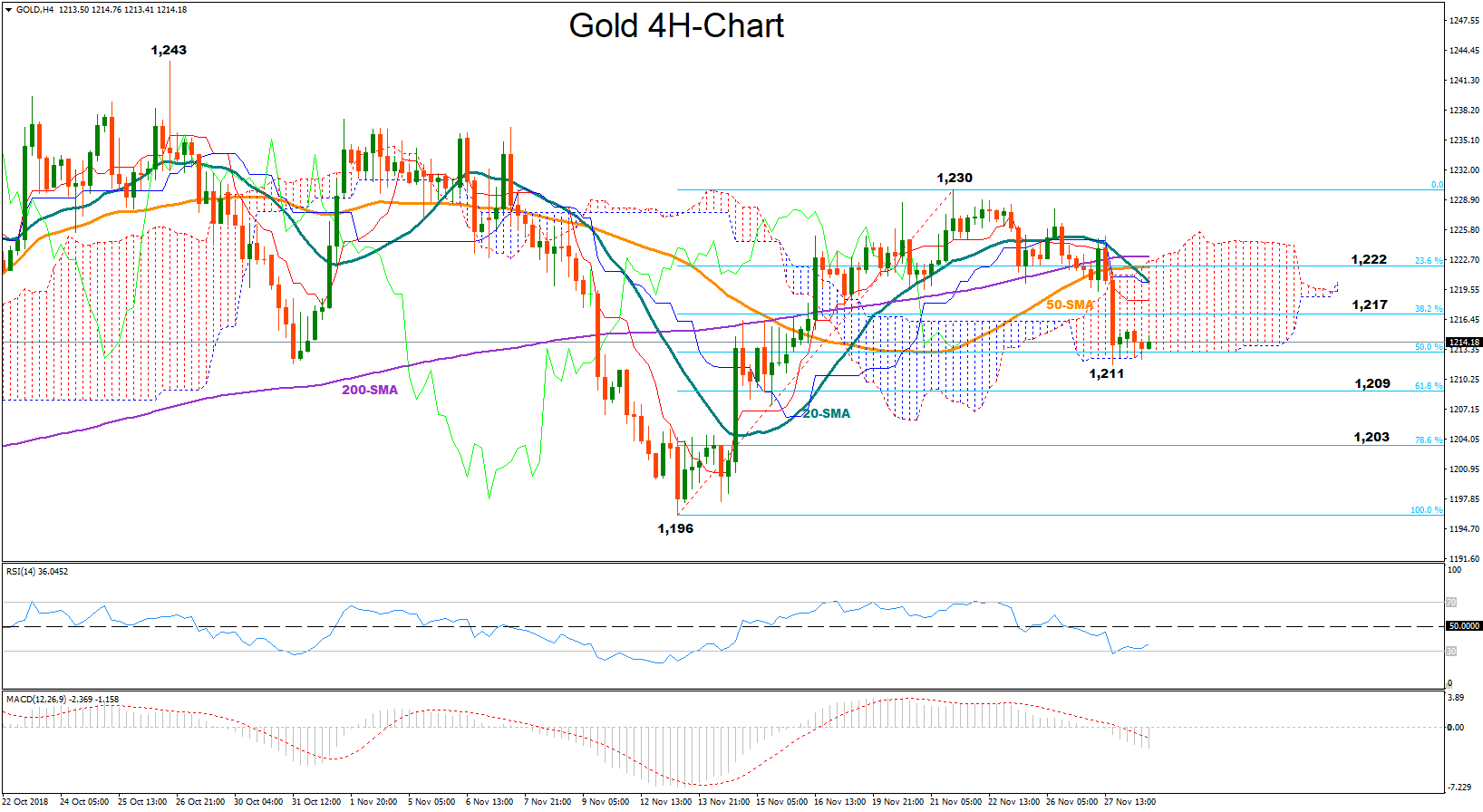
EUR/JPY Analysis: Decline Still Possible
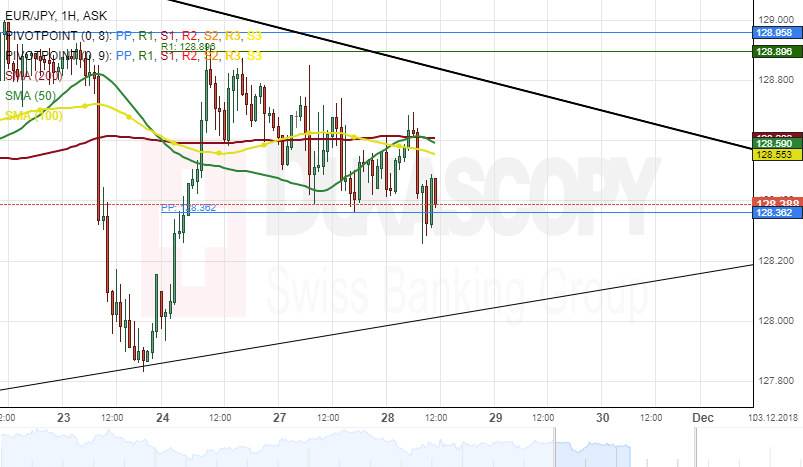
The common European currency traded sideways against the Japanese Yen on Tuesday. The currency pair was moving along the three moving averages during the previous trading session.
The exchange rate breached a traditional weekly pivot point at 128.40 during the first part of Wednesday's session.
Given that the EUR/JPY has breached the weekly PP, the common scenario would be a decline towards the lower boundary of an ascending trendline at 128.80 during the following trading session.
However, technical indicators suggest that this decline might not happen immediately.
NZD/USD Analysis: Supported By SMAs
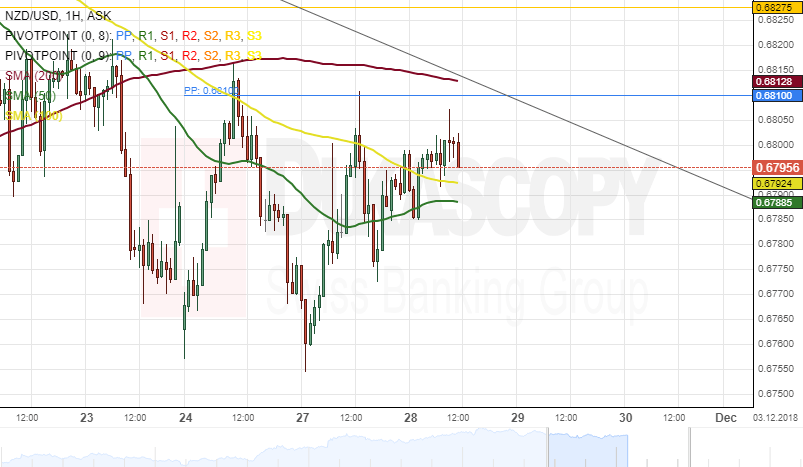
The New Zealand Dollar appreciated by about 56 base points against the US Dollar on Tuesday. The exchange rate breached both the 50– and 100-hour SMAs near 0.6800 during Tuesday's session.
However, after hitting the weekly PP at 0.6810, the currency pair began to decline. Currently, the price is near a support level formed by the 50– and 100-hour simple moving average at 0.6788.
If the NZD/USD pair passes the support SMAs, the currency exchange rate could aim at the weekly S1 near 0.6745.
On the other hand, if the support level holds, bullish traders could push the rate towards the upper boundary of a downtrend line at 0.6810.
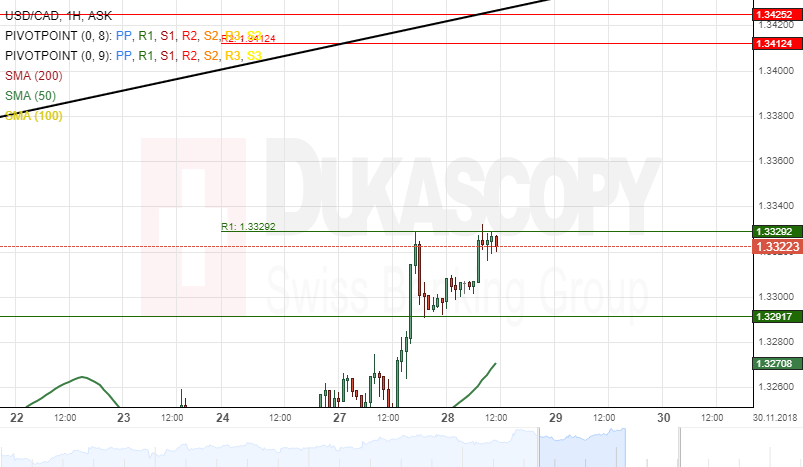
USD/CAD Analysis: Remains Near 1.3329
The US Dollar appreciated about 90 base points against the Canadian Dollar on Tuesday. However, after hitting a resistance level set by the weekly R1 at 1.3329. the currency pair made a U-turn down.
The exchange rate was trading between the weekly resistance level at 1.3329 and the monthly R1 at 1.3291 during the European session on Wednesday and could be set for a breakout.
As for the near future, it is likely that the currency exchange rate will dash through the weekly R1 within this session and aim for a resistance cluster set by the weekly and the monthly PPs at 1.3425.
AUD/USD Analysis: Meets Resistance Level
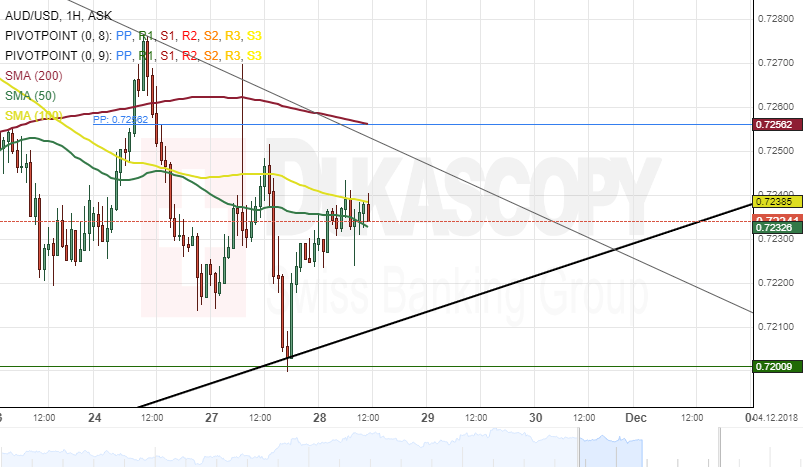
The Australian Dollar depreciated about 70 base points against the US Dollar on Tuesday. The currency pair tested the monthly pivot point at 0.7200 during yesterday's session.
Today's session begins with a bullish sentiment. However, a strong resistance level formed by the combination of the 50– and 100-hour SMAs at 0.7239 stopped the bullish momentum during the first half to Wednesday's trading session.
If this resistance level holds, the currency exchange rate could aim for the bottom border of an ascending channel at 0.7200 today.
On the other hand, if the rate passes the SMAs, the next target for the pair will be near the upper boundary of a descending trendline at 0.7256.
AUD/USD Outlook: The Downside Remains Vulnerable While 0.7270/80 Zone Pivots Cap
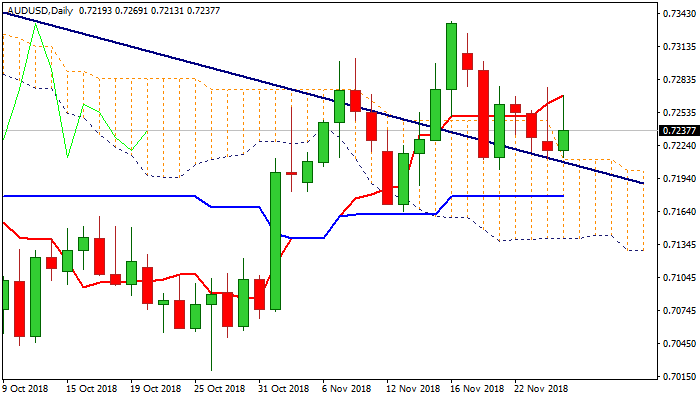
The Aussie dollar holds bid tone on Wednesday, despite stronger greenback and downbeat Australian data released earlier today (Q3 Construction work done -2.8% vs 0.9% f/c).
The pair holds above top of falling thick daily cloud which marks significant support at 0.7211, with strengthening momentum and north-turning slow stochastic on daily chart, being supportive for further recovery.
On the other side, strong upside rejections in past two days that left daily candles with long upper shadows, suggest that recovery attempts are lacking strength and keep the downside vulnerable.
Selling upticks into 0.7270 zone (Mon/Tue highs, reinforced by daily Tenkan-sen) remains favored for renewed attack at cloud base.
Sustained break into daily cloud would generate bearish signal, which would require confirmation on break below 0.7178 (55SMA / 50% of 0.7020/0.7335 rally).
Conversely, close above 0.7270/80 barriers would neutralize bearish threats and shift focus higher.
Res: 0.7242, 0.7253, 0.7276, 0.7300
Sup: 0.7222, 0.7211, 0.7199, 0.7187
China Xi in Spain, pledges to open markets access to foreign investments
Chinese President Xi Jinping is visiting Spain today and he's supposed to meet Trump later in the week in Argentina as sideline of G20 summit. Xi repeated his messages to the Spanish upper house of parliament that China planned to import USD 10T worth of goods over the next five years.
Also, Xi pledged that "China will make efforts to open, even more, its doors to the exterior world and we will make efforts to streamline access to markets in the areas of investment and protect intellectual property."