

Sample Category Title
USD/JPY Mid-Day Outlook
Daily Pivots: (S1) 113.51; (P) 113.67; (R1) 113.94; More..
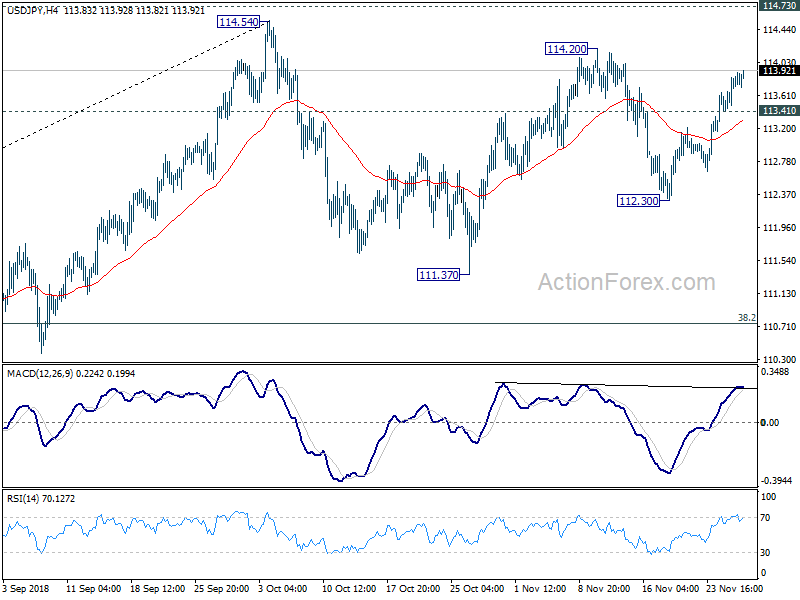
Intraday bias in USD/JPY remains on the upside as rise from 112.30 is in progress for 114.20/73 key resistance zone. Decisive break there will resume larger rally from 104.62. On the downside, below 113.41 minor support will turn intraday bias neutral first. Overall, price actions from 114.54 are seen as a consolidation pattern. Hence, even in case of another decline, downside should be contained by 38.2% retracement of 104.62 to 114.54 at 110.75 to bring rebound.
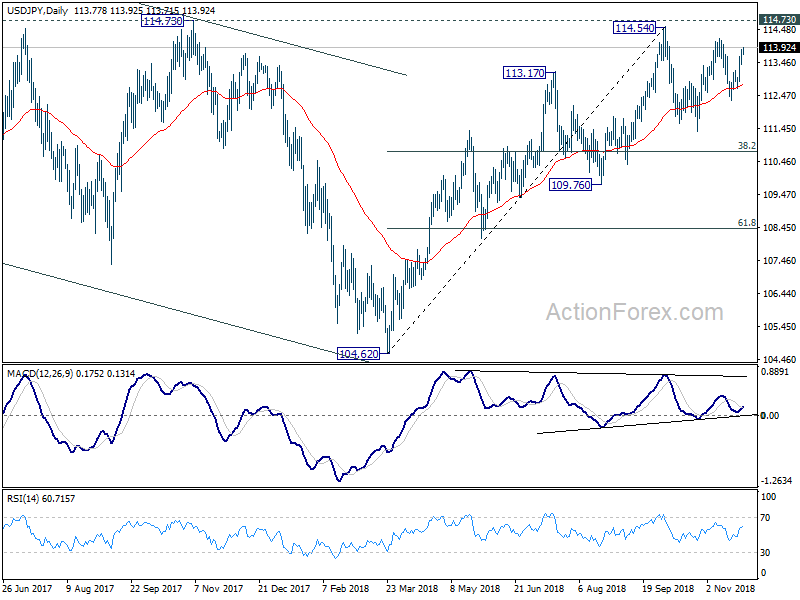
In the bigger picture, corrective fall from 118.65 (2016 high) should have completed with three waves down to 104.62. Decisive break of 114.73 resistance will likely resume whole rally from 98.97 (2016 low) to 100% projection of 98.97 to 118.65 from 104.62 at 124.30, which is reasonably close to 125.85 (2015 high). This will stay as the preferred case as long as 109.76 support holds. However, decisive break of 109.76 will dampen this bullish view and turns outlook mixed again.
USD/CHF Mid-Day Outlook
Daily Pivots: (S1) 0.9973; (P) 0.9988; (R1) 1.0002; More...
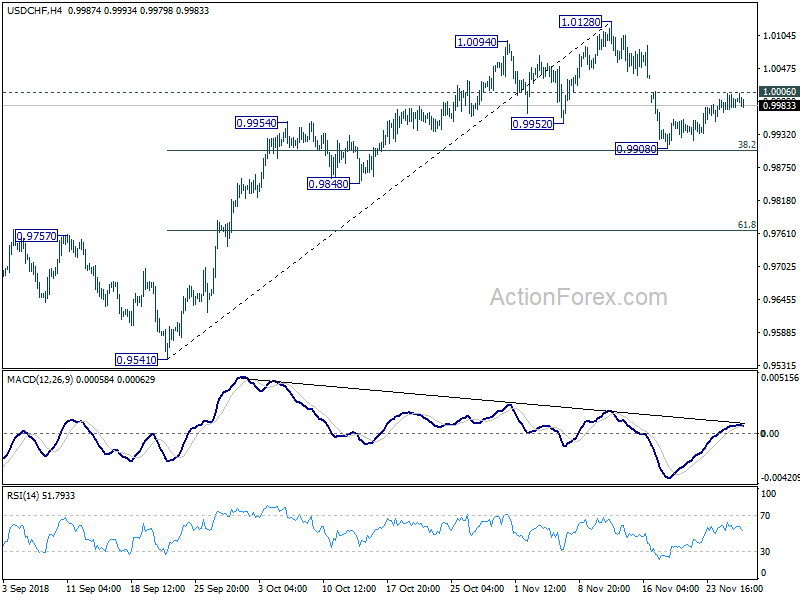
No change in USD/CHF's outlook and intraday bias remains neutral first. On the upside, break of 1.0006 minor resistance will argue that the pull back from 1.0128 has completed. Intraday bias will be turned back to the upside for retesting 1.1028. However, on the downside, break of 38.2% retracement of 0.9541 to 1.0128 at 0.9904 will target 0.9848 key support level.
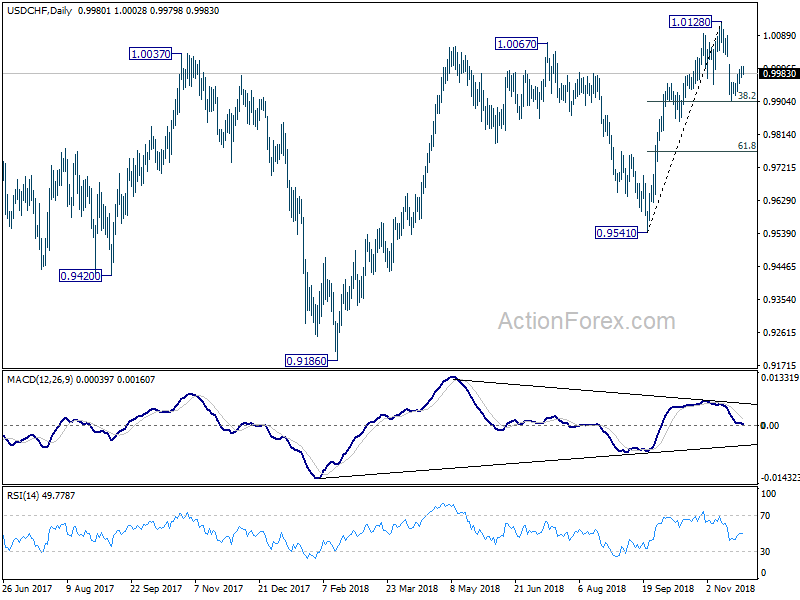
In the bigger picture, the pullback from 1.0067 has completed at 0.9541 already. And rise from 0.9186 is likely resuming. Firm break of 1.0067 will pave the way to retest 1.0342 key resistance. We'd be cautious on strong resistance from there to limit upside to bring another medium term fall to extend long term range trading. However, break of 0.9848 near term support will dampen this view and bring deeper decline back to 0.9541 support and possibly below.
EUR/USD Mid-Day Outlook
Daily Pivots: (S1) 1.1264; (P) 1.1304; (R1) 1.1332; More.....
EUR/USD's fall from 1.1472 is still in progress and intraday bias remains on the downside for 1.1215 support. Decisive break there will resume larger down trend for 1.1186 fibonacci level next. On the upside, above 1.1383 minor resistance will turn intraday bias back to the upside for 1.1499 resistance. Firm break there will indicate near term reversal and turn outlook bullish for 1.1814 key resistance.
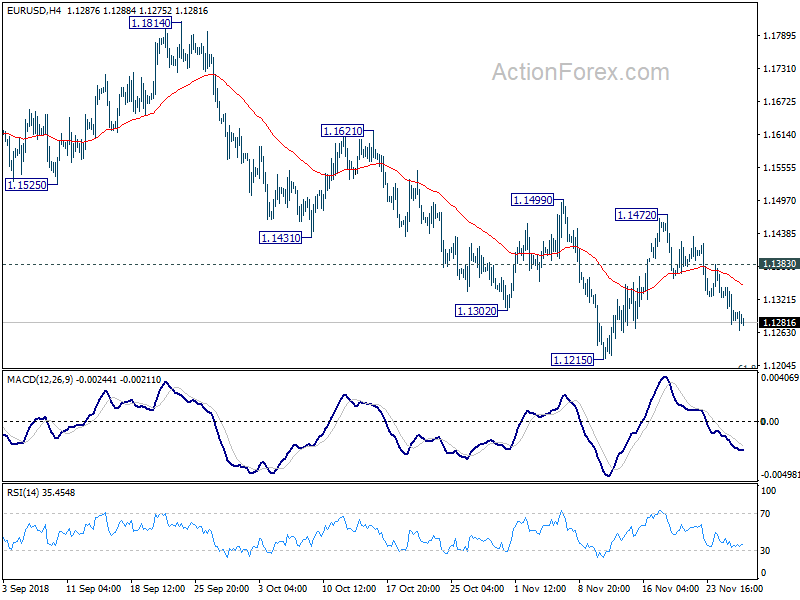
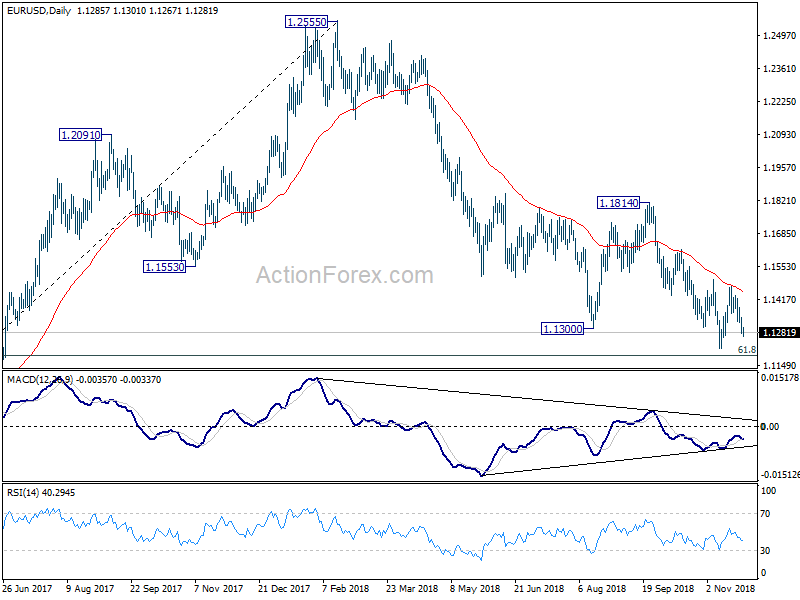
In the bigger picture, down trend from 1.2555 medium term top has just resumed and should target 61.8% retracement of 1.0339 (2017 low) to 1.2555 at 1.1186 next. Sustained break there will pave the way to retest 1.0339. On the upside, break of 1.1814 resistance is now needed to confirm medium term bottoming. Otherwise, outlook will stay bearish in case of strong rebound.
USD/CAD Pushes above 1.33 as Canadian Dollar Dips, US GDP Meets Expectations
The Canadian dollar continues to lose ground this week. In Wednesday’s North American session, USD/CAD is trading at 1.3330, up 0.26% on the day. In economic news, there are no Canadian events for a third straight day. In the U.S, Preliminary GDP for the third quarter posted a gain of 3.5%, just shy of the estimate of 3.6%. This follows an identical gain of 3.5% in the Advanced GDP release. Thursday promises to be a busy day. Canada releases current account and there are three key events in the U.S. – Core PCE Price Index, personal spending and unemployment claims. As well, the FOMC releases the minutes of its November policy meeting.
The Canadian dollar continues to struggle. The currency is lower for a fourth straight day and USD/CAD has pushed above the 1.33 level for the first time since June. The ongoing U.S-China trade spat has hurt Canadian exports, and lower oil prices are also weighing on the economy. After a lack of Canadian events this week, Canada releases its monthly GDP report, and a solid reading could reverse the Canadian dollar’s fortunes.
The markets are keeping a close eye on the G-20 summit in Argentina, which begins on Friday. President Trump will meet with Chinese President Xi Jinping on the sidelines, and the stakes are high, given the full-blown trade war between the world’s two largest economies. Will we see a thaw in the tariff spat, or will Trump and Xi take shots at each other’s policies? Trump has threatened to raise tariffs on Chinese products from 10 percent to 25 percent, but this could be grandstanding ahead of the summit. Trump has a knack of reaching agreements with his adversaries despite hostile rhetoric, so it’s entirely possible that the parties will agree to keep negotiating, which could lift the mood of investors and boost the wobbly Canadian dollar.
GBP/USD Mid-Day Outlook
Daily Pivots: (S1) 1.2703; (P) 1.2765; (R1) 1.2803; More...
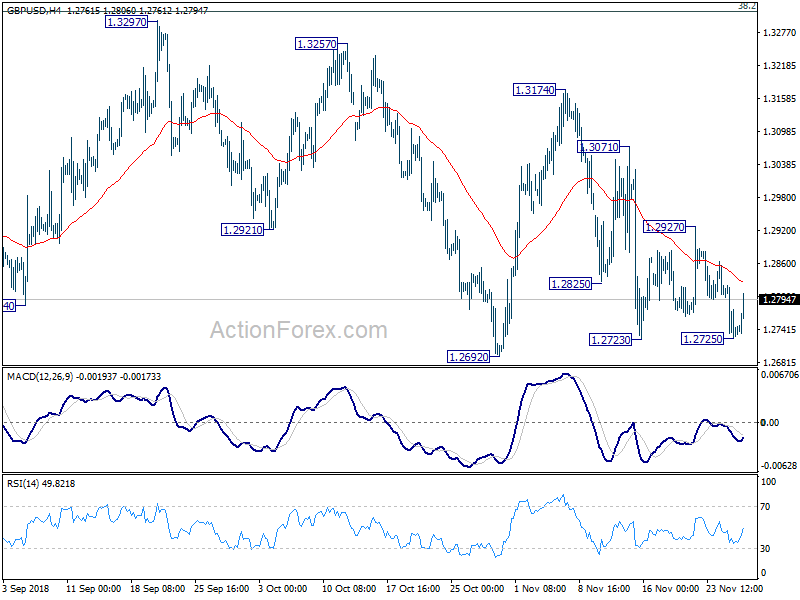
GBP/USD formed a temporary low at 1.2725, ahead of 1.2723 support and recovered. Intraday bias is turned neutral again. On the upside, above 1.2927 resistance will bring stronger rebound to 1.3071 and possibly above. On the downside, break of 1.2725 should extend recent fall to retest 1.2661 key support. After all, price actions from 1.2661 are viewed as a consolidation pattern. Even in case of strong rebound, upside should be limited by 1.3316 fibonacci level to bring down trend resumption eventually.
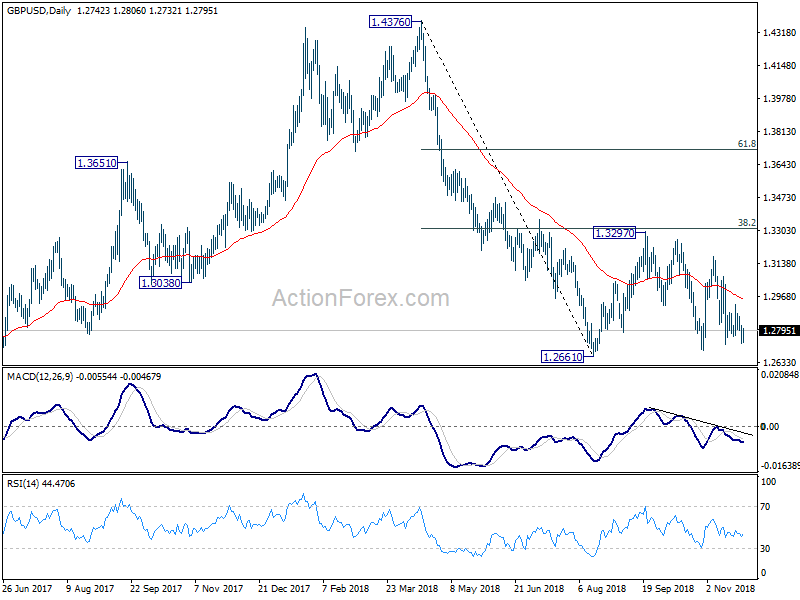
In the bigger picture, whole medium term rebound from 1.1946 (2016 low) should have completed at 1.4376 already, after rejection from 55 month EMA. The structure and momentum of the fall from 1.4376 argues that it's resuming long term down trend. And this will be the preferred case as long as 38.2% retracement of 1.4376 to 1.2661 at 1.3316 holds. However, firm break of 1.3316 would bring stronger rebound to 61.8% retracement at 1.3721. And, the eventual depth of the fall from 1.4376, and the chance of hitting 1.1946 low, will depend on the strength of the interim corrective rebound from 1.2661.
Sterling Makes a Come Back, Dollar Awaits Fed Powell
The British Pound makes a strong come back today and is trading as the strongest one at the time of writing. UK government released its long term Brexit economic analysis, showing that Prime Minister Theresa May's Brexit deal could bring as little as -0.1% drag in GDP in 15 years. Though, Sterling's rebound today is more due to lack of negative developments and technical, rather than the PM.
Thanks to rebound in the stock markets, Australian Dollar is the second strongest one for today. Dollar is following as the third strongest but it could be vulnerable. Trump just renewed his personal attack on Fed chair Jay Powell and said he's "not even a little bit" happy with him. Powell's speech today will be closely watched for any responses, or change in tone. Meanwhile, Canadian Dollar is weakest followed by Yen and then Euro.
Technically, GBP/USD's rebound ahead of 1.2723 support suggests temporary bottoming at least. Focus is back to 1.2927 minor resistance. ERU/GBP's break of 0.8824 minor support indicates rejection by 0.8939 resistance. And risks is now skewed to the downside for 0.8655 support. GBP/JPY will be eying 145.99 minor resistance to confirm short term bottoming.
In other markets, FTSE is current down -0.10%, mainly due to Pound's strength. DAX is up 0.15% and CAC is up 0.26%. German 10 year yield is down -0.001 at 0.351. Italian 10 year yield is down -0.027 at 3.264. German-Italian spread remains below 300. Italy's willingness to tweak its budget plan helps sentiments. Earlier in Asia, Nikkei rose 1.02%. Hong Kong HSI rose 1.33%. China Shanghai SSE rose 1.05%. Singapore Strait Times rose 0.13%. It seems that Asian investors are cautiously optimistic that Trump and Xi could make a deal of some sort in Argentina later this week.
Released from the US, trade deficit widened to USD -77.2B in October, above expectation of USD -76.7B. Wholesale inventories rose 0.7% mom versus expectation of 0.5%. Q3 GDP growth was unrevised at 3.5% annualized, below expectation of 3.6%. Earlier today, Eurozone M3 rose 3.9% yoy in October, above expectation of 3.5% yoy. German Gfk consumer climate for December dropped -0.2 to 10.4, slightly below expectation of 10.6. UK BRC shop price rose 0.1% yoy in November. Australia construction work done dropped -2.8% in Q3
UK government Brexit scenario analysis, from -10.7% GDP contraction to -0.1% in 15 years
The UK Government released a series of five papers on Brexit today. The most anticipated in the one on long term economic analysis of Brexit. In short, according the government, in 15 years by 2034 after Brexit:
- GDP could contract as much as -10.7% in case of no-deal Brexit with zero net inflow of EEA workers
- GDP would contract just -1.4% if it's modelled after EEA-type (European Economic Area) of deal, that is, Norway kind of deal.
- Under Prime Minister Theresa's Plan, GDP would contract only -0.6% if there is no change in migration arrangement. Or, in the best case scenario, GDP could just contract -0.1%.
The EU Exit: Long-term economic analysis report here. And, all five papers here.
In the parliament, Prime Minister Theresa May hailed her own plan and said "What the analysis shows, it does show that this deal that we have negotiated is the best deal for our jobs and our economy which delivers on the results of the referendum."
Earlier, Chancellor of Exchequer Philip Hammond told BBC that "If the only consideration, the only consideration, was the economy, then the analysis shows clearly remaining in the European Union would be a better outcome for the economy, but not by much. But he also noted that "The prime minister's deal delivers an outcome that is very close to the economic benefits of remaining in."
ECB de Guindos: Challenges remain in the form of low trend growth
ECB Vice President Luis de Guindos said in a speech that Eurozone economy is "continuing to grow" and the growth is "broad-based across countries and sectors". He added that "during this recovery, the countries that were most affected by the crisis have regained competitiveness thanks to a combination of accommodative monetary policy, fiscal consolidation and structural reforms."
However, de Guindos warned that "challenges remain in the form of low trend growth compared with other advanced economies, and persistently high public and private debt levels in a number of euro area countries.". He urged further efforts to "strengthen productivity growth and boost productive investments to lift long-term potential growth."
Italy to tweak budget, balance growth and public accounts
Italian Economy Minister Giovanni Tria said today that the coalition government is seeking to adjust its 2019 budget plan. They'd still have to support economic growth, but at the same time need to avoid disciplinary actions by European Commission. Tria said "we are attentively seeing if there is financial space to improve the balance between the need to support growth and the need to solidify the sustainability of the public accounts."
Separately, Deputy Prime Minister Luigi Di Maio, leader of Five-Star Movement, said "we must talk with the EU to find a solution, but we cannot betray the promises we made, otherwise we will become like all the other (governments)."
China Xi in Spain, pledges to open markets access to foreign investments
Chinese President Xi Jinping is visiting Spain today and he's supposed to meet Trump later in the week in Argentina as sideline of G20 summit. Xi repeated his messages to the Spanish upper house of parliament that China planned to import USD 10T worth of goods over the next five years.
Also, Xi pledged that "China will make efforts to open, even more, its doors to the exterior world and we will make efforts to streamline access to markets in the areas of investment and protect intellectual property."
GBP/USD Mid-Day Outlook
Daily Pivots: (S1) 1.2703; (P) 1.2765; (R1) 1.2803; More...
GBP/USD formed a temporary low at 1.2725, ahead of 1.2723 support and recovered. Intraday bias is turned neutral again. On the upside, above 1.2927 resistance will bring stronger rebound to 1.3071 and possibly above. On the downside, break of 1.2725 should extend recent fall to retest 1.2661 key support. After all, price actions from 1.2661 are viewed as a consolidation pattern. Even in case of strong rebound, upside should be limited by 1.3316 fibonacci level to bring down trend resumption eventually.
In the bigger picture, whole medium term rebound from 1.1946 (2016 low) should have completed at 1.4376 already, after rejection from 55 month EMA. The structure and momentum of the fall from 1.4376 argues that it's resuming long term down trend. And this will be the preferred case as long as 38.2% retracement of 1.4376 to 1.2661 at 1.3316 holds. However, firm break of 1.3316 would bring stronger rebound to 61.8% retracement at 1.3721. And, the eventual depth of the fall from 1.4376, and the chance of hitting 1.1946 low, will depend on the strength of the interim corrective rebound from 1.2661.
Economic Indicators Update
| GMT | Ccy | Events | Actual | Forecast | Previous | Revised |
|---|---|---|---|---|---|---|
| 00:01 | GBP | BRC Shop Price Index Y/Y Nov | 0.10% | -0.20% | ||
| 00:30 | AUD | Construction Work Done Q3 | -2.80% | 1.00% | 1.60% | 1.80% |
| 06:00 | EUR | German GfK Consumer Confidence Dec | 10.4 | 10.6 | 10.6 | |
| 09:00 | EUR | Eurozone M3 Money Supply Y/Y Oct | 3.90% | 3.50% | 3.50% | 3.60% |
| 13:30 | USD | Trade Balance (USD) Oct | -77.2B | -76.7B | -76.0B | -76.3B |
| 13:30 | USD | Wholesale Inventories M/M OCt P | 0.70% | 0.50% | 0.40% | |
| 13:30 | USD | GDP Annualized Q/Q Q3 S | 3.50% | 3.60% | 3.50% | |
| 13:30 | USD | GDP Price Index Q3 S | 1.70% | 1.70% | 1.70% | |
| 15:00 | USD | New Home Sales Oct | 583K | 553K | ||
| 15:00 | USD | Richmond Fed Manufacturing Index Nov | 16 | 15 | ||
| 15:30 | USD | Crude Oil Inventories | 0.6M | 4.9M |
ECB de Guindos: Challenges remain in the form of low trend growth
ECB Vice President Luis de Guindos said in a speech that Eurozone economy is "continuing to grow" and the growth is "broad-based across countries and sectors". He added that "during this recovery, the countries that were most affected by the crisis have regained competitiveness thanks to a combination of accommodative monetary policy, fiscal consolidation and structural reforms."
However, de Guindos warned that "challenges remain in the form of low trend growth compared with other advanced economies, and persistently high public and private debt levels in a number of euro area countries.". He urged further efforts to "strengthen productivity growth and boost productive investments to lift long-term potential growth."
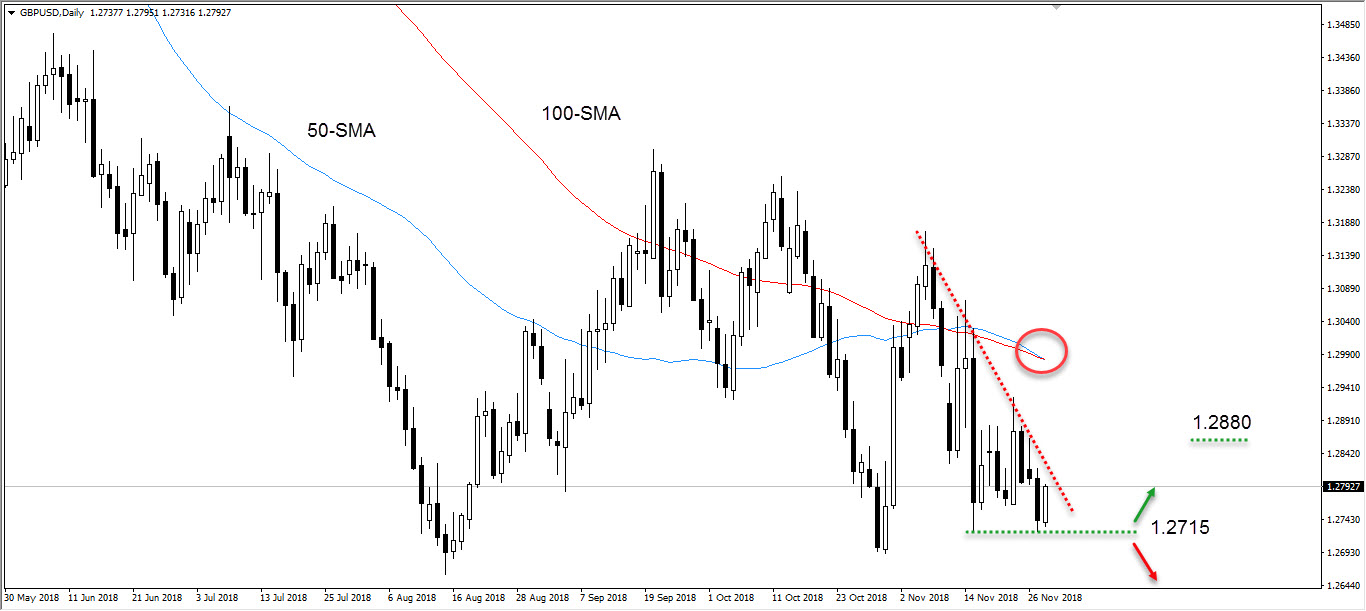
GBPUSD: The Risk Stays Seen higher, With the Medium-Term Downtrend
A clear break below the support at 1.27 is needed to resume the bearish trend
GBPUSD fall further to test support at 1.2715/18, and this has managed to hold for now. So, Further consolidation above here should be expected and near-term resistance is seen at 1.2880. However, our bias stays bearish.
DAX Edges Lower as Nervous Investors Eye G-20 Meeting
The DAX index has posted slight losses in the Wednesday session. Currently, the DAX is trading at 11,331, up 0.20% on the day. On the release front, German GfK consumer climate dipped to 10.4 points, shy of the estimate of 10.5 points. The U.S. releases Preliminary GDP, with an estimate of 3.6%. On Thursday, German Preliminary CPI is expected to remain at 0.2%. As well, Germany releases unemployment change and the ECB will publish its financial stability review.
Investors are keeping an eye of the G-20 summit in Argentina, which begins on Friday. President Trump will meet with Chinese President Xi Jinping, and the stakes could not be higher, given the full-blown trade war between the world’s two largest economies. Will we see a thaw in the tariff spat, or will Trump and Xi take shots at each other’s policies? Last week, White House advisor Larry Kudlow warned that the summit could be the scene of a direct confrontation between the parties. However, President Trump has a knack of reaching agreements with his adversaries despite hostile rhetoric, so it’s entirely possible that the parties will agree to keep negotiating, which could lift the mood of investors and boost the equity markets.
In Germany, confidence indicators are down in November, raising concerns about the strength of the economy. GfK consumer climate dropped to 10.4 points, its weakest level since May 2017. Earlier in the week, Ifo Business Climate dropped to 102.3, missing the forecast of 102.0 points. This marked a 4-month low. The ongoing U.S-China trade war has hurt the German export sector, as German companies that export to both the U.S. and China are now facing higher tariffs. Germany’s economy posted a rare decline in the third quarter, with a contraction of 0.2%. Another problem is lower eurozone growth, as weak economic activity in the third quarter appears to be the story in the fourth quarter. As well, the looming departure of Britain from the European Union and the crisis over the Italian budget have weighed on German business and consumer confidence levels.
Euro Subdued, German Consumer Confidence Dips
EUR/USD is showing little movement in the Wednesday session. Currently, the pair is trading at 1.1283, down 0.09% on the day. On the release front, German GfK consumer climate dipped to 10.4 points, shy of the estimate of 10.5 points. In the U.S., the key event is Preliminary GDP, with an estimate of 3.6%. On Thursday, German Preliminary CPI is expected to remain at 0.2%. As well, Germany releases unemployment change and the ECB will publish its financial stability review. The U.S. releases Core PCE Price Index, personal spending and unemployment claims. As well, the FOMC releases the minutes of its November policy meeting.
Is the German economy in trouble? Confidence indicators are down in November, raising concerns about the strength of the economy. GfK consumer climate dropped to 10.4 points, its weakest level since May 2017. Earlier in the week, Ifo Business Climate dropped to 102.3, missing the forecast of 102.0 points. This marked a 4-month low. The ongoing U.S-China trade war has hurt the German export sector, as German companies that export to both the U.S. and China are now facing higher tariffs. Germany’s economy posted a rare decline in the third quarter, with a contraction of 0.2%. Another problem is lower eurozone growth, as weak economic activity in the third quarter appears to be the story in the fourth quarter. As well, the looming departure of Britain from the European Union and the crisis over the Italian budget have weighed on business and consumer confidence levels in German.