Sample Category Title
Fed Powell said rate “just” below neutral, is the Fed still independent?
Dollar dives sharply as Fed Chair Jerome Powell seems to be backing down from his monetary stance, facing political pressure from Trump.
The key take away is that Powell said ". Interest rates are still low by historical standards, and they remain just below the broad range of estimates of the level that would be neutral for the economy‑‑that is, neither speeding up nor slowing down growth."
That is, in Powell's view, federal funds rate at 2.00-2.25% is "just below" neutral.
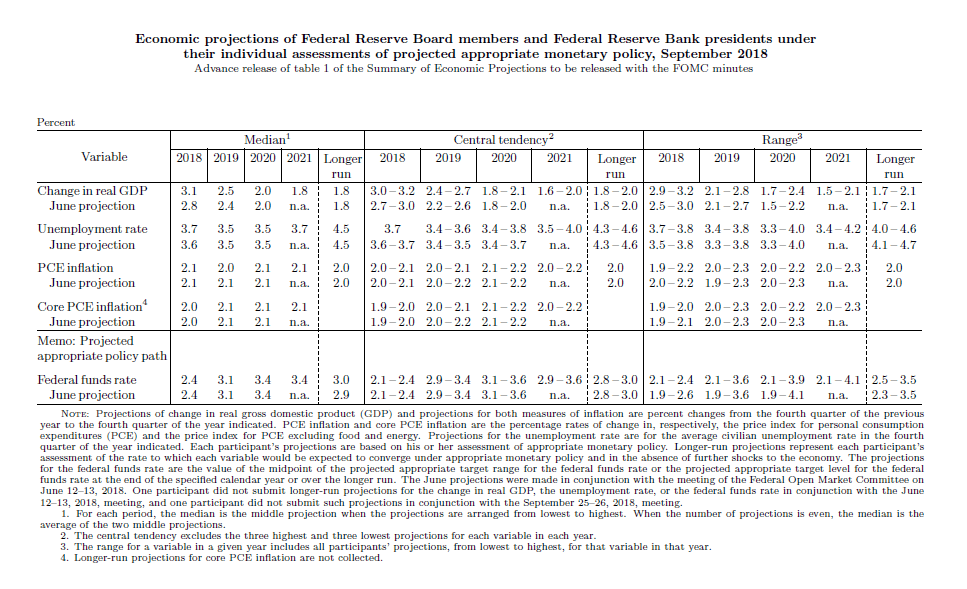
However, it should be noted that in September projections, median longer run projected federal funds rate was 3.0%. Central tendency was at 2.8-3.0%. And the range was from 2.5-3.5%.
2.00-2.25% couldn't be considered being "just below" 3.0%, nor 2.8-3.0%. So, is Powell finally revealing himself as a dove, not that balanced, composed Fed chair that he protraited? Or is he selling Fed's independence?
Also, back on October 3, Powell said "We may go past neutral, but we're a long way from neutral at this point, probably" (see this CNBC report). Powell in his own words on October 3. Just in case, start at 8:00.
https://youtu.be/lEPcPIYTMY0?t=8m1s
Did the economic outlook change that much since then? Or he lied back in October? Or he is lying now?
BoE projects GDP to be 1.75% higher in close partnership with EU after Brexit
Following the UK Government, BoE also released it's economic analysis of different Brexit scenarios.
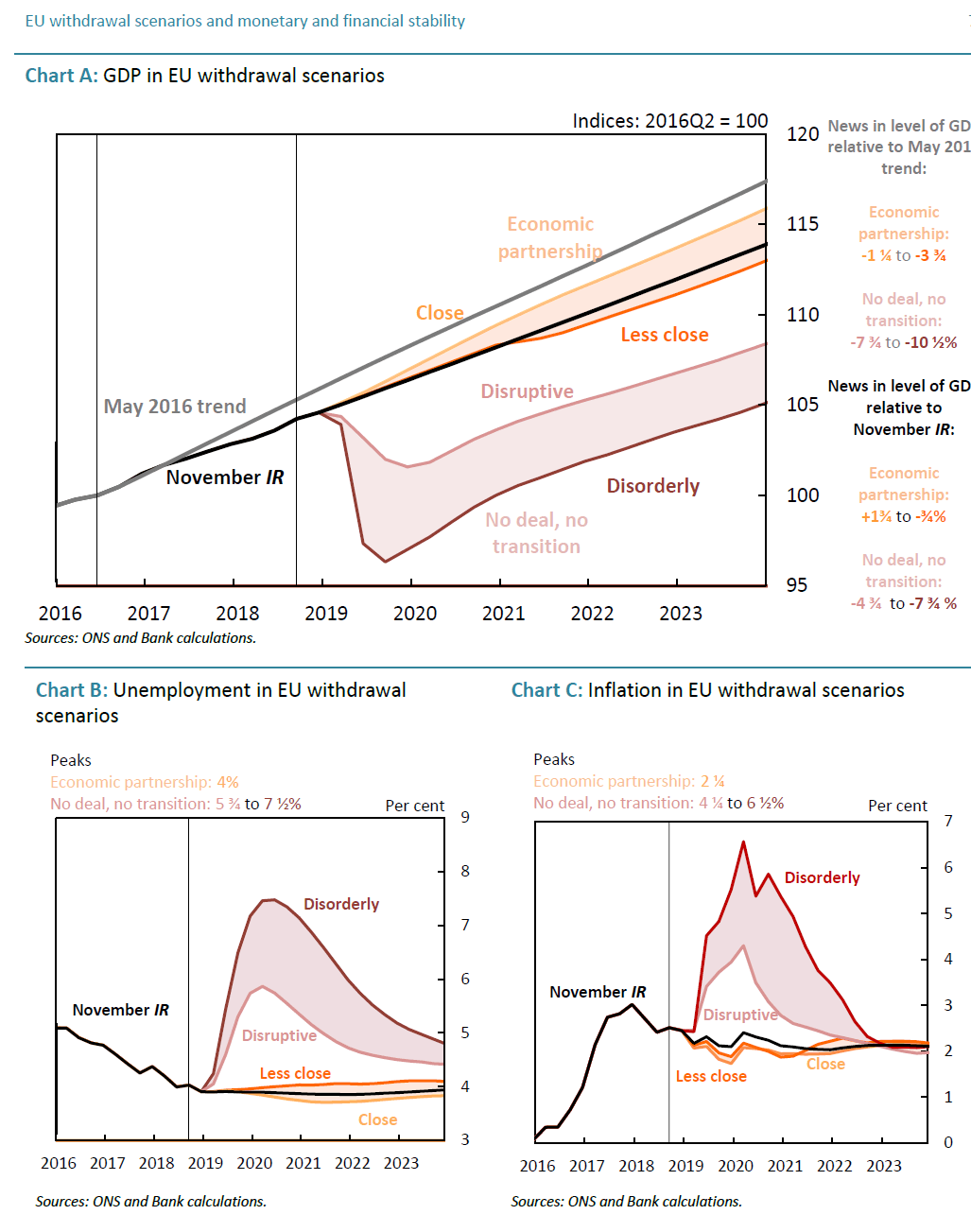
In short, in case of economic partnership with EU after Brexit, and relative to November Inflation Report (IR), by end of 2023:
- GDP is 1.75% higher in the close partnership scenario
- GDP is -0.75% lower in the less close partnership scenario
- Unemployment rate will be at 4%, slightly lower than the IR
- Inflation is a little lower reflecting appreciation of Sterling and peat at 2.25%
In case of no deal, no transition, relative to November IR, by the end of 2023, in worst case:
- GDP is -4.75 to -7.75% lower
- Unemployment rate will jump to 5.75-7.50%
- Inflation will peak at 4.25 to 6.25%
USD/JPY – Strong Dollar Pushes Yen Close to 114
The Japanese yen has ticked lower in the Wednesday session. In North American trade, USD/JPY is trading at 113.91, up 0.11% on the day. On the release front, U.S. Preliminary GDP for the third quarter gained 3.5%, just shy of the estimate of 3.6%. This follows an identical gain of 3.5% in the Advanced GDP release. Japan will release retail sales, with an estimate of 2.7%. Thursday promises to be a busy day, as the U.S. releases three key indicators – Core PCE Price Index, personal spending and unemployment claims. As well, the FOMC releases the minutes of its November policy meeting. Japan will publish Preliminary Industrial Production.
The Bank of Japan is committed to its target of just below 2 percent, but that goal remains elusive. BoJ Core CPI, the preferred inflation indicator of the bank, edged up to 1.3%, its highest level in 2018 (the indicator posted an identical gain in August). Inflation could face further headwinds, as the slowdown in China and the ongoing global trade war takes a bite out of the country’s export sector. As well, the recent drop in oil prices is also likely to hamper inflation. There is little reason to expect that inflation will gather any upward momentum and some analysts are forecasting that inflation in 2018 will fall below the 1 percent level. Weak inflation means that the BoJ has little incentive to alter its ultra-accommodative monetary policy.
All eyes are on the G-20 summit in Argentina, which begins on Friday. Analysts aren’t particularly interested in the agenda of the summit, which is likely to be overshadowed by a meeting on the sidelines between President Trump and Chinese President Xi Jimping. The stakes are high, as the tariff spat between the two economic giants threatens to dampen global growth. Will we see a thaw in the tariff spat, or will Trump and Xi take shots at each other’s policies? Trump has threatened to raise tariffs on Chinese products from 10 percent to 25 percent, but this could be grandstanding ahead of the summit. Trump has always preached ‘the art of the deal’, and the markets are hoping that cooler heads will prevail and the U.S. and China can reach some kind of agreement.
USDCAD Bullish at 5-Month Peak, Eyes Highest Since Mid-2017
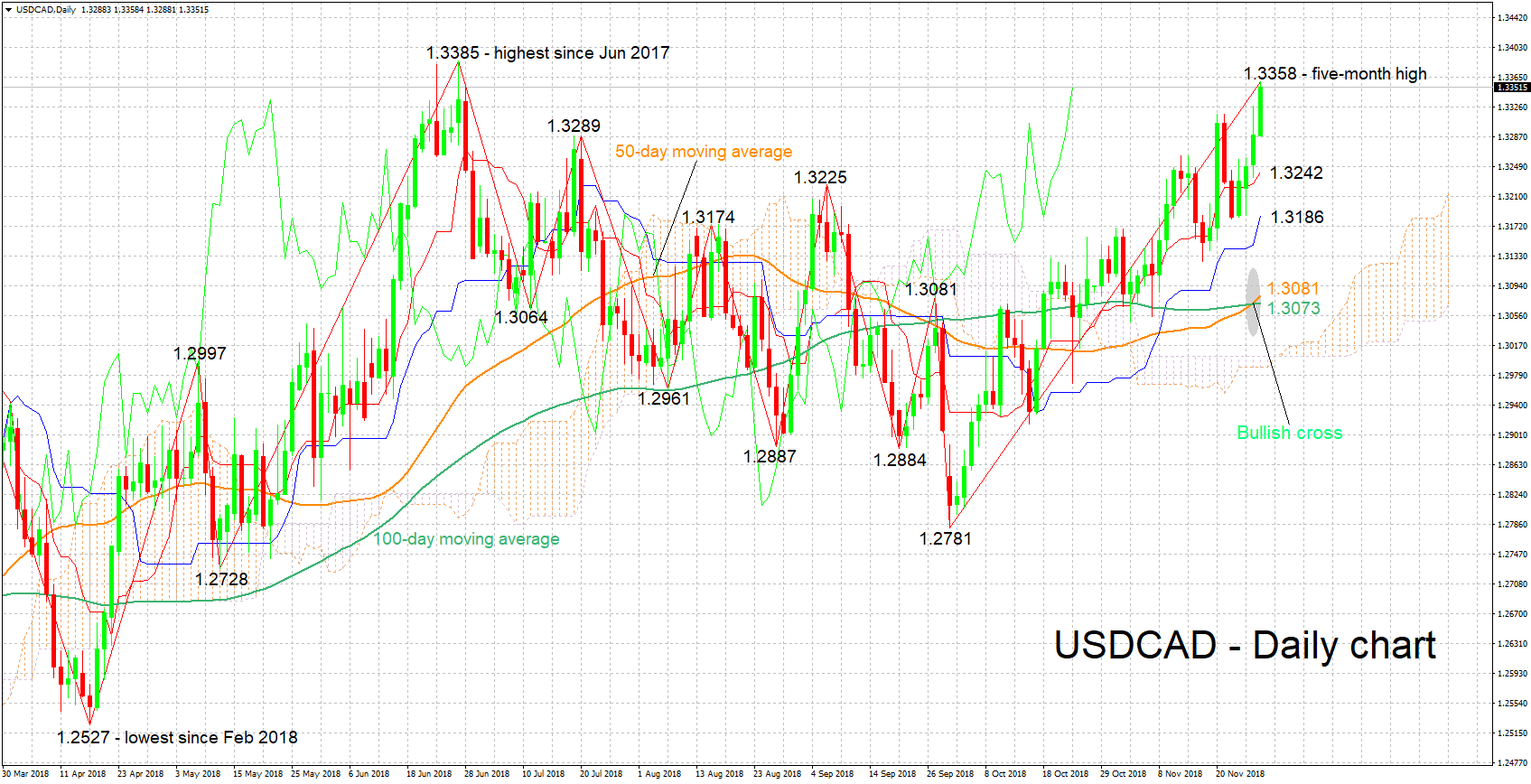
USDCAD touched a fresh five-month high of 1.3358 on Wednesday, trading not far below its firmest since June 2017 of 1.3385 hit in late June of the current year.
The Tenkan- and Kijun-sen lines are positively aligned on the daily chart, acting as a testament of the bullish sentiment that is in place in the short term.
Stronger gains may meet resistance around the 1.3385 peak. A decisive break above would turn the attention to the 1.35 handle which may hold psychological significance.
On the downside, support could come around the July top of 1.3289. The area around the Tenkan-sen at 1.3242, which also encapsulates the 1.3225 high, would come in focus in case of steeper losses. Lower still, the Kijun-sen at 1.3186 would be eyed.
The medium-term picture is looking positive, with price action comfortably above the 50- and 100-day moving average lines, as well as above the Ichimoku cloud. Additionally, the 50- and 100-day MAs have just recorded a bullish cross.
Overall, both the short- and medium-term outlooks are looking bullish at the moment. For perspective, year-to-date, the pair is trading higher by 6.1%.
Dollar Unfazed from Morning Data Dump and Fed Report; All Eyes on Powell
A wrath of US economic data had little impact on the US dollar early in New York as markets eagerly await Fed Chair Powell’s keynote speech at Economic Club of NY at 12:00 EST (17:00 GMT). The market will be looking to see if the Chairman will validate the notion that US will see a slower path of growth or provide a hint of a change with the rate hike schedule. Following the September meeting, the Fed’s dot plot targeted four more rate hikes through the end of next year, one at the December meeting and 3 more in 2019. Investors however are pricing in one less rate hike in 2019. Powell may keep things consistent, highlight being data dependent and not provide any major shifts of his stance on the economy or tightening schedule.
Yesterday, the dollar benefited from Fed Vice Chair Clarida’s comments that gradual rate hikes are appropriate, a slight shift from his dovish comments on November 16th.
Morning Data:
The second reading on US Q3 GDP came in unrevised from the advance reading and in line with expectations at 3.5%. The release highlighted “upward revisions to nonresidential fixed investment and private inventory investment were offset by downward revisions to personal consumption expenditures (PCE) and state and local government spending.” The Fed’s preferred measure of inflation, PCE came in at 1.5%, slightly softer than the advance reading of 1.6%. A hotter number could have provided the dollar with a boost.
The October reading for Advance Goods Trade Balance was a deficit of $77.2B, up $1.0 billion from September and slightly wider than analysts’ expectations. Exports posted a decline of 0.6% to $140.5 billion, leading many to believe that the data can get much worse if no progress is made on the trade front. Wholesale inventories for October, adjusted for seasonal variations but not for price changes rose 0.7% to $650.4 billion from September 2018, and were up 6.6% from October 2017.
At 10:00 AM EST (15:00 GMT) the November reading for Richmond Fed Manufacturing index came in slightly softer at 14, 1 point softer than both the analysts’ estimate and prior month’s reading. The October New Home Sales, fell 8.9% to 544,000 reading, markets were expecting a 3.7% gain.
Fed Financial Stability Report
The Fed’s report noted that developments in domestic and international markets could pose near-term risks to the U.S. financial system. The ultimate effects of shocks arising from such developments likely depend on the vulnerabilities in the financial system identified in the previous sections of this report. Regarding the financial system the release stated that the nation’s largest banks are strongly capitalized, and leverage of broker-dealers is substantially below pre-crisis levels. Insurance companies have also strengthened their financial position since the crisis. Even if central bank policies are fully anticipated by the public, some adjustments could occur abruptly, contributing to volatility in domestic and international financial markets and strains in institutions. Many analysts are interpreting the report as a cautionary note.
Price action on the EUR/USD 4-hour chart displays that the recent range trading from 1.1200 to 1.1550 has been firmly in place since mid-October. The current four-day slide is tentatively finding support from the 1.1270 region. Price is tentatively forming a bullish Gartley pattern. Point D is targeted with the 78.6% Fibonacci retracement level of the X to A leg and the 200.0% Fibonacci expansion level of the B to C move. If valid, we could see a bullish bounce target the 1.1350 area. If invalidated, deeper support could from the 1.1215 level.
Trump studying auto tariffs again after GM plants closure
Trump blamed other car exporting countries for taking advantage of the US for decades. And he claimed that if the 25% "chicken tax" is imposed on cars, GM would not be closing their plants in Ohio, Michigan and Maryland. And because of GM event, auto tariff is being studied now.
He tweeted. "The reason that the small truck business in the U.S. is such a go to favorite is that, for many years, Tariffs of 25% have been put on small trucks coming into our country. It is called the "chicken tax." If we did that with cars coming in, many more cars would be built here .....and G.M. would not be closing their plants in Ohio, Michigan & Maryland. Get smart Congress. Also, the countries that send us cars have taken advantage of the U.S. for decades. The President has great power on this issue - Because of the G.M. event, it is being studied now!"
https://twitter.com/realDonaldTrump/status/1067791101782831104
https://twitter.com/realDonaldTrump/status/1067792610180456448
Sunset Market Commentary
Markets
Global core bonds move sideways today as there was only second-tier economic data to steer investors and international politics remained relatively silent. Main events of the day are planned after European close: Brexit analysis by the Bank of England followed by a Q&A session with governor Carney and comments from Fed Chair Powell. Asian equities opened today’s trading sessions with gains, while European equities opened more hesitantly to hover around opening levels throughout the day, a move copied by German Bunds. Italy’s Di Maio repeated his government is open for dialogue with the European Union, but that they cannot break promises made to voters. Italian FM Tria told the Senate in Rome that “intense dialogue” with the EU is necessary, confirming the Italian willingness to budge on its budget proposal to avoid an escalation. Tria will sit down with PM Conte and Deputy PM’s Salvini and Di Maio tonight to discuss its possibilities. US Treasuries traded flat ahead of Federal Reserve chairman Powell’s speech of tonight. Markets will pay attention to Powell’s tone on worries about potentially slowing US economic growth. The US 10-yr yield tested the 3.05% support area, but the latter is proving resilient. US yields edge cautiously higher across the curve with changes up to 0.7 bps (10-yr). German yields hardly move with changes between -0.1 bps (2-yr, 30-yr) to +0.3 bps (5-yr). Spreads over German 10-yr yields were steady.
Global investors remained in wait-and-see modus today, looking forward to a speech of Fed Chair Powell this evening. This was also visible in the intraday USD price action. European equities hovered around unchanged levels during the morning session. Interest rates and interest rate differentials also provided little guidance for the FX trading. US eco data were second tier and close to expectations. The dollar held close to recent peaks. Investors apparently don’t want to be positioned short USD going into the speech of Fed’s Powell. A positive assessment of the Fed president might support US yields and the dollar. EUR/USD hovers in a tight range in the upper half of the 1.12 big figure. USD/JPY stabilizes slightly below, but within reach of the 114 level. Powell’s speech is scheduled at CET 18.00.
Sterling succeeded somewhat of a remarkable rebound today. Over the previous days, the UK currency was fighting an uphill battle as investors stayed cautious on sterling long positions as the approval of the Brexit deal in Parliament remained highly unlikely. Today’s sterling rebound was said to be driven by headlines that labour was pondering the option of a second referendum. Also for this option the question remains whether it can secure a political majority. So for now, we doubt that it might be a strong enough basis for a sustained sterling rebound. Later during the day, the UK government published its analysis on the economic impact of Brexit under several scenario’s. However, as there was no detailed analysis of the economic consequences of the Brexit deal that will be put to the parliamentary vote at Dec 11, the impact of the document on markets was limited. EUR/GBP is trading in the 0.8830 area. Cable trades in the high 1.27 area. The BoE will publish its impact analysis on Brexit later today.
News Headlines
Ahead of next week’s OPEC+ meeting, Saudi Arabia’s energy minister said he wants stability brought back to the oil market through output cuts, but added his country “will not do it alone”. Putin said Russia is ready for cooperation with its OPEC allies, but is already satisfied with an oil price of $60/b.
A UK governmental analysis revealed UK BBP could be up to 10.7% lower over 15 years if there is no deal and migration to the island is to be fully blocked. The economic impact of the current Brexit deal was not provided. Instead, the government estimated the impact of May’s rejected Chequers plan at a 0.6% GDP loss over 15 years, or 2.5% without any EU migration.
Limited Revisions Keep U.S. Growth Unchanged at 3.5% in the Third Quarter
The U.S. economy grew at a 3.5% annualized pace in the third quarter according to the BEA's second estimate. This matched the advanced estimate (3.5%), and market expectations. Beneath the headline, a slight downward revision to consumer spending was offset by an upward revision to business investment.
Real personal consumer spending remained strong but was revised down to 3.6% from the initial 4% estimate. This largely reflected weaker growth in durable goods (3.9% annualized, versus 6.9% in the advance estimate).
Business investment was revised up to 2.5% from a 0.8% gain reported in the advance estimate. The revisions came in structures spending, which now fell 1.7% (-7.9% adv.) and equipment outlays, which rose 3.5% (0.4% adv.). Spending on intellectual property was revised down to 4.3% (7.9% adv.).
Residential investment was also revised up, and is now estimated to have declined 2.6% in the third quarter (previously: -4.0%).
Government spending was revised down to 2.6% (3.3% adv.) on weaker spending at the state and local level.
Exports were revised down to a 4.4% drop (-3.5% adv.), while imports were essentially unchanged at a 9.2% jump. That means net trade subtracted 1.9 percentage points from growth (-1.8% adv.), a shift which was largely offset by a bigger contribution from inventory building (+2.3 p.p. vs 2.1 p.p. adv.).
Corporate profits for the third quarter were also released, and were up a healthy 14.3% annualized before taxes (and including inventory and capital adjustments). That marks the second straight quarter of double-digit gains in profits, which were up 10.3% versus a year ago. That marks the fastest year-on-year growth in profits since 2012. Corporate profits now account for 11.2% of GDP, the highest share in three years.
Key Implications
Once again the revisions in the second estimate of GDP were uneventful. If anything, the composition of growth is more encouraging with a better showing for business investment. Looking ahead, monthly indicators point to a slower, but still solid, pace of growth in the fourth quarter (between 2 - 2 ½%). Slower growth will largely reflect a moderation in consumer spending, as the boost from tax cuts that lifted spending through the middle of the year fades.
On the plus side, healthy growth in corporate profits suggests businesses have the capacity to keep investing, if they remain confident about future demand. With various measures of business confidence starting to show strain from the ongoing ratcheting up of import tariffs and retaliation on U.S. exports, the question is whether worries will translate into revised capital expenditure plans. The drop in oil prices adds another negative to the outlook for investment in the oil patch.
As 2019 quickly approaches the risks to the downside are mounting. We will hear from the Fed Chair at noon today, and hopefully get a better sense of how the Fed is weighing the downside risks. So far, the Fed seems likely to remain on track to gradually normalize monetary policy. With inflation at target and the economy running hot, we anticipate that the Fed will raise rates in December, but there is downside risk to our expectation for hikes in 2019.
WTI Oil Outlook: Bears Regaining Control after Recovery Stalled; OPEC Meeting Next Week Key
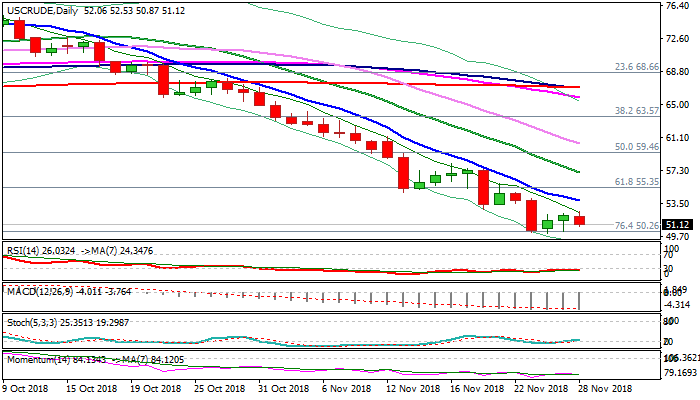
WTI oil holds in red on Wednesday and dipped below $51 handle, retracing over 61.8% of two-day $50.09/$52.53 recovery and signaling that corrective phase might be over. Oil bears took a breather after falling over 6% last Friday, helped by optimism over possible reduction in the output from OPEC and Russia. Recovery was capped by broken 200WMA, losing traction well below pivotal barrier at $53.82 (falling 10SMA) and signaling that initial improvement in sentiment might be short-lived. Fears about global growth slowdown and escalation of US/China trade conflict if two Presidents fail to reach an agreement on G20 meeting on Friday, which would significantly impact global demand, keep oil prices under strong pressure. Bearish daily/weekly techs and the strength / length of corrective actions during the whole downtrend from 03 Oct 2018 at $76.88 high, suggests that corrective has finished and renewed attack at psychological $50 support could be likely scenario. Adding to scenario was Tuesday's API crude stocks report which showed build of oil inventories by 3.5 mln bls (following previous week's 1.5 mln bls draw). Release of US EIA crude stocks report today (0.7 mln bls build f/c) would add to negative outlook if data come above expectations. OPEC meets next week and this could be the key event for oil market, as the bloc is expected to announce whether they are going to reduce production or not. Saudi Arabia announced that they will not take any unilateral action and want all members to agree before proceeding with output cut. On the other side, Saudi Arabia's position is complicated as they show willingness to take action along with other main oil producers, but are under strong pressure from US President Trump who asked Saudis to keep the output unchanged and further lower oil prices. Bearish scenario on sustained break below $50 would risk extension towards $45 zone initially and would unmask key support at $42.04 (2017 low). Conversely, sustained break above 10SMA would sideline bearish threats and generate initial recovery signal.
Res: 52.53; 52.76; 53.81; 54.09
Sup: 50.26; 50.00; 49.10; 46.99
EUR/GBP Mid-Day Outlook
Daily Pivots: (S1) 0.8836; (P) 0.8862; (R1) 0.8890; More...
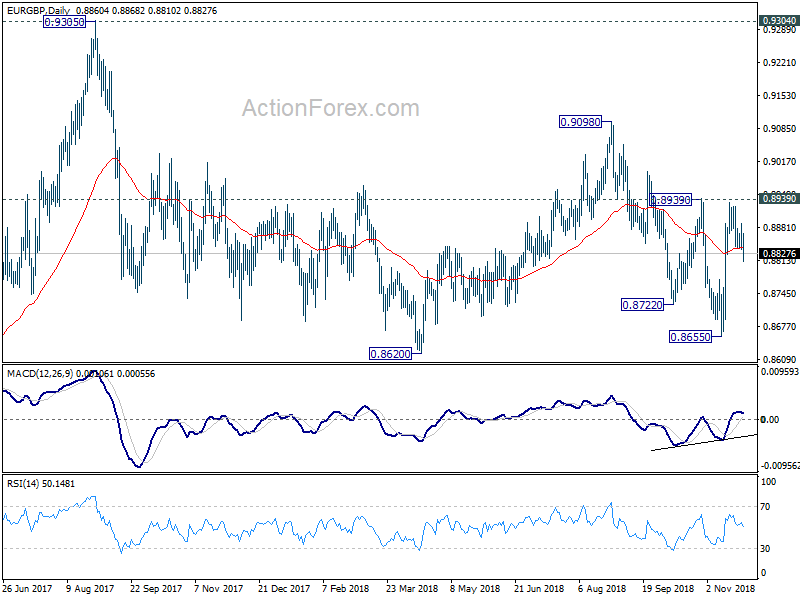
EUR/GBP's break of 0.8824 minor support argues that rebound from 0.8655 might be completed at 0.8931, after being rejected by 0.8939 resistance. Intraday bias is turned back to the downside for retesting 0.8655. On the upside, firm break of 0.8939 resistance will confirm completion of the fall from 0.9098 and turn outlook bullish for this resistance.
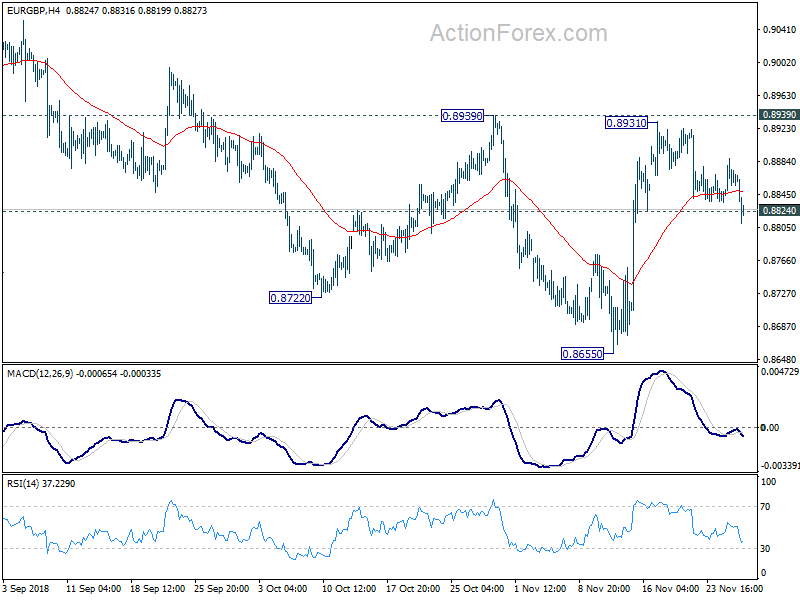
In the bigger picture, EUR/GBP is seen as staying in long term range pattern started at 0.9304 (2016 high). Sustained break of 0.8939 resistance will confirm that it's in a medium term rising leg for 0.9098 and above. And for now, in case of another fall, downside will likely be contained by 0.8620/55 support zone to bring rebound.