Sample Category Title
GBPUSD Awaiting Key UK Retail Sales Data
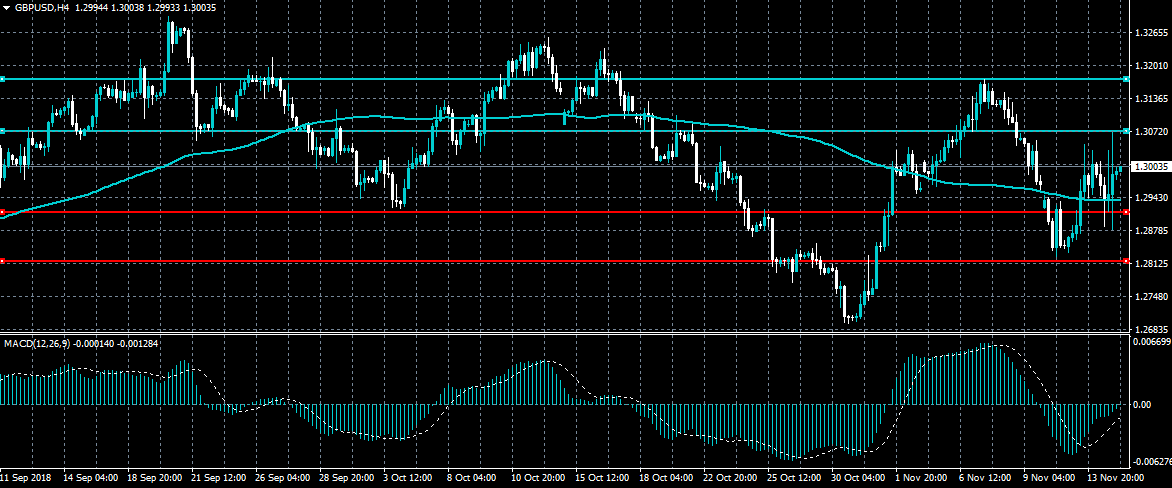
The British pound is trading around the psychological 1.3000 level against the US dollar, ahead of the release of key Retail Sales data from the United Kingdom economy this morning. The GBPUSD pair remains volatile amidst ongoing Brexit news, with price earlier spiking towards the 1.3070 level. Buyers need to break the 1.3100 resistance level while sellers need to keep the price below the 1.2940 support level.
The GBPUSD pair is intraday bullish while trading above the 1.2940 level, key technical resistance is now found at the 1.3070 and 1.3100 levels.
If the GBPUSD pair trades below the 1.2940 level, key support is found at the 1.2900 and 1.2866 levels.
USDJPY Falls Under Trendline Support
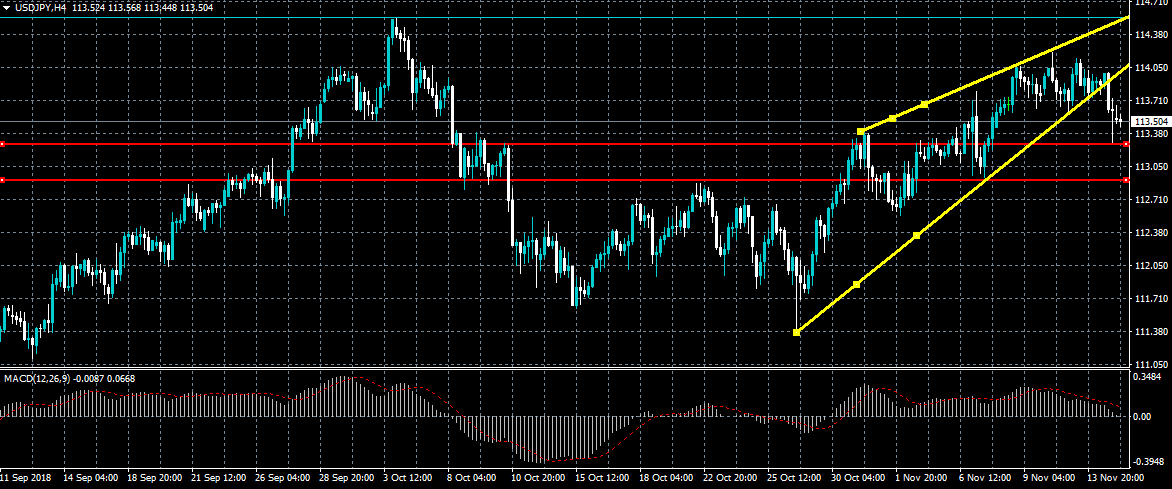
The US dollar has broken to the downside against the Japanese yen, following a strong move lower in US equity markets on Wednesday. The USDJPY pair has broken below key trendline support from the well-defined rising wedge pattern on the four-hour time frame. Additional intraday selling pressure will be placed on the USDJPY pair if price trades below the 112.94 support level.
The USDJPY pair is intraday bearish while trading below the 113.89 level, key technical support is now found at the 113.28 and 112.94 levels.
If the USDJPY pair trades above the 113.70 level, buyers may test the 113.89 and 114.19 resistance levels.
Bitcoin Drops Like A Rock Ahead Of Bitcoin Cash Forking
Since September, the price of Bitcoin has mostly been stable. The volatility reduced in what many experts believed was the calm before the storm. The storm came yesterday, when Bitcoin had the sharpest decline since February this year. The price declined by more than 15% to a low of $5430. Bitcoin’s price has dropped by more than 70% from the YTD high. Other cryptocurrencies like Ether, Litecoin, and Ripple dropped by more than 15% as well.
The decline that happened overnight was associated with a new Bitcoin Cash fork. Many Bitcoin holders sold their holdings as they tried to raise cash to buy Bitcoin Cash when it splits. They anticipate that the value of the new coins will increase. When the split happens, the two new Bitcoin Cash will become competitors. In addition, the process of mining the new currency will be relatively easy before the hash rates increases.
Last year, Bitcoin Cash was created by the forking of Bitcoin. This led to a new forking craze in which a number of software development teams started creating new money by changing the original computer code. After the forking happens today, Bitcoin Cash will be led by Craig Wright while another rival faction will lead the new version of Bitcoin Cash.
All these issues raise serious concerns about the relevance of the cryptocurrency world with investors worrying what will happen if the forking craze continues. In other words, they are concerned about the value of their currencies when a new one is created. Bitcoin’s current price is the lowest it has been since last year. In an article last week, Bloomberg Intelligence warned that declines below $5900 could see the price drop to $2000.
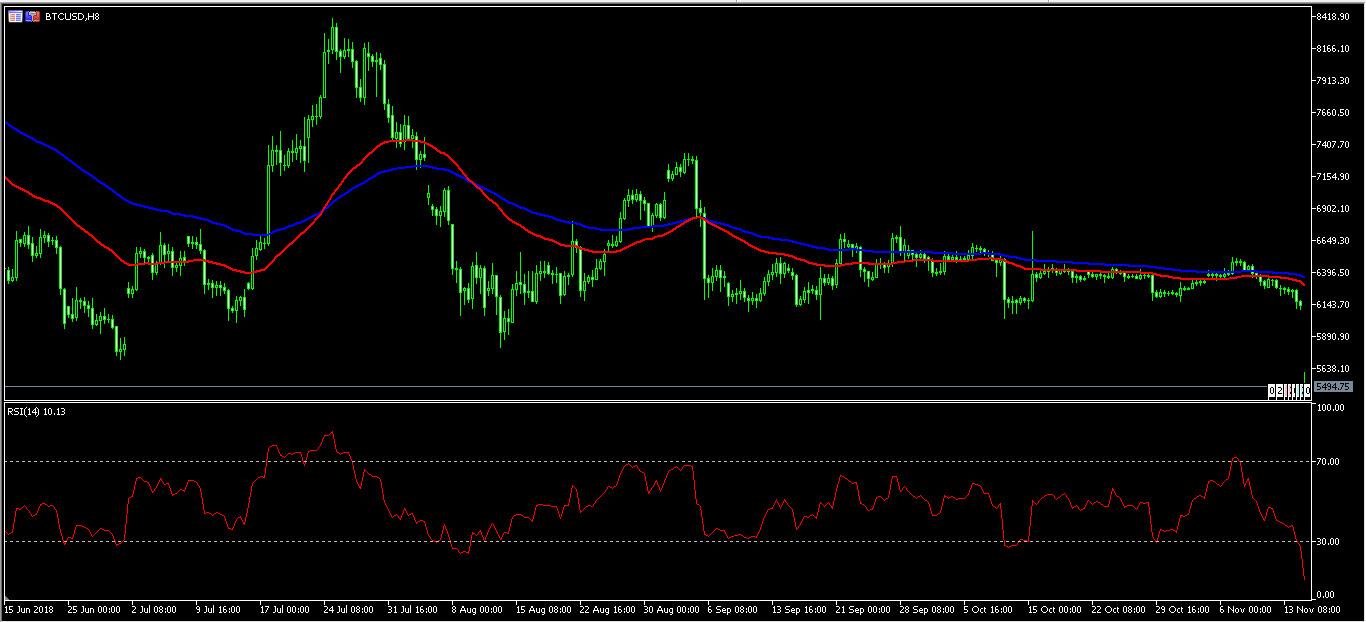
The BTC/USD pair’s current price is below all the main moving averages while the RSI is currently at 10. While this could be viewed as a sign to buy, the low RSI is also an indicator of how strong the bearish momentum is. Therefore, the pair could remain within these levels or even fall lower as forking happens.
Sterling Remains Volatile As May Warns Of Difficult Days Ahead
The Aussie gained after Australia released solid job numbers. In October, the country’s unemployment rate remained at 5.0%, which was better than the consensus estimate of 5.1%. The participation rate increased to 65.6% while the employment change increased by 32.8K. This was almost double than what investors were expecting.
The US dollar index rose after investors were told to prepare for more rate hikes ahead. In an interview with Dallas Fed President Robert Kaplan, Fed Chairman Jay Powell credited the Fed for the current strength of the economy. He also said that the Fed could hike interest rates ‘at any time in 2019’. If this happens, it will be a major change in Fed policy. Over the past few years, the Fed has adopted the policy of forward guidance, which allows investors to anticipate policy changes in advance. He also said that the global economy was ‘gradually chipping away’. The Fed is expected to hike rates in December making it the fourth hike this year.
The price of crude oil resumed declines overnight. This was mostly because of increased US crude oil stocks. According to the American Petroleum Institute (API), inventories rose to 8.79 million barrels. This was higher than the previous week’s increase of 7.83 million. Another report from EIA suggested that US frackers were increasing production. It was estimated that they will increase production by almost 150K barrels per day. Today, the EIA will release its weekly reading of the inventories.
Sterling continued its volatility overnight. This is even after Theresa May’s cabinet accepted the deal that was passed by the UK and the EU. However, investors are concerned about what will come next in parliament. In a statement, Theresa May predicted that the coming days will be difficult for the country. This is because many in her party have disagreed with the deal that was announced. They argue that she gave Brussels too much. In a statement, she said that the agreed deal was the best that could be negotiated.
AUD/USD
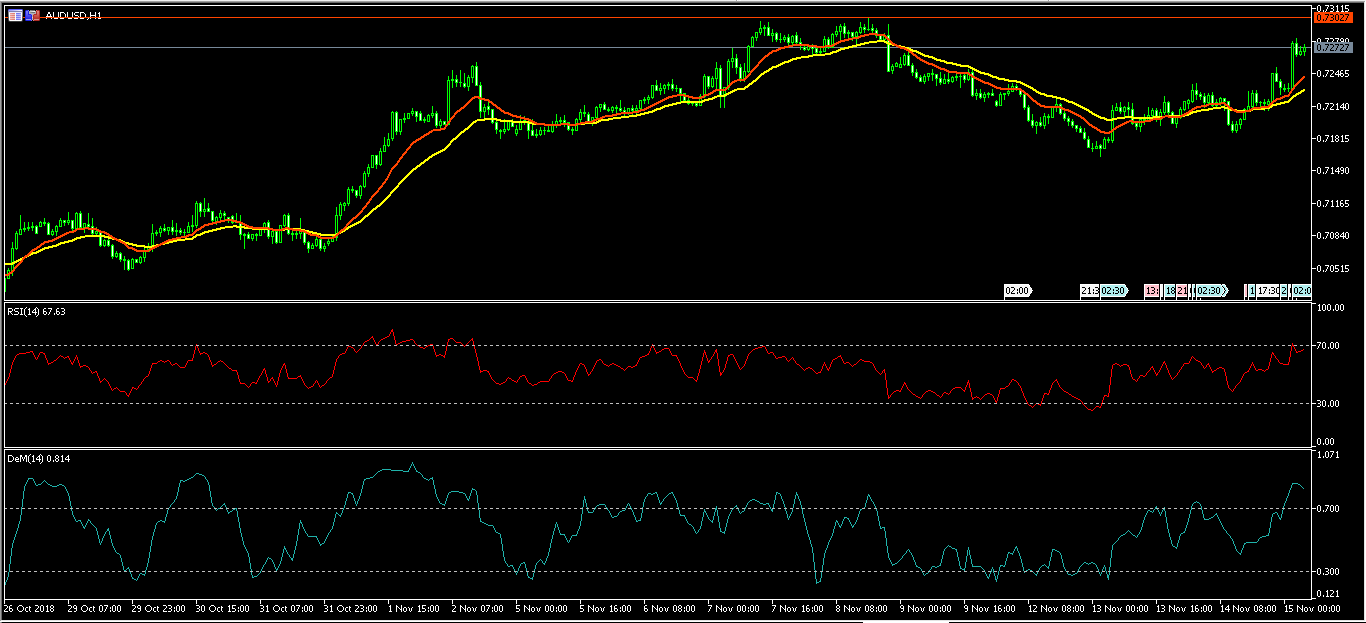
The AUD/USD pair rose sharply to an intraday high of 0.7280. This was the highest it has been since October 8. It was also a continuation of the upward trend that started on Tuesday this week. The pair’s short-term EMAs show that the upward trend could continue. This is confirmed by the RSI, which is at 67 and the Demarker indicator. More upward movements will likely take the pair to test the 0.7300 level.
EUR/USD
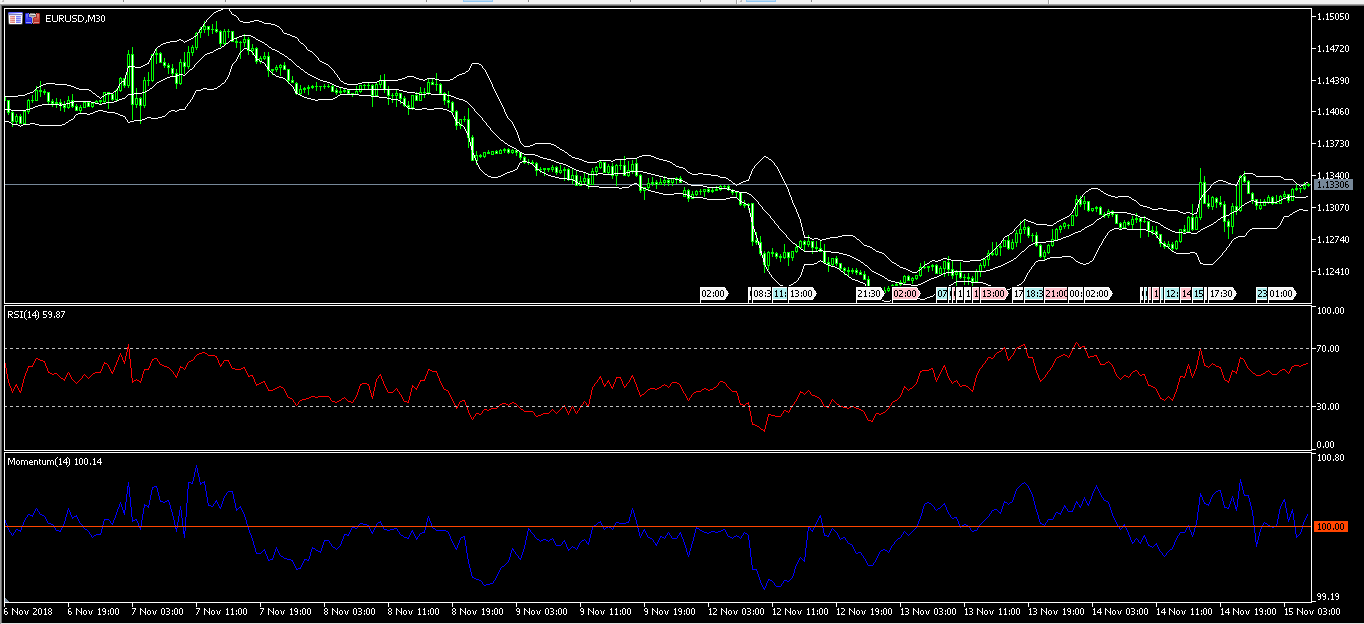
The EUR/USD made small gains in the Asian session as traders waited for the important retail sales data from the US. On the 30-minute chart, the pair’s price was along the upper band of the Bollinger Bands. The RSI was largely unmoved at around the 59 level while the momentum indicator moved slightly above the 100 level. The pair will likely continue moving up to test the 1.1350 level.
XBR/USD
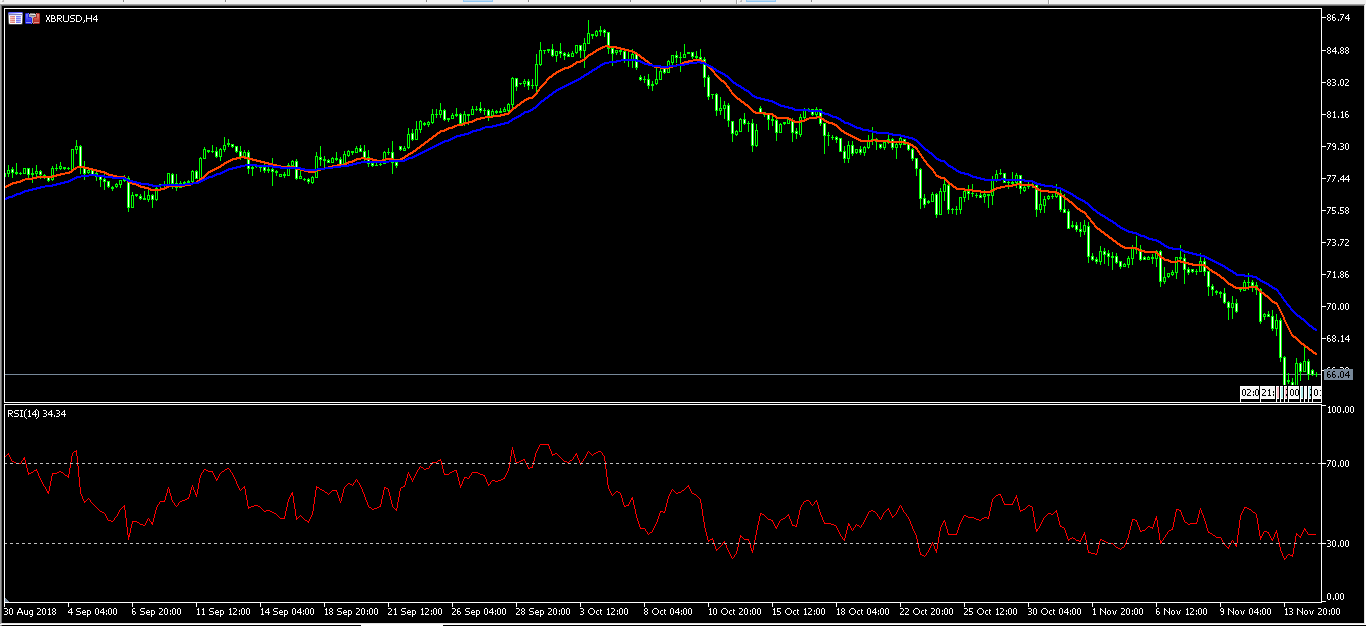
Yesterday, the price of Brent moved higher slightly. Overnight, the XBR/USD pair resumed the decline and reached a low of 66. This was close to the previous low of 65. On the four-hour chart, the pair’s double EMA show no signs of a reversal, which is an indication that it could continue the downward trend. This is confirmed by the MACD and the RSI as shown below. There is a likelihood that the pair will continue moving lower to below 65.
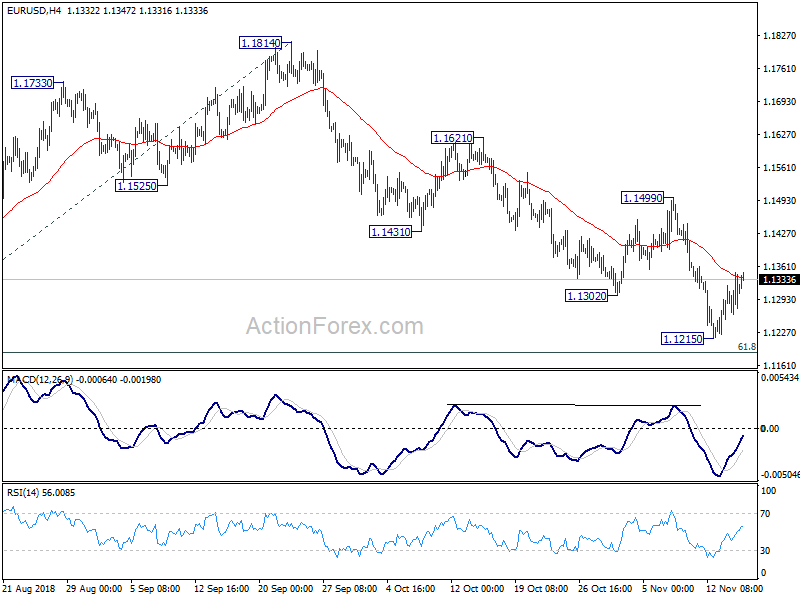
EUR/USD Daily Outlook
Daily Pivots: (S1) 1.1266; (P) 1.1306; (R1) 1.1350; More.....
EUR/USD is staying in consolidation above 1.1215 temporary low and intraday bias remains neutral first. Upside of recovery should be limited below 1.1499 resistance to bring fall resumption. On the downside, break of 1.1214 will target 1.1186 fibonacci level first. Break will target 61.8% projection of 1.2555 to 1.1300 from 1.1814 at 1.1038 next.
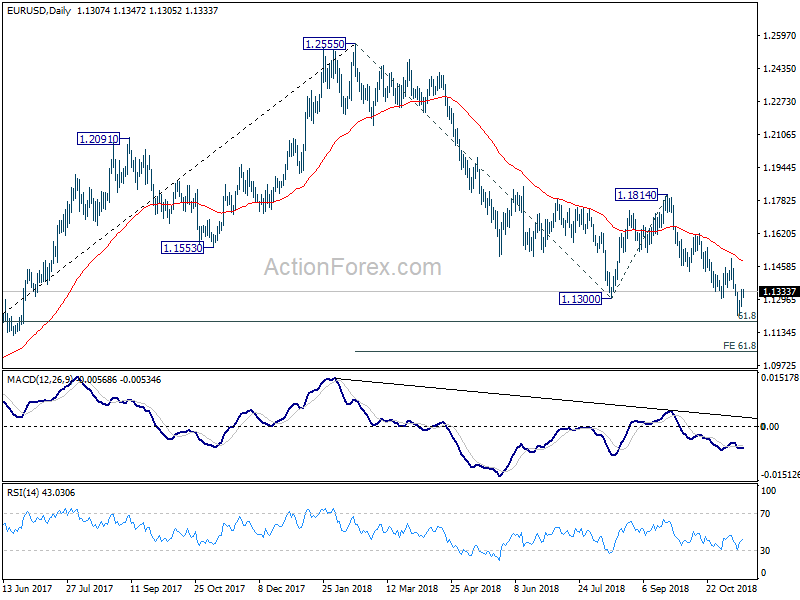
In the bigger picture, down trend from 1.2555 medium term top has just resumed and should target 61.8% retracement of 1.0339 (2017 low) to 1.2555 at 1.1186 next. Sustained break there will pave the way to retest 1.0339. On the upside, break of 1.1814 resistance is now needed to confirm medium term bottoming. Otherwise, outlook will stay bearish in case of recovery.
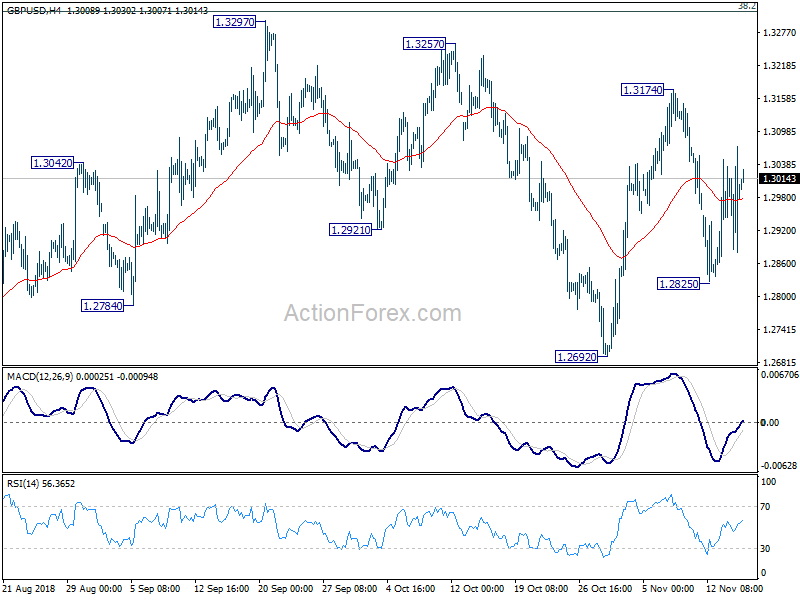
GBP/USD Daily Outlook
Daily Pivots: (S1) 1.2888; (P) 1.2980; (R1) 1.3081; More...
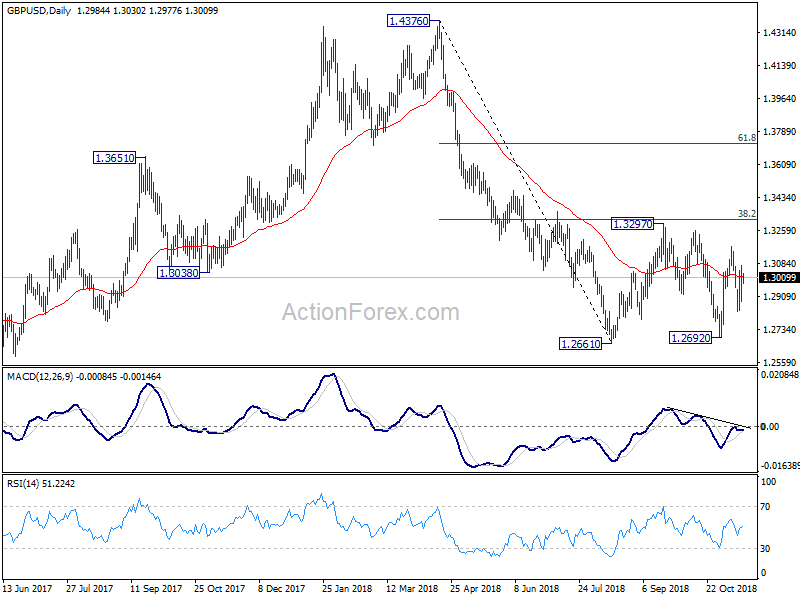
Intraday bias in GBP/USD remains neutral at this point. Overall outlook is unchanged that price actions from 1.2661 are viewed as a consolidation pattern. In case of stronger rise, strong resistance should be seen at 1.3316 fibonacci level to limit upside to bring down trend resumption eventually. On the downside, below 1.2825 will resume the fall from 1.3174 to 1.2661/92 key support zone. Decisive break there will resume larger down trend from 1.4376.
In the bigger picture, whole medium term rebound from 1.1946 (2016 low) should have completed at 1.4376 already, after rejection from 55 month EMA. The structure and momentum of the fall from 1.4376 argues that it's resuming long term down trend. And this will be the preferred case as long as 38.2% retracement of 1.4376 to 1.2661 at 1.3316 holds. However, firm break of 1.3316 would bring stronger rebound to 61.8% retracement at 1.3721. And, the eventual depth of the fall from 1.4376, and the chance of hitting 1.1946 low, will depend on the strength of the interim corrective rebound from 1.2661.
USD/CHF Daily Outlook
Daily Pivots: (S1) 1.0034; (P) 1.0069; (R1) 1.0097; More...
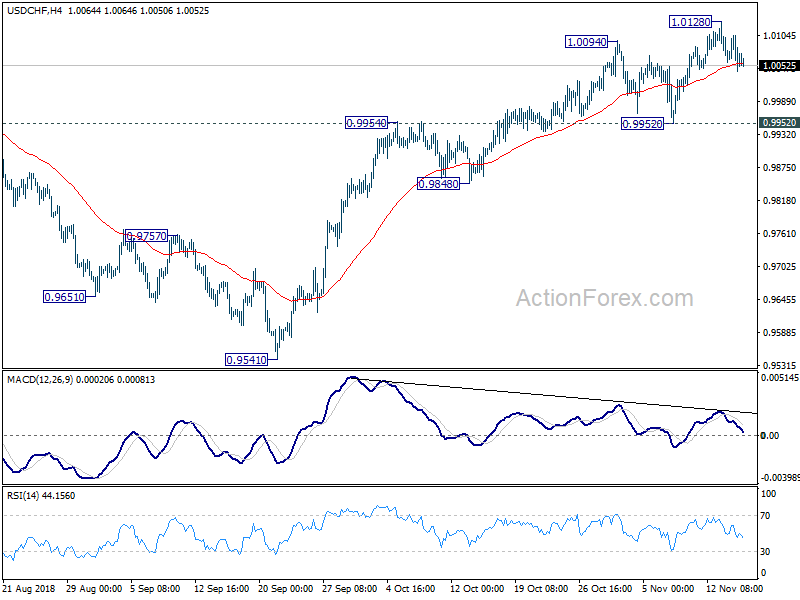
USD/CHF is staying in consolidation from 1.0128 temporary top and intraday bias remains neutral first. Another rally is expected as long as 0.9952 support holds. On the upside, break of 1.0128 would resume larger rise from 0.9186 and target 1.0342 key resistance. However, firm break of 0.9952 will indicate short term topping and bring deeper fall.
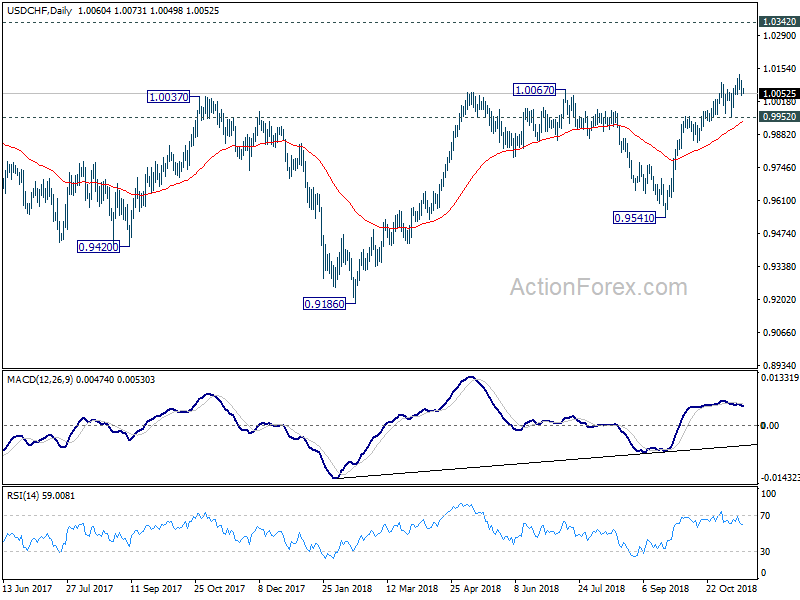
In the bigger picture, the pullback from 1.0067 has completed at 0.9541 already. And rise from 0.9186 is likely resuming. Firm break of 1.0067 will pave the way to retest 1.0342 key resistance. We'd be cautious on strong resistance from there to limit upside to bring another medium term fall to extend long term range trading. However, firm break of 0.9848 near term support will dampen this view and bring deeper decline back to 0.9541 support and possibly below.
Plenty Of Uncertainty Dominates The Markets
Market movers today
There is pressure on European financial markets given the weak economic growth data from Germany, Brexit and the budget clash between Italy and the EU.
Yesterday, PM Theresa May got support for her Brexit deal from the cabinet as expected. She said it was a 'collective' not a 'unanimous' decision, suggesting that some ministers were against the deal.
Today, there is a string of US data due - US retail sales that have been robust for a long time on the back of a strong labour market and tax cuts earlier this year. We expect it to stay decent as household fundamentals are still strong. The two regional surveys, Empire Index and Philadelphia Fed, will give the first indication of manufacturing confidence in October. Recently, ISM manufacturing has softened and in line with consensus, we expect surveys to moderate further from the quite high levels reached earlier this year. Initial jobless claims and import prices are also due for release today.
In Scandi, Swedish unemployment and the Norwegian trade balance are being released.
Selected market news
PM Theresa May got support for her Brexit deal from the Cabinet, but it was not a 'unanimous' decision, suggesting that some ministers were against it. The real test is still whether it can pass the House of Commons, where a vote is expected in mid-December.
Markets are still uncertain, which was reflected in the modest move in GBP yesterday. Hence, we need more confirmation on the deal before we can see GBP strengthening.
Asian equity markets were also mixed this morning after a slide in US equity markets late yesterday. The negative reaction in the US equity markets was due to Fed Chair Powell indicating that the recent volatility in the markets would NOT change US monetary policy in a Q&A session very late yesterday evening.
He indicated that equity market volatility was only one of many factors that the Fed was considering when setting rates. His comments also confirmed the expectations of a December hike from the Fed.
USD/JPY Daily Outlook
Daily Pivots: (S1) 113.28; (P) 113.64; (R1) 114.00; More..
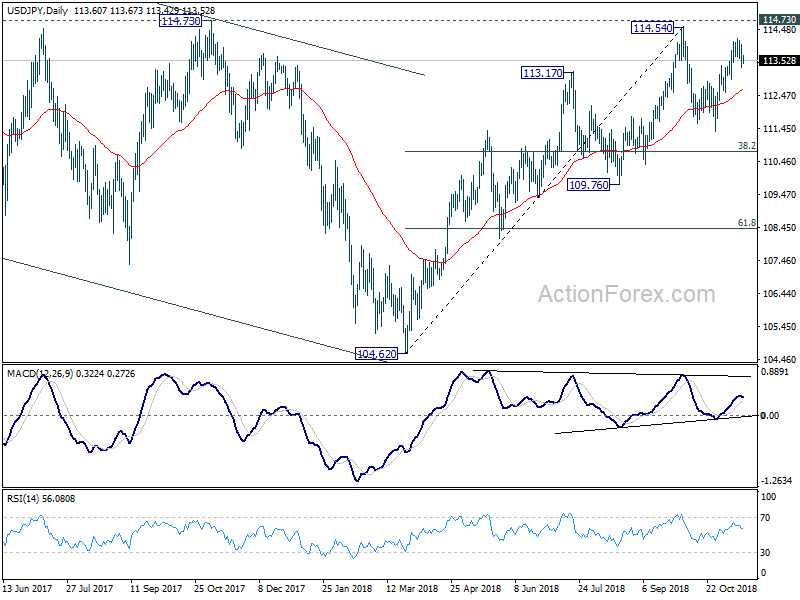
Intraday bias in USD/JPY is neutral for moment. Due to loss of upside momentum as seen in 4 hour MACD, in case of another rise, upside should be limited by 114.54/73 zone to bring reversal. On the downside, break of 112.94 minor support will extend the consolidation pattern from 114.54 with another falling leg back to 111.37. Overall, rise from 104.62 is still in progress and decisive break of 114.73 will confirm resumption.
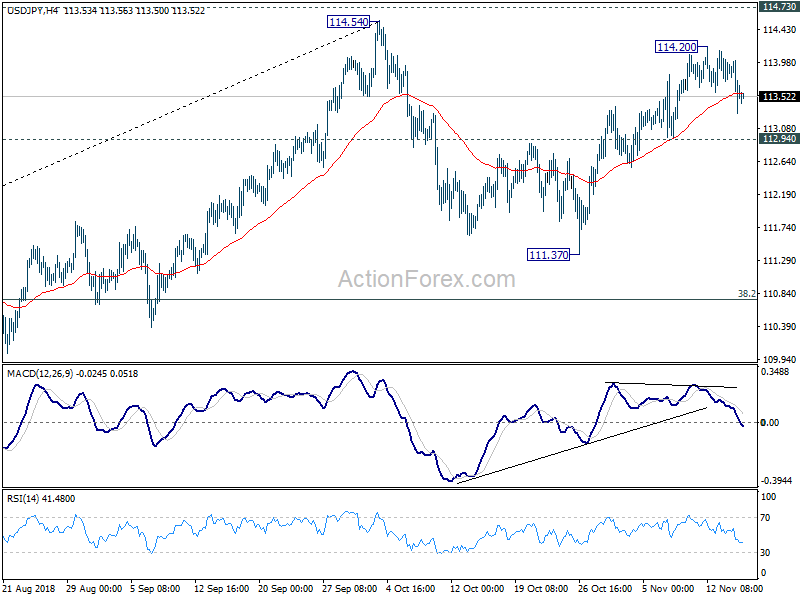
In the bigger picture, corrective fall from 118.65 (2016 high) should have completed with three waves down to 104.62. Decisive break of 114.73 resistance will likely resume whole rally from 98.97 (2016 low) to 100% projection of 98.97 to 118.65 from 104.62 at 124.30, which is reasonably close to 125.85 (2015 high). This will stay as the preferred case as long as 109.76 support holds. However, decisive break of 109.76 will dampen this bullish view and turns outlook mixed again.
Brexit Monitor: Cabinet Not Unanimously Behind May While Brexiteers Are Discussing Whether To Try And Challenge Her
Key dates
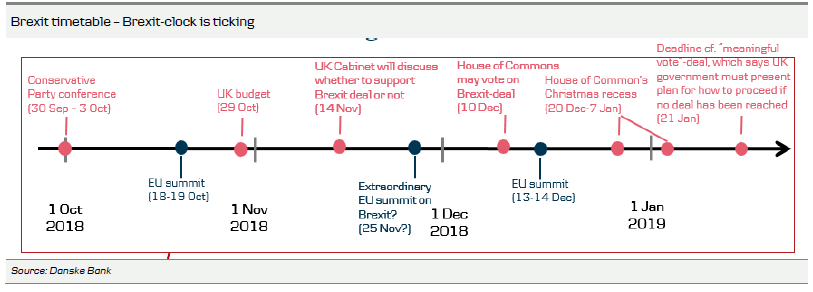
- Today (14 November): UK Cabinet meets to discuss Brexit deal at 3pm. Will the Cabinet support the deal?
- 25 November (not confirmed): Extraordinary EU summit on Brexit. Deal to be signed (assuming Cabinet says yes)
- 10 December (not confirmed): Possible date for House of Commons vote on Brexit agreement
- 13-14 December: EU summit 20 December to 7 January: House of Commons recess due to Christmas
As expected, PM Theresa May got support for her Brexit deal from the Cabinet. While this was expected, given what the media reported beforehand, it seems like it was not as easy as we had expected. Theresa May said it was a “collective” not a “unanimous” decision, suggesting that some ministers were against. The BBC reports as many as nine ministers probably argued against the deal. Also, we cannot rule out resignations from the Cabinet either already today or over the coming days.
The withdrawal text has also been released (see link (pdf)) and the full deal is nearly 600 pages long with only a few pages for the political declaration on the future relationship, saying that the UK and the EU want a close relationship going forward. According to Bloomberg, the UK and the EU will recognise each other’s financial regulations, so some sort of equivalence, which the EU cannot pull out of overnight. However, banks would still lose a financial passport to the EU’s internal market for financial services.
As anticipated, there will be a review mechanism, which before 1 July 2020 needs to determine whether an agreement on a permanent deal can avoid activating the backstop. Otherwise, the options are to either activate the UK-wide backstop (the UK stays in the customs union [called a single customs territory, see Article 6] including “level playing field” conditions and Northern Ireland obeying many single market rules; the European Court of Justice will continue to have jurisdiction in the UK in certain areas) or extend the transition period for an unspecified period of time (Articles 3 and 132). The UK cannot decide this itself, both sides need to agree. Also, if the UK wants to leave the customs backstop, it needs to be a joint decision with the EU (something the Brexiteers, even the softer ones, have been very critical towards). The UK can notify the EU that it thinks the backstop is no longer needed (Article 20) and the UK and the EU would discuss it at a meeting held no longer than six months afterwards. Still, the Withdrawal Agreement says that the aim is still to sort things out in a permanent deal and that the intention of the withdrawal deal is that it should “only apply temporarily”.
We still expect it to be smooth sailing for the EU leaders to give their consent to the deal when the extraordinary EU summit on Brexit takes place likely on 25 November. The real test is still whether it can pass the UK House of Commons. A date is expected to be held in mid-December (10 December has been reported).
The problem for Theresa May is that both hardliners, Theresa May’s supporting party DUP, the Labour leadership (see The Guardian), LibDems and the Scottish National Party have said they are voting against the deal. That means PM Theresa May needs support not only from the moderate Conservatives but also some Labour MPs. May will probably tell them that it is this deal or nothing, so the strategy is that the Labour MPs would fear a “no deal” Brexit scenario so much that they will vote in favour of her deal.
While markets think it was positive that PM Theresa May got support from the Cabinet, markets are still not getting overexcited just yet. One reason is that it seems like the hardliners in the Conservative Party may try to challenge Theresa May as party leader (requires 15% or 48 Conservative MPs to send a no confidence letter to trigger a no confidence vote). If they succeed in finding 48 Conservatives, the Conservative MPs would vote in a no confidence vote (simple majority). If she loses, the Conservative Party needs to find a new leader, which is probably going to take time, meaning the EU may have to extend the Article 50 deadline on 29 March 2019. The problems for the hardliners are 1) are there enough to mount a challenge to her? 2) Are they risking a second referendum (remember ‘the remain’ camp has tailwind in the opinion polls at the moment)?
Another reason why the GBP movement was limited was that the Cabinet support was expected and the real test is whether it can pass the House of Commons.
When we get more clarification in either direction, we expect to see bigger movements in GBP and until then GBP will stay volatile. We forecast 0.84 in 3M assuming the deal passes.