

Sample Category Title
UK’s ILO Unemployment Rate Surprisingly Advanced In The Three Months Ended September
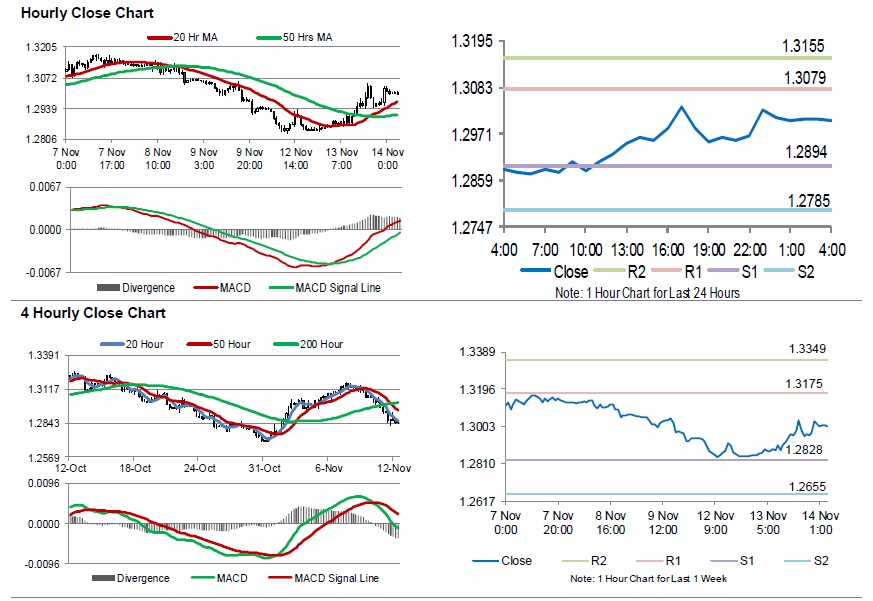
For the 24 hours to 23:00 GMT, the GBP rose 1.37% against the USD and closed at 1.3028, amid optimism over a Brexit deal.
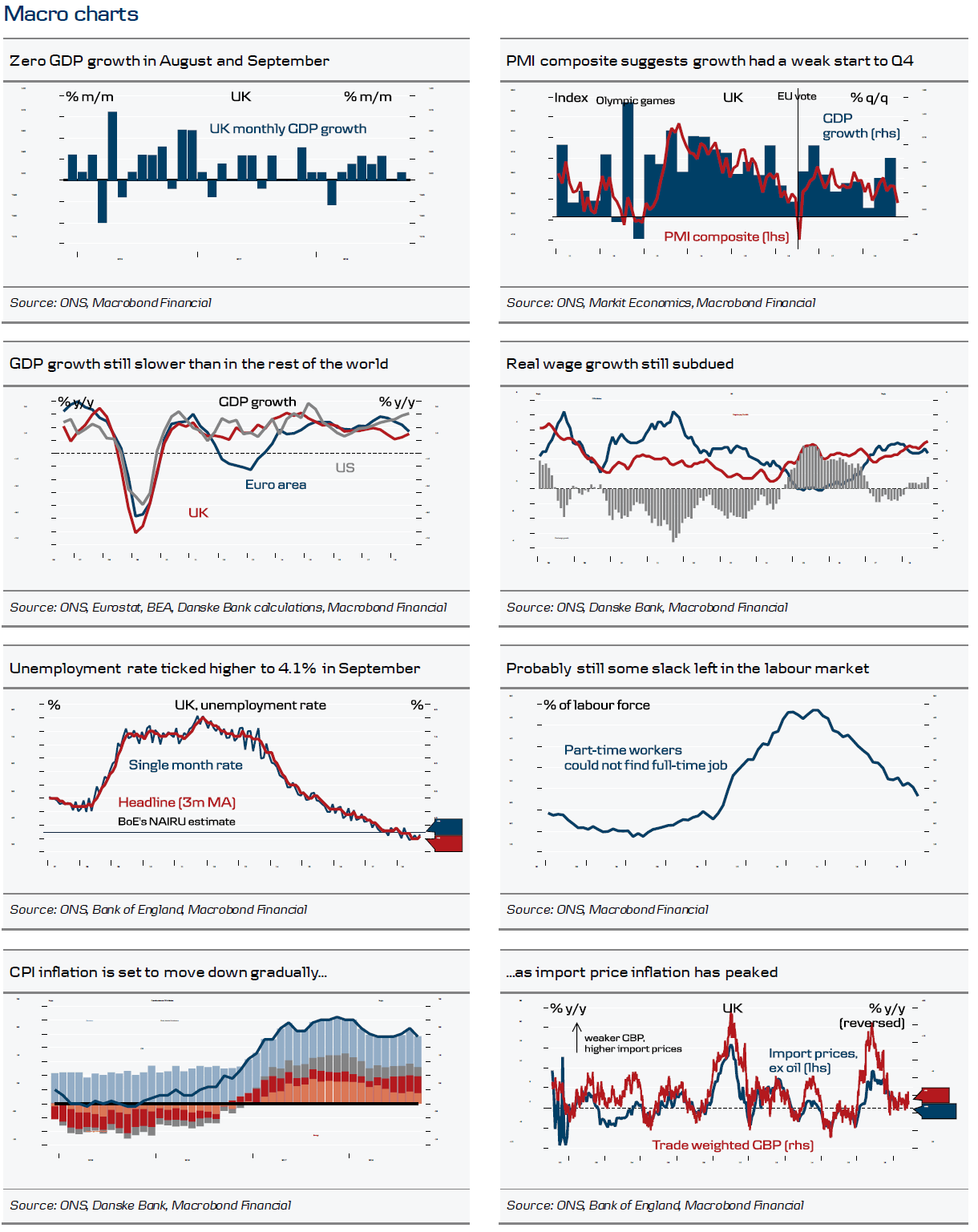
Data indicated that the UK's ILO unemployment rate unexpectedly climbed to 4.1% in the three months ended September 2018, compared to a reading of 4.0% in June-August 2018. Market participants had envisaged the unemployment rate to record a steady reading. Meanwhile, the nation's average earnings including bonus rose 3.0% on an annual basis in July-September 2018, in line with market expectations and compared to a revised advance of 2.8% in the June-August 2018.
In the Asian session, at GMT0400, the pair is trading at 1.3002, with the GBP trading 0.20% lower against the USD from yesterday's close.
The pair is expected to find support at 1.2894, and a fall through could take it to the next support level of 1.2785. The pair is expected to find its first resistance at 1.3079, and a rise through could take it to the next resistance level of 1.3155.
Looking ahead, investors would closely monitor UK's consumer price index, retail price index and producer price index, all for October, along with the house price index for September, slated to release in a few hours.
The currency pair is trading above its 20 Hr and 50 Hr moving averages.
Japan’s GDP Contracted In The 3Q 2018
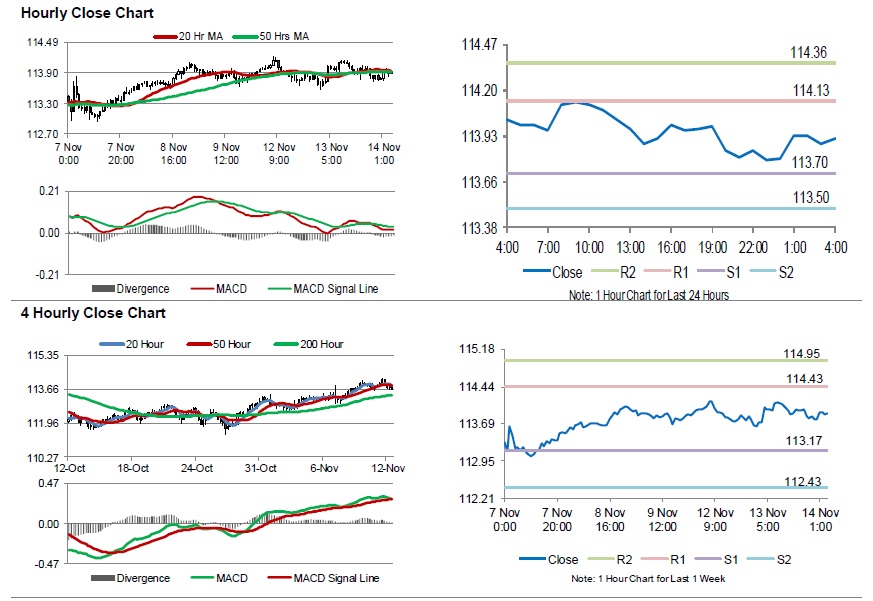
For the 24 hours to 23:00 GMT, the USD slightly declined against the JPY and closed at 113.78.
In the Asian session, at GMT0400, the pair is trading at 113.91, with the USD trading 0.11% higher against the JPY from yesterday's close.
Overnight data indicated that Japan's flash annualised gross domestic product (GDP) retreated 1.2% on a quarterly annual basis in 3Q 2018, as natural disasters hindered the exports and consumption. In the previous quarter, the GDP had recorded a rise of 3.0%, while market participants had expected for a drop of 1.0%. Additionally, the nation's final industrial production dipped 2.5% on a yearly basis in September, compared to a drop of 2.9% in the previous month.
The pair is expected to find support at 113.70, and a fall through could take it to the next support level of 113.50. The pair is expected to find its first resistance at 114.13, and a rise through could take it to the next resistance level of 114.36.
The currency pair is showing convergence with its 20 Hr and 50 Hr moving averages.
Swiss Franc Trading A Tad Lower In The Asian Session
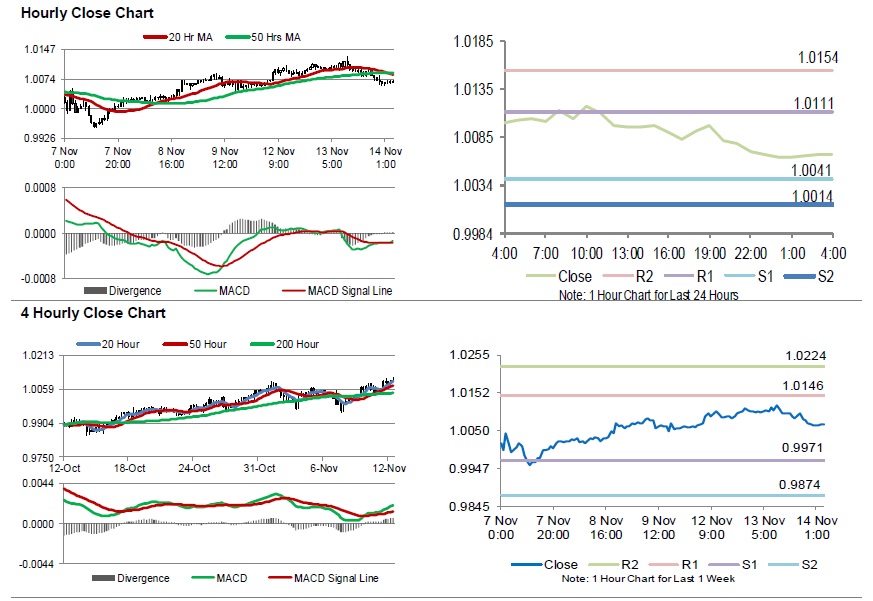
For the 24 hours to 23:00 GMT, the USD declined 0.38% against the CHF and closed at 1.0066.
On the macro front, Switzerland’s producer and import price index advanced 2.3% on an annual basis in October, compared to a climb of 2.6% in the prior month. Market participants had anticipated the index to gain 2.2%.
In the Asian session, at GMT0400, the pair is trading at 1.0067, with the USD trading slightly higher against the CHF from yesterday’s close.
The pair is expected to find support at 1.0041, and a fall through could take it to the next support level of 1.0014. The pair is expected to find its first resistance at 1.0111, and a rise through could take it to the next resistance level of 1.0154.
With no macroeconomic releases in Switzerland today, investors would look forward to global macroeconomic releases for further directions.
The currency pair is trading below its 20 Hr and 50 Hr moving averages.
Loonie Trading Slightly Lower In The Morning Session
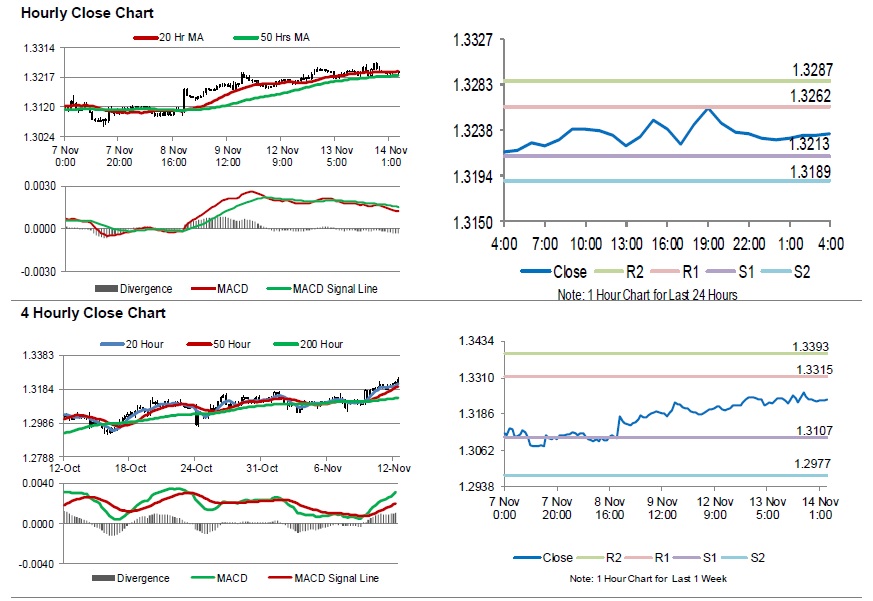
For the 24 hours to 23:00 GMT, the USD declined 0.08% against the CAD and closed at 1.3231.
In the Asian session, at GMT0400, the pair is trading at 1.3236, with the USD trading marginally higher against the CAD from yesterday’s close.
The pair is expected to find support at 1.3213, and a fall through could take it to the next support level of 1.3189. The pair is expected to find its first resistance at 1.3262, and a rise through could take it to the next resistance level of 1.3287.
Amid no major macroeconomic releases in Canada today, investors would focus on global macroeconomic factors for further cues.
The currency pair is showing convergence with its 20 Hr and 50 Hr moving averages.
Australia’s Westpac Consumer Confidence Index Rose In October
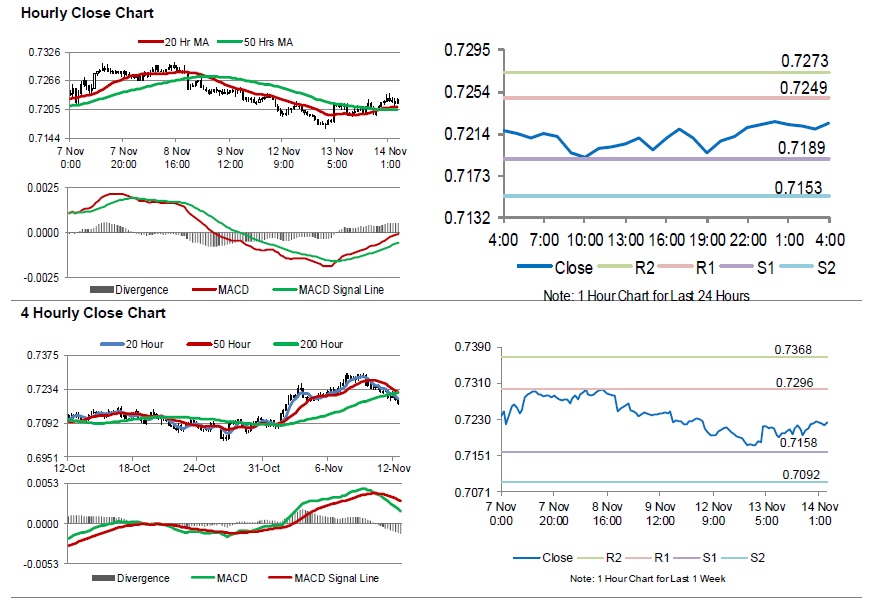
For the 24 hours to 23:00 GMT, the AUD rose 0.64% against the USD and closed at 0.7222.
LME Copper prices rose 0.8% or $46.5/MT to $6130.0/MT. Aluminium prices declined 0.5% or $9.0/MT to $1925.0/MT.
In the Asian session, at GMT0400, the pair is trading at 0.7224, with the AUD trading a tad higher against the USD from yesterday's close.
Overnight data revealed that Australia's Westpac consumer confidence index jumped 2.8% on monthly basis to a level of 104.3 in November, following a level of 101.5 in the prior month.
Elsewhere in China, Australia's largest trading partner, industrial production rose 5.9% on an annual basis in October, compared to a gain of 5.8% in the preceding month. Market participants had anticipated industrial production to advance 5.8%. Moreover, the nation's retail sales rose 8.6% on an annual basis in October, compared to an advance of 9.2% in the prior month. Market had expected retail sales to climb 9.2%.
The pair is expected to find support at 0.7189, and a fall through could take it to the next support level of 0.7153. The pair is expected to find its first resistance at 0.7249, and a rise through could take it to the next resistance level of 0.7273.
Trading trend in the Aussie today is expected to be determined by Australia's unemployment rate for October, set to release overnight.
The currency pair is trading above its 20 Hr and 50 Hr moving averages.
Gold: Yellow Metal Trading On A Stronger Footing This Morning
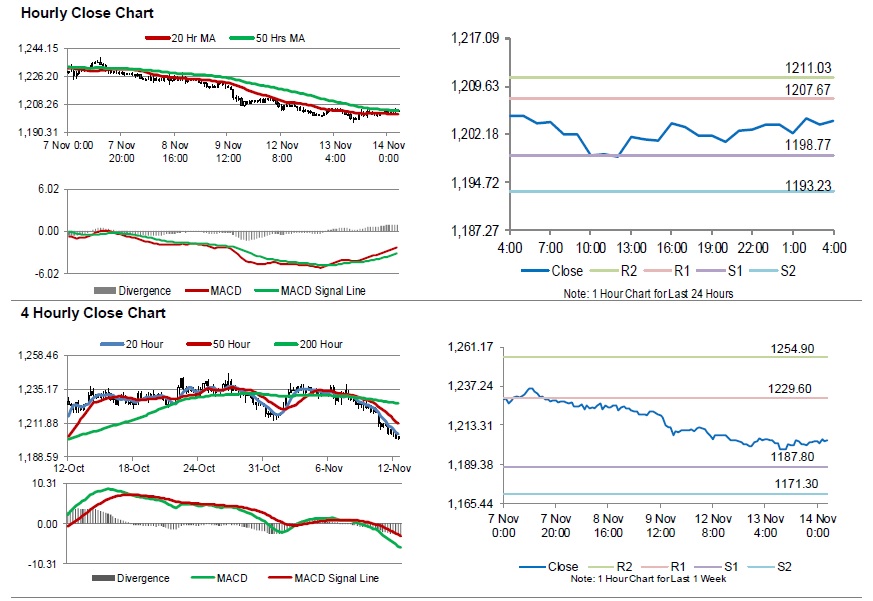
For the 24 hours to 23:00 GMT, Gold rose 0.17% against the USD and closed at USD1202.80 per ounce, amid weakness in US equities.
In the Asian session, at GMT0400, the pair is trading at 1204.30, with gold trading 0.12% higher against the USD from yesterday’s close.
The pair is expected to find support at 1198.77, and a fall through could take it to the next support level of 1193.23. The pair is expected to find its first resistance at 1207.67, and a rise through could take it to the next resistance level of 1211.03.
The yellow metal is trading above its 20 Hr moving average and showing convergence with its 50 Hr moving average.
Silver: White Metal Extends Its Gains In The Asian Session
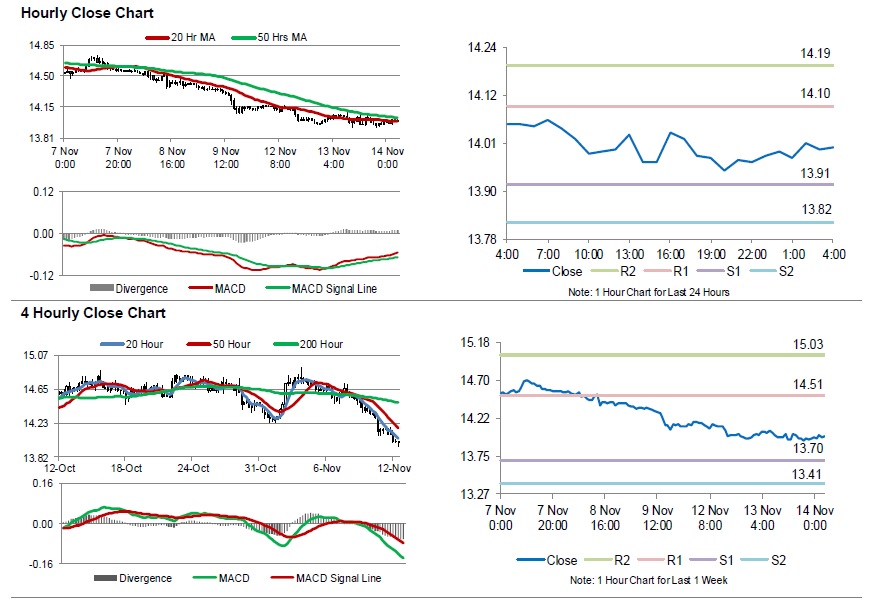
For the 24 hours to 23:00 GMT, Silver rose 0.07% against the USD and closed at USD13.98 per ounce, tracking gains in gold prices.
In the Asian session, at GMT0400, the pair is trading at 14.00, with silver trading 0.14% higher against the USD from yesterday’s close.
The pair is expected to find support at 13.91, and a fall through could take it to the next support level of 13.82. The pair is expected to find its first resistance at 14.09, and a rise through could take it to the next resistance level of 14.19.
The white metal is showing convergence with its 20 Hr moving average and trading below its 50 Hr moving average.
Crude Oil: Oil Reverses Its Losses In The Morning Session
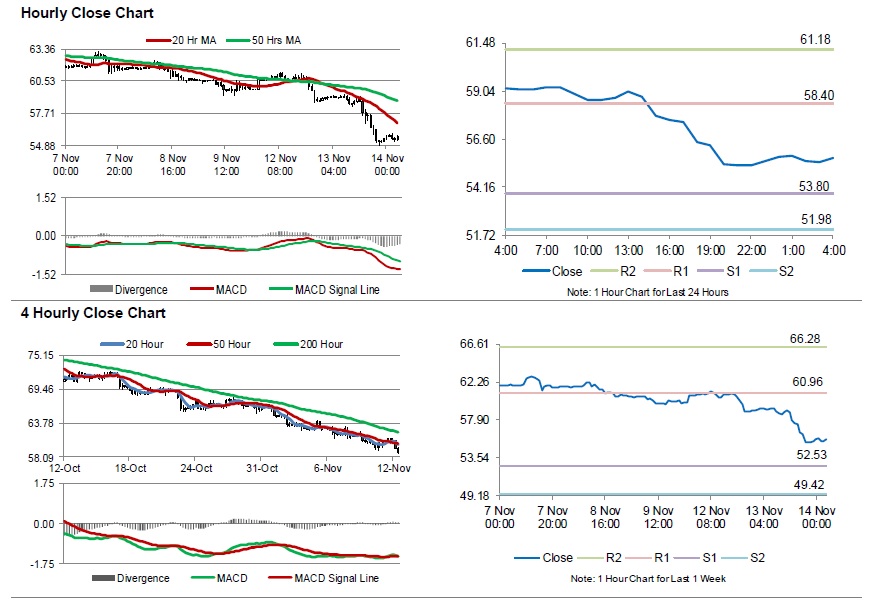
For the 24 hours to 23:00 GMT, Crude Oil declined 5.73% against the USD and closed at USD55.49 per barrel, led by weak prospects for global economic growth and declining demand for oil.
In the Asian session, at GMT0400, the pair is trading at 55.63, with oil trading 0.25% higher against the USD from yesterday’s close.
The pair is expected to find support at 53.80, and a fall through could take it to the next support level of 51.98. The pair is expected to find its first resistance at 58.40, and a rise through could take it to the next resistance level of 61.18.
Crude oil is trading below its 20 Hr and 50 Hr moving averages.
Brexit Monitor: The Real Test Is The Vote In The House Of Commons
Key dates
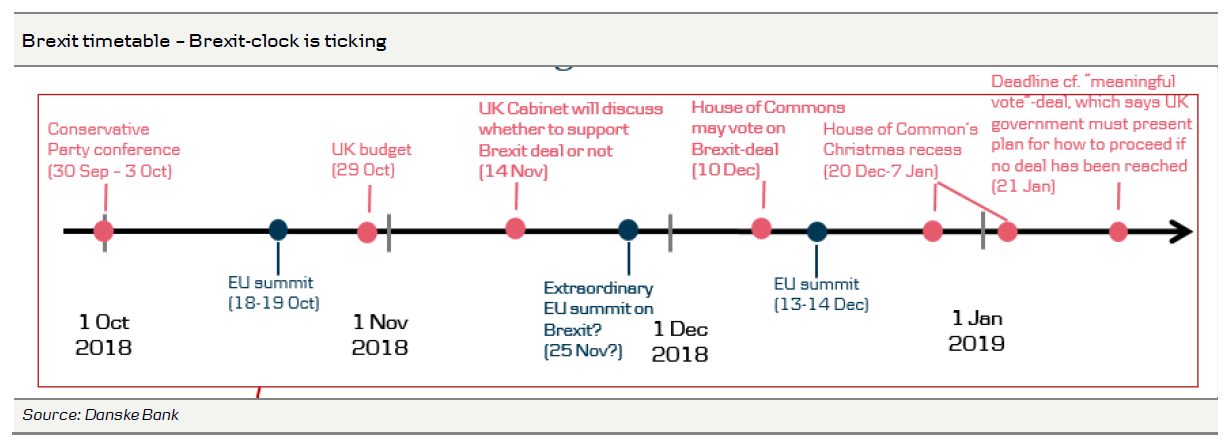
- Today (14 November): UK Cabinet meets to discuss Brexit deal at 3pm. Will the Cabinet support the deal?
- 25 November: Extraordinary EU summit on Brexit. Deal to be signed (assuming Cabinet says yes)
- 10 December: Possible date before House of Commons vote on Brexit agreement
- 13-14 December: EU summit
- 20 December to 7 January: House of Commons recess due to Christmas
Key questions
- What does the backstop look like? Can the UK leave the Customs Union unilaterally?
- Can Theresa May’s Cabinet support the deal?
- Will EU politicians/leaders support the deal?
- Will the deal survive a vote in the House of Commons? Can PM Theresa May persuade the Labour MPs to vote in favour of the deal?
- What about the political declaration on the future relationship?
According to media reports, PM Theresa May and the EU have reached a (technical) agreement on the UK’s withdrawal from the EU. The market responded accordingly by strengthening the GBP and EUR/GBP fell to 0.866 but later recovered back above 0.87. We had not expected PM Theresa May would be able to pull it off this week given she has been under heavy fire from all sides of British politics, so this is a positive development. We still do not know the exact content of the deal but, according to media reports, the backstop will be UK-wide although Northern Ireland has to stay aligned with most EU single-market rules.
The UK Cabinet will meet today at 15:00 CET to discuss the draft text and whether it can support it or not. Also, the EU ambassadors meet with the EU’s chief negotiator Michel Barnier to have a look at the text. While we think it is smooth sailing for the EU to agree on the text, it is more difficult to say how the UK Cabinet will react. Many ministers have been very clear that they cannot say yes to a withdrawal agreement where the UK is not able to leave the EU customs union unilaterally (see The Guardian for a full list of which ministers may resign over the deal). They fear such an arrangement would leave the UK inside the customs union forever, making them unable to make free trade deals with other countries. Media reports suggest that the deal includes a review/exit mechanism but not the details of how it looks. It will also be interestingto see whether the deal includes an option to extend the transition period beyond 31 December 2020, an idea which was floated last month. We also do not know at this point whether the deal includes a ‘backstop to the backstop’ (EU’s demand), which, however, seems likely if the UK is, in one way or another, to leave the UK-wide backstop. As we mentioned in our latest Brexit monitor, this is also the impression one gets from the letter PM Theresa May sent last week to DUP leader Foster.
If both the UK Cabinet and the EU say yes to the deal, the EU will most likely call for an extraordinary Brexit summit later this month (25 November has been suggested),where the EU leaders will give their approval. However, as we argued in the previous monitor, we think the real test was not whether PM Theresa May could sign a deal with the EU, but whether it can pass the UK House of Commons. We have to listen closely to statements from different political parties (and not least different wings of the parties) and top politicians. Leading Brexiteer Boris Johnson has already said he will vote against the deal, as he argues it will make the UK a vassel state, see Daily Mail. Jacob Regg-Moss has done the same. Brexit hardliners voting against the deal are probably at least 25 persons but could easily be more. In a letter (Twitter), the DUP’s leader Arlene Foster has stated the deal will weaken the Union and is not in the national interest.
The fact that we do not knowthe responses from the UK Cabinet, EU leaders and not least whether a majority in the House of Commons can support the deal explains why the GBP strengthening was only to a limited extent. This also means that the renewed Brexit optimism may fade again in the very near term, sending EUR/GBP higher. GBP is likely set to stay volatile.
Besides the support from moderate Conservatives, PM Theresa May probably needs support from Labour MPs to pass the deal. The question is whether she can persuade enough of them? Every vote counts and the best strategy is probably what PM Theresa May has already tried to do: telling the hard Brexiteers that by not voting in favour of the deal it may very well end up that Brexit never happens at all and telling the remainers and soft Brexiteers that the alternative is the bad ‘no deal’ Brexit scenario. The Conservative Chief Whip has said he is “confident” there will be a majority in the House of Commons. Most political analysts are having a hard time seeing the deal getting through the House of Commons at the moment, but let’s see in the next couple of weeks whether momentum may shift. The date for the vote in the House of Commons has been suggestedto be 10 December, assuming the Cabinet gives its approval.
When we get more clarification that there is support for the deal – and again, most importantly whether it has support in the House of Commons – the GBP should appreciate more. We forecast EUR/GBP in 0.84 in 3M. For more, see Corporate Hedger: Strong November could turn to cold December for GBP, 13 November.
Another interesting thing to look out for is the political declaration on the future relationship, which we have not heard much about due to the discussions on the backstop. How concrete and precise is it? Or are the details limited? Or have they not really started discussing the future framework? The more vague and weak the political declaration is, the more difficult it will be to sell the Brexit deal to the lawmakers. The problem is that while the withdrawal agreement will be hundreds of pages, the political declaration will probably be very short. The negotiations will continue during the transition period running from 30 March 2019 to 31 December 2020. If no permanent agreement is found, the backstop proposal will come into force. The problem is that two years is not a long time to negotiate despite that the UK and the EU would start from a different starting point than other negotiations, as everything is already aligned to begin with.
Japan GDP contracted -0.3% qoq, exports contracted at fastest pace in over three years
Japan GDP contracted -0.3% qoq in Q3, matched expectation. Annualized rate showed -1.2% contraction, worse than expectation of -1.0%. GDP deflator dropped -0.3%, lowest than expectation of -0.2%. One detail to note is that exports contracted -1.8% qoq, fastest decline in over three years. It seems that the contraction in Q3 cannot be explained only by natural disasters. But the steep contraction in exports argued that US related trade tensions was also weighing on the economy of Japan. Though, it will take another quarter or two to really gauge the impact from protectionism.
Japan Economy Toshimitsu Motegi sounded confident and optimistic though. He said that "Japan's economy is expected to recover driven mainly by domestic demand. Though he also warned that "we need to be vigilant to the impact of overseas uncertainties, financial market volatility and how trade problems affect the global economy."
Also from Japan, tertiary industry index dropped -1.1% mom in September versus expectation of -0.4% mom. Industrial production dropped -0.4% mom versus expectation of -1.1% mom.