Sample Category Title
Market Morning Briefing: Pound Is Trading In The Middle Of The Broad 1.2700-1.3150 Range
STOCKS
While acknowledging chances of near-term dip over the last couple of days, we have been reluctant to be long-term bearish yet. As it turns out, most Indices have respected the Supports we mentioned yesterday. We see hints of bullishness in India, but China, Germany and USA may have to do some more hard work to put the Bears to rest. Else, one more decline to either re-test old lows or establish new lows (in Shanghai) may have to be kept in mind
The Nikkei (21864, +0.25%) trades higher today after it bounced from an intra-day low of 21484.65 yesterday, just a tad below our Support at 21500. Now that the Support has held, there is increased chance of a rise past 21900-22000, which could be bullish.
There is a lot of market concern about slow-down in China. Although the Shanghai (2642, -0.49%) did well to move up to 2666 yesterday, it trades a little lower again today. It needs to break above 2700 in order to acquire proper bullishness else it might be vulnerable to a fresh decline towards 2500 (if not lower) in the medium/long term. Staying above 2600 in the near-term will help the Bullish-possibility.
As hoped, the Nifty (10582.50, +100.30, +0.96%) found Buyers above 10400 yesterday. Should it now manage to rise past 10650 over the course of this week (chances are decently good while above 10400) it may well move up to 10900-11000 over the next couple of weeks. Beware important Resistance at that level, though.
While the DAX (11472, +1.30%) did well yesterday to remain well above the mentioned Support at 11300 and even move up 1.30%, it needs to be rise past 11500-600 to beat back the Bears. Else, while below 11500, it may remain vulnerable to a near-term decline towards 11051.
The Dow (25286, -0.40%) dipped to a low of 25194 yesterday. We still need to see whether the Support at 25250-000 holds or not. we prefer a bounce, but let us see.
COMMODITIES
News that Trump urged OPEC and Saudi Arabia to maintain their current policy of gradually increasing output and the OPEC’s monthly report stating a lower demand growth forecast for 2019 pulled down crude prices further yesterday.
While the crude prices are clearly in the bear zone, Brent (65.10) is almost at the 65 level, mentioned yesterday. Further fall from here looks less likely just now. Below 65, downside could be capped at 62. Preference is for a bounce from support levels near 65.0-64.5 back towards 70 in the medium term.
WTI (55.33) has broken below support at 60. Only a bounce in Brent could pull up WTI back to higher levels; else a fall towards 52-50 could be possible.
Gold (1204.30) is almost stable and trading near levels seen yesterday. Immediate support near 1200 is likely to hold and produce a bounce back towards 1225 or higher in the medium term. While above 1200, view is bullish.
Copper (2.6810) has moved up a bit. While above support at 2.65, the price is likely to move up towards 2.75-80 as mentioned yesterday. A break below 2.65, if seen could take the price down to lower support at 2.60. In the next few sessions copper may trade sideways above 2.65.
FOREX
Decline in Dollar Index has lead to some recovery in most of the currencies. Also the Emerging currencies could see some strength against the US Dollar today, boosted by the sharp decline in the crude prices.
Dollar Index (97.07) has come off from daily resistance as expected. There is scope for a fall towards 96.5-96.0 in the near term. View is bearish for the next few sessions.
Euro (1.1298) moved up from levels near 1.12 itself without attempting to test 1.11. While correction in Dollar Index is seen in the near term, we could possibly see some recovery in Euro too with a slight bounce towards 1.1350. In that case, a possible fall towards 1.11 could be delayed.
USD/JPY (113.88) is stuck in the 113.5-114.3 region and could see some ranged trade within this zone for a couple of sessions more. It has recovered by rising back to levels above 113.75, negating a fall towards 113 just now.
Aussie (0.7218) has also bounced from support near 0.7175-0.7150 mentioned yesterday and could move up towards 0.73 again in the near term. But note the 21-Week MA on the weekly line chart which needs to break on the upside to initiate further upmove in the medium term.
Pound (1.3004) is trading in the middle of the broad 1.2700-1.3150 range; both being important support and resistances for the near term. A break above 1.3050 could take it higher towards 1.3150; else a fall from 1.3050 could push back the pair towards 1.28-1.27 in the coming week.
EUR/JPY (128.70) is also stuck within the 129.50-127.50 region both being immediate resistance and support level. The current bounce could take it higher towards 129.50 which is a decent resistance and could push back the prices towards support at 127.5.
Fall in Dollar Index and a sharp decline in Brent could lead to a gap down opening for USDINR (72.6750) pushing the pair down towards 72.30/20. A break below 72.20, if seen could open up further downside chances of testing 71.80. Watch price action if a break below 72.20 is seen.
INTEREST RATES
US Yields were stable/ up by 1bp across the Curve yesterday. Although we talked about a dip to 3.10% on the 10Yr (currently 3.15%) yesterday, we also see good Supports at 2.86% on the 2Yr (currently 2.90%), at 3.10-05% on the 10Yr and at 3.30% on the 30Yr (currently 3.36%). These are likely to hold on first testing and can produce a bounce that lasts up to the FOMC meeting in December, possibly along with a bounce in Brent towards 70 in the near term.
In India, the 10Yr GOI (7.76%) could be on the verge of breaking below 7.75% or might see a near-term rise towards 7.90% before it comes down again. The longer term picture may call for 7.60% while below 7.90%.
EU Malmstrom: If US auto tariffs were to happen, that would not be on EU
The US Commerce Department has submitted the draft recommendations regarding Section 232 national security tariffs on autos to the White House this week. The recommendations were discussed at a regular weekly meeting of Trump's top trade officials yesterday. So far, no immediate action is taken by Trump.
At the same time, EU Trade Commissioner Cecilia Malmstrom will meet US Trade Representative Robert Lighthizer on Wednesday to carry on trade negotiations. Ahead of that, she said "We assume that if that (U.S. auto tariffs) were to happen, that would not be for the European Union,". She referred to the agreement between Trump and European Commission President Jean-Claude Juncker that auto tariffs won't apply to the EU when negotiations are still on going. Malmstrom also reiterated that the scope of the EU-US trade deal will be "limited" to industrial goods. She emphasized "be very clear, it will not include agriculture."
Juncker said earlier this week that "we had achieved that there will not be a new trade conflict over the summer months until the end of the year, particularly with regard to car tariffs."
UK and EU agreed Brexit texts, May to hold Cabinet meeting today
The UK and EU have finally agreed on the texts of the Brexit withdrawal agreement after intensive work this week. UK Prime Minister Theresa May's office confirmed and said "Cabinet will meet at 2:00pm tomorrow to consider the draft agreement the negotiating teams have reached in Brussels, and to decide on next steps." And, "Cabinet ministers have been invited to read documentation ahead of that meeting". Approval by the Cabinet will just make the deadline for holding a special EU summit by the end of November for the issue.
It's reported that the agree will adopt a UK-wide customs backstop aimed preventing a hard Irish border. It's so far unsure how much support May could get from her Cabinet. Boris Johnson and Jacob Rees-Mogg have already voiced objection to the draft agreement immediately. Johnson said the plan was "utterly unacceptable to anyone who believes in democracy" and he would vote against it. Rees-Mogg warned that UK would become a "vassal state" with Northern Ireland "being ruled from Dublin". And Mogg added "It is a failure of the government's negotiating position and a failure to deliver on Brexit".
On the other hand, it's reported that five senior ministers Dominic Raab, Jeremy Hunt, Sajid Javid, Michael Gove and Geoffrey Cox will back the Brexit deal.
Gold Price Slides Below Key Support, US CPI Next
Key Highlights
- Gold price failed to surpass the $1,240 resistance and declined against the US Dollar.
- There was a break below a major bullish trend line with support at $1,224 on the 4-hours chart of XAU/USD.
- The UK ILO Unemployment Rate increased from the last reading of 4.0% to 4.1%.
- Today, the US Consumer Price Index for Oct 2018 will be released, which is forecasted to increase 0.3% (MoM).
Gold Price Technical Analysis
There were many attempts by buyers to push gold price above the $1,240 resistance this month against the US Dollar, but they failed. As a result, the price declined sharply and moved below the $1,220 support.
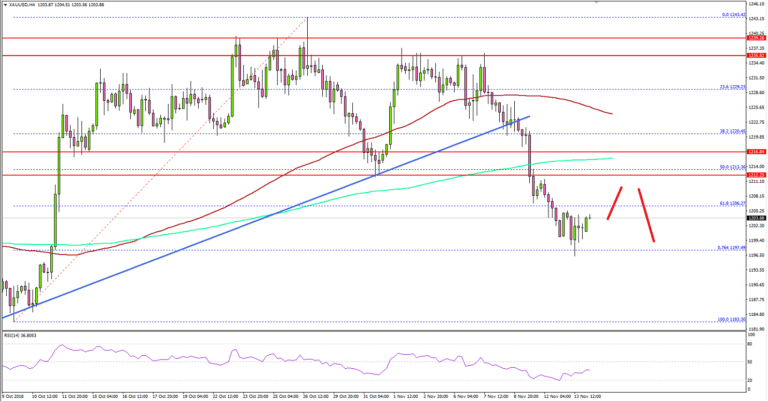
The 4-hour chart of XAU/USD indicates that the price declined below a few important supports recently such as $1,222, $1,220, $1,212 and $1,208. The price even broke the 50% Fib retracement level of the last wave from the $1,183 low to $1,243 high.
More importantly, there was a close below the $1,212 support and the 100 simple moving average (red, 4-hours). It opened the doors for more losses and the price tested the 76.4% Fib retracement level of the last wave from the $1,183 low to $1,243 high.
Clearly, the price moved into a bearish zone below $1,212 and a major bullish trend line with support at $1,224. If sellers remain in control, the price could slide further towards the $1,188 and 1,185 support levels.
On the flip side, if there is an upside correction, the previous supports at $1,208 and $1,212 are likely to prevent gains and act as hurdles for buyers.
Looking at major pairs, EUR/USD and GBP/USD recovered slightly during the past few sessions, but they both are still trading below important resistances (1.1350 and 1.3040 respectively).
Economic Releases to Watch Today
- German Gross Domestic Product for Q3 2018 (YoY) (Preliminary) – Forecast 1.3%, versus 2.3% previous.
- German Gross Domestic Product for Q3 2018 (QoQ) (Preliminary) – Forecast -0.1%, versus 0.5% previous.
- Euro Zone Gross Domestic Product Q3 2018 (QoQ) (Preliminary) – Forecast 0.2%, versus 0.2% previous.
- Euro Zone Gross Domestic Product Q3 2018 (YoY) (Preliminary) – Forecast 1.7%, versus 1.7% previous.
- UK Consumer Price Index Oct 2018 (YoY) – Forecast +2.0%, versus +1.9% previous.
- UK Core Consumer Price Index Oct 2018 (YoY) – Forecast +2.0%, versus +1.9% previous.
- US Consumer Price Index Oct 2018 (MoM) – Forecast +0.3%, versus +0.1% previous.
- US Consumer Price Index Oct 2018 (YoY) – Forecast +2.5%, versus +2.3% previous.
- US Consumer Price Index Ex Food & Energy March 2018 (YoY) – Forecast +2.2%, versus +2.2% previous.
There’s Significant Risk Ahead
US equities finished mostly lower after a and extremely intense session as oil prices were hammered mercilessly dragging the energy sector stocks into the abyss while any hope for resolution of the U.S.-China trade spat could remain little than a pipe dream given that there is no certainty China will buckle to US demands.
But it's going to be a bumpy ride for markets magnified by multiplex Brexit developments, sagging equities and of course 7% drop in oil but on the data front, CNY retail sales, CNY IP and USD's core CPI report will be Wednesday's headline events. All of which suggests significant risk beckons
Oil markets
Crude continues to extend its declines with US markets registering a 7 % drop overnight. Oil prices remain the hottest topic in capital markets if not in the world after extending their slide to 12 days and suffering one of the more precipitous falls in years.
It's all about the toxic combination of weakening global demand and oversupply that has sent prices tumbling. This week's initial catalyst was President Trump after tweeting oil prices “should be much lower based on supply” iBut taking their cues from sagging equity markets which are flashing red on global growth concerns, oil traders continued to pound oil prices lower suggesting this trend could extend.
Additionally, OPEC mentioned in their Monthly Oil Market Report, released yesterday, that they see demand for the cartel's crude declining at a more rapid pace than initially anticipated in 2019 (due to a slowing global economy)
While declining global PMI's are supporting a strong case for a desynchronized overall growth narrative, China's new yuan loans have dropped much more than expected in October, according to the PBoC, coming in at CNY697bn (vs 904bn expected). M2 Money supply increased by just 8.0% when it had been expected to rise to 8.4%MoM. But more significantly aggregate financing also dropped to CNY728.8bn (a big miss compared to the 1300bn expected) As per Bloomberg: “Aggregate financing includes bank lending, off-balance-sheet loans and bond and stock sales”. This print is a massive miss suggesting and validates the negative outlook for China in Q4.
This data is signalling much slower growth in China and by extension global growth, which likely attracted a plethora of cross-asset types to join the Oil selling frenzy. But when the hoard mentality sets in at either side of the equation, my experience tells me to look for a reversal.
On the supply side of the equation due to the U.S. holiday Monday, the weekly inventory reports will be a day later than usual with, the weekly API inventory report due Wed 16:30 Est with the official DOE numbers to be released on Thursday morning (11:00 EST). But both Bloomberg and Reuters surveys are suggesting crude stockpiles are expected to have increased yet again (3-3.5 million barrels) while reports also see Cushing inventories increasing some 2.5 million barrels.
On the heavily subscribed EIA Monthly Drilling Productivity Report as well as the IEA's World Energy Outlook for 2018. U.S. shale oil output to rise 113,000 barrels per day to 7.94 million barrels per day in December( Reuters) confirming that oil markets are during a shale oil supply shocker
Brexit
The Pound his heading up again this morning on positive Bloomberg headlines: *RAAB, HUNT, JAVID, GOVE AND COX TO BACK MAY'S BREXIT DRAFT: SUN.
In what could be a watershed moment, British and EU negotiators have finally agreed to one of the most contentious divorce battles in recent history.
China
Chinese shares rallied, the yuan strengthened slightly, and USD bulls tapped the brakes ahead of tonight CPI. But there were some USD haven reversals in play after the market is reacted positively to SCMP headlines reporting that Chinese Vice Premier Liu He will visit the US to set the stage for the Trump -Xi meeting at this months G20 in Argentina.
Although my pessimistic radar is sending off negative signals about this meeting, where there a will there is a way and provided discussion continue the market will continue to see the light at the end of the tunnel. But I'm still having trouble getting over yesterday China M2 disaster print, but maybe that will change if we see some positivity in China's data dump today.
G-10
It is a massive day for the dollar with US core CPI later today. Also, traders will be all ears on two key Fed speeches. The House Financial Services Committee plans to hear semi-annual testimony on banking supervision from Fed Vice Chairman for Supervision Quarles at 15:00 GMT/10:00 EST. While Fed Chairman Jerome Powell will also discuss national and global economic issues with Dallas Fed President Robert Kaplan at an event hosted at the Dallas Fed at 23:00 GMT/18:00 EST
Euro
The Euro has recovered from oversold conditions yesterday on a combination of profit taking amidst positive Brexit headlines. But I can't help but think this move is little more than a Brexit induced sympathy rally As EU data continues to underwhelm with German ZEW Current Situation missing at 58.2 vs 65.0 expectations. Italy will hold its 2019 deficit target at 2.4% (as expected) but also keep its GDP target at 1.5% But this response will ultimately fall short of being viewed as a viable solution.
Gold Markets
Gold is hanging around towards the lower end of the one-month range. But appetite remains muted even with US equity markets failing to regain composure and a slightly weaker USD. The lack of upside momentum suggests aggressive USD rally post US midterm election is having a negative impact on Gold demand.
Eco Data 11/14/18
[php_everywhere instance="1"]
Today’s top mover: GBP surges on Brexit hope, CAD dives as WTI oil free fall extends
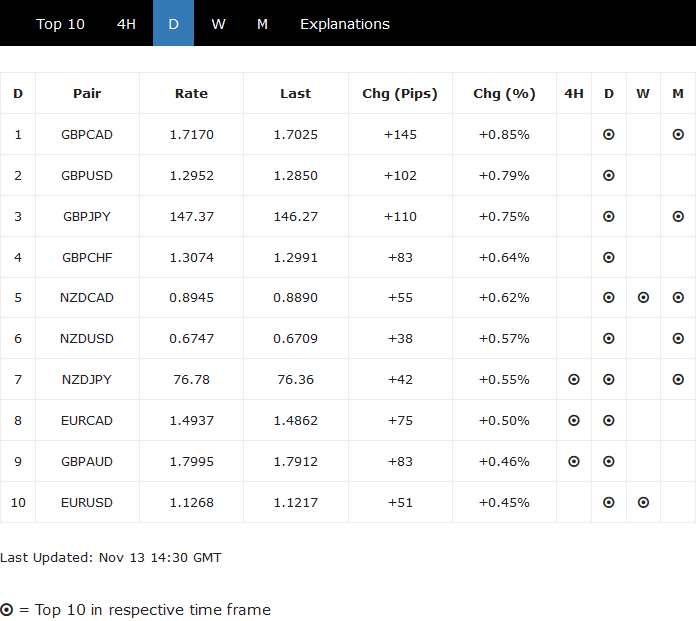
At the time of writing, GBP/CAD is the top mover for today. But it's very tight. Sterling is strongest for sure as boosted by Brexit optimism. The headlines flying around suggest that both UK and EU are working intensely to complete the withdrawal agreement, including the stick Irish backstop, within a day or two. That would give a green-light to hold an unscheduled EU summit to approve the deal later in November.
While there is no confirmation of any sort for the moment, at least, traders are betting on a positive outcome.
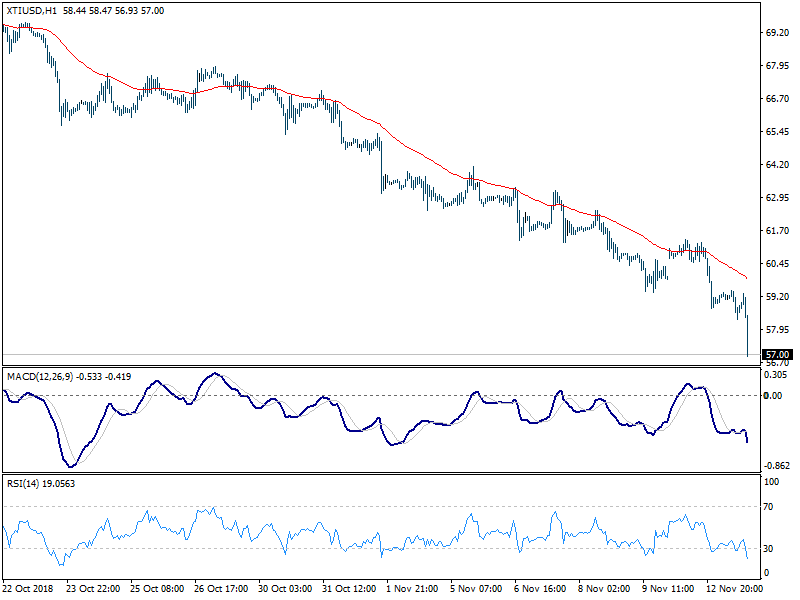
On the other hand, Canadian Dollar suffers renewed selling as oil price decline accelerates. WTI crude oil has now breached 57. The news of Saudi Arabia's export cut earlier this week just gave oil price a temporary lift.
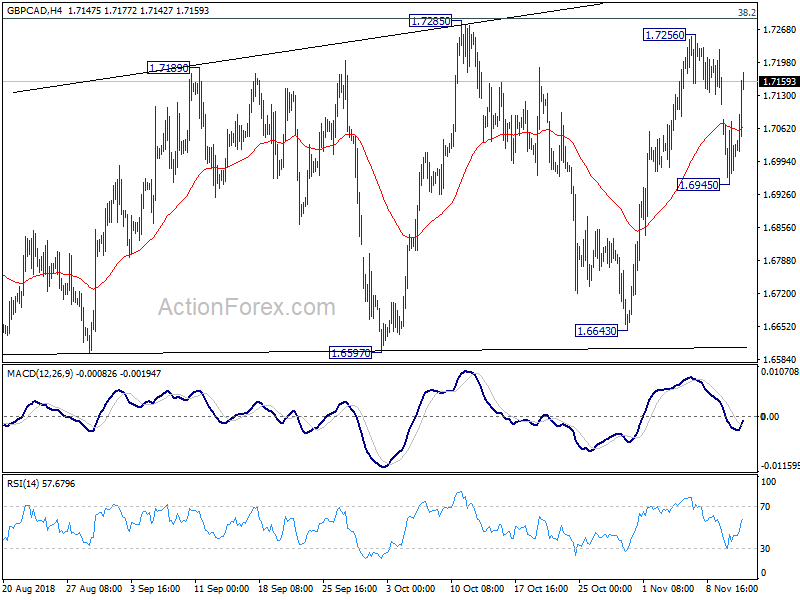
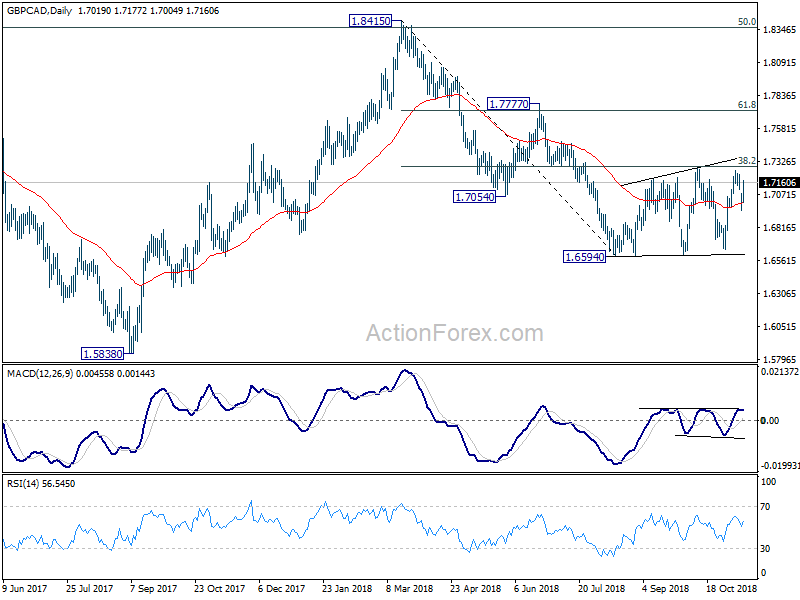
Take a look at GBP/CAD, the cross had two attempt to break through 1.6594 support in October but failed. This week's rebound off 55 day EMA is a bullish development. But for now, it's still holding in range of 1.6594/7285. So, we'd treat the current rebound as part of the consolidation pattern from 1.6594. That is, upside attempt would be limited by 38.2% retracement of 1.8415 to 1.6594 at 1.7290. Fall from 1.8415 is still expected to resume through 1.6594 low at a later stage. However, firm break of 1.7290 will invalidate out view and would at least bring further rise rise back to 61.8% retracement at 1.7719.
More Euro Underperformance in Store by Year-End?
Mostly euro-friendly election outcomes, at least in the eyes of investors, and economic data pointing to a strong pickup in economic activity were the factors that rendered the euro the best performing major currency in 2017. Specifically, the common currency advanced by 14.1% versus its US counterpart. This compares to the -6.1% so far in 2018, partially owed to the absence of the aforementioned euro-supportive drivers, something that also paves the way for further underperformance during the remainder of the year.
Eurozone & US: different growth stories
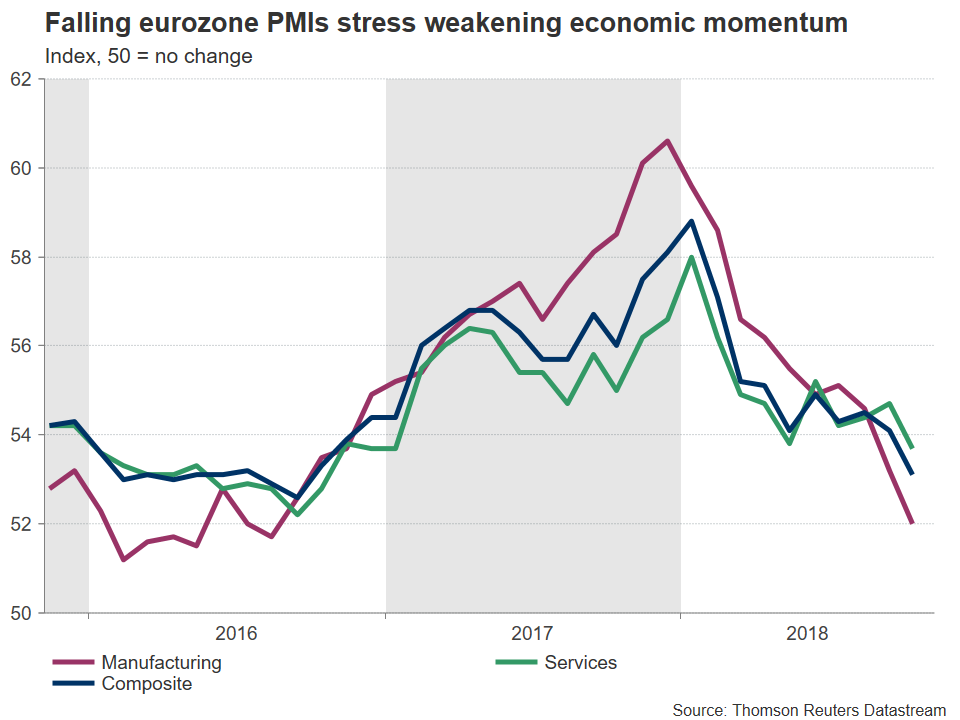
Eurozone PMIs have been on a declining path since late 2017 for manufacturing and early 2018 for the prints on services and the composite measure than blends the two sectors. Particularly, the composite PMI, which is also viewed as a good overall growth indicator for eurozone economies, has fallen to its lowest since September 2016 of 53.1 during October. On the upside, the measure remains in growth territory above 50. However, the retreat from January’s more-than-a-decade high of 58.8 is profound and clearly points towards slowing economic activity in the euro area. Relating to this, the freshly released forecasts by the European Commission make reference to 2018 eurozone GDP growth of 2.1%, which reflects a notable moderation from 2017’s decade high of 2.4%, while the Commission also projects further easing in the years ahead.
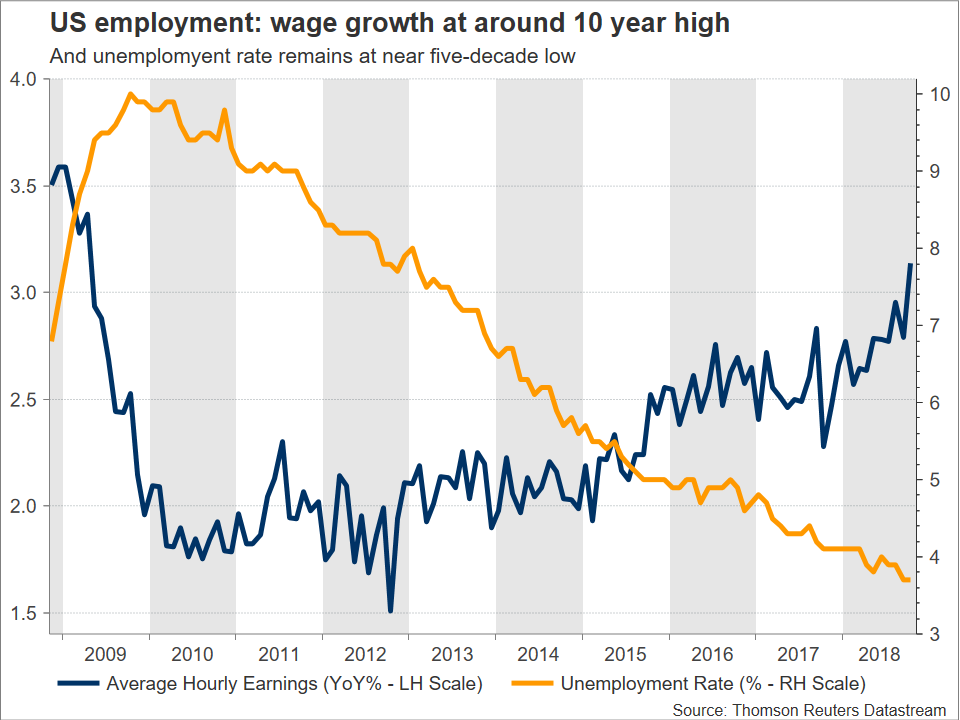
How does the world’s largest economy compare to the abovementioned? A contrast is at play: overall, US economic releases are pointing to a vibrant economy that is expanding at its fastest pace in years. Indicatively, key labor market data for October showed the unemployment rate holding at the near five-decade low of 3.7%, while wage growth, as gauged by average earnings, grew by 3.1% annually, its strongest in around ten years. (Yes, wage growth appears to be making a comeback in the US!) Economic growth differentials in the favor of the US are supportive of higher yield differentials again in the US’ favor, which in turn are dollar-positive.
Monetary policy divergence also supports case for stronger dollar
A divergence is also at play on the monetary policy front that again is advocating for a weakening euro/dollar pair as the year unfolds. Namely, the Fed remains firmly on track to continue normalizing rates. In September, the central bank delivered its eighth 25bps rate increase since it started its tightening cycle in late 2015. Additionally, it is expected to proceed with the ninth such hike in December and remain on a normalization path in 2019 as well. Comparing with the ECB: market-derived pricing at the moment suggests the Bank will deliver its very first post-crisis rate rise no earlier than Q4 2019. Additionally, there are growing fears that the soft patch of economic data out of the eurozone may force ECB policymakers to downgrade their growth projections at the Bank’s December meeting, something that may push even further back in time the beginning of rate increases.
As a bare minimum, the previous are acting in favor of a wider US-eurozone (using Germany as a proxy) yield spread in the short-end of the maturity spectrum, something which is typically associated with a firmer dollar relative to the euro.
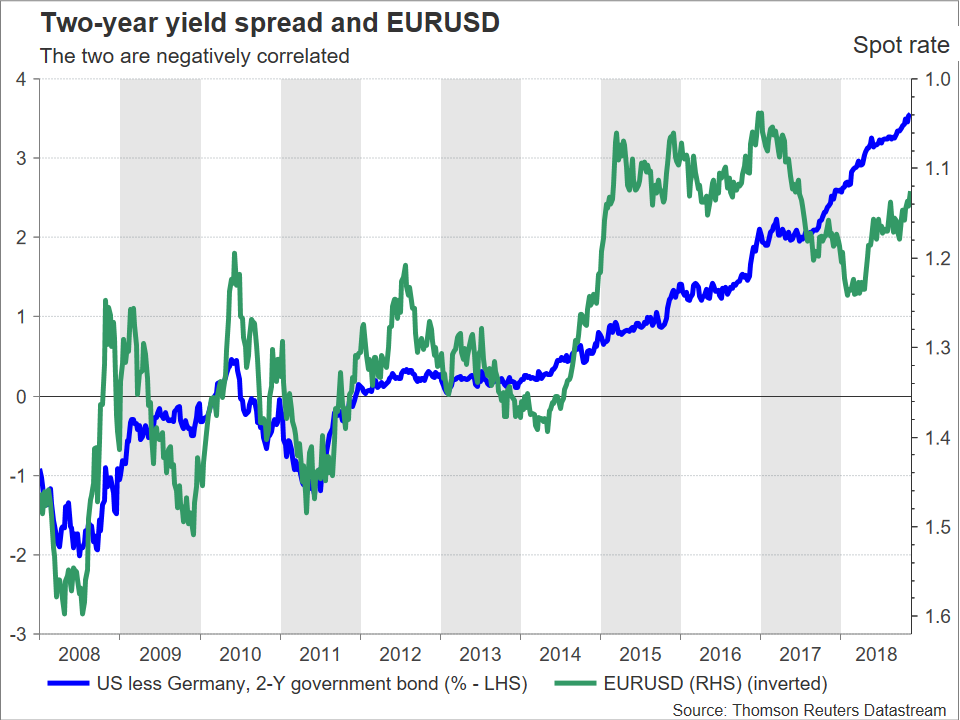
Icing on the cake: downside risks from Italy
Clouding the outlook for the euro even more, is the EU-Italy budget battle over the latter’s spending plans, which according to the European Commission deviate from the bloc’s fiscal rules. The Italian government faces a deadline on Tuesday (today) to revise its budget proposal. The country’s officials, though, seem unwilling to push forward a revision that would satisfy EU demands, something which could theoretically see Italy facing fines.
Proceeding with fines though is not the likely course of action on behalf of the EU, as that could close any window for a constructive discussion between the two sides. What should the markets expect then? It seems that this story still has room to run, with a “kick the can down the road” approach possibly emerging. (Can it be argued that the EU has a long history of kicking the can down the road on major issues?) This though could keep the euro hostage to headlines on the topic, putting a lid on gains from potentially upbeat prints out of the eurozone moving forward, as investor angst over Italy may limit bullish tendencies on the currency.
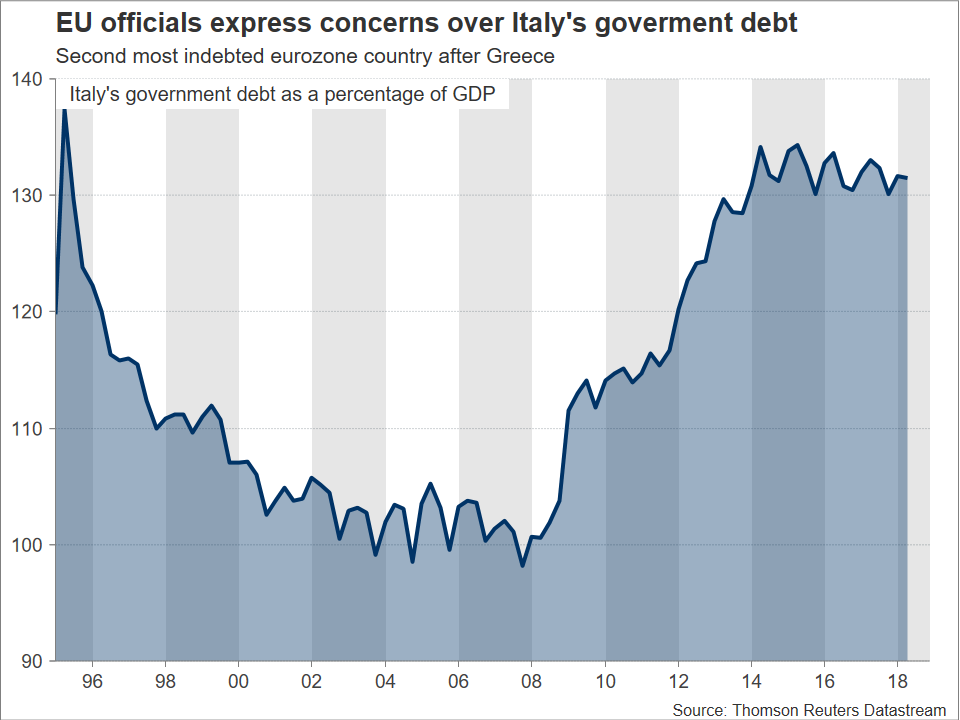
As a reminder, the fading of political risks was a theme that acted as a catalyst for the euro’s positive performance in 2017. Now that such risks are making a comeback, even posing existential threats to the eurozone, they’re haunting the single currency. Analogies to Greece come to mind. In this case though, it should also be kept in mind that Italy, unlike Greece, is “too big to fail”. The repercussions from an Italian crash would be destructive.
And the Italian saga is perhaps only the tip of the iceberg. Further muddying the outlook for the euro are the somewhat fragile government coalition in Germany, an evasive Brexit deal, and global trade tensions which have the capacity to hurt the common currency much more than the greenback. In fact, not only is the dollar not hurt by trade skirmishes, but it also attracts safe-haven flows, something which is likely to continue, at least by the end of the year – the current report’s forecasting period.
Conclusion and caveats in place
Taking everything into account, political and trade risks, a much more hawkish Fed compared to the ECB, in conjunction with a slowing eurozone economy that stands in contrast to booming activity on the other side of the Atlantic, are tilting the outlook for euro/dollar to the downside by the end of 2018. For the record, futures markets’ short positions on the euro are currently the most bearish since March 2017.
However, there are some caveats in place that could see the single currency posting sizable gains instead. A Brexit deal for example is likely to see EURUSD edging higher together with GBPUSD, as the two are highly positively correlated lately; EURGBP though is expected to depreciate under such a scenario. Also, a relief rally would most probably be in store should the Italian story close in a manner that is seen as removing euro area uncertainty.
Technical picture for EURUSD
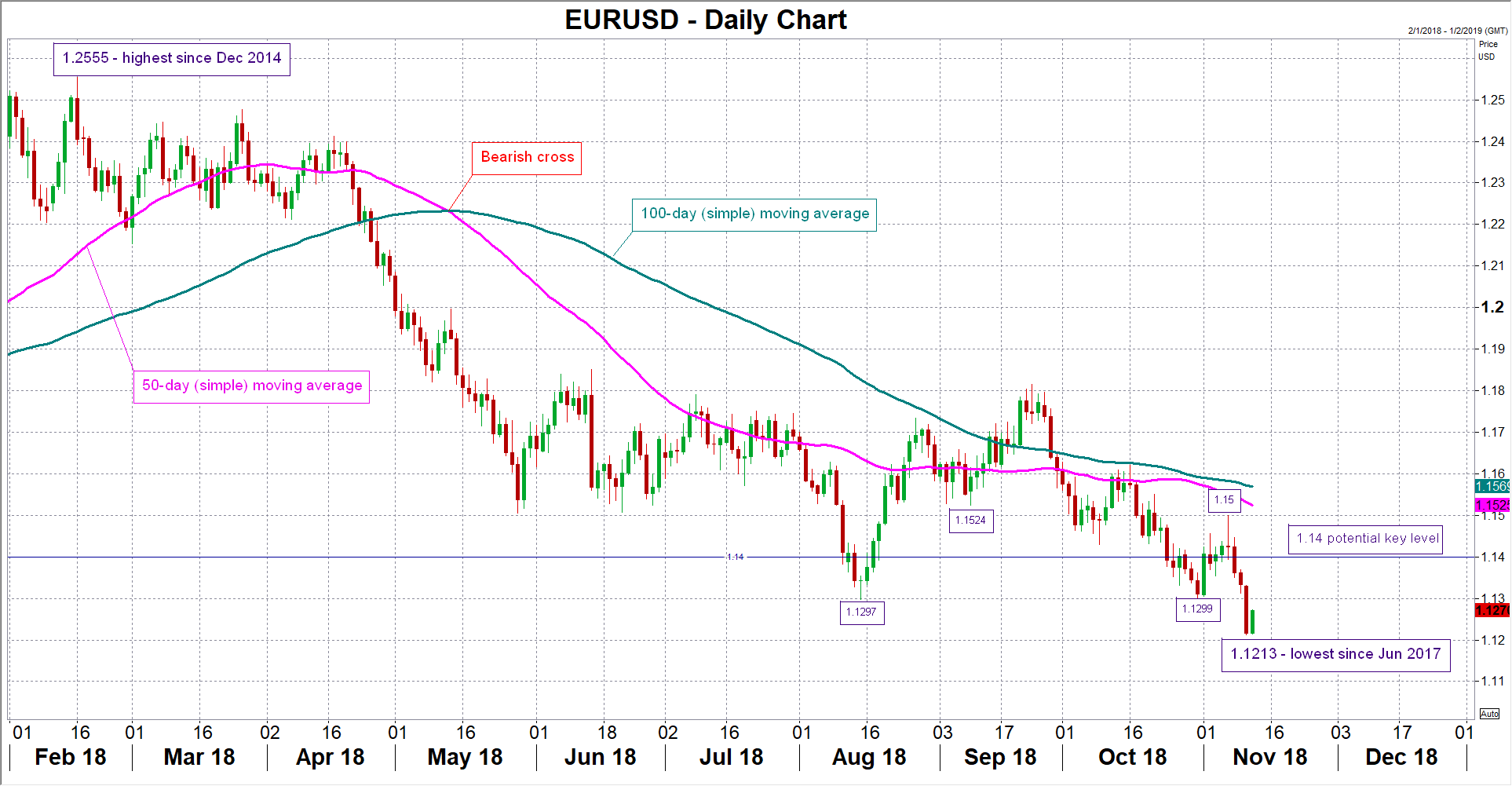
Euro/dollar is looking bearish in both the short- and medium-term at the moment, with the pair trading not far above its lowest in around one-and-a-half years.
In terms of key levels: further declines may see EURUSD finding initial support around the 1.12 round figure; the zone around this mark encapsulates a key technical point, namely 1.1187, which is the 61.8% Fibonacci retracement of the pair’s upleg from early 2017 to February 2018. Steeper losses would turn the focus to the region around the 1.11 handle, which also captures the June 2017 nadir near 1.1120.
On the upside, advances could meet resistance around 1.13, 1.14 and 1.15, which may be of psychological importance. The areas around some of these also include numerous tops and bottoms from the recent past.
For perspective, being lower by 6.1% year-to-date, the euro is the third worst performing major currency, only doing better relative to the Aussie and the Swedish krona, the latter one being the lead decliner.
Sunset Market Commentary
Markets:
Global core bonds are steady today. Both German Bunds and US Treasuries are hovering near opening levels awaiting developments on the Italian budget proposal and brexit. Italy had until today to submit a revised budget proposal to the European Commission. Italy’s La Stampa reported that the government had no intention to leave its stance on the 2.4% budget deficit for 2019, while PM Conte was seeking a partly conciliatory answer to the EU. At the time of writing, no new proposal was sent to Brussels yet. Italian BTP futures slid to this month’s low but rebounded after decent 3-yr, 8-yr and 20-yr bond auctions. German Bunds remained steady despite the marginal improvement in risk sentiment overnight. German ZEW expectations for November printed -24.1, up from -24.7 in October. Markets expected a further decline to -26.0. Moves in German yields are mixed with changes ranging from -0.6 bps (30-yr) to +0.6 bps (3-yr). Despite steady US Treasuries, the US yield curve edges lower with changes between -1.0 bps (30-yr) and -3.4 bps (5-yr) as it catches up after yesterday’s close. Credit spreads over Germany are steady, with Greece (+5 bps) underperforming.
EUR/USD rebounded during Asian dealings from yesterday’s fresh 2018 low (1.1218) on easing trade tensions following reports that China’s VP will visit the US. The pair retreated at first European trading hours, but edged higher afterwards in lockstep with European equities as risk sentiment turned for the better. A slightly less negative German ZEW-indicator (expectations) might have supported the recovery. Today’s risk climate proves fragile as (European) equities struggle to maintain gains. EUR/USD on the other hand holds on tight to intraday-highs even though the Italian budget deadline (midnight) draws near. It suggests the euro has discounted enough bad news at current levels. The common currency is probably also enjoying brexit spillovers (see below). EUR/USD is trading close to 1.127. USD/JPY’s rally this morning again halted at around 114.10, dropping to 113.9, only marginally higher than yesterday’s close.
Brexit headlines were constructive today with deputy PM Lidington saying this morning a deal is “almost within touching distance”. As EU/UK negotiations proceed, PM May told her Cabinet ministers to remain standby for a meeting as talks with Brussels are expected to close as early as today or tomorrow. Sterling entered European dealings quite stable but started rallying soon on the prospect of an imminent brexit deal. The pound received backing from a strong but largely anticipated labour report. Worth mentioning however is the strongest uptick in wages since 2008 (3.2% 3M/YoY), suggesting increasing inflationary pressures. EUR/GBP’s fall halted around noon before dropping below the 0.87-handle. Sterling bulls shrugged off EU comments, saying they are “not there yet”. Cable is on a 1.30 mark pursuit. Brexit optimism reigns for now.
News Headlines:
The research division of OPEC has lowered its projections for the 2019 oil demand growth. It calculated that world oil demand growth will rise by 1,29m b/d next year, lower than the 1,36m b/d forecast of last month. Saudi Arabia’s energy minister already said on Monday that a 1m b/d drop in oil supplies is necessary to balance the market.
ECB Praet said that the ECB should look through recent economic slowdown signs and continue its normalization. On PSPP reinvestments, he admitted that the passive loss of duration of the ECB’s bond portfolio will over time tend to steepen the yield curve as the central bank’s forward guidance keeps the front end of the curve well anchored.
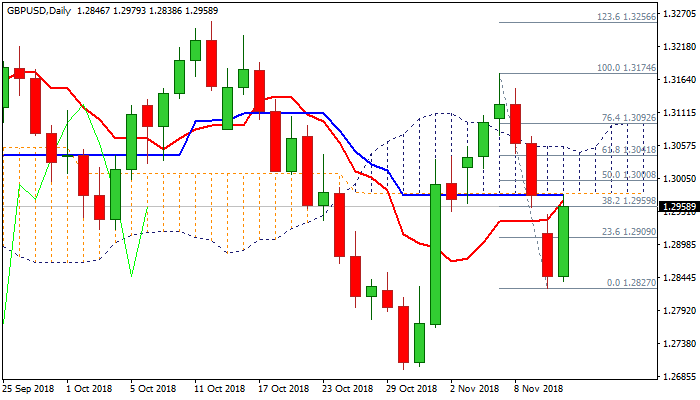
GBPUSD Outlook: Renewed Brexit Optimism and Upbeat Earnings Data Helped Pound’s 1% Recovery
Cable holds in strong bullish mode in early US trading on Tuesday, following nearly 1% advance in Asia and Europe.
Fresh bullish sentiment emerged from optimistic comments about Brexit and boosted by upbeat UK earnings data (Sep ex-bonus 3.2% vs 3.1% f/c/prev and Sep earnings including bonus in line with 3.0% f/c and Aug figure at 2.8%, revised from 2.7%).
Strong earnings data offset negative impact from unexpected rise in jobless claims (20.2K vs 4.3K f/c) and Sep unemployment rising to 4.1% vs 4.0% f/c/prev.
Strong bullish acceleration is on track to fill Monday's gap and generate bullish signal on formation of bullish outside day.
Bulls pressure key barrier at 1.2980 (daily cloud base, reinforced by 10SMA/Kijun-sen) with firm break here needed to neutralize downside risk and signal stronger recovery through psychological 1.30 barrier towards next pivots at 1.3042/46 (Fibo 61.8% of 1.3174/1.2827 fall/daily cloud top).
The Brexit talks remain key event and main driver of sterling, with further optimistic tone likely to accelerate recovery.
Res: 1.2980; 1.3000; 1.3046; 1.3092
Sup: 1.2946; 1.2909; 1.2878; 1.2838