Sample Category Title
EU Vs Italy Sacks Euro
EU vs Italy sacks Euro
Three weeks after rejecting Italy’s deficit budget proposal, the EU will have to take serious decisions on 21 November. The consequence of inaction could have a tough impact on the Italian government, as Brussels could request Italy to transfer a deposit equivalent of 0.20% of its GDP to the EU rescue fund, while cutting billion of EU funds. Additionally, will the European Central Bank, which is expected to stop its bond-buying program by the end of the year, support the Italian economy through refinancing operations?
We expect the Italian government to reconsider its budget sooner or later, as the market reaction would push Italian yields to their 2014 high: too costly for the budget initially planned. The decision could have a considerable impact on the Italian government budget on one side and the single currency on the other. Dropping by -1.68% from prior week, EUR/USD is currently bouncing back, approaching the 1.1255 range.
US equities rebound
Yesterday’s sharp drop in technology led by Apple’s fall of 5% pushed the global market downward. Hard hit is the technology index NASDAQ closing at -2.78%, followed by the Dow Jones at -2.32% and finally the S&P 500 at -1.97%. The move was also felt by the volatility index VIX, which rose above 20.50% intraday and finally eased towards 19.70%.
However, the trend is expected to turn, as futures are turning green due to the hopeful Sino-American trade talks at the end of the month. To ease tensions, China Vice Premier Liu He, after a phone call with US Treasury Secretary Steven Mnuchin on Friday, is expected to visit the US for talks prior to the Xi-Trump meeting on 30 November in Argentina. In the case of a positive deal, we could see a global rally.
Aussie To Eye Wages And Chinese Data Prior To Jobs Numbers
Australia will publish wage growth data on Wednesday at 0:30 GMT ahead of employment figures the following day, while key indicators out of China due at 02:00 GMT will also be attracting attention for the Australian dollar. The aussie has been faring somewhat better during November after sagging at 32-month lows in October. An upbeat RBA and better-than-expected trade numbers lifted the local dollar during the past week. But whether it can maintain the positive momentum could depend on the upcoming data.
Australia's wage price index has been hovering around 2% since early 2016 as subdued consumer prices have kept inflation expectations low and spare capacity in the labour market remains abundant. Wages were up 2.1% year-on-year in the second quarter of the year, picking up slightly from 2.0%. A further acceleration is anticipated for the third quarter, with the wage price index forecast to rise to a 4-year high of 2.3%. The quarter-on-quarter rate is expected to stay unchanged at 0.6%.
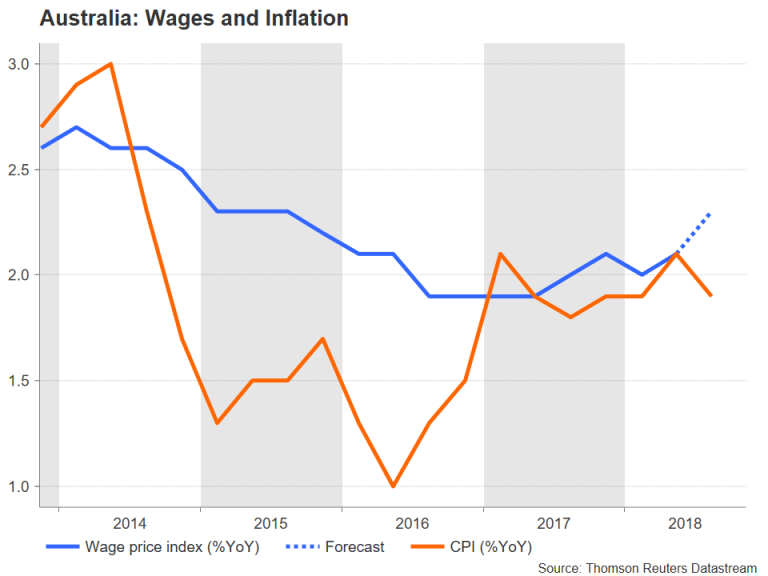
While higher wage growth would be welcomed by the Reserve Bank of Australia (RBA), it's unlikely to significantly alter the RBA's near-term view of earnings as the central bank would want to wait and see whether the uptrend is sustainable before getting encouraged by the data. Muted wage growth is one of the factors keeping Australian inflation glued to the 2% zone to the frustration of the RBA, which is eager to see a build up of price pressures so that it can begin lifting its benchmark rate from the record low of 1.50%.
The aussie stands to benefit from stronger wage data on Wednesday, building on its recent gains. However, it may be difficult for the aussie/dollar pair to make much headway as closely-watched economic gauges out of China could offset any potential optimism from the domestic figures. China's economy slowed more than anticipated in the third quarter, dimming the outlook for demand for Australian exports. Data due on Wednesday is likely to show that the Chinese economy continued to lose some steam in October.
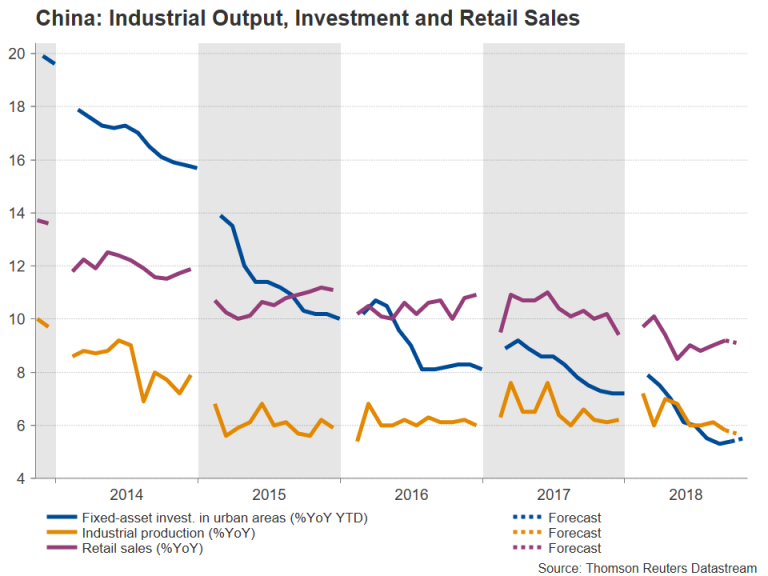
Industrial output in China is forecast to have risen by 5.7% y/y in October, moderating slightly from the prior 5.8%. Fixed-asset investment growth in urban areas is expected to have quickened to 5.5% y/y between January and October, improving further from the record low of 5.3% set in August. But retail sales are forecast to ease in October, from 9.2% to 9.1% y/y.
Aussie/dollar could break above immediate resistance around 0.7215 in the 4-hour chart should Wednesday's releases be mostly on the strong side, with the 50-period moving average slightly higher also potentially slowing further advances. A push above this area would bring into range the 23.6% Fibonacci retracement of the upleg from 0.7018 to 0.7302, at 0.7235. Steeper gains would set the path for a challenge of the 6-week high of 0.7302 touched last week.
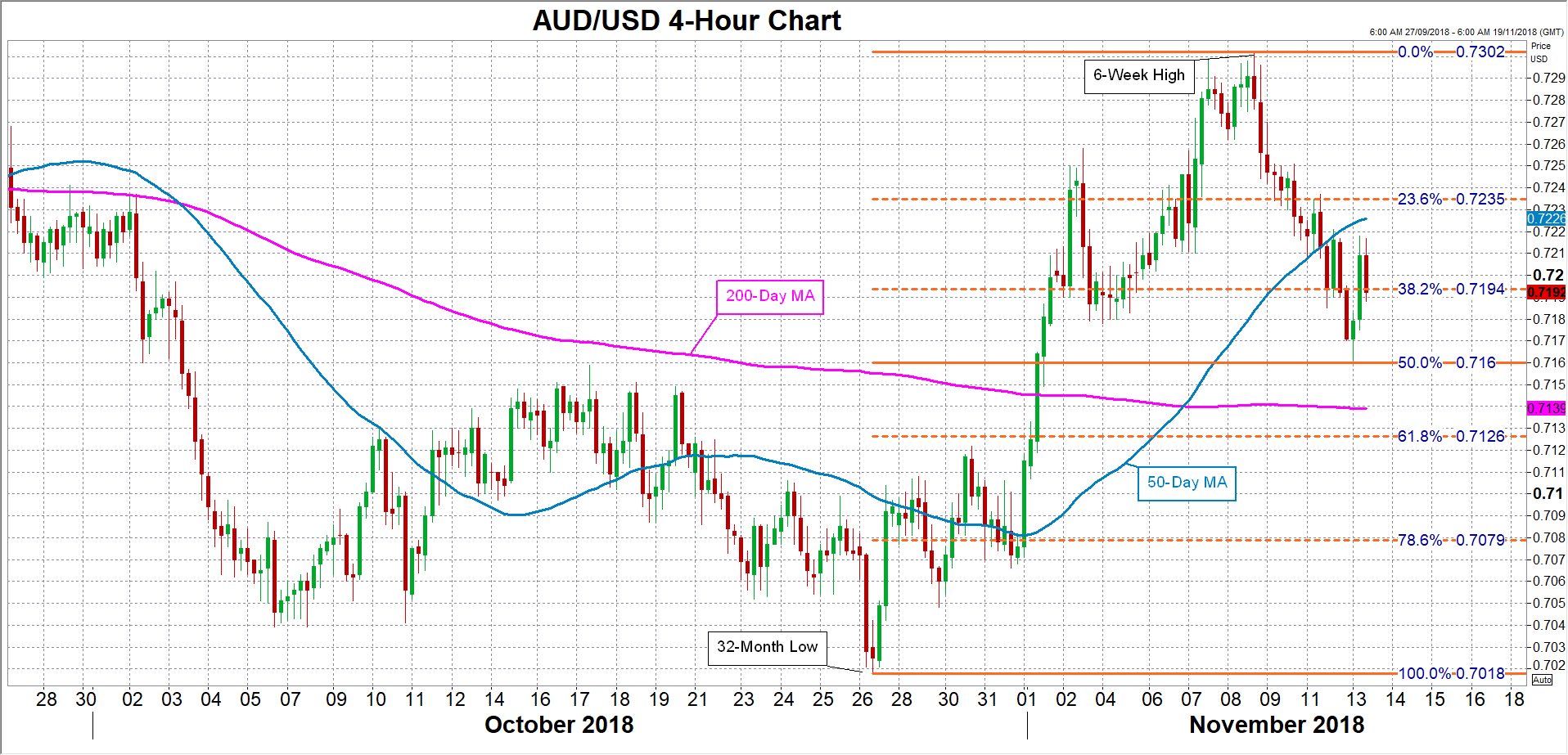
If, however, the data broadly disappoint, aussie/dollar could seek immediate support at the 38.2% Fibonacci retracement at 0.7194. A drop below this level would open the way for the 50% Fibonacci at 0.7160. A breach of the 50% Fibonacci would shift the near-term risks back to the downside and take the focus to the 61.8% Fibonacci at 0.7126.
EURUSD Bears May Target 1.1178 Support
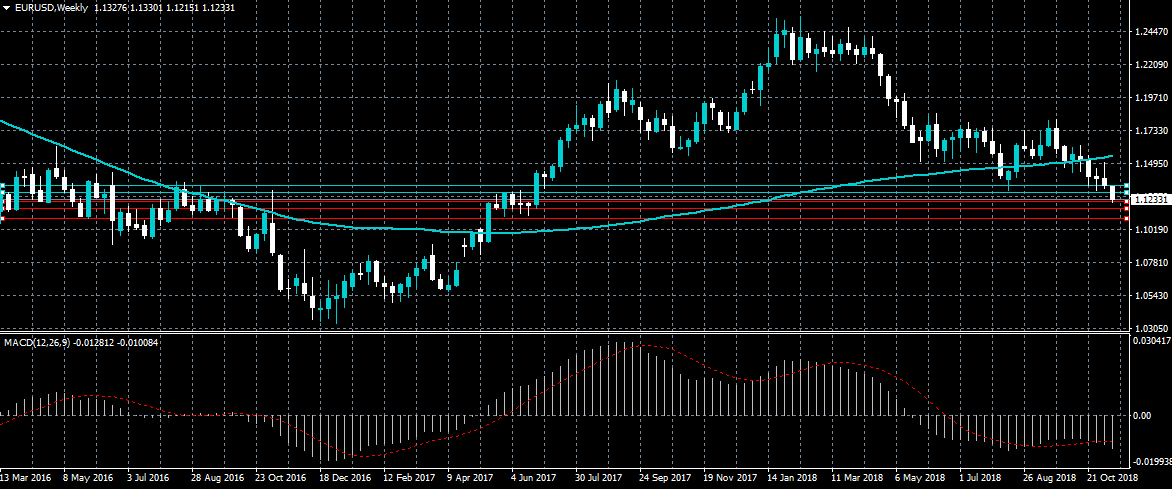
The euro currency has remained under pressure against the US dollar during the European trading session, with price managing only a tepid move above 1.1250 level. EURUSD sellers are once again probing towards the current yearly low for the pair, at 1.1216. Bears may target the June 27th 2017 trading low, at 1.1178, if the 1.1216 support level is broken during the US trading session.
The EURUSD pair is strongly bearish while trading below the 1.1216 level, key technical support is now found at the 1.1178 and 1.1120 levels.
If the EURUSD pair moves above the 1.1258 level, key intraday resistance is found at the 1.1280 and 1.1330 levels.
USDJPY 114.19 Resistance Level Now Key
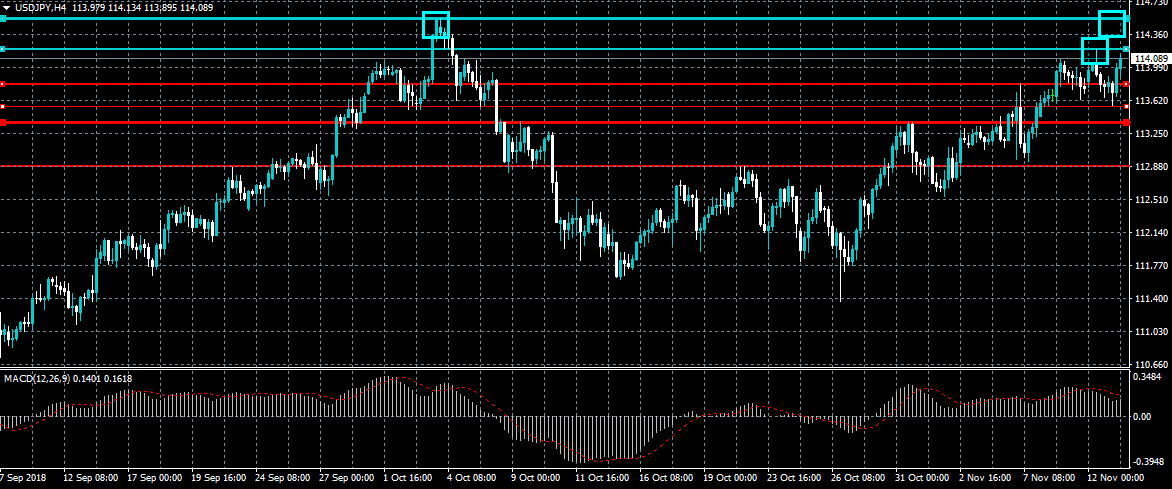
The US dollar is once again trading above the 114.00 resistance level against the Japanese yen currency, following a brief dip towards the 113.50 support level. Buyers now need to break above the 114.19 level, to further encourage bulls to test the 114.54 level. Overall, the USDJPY pair remains well supported by strength in the greenback, with the US dollar index soaring to fresh 2018 trading highs.
The USDJPY pair is strongly bullish while trading above the 114.19 level, key technical resistance is now found at the 114.54 and 115.00 levels.
If the USDJPY pair trades below the 114.00 level, sellers may target the 113.51 and 113.37 support levels.
Elliott Wave Analysis: USDCAD Update
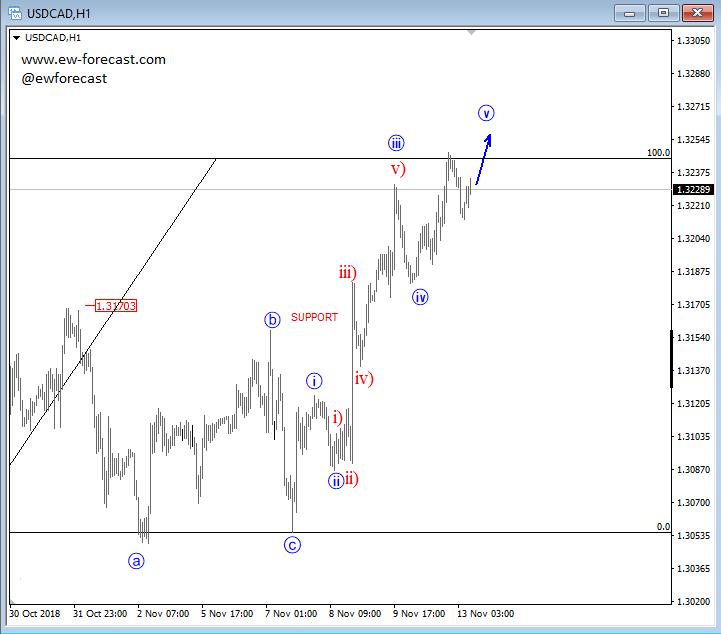
USDCAD is again at a new high as dollar remains strong and CAD weak because of declining oil prices. However, USDCAD is in a fifth wave rise so upside can be limited in the near future as a three wave correction may unfold in the near term.
USDCAD, 1h
XAU/USD Analysis: Passes 50.00% Fibo
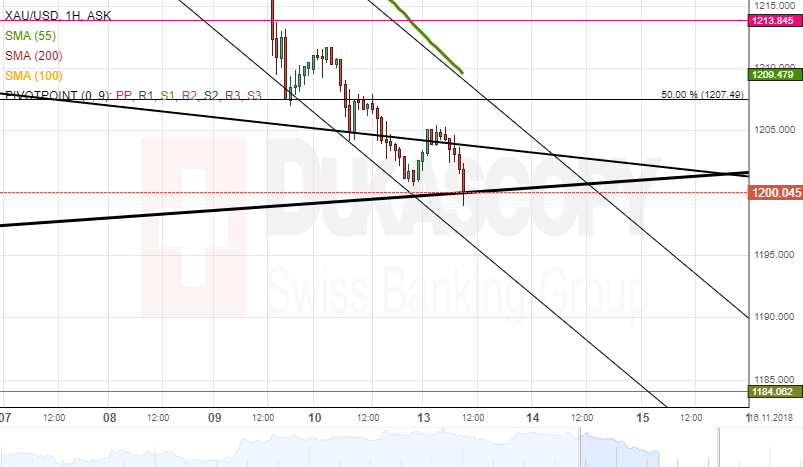
During Monday's trading session, the yellow metal passed through the bottom boundary of the descending small pattern line to end the trading session at the 1,201.74 mark. On Tuesday morning, the gold passed through the support of the 50.00% Fibonacci retracement level to trade at the 1207.26 mark.
In regards to the near-term future, the gold will trade downside due to resistances of the 55-hour SMA and the 50.00% Fibonacci retracement level. Most likely, the yellow metal will be located at the 1,195.00 level during the trading session.
On the other hand, the ascending small pattern line at 1,200.00 could support the yellow metal to push it to trade at the 1,205.00 level on Tuesday.
German ZEW: No speedy recovery after current weak development, Eurozone even worse
German ZEW Economic Sentiment improved to -24.1 in November, up from -24.7 and beat expectation of -24.2. Current Situation index, however, dropped sharply to 58.2, down from 70.1 and missed expectation of 65.0. Eurozone ZEW Economic Sentiment dropped to -22.0, down from -19.4 and missed expectation of -17.3. Eurozone Current Situation dropped sharply by -13.8 to 18.2. ZEW noted that "the outlook for the Eurozone has deteriorated even more than it has for Germany."
ZEW President Professor Achim Wambach noted in the release "The figures for industrial production, retail sales and foreign trade in Germany all point towards a weak development of the German economy in the third quarter. This is reflected by the fact that the assessment of the current situation has experienced a decline. The expectations of the survey participants for the coming six months do not show any improvement. This means that, at the moment, they do not expect to see a speedy recovery of the currently weak development of the economy".
USD/JPY Analysis: Trades At 114.00
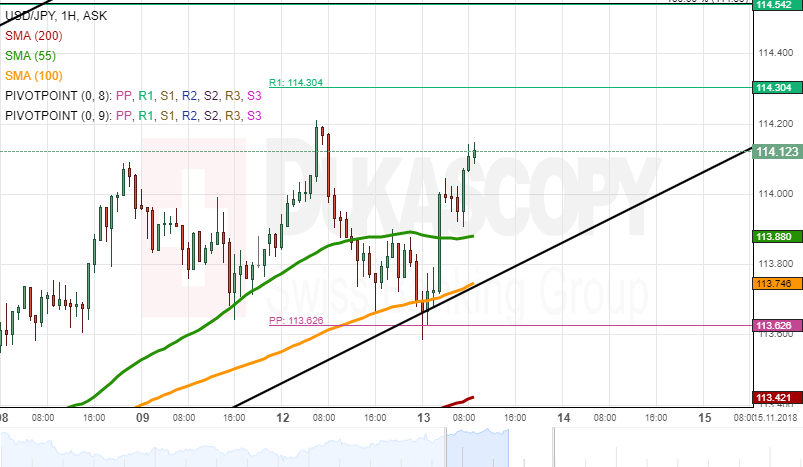
During Monday's trading session, the currency exchange rate passed through the bottom boundary of the ascending medium pattern line to end the trading session near the weekly PP at the 113.58 mark. On Tuesday morning, the US Dollar broke the resistances of the 55-hour and the 100-hour SMAs to surge to the 114.11 mark.
In regards to the near-term future, most likely, the US Dollar might meet the weekly R1 at the 114.30 during the day. mark. Besides, today's US FOMC Member Brainard Speech at 15:00 GMT could support the rates movement upwards.
On the other side, the currency exchange pair might move sideways to stay at the 114.15 level during the trading session on Tuesday.
GBP/USD Analysis: Trades Near 62.20% Fibo
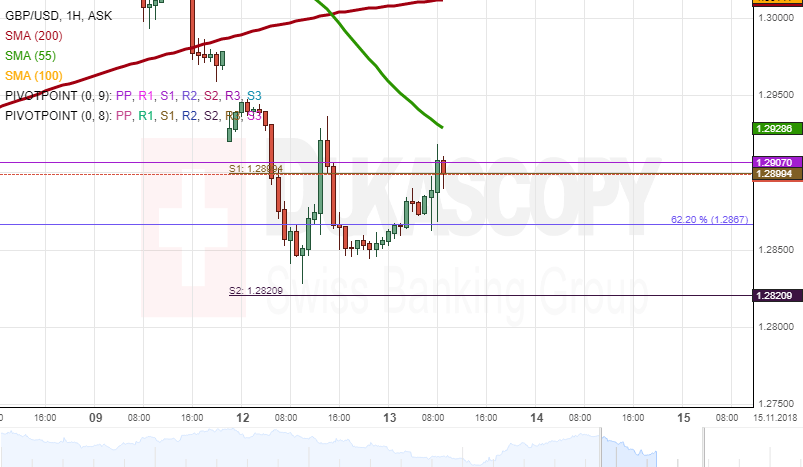
During Monday's trading session, the currency rate passed through the support of the 62.20% Fibo to trade near the weekly S2 at 1.2820 as it was expected. The rate ended up the Monday's trading session at the 1.2852 mark. On Tuesday morning, the British pound was located between the weekly S1 and the 62.20% Fibonacci retracement level to trade at the 1.2872 mark.
In regards to the near-term future, the British Pound will depreciate to the 1.2750 level due to the resistances of the weekly S1 at 1.2899, the monthly pivot point at 1.2907 and the 55-hour simple moving average.
On the other side, the rate might surge to 1.2950 level during today's UK Average Earnings Index at 9:30 GMT. Watch out for the news!
EUR/USD Analysis: Breaks Horizontal Pattern At 1.1300
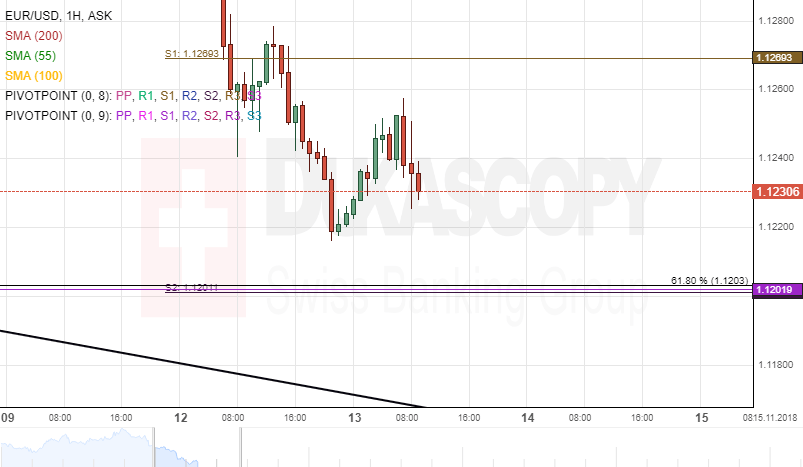
During Monday's trading session, the European Single Currency passed through the bottom boundary of the horizontal pattern line to end the trading session at the 1.1222 mark. During Tuesday's morning hours, the currency exchange rate was located below the weekly S1 at the 1.1239 mark.
In regards to the near-term future, most likely, the currency exchange rate will trade sideways between the range of the weekly S1 and the 61.80% Fibo. The 55-hour SMA will catch up the rate to give an additional resistance.
On the other hand, the predictions for the currency pair could be broken due to today's US FOMC Member Brainard Speech at 15:00 GMT.