Sample Category Title
CRUDE OIL Retains Bear Pressure, Eyes 68.00 Support Zone
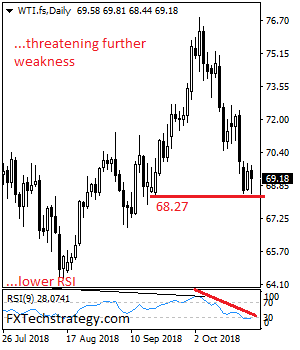
CRUDE OIL retains bear pressure with more decline expected towards the 68.00 level. On the downside, support resides at the 67.50 level where a break will expose the 67.00 level. A cut through here will set the stage for a run at the 66.50 level. Further down, support resides at the 66.00 level. Its daily RSI is bearish and pointing lower suggesting further weakness. On the upside, resistance resides at the 69.50 level. Further out, resistance comes in at the 70.00 level. A break above here will aim at the 70.50 level and then the 71.00 level followed by the 71.50 level. All in all, CRUDE OIL remains biased to the downside short term.
Markets Remain Shrouded In A Thick Blanket Of Risk
Markets remain shrouded in a thick blanket of risk.
The USD outperformed on Monday on the back of Italy and Brexit risk while the mere utterance of a protracted equity correction remains a highly sensitive topic that investors fear could morph from a wall of worry into a towering wall of pain.
Risk aversion continues to permeate every pocket of the markets whether triggered by President Trumps latest tweets on immigration or the blustery headwinds from Riyadh to Rome; markets remain shrouded in a thick blanket of risk.
For the most part, US equities struggled overnight and were unable to hold on to Shanghai Composite Index intervention induced gains as US banks toppled the most while energy producers struggled as crude prices hit a five-week low.
But looking ahead today, it seems like a quieter docket than usual, but trader remain on headline watch ( as usual)
Oil Markets
Oil prices are pointing lower again with the Saudi credit default swaps ballooning as the market becomes incredibly uncertain if there will be a shift in power when the Crown price is directly linked the Khashoggi murder.
The market turned offered again after Saudi Energy Minister Khalid Al-Falah, likely in an attempt to diffuse geopolitical tensions, said production would soon increase from 10.7 million barrels per day to 11.0 as part of the ongoing effort to offset the impact of US sanctions on Iranian crude oil exports. Of course, digging into spare capacity does raise future concerns in the face of another significant supply disruption.
It is no sure-fire proposition that the kingdom’s reserves will be enough to offset the enormous loss of production from Iran and Venezuela while leaving market ever so delicately balanced and prone to any supply disruption as other the Middle East concerns, North and West Africa remain hotspots in months ahead. And with traders all too aware that we are little more than one supply disruption away from upsetting the supply and demand apple cart and shooting oil prices higher yet again.
While the Khashoggi saga appears to be far from over the thoughts that US-Saudi tensions could lead to a supply disruption are but a distant memory.
Nearby November WTI futures expire in NY, so position squaring amid thinner volumes were the primary focus there today, but the contracts did coat trail prompt Brent lower none the less.
Gold Markets
Gold came under pressure overnight as freshly minted long equity hedge positions were squeezed by a stronger USD and despite Brexit and Italy concerns global equity markets did get some traction from China markets after verbal intervention suggests officials are prepared to stimulate the economy, including deeper cuts in personal tax rates. And while it’s easy to be cynical about the longer-term impact of this type of Chinese intervention it nearly always works over the short term, so gold prices conceded some gains.
Currency Markets
The British Pound
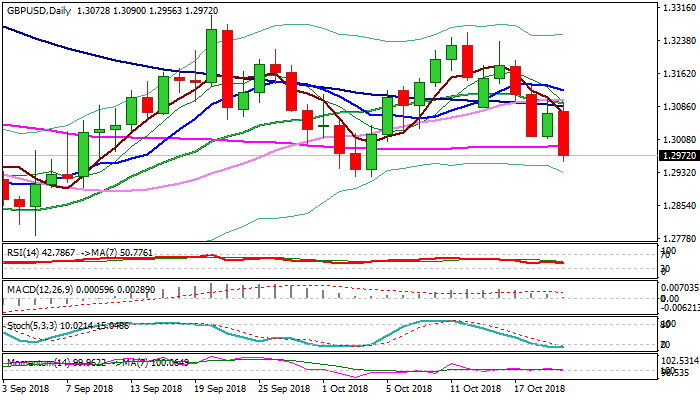
Overnight headlines brought a lot of PM May pushbacks. Acrimony within her party is, of course, a massive barrier that might ultimately result in a leadership battle, The Telegraph reported that a Eurosceptic amendment was gaining traction in Parliament ahead of Wednesday’s discussion; but so far that bluster seems to have faded. Sterling bids were in short supply overnight after GBPUSD breached the 55d MA (1.2990). But for the time being there appears to be some support structure lurking around 1.2950 that are keeping the Pound bears at bay.
The Euro
Of course, the EUR has its worries with Italian budgets, but with chatter, the ECB may push back its 2019 outlooks to the December meeting, it does suggest the current European political malaise might weighing on policy sentiment
The Australian Dollar
China risk rallies but the Aussie dollar doesn’t. Look no further than the mulishly sticky USDCNH that remains tethered to the 6.94 and the Australian government’s fragility taking centre stage. Mind you I’m trying to figure out when the Oz government hasn’t been in a fragile state as this seems to be the norm down under.
The Malaysian Ringgit
Uncertain global risks slippery oil prices and pre-budget malaise has traders for the most part sidelined. The next focus is no tomorrows CPI but given the tepid inflation readings this year, its unlikely to shift the dial from the markets more dovish read on future BNM policy.
Eco Data 10/23/18
[php_everywhere instance="1"]
Gold Slips as Dollar Flexes Muscle
Gold has headed lower in the Monday session. In North American trade, the spot price for one ounce of gold is $1221.35, down 0.42% on the day. It’s a quiet start to the week, with no U.S releases on the schedule. On Tuesday, the U.S releases Richmond Manufacturing Index.
Relations between the U.S and China remain strained, as the trade war continues to simmer between the world’s two largest economies. On Thursday, the U.S Treasury Department released its semi-annual report on foreign exchange rates, and there was some relief in the markets as the report did not name China as a currency manipulator. Still, the report said that the U.S was “deeply disappointed’ with that China refuses to disclose the extent of its foreign currency intervention. The Chinese yuan has slipped some 9 percent since April, and U.S officials are concerned that China has deliberately weakened the currency in order to counter U.S tariffs on Chinese goods, and will continue to monitor China’s currency practices.
Gold prices were up last week, despite a hawkish tone from the Federal Reserve minutes on Thursday. The minutes indicated that a majority of members want to continue raising interest rates until the U.S economy shows signs of slowing down. However, the duration of a tighter policy remains unclear, as the minutes noted that “there is considerable uncertainty surrounding all estimates of the neutral federal funds rate.” This would likely be around the 3 percent level, which will not be reached until the second half of 2019, as the Fed has indicated it will raise rates three times next year. At the September meeting, the Fed removed the phrase “the stance of monetary policy remains accommodative”, which was considered outdated, given the policy of steady rate hikes. As rates approach the “neutral rate”, we could see further changes in language at upcoming policy meetings.
Strong Dollar Pushes British Pound Below 1.30
GBP/USD has posted strong losses in the Monday session. In North American trade, the pair is trading at 1.2975, down 0.72% on the day. On the release front, there are no British or U.S events. On Tuesday, the U.K releases CBI Industrial Order Expectations and the U.S publishes the Richmond Manufacturing Index.
Brexit negotiations appear deadlocked, although Prime Minister May sounded surprisingly upbeat about the status of the talks, stating in parliament that 95% of the issues have been resolved, with the status Irish border remaining in dispute. May continues to face difficulties with a restless cabinet, as some ministers are uneasy about her remarks last week that she was open to extending the transition period. May could face a leadership challenge, and a huge rally in London calling for a second referendum underscores the volatile political climate in Britain ahead of Brexit Day in just five months time. The uncertainty surrounding Brexit continues to weigh on the pound, which dropped below the symbolic 1.30 line on Monday, for the first time since the October.
Relations between the U.S and China are frosty, with the markets nervous that the trade war could worsen. The U.S Treasury Department released its semi-annual report on foreign exchange rates, and there was some relief in the markets as the report did not name China as a currency manipulator. Still, the report said that the U.S was “deeply disappointed’ with that China refuses to disclose the extent of its foreign currency intervention. The Chinese yuan has slipped some 9 percent since April, and U.S officials are concerned that China has deliberately weakened the currency in order to counter U.S tariffs on Chinese goods, and will continue to monitor China’s currency practices.
Mid-US udpate: European stocks reversed, Dollar and CAD strong
It isn't too clear what's the driving force in the forex markets today, except Brexit concerns on Sterling's weakness. Italy's budget remains a concern as the coalition government replied to EU insisting to stick with it's deficit target in 2019. European Commission will discuss the way to handle it in a regular meeting tomorrow. For now, Euro is trading mixed only. New Zealand Dollar and Australian Dollar are the weakest ones next to Sterling, getting no support from strong rebound in Chinese stocks.
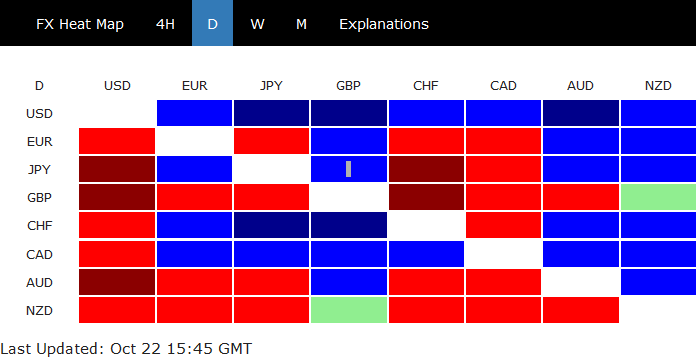
On the other hand, US and Canadian Dollar are the strongest ones, followed by the Swiss Franc. It's also unclear what's driving the greenback higher. US treasury yields are trading generally lower at the time of writing. Stocks are also weak except NASDAQ. Though, Canadian Dollar could be seen as paring Friday's steep loss with anticipation of rate hike by BoC later in the week. Swiss Franc's strength could be explained by the sharp pull back in EUR/CHF as Euro's rally attempt falters.
In other markets, majors European stock indices reversed after initial rally.
- FTSE closed down -0.04% at 7047.22
- DAX closed down -0.21% at 11529.14
- CAC closed down -0.51% at 5058.77.
- German 10 year yield drops -0.010 to 0.453
- Italian 10 year yield drops -0.1033 at 3.478. This is mainly a reaction to Moody's downgrade with stable outlook last week. German-Italian yield spread remain at around the alarming 300 level.
Elliott Wave Analysis: EURJPY In A Correction
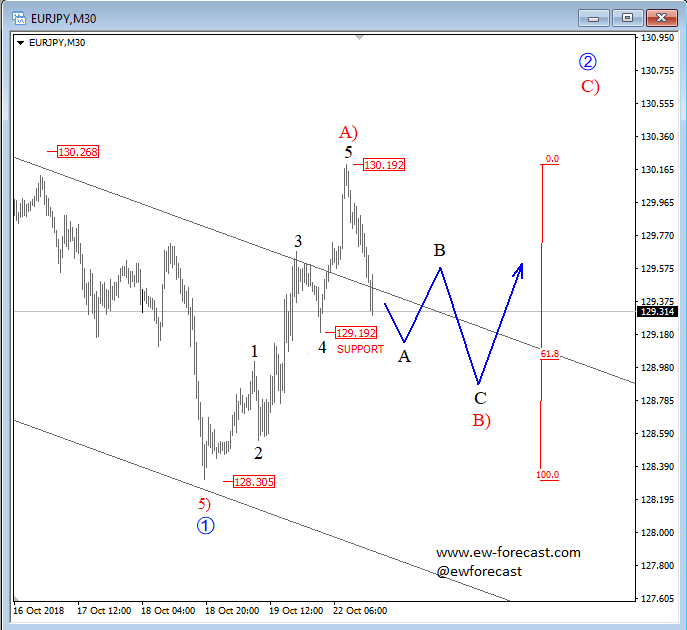
EURJPY made a five-wave recovery within higher degree wave A), which looks to have found its top at the 130.19 level, from where a sharp drop occured. This drop can now be part of a hgiher degree corrective wave B), that is unfolding its minor three legs. We see curently sub-wave A in play, that can look for support and a bouce into the following sub-wave B at the 129.19 level, level of a former swing low. That being said, higher degree wave B) pullback can look for a base near the 128.78 area, and later aim for higher levels, above the 130.19 into wave C).
EURJPY, 30Min
Japanese Yen Edges Lower, BoJ Inflation ahead
The Japanese yen has edged lower in the Monday session. In North American trade, USD/JPY is trading at 112.68 up 0.12% on the day. On the release front, Japanese All Industries Activity improved 0.5%, up from 0.0% month earlier. The reading was a shade better than the estimate of 0.4%. On Tuesday, Japan releases BoJ Core CPI, the preferred indicator of the Bank of Japan.
Japanese policymakers are keeping a close eye on the strained relations between China and the U.S., as the trade war between the two economic giants shows no signs of abating. The U.S Treasury Department released its semi-annual report on foreign exchange rates, and there was some relief in the markets as the report did not name China as a currency manipulator. Still, the report said that the U.S was “deeply disappointed’ with that China refuses to disclose the extent of its foreign currency intervention. The Chinese yuan has slipped some 9 percent since April, and U.S officials are concerned that China has deliberately weakened the currency in order to counter U.S tariffs on Chinese goods, and will continue to monitor China’s currency practices.
The Bank of Japan’s radical monetary easing policy has cut into the profits of many financial institutions, but the BoJ has no plans to alter course. The bank released its semiannual financial system report, which noted that the financial sector shows no signs of overheating and that banks continue their “active lending attitudes”. The BoJ is unlikely to make any changes to policy before 2020, aside from some minor tweaks. Bank policymakers will meet on Oct. 30-31 for the next policy meeting.
DAX gains ground as Moody’s maintains Italy’s credit rating outlook after downgrade
The DAX index has started the new trading week with considerable gains. Currently, the index is at 11,607, up 0.47% on the day. The sole event on the schedule is the German Bundesbank monthly report. On Tuesday, Germany releases PPI and eurozone consumer confidence.
Relations between the U.S and China are strained, with global markets nervous that the trade war between the world’s two largest economies could worsen. The U.S Treasury Department released its semi-annual report on foreign exchange rates, and there was some relief in the markets as the report did not name China as a currency manipulator. Still, the report said that the U.S was “deeply disappointed’ with that China refuses to disclose the extent of its foreign currency intervention. The Chinese yuan has slipped some 9 percent since April, and U.S officials are concerned that China has deliberately weakened the currency in order to counter U.S tariffs on Chinese goods, and will continue to monitor China’s currency practices.
There was some good news out of Italy on Friday, as the Moody’s credit rating agency maintained the outlook on Italy’s credit rating as ‘stable’. There had been fears that Moody’s might downgrade Italy’s debt to ‘junk’, after it lowered its rating to Baa3, its lowest grade. The yield on Italian 10-year bonds dropped to 3.30%, its lowest level in two weeks. Italy’s draft budget has become the latest crisis for the European Union. The budget boosts public spending and cuts, and sets a budget deficit goal of 2.4%, which would be higher than last year, in breach of EU law. Italy’s debt stands at an astounding 132% of GDP, and there is a real risk that the country’s financial woes could destabilize the entire eurozone.
GBPUSD Outlook: Penetration of Daily Cloud Could Risk Deeper Fall
Cable fell deeply into daily cloud and hit the lowest since 04 Oct, after rising Brexit fears sparked fresh bearish acceleration through pivotal 1.30 support zone. Disagreement over Brexit within the UK ruling party and the issue with Irish border which remained unsolved after two sides agreed on most of Brexit divorce points, threatens to undermine PM May's leadership. Today's fall marks so far the biggest one-day loss in October, with growing negative sentiment risking further weakness, which could accelerate on break below cloud base. Series of significant supports lay ahead: daily cloud base (1.2933); 03/04 Oct lows at 1.2921 and Fibo 61.8% of 1.2661/1.3297 ascend (1.2904), with break here to generate strong bearish signal and risk deeper fall. Weakening techs on daily chart support scenario, but situation over Brexit talks would be key event and pair's main driver.
Res: 1.2992; 1.3012; 1.3054; 1.3090
Sup: 1.2944; 1.2921; 1.2904; 1.2811