

Sample Category Title
COPPER Outlook: Fresh Rally on Strong Fundamentals Struggles to Clear Falling 100SMA Barrier
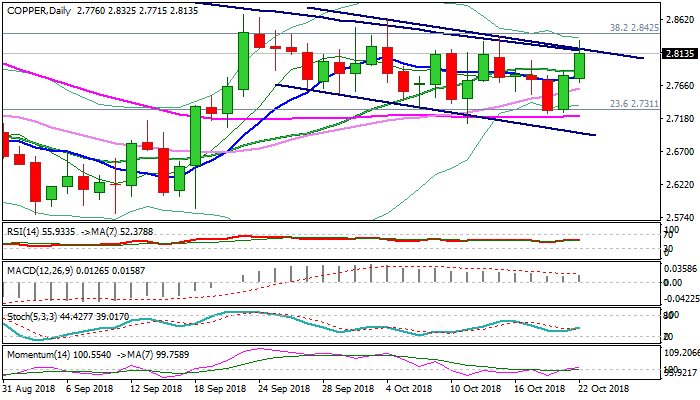
Copper maintains firm tone and advances for the second day, hitting one-week high at $2.8325 on Monday. The metal price rallied on rising expectations of stronger demand from world’s top consumer China. Bounce from $2.7250 zone, where 55SMA contained multiple downside attempts, cracked important barrier at $2.8167 (falling 100SMA), which kept upside attempts during past five weeks limited. Fresh advance needs close above 100SMA to generate bullish signal for extension towards highs at $2.8645 (04 Oct) and $2.8695 (21 Sep), which mark key short-term barriers and guard the base of thick weekly cloud ($2.8960). Daily MA’s (10/20/30) turned to bullish setup and support the advance along with bullish momentum, but failure to clear 100SMA would keep the price within short-term bear-channel and keep risk of fresh weakness alive. Converging daily SMA’s - 20 ($2.7865) and 10 ($2.7815), mark pivotal support and break lower would weaken near-term structure.
Res: 2.8167; 2.8325; 2.8465; 2.8695
Sup: 2.8035; 2.7715; 2.7616; 2.7250
Into US session: Euro turned mixed after Italy’s reply to EU, Sterling weakest
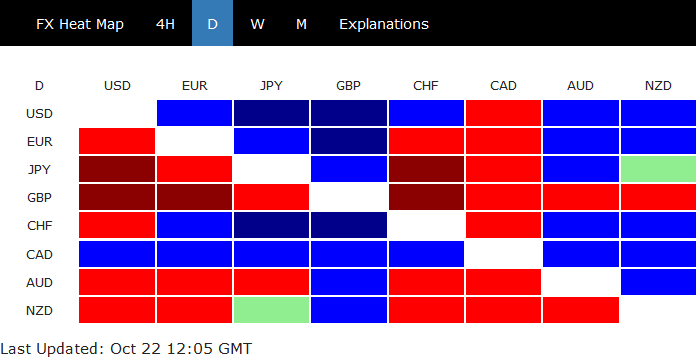
Entering into US session, Sterling is trading as the weakest one for today so far. Brexit concerns are weighing on the Pound. UK Prime Minister Theresa May is going to tell the parliament that 95% of the withdrawal agreement is done. But she continues to reject EU's Irish backstop proposal. The deadlock remains a deadlock. Yen is among the weakest on strong global risk appetite, following rally in Chinese stocks and sharp fall in Italian yield. On the other hand, Canadian Dollar and Dollar are trading as the strongest ones. Canadian Dollar is trying to recover from Friday's steep losses, with expectation that BoC will raise interest rate this week.
Euro is mixed at the time of writing. EUR/USD hit as high as 1.1550 today but reversed after Italy replied to the EU, insisting to stick to its "hard" but "necessary" budget. The sentiment is not totally reflected in Italian yield though. Italian 10 year yield is down -0.1358 at 0.3446 at the time of writing. However, we'd like to point out that German 10 year yield is now at 0.459, down -0.004. That is, German-Italian spread is still at 298, less alarming but still very alarming.
In European markets
- FTSE is up 0.88% at 7111.94
- DAX is up 0.81% at 11646.49
- CAC is up 0.49% at 5109.37.
Earlier in Asia,
- China Shanghai SSE rose 4.09% to 2654.88, should have confirmed medium term bottoming.
- Hong Kong HSI rose 2.32% to 26153.15
- Nikkei rose 0.37% to 22614.82
- Singapore Strait Times rose 0.51% to 3078.06.
- Japan 10 year JGB yield rose 0.0031 to 0.153
Euro Returns Below 1.15 after Italy’s Response; UK PM to Speak in Parliament
Here are the latest developments in global markets:
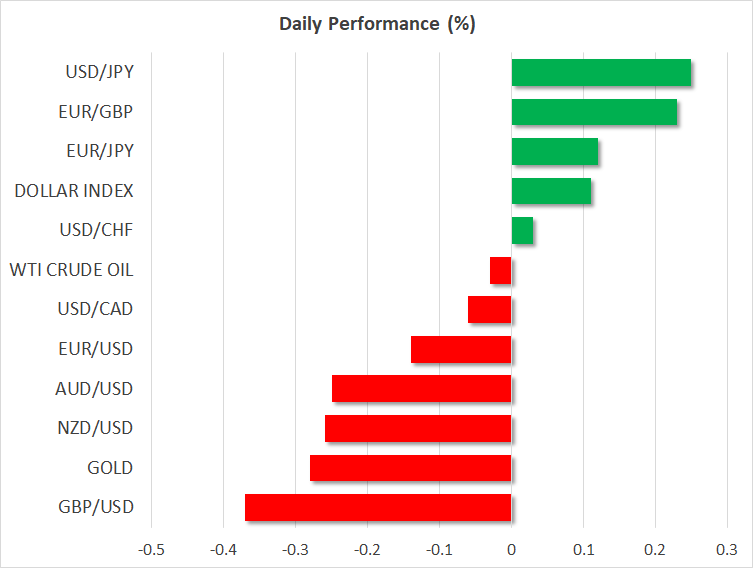
- FOREX: Sterling was declining by 0.25% against the US dollar on Monday as uncertainties around the Irish border weighed on hopes that a Brexit deal is close ahead of the UK Prime Minister’s speech in the Parliament. Pound/yen was fairly steady, while euro/pound increased by 0.23%. Euro/dollar reversed earlier gains to trade at 1.1494 (-0.16%) after Italy’s Finance Minister backed the 2019 draft budget even after EU’s warning letter last week (see below). Dollar/yen traded up by 0.24%, posting an almost 2-week high at 112.87, while the US dollar index was flat at 95.73. In the antipodean sphere, aussie/dollar and kiwi/dollar gained by 0.20% and 0.21%, rising towards 0.7100 and 0.6580 respectively. Dollar/loonie was down by 0.08% at 1.3086 following steep gains on Friday. The chinese offshore yuan jumped by 0.18% versus the US dollar as China committed to use fiscal relief to support the economy amid rising trade protectionism from the US.
- STOCKS: European equities edged higher on Monday as traders turned their attention on earnings and sentiment bounced back after Moody’s kept Italy’s sovereign outlook stable. The pan-European STOXX 600 index and the blue-chip Euro STOXX 50 advanced by 0.34% at 1100 GMT with almost all sectors in positive territory. The German DAX 30 was up by 0.53%, the French CAC 40 rose by 0.27%, while the Italian FTSE MIB gained 0.64%. The UK’s FTSE 100 increased by 0.63%. In Asia, equities closed in positive territory, with Shanghai stocks outperforming by 4.0%. In the US, futures tracking the S&P 500, Dow Jones, and Nasdaq 100 are pointing to a higher open today. In corporate news, Ryanair’s profits for the second quarter declined unexpectedly on the back of higher oil prices and strikes.
- COMMODITIES: Oil prices moved up today after Saudi Arabia’s energy minister referred that has no intention of unleashing an oil embargo on Western consumers. West Texas Intermediate crude oil and London-based Brent added 0.20% to their price challenging $69.32/barrel and $80/barrel respectively. Turning to precious metals, gold prices were on the downside below the 3-month high of $1233, losing 0.24% on the day.
Day Ahead: Theresa May speaks before Parliament; Italian budget and Trade to be in focus as well
Brexit could make headlines later in the day as the UK Prime Minister is widely expected to explain her Brexit strategy at the Parliament at 1430 GMT after the EU summit failed to break the deadlock around the sticking Irish border issue last week. Still, May is anticipated to use a positive tone in front of lawmakers, probably saying that a Brexit agreement is almost done, and a few details remain to be solved. But some of her Conservative Eurosceptic partners as well as some counterparts in the Labor party are likely to challenge her by asking for answers about her willingness to extend the two-year transition period as well as her softer stance regarding the timeline of the Irish border after reports unveiled that May’s administration could accept an open-ended timeframe. Note that pro-Brexit members in the Cabinet favor an end day for the backstop to avoid any delay in the UK’s departure from the EU.
On Wednesday, May could face a leadership challenge at the 1922 Conservative Committee meeting if she finally attends the event, as the body threatens to call for a no-confidence vote against the British Prime Minister and her Brexit plans.
As a response to the European Commissions’ letter to Italy which outlined that the submitted budget draft was not in compliance with policy obligations written in the Stability and Growth pact, the Italian Finance Minister, Giovanni Tria, messaged that the deficit target for 2019 is not likely to change and the government is ready to intervene if this is not respected. Yet Tria mentioned that the government does not intend to raise the deficit in 2020 and 2021, adding that Rome will continue to have a constructive dialogue with the EU. Confidence, however, remained fragile in the euro market, with investors eagerly waiting the European Commission to determine the next steps in assessing Italy’s budget on Tuesday, where a rejection of the spending plan is a highly likely outcome.
Trade uncertainties will also remain pinned in the background following China’s decision to cut personal income taxes to mitigate the negative consequences from the US-Sino trade war. The action could be a sign that Beijing is not afraid of US tariffs even if those have already started to weigh on the country’s economic performance and thus the dispute might continue for longer.
Turning to the economic calendar, data releases will be relatively light with the Canadian wholesale trade figures attracting the most interest in major markets.
In stock markets, Logitech International will be among companies to report results after the US markets close.
As for public appearances, RBA members including the Deputy Governor, Guy Debelle, will be talking at the Sibos 2018 Conference in Sydney overnight.

Italy tells EU it will stick to hard but necessary budget
In a formal response to the EU, Italian Economy Minister Giovanni Tria indicated the country will stick to its draft budget plan. That is, the deficit to GDP target for 2019 will be kept at 2.4%. Though, Tria expressed the eagerness to engage in conversation with EU. Prime Minister Giuseppe Conte also emphasized that 2.4% is the cap that "for sure we won't exceed".
Tria said the budget was a "hard, but necessary decision in light of Italy's delay in catching up to pre-crisis levels of GDP and the desperate economic conditions in which the most disadvantaged citizens find themselves in". And, "the government trusts that what it has explained is sufficient to clear up the setup of its budget and that the (fiscal) law will not put at risk the financial stability of Italy or other EU state members."
Also, he said "while recognizing the divergence of the respective evaluations, the Italian government will remain in a constructive and fair dialogue." And, "the government is confident it can get investment and GDP growth moving again and that the recent rise in the government bond yields will be reabsorbed as the investors learn about all the details of the measures in the budget law."
EUR/USD – Lack Of Data Leaves Euro Subdued
EUR/USD has steadied on Monday, after posting considerable gains in the Friday session. Currently, the pair is trading at 1.1499, down 0.13% on the day. The sole event is the German Bundesbank monthly report. On Tuesday, Germany releases PPI and eurozone consumer confidence.
The euro ended the week with considerable gains, boosted by a strong eurozone current account and soft U.S housing numbers. Eurozone current account surplus climbed from EUR 21.3 billion to 23.9 billion, crushing the estimate of EUR 21.4 billion. This marked a 4-month high. In the U.S, Existing Home Sales slipped t0 5.15 million, down from 5.34 million a month earlier. This was the smallest lowest existing home sales level since November 2015. The increase in interest rates has led to higher mortgage rates, which has dampened home sales. U.S construction numbers were soft earlier in the week, as Building Permits and Housing Starts both missed their estimates.
Relations between the U.S and China are frosty, with the markets nervous that the trade war could worsen. The U.S Treasury Department released its semi-annual report on foreign exchange rates, and there was some relief in the markets as the report did not name China as a currency manipulator. Still, the report said that the U.S was “deeply disappointed’ with that China refuses to disclose the extent of its foreign currency intervention. The Chinese yuan has slipped some 9 percent since April, and U.S officials are concerned that China has deliberately weakened the currency in order to counter U.S tariffs on Chinese goods, and will continue to monitor China’s currency practices.
GBP/USD Trades Between PPs
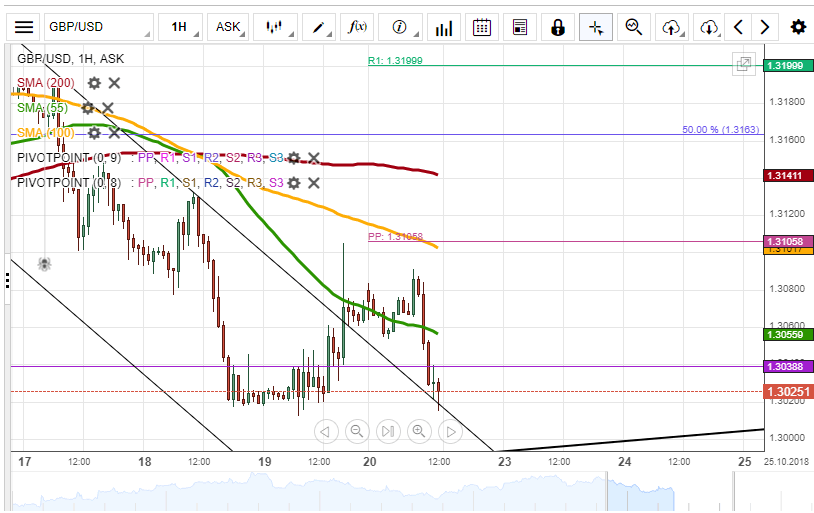
The British pound appreciated 0.24% against the US Dollar since Friday's session. During the previous session, the rate broke the monthly PP at 1.3038 and was resisted by the 55-hour SMA at 1.3060 to stop the trade at the 1.3054 mark. On Monday morning, the rate broke the resistance of the 55-hour SMA to trade at the 1.3079 mark.
n regards to the near-term future, most likely, the British pound will trade between the weekly pivot point at 1.3405 and the monthly pivot point at 1.3038 due to a lack of any fundamental news during the trading session.
In addition, the 55-hour simple moving average will try to support the rate at 1.3050 level on Monday.
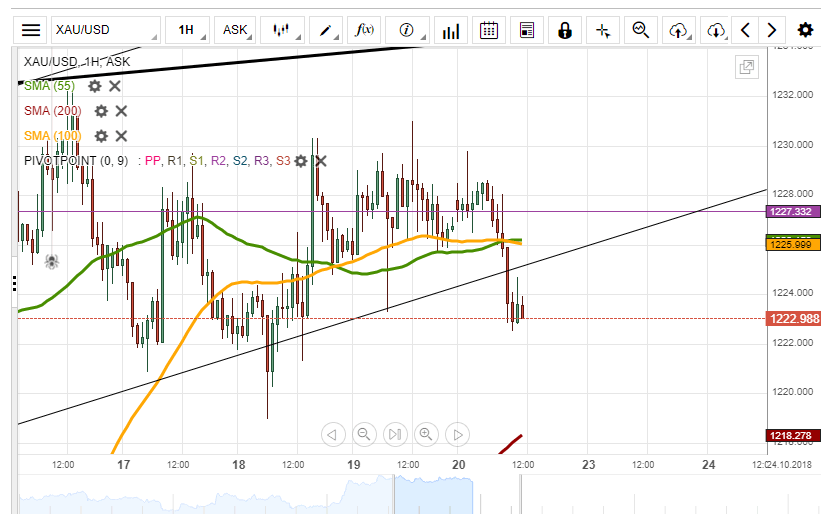
XAU/USD Trades At 1,226.00
The gold price appreciated 0.20% since Friday's session. During the previous trading session, the yellow metal was supported by the 55-hour and the 100-hour SMAs to stop the trade at the 1,227.03. On Monday morning, the gold still supported by the 55-hour SMA and the 100-hour SMA to trade at 1,226.88 mark.
In regards to the near-term future, most likely, the gold will break the resistance of the monthly R2 at 1,227.33 mark to surge to the large pattern line due to break-out of the 55-hour and the 100-hour SMAs.
However, the rate might get resisted by the monthly R2 to pass the rate through the SMAs to trade near the bottom boundary of the trade pattern line at 1,224.00
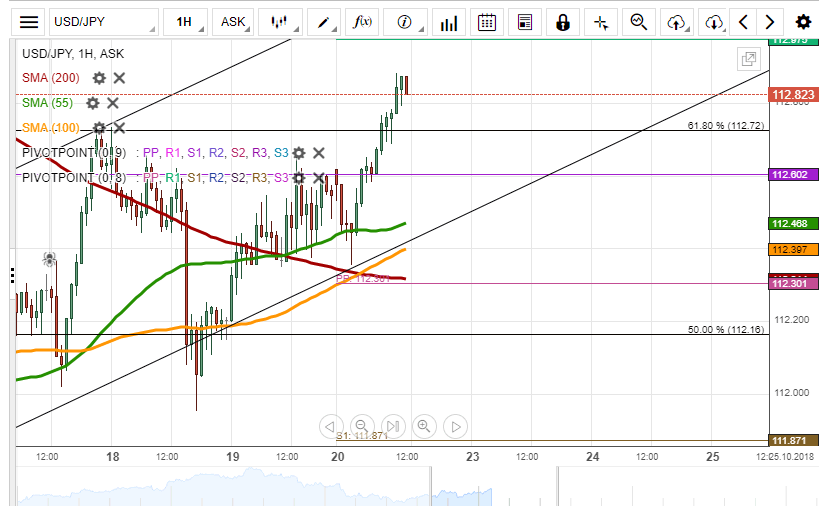
USD/JPY Breaks 61.80% Fibo
The US Dollar appreciated 0.37% against the Japanese Yen since Friday's session. During the previous trading session, the rate was supported by the 55-hour SMA to stop the trade at 112.35. On Monday, the US Dollar broke the resistances of the monthly PP at 112.60 and the 61.80% Fibo to trade at the 112.72 mark.
In regards to the near-term future, most likely, the US Dollar will be supported by the 61.80% Fibo to trade at 112.80 level on Monday. However, the surge will not be significant due to a lack of any fundamental news during the trading session.
On the other side, the rate might get resisted by the 61.80% Fibo to trade at 112.50 level during the day.
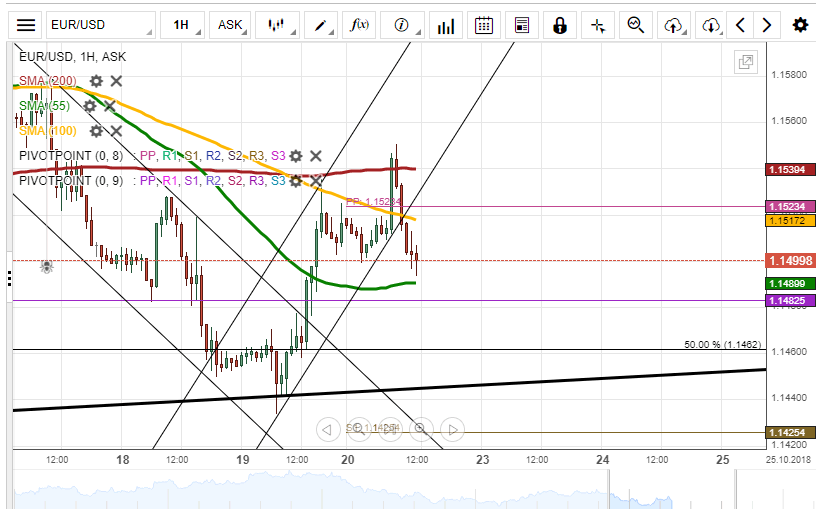
EUR/USD Will Stay Near 1.1500
The European Single Currency appreciated 0.40% against the US Dollar since Friday's session. During the last trading session, the currency pair broke the resistance of the monthly S1 at 1.1482 and was stopped by the 200-hour SMA at 1.1539. On Monday, the rate broke the weekly PP at 1.1523 to trade at the 1.1542 mark.
In regards to the near-term future, most likely, the rate will trade sideways to stay near the 1.1500 level due to a lack of any fundaments during the trading day. The 200-hour SMA should resist the European Single Currency during the day.
Besides, the 55-hour SMA will try to catch up the rate after the Friday's surge.
The Midterm Elections and Our Economic Outlook
Executive Summary
The 2016 United States election was a landmark event, and its impact has rippled through nearly all asset classes and the domestic and global economies. On November 6, 2018, Americans will go back to the polls for the midterm elections. Might this round of elections have similarly significant financial market and economic consequences? In this special report, we lay out the key assumptions that underpin our economic forecast and highlight how that thinking might change under different conditional midterm election outcomes.
In short, we are skeptical the 2018 midterms will match the 2016 election in terms of sweeping macroeconomic implications. The 2016 election was a watershed election, and it resulted in the first "unified government" (i.e., one party controlling the White House and both chambers of Congress) since 2009-2010 and the first Republican unified government since 2005-2006. Generally speaking, the move from divided government to unified government opens up more possible policy outcomes as one party unites to pass landmark legislation. As we look to the other side of the 2018 election, the two possible outcomes are a move from unified government to divided government or a continuation of the status quo. Regardless of which occurs, we believe these two outcomes are less likely to produce a clear inflection point in the nation's fiscal policy, as happened in 2016.
More specifically, the tax cuts enacted at the end of last year are unlikely to be repealed or significantly expanded, in our view. In addition, unless the economy begins to decelerate markedly, we are also skeptical the stars will align for another discretionary spending increase as large as the one that Congress passed in Q1-2018. The United States-Mexico-Canada Agreement (USMCA) to replace the North American Free Trade Agreement (NAFTA) will likely see a vote in 2019, although a divided government could make this a bit more of a rocky process. Finally, other policy areas, such as health care, could also enter the spotlight in the next Congress. But, while the political battles in these areas will surely grab major headlines as the Affordable Care Act debate did in 2017, more often than not these debates are not enough for us to make material changes to our macroeconomic forecast for U.S. economic growth, interest rates, etc. That said, politics, like the economy, is often full of surprises, and we will be monitoring any developments in the month ahead that might change our view. Should that occur, we will update our forecast and readers accordingly.
The Landscape: Where Do Things Stand?
Before we dive into possible policy outcomes, what would it take for Democrats to take back one or both chambers of Congress? In the House of Representatives, Democrats need to gain a net 23 seats to secure the 218 seats needed for a majority. Historically speaking, the president's party tends to lose seats in midterm elections. In the 18 midterm elections since World War II, the president's party has lost seats 16 times, with an average of about 25 lost seats for the president's party. Thus, even an "average" midterm election for the party out of power (the Democrats in this case) could be enough for them to flip control of the House.
At first blush, the math in the Senate also seems favorable for Democrats. Republicans hold a slim 51-49 seat advantage, so Democrats would need to gain a net two seats to gain control of the Senate (in the event of a 50-50 tie, the vice president breaks the tie). Unlike the House, however, only one-third of Senators are up for election every two years, and this particular class of 35 Senators contains 26 Democrats to just nine Republicans. Of those 26 Democrats, several of the Democratic Senators up for reelection are campaigning in states won decisively by President Trump, such as West Virginia, Indiana, Missouri, North Dakota and Montana. Thus, while it is certainly possible Democrats could gain control of the Senate, it is an uphill battle. Furthermore, even if Democrats somehow swept the floor and won every Senate seat, they still would fall short of a "supermajority" (traditionally deemed 60 votes to overcome a filibuster).
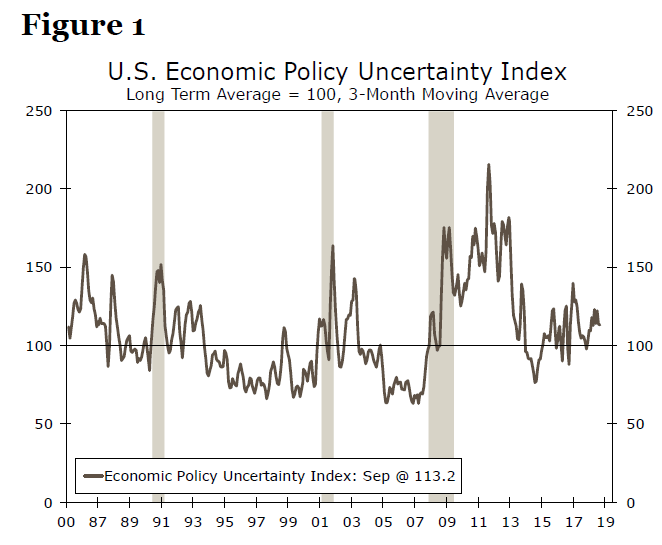
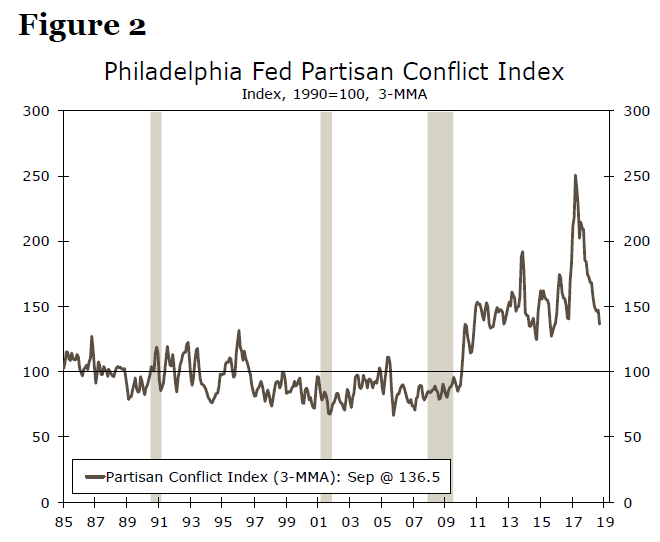
As we approach the climax of the campaign season, the U.S. economy continues to expand at a healthy clip despite perceived uncertainty about the political outcome post November 6. While difficult to measure, some of the leading measures of economic policy uncertainty or partisan conflict have shown few signs of breaking out (Figures 1 and 2).1 Given this backdrop, in the sections below we highlight some of the key areas we will be watching post-midterms and lay out what assumptions underlie our macroeconomic forecast at this time.
Tax Policy: Could the Tax Cuts and Jobs Act Be Repealed or Expanded?
The tax reform bill passed at the end of 2017 (denoted here as the Tax Cuts and Jobs Act, or TCJA) was arguably the most significant policy change to occur since the 2016 election as it relates to our macroeconomic outlook. Perhaps the two questions we hear most often on this front are 1) might a Democrat-controlled Congress repeal the tax cuts or 2) might Republicans maintaining control of Congress lead to even more sweeping tax cuts?
At this time, neither of these two scenarios are our base case, and as such as we have no major tax policy changes baked into our forecast for the foreseeable future. While Democrats in Congress may wish to repeal some or all of the TCJA, it seems unlikely the president would sign a bill to repeal one of the landmark achievements of his presidency were Congress to pass a bill along these lines. Even in the most successful of election outcomes, Democrats would need bipartisan support for the two-thirds majority necessary in the House and Senate to override a president's veto.
What about the possibility of more tax cuts from a Republican-dominated Congress? This is possible, although any "Tax Reform 2.0" is likely to be limited in scope, as we laid out in a report written in August.2 In short, when Republican policymakers outlined their main goals of a second tax bill, the key plank appeared to be an effort to make permanent the individual tax cuts that are currently set to expire in 2025. Unless Republicans are able to secure a 60 seat majority in the Senate, however, this would require bipartisan support or some way to offset the cost of making the tax cuts permanent. This is because the reconciliation process, which was used to pass the TCJA with less than 60 votes, is likely not an option for making the individual tax cuts permanent (had it been an option, they probably would never have been temporary in the first place). Thus, from our point of view, the likelihood of a significant fiscal contraction or expansion from a change in tax policy next year is relatively small, absent a major change in economic conditions.
Federal Spending: Tighter Times Ahead?
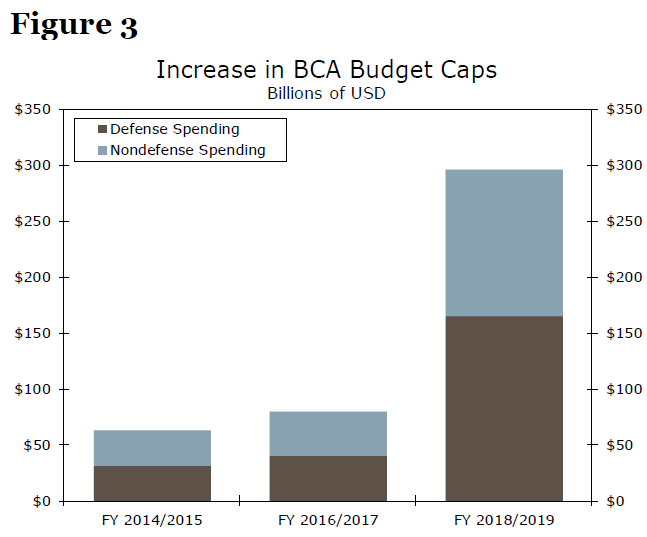
The spending side of the ledger is a more obvious catalyst for change on the other side of the midterm elections. At present, the United States is operating under a two-year budget deal that expires on September 30, 2019. This most recent budget deal increased discretionary spending well above the caps imposed by the Budget Control Act of 2011 (BCA) and was nearly quadruple the increase passed for the FY 2014/FY 2015 period (Figure 3). Under current law, however, inflationadjusted discretionary spending would likely fall in FY 2020 as the BCA caps snap back into place. Were this to occur, the spending side of the ledger would likely swing from a net positive to a netnegative for the direct impulse to economic growth.
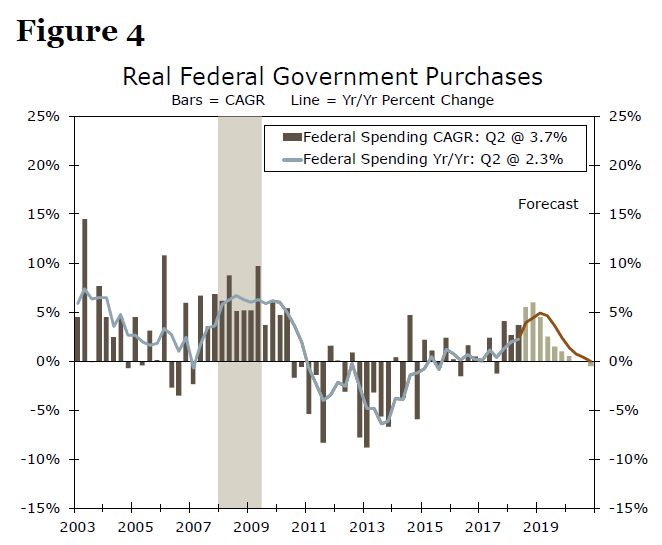
In our forecast, we have essentially split the difference between the fiscal expansion of the past few years and the looming fiscal contraction that would occur under current law (Figure 4). Inflationadjusted federal consumption and investment growth converges toward zero in 2020, leading federal spending to have a more neutral direct impulse to growth. With the 2020 election starting to loom by fall 2019, it seems unlikely policymakers on either side of the aisle will want a material fiscal contraction. That said, with budget deficit pressures having mounted significantly, there will also likely be some counter pressure to limit (to some extent) any additional spending growth. Put more plainly, our base case is for policymakers to once again increase discretionary spending above the BCA caps, but more in-line with what was seen from FY 2014-2015.
That said, we see more uncertainty in this forecast than on the tax front. President Trump has appeared sympathetic to policy stimulus of all kinds, and our current forecast is for U.S. economic growth to start slowing in the second half of 2019 into 2020. Were that to occur, it is possible fiscal policymakers might see another large boost to spending as just what the doctor ordered. Alternatively, it is easy to imagine a scenario where a Democratically-controlled Congress and the president engage in a prolonged budget standoff next year that results in a sharper deceleration in federal government spending than we currently envision.
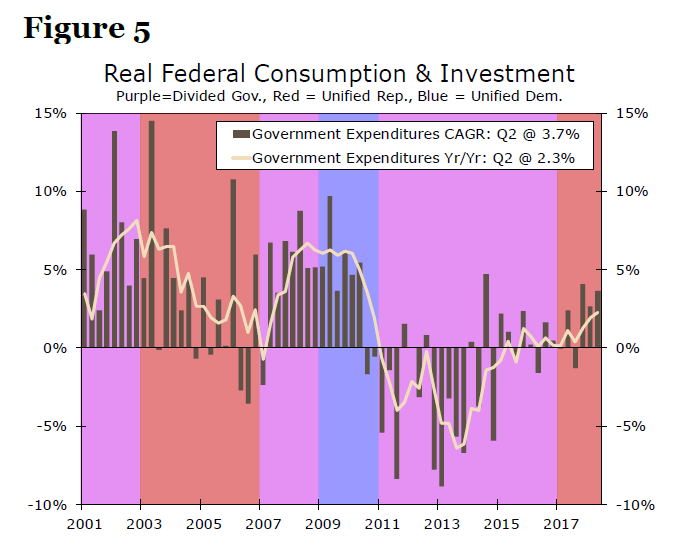
When turning to history as a guide, the trend in federal consumption and investment shows no obvious trend when the federal government is under divided or unified party control, regardless of which party holds the reins (Figure 5). Thus, we see the balance of risks here as roughly balanced, though regardless of the outcome the impact will not likely be felt until 2020.
The Budget Deficit: Will the Pace of Growth Continue?
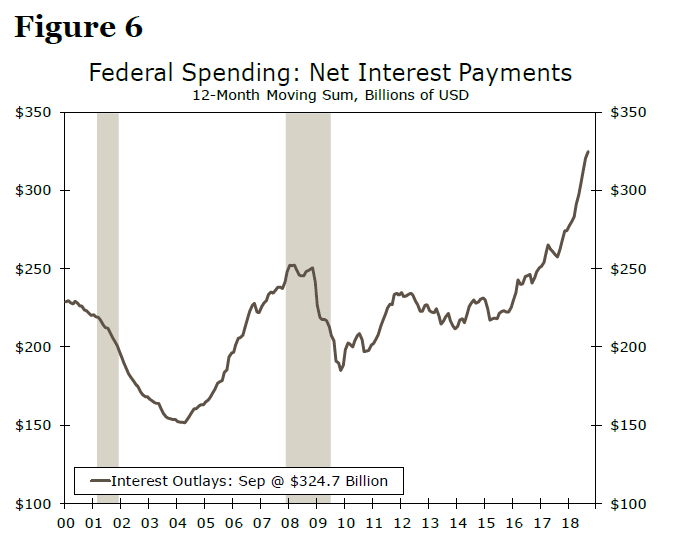
Against this backdrop, our forecast for the federal budget deficit in FY 2019, which just began on October 1, is $1.05 trillion. If realized, this would mark a significant widening from the FY 2018 budget deficit of $779 billion, as the tax cuts and increased spending will be in effect for the full fiscal year. After FY 2019, however, we expect the deficit to continue widening, but at a much slower pace than seen over the FY 2018-2019 period. An aging population and rising health care costs/interest rates will be structural pressures, but the one-time level shift in the deficit as a result of the tax cuts/2018 budget deal will have largely faded. Skyrocketing net interest spending is one reason we are skeptical of a major infrastructure bill passing the next Congress if the economy remains in fairly healthy shape (Figure 6). In a sense, the time to "borrow and build" has passed as interest rates have continued to normalize.
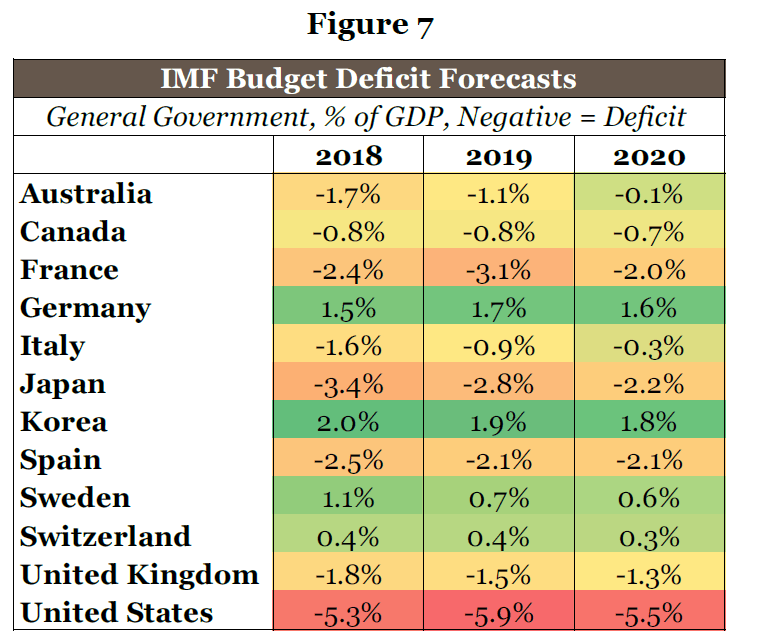
Might the next Congress, regardless of its composition, surprise us with more fiscal stimulus than we have baked into our forecast? It is certainly possible, particularly if the economy were to sharply decelerate. But when viewed through an international lens, fiscal policy in the United States is already remarkably expansionary. Despite economic growth that is among the fastest in the developed world at present, the United States is currently running the largest budget deficit across all levels of government relative to its major developed economy peers (Figure 7).
What about other Policy Areas?
One final policy area we will be keeping an eye on post-midterms is the debate over the USMCA, the deal negotiated to update and replace portions of NAFTA. Though the president will likely sign the agreement before year's end, a vote in the House and Senate is unlikely until 2019. Divided government, should it come to pass, could make this a bit more of rocky process. One aspect of the trade agreement process that should help regardless of the election outcome is that, unlike many other forms of legislation, the process by which trade agreements are voted on in Congress makes it much harder for a determined group of Senators to use procedural measures to indefinitely delay a vote in the upper chamber.3 Thus, while the road ahead may prove to be rocky at times, our forecast assumes that the NAFTA renegotiation of the past couple years ends with the eventual adaptation of the USMCA.
Other policy areas, such as health care, could also enter the spotlight in the next Congress. But, while the political battles in these areas will surely grab major headlines as the Affordable Care Act debate did in 2017, more often than not these debates are not enough for us to make material changes to our macroeconomic forecast for key variables such as U.S. economic growth, interest rates, etc. We will be monitoring them closely and will update our readers should any developments in these other policy areas change our thinking about the economic outlook.
Conclusion
In this report, we have laid out the key assumptions that underpin our economic forecast and done our best to highlight how that thinking might change under different conditional midterm election outcomes. Broadly speaking, however, we are skeptical that the 2018 midterms will have macroeconomic consequences of the same magnitude as the 2016 election. That said, politics, like the economy, is often full of surprises, and we will be monitoring any developments in the month ahead that might change our view. Should anything occur on the policy front that changes our thinking, we will update our forecast and readers accordingly.
1 For those interested in reading more about these indices, please see http://www.policyuncertainty.com/media/EPU_BBD_Mar2016.pdf https://www.philadelphiafed.org/research-and-data/real-time-center/partisan-conflict-index
2 Bryson, J.H., Kinnaman, A. & Pugliese, M. (August 2018). "Tax Reform 2.0: The Sequel." Wells Fargo Securities Economics Group. Also available upon request.
3 For further reading on the procedural timeline for USMCA's future in Congress, see Fergusson, F. I, & Davis, M.C. (September 2018). "Trade Promotion Authority (TPA): Frequently Asked Questions." Congressional Research Service.