

Sample Category Title
Gold: Yellow Metal Reverses Its Losses This Morning
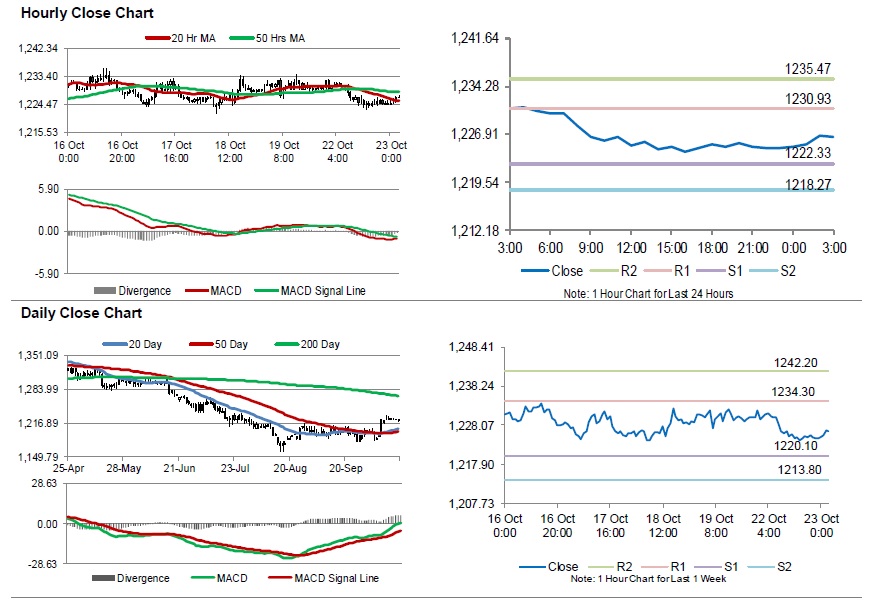
For the 24 hours to 23:00 GMT, Gold declined 0.46% against the USD and closed at USD1224.80 per ounce, amid strength in the US dollar.
In the Asian session, at GMT0300, the pair is trading at 1226.40, with gold trading 0.13% higher against the USD from yesterday’s close.
The pair is expected to find support at 1222.33, and a fall through could take it to the next support level of 1218.27. The pair is expected to find its first resistance at 1230.93, and a rise through could take it to the next resistance level of 1235.47.
The yellow metal is trading between its 20 Hr and 50 Hr moving average.
Silver: White Metal Trading On A Weaker Footing In The Asian Session
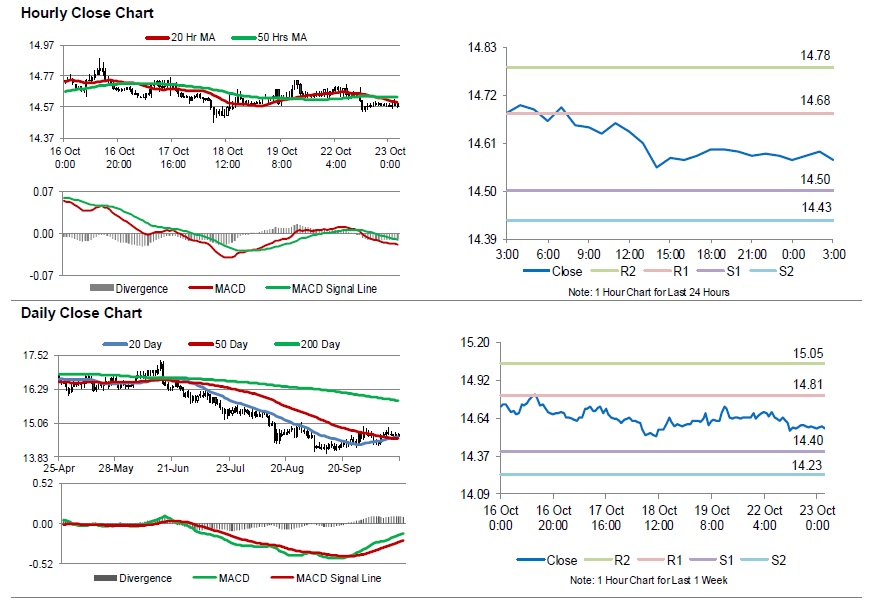
For the 24 hours to 23:00 GMT, Silver declined 0.58% against the USD and closed at USD14.58 per ounce, tracking losses in gold prices.
In the Asian session, at GMT0300, the pair is trading at 14.57, with silver trading 0.07% lower against the USD from yesterday’s close.
The pair is expected to find support at 14.50, and a fall through could take it to the next support level of 14.43. The pair is expected to find its first resistance at 14.68, and a rise through could take it to the next resistance level of 14.78.
The white metal is showing convergence with its 20 Hr moving average and trading below its 50 Hr moving average.
Crude Oil: Oil Trading Lower, Ahead Of API’s Weekly Crude Oil Stockpiles Data
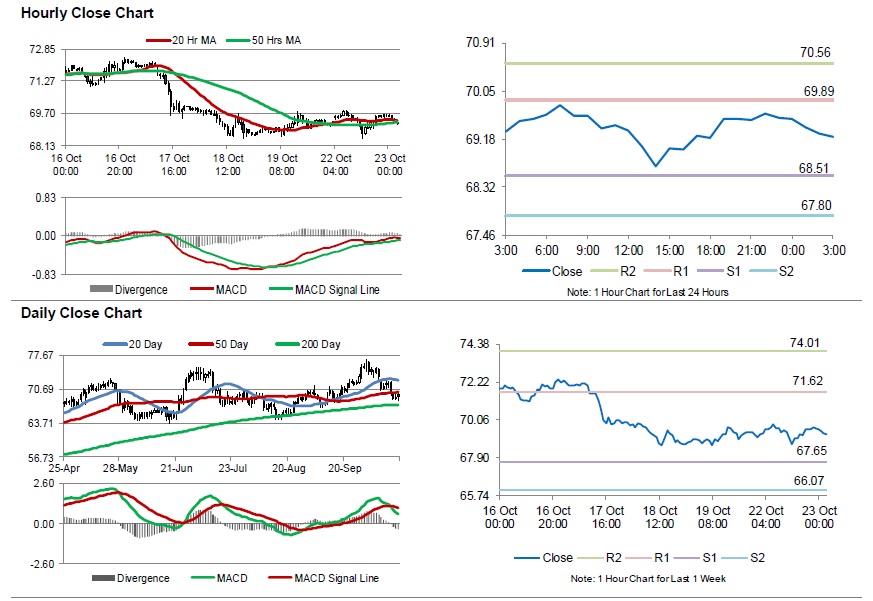
For the 24 hours to 23:00 GMT, Crude Oil rose 0.48% against the USD and closed at USD69.57 per barrel.
In the Asian session, at GMT0300, the pair is trading at 69.23, with oil trading 0.49% lower against the USD from yesterday's close, after Saudi Arabia pledged to keep energy markets supplied.
The pair is expected to find support at 68.51, and a fall through could take it to the next support level of 67.79. The pair is expected to find its first resistance at 69.89, and a rise through could take it to the next resistance level of 70.56.
Crude oil is showing convergence with its 20 Hr and 50 Hr moving averages.
An update on AUD/USD short, lower the stop slightly
Here an update on our AUD/USD short (entered at 0.7100) as last discussed in the weekly report. Finally, we're seeing the weakness anticipated in the pair as it drops to as low as 0.7058 so far today. The solid break of 0.7088 minor support argues that corrective rise from 0.7040 is likely competed at 0.7159 already. And the larger fall is possibly resuming. Further decline should be seen to 0.7040 first.
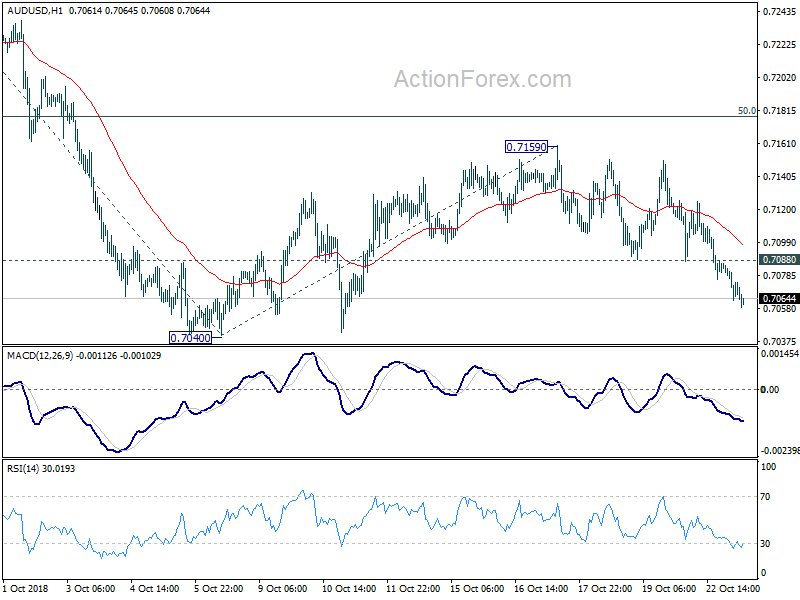
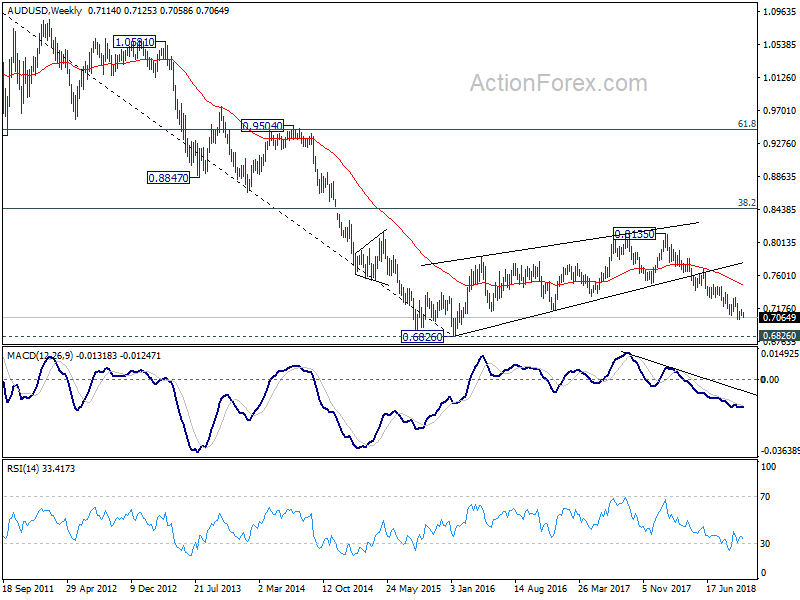
Break of 0.7040 will resume whole down trend form 0.8135 and should target a test on 0.6826 (2016 low). It's still early to tell. But we're looking at the possibly of resuming long term down trend from 1.1079 (2011 high). We'll looking downside momentum of the next fall, upon breaking 0.7040, to gauge the chance.
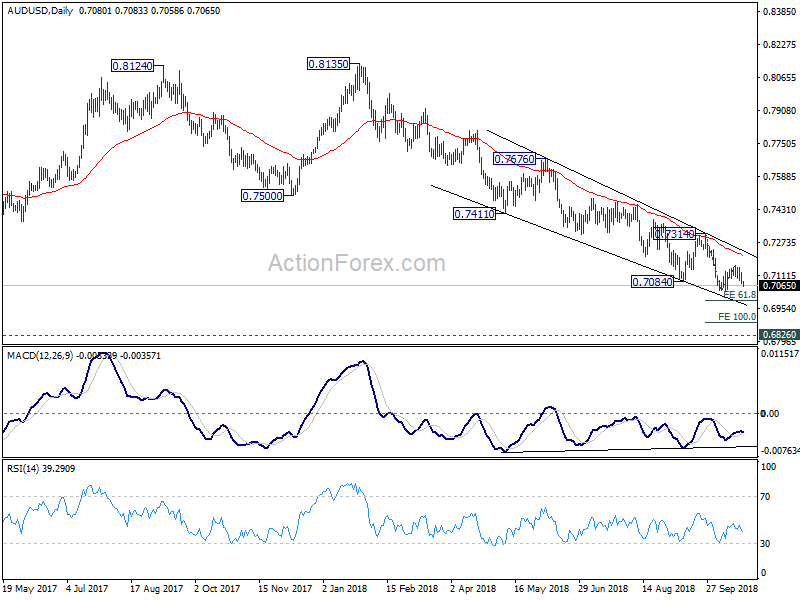
For now, we'll hold on to the short position. Stop will be lowered from 0.7185 (slightly above 50% retracement of 0.7314 to 0.7040 at 0.7178) to 0.7165 (slightly above 0.7159 resistance). We'll decide whether to exit at around 0.6826 later.
ECB Likely More Cautious amid Soft Core Inflation and Italy. Reinvestment Details to be Revealed in December
We expect ECB to emphasize downside risk to growth in this week's meeting on October 25. That would be a slight shift from the more hawkish stance at the last meeting six weeks ago. With the path of QE announced in June, the focus is on the reinvestment arrangement. Yet, we do not expect the central bank to give much detail on the issue until the December meeting. Market volatility has recently spiked as Italy’s aggressive budget plan might violate EU’s fiscal rule and has triggered rating downgrade. We expect discussion about the issue at the press conference. There would be no new staff economic projections.
At the testimony before the European Parliament last month, President Mario Draghi noted “a relatively vigorous pick-up in underlying inflation” and suggested that “reflecting these dynamics, the ECB projections foresee inflation excluding food and energy reaching 1.8% in 2020”.
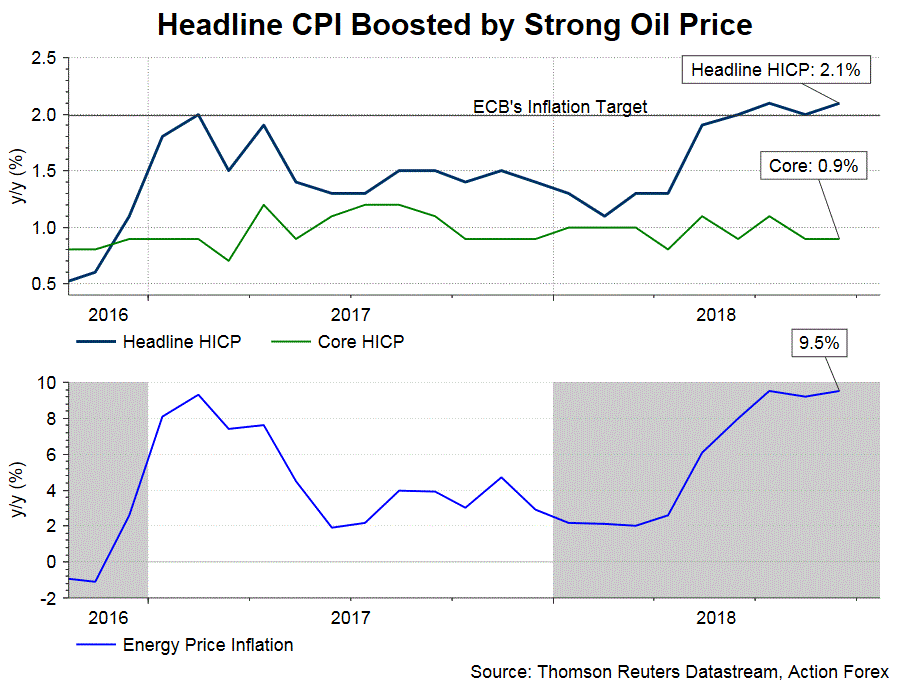
Yet, the dataflow released afterwards did not suggest the same. Headline HICP steadied at +2.1% y/y in September. Core inflation remained soft at +0.9% y/y, from +1.2% in August. The divergence can be explained by strong energy price inflation, which jumped +9.5% y/y last month.
While headline inflation might signal that the ECB’s target (inflation below, but close to, +2%) has more or less been attained, the trend in the core reading indicates that the underlying momentum remains soft. Risk is skewed to downside for ECB’s forecast of 2019 inflation at 1.5%. Meanwhile, the economic growth outlook is clouded by trade protectionism and Brexit uncertainty.
Earlier this month, the Italian government has announced that it would now set the budget deficit targets to 2.4% of GDP for 2019, 2.1% for 2020 and 1.8% for 2021. The draft plan has been submitted to the European Commission for assessment. The Commission would discuss the plan today and is expected to reject the proposal.
The budget plan has led Moody's to lower Italy’s credit rating to "Baa3" from a previous "Baa2". It’s now just one notch above junk with a stable outlook. On October 13, Draghi criticized the Italian government for creating damage. As he noted, “a budgetary expansion in a high debt country becomes much more complicated … The results… is that household and firms pay higher interest rates on loans”.
Meanwhile, under the EU rule, the ECB is not allowed to offer rescue if Italy’s government or its banking sector run out of cash unless the country secures a bailout from the EU. We expect questions from the floor at Q&A if Draghi does not talk about it in his speech
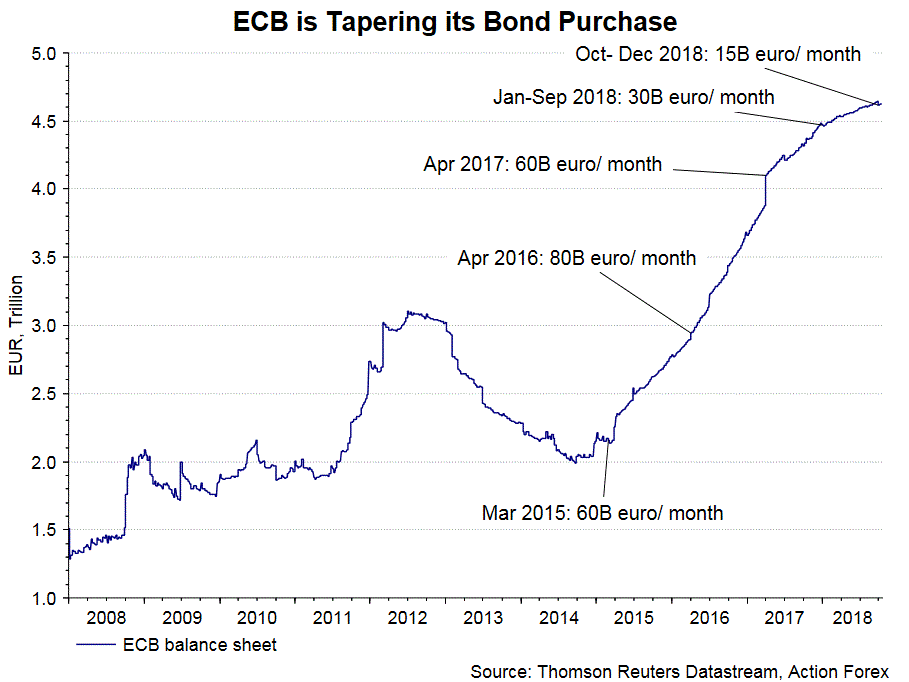
At the June meeting, ECB announced that the monthly purchase of asset would reduced to 15B euro from October to December. The central bank has indicated that the reinvestment plan would be revealed before end of the year. While Draghi has affirmed that “capital key” is the guideline for the reinvestment process, ECB member Olli Rehn suggested that the will be a new capital key which is going to be the guiding principle. Given uncertain economic outlook and Italy’s budget issue, we believe December would be a better timing for the announcement. It gives the members more time for assessment.
Markets shrug Trump’s unsubstantiated tax cut for middle class
Trump talked about the plan to give middle class 10% tax cut yesterday. He said "we're putting in a resolution some time in the next week and a half to two weeks [and] we're giving a middle-income tax reduction of about 10 percent." He insisted that the plan will go through Congress rather than executive order. And the vote will be done after mid-term election.
But the initiative is widely criticized as unsubstantiated as Republican congressional leaders and White House officials were reported to have heard nothing about the plan. Additionally, Congress is in recess ahead of mid-term election and there is no plan to return to Washington for the matter.
White House spokeswoman Lindsay Walters clarified yesterday that "as part of Tax Reform 2.0, the first elements of which were passed the House in September, the President would like to see an additional tax cut of 10% for middle-income families." That effectively confirmed that the idea of 10% tax cut is something entirely new.
The three bills of the so called Tax Reform 2.0 was passed in the House in late September. And it's already facing a tough batter in the Senate. It is seen as nearly impossible to add additional deficit ballooning 10% tax cut to the plan and get through either House or Senate. The claimed 10% tax cut for the middle class is seen as campaign gimmick rather than anything with substance.
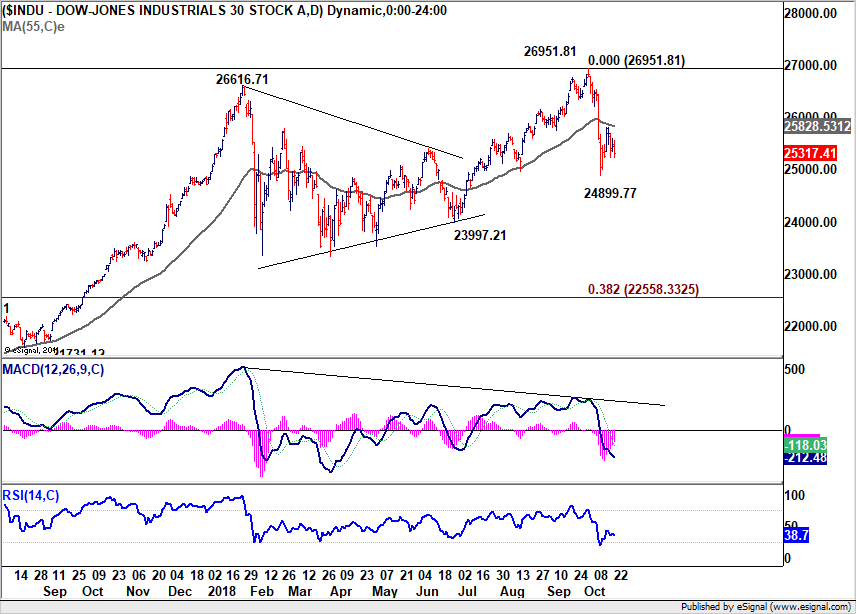
The US markets shrugged off the news with DOW closing down -0.50% at 25317.41. Consolidation from 24899.77 is in progress but fall from 26951.81 medium term should resume sooner or later.
UK May: Brexit transition extension or backstop is a sovereign choice
Speaking to the Parliament yesterday, UK Prime Minister Theresa May outlined four more steps to complete the remaining 5% of Brexit agreement with the EU. Those include a firm commitment to EU-UK temporary customs arrangement; an option to extend the implementation period as alternative to Irish backstop; the flexibility for the UK to leave as will; and, ensuring full access for all of Northern Ireland business to the Great Britain.
May added that both the option of transition extension and backstops only insurance policy and are undesirable. And the best outcome is for the future arrangement to be in place by December 2020. And she added that it would be a "sovereign choice" on whether an extension or a UK-EU customs backstop would be preferable.
May also said that "95 per cent of the Withdrawal Agreement and its protocols are now settled." But Labor leader Jeremy Corbyn criticized that "nothing is agreed until everything is agreed."
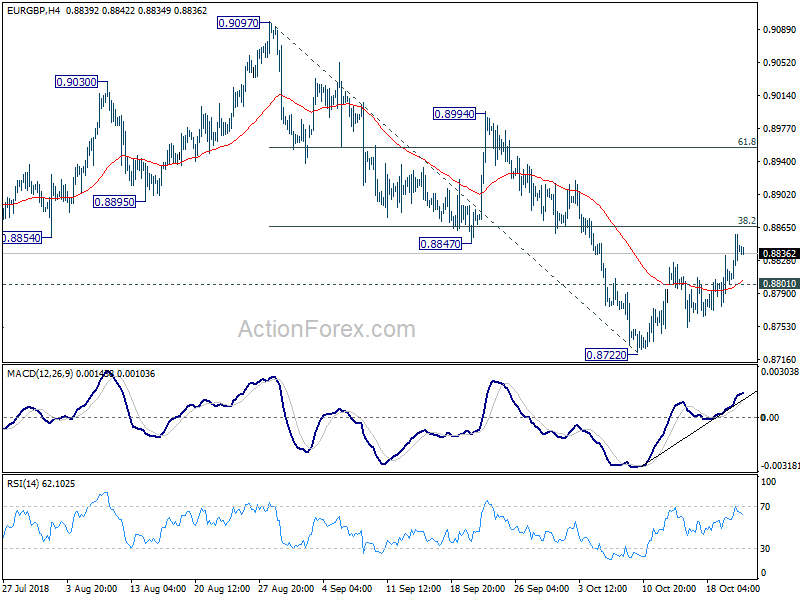
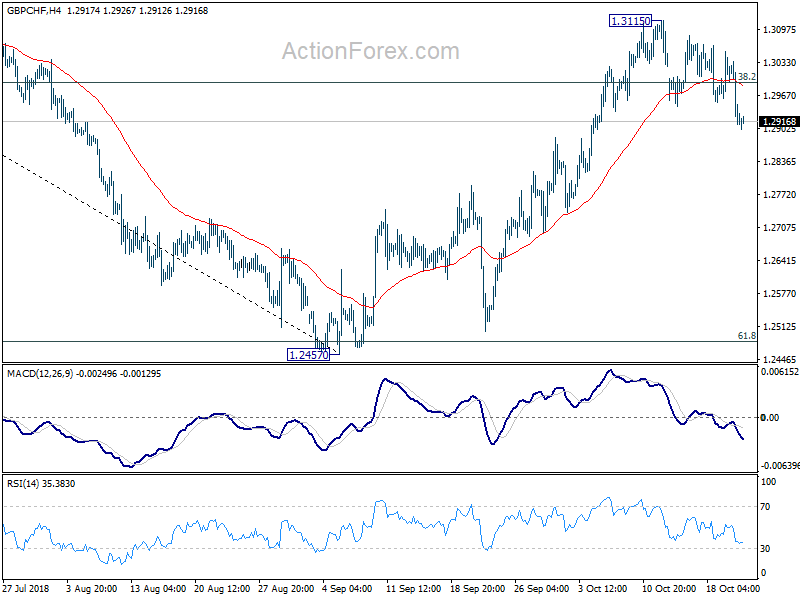
Sterling is notably lower against Euro and Swiss Franc since the start of the week.
Market Morning Briefing: Pound Has Broken Below 1.30 And Could Target 1.28 In The Next 1-2 Weeks
STOCKS
Bears are still hovering around ready to take control in Shanghai, Nifty and Nikkei. Dax and Dow has supports below current levels and would have to see some range trade before attempting to move up.
Dow (25317.41, -0.50%) was dragged lower as energy and financial stocks declined in yesterday’s trade. We continue to hope that the support at 25000 may hold, limiting the downside scope for Dow in the longer run. But, failure to hold above 25000 would open up chances of testing 24000 levels on the downside. Dow is likely to trade above 25000 for at least this week and the next. Preference is for a bounce from 25000.
Dax (11524.34, -0.26%) dipped back again after trying to rise above 11600. As mentioned yesterday, support near 11300-11400 may hold in the near term eventually pushing back the index to higher levels.
Nikkei (22200.53, -1.83%) has been trying to move back to levels above 22400 but is unable to sustain at higher levels. The index has again fallen back towards 22200 and while the struggle to move up continues, the bears could take over leading to sharp fall in the coming sessions towards 21500-21000. Sentiment remains bearish while below 22200.
Shanghai (2635.53, -0.73%), after bouncing back well from support near 2450 could now head towards immediate resistance near 2750 and would find it difficult to break on the upside on first attempt. Channel downtrend is holding for now as seen on the 3-day candle chart and while 2750 holds, another dip is possible from there by next week. Near term looks bullish followed by a fall back towards 2600.
Nifty (10245.25, -0.57%) has weekly support at 10200 and lower support on the 3-day candle chart at 10000. These supports are crucial in the medium term and could well produce a bounce back towards 10800-10900 in the longer run. For now, we consider a scope of testing 10000 on the downside before starting to move up again.
COMMODITIES
Precious metals and Copper is stuck in the small narrow range while Crude prices may find some support below current levels.
WTI (69.23) has immediate support on the weekly candles and a bounce back towards 74-76 levels looks likely in the near term.
Brent (79.55) on the other hand has some more room on the downside towards 76 which is likely to be tested before a bounce is seen. Overall crude prices look bullish for the medium term while the mentioned supports hold.
Gold (1226.50) is stuck in the narrow range above 1210/20 levels and could probably remain so this week. 1240 is an important immediate resistance on Gold and could possibly push the prices back towards 1210. But in the longer run, a break above 1240 is needed to initiate the bullish momentum taking the prices towards 1250+.
2.70-2.83 is the trade zone for Copper (2.7755) for the next 5-6 sessions. Sideways consolidation is likely to continue for some more time with an eventual break on either direction thereafter initiating a sharp move. A break out on either direction would be accompanied by similar movement in the Chinese Stock prices and Aussie.
FOREX
Pound has broken below 1.30 and could target 1.28 in the next 1-2 weeks. Watch crucial supports near 1.141 and 0.704 on Euro and Aussie. Watch resistance near 73.60 on USDINR.
Euro (1.1462) came off from resistance near 1.155 yesterday and could move lower towards support on 3 day candles near 1.141-1.142 in the next couple of sessions.
Dollar Index (96.016) – Contrary to our expectation, Dollar Index has again moved up and is now close to resistance near 96.20-30 on 3 day candles. A break above this resistance could potentially be bullish in the next 1-2 months.
Dollar Yen (112.57) – While above 112.5, it could rise towards the 21 days MA at 112.96, which could provide some near term resistance. Support near 112.0-112.2 would have to break, for us to start looking at the downside.
Euro-Yen (129.03) saw a false break yesterday above resistance trendline on daily candles and is now again trading below the resistance near 129.40. It continues to look bearish and could test 128.5 in the next 1-2 sessions. Over the next 2-4 weeks, a test of 127 (support on weekly candles) is possible.
Pound (1.2967) has broken below support at 1.30 on daily candles. While below 1.300-1.302, it could move lower to test levels near 1.29 in this week. It could target support on weekly candles near 1.28 in the next couple of weeks.
Aussie (0.7069) – Contrary to our expectation of a rise towards 0.715, Aussie has fallen below 0.71 and could test support near 0.705-0.704 in today’s session. As we have been saying, 0.705-0.704 is a crucial long term support level, which if broken, could be very bearish for the Aussie.
Dollar Rupee (73.56): Support at 73.20 is holding well. Another attempt to re-test 73.20 could be seen over the next couple of sessions. Else, a break above 73.60 on the upside could take it higher towards 73.80.
INTEREST RATES
India 10 year yield (7.93%) : While above 7.90%, it could rise towards 8% in the near term. A break back below 7.90% would however open up support near 7.80%-7.75%.
The US 10 Year (3.18%) : Repeating yesterday’s comments: Support to watch out for is now slightly higher near 3.17%. While above that, there are chances of a rise towards the previous high of 3.25%-3.26%. A break below 3.17% could take it towards 3.10%. -
10 Year German-US spread (-2.73%) is likely to fall towards long term support near -2.80%. A break below -2.80% (if it happens) would be very bearish.
2 Year German-US Spread (-3.49%) has room to fall further towards -3.56% to -3.60% in the near term.
German 10 year yield (0.45%) – Repeating yesterday’s comments: While below 0.55%-0.60%, it could fall towards support near 0.35%-0.30% in the near term. A break of 0.30% (if it happens) would be very bearish.
European Commission to discuss actions on Italy’s budget today
European Commission is set to discuss the actions regarding Italy's draft budget today. Italy sent a three-page letter to the Commission yesterday, explaining its position on the budget, but without directly addressing the questions as presented by the Commission's letter to them. Instead, Economy Minister Giovanni Tria tried to pain the budget plan, raising deficit target to 2.4% of GDP, as a "hard but necessary" decision after considering "macroeconomic and social conditions". Prime Minister Giuseppe Conte, also expressed the willingness for a "constructive dialogue" but reject any prejudice.
European Commissioner for Economic Affairs Pierre Moscovici emphasized the "the European commission does not want a crisis between Brussels and Rome." But he added that "the maximum that we can do … is to ask Italy to resubmit another budget, which takes account of the observations, of the questions, and also of European rules."
While attentions are mainly on the top line 2.4% of GDP deficit target, there are other issues that are yet to be addressed by Italy. In particular, the Italian government forecasts the economy to growth 1.5% in 2019, based on the budget. However, as the Commission pointed out in its letter, the plan has not been endorsed by any "independent fiscal monitoring institution", like the Parliamentary Budget Office. And that's a breach of EU rules. The growth projection is the basis for deficit target calculation and Italy has to either ask the PBO to reveal and endorse it, or explain why they just come up with the numbers on their own.
GBP/USD Targets Fresh Monthly Lows Below 1.2920
Key Highlights
- The British Pound failed to break the 1.3250 resistance and declined sharply against the US Dollar.
- There is a connecting bearish trend line formed with resistance at 1.3050 on the 4-hours chart of GBP/USD.
- The Chicago Fed National Activity Index (CFNAI) declined from the last revised reading of 0.27 to 0.17 in Sep 2018.
- Today, the UK CBI Industrial Trends Orders Survey Index for Oct 2018 will be released, which is forecasted to remain at -1.
GBPUSD Technical Analysis
This past week, the British Pound climbed above the 1.3120 and 1.3150 resistances against the US Dollar. However, the GBP/USD pair failed to break the 1.3250 resistance area and started a downside move.
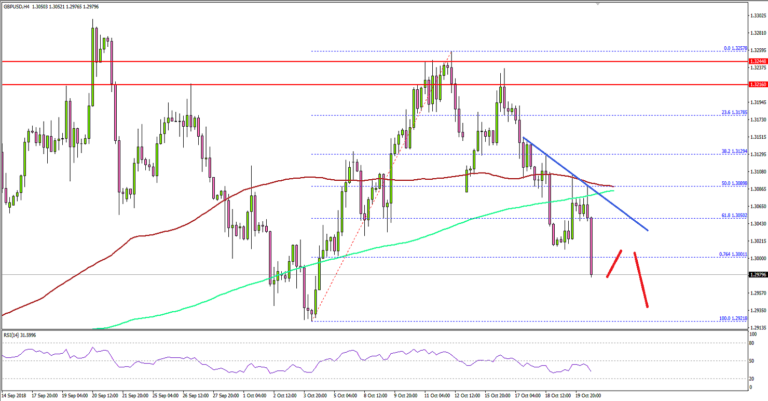
Looking at the 4-hours chart, the pair failed to hold key supports near the 1.3150 and 1.3100 levels and declined heavily. During the decline, the pair even settled below the 1.3100 support and the 100 simple moving average (red, 4-hours).
More importantly, there was a break below the 61.8% Fib retracement level of the last upside wave from the 1.2921 low to 1.3257 high. It opened the doors for more losses and the pair declined below 1.3000.
If the pair continues to move down, it could soon test the 1.2921 low, below which it could target a new monthly low. The next support could be near the 1.2850 level and the 1.236 Fib extension level of the last upside wave from the 1.2921 low to 1.3257 high.
On the upside, there is a strong resistance near the 1.3040 level. There is also a connecting bearish trend line formed with resistance at 1.3050 on the same chart.
A proper break above the trend line and the 100 SMA is needed for buyers to take back control. If not, there is a risk of more losses towards or below 1.2920 in the near term.
Economic Releases to Watch Today
- UK's CBI Industrial Trends Survey Orders Oct 2018 (MoM) – Forecast -1, versus -1 previous.
- German Producer Price Index for Sep 2018 (MoM) – Forecast +0.3%, versus +0.3% previous