

Sample Category Title
Market Morning Briefing: Aussie Should Test Resistance Near 0.72 In This Week
STOCKS
Dow (25250.55, -0.35%) is likely to trade sideways above support near 25000 for a few sessions before rising up towards 25750-26000. While above 25000, near to medium term looks bullish. Only if the index breaks below 25000, we would look at further downside.
Dax (11614.16, +0.78%) has important weekly support near 11400 which is likely to hold in the near term producing a bounce back towards 11700-11800 levels. As mentioned yesterday, Dax managed to close above 11600 and if the rise sustains, the index could attempt to move up in the next few sessions.
Nikkei (22421.27, +0.67%) is stable today. Trading above support at 22000, Nikkei could see some ranged trade in the 22600-22000 region. A rise above 22600 is needed to bring back near term bulls into the picture. Else, while below 22600, the index continues to look bearish and could make fresh lows.
Shanghai (2577.99, +0.39%) is also ranged in the 2650-2500 region. Note 2450 on the downside is an important support level and we do not look at levels below 2450 in the medium term. The index could soon bounce back towards 2700 in the near term.
Nifty (10512.50, +0.38%) is trying to rise towards 10700-10800 levels. Interim corrective fall from there could be seen thereafter, falling back towards 10500.
COMMODITIES
Brent (81.07) could see an interim rise towards 82-84 levels before coming off from there. On the medium term, there is room on the downside towards 78-76 levels.
WTI (71.92) is stable and is trading above immediate support levels. 21MA and 13MA on the 3-day candles provide support as well. While these hold, near term looks bullish for WTI. Note that scope of falling to 68 is not fully negated just now.
Gold (1229.50) has been steadily rising and cold soon test 1250-1260 on the upside. In the longer term, there is scope for eventually rising towards 1300. View is bullish.
Copper (2.7830) will have to break out from the ranged movement within 2.85-2.75 region to determine further course of movement. For now, this week could see the range trade to continue.
FOREX
Watch support at 111.60-70 on Dollar Yen. Euro could rise to 1.1611 while above 1.154. USDINR needs to break below 73.60 for confirmation of a deeper correction.
Euro (1.1583) : While above 1.154, it could retest the 21 days MA at 1.1611 in today’s session. A break above that would increase chances of resistance near 1.17 being tested in Oct. Conversely, a break below 1.154 could negate the above mentioned upside possibility.
Dollar Index (95.05) should dip to support near 94.60-70 by tomorrow as the Euro possibly rises towards 1.1611. After that, a break beyond 1.1611 on the Euro would correspond with a further dip for the Dollar Index towards 94.2-94.1. This would be a crucial support to watch out in Oct-Nov.
Dollar Yen (111.97) tested crucial support near 111.60-70 yesterday and is currently staying above it. While below 112.2, it could break below the 111.60-70 support. Conversely, a breach above 112.2 would open up another test of 113-114. Yesterday, we had said that preference is for the support to hold – however, the preference has now shifted more towards a possible break of the support.
Euro-Yen (129.68) looks bearish towards 127 on 3 day and weekly candles – this level could be tested sometime in the next 2-3 weeks. In this week, while below 130, it could move further down towards 129.
Pound's (1.3149) would need to break below 1.3086 (yesterday’s low) if 1.30 has to be tested in this week. Otherwise, it could now keep rising towards 1.325 (resistance on daily candles) and then come off from there later in the week.
Aussie (0.7138) should test resistance near 0.72 in this week or max by next week. A break above 0.72 and then above 0.7322 (21 weeks MA) would be required to negate the possibility of a downside below 0.705 in the next 1-2 months.
Dollar Rupee (73.835): Watch Support at 73.80-70 today. Can still produce a bounce to 74.00-25 if it holds. A break below 73.60 (at least) would be needed to suggest otherwise.
INTEREST RATES
India 10 year yield (7.92%) – As expected, it has moved down towards support near 7.90%. In case this support breaks, there is lower support near 7.80%-7.75%, which should hold in Oct-Nov. Conversely, a break below that would be very bearish.
The US 10 Year (3.16%) : Immediate support for the US 10 year seems to be near 3.15%. Only if it breaks below that, we can look at lower levels. While above this support, it could retest resistance near 3.25%.
Yesterday, US Retail Sales data showed that the growth in Sep (0.1%) was much lower than the expected 0.6%. This could have had a bearish impact on yields but increased supply of US treasury bonds seems to be keeping yields elevated. If further more data releases on the US economy disappoint in the next couple of weeks, the chances of a break below 3.15% on the US 10 year would increase. Watch out for the US Industrial Production data release today.
10 Year German-US spread (-2.66%) – There is immediate resistance near -2.60% to -2.65% and support near -2.725%. Medium term preference is for a break below -2.725% towards lower long term support near -2.80%. A break above -2.60% would however negate the medium term bearishness.
RBA minutes: USD appreciation raised risks for emerging economies, but helpful to Australia
In the minutes of October 2 meeting, RBA noted that global economic conditions had continued to be positive for Australia, despite risks including trade policies. Also, elevated energy and bulk commodity prices supported its terms of trade. Broad based appreciation of the US dollar "had raised risks for some economies, particularly the more fragile emerging market economies". But the "resultant modest depreciation of the Australian dollar was likely to have been helpful for domestic economic growth.
Domestically, RBA maintained that GDP growth would be "above potential over the following two years". Forward-looking indicators of labour demand continued to point to above-average growth". And wage growth is expected increase "gradually". However, subdued household income growth remained an "important source of uncertainty for the outlook for consumption and inflation."
Overall, RBA also maintained that " the next move in the cash rate was more likely to be an increase than a decrease." However, "since progress on unemployment and inflation was likely to be gradual, they also agreed there was no strong case for a near-term adjustment in monetary policy."
(RBA) Minutes of the Monetary Policy Meeting of the Reserve Bank Board
Sydney – 2 October 2018
Members Present
Philip Lowe (Governor and Chair), Guy Debelle (Deputy Governor), Wendy Craik AM, Philip Gaetjens, Ian Harper, Allan Moss AO, Carol Schwartz AM, Catherine Tanna
Members granted leave of absence to Mark Barnaba AM in terms of section 18A of the Reserve Bank Act 1959.
Others Present
Michele Bullock (Assistant Governor, Financial System), Luci Ellis (Assistant Governor, Economic), Christopher Kent (Assistant Governor, Financial Markets), Alexandra Heath (Head, Economic Analysis Department), Jonathan Kearns (Head, Financial Stability Department)
Anthony Dickman (Secretary), Andrea Brischetto (Deputy Secretary)
International Economic Conditions
Members commenced their discussion of the global economy by noting that GDP growth in many of Australia's trading partners had continued at an above-trend pace in the first half of 2018. Although timely measures of global activity had recently eased somewhat, global growth was expected to remain solid over the following couple of years. Members noted that developments in trade policies continued to pose significant risks to this outlook. While the United States had concluded trade negotiations with Canada and Mexico, additional tariff measures had been implemented by the United States and China in the weeks leading up to the meeting. To date, the tariffs imposed on US imports of Chinese products had affected capital goods and industrial inputs proportionately more than consumer goods.
In the United States, GDP growth had remained strong in the first half of 2018 and, more recently, industrial production growth and surveyed conditions in the manufacturing sector had been robust. The strength in economic activity had partly reflected the fiscal stimulus, which had more than offset any effect of higher tariffs. GDP growth had remained above trend in the euro area and Japan. Growth in output in Japan had been supported by strong growth in investment, which was expected to continue. However, growth in industrial production in Asia had eased, as had growth in exports and new export orders; exports from the euro area to China had also eased.
Above-trend growth in the major advanced economies had led to further absorption of spare capacity in their labour markets. As a result, wages growth had increased noticeably. Members observed that minimum wages had been increasing faster than average wages across a number of economies. Most notably, in South Korea minimum wages had increased by more than 15 per cent in 2018 and a further increase of 10 per cent was scheduled for 2019. Members noted that increases in minimum wages of this magnitude could affect employment decisions, although smaller increases, such as the recent increase in Australia, were unlikely to have a material effect on growth in employment.
Higher wages growth had contributed to a pick-up in core inflation in a number of advanced economies. Core inflation in the United States had picked up to be around the Federal Reserve's inflation goal. However, core inflation in the euro area and Japan remained subdued. Higher oil prices were expected to contribute to an increase in headline inflation in a number of economies.
In China, data received over the previous month had been mixed and continued to suggest that economic activity had remained subdued in some sectors, most notably infrastructure investment. In contrast, manufacturing and real estate investment had edged higher. There were indications that real estate investment might pick up further: housing demand had remained strong; housing prices had increased, particularly in cities where housing policies were less restrictive; and production of construction-related products had been relatively strong. To some extent, the outlook for infrastructure investment depended on government policy and local governments continuing to obtain funding through bond issuance. Overall, total social financing in China had increased a little over recent months.
Consumer price inflation in China had picked up, mainly because of higher oil and food prices, while core inflation had remained relatively subdued. Members noted that food and energy make up a relatively large share of Chinese households' consumption and that recent disease- and weather-related supply problems are likely to result in further increases in food prices.
The prices of iron ore and coking coal had increased since the previous meeting, partly reflecting strong demand by Chinese steel producers and reports that the upcoming winter restrictions on Chinese steel production might not be as strict as in the previous year. Supply disruptions had also contributed to a recent increase in coking coal prices. Base metals prices had been little changed and remained well below levels of a few months earlier. Oil prices had risen to levels last seen in 2014, partly as a result of lower-than-expected supply. The June quarter national accounts had recorded a modest decline in Australia's terms of trade.
Domestic Economic Conditions
The June quarter national accounts had been released the day after the previous meeting. Real GDP had increased by 0.9 per cent in the quarter, and upward revisions to growth in earlier quarters had taken GDP growth over the year to the June quarter to 3.4 per cent, which was the strongest year-ended rate of growth since 2012. More recent data had pointed to further solid growth in GDP in the September quarter, although growth was expected to have moderated a little from the strong rates recorded over the first half of the year.
Household consumption growth had picked up in the June quarter and had remained elevated over the preceding year in the face of the weak income growth reported in the national accounts. Members observed that uncertainty about how consumption would respond if there were an extended period of low income growth, and/or declining housing prices, remained an important consideration for the forecasts. More recently, retail sales values had been flat in July and information from liaison with retailers had continued to point to below-average growth in nominal retail spending.
Dwelling investment had increased in the June quarter and over the year. The increase had been concentrated in New South Wales and Victoria, where capacity constraints in the construction industry were apparent. Looking forward, members noted that the decline in residential building approvals since mid 2016 suggested dwelling investment was likely to be close to its peak in the current cycle. Nonetheless, the large pipeline of work yet to be done was expected to support a high level of dwelling investment in the period ahead.
In the established housing market, overall conditions had continued to ease gradually. Housing prices had fallen a little further in Sydney and Melbourne in recent months and price declines had become more widespread in both cities. Housing prices had also declined further in Perth, but had been little changed in other mainland capital cities. Rental vacancy rates had declined over the preceding couple of years in all capital cities except Sydney, although the vacancy rate remained high in Perth.
Public sector spending had continued to grow relatively strongly, with both public consumption and investment having contributed to GDP growth over the year to the June quarter. Recent data on work yet to be done on infrastructure projects had suggested public investment would remain high over the following couple of years. The final federal budget outcome for 2017/18 revealed that the deficit had been smaller than expected, owing to higher revenue and lower-than-expected spending.
Mining investment had risen strongly in the June quarter, partly reflecting higher expenditure on machinery and equipment as well as a sharp increase in exploration activity. Non-mining investment had declined somewhat in the June quarter, but had increased strongly over the preceding year. Overall conditions in the business sector had remained positive. Survey measures of business conditions had remained well above average, despite easing a little since the start of the year. Profits had risen strongly over the preceding year, particularly in the mining sector, where commodity prices had been higher than previously expected and production had risen. There had been a broad-based increase in export volumes in the June quarter, led by rural exports. This had been driven partly by higher meat exports, as drought conditions and rising feed costs for livestock had encouraged higher meat production. Members noted that economic conditions had remained challenging in drought-affected parts of the country. Farm production was expected to decline in 2018/19 because drought conditions in some key farming regions were expected to reduce crop yields.
Members noted that employment had risen strongly in August, driven by full-time employment, and employment growth had been stronger than population growth over the year. Employment growth over the preceding year had been strong in business services, while employment in the health and social assistance industry had been relatively stable, having increased strongly in earlier years. Employment in the manufacturing sector had picked up recently. The participation rate had been little changed at a high level in 2018. Having been around 5½ per cent for the preceding year, the unemployment rate had declined a little to 5.3 per cent in July and August. Members noted that spare capacity in the labour market had declined over recent months; youth unemployment rates (that is, for people aged between 15 and 24 years) had fallen, as had the rate for people who had been unemployed for up to a year. The underemployment rate had also edged lower.
Job vacancies had increased a little in the September quarter and had remained historically high relative to the size of the labour force. Taken together with other leading indicators of labour demand, such as surveys of firms' employment intentions, this continued to suggest that employment growth would exceed population growth in coming months, which was expected to result in further gradual absorption of spare capacity in the labour market.
Despite ongoing improvements in labour market conditions, the national accounts measure of average earnings growth had been weak in the June quarter and had increased by only 2 per cent over the year to the June quarter. Other components of household income, including government transfers, had also recorded below-average growth in the recent period. Members noted that growth in unit labour costs, which adjust hourly earnings for productivity growth, had been subdued for a number of years, averaging less than 1 per cent in year-ended terms and had led to downward pressure on underlying inflation.
Financial Markets
Members commenced their discussion of financial markets by noting that financial conditions in advanced economies remained accommodative, although they were gradually becoming less so in some economies. By contrast, financial conditions had generally tightened in emerging markets in 2018, with a few economies having economic, financial or political vulnerabilities.
Members noted the divergence in monetary policy paths among the major central banks, consistent with differences in spare capacity and the inflation outlook across economies. In the United States and Canada, policy accommodation was being removed, with further gradual increases in policy rates widely expected in the coming year. The Federal Reserve had increased the federal funds rate by 25 basis points in September, as anticipated; both the median projection of Federal Open Market Committee (FOMC) members and market pricing suggested a further increase in December. The median FOMC projection remained for the federal funds rate to increase to a little above the median FOMC estimate of the neutral level over the subsequent two years. While financial market pricing implied a somewhat higher path for the federal funds rate than was the case a month earlier, this path was still below that implied by the median FOMC projection.
Some gradual removal of monetary stimulus was also expected in the United Kingdom, Norway and Sweden, although policy rates in these economies remained very low. Members observed that market pricing implied that policy rates were expected to be steady over the coming year in Australia and New Zealand, where rates had not reached the very low levels observed in some other economies. In Japan, the euro area and Switzerland, maintenance of very stimulatory policy settings, including negative policy rates, was expected for some time.
Government bond yields had edged higher in most advanced economies over the previous month, mostly reflecting higher real yields. This was consistent with increased market expectations for further increases in the US federal funds rate. Nevertheless, government bond yields generally remained low by historical standards, with inflation expectations contained and term premia at unusually low levels. Other indicators also pointed to continued accommodative financial conditions in most advanced economies, with credit spreads, equity risk premia and equity market volatility having generally remained low. One notable exception was Italy, where market concerns about the future stance of fiscal policy had resulted in the yield spread of Italian debt over German Bunds increasing sharply following the release of the Italian government's draft budget.
Members noted the ongoing financial fragility in Turkey, Argentina and, to a lesser extent, Brazil. There had been substantial exchange rate depreciations and increases in government bond yield spreads in these economies since early 2018. Recently, financial conditions in these economies had stabilised somewhat, although they warranted monitoring, including to the extent that a tightening in financial conditions might spill over more indiscriminately to other emerging markets. In Turkey and Argentina, the central banks had increased policy rates sharply to stem concerns about further exchange rate depreciation given the economies' exposure to foreign currency-denominated debt. The Argentine authorities had reached a provisional agreement with the International Monetary Fund to revise the terms of the financial assistance package agreed earlier in the year.
In China, the authorities had implemented fiscal and monetary easing measures in the context of moderating growth. Members noted the targeted and modest nature of the policy measures given policymakers' ongoing commitment to containing vulnerabilities in the financial system. Chinese equity prices had declined substantially earlier in 2018 and the renminbi had depreciated, but both had been relatively stable more recently.
Turning to financial developments in Australia, members noted that the Australian dollar had depreciated by around 8 per cent against the US dollar over 2018. This had occurred in the context of US long-term bond yields having moved above those in Australia over this period and notwithstanding some rise in commodity prices more recently. On a trade-weighted basis, the depreciation of the Australian dollar had been more modest, and the trade-weighted index was noted as being in the lower part of the range that had prevailed over the preceding few years.
Interest rates on bank bills and other money market instruments had remained above their averages of 2017, but the pattern of temporary sharp rises in these rates towards the end of recent quarters had not been repeated at the end of September. Banks' net bond issuance had remained strong in 2018. Non-financial corporate bond issuance had also been robust in the first half of 2018, although it had been more subdued in the September quarter. At the same time, however, corporate bond spreads had remained low and growth in business credit had picked up a little.
Members observed that there had been a modest increase in banks' overall funding costs over the first half of 2018, reflecting the higher cost of debt funding as a result of the increase in money market interest rates; the cost of funding sourced from retail deposits had remained very low over 2018 and had even declined a little recently.
Most of the major banks and many other lenders had announced increases in housing lending rates in response to the higher funding costs. This was likely to unwind the decline observed in the average outstanding variable housing lending rate over the preceding year. Growth in housing credit had continued to ease, driven largely by investors, while growth in lending to owner-occupiers had remained relatively strong at 7 per cent in six-month-ended annualised terms. Members noted that, on average, interest rates offered on new housing loans remained below interest rates on outstanding loans for owner-occupiers, and even more so for investors, indicating that banks were continuing to compete for new borrowers.
Variable interest rates on outstanding loans to large businesses, many of which are directly linked to bank bill swap rates, had increased in line with the increase in bank bill rates over 2018, although they remained very low. The average interest rate on outstanding variable-rate loans to small businesses had been little changed over the preceding year.
Australian share prices, even when compared on the basis of accumulation indices (which take account of dividend payments), had underperformed relative to major global markets in the preceding month. Movements in equity prices in Australia had been mixed across different sectors. Share prices of financial corporations had declined, with share prices for the insurance sector having declined over the previous month following developments in the Royal Commission into Misconduct in the Banking, Superannuation and Financial Services Industry. By contrast, equity prices in the resources sector had increased, reflecting higher commodity prices.
Financial market pricing implied that the cash rate was expected to remain unchanged for a considerable period.
Financial Stability
Members were briefed on the Bank's regular half-yearly assessment of the financial system. Overall, financial stability risks were broadly similar to the assessment made six months earlier.
Globally, ongoing economic growth had supported financial stability. Banks' improved profitability had enabled them to boost their capital. However, some banks in Europe still had low levels of capital. Banks' asset performance had also improved in most advanced economies. The share of non-performing loans had fallen and in many economies had returned to pre-crisis levels. However, in some economies the share of non-performing loans remained high. Regulatory reforms implemented following the financial crisis had resulted in an increase in banks' capital ratios, which had significantly improved the resilience of the banking system.
Members noted that low government bond yields, while having risen somewhat in the United States in recent months, were underpinning the high valuation of many assets. This implied that any sharp increases in long-term interest rates could precipitate significant price falls across broad asset classes. The compensation investors required for bearing risk also remained at low levels.
In contrast to advanced economies, in China non-financial corporate debt, relative to GDP, had increased substantially since the financial crisis to a level that was high by international standards. This was a significant financial stability concern. Growth in debt had slowed in the previous couple of years, but the earlier rapid growth in lending had raised concerns about the quality of that lending. The Chinese authorities were continuing to address financial stability risks and these efforts were yielding noticeable results. Specifically, there had been a pronounced slowing in credit provided through non-bank financial institutions and the extent of their linkages with banks was stabilising.
Turning their discussion to financial conditions in Australia, members discussed the effect of the tightening of loan serviceability standards implemented over recent years in response to risks in housing lending. They noted that most borrowers took out a loan that was substantially smaller than the maximum loan that lenders were prepared to offer; three-quarters of borrowers had taken out loans that were less than 80 per cent of their maximum borrowing capacity based on serviceability considerations. This suggested that relatively few borrowers would have been constrained by the tightening in lending standards that had reduced maximum loan sizes to date.
The two quantitative policy measures that had been implemented in previous years – namely, the investor and interest-only benchmarks – were judged to have been effective in reducing the specific risks they targeted. The rate of growth in lending to investors had declined and remained well below 10 per cent per annum, and the share of interest-only loans in new housing lending had fallen from around 40 per cent to 15 per cent. The share of interest-only loans in the stock of outstanding loans had also declined, in large part because lenders had increased interest rates on existing interest-only loans.
Members discussed quantitative analysis undertaken by Reserve Bank staff, which showed that the investor benchmark imposed in 2014 had led to a change in the composition of new lending for housing. In particular, the investor benchmark had resulted in lending to investors growing more slowly but lending to owner-occupiers growing more quickly, with no discernible change in new housing lending in aggregate at the time. Additional analysis indicated that over the preceding few years, the investor benchmark had resulted in slower growth of housing prices in locations with a high share of investors, relative to locations with a low share of investors. While slower growth in housing prices had not been the objective of the policy measures, members noted that the analysis suggested around two-thirds of the difference in growth in housing prices between these regions in recent years could be attributed to the prudential measures.
Yields on Australian commercial property had declined over recent years, although spreads to government bond yields were within the range historically observed. Members noted there was strong foreign demand for commercial property, with some foreign investors willing to accept lower yields and hence pay higher prices than domestic investors. Office vacancy rates in Sydney and Melbourne generally were low, which was promoting construction activity.
Australian banks' ratio of non-performing housing loans had edged up further over the first half of 2018. The ratio was around the same level observed following the financial crisis, but remained low both in absolute terms and relative to other countries. The vast majority of banks' non-performing loans remained well secured. Much of the increase in non-performing loans had occurred in Western Australia, where economic conditions had been weak.
Australian banks' capital ratios had also increased substantially after the onset of the financial crisis. The major banks were close to or already meeting 'unquestionably strong' capital levels and other banks were above their regulatory minimums. Members noted that the return on equity for the major banks in Australia remained high relative to that in other countries. In the United States and Japan, return on equity for large banks had settled at around 8–10 per cent, considerably lower than that prevailing before the financial crisis, while the Australian major banks continued to achieve rates of return on equity well above this level.
Members discussed the release of the interim report of the Royal Commission into Misconduct in the Banking, Superannuation and Financial Services Industry. The report contains many questions covering a broad range of issues, but at this stage provides relatively little indication of the recommendations that are likely to be made in the final report. Members observed that while the regulators had already overseen a tightening of lending standards, and a degree of tightening of lending standards had been implemented by banks in anticipation of the Commission's findings, it was possible that banks could tighten lending conditions further given the issues raised in the report. Members noted that it would be important to monitor the future supply of credit to ensure that economic activity continued to be appropriately supported.
Considerations for Monetary Policy
In considering the stance of monetary policy, members noted that global economic conditions had continued to be positive for the Australian economy, although the global economic outlook was subject to a range of risks. Most notably, developments in international trade policy continued to be a source of uncertainty. However, energy and bulk commodity prices had generally remained elevated, which had supported Australia's terms of trade.
Members noted that most advanced economies had continued to grow at above-trend rates and labour markets had continued to tighten. This had led to a noticeable increase in wage pressures. Core inflation had picked up in the United States and a number of smaller advanced economies, but had remained subdued in the euro area and Japan. Headline inflation had been boosted by higher oil prices. Although some sectors of the Chinese economy had slowed, the authorities had eased fiscal and monetary policy in a targeted way to support near-term growth, while continuing to pay close attention to financial risks.
Against the background of rising global inflationary pressures, a few central banks, including the Federal Reserve, had increased their policy rates in recent months, and the degree of monetary policy accommodation was expected gradually to be reduced. Changes in the expected paths of monetary policy had been reflected in changes to financial market pricing, most notably a broad-based appreciation of the US dollar. This appreciation had raised risks for some economies, particularly the more fragile emerging market economies, but the resultant modest depreciation of the Australian dollar was likely to have been helpful for domestic economic growth.
Recent data on economic activity in the Australian economy had been generally positive and consistent with the forecast for GDP growth to be above potential over the following two years. GDP growth had been well above potential growth over the year to the June quarter, supported by strong public demand, resource exports, non-mining business investment and steady consumption growth. Employment growth had increased, the participation rate had remained high and the unemployment rate was trending lower. Business conditions had also remained positive, although the drought had led to difficult conditions in parts of the farm sector.
Forward-looking indicators of labour demand continued to point to above-average growth in employment in the period ahead and further falls in the unemployment rate. Wages growth was expected to increase gradually as spare capacity in the labour market is absorbed. However, recorded household income growth had been subdued and this continued to be an important source of uncertainty for the outlook for consumption and inflation.
Housing prices had declined noticeably in Sydney and Melbourne, following significant growth over preceding years, but had been little changed in most other cities. Housing credit growth had declined, largely as a result of a sizeable slowing in demand from investors. Some lenders had increased their standard variable housing lending rates by small amounts in response to higher money market interest rates, although housing lending rates had been reduced for some new loans. More generally, lending standards had become tighter than they had been a few years previously, partly reflecting the introduction of supervisory measures to help contain the build-up of risk in household balance sheets. Some further tightening of lending standards by banks was possible, although competition for borrowers of high credit quality remained strong.
Taking account of the available information, members assessed that the current stance of monetary policy would continue to support economic growth and allow for further progress to be made in reducing the unemployment rate and returning inflation towards the midpoint of the target. In these circumstances, members continued to agree that the next move in the cash rate was more likely to be an increase than a decrease. However, since progress on unemployment and inflation was likely to be gradual, they also agreed there was no strong case for a near-term adjustment in monetary policy. Rather, members assessed that it would be appropriate to hold the cash rate steady and for the Bank to be a source of stability and confidence while this progress unfolds. Therefore, the Board judged that holding the stance of monetary policy unchanged at this meeting would be consistent with sustainable growth in the economy and achieving the inflation target over time.
The Decision
The Board decided to leave the cash rate unchanged at 1.5 per cent.
New Zealand Dollar surges after CPI beat expectations, AUD/NZD dives
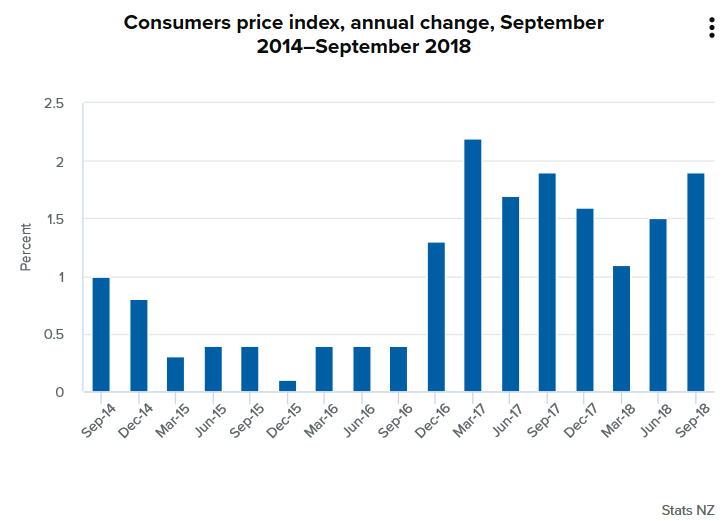
New Zealand CPI rose 0.9% qoq in Q3, and beat expectation of 0.7% qoq. Annual rate accelerated to 1.9% yoy, up from 1.5% yoy in Q2, and beat expectation of 1.7% yoy. StatsNZ noted that the 1.9% annual increase in CPI was mainly due to the housing and household utilities group (3.1% yoy). The group was influenced by higher prices for construction, rents, local authority rates, electricity, and property maintenance services. though for the quarter, increases in fuel prices edged out housing. Transport prices rose 2.4% qoq, driven by petrol prices which is up 5.5% qoq.
Trimmed-mean CPI, which exclude extreme price movements – ranged from 1.8 to 1.9 percent for the year, which is roughly equivalent to the 1.9 percent overall rise in the CPI. CPI ex-petrol rose 1.2% yoy, CPI ex-food rose 2.3% yoy, CPI ex-household energy and vehicle fuels rose 0.9% yoy.
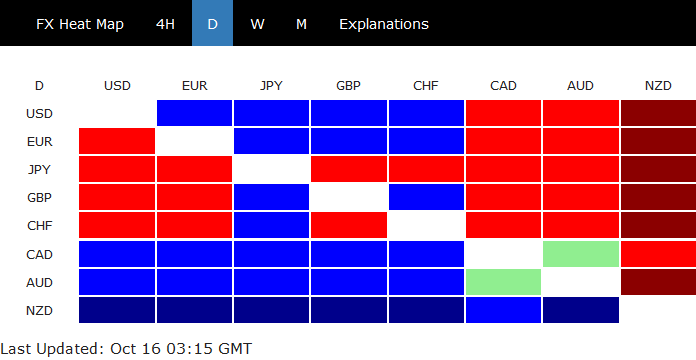
New Zealand Dollar is trading as the strongest one for today after the release.
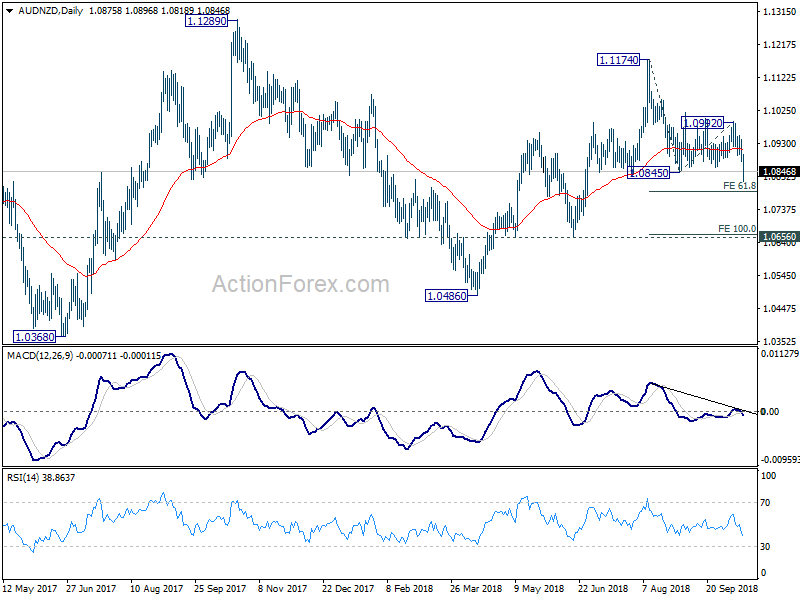
AUD/NZD dives sharply after the release today. Break of 1.0845 support finally confirms resumption of the decline from 1.1174 and affirm the whole rise from 1.0486 is completed. Further fall is now expected to 61.8% projection of 1.1174 to 1.0845 from 1.0992 at 1.0789 and below. Strong support will likely be seen at 1.0656, which is close to 100% projection at 1.0663, to bring rebound.
GBP/USD Holding Gains Above Crucial Support
Key Highlights
- The British Pound declined recently and tested the 1.3080-1.3100 support against the US Dollar.
- GBP/USD tested a connecting bullish trend line with support at 1.3100 on the 4-hours chart.
- The US Retail Sales in Sep 2018 increased 0.1%, less than the +0.5% forecast.
- Today, the US Industrial Production for Sep 2018 will be released, which is forecasted to increase 0.3% (MoM).
GBPUSD Technical Analysis
The British Pound started a downside correction after testing the 1.3250 resistance against the US Dollar. The GBP/USD pair traded below the 1.3150 support, but buyers protected the key 1.3080-1.3100 support.
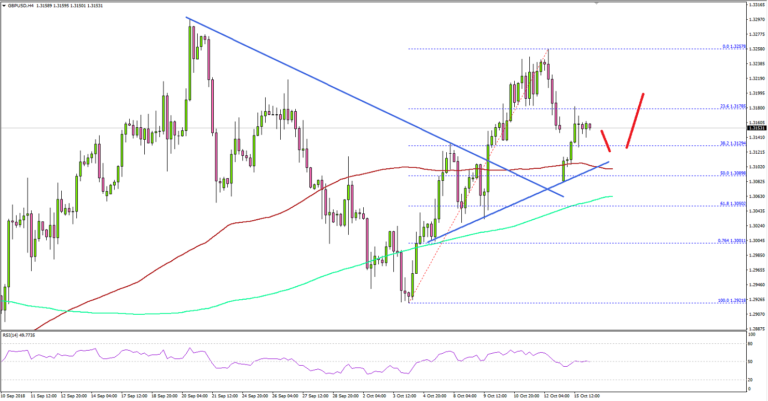
Looking at the 4-hours chart, the pair formed a high at 1.3257 and corrected below the 38.2% Fib retracement level of the last wave from the 1.2921 low to 1.3257 high. However, the downside move was protected by the 100 simple moving average (red, 4-hours) and 1.3080 level.
Moreover, the 50% Fib retracement level of the last wave from the 1.2921 low to 1.3257 high also acted as a support. It seems like the pair completed a downside correction at a major technical support and it could continue to move higher above 1.3200.
On the upside, the key resistances above 1.3200 are at 1.3220 and 1.3250. On the flip side, there is a connecting bullish trend line formed with support at 1.3100 on the same chart.
As long as the pair is trading above the trend line, 1.3080, and the 100 simple moving average (red, 4-hours), it may possibly continue to move higher.
Fundamentally, the US Retail Sales report for Sep 2018 was released by the US Census Bureau. The market was looking for a rise of around 0.5% in sales compared with the previous month.
However, the actual result was disappointing as there was only 0.1% rise in sales in Sep 2018, which was similar to the last reading. Looking at the Retail Sales ex Autos, there was a decline of 0.1%, whereas the market was positioned for a 0.3% rise.
Overall, the US Dollar faced an increased selling pressure, which may perhaps help GBP/USD and EUR/USD in the short term.
Economic Releases to Watch Today
- UK Claimant Count Change August 2018 – Forecast 10.0K, versus 8.7K previous.
- UK ILO Unemployment Rate Sep 2018 (3M) – Forecast 4%, versus 4% previous.
- German ZEW Business Economic Sentiment Index for Oct 2018 – Forecast -11.3, versus -10.6 previous.
- Euro Zone Trade Balance August 2018 – Forecast €14.1B versus €12.8B previous.
- US Industrial Production Sep 2018 (MoM) – Forecast 0.3%, versus +0.4% previous.
- US Capacity Utilization Sep 2018 – Forecast 78.2%, versus 78.1% previous.
Italian cabinet approved budget, drama with EU begins
Italian cabinet approved the 2019 budget that would boost budget deficit from the current 1.8% of GDP to 2.4% next year. The key measures include basic income for the poor and tax cuts for the self-employed. Retirement age was also lowered and there is partial amnesty offered to settle tax disputes. Prime Minister Giuseppe Conte hailed after the cabinet meeting that "this budget keeps the government's promises while keeping public accounts in order." Economy Minister Giovanni Tria also talked down the potential clash with the EU and said "the idea that this budget can blow up Europe is totally unfounded."
But no matter what Italy says, the drama with EU will now formally begin. After formally receiving the budget, European Commission will have a week, by October 22, to identify "particularly serious non-compliance with the budgetary policy obligations" of a state. By October 29, the Commission will have to decide whether to reject the draft budget as non-compliant, with written explanations. The showdown will come on November 5 in the Eurogroup of finance ministers meeting. And Italy is expected to submit a revised budget on November 19.
Risk Remains On The Back Foot
Risk remains on the back foot
Risk sentiment remains on the back foot as the volatile stock action continued in Asia and Europe overnight. And while the US markets ended a very jittery day lower, the losses were limited as the markets enter a stalemate period to rethink the plethora of looming market uncertainties, ambiguities and flat out worries in what was an untypically quiet New York session. But this relative calm belies the building storm clouds on the horizon.
The world economy is facing multiple complications none more so than the reality that while US economy is settling into a stable growth trajectory, the rest of the world continues to wrestle with slower growth and currency pressures. Which raises the big question, how long can the anomalously robust US market hang on in the face of mounting global risks?
China uncertainty
The most significant risk for Global markets is neither a correction in US markets or the argument that US assets are overbought and need a ” shake out” as they are overbought for a reason. But instead, trade wars and China’s domestic financial polarity has taken a toll on both local and global economies, which has lost significant growth momentum. So far, the Pboc has resisted dipping into the cookie jar knowing that short-term monetary policy adjustment could worsen rather than improve conditions as this could lead to Yuan instability. While the renminbi’s depreciation has arguably offset some of the negative from the tariff impact but further currency depreciation or even using it as a competitive tool could set off intense waves of capital outflow- which could lead to a currency depreciation spiral. A consequence that should make global capital markets tremble.
Rock and a hard place
Most developed countries are not much better off due tot he plethora of debt on the balance sheets while still running in a historically low-interest rate environment. It’s not like they have any room to stimulate the economy. And while this slowdown in global growth momentum could be little more than a bump in the road in the expansionary cycle given trade and geopolitical concerns the big problem is that concerns around Brexit unknowns; German Chancellor Merkel’s political losses in regional elections; US-Saudi relations and of course US-China tension, is showing little signs of easing. And with Citibank’s Economic Surprise Index for the US (CESI USD) back in negative territory, no wonder equity investors are doing a cut and run.
Oil Markets
The petroleum markets tested the upside as tensions flared over the disappearance of journalist Jamal Khashoggi, but have calmed down since Saudi Arabian Energy Minister Khalid Al-Falih assured that the kingdom would remain a reliable supplier to its customers.
However, there was no explicit mention of Saudi’s using oil as their ” ace in the hole” bargaining chip against possible US sanctions, which would be like committing political suicide as far the US -Saudi relations if not the rest of the world. Look no further than the reaction of the corporate worlds were hoards pulling out of next week’s Financial Conference in Riyadh, dubbed “Davos in the desert”.
But West Texas Intermediate crude oil turned higher on Monday as the US Bureau of Safety, and Environmental Enforcement reported 198,622 bpd of crude oil production still offline due to Hurricane Michael, bringing total production losses to over 3.5 million barrels per day.
While Brent Crude is finding further support from the latest round of observed crude and condensate export data for Iran, which showed the country’s exports fell even further during the first half of October.
But we’re squarely back to the case of competing narratives where the oil market is “adequately supplied for now,” but the supply losses from Venezuela and Iran leave the market suffering from “strain,” according to a new report from the International Energy Agency (IEA).
But with the geopolitical embers are glowing threatening to ignite the middle east powder keg, and with traders all too aware that we are little more than one supply disruption away from tipping the fragile Oil market supply and demand apple cart, oil prices remain firmly supported in early Asia trade.
The spare production capacity argument should continue to support oil over the short term. The IEA pegged additional capacity at around 2 million barrels per day. But the markets know these reserves have never been tested raising the questing how much extra capacity can be brought online immediately But, in the meantime, until additional supplies are made available, that crimp in quantity should be enough to support Oil prices until proven otherwise
Gold Markets
The Gold Rush has cooled off a bit but with the USD and global equity market looking increasing fragile dips will be supported. While much of yesterday’s prices action was triggered on the unwinding of short positions last weeks, break if 55day moving average and with traders now eyeing the critical 100day at $1239 suggest a push higher on any hint of equity market weakness
Malaysian Ringgit
The Ringgit continues to trade defensively ahead of the budget, but there were few EM specific currency developments Monday.
Retail Sales Mixed, Stocks Dead Cat Bounce
US retail sales were soft on the headline but the details were solid. US stocks displayed a deadcat bounce, suggesting that false rebounds are ere to stay into next month's US mid-term election.The New Zealand dollar was the top performer Monday while the US dollar lagged. Chinese CPI is due up next.
US retail sales rose just 0.1% in September in the second consecutive month of lackluster gains but there were signs that Hurricane Florence might have curbed spending. In addition, the closely-watched control group rose 0.5% compared to 0.4% expected.
The market took the report in stride with little reaction in the FX market. USD/JPY had earlier slid to 111.65 to start the week on a soft note.
The bigger market move came on the Bank of Canada's business outlook survey. It showed stronger sales forecasts, a tighter jobs market and a jump in investment intentions – and the survey was done before the new NAFTA deal. As a result, USD/CAD fell to 1.2955 from 1.3050 earlier in the day.
The BOC meets next week and the report made a hike a near-certainty and also raised the odds of another hike in December or January. Separately, Canadian exports to China are up 23% in the first half of the year in a sign that Chinese are canceling US orders and redirecting them elsewhere.
Looking ahead, Chinese CPI is the next item on the calendar at 0130 GMT. The consensus is for a slight acceleration to 2.5% y/y from 2.3%. We also continue to await the US Treasury FX manipulation report.
UK May: Not far apart with EU; EU Tusk: No-deal Brexit more likely than ever
UK Prime Minister Theresa May told the parliament yesterday that they're not "far apart" with the EU. And she urged not to let the disagreement on Irish backstop "derail the prospects of a good deal" and leave the UK with no-deal Brexit. But at the same time, she insisted that Northern Ireland must not be treated differently from the rest of the UK.
European Council President Donald Tusk, however, warned that the remaining 27 states "must prepare the EU for a no-deal scenario, which is more likely than ever before." And he added the Brexit negotiation has "proven to be more complicated than some may have expected."
May will meet other EU leaders in Brussels at the summit on Wednesday and hopes to resolve a few "critical issues". EU leaders will then listen to the recommendation by chief negotiator Michel Barnier for the way forward.
Canadian Business Sentiment Still Positive in Q3 BOS Despite Trade Uncertainties
Highlights:
- The survey was upbeat with business investment intentions rising despite the survey being conducted prior to the U.S., Canada, and Mexico agreeing to a NAFTA replacement earlier this month.
- Capacity constraints and rising current demand remained the most important drivers of business investment activity
- The data should only further cement expectations for a gradual Bank of Canada rate hiking path to continue
Our Take:
Businesses remained upbeat in the Bank of Canada’s Q3 (Autumn) Business Outlook Survey — and that despite interviews being conducted before the U.S., Canada, and Mexico agreed on a NAFTA replacement earlier this month. Indeed, the survey broadly supported the view that increasing domestic capacity constraints and tight labour markets had become a more significant impediment to growth than trade uncertainty, even before the NAFTA renegotiation resolution. US trade policy was cited as a concern for some businesses but overall machinery and equipment investment intentions nonetheless jumped higher — driven by strong demand (including export demand) and the need to expand existing capacity. More than half (56%) of firms reported they would have trouble boosting production to meet unexpected demand. Labour shortages became more widespread and more intense in the Q3 survey. Of course not all trade concerns have gone away with remaining U.S./Canada steel and aluminum tariffs in particular reportedly having some upward impact on input prices. Some, although not all, of those costs are still expected to be passed on to output prices. Most businesses (62%) continued to anticipate consumer price inflation to be at or above the 2% midpoint of the Bank of Canada’s 1% to 3% inflation target range.
In terms of near-term policy implications, a soft survey result in Q3 would likely have been discounted given NAFTA renegotiation concerns over the survey period have now eased. In the event, a firmer report only further cements the odds that the Bank of Canada will remain on a gradual rate hiking path with the next 25 basis point hike to the overnight target rate coming at next week’s policy meeting.