

Sample Category Title
Eco Data 10/16/18
[php_everywhere instance="1"]
BoC: Businesses Remain Optimistic about the Future
Canadian firms were upbeat over the third quarter of the year, according to the Bank of Canada's quarterly Business Outlook Survey (BOS). The Bank's "BOS Indicator" remained elevated despite falling back a touch to 2.8 (from 3.1).
It's important to note that the survey was conducted between August 24th and September 19th, just before the breakthrough that resulted in the new USMCA free trade deal.
The balance of opinion around future sales rebounded to 15% (from 6% in 18Q2), as firms anticipate strong U.S. growth over the next year to help boost export orders. In contrast, 'indicators of future sales', which captures order books, advanced bookings, and similar metrics, eased to 40% after rising for two consecutive quarters.
After falling in the previous two quarters, investment intentions saw the balance of opinion rising to 33% - the highest reading since 17Q1. The details of the report show that capacity constraints are helping driving investment intentions higher. Moreover, firms also appear to be on a drive to improve productive efficiency, with fewer firms intending to spend just to maintain their current capital base. Drivers and impediments to business investment were fleshed out in Box 1 of the report. Domestic and foreign demand were among the key drivers of investment, while uncertainty and regulation and taxes were cited as key impediments to investment.
The drive to expand capacity is also leading firms to increase hiring over the next 12 months, but this may prove challenging as labour shortages appear to have become more intense and widespread. At 50%, the balance of firms reporting more intense labour shortages has risen to its highest level since 2006Q3.
Rising capacity pressures, more intense labour shortages, steel and aluminum tariffs, along with higher commodity prices are feeding through into expectations that input prices are likely to rise at a faster pace in the year ahead. On balance, firms expect to raise output prices, with about three-fifths of firms expecting inflation to transpire in the 2% to 3% range. However, competitiveness concerns continue to remain a source of negative price pressures.
Senior Loan Officer Survey
The Senior Loan Officer Survey (SLOS), was also released this morning and continued to indicate an easing of lending conditions for businesses. This marked a fourth consecutive quarter of easier lending terms for businesses amid increased competition among lenders for corporate borrowers. Lending conditions for small business and commercial borrowers remained unchanged, while demand for credit strengthened broadly from all business borrowers.
On the household side, lending conditions have remained little changed from the prior quarter. Mortgage lending conditions, particularly the price component, continued to ease as lenders competed for reduced pool of borrowers owing to B-20 rules. Demand for high-ratio mortgages has remained unchanged, but increased for both low-ratio mortgages and home equity lines of credit. Lending conditions for non-mortgage credit have tightened slightly relative to the prior quarter, while demand has remained relatively unchanged with softer demand for auto loans offsetting increased demand for other types of consumer credit.
Key Implications
Canadian firms remain bullish on the future. The boost in investment intentions corresponds to elevated capacity pressures and should help alleviate concerns that firms won't be able to meet the anticipated increase in domestic and foreign sales. In addition, labour shortages may be a sign that wage pressures should continue to build, adding to the basket of inflationary pressures down the road.
On the lending side, the slowdown in Canadian housing market activity has weighed on mortgage growth. Mortgage credit has decelerated significantly in the aftermath of the B-20 guidelines, falling to 3.7% y/y in July, down from a 6% y/y pace at the same point in the previous year. Although activity has rebounded from a slump in the first half of the year, the Canadian housing market is expected to continue to face challenges in this rising interest rate environment.
A solid BOS, together with stronger than expected growth in the third quarter, should provide the Bank of Canada with more than enough conviction to move rates higher by another 25bps next Wednesday. It also raises the question of the timing of the next rate hike now that the USMCA has alleviated some of the trade-related uncertainty that was exerting a headwind on its growth outlook. Assuming economic data continuing to confirm the Bank of Canada's outlook for growth and inflation, we expect the next hike likely to come in early 2019.
Gold Rises as Metal Regains Safe Haven Title
Gold rose on Monday after US retail sales missed the forecast. Economists had estimated a rebound in core and headline retail sales, but a fall in the food services sector dragged the index lower. Overall US sales continued to show a strong pace of growth.
The yellow metal has risen as investors are seeking safety as global stock continue to drop. Geopolitics events have snowballed around the globe and traders have to value the possible impacts of a trade war between the US and China, Brexit negotiations, monetary policy divergence between major central banks and a global growth slowdown.
The energy market is also in turmoil as events during the weekend have put Saudi Arabia on a public relations offensive with a treat of economic retaliation.
Gold has surged over 1 percent on Monday taking advantage of the US dollar softness following the retail sales data miss. The minutes from the September Federal Open Market Committee (FOMC) meeting on Wednesday will bring more insights into the central bank’s plans and could reverse the direction of the greenback, putting pressure on gold.
Gold Jumps to 11-Week High, US Retail Sales Disappoints
Gold has started the week with sharp gains. In Monday’s North American trade, the spot price for one ounce of gold is $1227.98, up 0.85% on the day. Earlier in the day, gold prices touched a high of $1233, its highest level since mid-July. On the release front, U.S data was mixed. On the release front, U.S retail sales were much softer than expected. Retail Sales posted a meager gain of 0.1%, shy of the estimate of 0.4%. Core Retail Sales surprised with a decline of 0.1%, compared to an estimate of 0.4%. This marked the first decline since June 2017. There was better news from the manufacturing front, as Empire State Manufacturing Index strengthened to 21.1, above the estimate of 20.4 points. Later in the day, the U.S Treasury is expected to release the semi-annual currency report.
Gold prices have dropped sharply in recent months. During the April-September period, gold slumped some 10 percent. However, October has taken a reverse direction, with gains of 3.0 percent. The U.S economy in excellent shape and inflation growing higher, and that has allowed the Federal Reserve to stay on track with gradual increases in interest rates, even with President Trump expressing his displeasure over rate increases. In October, the Fed raised rates for a third time this year, and the odds of a December rate are pegged at 78%, according to the CME Group. Furthermore, the Fed indicated that three more rate hikes are on the way in 2019. This vote of confidence in the economy has strengthened the U.S dollar and conversely, weighed on gold prices.
Will there be any surprises in the U.S Treasury currency report? The report provides details of global exchange rate policies, as well as a list of countries which are deemed currency manipulators. In the April report, the U.S did not name any of its major partners as currency manipulators. Since then, the Trump administration has imposed some $200 billion in tariffs on Chinese goods. China has retaliated with its own tariffs on U.S goods, and there has been speculation that China could respond to the U.S tariffs by devaluating the Chinese yuan in order to bolster Chinese exports. In 2015 and 2016, the markets dropped sharply on fears that China would implement a major devaluation of its currency. Traders should treat the report as a market-mover.
UK Jobs Data in Focus as Crucial EU Summit Looms
With optimism around a Brexit deal being wrapped up this week receding, markets could turn their attention back to economic data on Tuesday at 0830 GMT, when the UK will release its latest employment figures. After that, sterling’s fortunes will likely be tied to how the crucial EU summit commencing on Wednesday plays out, and whether investors are left with the impression that a deal may be finalized in November, or not.
Hopes that a Brexit deal would be reached as early as this week came crashing down on Sunday, following news that the negotiations have been “paused” until the EU summit kicks off on Wednesday, amid a lack of progress on the Irish border issue. While it’s not entirely out of the question that an agreement is found at the last minute, developments generally point to the direction of the talks being extended for a few weeks, with a special EU summit to be called in November if enough headway has been made until then.
Ahead of this week’s summit, investors could briefly turn their gaze back to economics on Tuesday, when the UK releases its jobs data for the three months to August. Forecasts point to an employment report that would reaffirm the labor market’s strength, with the unemployment rate expected to have held steady at 4.0% – a low last seen in 1975. Meanwhile, average weekly earnings both including and excluding bonus pay are projected to have grown at the same pace as previously, at 2.6% and 2.9% respectively in yearly terms. As for where risks may lie, the UK services PMI for August was very upbeat, noting that employment growth accelerated to its fastest in six months.
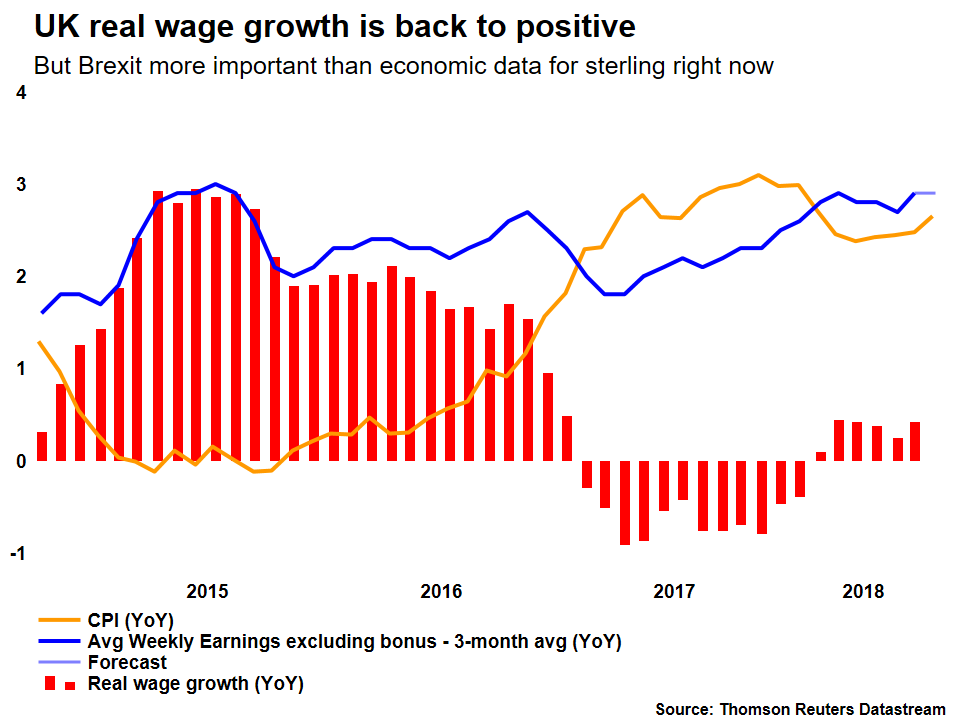
While a strong set of data could provide some support to the pound, political developments may eclipse economic ones in driving the currency overall over the coming weeks, considering the critical juncture the Brexit process is currently at. Separately, the fact that the next BoE rate hike is priced in only for August 2019 suggests investors expect policymakers to remain sidelined until the political fog lifts, and that economic data alone may have less of an impact than usual on policy decisions.
With respect to the upcoming EU summit, while nothing concrete (like a deal) may come out of it, markets will still watch the tone of any relevant remarks from EU officials closely as they try to gauge whether reaching an accord in November is a realistic prospect, or not. Indeed, the pound has been sensitive to optimistic rhetoric in recent weeks, gaining ground on comments suggesting a deal is possible, even when they lacked real substance.
Although it’s a close call, the most likely outcome still appears that of a deal being ultimately reached, given the strong desire on both sides for one. Even if that is the case, however, it’s not going to be a smooth trip higher for sterling. The amount of work that remains to be done on the Irish border implies the pound will likely stay volatile, and hostage to incoming headlines for a while. That said, once an accord does appear to be imminent, then the rally in the currency may be quite explosive. The heavy net-short speculative positioning on the pound (CFTC data) allows room for a sudden and violent surge in case numerous investors simultaneously rush to cover or unwind their bearish bets.
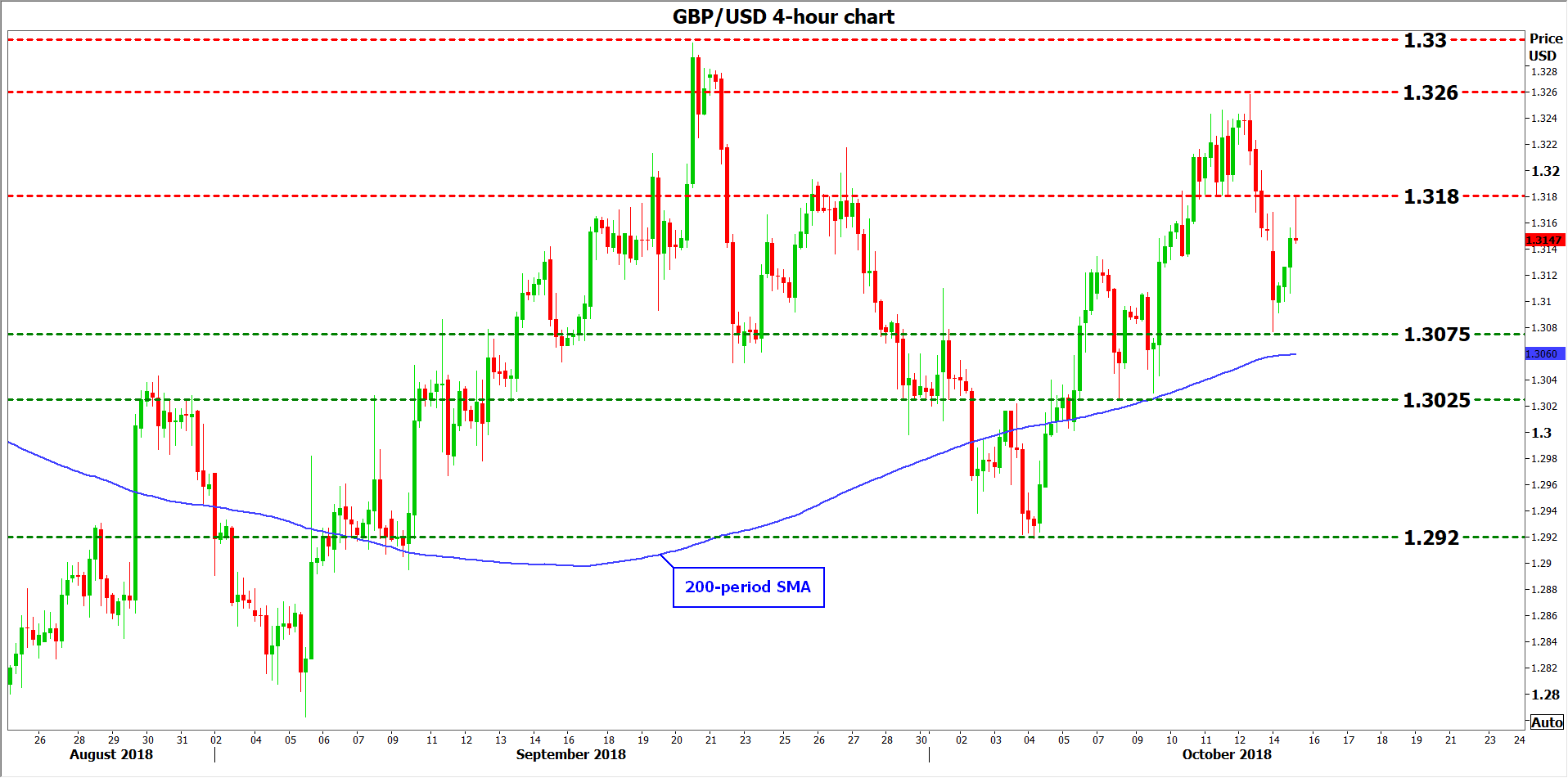
Technically, advances in sterling/dollar may meet initial resistance around 1.3180, an area marked by the inside swing low on October 11. An upside break could open the way for a test of the October 12 high of 1.3260, before the 1.3300 zone comes into view – this being the September 20 peak.
On the flipside, declines in the pair could stall around the 1.3075 territory, defined by the October 15 low. If the bears pierce below it, then the October 8 trough of 1.3025 could provide some support, with even steeper downside extensions seeing scope for a test of the 1.2920 area – the October 4 low.
New Zealand Inflation Awaited to Help Kiwi Extend Rebound
New Zealand inflation data for the third quarter will be made public at 2145 GMT on Monday, probably giving impetus to the Reserve Bank of New Zealand’s hopes that inflation will rise towards the midpoint of its target. The kiwi lost significant ground lately against the greenback, becoming the worst performer among G10 currencies during the past month after aussie. While an upbeat inflation report could give some joy to the local currency if the numbers strengthen more than the markets are pricing in, the reasoning behind, though, could be unsustainable.
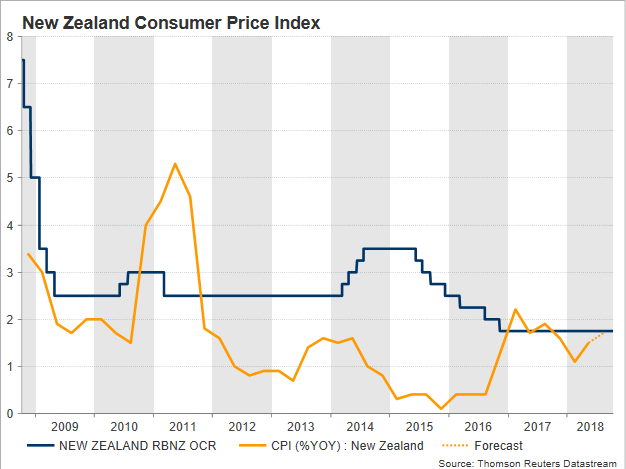
Consumer prices in New Zealand are said to have increased at an annual rate of 1.7% in the three months to September, slightly faster than in the second quarter when house prices pushed headline inflation higher to 1.5%, and much better than the 1.1% growth recorded in the first quarter. On a quarterly basis, upside inflationary pressures are expected to have gained momentum too, with the CPI inching up, from 0.4% to 0.7%. The core measure, though, which washes away volatile items such as food and energy and thus displays a better gauge of the actual inflation trend, decreased for the fourth consecutive quarter in Q2, flagging that the recent pickup in headline CPI might be temporary. Note that crude prices were elevated in the third quarter, with fresh taxes on fuel adding further pressure to New Zealanders’ pockets.
Turning to factors affecting price growth, consumers’ feeling about the economy was downbeat in the third quarter, the Westpac Banking Corporation said, with the corresponding index falling to the lowest in six years. A worrying sign that consumers might spend less in the coming months and therefore retailers might judge wiser to avoid any price rises for now. Yet recent evidence on electronic card retail sales indicated that things are not so bad, with the gauge hitting a one-year high of 6.7% y/y in August before easing to 5.7% in September.
On the supply side, business confidence was in the doldrums according to the Australia and New Zealand Banking Group (ANZ ). Although the measure ticked up in September, it held in negative territory and around 10-year lows, hinting that intentions for investment and hiring are very low, especially under a subdued currency and a risky global trade environment given the US-Sino import tariff game. Increasing wages seem to be another concern for companies as the new coalition government plans to push the minimum hourly wage up from NZ$16.50 this year to NZ$20 in 2021, reducing firms’ profitability.
In the monetary policy front, the RBNZ is positive that pricing pressures will build up and the CPI will gradually rise towards the 2.0% midpoint of its range target. However, policymakers have downgraded GDP growth forecasts for 2019 to 2.6% from 3.1% previously and have messaged that interest rates will remain steady at a record low of 1.75% until 2020, at a time when their US counterparts are ready to hike rates at least four times until 2020. Yet the deadlock in US-Sino trade talks, which will probably last for a while longer as US midterm elections approach, suggests that things could worsen before getting any better. Hence, as this is beyond the government’s control, policymakers judge that monetary policy should remain accommodative, while not ruling out any rate cuts in case the economy shows signs of slowing sharply.
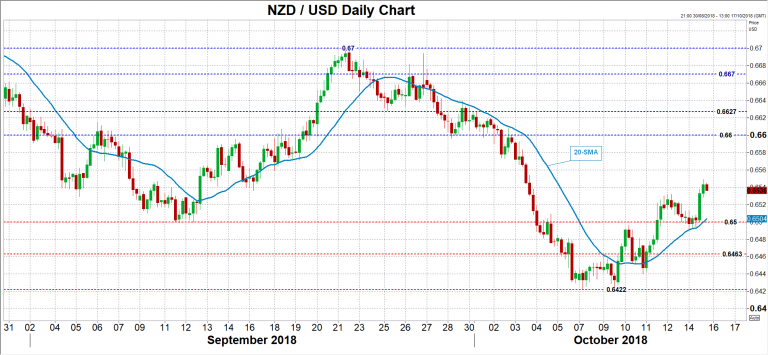
Turning to FX markets, kiwi/dollar has been pushing higher after creating a bottom at a 2 ½-year low of 0.6422, breaking a key resistance around 0.6500 on Thursday. Positive momentum could strengthen towards 0.6600 if inflation on Tuesday beats expectations, while slightly higher the area between 0.6625-0.6670, which halted both upside and downside movements in the past, should gather interest as well. Further above, the focus would shift to the 0.6700 level.
In the alternative scenario if inflation appears disappointingly lower, making rate cuts more likely in the future, the 0.6500 round level where the price strongly rebounded on September 11 and paused once again last Wednesday may stand as a wall to downside corrections. Moving lower, the inside swing high on October 10 could be another level to watch before the 2 ½ -year low of 0.6422 comes into view.
Turkish Lira Advances Further on Weaker Dollar / Hopes of Improving Relation with US
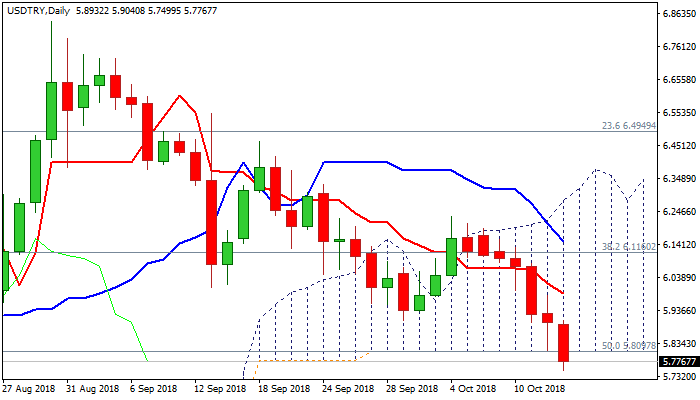
The USDTRY pair fell further on Monday and probes below one of key supports at 5.8097 (base of thick daily cloud).
Turkish lira was boosted after court released US pastor, who was imprisoned for two years, in case that worsened relations between the US and Turkey.
Hopes that the relations between two countries will start to improve, boosted lira, with additional support from weaker dollar that was additionally hit by weaker than expected US retail sales.
Bearish daily techs add to positive outlook for lira, as multiple bear-cross has formed (10/55 & 20/55 SMA) and momentum studies are in firm bearish mode.
Eventual close below daily cloud would confirm bearish stance and expose next key support at 5.6875 (16 Aug low, posted after strong pullback from new all-time high at 7.1074.
Corrective upticks towards falling 10 SMA (6.0190) could be expected on oversold conditions and would provide better selling opportunities.
Res: 5.9040; 5.9892; 6.0190; 6.0661
Sup: 5.7499; 5.6875; 5.5336; 5.5035
GBPUSD Outlook: Sterling Stands at the Front Foot ahead of PM May’s Statement on Brexit to the Parliament
Cable holds near session high at 1.3181 in early hours of US trading and awaiting PM May's statement to UK parliament on Brexit, scheduled at 14:30GMT. Sterling opened with gap-lower on Monday after Brexit talks over the weekend stalled, as negotiations got stuck over the border of Northern Ireland, but regained traction and advanced on weaker dollar. Rally covered overnight's gap, reducing downside risk, however, could take a hit if May's statement to PM's raises fears of negative scenario – no-deal Brexit. May faces strong pressure after talks stalled, with growing opposition to her plan, making her task to finalize negotiations and satisfy all sides, very difficult. Hopes of reaching a deal on EU summit later this week are still alive, with positive tone from May statement today expected to further inflate sterling. Conversely, today's recovery could melt easily if traders feel threats from May's speech, with retest of daily low (1.3083) and sub-1.30 acceleration, seen as likely scenario.
Res: 1.3181; 1.3217; 1.3257; 1.3297
Sup: 1.3111; 1.3083; 1.3075; 1.3050

EURUSD Outlook: Euro Extends Recovery, Supported by Risk Aversion/Weaker than Expected US Retail Sales
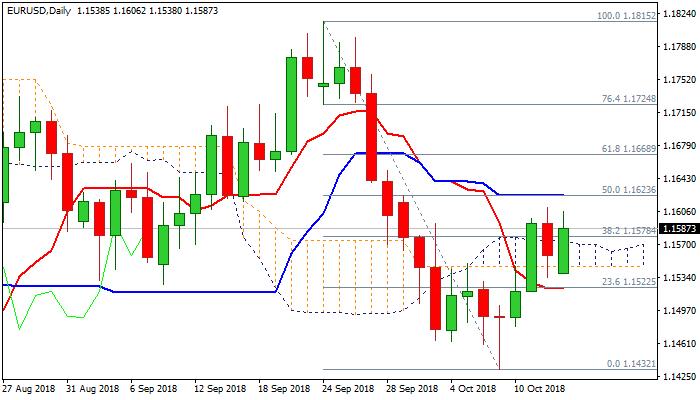
The Euro stands at the front foot in early US trading on Monday and extends bullish acceleration which started at the beginning of European session. Fresh risk aversion helped single currency to fully reverse Friday's losses and generate bullish signal on return above daily cloud, with advance being additionally boosted by weaker than expected US retail sales in September, which deflated the dollar. Fresh advance pressures Friday's high (1.1610) reinforced by falling 20SMA, with firm break here to expose 1.1623/27 (50% of 1.1815/1.1432 / 100SMA and 1.1668 (Fibo 61.8%) in extension. Close above daily cloud is required to keep bulls in play.
Res: 1.1610; 1.1627; 1.1668; 1.1724
Sup: 1.1574; 1.1545; 1.1538; 1.1529
US: Retail Sales Headline Misses Expectations, But Core Sales Come in Strong in September
Retail sales edged up by only 0.1% m/m in September, disappointing the expectations for a 0.6% gain.
A massive decline in sales at food services and drinking places, which fell by 1.9% and marking its worst monthly performance since December 2016, weighed heavily on the headline. This category had a stellar performance in the prior months, and the September slump can likely be chalked up to hurricane Florence. Sales at gasoline stations were also down 0.8%, the first monthly decline since July 2017.
Meanwhile, following three months of weak data, sales at auto & parts dealers rose 0.8% in September, something that was already communicated in the strong vehicle sales report two weeks ago. Sales at building material stores edged up 0.1% in September.
Excluding the above volatile categories (gas, autos, building materials, and food services), the so-called 'control group' used in calculating GDP did much better, rising 0.5% on the month – slightly ahead of expectations for a 0.4% gain. Delving into the details, most categories rose on the month. Sales of furniture (+1.1%) and electronics & appliances (+0.9%) were up; retailers selling clothing (+0.5%) and sporting goods (+0.7%) also did well.
Sales at general merchandise stores rose by a modest 0.3%, however, sales at department stores continued to be soft, declining 0.8%. Meanwhile, online retailers had a decent month, with sales up 0.7% on the month, and 10.3% from a year ago.
Key Implications
Despite the weak headline, the September retail sales report offers few signs for concern. The disappointing headline print was likely heavily influenced by hurricane Florence. This is reaffirmed by the unusual weakness in the restaurant sales figures.
Most importantly, core retail sales remained strong, suggesting there's little reason to worry about U.S. consumers right now. Job growth remains strong, wages are advancing and consumer confidence is high, suggesting U.S. consumer spending will likely average around 3.5% (annualized) in the third quarter. Coming on the heels of 3.8% gain the prior quarter, this would mark the best back to back quarterly performance since 2014.