

Sample Category Title
Asia Market Update : A Time Out
China Data
China CPI data came out bang on market expectation while the PPI rose slightly 3.6 % versus 3.5 % but continues to trend lower despite weaker Yuan and tariff price pressures. But given the delta to expectations are negligible there isn’t much of trade to be had on the data.
Regional equity markets
Regional markets are trading more positively this morning as overall regional volatilities are falling. A weaker US dollar profile is helping to cool depreciation pressure on the Yuan as overextended shorts are getting pared. Don’t confuse this recovery with anything other than consolidation amidst a protracted downtrend in Asia equities. Traders are looking to sell upticks given that intraday volatility can ignite on the drop of a dime.
While neither new or original for that matter and with discussions centring on market uncertainties the topic of China infrastructure spending is making the rounds yet again.
Since additional monetary easing could trigger a run on the Yuan; there’s more chatter that China will move back to its old habits of pumping up infrastructure spending to boost economic growth as Beijing is preparing to pull out their old stimulus playbook.
But overall a quiet start today in the wake of an unusually quiet Monday in US market.
Oil markets
Oil bulls are latching on to falling Iran export data which showed the country’s exports fell even further during the first half of October. Which gives rise to the spare capacity ” proof is in the pudding” argument that until supplies are made quantifiably available, given Venezuela and Iran shortfalls, that squeeze in supply should be enough to support Oil prices until proven otherwise. With so much noise in the market, traders top side ambitions could temper ahead of this week’s US inventory data sets.
Currencies
The US Dollar
Dollar bulls still fear we are little more than a Jay Powell headline away from sending the dollar into full out retreat. especially if he or this week FOMC minutes do walk back the hawkish market interpretation from the last policy meeting.
The Yuan
The USDCNH remains in a very tight range with overnight funding getting extraordinarily liquid, but the forward curve remains under pressure as traders continue to unwind some of the USD paid in forwards on a carryover from the slight de escalation of USD-China tension on the back of Trump -Xi meeting and a softer tone for the Pboc at the IMF in Bali. However, USDCNH remains bid on dips below 6.92 despite today’s CNY fix at 6.9119 today, -35 pips from last fixing and -151 pips from the previous closing at 6.9270 on 16:30 Beijing time. But well in line with market expectations.
With lower CNH vols comes some breathing room for local EM as the Won is making significant headway after the softer US retail sales print. In the absence of strong US economic data for the USD to anchor too, it continues to struggle but EM risk is fraught with peril, and I suspect this is more of a case positions squaring rather than bullish bets put on the table.
New Zealand Dollar
NZD CPI has overshot expectations: +0.9%QoQ for Q3 versus 0.4% prior and 0.7% expected. The RBNZ forecast stood at 0.4%. but taking the gains from energy out of the equation but with very mixed signals on the USD appetite to fade the move has been muted as dollar bulls remain nose-ringed to this weeks FOMC minutes
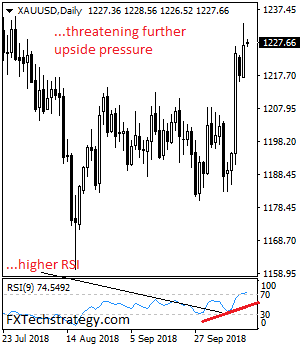
GOLD Eyes Further Strength Towards 1,235.00 Zone
GOLD eyes further strength short term as it looks for strength. On the downside, support comes in at the 1,220.00 level where a break will turn attention to the 1,210.00 level. Further down, a cut through here will open the door for a move lower towards the 1,200.00 level. Below here if seen could trigger further downside pressure targeting the 1,190.00 level. Its daily RSI is bullish and pointing higher suggesting further strength. On the upside, resistance resides at the 1,240.00 level where a break will aim at the 1,250.00 level. A turn above there will expose the 1,260.00 level. Further out, resistance stands at the 1,270.00 level. All in all, GOLD looks to recover further higher.
USD/JPY Daily Outlook
Daily Pivots: (S1) 111.51; (P) 111.88; (R1) 112.13; More..
USD/JPY recovers mildly after dropping to 111.62. But as long as 112.52 minor resistance holds, deeper fall is expected. Current decline is seen as correcting whole rise from 104.62. Deeper fall would be seen to 38.2% retracement of 104.62 to 114.54 at 110.75. We'll look for bottoming signal above 109.76 key support. On the upside, considering mild bullish convergence condition in 4 hour MACD, above 112.52 minor resistance will indicate completion of the pull back and bring retest of 114.54 high.
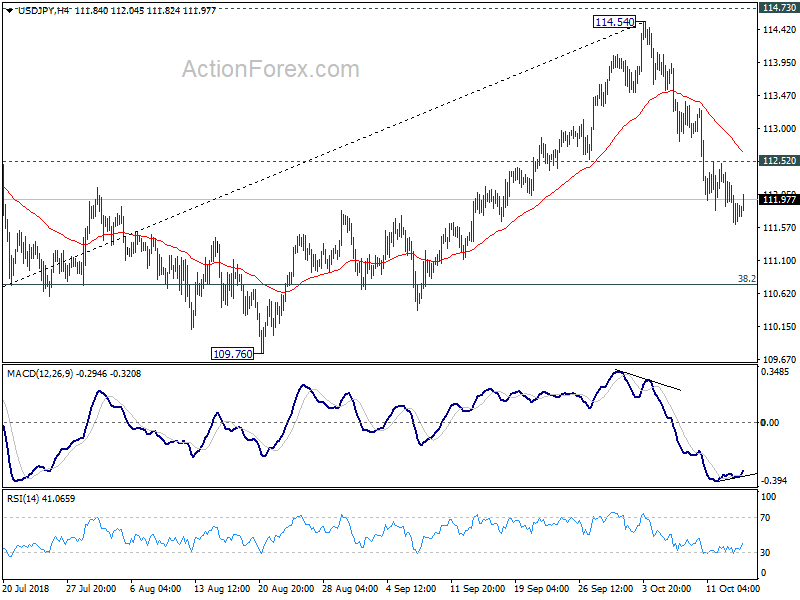
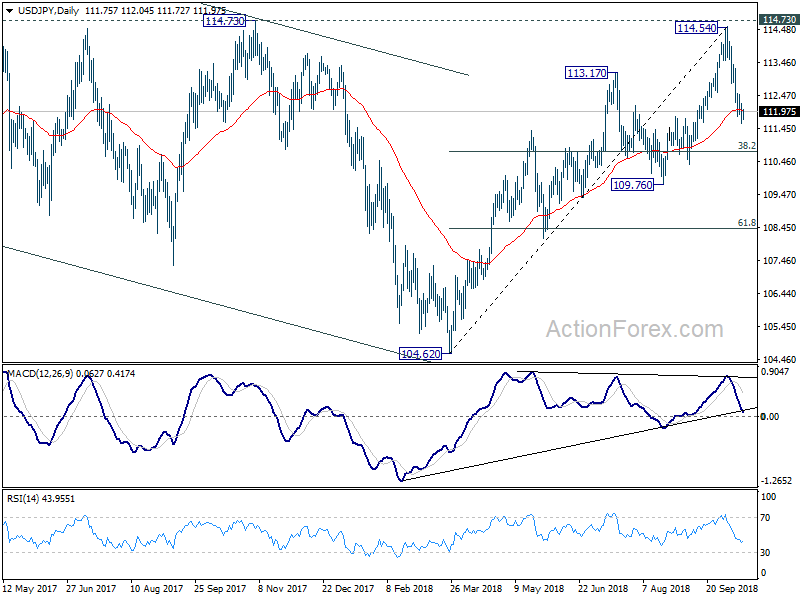
In the bigger picture, corrective fall from 118.65 (2016 high) should have completed with three waves down to 104.62. Decisive break of 114.73 resistance will likely resume whole rally from 98.97 (2016 low) to 100% projection of 98.97 to 118.65 from 104.62 at 124.30, which is reasonably close to 125.85 (2015 high). This will stay as the preferred case as long as 109.76 support holds. However, decisive break of 109.76 will dampen this bullish view and turns outlook mixed again.
USD/CAD Daily Outlook
Daily Pivots: (S1) 1.2947; (P) 1.3000; (R1) 1.3044; More...
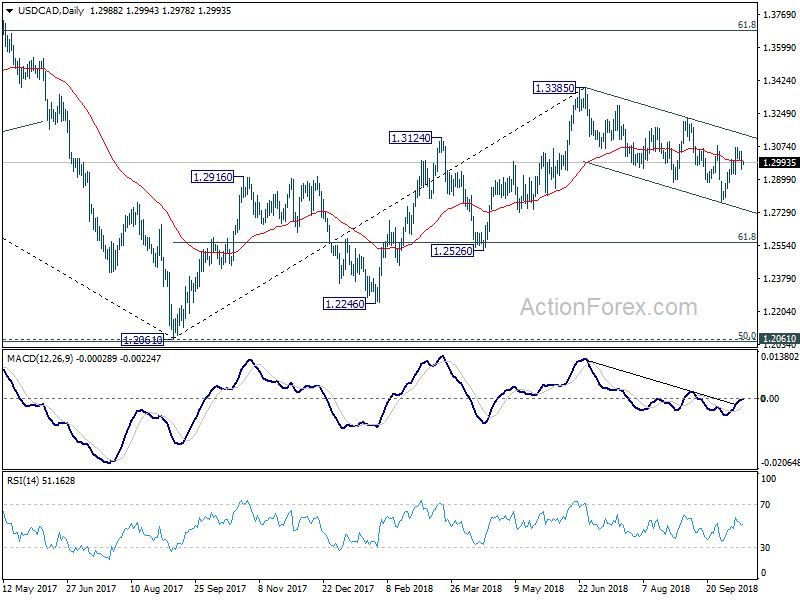
Intraday bias in USD/CAD stays neutral first. On the upside, decisive break of 1.3081 will be the first sign of completion of whole choppy fall from 1.3385. In that case, near term outlook will be turned bullish for 1.3225 resistance for confirmation. On the downside, below 1.2886 minor support will turn bias to the downside for 1.2781 instead. That would also argue that fall from 1.3385 is still in progress for another low.
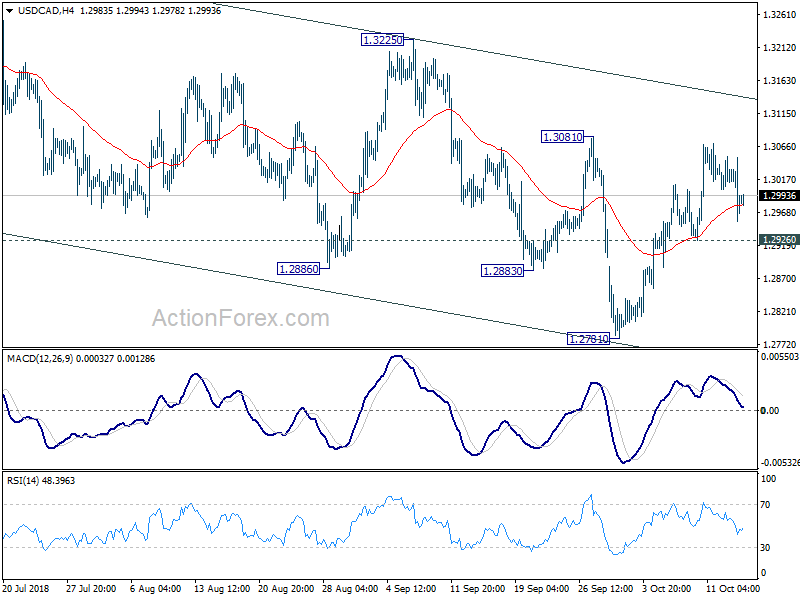
In the bigger picture, corrective rebound from 1.2061 could have completed at 1.3385 already. Deeper fall is mildly in favor to 61.8% retracement of 1.2061 to 1.3385 at 1.2567, which is close to 1.2526 support. For now, we're not seeing fall from 1.3385 as resuming larger down trend from 1.4689 (2015 high) yet. Thus, we'll look for bottoming signal again below 1.2567 . On the upside, though, break of 1.3081 resistance will argue that the pull back from 1.3385 is completed and rise from 1.2061 is resuming for another high above 1.3385.
AUD/USD Daily Outlook
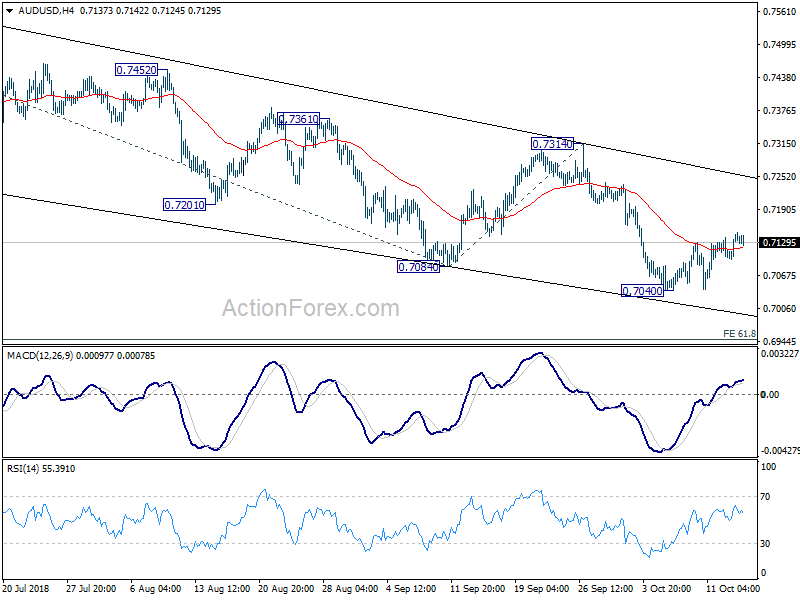
Daily Pivots: (S1) 0.7103; (P) 0.7126; (R1) 0.7154; More...
No change in AUD/USD's outlook. Corrective rise from 0.7040 might extend higher. But upside should be limited well below 0.7314 resistance to bring fall resumption. On the downside, break of 0.7040 will resume recent down trend to 61.8% projection of 0.7676 to 0.7084 from 0.7314 at 0.6948 next.
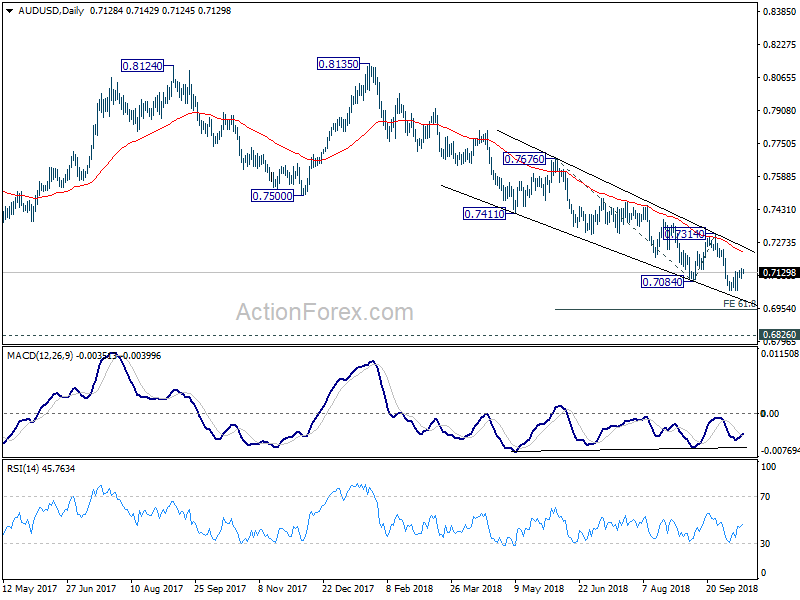
In the bigger picture, fall from 0.8135 is tentatively treated as resuming long term down trend from 1.1079 (2011 high). Decisive break of 0.6826 will target 0.6008 key support next (2008 low). However, break of 0.7500 support turned resistance will argue that the corrective pattern from 0.6826 is going to extend with another rising leg before completion.
EUR/USD Daily Outlook
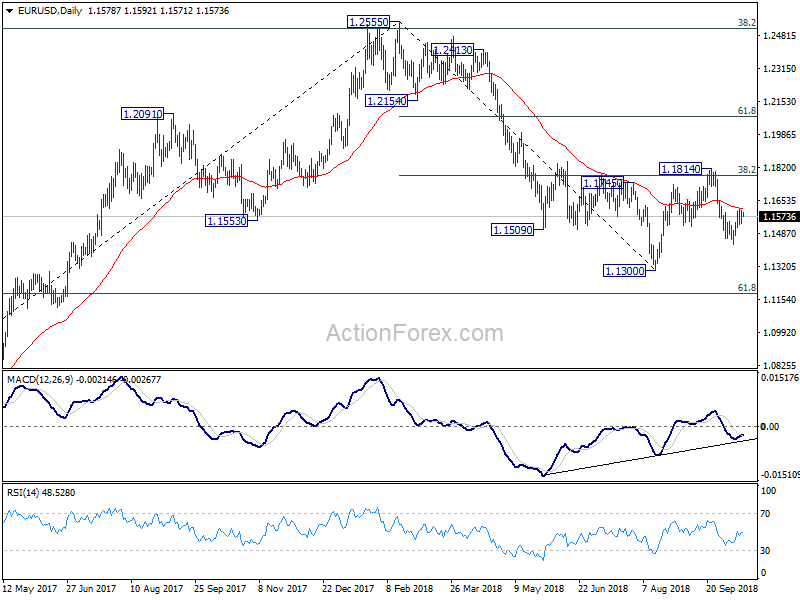
Daily Pivots: (S1) 1.1546; (P) 1.1576; (R1) 1.1609; More.....
Intraday bias in EUR/USD remains neutral for the moment. On the upside, break of 1.1610 will extend the rebound from 1.1431 towards 1.1814 resistance. But we'd expect upside to be limited by 1.1779/1814 resistance zone to bring down trend resumption eventually. On the downside, break of 1.1534 will indicate completion of rebound from 1.1431. Intraday bias will be turned back to the downside for 1.1431 and then 1.1300 low.
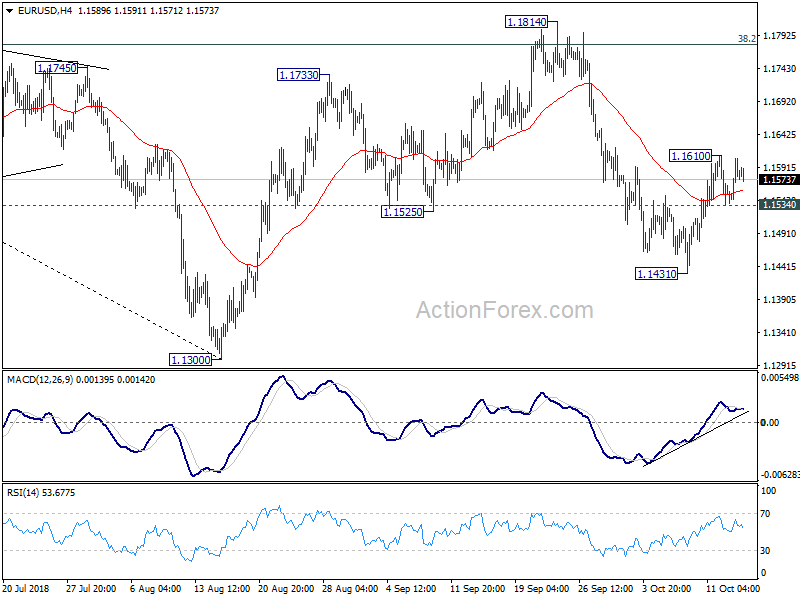
In the bigger picture, corrective pattern from 1.1300 could have completed at 1.1814 after hitting 38.2% retracement of 1.2555 to 1.1300 at 1.1779. Decisive break of 1.1300 will resume the down trend from 1.2555 to 61.8% retracement of 1.0339 (2017 low) to 1.2555 at 1.1186 next. Sustained break there will pave the way to retest 1.0339. On the upside, break of 1.1814 will delay the bearish case and extend the correction from 1.1300 with another rise before completion.
GBP/USD Daily Outlook
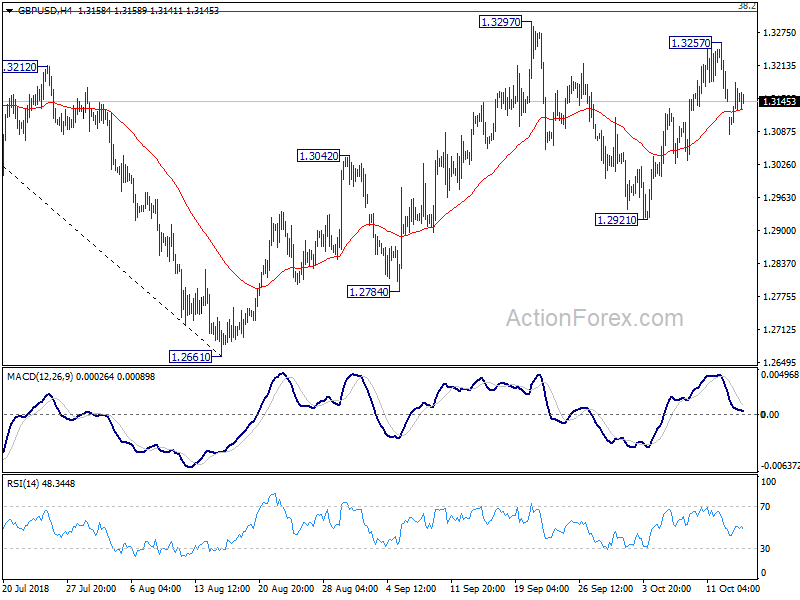
Daily Pivots: (S1) 1.3097; (P) 1.3140; (R1) 1.3193; More...
No change in GBP/USD's outlook. The rebound from 1.2921 should have completed at 1.3257 already. Deeper fall is in favor to 1.2921 support first. Break there will resume the fall from 1.3297 and target 1.2661/2784 support zone. On the upside, in case of another rally, we'd continue to expect strong resistance at 1.3316 key fibonacci level to bring down trend resumption eventually.
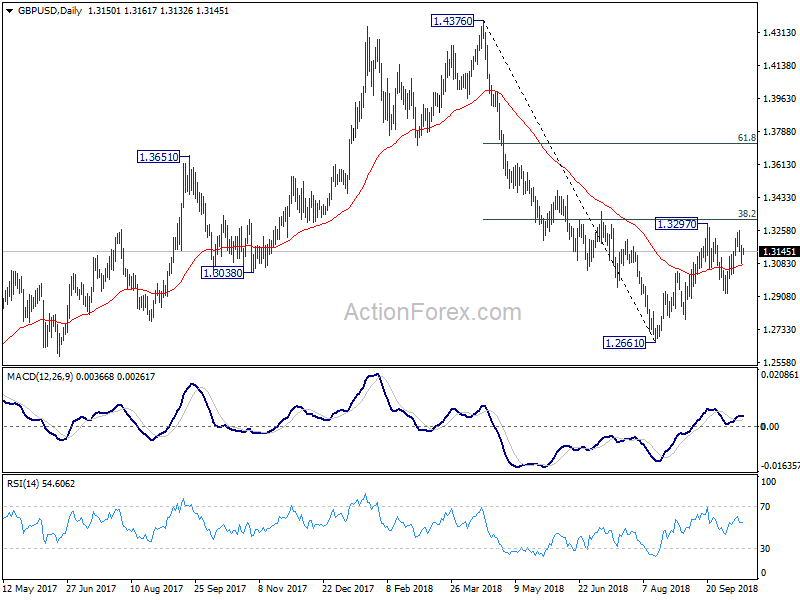
In the bigger picture, whole medium term rebound from 1.1946 (2016 low) should have completed at 1.4376 already, after rejection from 55 month EMA. The structure and momentum of the fall from 1.4376 argues that it's resuming long term down trend. And this will be the preferred case as long as 38.2% retracement of 1.4376 to 1.2661 at 1.3316 holds. However, firm break of 1.3316 would bring stronger rebound to 61.8% retracement at 1.3721. And, the eventual depth of the fall from 1.4376, and the chance of hitting 1.1946 low, will depend on the strength of the interim corrective rebound from 1.2661.
USD/CHF Daily Outlook
Daily Pivots: (S1) 0.9837; (P) 0.9879; (R1) 0.9911; More...
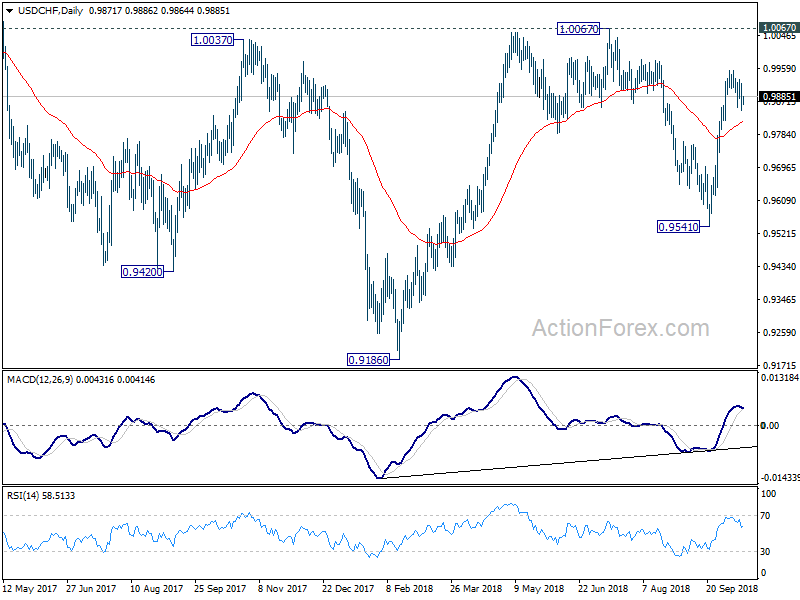
USD/CHF's consolidation from 0.9954 is still in progress and deeper pull back cannot be ruled out. But downside should be contained by 38.2% retracement of 0.9541 to 0.9954 at 0.9796 to bring rise resumption. On the upside, break of 0.9954 will resume the rise from 0.9541 and target 1.0067 resistance next.
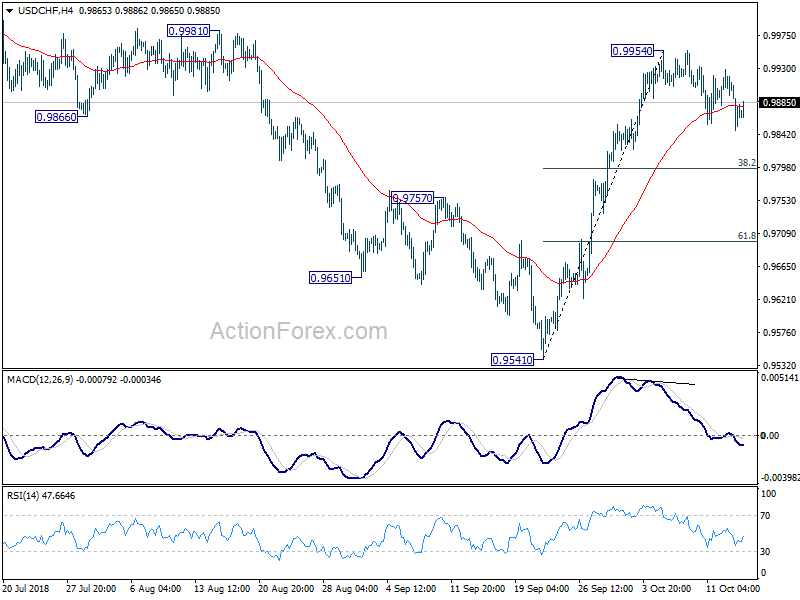
In the bigger picture, the pullback from 1.0067 has completed at 0.9541 already. And rise from 0.9186 is likely resuming. Firm break of 1.0067 will pave the way to retest 1.0342 key resistance. We'd be cautious on strong resistance from there to limit upside to bring another medium term fall to extend long term range trading.
New Zealand Dollar Jumps on CPI, Dollar Recovers after Brief Selloff
New Zealand Dollar rises sharply and broadly today as boosted by consumer inflation data. Other than that the forex markets are pretty directionless. Despite being sold off yesterday after retail sales, Dollar recovers broadly today as corrective trading continues. The greenback is in tie with Canadian Dollar as the strongest ones. Yen and Swiss Franc are trading lower as Asian markets turned mixed despite another day of decline in the US. After all the Brexit headlines, Sterling is trading mixed together with Euro and Australian Dollar.
In other markets, US equities closed slightly lower as recovery attempt lost momentum. DOW lost -0.35%, S&P 500 dropped -0.59% and NASDAQ dropped -0.88%. Treasury yields recovered with 10 year yield rose 0.022 to 3.163 but stayed well off recent high at 3.248. At the time of writing, Nikkei is trading up 0.27%, Singapore Strait Times down -0.41%, Hong Kong HSI down -0.19% and China Shanghai SSE down -0.15%.
Technically, while EUR/USD rebounded from 1.1534 minor support, it's upside was limited below 1.1610 temporary top. Range breakout is still awaited. Despite yesterday's recovery, More downside is still mildly in favor in GBP/USD. USD/JPY is starting to lose some downside momentum as seen in 4 hour MACD. And focus could turn back to 112.52 minor resistance should today's recovery extends.
New Zealand Dollar surges after CPI beat expectations
New Zealand CPI rose 0.9% qoq in Q3, and beat expectation of 0.7% qoq. Annual rate accelerated to 1.9% yoy, up from 1.5% yoy in Q2, and beat expectation of 1.7% yoy. StatsNZ noted that the 1.9% annual increase in CPI was mainly due to the housing and household utilities group (3.1% yoy). The group was influenced by higher prices for construction, rents, local authority rates, electricity, and property maintenance services. though for the quarter, increases in fuel prices edged out housing. Transport prices rose 2.4% qoq, driven by petrol prices which is up 5.5% qoq.
Trimmed-mean CPI, which exclude extreme price movements – ranged from 1.8 to 1.9 percent for the year, which is roughly equivalent to the 1.9 percent overall rise in the CPI. CPI ex-petrol rose 1.2% yoy, CPI ex-food rose 2.3% yoy, CPI ex-household energy and vehicle fuels rose 0.9% yoy.
RBA minutes: USD appreciation raised risks for emerging economies, but helpful to Australia
In the minutes of October 2 meeting, RBA noted that global economic conditions had continued to be positive for Australia, despite risks including trade policies. Also, elevated energy and bulk commodity prices supported its terms of trade. Broad based appreciation of the US dollar "had raised risks for some economies, particularly the more fragile emerging market economies". But the "resultant modest depreciation of the Australian dollar was likely to have been helpful for domestic economic growth.
Domestically, RBA maintained that GDP growth would be "above potential over the following two years". Forward-looking indicators of labour demand continued to point to above-average growth". And wage growth is expected increase "gradually". However, subdued household income growth remained an "important source of uncertainty for the outlook for consumption and inflation."
Overall, RBA also maintained that " the next move in the cash rate was more likely to be an increase than a decrease." However, "since progress on unemployment and inflation was likely to be gradual, they also agreed there was no strong case for a near-term adjustment in monetary policy."
UK May: Not far apart with EU; EU Tusk: No-deal Brexit more likely than ever
UK Prime Minister Theresa May told the parliament yesterday that they're not "far apart" with the EU. And she urged not to let the disagreement on Irish backstop "derail the prospects of a good deal" and leave the UK with no-deal Brexit. But at the same time, she insisted that Northern Ireland must not be treated differently from the rest of the UK.
European Council President Donald Tusk, however, warned that the remaining 27 states "must prepare the EU for a no-deal scenario, which is more likely than ever before." And he added the Brexit negotiation has "proven to be more complicated than some may have expected."
May will meet other EU leaders in Brussels at the summit on Wednesday and hopes to resolve a few "critical issues". EU leaders will then listen to the recommendation by chief negotiator Michel Barnier for the way forward.
Italian cabinet approved budget, drama with EU begins
Italian cabinet approved the 2019 budget that would boost budget deficit from the current 1.8% of GDP to 2.4% next year. The key measures include basic income for the poor and tax cuts for the self-employed. Retirement age was also lowered and there is partial amnesty offered to settle tax disputes. Prime Minister Giuseppe Conte hailed after the cabinet meeting that "this budget keeps the government's promises while keeping public accounts in order." Economy Minister Giovanni Tria also talked down the potential clash with the EU and said "the idea that this budget can blow up Europe is totally unfounded."
But no matter what Italy says, the drama with EU will now formally begin. After formally receiving the budget, European Commission will have a week, by October 22, to identify "particularly serious non-compliance with the budgetary policy obligations" of a state. By October 29, the Commission will have to decide whether to reject the draft budget as non-compliant, with written explanations. The showdown will come on November 5 in the Eurogroup of finance ministers meeting. And Italy is expected to submit a revised budget on November 19.
Elsewhere
China CPI accelerated to 2.5% yoy in September, PPI dropped to 3.6% yoy, both matched expectations. UK employment data will be a major focus in European session. Eurozone will release trade balance and German ZEW economic sentiment. Later in the day, Canada will release international securities transactions. US will release industrial production and NAHB housing index.
USD/JPY Daily Outlook
Daily Pivots: (S1) 111.51; (P) 111.88; (R1) 112.13; More..
USD/JPY recovers mildly after dropping to 111.62. But as long as 112.52 minor resistance holds, deeper fall is expected. Current decline is seen as correcting whole rise from 104.62. Deeper fall would be seen to 38.2% retracement of 104.62 to 114.54 at 110.75. We'll look for bottoming signal above 109.76 key support. On the upside, considering mild bullish convergence condition in 4 hour MACD, above 112.52 minor resistance will indicate completion of the pull back and bring retest of 114.54 high.
In the bigger picture, corrective fall from 118.65 (2016 high) should have completed with three waves down to 104.62. Decisive break of 114.73 resistance will likely resume whole rally from 98.97 (2016 low) to 100% projection of 98.97 to 118.65 from 104.62 at 124.30, which is reasonably close to 125.85 (2015 high). This will stay as the preferred case as long as 109.76 support holds. However, decisive break of 109.76 will dampen this bullish view and turns outlook mixed again.
Economic Indicators Update
| GMT | Ccy | Events | Actual | Forecast | Previous | Revised |
|---|---|---|---|---|---|---|
| 21:45 | NZD | CPI Q/Q Q3 | 0.90% | 0.70% | 0.40% | |
| 21:45 | NZD | CPI Y/Y Q3 | 1.90% | 1.70% | 1.50% | |
| 00:30 | AUD | RBA Minutes | ||||
| 01:30 | CNY | CPI Y/Y Sep | 2.50% | 2.50% | 2.30% | |
| 01:30 | CNY | PPI Y/Y Sep | 3.60% | 3.60% | 4.10% | |
| 08:30 | GBP | Jobless Claims Change Sep | 4.5K | 8.7K | ||
| 08:30 | GBP | Claimant Count Rate Sep | 2.60% | |||
| 08:30 | GBP | ILO Unemployment Rate 3Mths Aug | 4.00% | 4.00% | ||
| 08:30 | GBP | Average Weekly Earnings 3M/Y Aug | 2.40% | 2.60% | ||
| 08:30 | GBP | Weekly Earnings ex Bonus 3M/Y Aug | 2.80% | 2.90% | ||
| 09:00 | EUR | Eurozone Trade Balance (EUR) Aug | 15.0B | 12.8B | ||
| 09:00 | EUR | German ZEW Economic Sentiment Oct | -12.3 | -10.6 | ||
| 09:00 | EUR | German ZEW Current Situation Oct | 72 | 76 | ||
| 09:00 | EUR | Eurozone ZEW Economic Sentiment Oct | -9.2 | -7.2 | ||
| 12:30 | CAD | International Securities Transactions (CAD) Aug | 12.65B | |||
| 13:15 | USD | Industrial Production M/M Sep | -0.10% | 0.40% | ||
| 13:15 | USD | Capacity Utilization Sep | 78.00% | 78.10% | ||
| 14:00 | USD | NAHB Housing Market Index Oct | 68 | 67 |
RBA Minutes – Content with Weak AUD but More Concerned about Credit Conditions
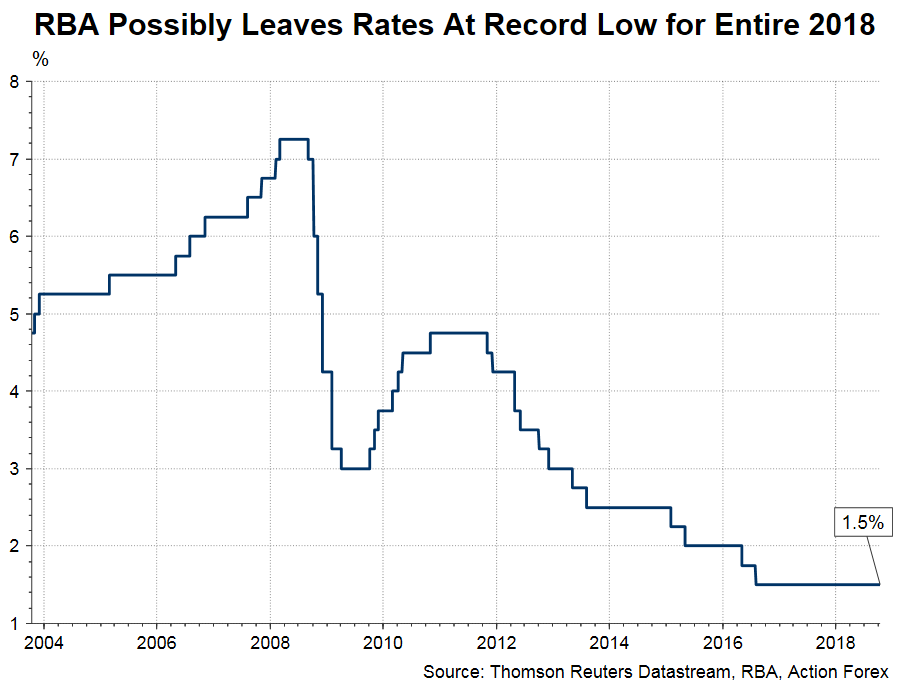
The RBA minutes for the October meeting reinforced its cautious stance on the monetary policy. With the cash rate unchanged at 1.5% for 24 consecutive months, the members have seen no urgency to make adjustment. While affirming the next move would more likely a rise than a fall, there is no sign of action any time soon. This is hinged on low wage growth and subdue inflation, despite strong economic growth and better job market conditions. The minutes revealed that the RBA remained content with AUD depreciation, but is getting more concerned about the tighter lending conditions.
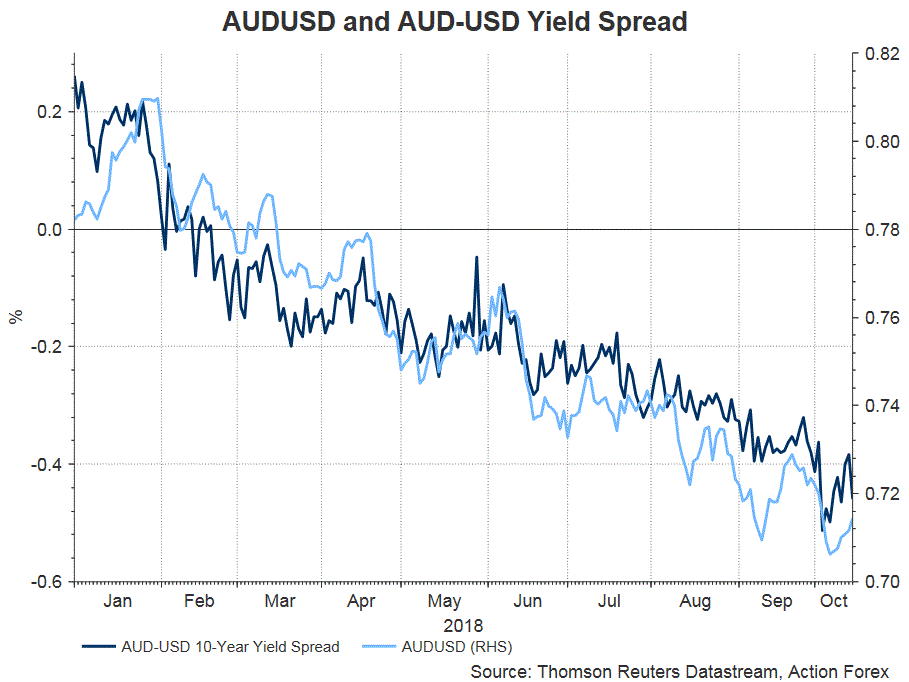
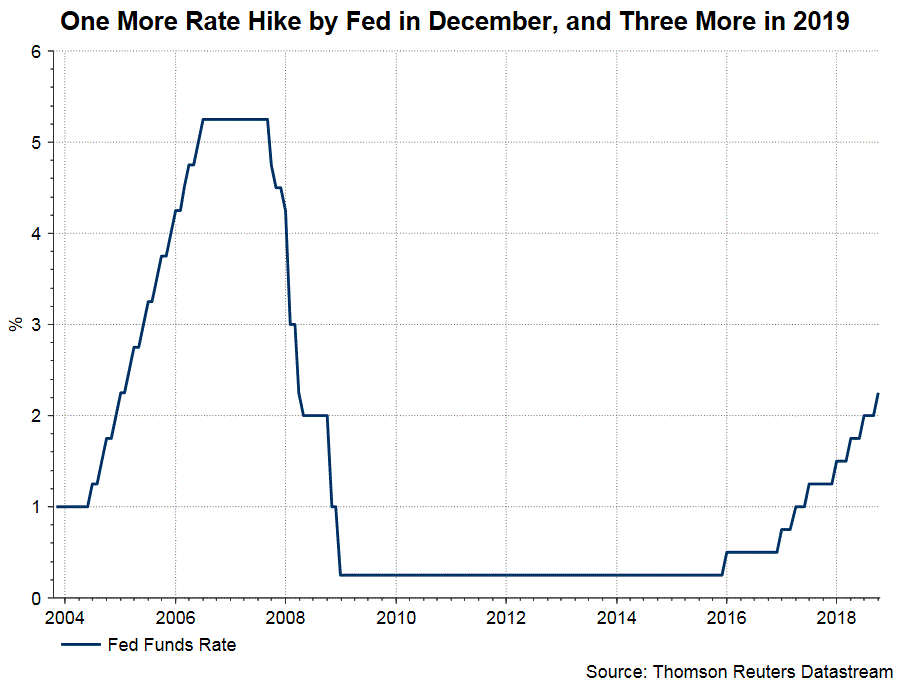
Yield spread widening and escalations of US-China trade war have been the key causes of AUD weakness. Fed’s monetary policy normalization process since 2015 has resulted in 8 rate hikes so far. The three rate hikes (25 bps each) in both 2017 and in the first nine months of this year have brought the Fed funds rate to 2-2.25%. On the other hand, RBA, after several times of rate hikes in 2009-2010, resumed easing before leaving its policy rate at historical low of 1.5% since August 2016. The divergence in monetary policy has caused US yields to surpass Australia’s early this year, leading capitals to flow out of the latter for the former. Meanwhile, the US-China trade war has huge impact on Australia, which exports much of its raw materials to China. Since Trump’s first tariff on Chinese goods took effect in July, Australian dollar has dropped more than 3% against US dollar. Yet, the members appeared satisfied with the movement, noting that the “modest depreciation of the Australian dollar was likely to have been helpful for domestic economic growth”.
Policymakers are closely watching the impact of the tighter market condition, brought about by the Royal Commission, on the economy. As noted in the minutes, “members observed that while the regulators had already overseen a tightening of lending standards, and a degree of tightening of lending standards had been implemented by banks in anticipation of the commission's findings, it was possible that banks could tighten lending conditions further given the issues raised in the report”. It added that the central bank would “monitor the future supply of credit to ensure that economic activity continued to be appropriately supported".