Sample Category Title
Crude Oil Outlook: Saudi Tensions Boost Oil Price But Key Barriers Still Hold
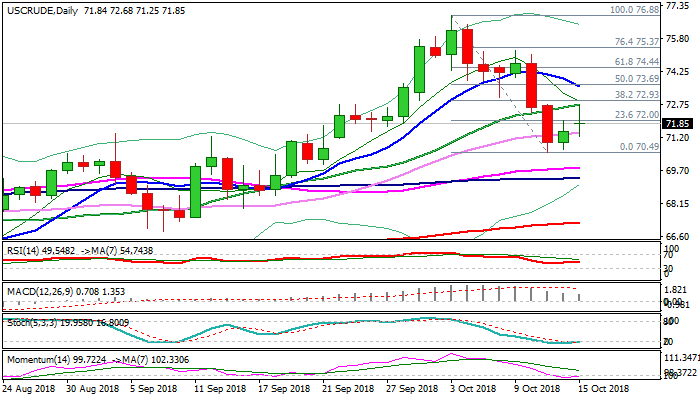
WTI oil moved higher in early Monday's trading, in extension of recovery from $70.49 (11 Oct low), after bullish close on Friday signaled stabilization following strong fall on Wed/Thu last week. Rising tensions over missing Saudi prominent journalist sparked fresh concerns about supply, as the US President Trump threatened severe punishment while Saudi Arabia responded, saying it would retaliate to any action. Recovery action on Monday was capped by 20SMA at $72.68, with subsequent pullback suggesting that bulls might be running out of steam. Near-term action remains biased higher as momentum is breaking into positive territory and slow stochastic reversing from oversold zone, continuing to underpin. Recovery needs break above 20SMA ($72.68) and Fibo 38.2% of $76.88/$70.49 ($72.93) to generate bullish signal for extension and also signal formation of higher low at $70.49, while sustained break above falling 10SMA / Fibo 50% ($73.60/69) is needed to confirm reversal. Alternatively, return and close below 30SMA ($71.42) would weaken near-term structure and risk retest of key near-term support at $70.49.
Res: 72.00, 72.68, 72.93, 73.60
Sup: 71.42, 71.00, 70.49, 70.00
Geopolitical Risks And Yields Dominate Proceedings
Monday October 15: Five things the markets are talking about
Following a weekend of warnings on global economic fragility from G10 finance leaders at an IMF meeting in Bali, has global equities starting this new week on the back foot, with regional bourses in Asia and Europe seeing red, while U.S equity futures are pointing to deep declines.
Sovereign yields are lower in this cautious climate, while yen has pushed higher along with gold. Crude oil has advanced as tensions rise between the U.S and Saudi Arabia over a missing journalist.
Politics and data are never a good mix and this week is awash with both.
Italy is to submit its contentious budget to the E.C. Already; the proposed budget has potentially broken specific thresholds, which would require a lot of debating from both parties. Expect Italian BTP yields again to come under pressure, backing up towards the psychological +4%.
The E.U meets on Wednesday and will get an update on the status of negotiations with the U.K’s Brexit. Expect the Irish border to be the ‘hot topic du jour. If there is insufficient progress, the possibility of a special summit next month to finalize an agreement looks dead in the water. Dealers expect the pound to remain volatile in the short-term.
The U.S Treasury report about the international economy and the FX market is to be released Tuesday. To neutral observers, China does not meet the threshold of “manipulation.” However, Trumps interpretation may be very different.
On the data front, the U.S releases retail sales this morning (08:30 am EDT) and FOMC minutes on Wednesday.
Across the pond, the U.K presents its labour report tomorrow, (Oct 16) inflation Wednesday (Oct 17) and retail sales Thursday (Oct 18).
In Canada, Friday’s upcoming data includes retail sales, and CPI – neither of the reports are expected to dissuade the market of pricing in a +25 bps rate hike at next weeks Bank of Canada (BoC) monetary policy decision.
1. Equities see red
In Japan overnight, the Nikkei closed at a two month low as automakers and other manufacturers were hit by news that the Trump administration would seek a provision about currency manipulation in future trade deals. The Nikkei share average ended down -1.8%, the weakest closing point since mid-Aug, while the broader Topix dropped -1.6%, the lowest close in seven-months.
Down-under, the ASX 200 fell to a six-month low overnight, led by the banking sectors growing concerns about the hit to earnings from an inquiry into misconduct. The S&P/ASX 200 index fell -1%. In S. Korea, the Kospi stock index fell -0.77% as institutions cut their exposure to riskier assets. The country’s biggest automaker Hyundai Motor slipped -1.7%, marking its lowest trading level in eight-years.
In China and Hong Kong, stock markets again slipped overnight following last week’s deepest dive in eight-months, as investors await the latest twist in the Sino-U.S trade dispute. The Shanghai Composite index closed lower by -1.5%, while in Hong Kong the Hang Seng closed -1.4% lower.
In Europe, regional bourses trade lower across the board, tracking U.S futures and Asian indices lower. The FTSE and sterling (£1.3140) trade a tad lower after the E.U and U.K paused Brexit talks until after this week’s mini-summit.
U.S stocks are set to open deep in the ‘red’ (-0.8%).
Indices: Stoxx600 -0.6% at 356.8, FTSE -0.3% at 6976, DAX -0.4% at 11474, CAC-40 -0.6% at 5066, IBEX-35 -0.3% at 8876, FTSE MIB -0.2% at 19225, SMI % at -0.8%, S&P 500 Futures -0.8%
2. Oil prices rise on Saudi tensions, gold higher
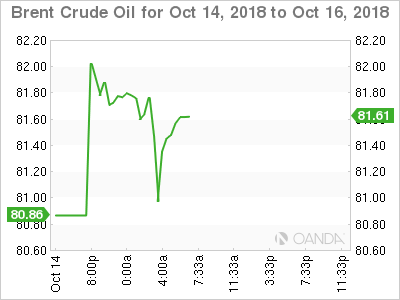
Oil prices remain bid this Monday morning as tension over the disappearance of a Washington post journalist and Saudi critic, Jamal Khashoggi, fuelled supply worries, although concerns over the long-term demand outlook dragged on sentiment.
Brent crude oil jumped +$1.49 a barrel to a high of +$81.92 before easing to +$81.13, up +70c. U.S crude (WTI) was last up +40c at +$71.74.
Saudi Arabia has been under pressure since Khashoggi, a U.S. resident, disappeared on Oct. 2 after visiting the Saudi consulate in Istanbul.
President Trump has threatened “severe punishment” if it is found that the journalist was killed in the consulate.
On Sunday, the Saudi’s said it would retaliate to any action taken against them over the Khashoggi case. The market is tentatively concerned that the Saudis may use oil as a tool for retaliation.
Despite prices starting the week better bid, there are still lower that last week’s high print.
Also limiting price gains is a report from the IEF last Friday stating that the market looked “adequately supplied for now” and cut its forecasts for world oil demand growth this year and next.
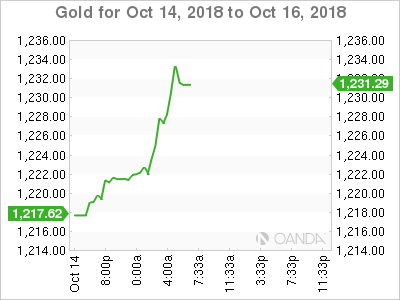
Ahead of the U.S open, gold prices have jumped +1% to hit a three-month high as global stocks resumed their fall and investors wrestled with the impact of the ongoing Sino-U.S. trade war and higher U.S interest rates. Spot gold is up +0.9% at +$1,228.24 an ounce, while U.S gold futures are up +0.8% at +$1,231.80 an ounce.
3. Italian and Portugal yields fall
Portuguese and Italian government bond yields have fallen this morning, with prices outperforming euro zone peers after ratings agency Moody’s upgraded Portugal’s credit rating back to investment grade.
Portugal’s 10-year bond yield fell -4 bps to +2.01% after Moody’s lifted its credit rating to Baa3 on Friday.
The positive periphery sentiment from Portugal has spilled over into Italy’s battered bond market. Italian 10-year BTP yields are down -4.5 bps to +3.53%.
Note: Expect Italian yields to trade rather volatile this week as Italy presents its budget to the E.C.
Elsewhere, the yield on U.S 10’s fell -1 bps to +3.15%. In Germany, the 10-year Bund yield has dipped -1 bps to +0.49%, the lowest in more than a week. In the U.K, the 10-year Gilt yield has eased -2 bps to +1.614%, the lowest in more than a week.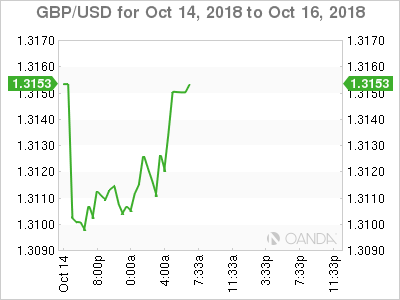
4. Dollar’s safe haven flows ease
Risk aversion flows initially provided a bid for the traditional safe-haven currencies of JPY (¥111.75) and ‘big’ USD, however, market sentiment has eased a tad ahead of the U.S open.
GBP (£1.3147) opened below the psychological £1.31 handle on concerns that a Brexit agreement might be slipping away after the U.K and E.U negotiators were said to have called ‘a pause’ in their Brexit talks and would now wait for the outcome of a summit mid-week (Wed) before any resumption.
TRY ($5.8208) is firmer by over +1% outright for its seventh session gain on optimism that relations between Turkey and U.S would improve following the release of U.S Pastor Brunson.
Bitcoin prices have spiked +6.5% this morning, jumping above +$6,600. While the catalyst behind the move higher is not clear and with few ready to label bitcoin a “true store of value” in turbulent times, BTC has held up better than most of late.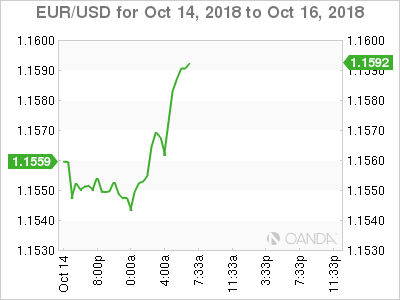
5. Embarrassing losses in Bavarian election shake Merkel’s coalition
Germany’s grand coalition could become even further unstable after coalition members suffered humiliating results in an election in the southern state of Bavaria.
Chancellor Merkel’s Bavarian allies slumped to their worst election results in almost 70 years and her junior coalition partners, the center-left Social Democrats (SPD), saw support in Bavaria halved.
The SPD had hoped that infighting over immigration between Merkel’s Christian Democrats (CDU) and the Bavarian Christian Social Union (CDU) allies would give them a boost in Bavaria.
But instead, the party saw support fall to just under +10%, prompting a discussion over the sustainability of its alliance with Merkel’s conservatives at the national level.
Note: SPD members are still bitter over their leaders’ decision to join a Merkel-led government.
Merkel’s authority may be called into question as soon as in two-weeks in an election in the western state of Hesse – the state is ruled by Merkel’s CDU in a coalition with the Greens, but polls suggest she is losing further support.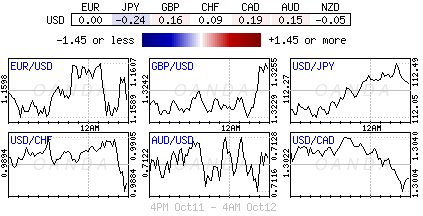
CHF And JPY Up Amid Risk-Off Sentiment
Safe-haven assets rise
After a painful last week, equities fell further on Monday with Asian markets blinking red across the screen. The Nikkei fell 1.87%, while Hong Kong’s Hang Seng slid 1.50%. In Europe, the atmosphere is not much better as most indices headed lower, with the exception of Italian equities that barely kept their heads above water. However, the uncertainty created by the clash between Italy and the European Union regarding Italy’s budget is far from over. It will likely continue to weight on equities and especially financials. In FX, investors don’t where to stand against the backdrop of tense Brexit negotiations and Italian budget jitters. The greenback has erased partially last week’s losses but still trades with a clear downtrend bias. The single currency edged slightly higher on Monday morning with EUR/USD rising 0.03% to 1.1563. The currency pair currently sits on the 1.1558 support, implied by the 50% Fibonacci level of its August-September rally.
We expect US rates will stabilise as investors finish pricing in the US Fed’s hiking cycle, which should end in 2020. On the long-end of the curve, the pace of the Fed balance sheet unwinding will be closely monitored. Nevertheless, the US central bank has already well communicated about this matter and no surprises are expected.
Pounds struggles as Brexit dangles
British pound optimism is over. EU chief negotiator Michel Barnier’s optimistic rhetoric is now sounding more concerned. After meeting with Brexit Secretary of State Dominic Raab in a one-hour meeting on Sunday, the tone of the negotiations has drastically changed. No further talks are planned until Wednesday 17 October, thus leaving one single day for both EU and UK negotiators to reach a deal that will be voted on by all 27 EU members the day after. According to Prime Minister Theresa May, the current terms are not agreeable. There is a risk that EU leaders decide during the Thursday, 18 October meeting to reject the extension of a special Brexit summit in November, which would damage the UK economy and lead to a no-deal Brexit in March 2019.
The fate of Brexit depends more than ever on decisions of EU policymakers, thus pushing further pressure on GBP. Additionally, will PM May be able to sell the agreement (if any) to UK MPs in December? GBP/USD is struggling to maintain its gains from a 1.3230 high (11 October). The currency pair is approaching 1.31.
Gold Advances To Almost 3-Month Peak, Exits Trading Range
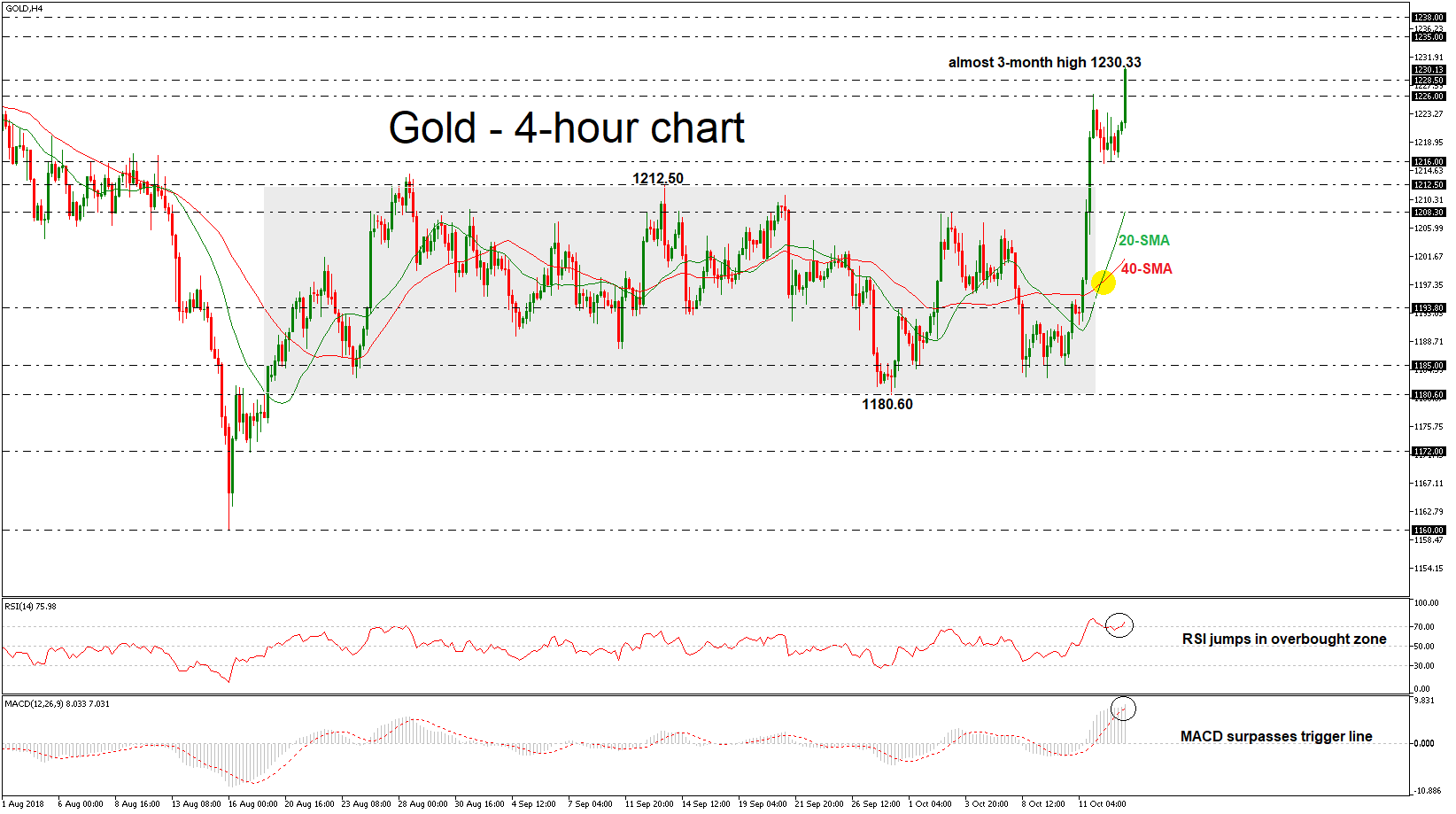
Gold reached a fresh near three-month high of 1230.33 today, continuing the aggressive bullish rally that started in the preceding week. The price successfully surpassed the narrow 1180.60 – 1212.50 range that had been holding since August 20, suggesting further upside moves in the near term.
Having a look at the technical indicators, in the 4-hour chart, the RSI surged to overbought territory and is still pointing to the upside, while the MACD created a bullish crossover with the trigger line in the positive zone. Moreover, the 20-simple moving average (SMA) jumped above the 40-SMA endorsing the aggressive run.
Further upside movement could drive the precious metal towards the 1235 resistance level, taken from the high on July 26. A significant leg above this barrier could send prices until the next immediate resistance of 1238, achieved on July 3. Moreover, a jump higher could challenge the 1265.60 resistance, where it topped on July 6.
On the flipside, in case of a bearish retracement the market could meet support at around 1216, identified by the latest lows. More losses could see the price retesting the 1212.50 hurdle before it heads lower to the 20-SMA, currently at 1208.30.
Overall, gold prices seem to be in a sharp upside movement over the last hours. Overbought conditions may justify some caution though.
AUDUSD Outlook: Fresh Recovery Looks For Break Through Fibo Barrier At 0.7145
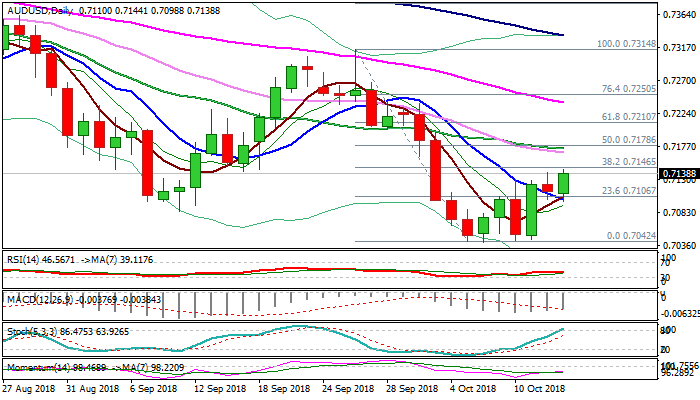
The Aussie dollar holds positive tone on Monday and accelerated higher in European trading, on positive signals from China and weaker greenback. Fresh rally pressures pivotal barrier at 0.7145 (Fibo 38.2% of 0.7314/0.7041 bear-leg), break of which would generate bullish signal for extension of recovery from 0.7040 zone base. Formation of 5/10SMA bull-cross and north-heading daily momentum which crossed above its 7-d SMA, underpin the action. Above 0.7145 Fibo barrier, recovery would focus converged falling 20/30SMA's, which mark next barriers at 0.7170 zone (also near Fibo 50% of 0.7314/0.7042 descend), which guard pivot at 0.7210 (Fibo 61.8%). Overbought slow stochastic warns of consolidative action in the near-term (no clear signal yet) with dips to be contained by 10SMA (0.7101) to keep bulls in play.
Res: 0.7145, 0.7170, 0.7210, 0.7238
Sup: 0.7101, 0.7080, 0.7042, 0.7000
Concerns Grow That There Would Not Be Enough Time To Implement Decisions Before The Brexit Mar 2019 Deadline
Notes/Observations
- No Brexit agreement seen until after the EU Leader Summit; concerns grow that there would not be enough time to implement decisions before the Mar 2019 deadline
Asia:
- BOJ Gov Kuroda stated that it would use interest rates to signal exit from easy policy; tocontinue its policy of powerful easing to achieve the inflation targetMarkets should not focus on the amount of government bonds (JGBs) the BoJ purchases, as they were no longer the policy target.
- China PBoC Gov Yi Gang stated that it was considering range of risks in currency policy, including worst case scenario; plenty of room for monetary adjustments amid trade row; monetary policy to remain neutral with more focus on guiding expectations
Europe:
- ECB's Draghi saw underlying inflation is hovering around 1%, but reiterated confidence that inflation was moving toward target; inflation was driven mainly by oil prices. Main risk was a sharp repricing of assets or sharp and sudden increase in interest rates; an inflation surprise was another risk but not that likely
- ECB’s Draghi noted that ECB would not intervene to help Italy. Did not see room for additional expenditures in Italy; All parties needed to ease the tone around Italy budgetary discussions
- ECB Villeroy (France) stated that the General Council would soon decide how to reinvest the proceeds of the bonds that expire in 2019, but should not yet commit beyond that point
- UK and EU negotiators said to have called 'a pause' in their Brexit talks and now plan to wait for the outcome of a summit mid-week (Wed) before any resumption. Brexit talks stalled as some key issues were still open, including the backstop for (Ireland/Northern Ireland) to avoid a hard border
- DUP leader Foster regards no-deal Brexit as 'likeliest outcome'. The dangers of a bad deal were worse than no deal; backstop would be permanent annexation of Northern Ireland from rest of UK. To travel Monday for a series of meeting
- Portugal has named cabinet Minister Pedro Siza Vieira as the new Economy Minister, replacing Manuel Caldeira Cabral
- Germany Bavaria regional election results saw the ruling Christian Social Union, lose it’s its absolute majority, receiving only 35.5% of votes (worst result since 1950). Note: CSU is the sister party to Chancellor Merkel’s Christian Democrats
- Sweden Moderate Party leader Kristersson said to end current attempt to form a government after being unable to get enough support for coalition
Americas
- President Trump 60 Minutes interview threatened to impose another round of tariffs on China and warned that Chinese meddling in US politics was a “bigger problem” than Russian involvement in the 2016 election"
Macro
- (UK) United Kingdom: A lot of weekend noise surrounding Brexit but essentially EU-27 leaders will hold a working dinner on Wednesday, before the official summit on Thursday and while there were signs that U.K. is closer than ever to a deal with the EU, it is already clear that Brexiteers as well as Northern Ireland's DUP, will oppose the plan as it is currently structured. Barnier may have the backing of EU leaders and a clear mandate, but British politicians have engaged in internal fights over the U.K.'s position in the talks. Meanwhile the window for a deal that also has to pass national parliaments is rapidly disappearing.
- (EU) ECB: Over the weekend Draghi warned of a sharp re-pricing in assets, "or a sharp and sudden increase in interest rates", which are "the main risk we should focus on". He said banks are "by and large" stronger than they were in the past, but also highlighted that shadow banking needs closer monetary and called for an enhancement of macro prudential tools in order to safeguard financial stability.
- (EU) ECB: French Central Bank Governor Villeroy said more clarity on the timing of the first interest rate hike since 2011 will come by the summer of next year. Villeroy added he "wouldn't see any value in trading off our flexibility tomorrow against more clarity today, but as we approach the summer of 2019, the balance will shift in favor of detailing our forward guidance." Some his colleagues at the ECB though have suggested discussions about the timing of the rate hike could start earlier next year but with evidence of a slowdown some are clearly dragging their feet on policy normalization.
SPEAKERS/FIXED INCOME/FX/COMMODITIES/ERRATUM
Equities
- Indices [Stoxx600 -0.6% at 356.8, FTSE -0.3% at 6976, DAX -0.4% at 11474, CAC-40 -0.6% at 5066, IBEX-35 -0.3% at 8876, FTSE MIB -0.2% at 19225, SMI % at -0.8%, S&P 500 Futures -0.8%]
Market Focal Points/Key Themes:
- European Indices trade lower across the board, resuming the downtrend tracking US and Asian Indices lower. FTSE and Cable trade a little lower after the EU and UK paused Brexit talks.
- On the corporate front fashion retailer Superdry trades sharply lower after hot weather dampened full year expectations, with Covatec Group another faller following its outlook cut; Greencore reverses earlier gains after divesting its US business to Hearthside. Elsewhere CHR Hansen, and Velocys trade higher following Earnings and updates. Electrolux drops 2% after the company comments on its exposure to Sears after its bankruptcy.
- Looking ahead Bank of America set to report alongside Charles Schwab as earnings are set to pick up in the week ahead.
Equities
- Consumer discretionary: Superdry Plc [SDRY.UK] -20% (trading update), Greencore Group [GNC.UK] -6.2% (to sell US business to Hearthside), Shoe Zone [SHOE.UK] +13% (preliminary earnings, dividend announcement), Distribuidora Internacional de Alimentacion SA [DIA.ES] -8% (said to announce Argentina-related losses), Ceconomy AG [CEC.DE] +3% (CEO resigns)
- Consumer staples: CHR Hansen [CHR.DK] +5% (earnings; Chairman will not seek re-election)
- Energy: GALP Energia [GALP.PT] -0.5% (reports production)
- Financials: Protector Forsikring [PROTCT.NO] -16% (profit warning), Aareal Bank AG [ARL.DE] +0.5% (CEO affirms FY18 outlook in interview)
- Healthcare: Convatec Group PLC [CTEC.UK] -30% (earnings; outlook cut; CEO to retire), Medivir [MVIRB.SE] -15% (CEO steps down), Getinge AB [GETIB.SE] -13.5% (makes provision for product liability claims), Sannthera Pharmaceuticals [SANN.CH] +10% (receives positive opinion on drug)
- Industrials: Robit [ROBIT.FI] -9% (outlook cut), FACC AG [FACC.AT] -0.5% (earnings), Electrolux [ELUXB.SE] -2% (comments on Sears bankruptcy exposure)
- Materials: Bekaert [BEKB.BE] +5% (restructures and refinances debt)
- Utilities: Velocys PLC [VLS.UK] +26.5% (board remains confident in company's future), Engie [ENGI.FR] +1% (company and Canadian fund to bid for Petrobras pipeline)
- Technologies: Iqe PLC [IQE.UK] +5% (appoints CFO)
Speakers
- ECB's Rehn (Finland): ECB should gradually move to data-dependent rate guidance. latest core inflation data somewhat disappointing
- Italy Govt still not in agreement on Budget Law with govt short €2B to fund announced budget measures
- German Economic Ministry Monthly Bulletin: Economic growth to be somewhat slower in Q3 (**Reminder: On Oct 10th German Economic Ministry cut its 2018 and 2019 GDP growth forecasts (as speculated) to 1.8% for both years)
- Germany CSU Party Head Seehofer: Will do our part to make sure the coalition at the national level was stable
- European Banking Authority (EBA) Chairman Enria: Euro Zone banks not made enough progress in raising loss-absorbing capital
- Poland Central Bank's Ancyparowicz reiterated view that rate stability is likely scenario for now
- Turkey Fin Min Albayrak stated that the downward trend in inflation was seen beginning in Oct; country to get rid of the shackles of inflation and rates. To reach year-end economic targets with falling inflation
- Japan Chief Cabinet Sec Suga reiterated that govt planned to raise the sales tax in Oct 2019
Currencies
- Risk aversion flows initially put a bid into safe-haven currencies of JPY and USD but the sentiment was dissipating as the EU session progressed.
- GBP was softer as concerns that a Brexit agreement might be slipping away after UK and EU negotiators were said to have called 'a pause' in their Brexit talks and would now wait for the outcome of a summit mid-week (Wed) before any resumption. The concern now that both sides would not have the time to implement decisions before the Mar 2019 deadline. GBP/USD lower by 0.3% at 1.3120
- TRY currency (Lira) was firmer by over 0.5% for its 7th straight session gains. Optimism that relations between Turkey and US would improve following the release of US Pastor Brunson. USD/TRY at 5.84 ahead of the NY morning.
Fixed Income
- Bund Futures trades at 158.68 up 12 ticks as the 10-year Bund rally back above the 0.50% level. A downside break of 157.25 sees 155.69 initially. To the upside 158.50 remains initial resistance.
- Gilt futures trades at 120.63 up 6 ticks following the move in Treasuries. Continued support at 120.50, with a continued move higher targeting 123.93 then 124.00.
- Monday's liquidity report showed Friday's excess liquidity rose from €1.893T to €1.906T. Use of the marginal lending facility stayed rose from €45M to €50M.
- Corporate issuance saw Tesco and Diageo come to market
Economic Data:
- (NL) Netherlands Aug Retail Sales Y/Y: 4.5% v 2.4% prior
- (DK) Denmark Sept PPI M/M: -0.5% v +0.5% prior; Y/Y: 5.8% v 7.1% prior
- (NO) Norway Sept Trade Balance (NOK): 21.1B v 31.8B prior
- (FI) Finland Sept CPI M/M: 0.2% v 0.1% prior; Y/Y: 1.3% v 1.3% prior
- (FI) Finland Aug Current Account: -€0.1B v +€0.1B prior
- (IN) India Sept Wholesale Prices Y/Y: 5.1% v 5.0%e
- (TR) Turkey July Unemployment Rate: 10.8% v 10.2% prior
- (CH) Swiss Sept Producer & Import Prices M/M: -0.2% v +0.3%e; Y/Y: 2.6% v 3.1%e
- (PL) Poland Sept Final CPI M/M: 0.2% v 0.2% prelim; Y/Y: 1.9% v 1.8% prelim
- (CH) SNB Total Sight Deposits for Week Ended Oct 12th (CHF): 577.6B v 577.5B prior
- (TR) Turkey Sept Central Gov't Budget Balance (TRY): -6.0B v -5.8B prior
- (CZ) Czech Aug Current Account (CZK): -7.0B v -10.0Be
- (IT) Italy Aug General Government Debt: €2.327T v €2.342T prior
Fixed Income Issuance
- (NO) Norway sold NOK3.0B vs. NOK3.0B indicated in 6-month bills; Avg Yield: 0.79% v 0.72% prior; Bid-to-cover: 2.89x v 3.17x prior
- (SK) Slovakia Debt Agency (ARDAL) sold total €167M in 2028 and 2037 Bonds
Looking Ahead
- 05:30 (NL) Netherlands Debt Agency (DSTA) to sell €2.0-4.0B in 3-month and 6-month bills
- 06:00 (IE) Ireland Aug Trade Balance: No est v €4.0B prior
- 06:00 (RO) Romania to sell Bonds
- 06:00 (IL) Israel to sell Bonds
- 06:45 (US) Daily Libor Fixing
- 07:25 (BR) Brazil Central Bank Weekly Economists Survey
- 08:00 (PL) Poland Aug Current Account: -€0.4Be v -€0.8B prior; Trade Balance: -€0.3Be v -€0.4B prior
- 08:00 (IN) India announces details of upcoming bond sale (held on Fridays)
- 08:00 (ES) Spain Debt Agency (Tesoro) announces size of upcoming auctions
- 08:05 (UK) Baltic Dry Bulk Index
- 08:30 (US) Sept Advance Retail Sales M/M: 0.6%e v 0.1% prior; Retail Sales Ex Auto M/M: 0.4%e v 0.3% prior, Retail Sales Ex Auto and Gas: 0.4%e v 0.2% prior, Retail Sales Control Group: 0.4%e v 0.1% prior
- 08:30 (US) Oct Empire Manufacturing: 20.0e v 19.0 prior
- 08:55 (FR) France Debt Agency (AFT) to sell combined €3.9-5.1B in 3-month, 6-month, 9-month and 12-month BTF Bills
- 09:00 (BE) Belgium Aug Trade Balance: No est v €0.4B prior
- 09:00 (CA) Canada Sept Existing Home Sales M/M: 0.0%e v 0.9% prior
- 09:30 (EU) ECB announces Covered-Bond Purchases
- 09:35 (EU) ECB calls for bids in 7-Day Main Refinancing Tender
- 10:00 (US) Aug Business Inventories: 0.5%e v 0.6% prior
- 10:30 (CA) Bank of Canada (BOC) Q3 Loan Officer Survey: No est v -8.9 prior
- 11:00 (IT) Italy Cabinet meets on Budget Law
- 11:30 (IL Israel Sept CPI M/M: 0.0%e v 0.1% prior; Y/Y: 1.1%e v 1.2% prior
- 12:00 (EU) ECB’s Nouy (SSM chief) in Brussels
- 14:00 (ES) ECB’s De Guindos (Spain)
- 16:00 (US) Weekly Crop Progress Report
Risk Aversion Remains At The Start Of The Week
Could strong retail sales report prompt more selling?
Markets remain in risk aversion mode at the start of the week, with losses being recorded across Asia and Europe and US futures pointing to a similar session on Wall Street.
While the losses being reported are more modest that those seen last week, which investors will hope represents some stability and normality returning to markets, it will remain a source of concern for now. Underlying risks in the markets remain plentiful, from Sino-US trade to Brexit, Italy's budget spat and now German political concerns following state elections in Bavaria.
While investors will primarily be focused on the numerous political stories and related risks, US earnings season which kicked off on Friday will provide a welcome distraction over the coming weeks. We'll also get US retail sales data on Monday which will be followed closely given investor anxiety about the prospect of higher interest rates and the pace that US yields are rising in anticipation of this. In these unsettled markets, a strong reading could actually have a negative impact if it prompts a further selling of Treasuries and another rise in yields.
Brexit talks heading for 11th hour fudge as crunch talks fail
Crunch talks in Brussels over the weekend lasting only an hour failed to produce a deal on the Northern Ireland border backstop that remains the main blocker to an agreement between the UK and EU. It was hoped that a compromise could be found ahead of the EU summit later this week but it's looking increasingly like being an eleventh hour fudge, which won't surprise anyone who's followed these talks for the last year and a half.
The pound is holding up relatively well despite the stalled progress over the weekend. The currency is likely to remain rather volatile over the coming weeks as talks continue and we see increasing amounts of commentary being leaked, not to mention more pressure on the May following reports that more letters of no confidence being submitted, taking the total number to 44, four short of the number required to trigger a vote.
Oil breaks with last week's trend on Saudi fears
Oil is trading higher at the start of the week, breaking with the trend towards the back end of last of being dragged lower along with overall risk appetite on growth concerns, following an heating up in rhetoric from the US and others towards Saudi Arabia over the weekend after the disappearance of journalist Jamal Khashoggi.
Saudi Arabia denies behind the disappearance and alleged murder and vowed to retaliate to any sanctions or pressure from other countries. This makes oil traders very nervous given that Saudi Arabia is among the world's largest producers and could use this as a tool against other governments, at a time when prices are already inflated and rising due to tighter supply on the back of years or coordinated cuts and more recently, Iranian sanctions.
Dollar suffers renewed selling, Gold breaks 1230
While resurfaced Brexit uncertainty keeps Sterling generally weak today, Dollar is trying to take over and fresh selling is seen in early European session. In particular, USD/JPY took out 111.82 minor support and resumed recent pull back from 114.54. Deeper fall should now be seen to 110.75 fibonacci level. AUD/USD also breaks last week's high and reaches 0.7143 so far. Swiss Franc and Yen are the strongest ones.
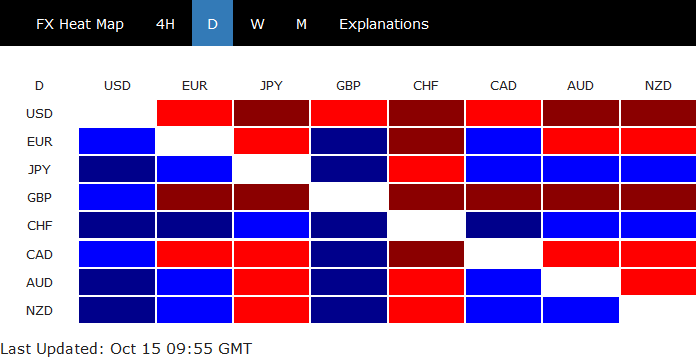
European markets is indeed mixed only. At the time of writing, DAX is up 0.07%, CAC down -0.32% and FTSE down -0.06%. German 10 year bund yield drops below 0.5 handle to 0.496. Italian 10 year yield is relatively stead at 3.573. Asian markets were troubled by risk aversion though. Nikkei closed down -1.87%, Singapore Strait Times down -0.76%, Hong Kong HSI down -1.38% and China Shanghai SSE down -1.49%
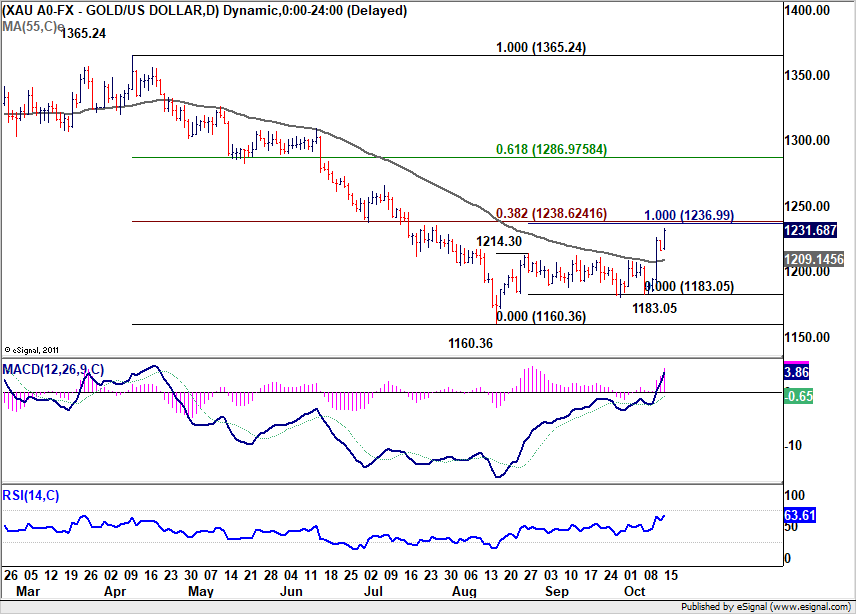
Gold's rally resumed by taking out last week's high and reaches 1233.30 so far. For now, we're still seeing rebound from 1160.36 low as a correction. Thus, strong resistance should be seen 1235.24/1236.99 cluster resistance zone (38.2% retracement of 1365.24 to 1160.36 at 1238.62, 100% projection of 1160.36 to 1214.30 from 1183.05 at 1236.99). to limit upside. However, firm break of this zone will invalidate our view and target 61.8% retracement at 1286.97 and above.
When Will The Sell-Off Stop? | Brexit Negotiations Still Stuck | Saudi Arabia No Longer Promising Investment
The major issue is still around the Irish border and the British Pound is paying the price for that. The ongoing tensions in Saidi Arabia may effect the FDI
How Low This Sell-off Will go
US markets posted their worst weekly performance and the questions for traders is if this will continue this week? It is always difficult to figure out if the current sell-off is only a healthy correction or if this is going to change into some much bigger. One way of finding this is to look at the price action if we start to see major downward moves for the index, and the momentum continue to build up then it means that the current sell-off is going to get ugly. On the other hand, if the selling momentum continue to fade off, it is clearly an opportunity for those who have been sitting on the sidelines,
British Pound Continue to Look at Bexit
Once again, there is no luck for the British Pound, the currency is mostly consolidating as the Brexit talks have not yielded any favourable outcome and now all eyes will remain on the upcoming Brexit summit which is taking place on Wednesday. The major issue is still around the Irish border and this stalls the Brexit discussions and as along as we do not have any clear decision on this, we think that traders may not commit to any big bets. There is no important economic data due today so Brextio will remain the key focus here and it is likely that we may break below the 1.31 mark.
Geopolitical tensions And Saudi Arabia
Saudi Arabia doesn’t look the most promising investment any more. In fact, the fund and firms which are involved or associated with Saudi Arabia are getting punished. Soft Bank which has produced a fair bit of positive headlines in relation to various corporations with Saudi Arabia is paying the price- its stock is down. But it is important to keep in mind that structural changes do not take place overnight, it takes time for this kind of changes to take effect. But if the geopolitical tensions continue to persist, it creates more obstacles for foreign direct investments.
Saudi Arabia can certainly play the same political game with the U.S. which it played in 1973- the oil embargo. But it needs to understand that the U.S has changed the landscape of the oil market massively, it is producing nearly 10 million b/d of oil. President Trump has already said that he thinks that it will be foolish to cancel the arms deal with the country. This indicates that that the U.S. is only interested in its own interest.
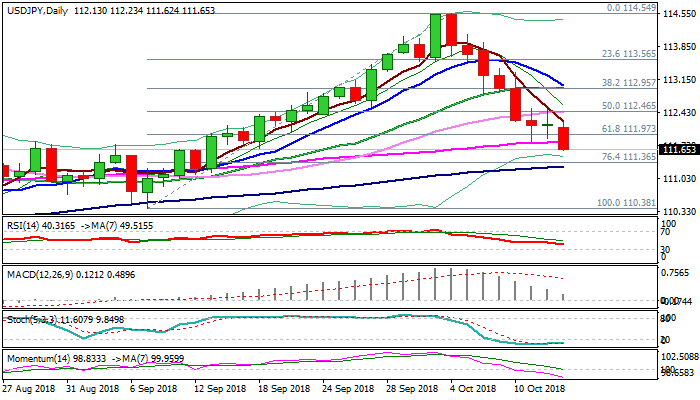
USDJPY Outlook: Yen Continues To Rise On Strong Safe-Haven Demand
The pair accelerated lower on Monday, extending last week’s fall, which marked the biggest weekly loss since the second week of February.
Fresh weakness emerges after consolidation of last Thu/Fri, shaped in double long-legged Doji.
Rising safe-haven demand, fueled by geopolitical tensions, boosted yen which hit one-month high against dollar on Monday.
Today’s fall eventually broke through cracked pivot at 111.97 (Fibo 61.8% of 110.38/114.54 rally) and heading towards daily cloud top at 111.47.
Daily cloud is spanned between 111.47 and 110.93 and together with 110.76 (Fibo 38.2% of larger 104.63/114.54 uptrend) marks pivotal supports, break of which would generate stronger bearish signal.
Bearish momentum continues to strengthen on daily chart and supports further weakness, but bears may take a breather on approach to cloud top as slow stochastic turned sideways in oversold zone.
Extended upticks should be capped by broken 30SMA (112.45) to keep bears in play.
Res: 111.97, 112.23, 112.45, 112.95
Sup: 111.62, 111.47, 111.29, 110.93