

Sample Category Title
Italian Yields Lower On Reports Italy Wants ECB To Continue Its Bond Buying Program
Notes/Observations
- Italy said to want ECB to begin a new QE program to ward off speculative attacks on its financial markets
- UK and EU officials said to see mid-November as the new Brexit deal deadline rather than Oct (Note: delays could present timetable challenges to ratifying the Brexit terms by Mar 29th 2019)
- France Q2 GDP data (2nd of 3 readings) came in-line at 0.2% (matched the sluggish Q1 print and the weakest reading since the last contraction back in the Q2 2016)
Asia:
- BOJ Board Member Suzuki stated that needed to continue to monitor impact of low rates on banks. Slight rise in 10-year JGB yield would have limited impact on bank lending and corporate bond market. The move to double the range for long-term yields was not intended to signal rate hike. Reiterated would swiftly respond to any rapid increases in yield.
Europe:
- UK and EU officials said to see mid-November as the new Brexit deal deadline, said to see deal by October as not likely
- EU Commissioner Oettinger (Germany) stated that it would not be a smart move if Italy blocked EU budget negotiations
Americas:
- Canada said to be prepared to make concessions related to dairy for NAFTA in exchange for compromises on other areas
- Canada PM Trudeau: looks forward to a NAFTA agreement if it's good for Canada. Has been progress on autos in the NAFTA talks but position on supply management hasn't shifted and would defend it
- Canada Foreign Min Freeland: 'Very constructive' meeting with USTR Lighthizer; returning to continue trade talks
Energy:
- Weekly API Oil Inventories: Crude: 0M (flat) v -5.2M prior
Economic Data:
- (JP) Japan Aug Consumer Confidence: 43.3 v 43.3e
- (DE) Germany Sept GfK Consumer Confidence: 10.5 v 10.6e
- (FR) France Q2 Preliminary GDP (2nd reading) Q/Q: 0.2% v 0.2%e; Y/Y: 1.7% v 1.7%e
- (FR) France July Consumer Spending M/M: 0.1% v 0.3%e; Y/Y: 0.2% v 0.2%e
- (HU) Hungary July Unemployment Rate: 3.6% v 3.6%e
- (TR) Turkey Aug Economic Confidence: 83.9 v 92.2 prior
- (TR) Turkey July Trade Balance: -$6.0B v -$5.5B prior
- (AT) Austria Aug Manufacturing PMI: 56.4 v 56.8 prior (31st month of expansion)
- (CH) Swiss Aug Credit Suisse Expectations Survey: -14.3 v -4.0 prior
Fixed Income Issuance:
- (IN) India sold total INR180B vs. INR180B indicated in 3-month, 6-month and 12-month bills
- (SE) Sweden sold SEK5.0B in 3-month bills; Avg Yield: -0.7952% v -0.8350% prior; Bid-to-cover: 2.34x v 2.05x prior
- (NO) Norway sold NOK2.0B in Apr 2028 bond; Avg Yield: 1.77% v 1.82% prior, Bid-to-cover: 2.74x v 2.71x prior
- (IT) Italy Debt Agency (Tesoro) solds €6.0B vs. €6.0B indicated in 6-month Bills; Avg Yield: 0.438% v 0.066% prior ; Bid-to-cover: 1.87x v 1.80x prior
SPEAKERS/FIXED INCOME/FX/COMMODITIES/ERRATUM
Equities
- Indices [Stoxx600 +0.1% at 385.4, FTSE -0.3% 7593, DAX 0.0% at 12524, CAC-40 0.0% at 5484, IBEX-35 -0.7% at 9538, FTSE MIB -0.4% at 20554, SMI -0.3% at 9059, S&P 500 Futures +0.1%]
- Market Focal Points/Key Themes: European Indices trade mixed in a quiet day of trade ahead of the long weekend in the US. Asian Indices traded mixed, with US Futures pointing to a slightly higher open. On the earnings Pernod Ricard trades lower after slightly missing estimates, with Emmi another notable decliner after missing estimates. RTL trades higher after a healthy beat, Petrofac also rises after earnings, while Tele Columbus trades over 25% higher after its cut outlook, but not as bad as feared. Looking ahead retail earnings continue with A&F, Dollar General, Dollar Tree, Burlington and Kirkland among others.
Movers
- Consumer Discretionary Pernod Ricard [RI.FR] -0.4% (Earnings), RTL [RTL.FR] +6% (Earnings), Emmi [EMMI.CH] -5.8% (Earnings)
- Healthcare Sinclair Pharma [SPH.UK] +30% (Possible 32p bid offer)
- Financials James Fisher [FSJ.UK] +3.1% (Earnings), Aroundtown Properties [AT1.DE] +1.5% (Earnings)
- Technology Sonova [SOON.CH] -2.8% (Placing), IQE [IQE.UK] -2.7% (Earnings)
- Materials Enquest [ENQ.UK] -0.5% (Kraken FPSO settlement)
- Energy Petrofac [PFC.UK] +1.6% (Earnings)
Speakers
- Italy govt reportedly seen reaching out to ECB for a new round of QE. Looking for ECB to pass a new program of bond purchases in order to shield Italian debt from financial speculation and avoid a sovereign rating downgrade
- Norway Fin Min Jensen: Spending of oil revenue cannot grow as fast as it has in the past. Need to keep budget back to avoid NOK curency (Krone) strength. Interest rates will be going higher
- Iceland Central Bank (Sedlabanki) Policy Statement reiterated that it had both the will and the tools necessary to keep inflation at target over the long term. If inflation expectations continued to rise and remain persistently above target then would call for a tighter monetary policy stance
- Turkey Central Bank (CBRT) announcement onInterbank Money Market Borrowing Limits stated that it would double the limits applicable before 13 August 2018
- Japan Cabinet Office (Gov’t) Monthly Economic Report for Aug maintained its overall assessment that economy was recovering at a moderate pace but did lowers its assessment on exports
Currencies
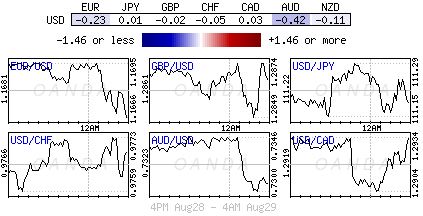
- The EUR/USD moved back below the 1.17 handle as concerns on Italy continued to simmer. Italy said to want ECB to begin a new QE program to ward off speculative attacks on its financial markets. The speculation help to send Italian BTP yields lower in the session.
- GBP/USD was steady but holding below the 1.29 level despiteUK and EU officials now saw mid-November as the new Brexit deal deadline rather than Oct (**Note: delays could present timetable challenges to ratifying the Brexit terms by Mar 29th 2019)
Fixed Income
- Bund Futures trades at 162.54 i[ 1 tick retracing some of the move as European Indices trade mixed. Resistance moves to 163.82 then 164. A downside break of 163.00 sees 162.69 initially.
- Gilt futures trades at 123.07 up 7 ticks following the move in Treasuries. Continued support at 123.12, with a continued move higher targeting 123.93 then 124.00.
- Wednesday 's liquidity report showed Tuesday's excess liquidity rose from €1.848T to €1.854T. Use of the marginal lending facility rose from €70M to €75M.
- Corporate issuance saw issuance floodgates open wide
Looking Ahead
- (IT) Italy Fin Min Tria in China to help build economic dialogue (thru Sept 1st)
- 05.30 (UK) Weekly John Lewis LFL sales data
- 05:30 (EU) ECB allotment in in 3-month LTRO tender
- 05:30 (DE) Germany to sell €3.0B in 0% Oct 2023 BOBL
- 06:45 (US) Daily Libor Fixing
- 07:00 (RU) Russia to sell RUB15B in Dec 2021 OFZ bonds
- 07:00 (US) MBA Mortgage Applications w/e Aug 24th: No est v 4.2% prior
- 08:00 (BR) Brazil July PPI Manufacturing M/M: No est v 2.1% prior; Y/Y: No est v 12.0% prior
- 08:05 (UK) Baltic Dry Bulk Index
- 08:30 (US) Q2 Preliminary GDP Annualized (2nd reading) Q/Q: 4.0%e v 4.1% advance; Personal Consumption: 3.9%e v 4.0% advance
- 08:30 (US) Q2 Preliminary GDP Price Index: 3.0%e v 3.0% advance; Core PCE Q/Q: 2.0%e v 2.0% advance
- 08:30 (CA) Canada Q2 Current Account: -$15.3Be v -$19.5B prior
- 09:00 (IL) Israel Central Bank (BOI) Interest Rate Decision: Expected to leave Base Rate unchanged at 0.10%
- 09:30 (BR) Brazil July Total Outstanding Loans (BRL) No est v 3.31T prior; M/M: No est v 0.7% prior
- 10:00 (US) July Pending Home Sales M/M: 0.3%e v 0.9% prior; Y/Y: -2.5%e v -4.0% prior
- 10:30 (US) Weekly DOE Crude Oil Inventories
- 11:30 (US) Treasury to sell $17B in 2-Year Floating Rate Notes
- 13:00 (US) Treasury to sell $31B in 7-Year Notes
- 13:30 (MX) Mexico Central Bank (Banxico) Quarterly Inflation Report (QIR)
- 15:00 (US) July Agriculture Prices Received: No est v 0.1% prior
- (BR) Brazil Aug CNI Consumer Confidence: No est v 101.6 prior
Trade Talks To Dictate Next Dollar Move
Wednesday August 29: Five things the markets are talking about
For now, trade negotiations remain the dominant theme for market moves as uncertainty over how Canada will respond to Monday’s ‘non-ratified’ agreement between the U.S and Mexico.
U.S-Canada talks are underway and a failure for Canada to agree over the new bilateral terms that have been agreed upon between the other two former Nafta members could mean tariffs going up on exports such as automobiles. However, there are reports that Canada is ready to make concessions on its dairy market to be included in any North American trade deal.
For the U.S, time constraints are an issue, with the U.S midterms in November; there is a 90-day period for Congress to be consulted on any decision to disband NAFTA.
Some European bourses and U.S futures are trading in the green after a lackluster Asian session. G10 currency pairs are again confined to a relatively tight trading range. The EUR has lost some of its lustre after the Italian government was said to be asking the ECB to pass a new program of bond purchases to protect the third largest European economy its debts.
On tap: The U.S economy is expected to have grown in Q2, but at a slightly slower pace. Preliminary GDP is released at 08:30 am.
1. Stocks mixed results
In Japan, the Nikkei rallied overnight for the seventh consecutive session as tech stocks advanced along with their counterparts stateside. The Nikkei ended the day up +0.15%, while the broader Topix rallied +0.46%.
Down-under, Aussie shares rallied, supported mostly by the financials and the tech sector. The S&P/ASX 200 index rose +0.8% at the close. The benchmark added +0.6% on Tuesday. In S. Korea, the Kospi stock index rose +0.26% on positive sentiment about the U.S-Mexico trade deal, but concerns over the Sino-U.S tariff war capped gains.
In Hong Kong, stocks rallied overnight, supported by property developers, but concerns for trade and economic growth in China put pressure on the Hang Seng’s China Enterprises index. At close of trade, the index was up +0.23%, while the Hang Seng China Enterprises index fell -0.13%.
In China, stocks fell, as the country’s state planner warned of more risks to growth in H2 of 2018. The blue-chip CSI300 index fell -0.4%, while the Shanghai Composite Index ended down -0.3%.
In Europe, regional bourses trade mixed in another quiet day ahead of the long weekend stateside. FTSE (-0.3%) is under pressure as miners weigh on the top-flight index in response to strength in the ‘big’ dollar.
U.S stocks are set to open in the ‘black’ (+0.1%).
Indices: Stoxx600 +0.1% at 385.4, FTSE -0.3% 7593, DAX 0.0% at 12524, CAC-40 0.0% at 5484, IBEX-35 -0.7% at 9538, FTSE MIB -0.4% at 20554, SMI -0.3% at 9059, S&P 500 Futures +0.1%
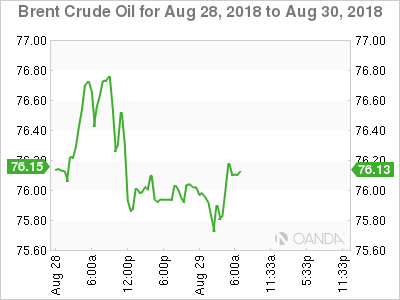
2. Oil slips on rising U.S supply, Venezuela investment
Oil prices are under pressure, pulled down by a rise in U.S inventories and hopes that new investment could halt a plunge in Venezuela’s output.
Brent crude oil is down -20c at +$75.75 a barrel, while U.S light crude -10c lower at +$68.43 a barrel.
There are reports of potential investment in Venezuela’s struggling oil production is also affecting markets.
Note: Venezuelan crude exports have been reduced by -50% in 24-months to below +1M bpd.
API data yesterday showed that U.S crude inventories rose by +38K barrels to +405.7M barrels in the week to Aug. 24. The market had been expecting a headline drawdown.
Expect dealers to take their cue from today’s official U.S fuel inventory data by the Energy Information Administration (EIA) – released at 10:30 am EDT.
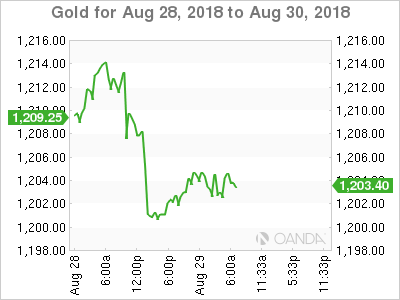
Ahead of the U.S open, gold prices have inched a tad higher after yesterday’s sharp fall, but a firmer U.S dollar, supported by higher rates and lingering Sino-U.S trade tensions seems to be capping the ‘yellow’ metals gain. Spot gold is up +0.3% at +$1,204.43 an ounce, while U.S gold futures are down -0.3% at +$1,210.60.
3. BTP yields fall on report that Italy may ask ECB for more QE
Italian bond yields have fallen -4 to -5 bps ahead of the U.S open, on reports that Italy may reach out to the ECB for help.
According to local sources, the Italian government plans to reach out to the ECB for a new round of QE to avoid a ratings downgrade.
Note: Italy has been searching for allies to support its bonds in recent weeks, with the U.S and China voicing concern about a recent widening in Italy’s bond yield spread over euro zone peers.
Italian 2-year BTP yields are down -5 bps at +1.24%, while its 10-year BTP yield fell -3 bps to +3.15%, narrowing the gap over German Bund yields to +277 bps from yesterday’s +280 bps.
Elsewhere, the yield on U.S 10-year notes declined -1 bps to +2.87%. In Germany, the 10-year Bund yield was unchanged at +0.38%, the highest in three-weeks, while the U.K’s 10-year Gilt yield declined -1 bps to +1.449%, the largest fall in more than a week.
4. Dollar shines for now
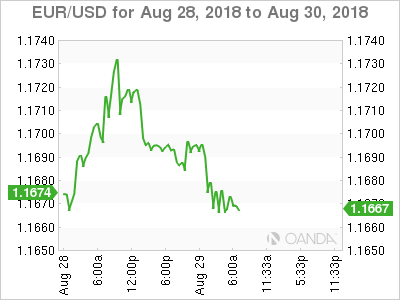
EUR/USD (€1.1670) has moved back below the €1.17 handle as concerns on Italy continued to simmer. The EUR’s move higher over the past fortnight (€1.13 to €1.17) removed all the pricing of political and economic risks from Turkey and the rest of emerging markets. However, the situation in Turkey has not changed – TRY continues to fall €7.4320 – but it seems the market has taken the view that European banks do not have too much debt exposure to Turkey. The EUR is also on firmer footing because the big dollar has not found that “safe haven” support on global trade worries.
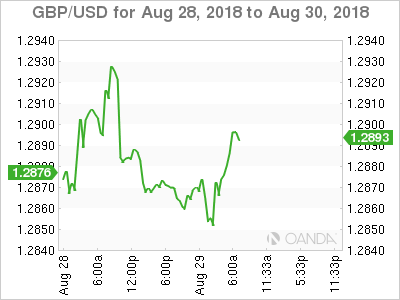
GBP/USD (£1.2888) is steady but holding below the psychological £1.29 level despite U.K and EU officials now saw mid-November as the new Brexit deal deadline rather than Oct.
Note: delays could present timetable challenges to ratifying the Brexit terms by Mar 29th 2019
Elsewhere, the CAD (C$1.2920) advanced after a report indicated that PM Trudeau is ready to make concessions on its dairy market to be included in any North American trade deal.
5. French consumer spending growth slowed in July
Data this morning showed that growth in French consumer spending slowed last month, but by less than expected, as households spent more on food and clothing.
According to Insee (French statistics agency) consumer spending rose just +0.1% on month after revised figures showed a +0.3% increase in June. The market was expecting a headline print of a month-to-month decrease of -0.2% in July.
Digging deeper, energy spending declined -0.2% on month primarily because of a drop in gasoline purchases, while household durable goods fell -0.8%, with a drop in TV purchases after the end of the soccer World Cup. But those declines were offset by a +0.2% on-month increase in food spending, as well as a +0.4% rise in clothing.
Euro Edges Lower as German Consumer Confidence Softens
EUR/USD has posted slight losses in the Wednesday session, erasing the gains seen on Tuesday. Currently, the pair is trading at 1.1673, down 0.18% on the day. On the release front, German GfK Consumer Climate edged lower to 10.5, shy of the estimate of 10.6 points. In France, consumer spending remained pegged at 0.1%, missing the estimate of 0.3%. Preliminary GDP posted a gain for of 0.2% for a second straight quarter. In the U.S, Preliminary GDP in the second quarter is expected at 4.0%. The previous GDP report came in at 4.1% in July. We’ll also get a look at Pending Home Sales, which is forecast to drop to 0.3%. On Thursday, Germany releases Preliminary CPI and the U.S publishes personal spending and unemployment claims.
The euro has taken a pause from its recent rally, which began on Friday and saw the euro gain 1.4%. On Tuesday, EUR/USD punched above the 1.17 line for the first time since August 1. The euro received a boost early in the week from an unexpectedly strong business confidence report in Germany. The Ifo Business Climate report improved to 103.8, easily beating the estimate of 101.9 points. This marked the first time this year that business confidence has improved, thanks to a strong German economy and a pause in the global trade war. On Wednesday, the news was less positive, as German GfK Consumer Climate dropped from 10.6 to 10.5 points, continuing the downward trend which has marked 2017. Back in January, the indicator was at 11.0 points, underscoring a decrease in consumer confidence.
The euro was last above the 1.20 line in May, and this symbolic level could remain elusive for quite some time. The reason? Mario Draghi and his ECB colleagues continue to send out the message that the ECB has no plans to raise rates until after the summer of 2019. The markets are not expecting a rate hike before October 2019, which means that the euro won’t be able to attract investors based on higher interest rates. This means that the euro is not particularly attractive unless there is an unexpected improvement in the German and eurozone economies.
Japanese Indicators To Point To Steady Start To Q3, Unlikely To Excite Yen Traders
Key data on industrial output, retail sales and the labour market will be watched out of Japan in the next few days, with investors hoping they will shed some light on the state of the Japanese economy at the start of the third quarter. The release schedule will begin with retail sales on Thursday (Wednesday, 23:50 GMT), and will be followed by the unemployment rate, the jobs/applicants ratio and industrial output on Friday (Thursday, 23:50 GMT). Typically, Japanese data do not trigger major moves in forex markets, but with some recent signs of strengthening wage growth and consumer spending, any further evidence pointing to such trends could fuel speculation of an early exit by the Bank of Japan from its massive stimulus program.
Retail sales growth accelerated to a revised 1.7% year-on-year in June as consumers spent more on food and fuel. Sales are forecast to have eased a little in July, rising by 1.2% y/y, though this would still represent the ninth consecutive month of positive growth. Japanese households have been turning more confident in recent months as a tight labour market has been gradually pushing up earnings. Household spending surged by 2.9% month-on-month in June, ending four straight months of declines. This follows a spike in both nominal and real wage growth in June, when total cash earnings rose by an annual rate of 3.3% – the highest since 1997, while real earnings growth quickened to 2.5%.
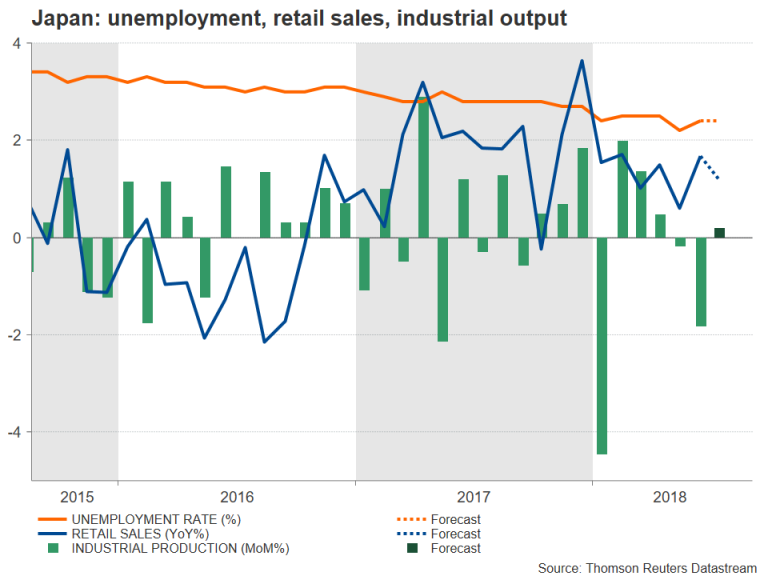
Rising labour shortages are the main reason for the long-awaited build up in wage pressures as the country’s jobless rate hovers near 25-year lows. The unemployment rate is forecast to have remained at 2.4% in July. The jobs/applicants ratio, which shows how many job openings are available per applicant, is expected to remain unchanged, at 1.62. With the labour market expected to tighten further in the coming months and a planned hike in the minimum wage, Japanese workers look set for further increases in their incomes, which bodes well for future household spending.
An improving domestic demand picture, led by higher wages and consumption, couldn’t have come at a better time as global trade tensions pose a serious downside risk to exports – Japan’s main growth engine. Exports have been rising at a moderate pace in 2018 compared to the double-digit growth enjoyed during much of 2017. This has started to reflect in industrial production, which slumped by 1.8% m/m in June. Output is expected to have recovered only marginally in July, increasing by just 0.2% m/m.
The yen is unlikely to react strongly to the data but any positive surprises in the figures that were to underpin the view of strengthening earnings and consumption could see the Japanese currency appreciate. Many analysts think the Bank of Japan could begin to curtail its ultra-loose monetary policy program before inflation has hit its 2% target if policymakers were confident that growth was on a sustainable path.
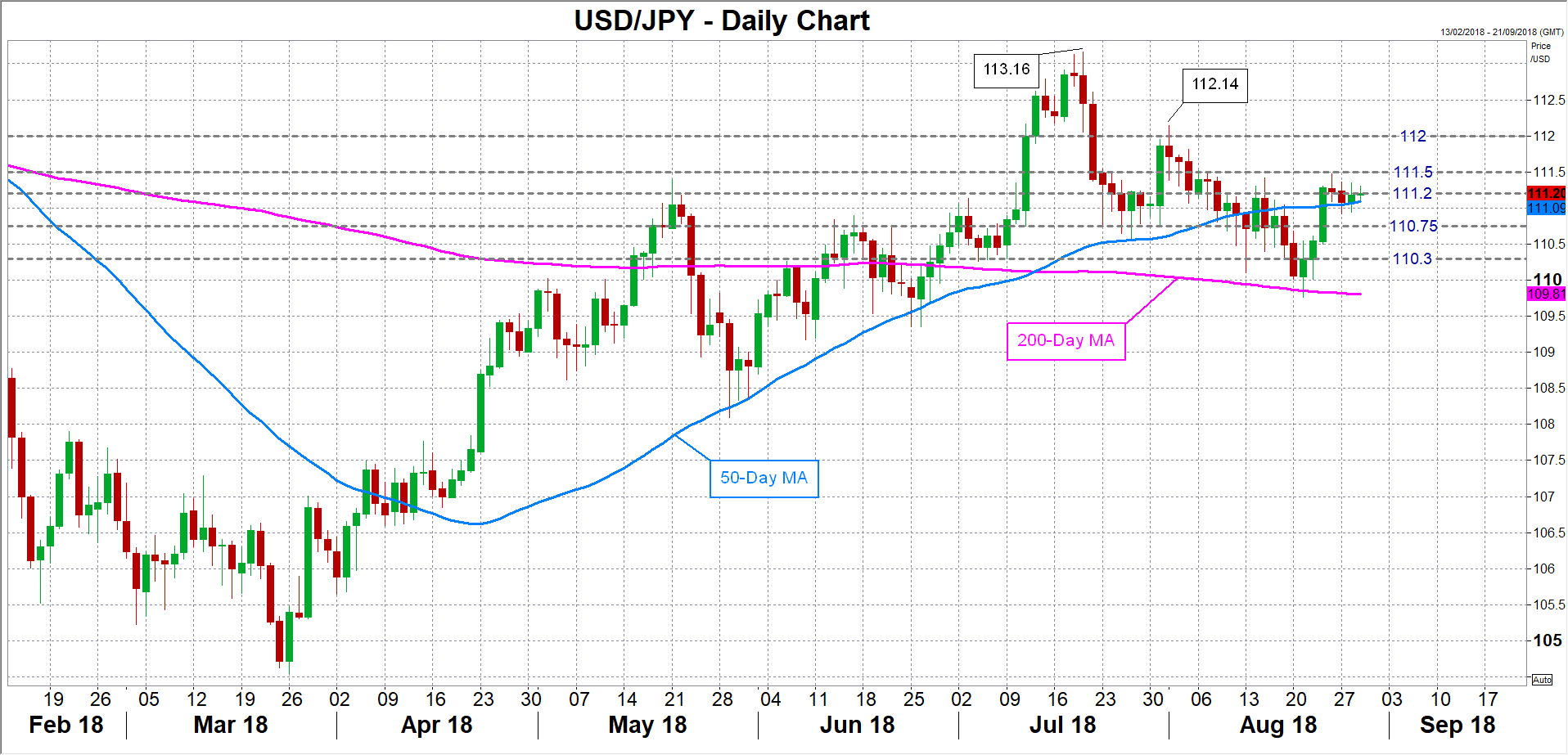
Dollar/yen could seek immediate support in the 110.75 region if the yen was to gain on the back of upbeat numbers this week. A drop below 110.75 would see the 110.30 area coming into focus before the pair was to test its 200-day moving average, currently around 109.80. Alternatively, a disappointing set of figures that point to renewed weakness in the Japanese economy could drive dollar/yen above the nearest key resistance at 111.50. Sharper gains would bring the 112-handle into view, with the next challenge coming from the August top of 112.14.
Stock Markets Profit-Taking Thrust Can Support The Dollar In The Coming Days
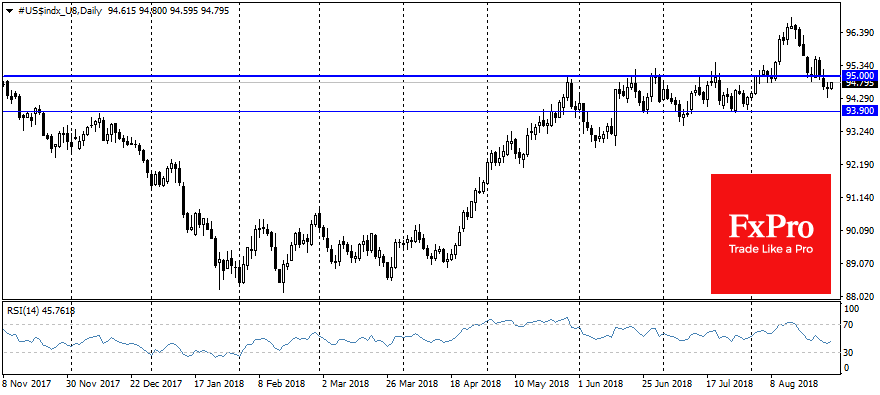
The dollar is almost unchanged to the major currencies in the past 24 hours; it managed to recover the losses incurred on Tuesday morning. The dollar index fell to 94.35, the lows since August 1 following the surge in demand for risky assets on the news about the start of the U.S.-Mexico trade negotiations.
However, the market has returned to the safe-haven demand quite quickly: EM currencies fell under pressure, and the participants of the U.S. stock exchanges fixed the profit after S&P 500 grew to 2900 level. The index earlier this week has finally overcome the downturn since the beginning of the year and has added 2.7% this month, renewing historical highs. 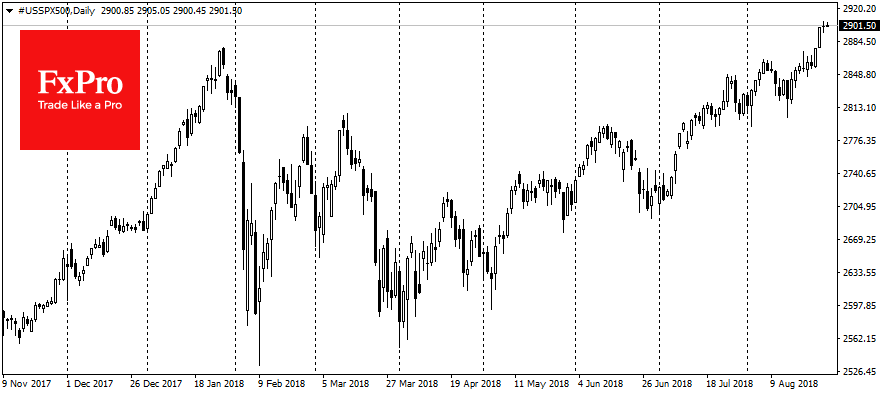
This is a considerably strong movement, so it is reasonable to expect some traction to the fixation of profits by major participants on final days of the month.
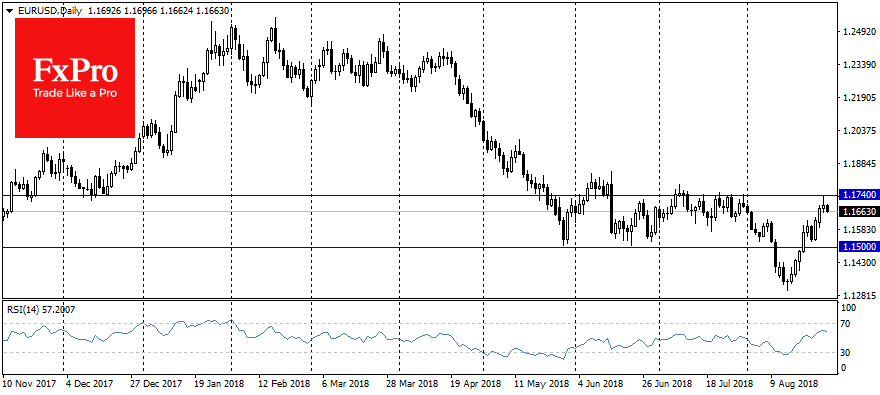
In this case, the dollar can get some support after two and a half weeks of decline. In addition, the single currency returned to the area of resistance, having reached the 1.1730 of dollar, after which the pair turned to decline and is traded now at 1.1680. The British pound, the Japanese yen and the Australian dollar were decreasing on Tuesday to the US dollar. Crude Oil and Gold were losing the part of their earlier gains as well, hitting the wave of profit-taking.
The Mexican peso lost on Tuesday 1.8% to 19.07 per dollar after the details of the bilateral agreement had been announced. With regard to the automotive industry, it provides the U.S. President with the possibility to introduce 25%-tariffs for the import of cars above the level of 2.4 million, which is solely one third higher than the deliveries of the year 2017. The lowering of the peso was reinforced by a general sentiment of currencies weakening in the developing countries during trading on Tuesday. 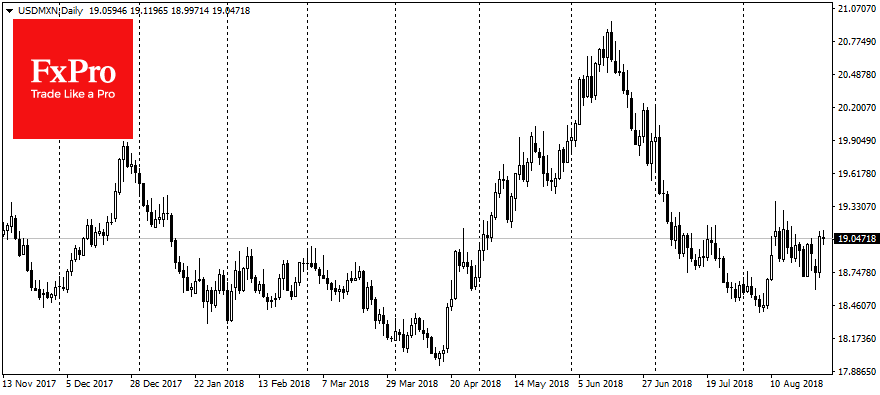
AUD In The Doldrums, NAFTA In Focus
AUD slips as Westpac increases rates
The US dollar was better bid against most of its peers on Wednesday morning as global stocks treaded water. The dollar index edged up 0.05% to 94.78 as the single currency tumbled on the 1.17 resistance, while the Australian dollar fell the most within the G10 complex, down 0.40% on the session. Despite the fact that key economic data are due for release later today, investors will remain focus on NAFTA’s revamp talks. Indeed, the big question now is whether Canada will follow Mexico’s footsteps and accept the amendments proposed by the Trump administration. The loonie was one the only G10 currency, with the Japanese yen, to edge higher against the dollar, up 0.05% with USD/CAD down to 1.2930.
The Aussie slid as low as $0.7299 after Westpac, one of Australia’s largest lender, announced it would lift its variable mortgage interest rates. The announcement triggered a selling in the Aussie as investors anticipated it would negatively affect economic growth. The decision will also keep the RBA side-lined for a longer period of time. The 2-year sovereign yield dropped more than 4bps to 1.97%, its lowest level since late May this year as traders lowered their expectations regarding the timing of the next rate hike. Therefore, it may take longer before seeing AUD/USD back around the $0.80 area.
US deal fails to support peso
As the gongs sounded of a US-Mexico trade deal, broad USD selling slowed while Mexican peso rose, yet MXN was unable to hold high ground. While the downside risk of a failed agreement has decreased, confusion has increased. For now, risky assets and emerging currencies are attractive, but ultimately they will need yield support.
Trump is hailing the Mexican agreement as the biggest trade deal ever. Canada has returned to the table, saying the door is open for agreement. Markets immediate reaction was of optimism, sending the S&P 500 to a new all-time high.
Global Stocks Higher But US-China Concerns Linger, Bitcoin Conquers $7000
It's remarkable how the initial euphoria from the US-Mexico trade deal has been slightly overshadowed by growing concerns over US-China trade relations deteriorating further.
The breakthrough in NAFTA negotiations between the United States and Mexico, coupled with optimism over Canada joining the agreement was certainly a positive step forward to easing trade war fears. However, two steps could be taken back if the Trump administration raises tariffs on $200 billion of Chinese goods on September 5th. This caution has slightly impacted risk sentiment this morning with Asian stocks edging marginally higher. Although European equity markets rose slightly higher at open, gains could be limited as investors continue to closely monitor the latest developments revolving around global trade.
Dollar steady ahead of US GDP
The Dollar slightly appreciated against a basket of major currencies on Wednesday as investors awaited the latest estimate for second quarter US GDP scheduled for release later in the day.
Dollar weakness has been a recurrent market theme since the middle of August thanks to US President Donald Trump, cautious Fed minutes and a fading safe-haven appeal. Although market expectations remain heightened over the Federal Reserve raising interest rates in September, the rate outlook for December and beyond may be heavily data dependent. The Dollar could receive a solid boost if US GDP shows robust growth in the revised second-quarter figures.
Focusing on the technical picture, the Dollar Index has staged a modest rebound from the 94.50 level. A breakout above 95.00 could inspire a move towards 95.45. Alternatively, a break back below 94.50 could open a path towards 94.20 and 94.00.
GBPUSD pressured below 1.2900
Sterling is likely to remainvulnerable to downside losses as fears of a no-deal Brexit weigh heavily on the currency and haunt investor attraction.
Although a vulnerable Dollar initially offered the Pound some support, prices remain capped below the 1.2900 resistance level. If the Dollar finds support this afternoon from the US GDP report, the GBPUSD could trade back towards 1.2820 and potentially lower. However, a technical breakout above 1.2900 may invite an incline towards 1.3030.
Bitcoin breaks above $7000
Bitcoin bulls both found ample support in the form of a vulnerable Dollar and improving risk sentiment this week with prices breaking above the $7000 level.
There seems to a be a strong sense of anticipation building ahead of the U.S. Securities and Exchange Commission's (SEC) decision in approving a Bitcoin ETF in September. If a Bitcoin ETF becomes reality, cryptocurrencies could receive a solid welcome boost.
Focusing on the technical picture, Bitcoin is looking bullish on the daily charts with prices trading marginally above $7050 as of writing. A breakout above $7100 could encourage an incline higher towards $7153 and $7200, respectively.
The Analytical Overview Of The Main Currency Pairs
The EUR/USD currency pair
Technical indicators of the currency pair:
Prev Open: 1.16776
Open: 1.16942
% chg. over the last day: +0.13
Day's range: 1.16916 – 1.16972
52 wk range: 1.0571 – 1.2557
The technical pattern on the EUR/USD currency pair is ambiguous. The trading instrument is in a sideways trend. Investors expect economic statistics from the US. At the moment, the key support and resistance levels are 1.16500 and 1.17000, respectively. We recommend opening positions from these marks. In the near future, the correction of the EUR/USD quotes after the rally is not ruled out.
The news feed on 2018.08.29:
Data on US GDP at 15:30 (GMT+3:00);
Pending home sales index in the US at 17:00 (GMT+3:00).
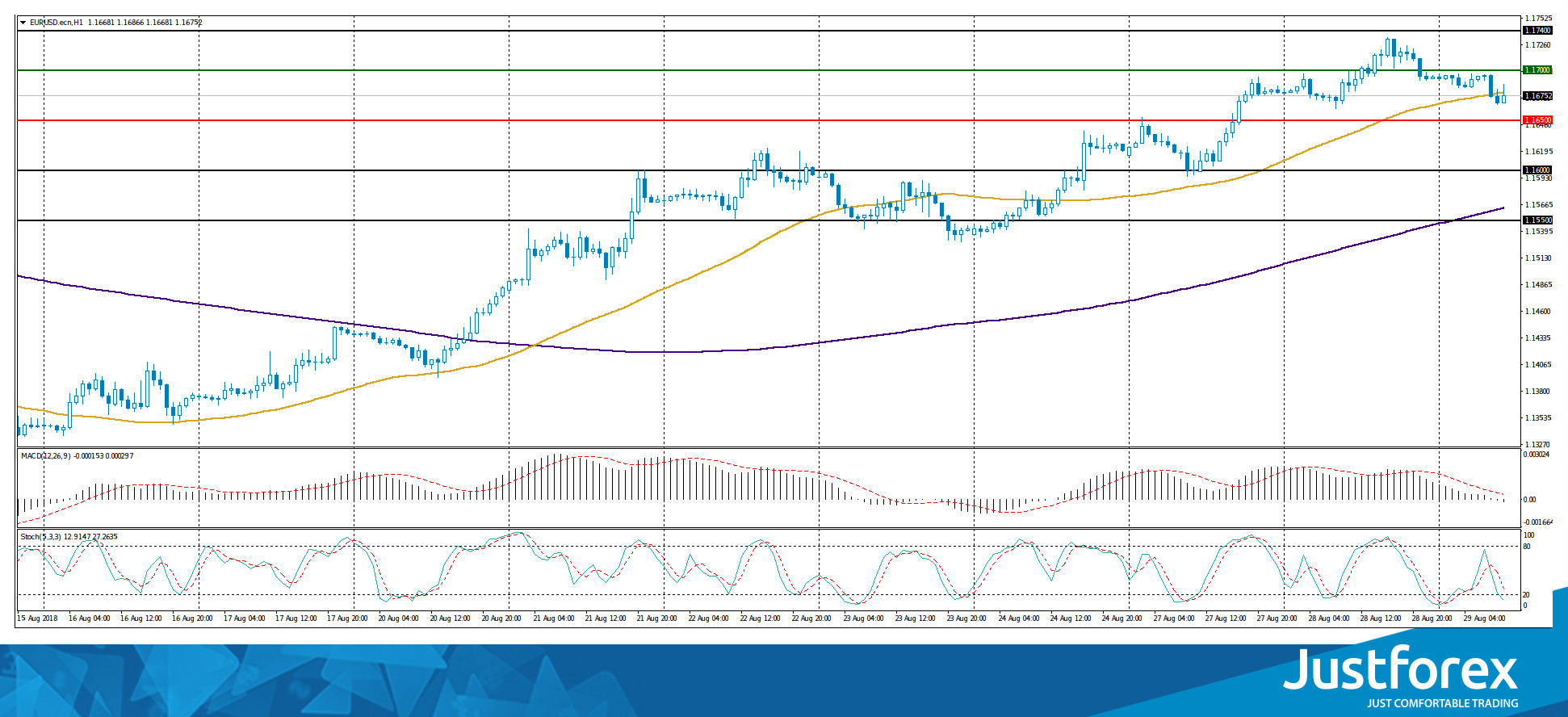
Indicators do not send accurate signals: the price is testing 50 MA.
The MACD histogram is located near the 0 mark.
Stochastic Oscillator is in the neutral zone, the %K line is below the %D line, which indicates the bearish sentiment.
Trading recommendations
Support levels: 1.16500, 1.16000, 1.15500
Resistance levels: 1.17000, 1.17400
If the price fixes above the round level of 1.17000, the EUR/USD currency pair is expected to grow. The movement is tending to 1.17400-1.17600.
Alternative option. If the price fixes below the support level of 1.16500, we recommend considering sales of EUR/USD. The movement is tending to the round level of 1.16000.
The GBP/USD currency pair
Technical indicators of the currency pair:
Prev Open: 1.28893
Open: 1.28642
% chg. over the last day: -0.18
Day's range: 1.28636 – 1.28721
52 wk range: 1.2361 – 1.4345
There is a variety of trends on the GBP/USD currency pair. At the moment, the quotes are moving in a flat. Financial market participants expect additional drivers. The key support and resistance levels are 1.28400 and 1.28800, respectively. The positions should be opened from these marks. We recommend paying attention to the news feed from the US.
Today, the news feed on the UK economy is calm.
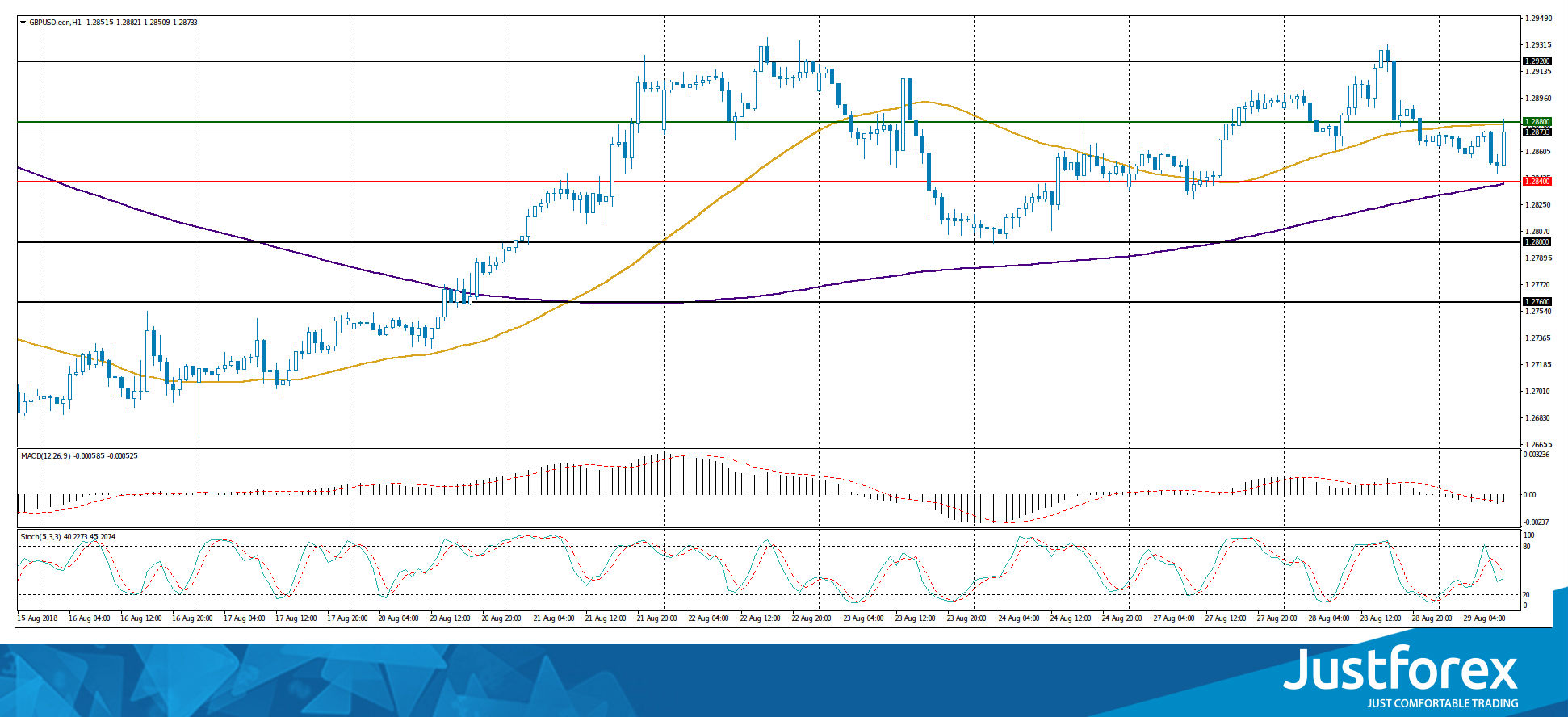
Indicators do not send accurate signals: the price is being traded between 50 MA and 200 MA.
The MACD histogram is in the negative zone, but above the signal line, which gives a weak signal to sell GBP/USD.
Stochastic Oscillator is located in the neutral zone, the %K line has started crossing the %D line. There are no signals at the moment.
Trading recommendations
Support levels: 1.28400, 1.28000, 1.27600
Resistance levels: 1.28800, 1.29200
If the price fixes above 1.28800, the GBP/USD currency pair is expected to grow. The target movement level is 1.29200-1.29500.
Alternative option. If the price fixes below 1.28400, we recommend considering sales of GBP/USD. The target movement level is 1.28000-1.27800
The USD/CAD currency pair
Technical indicators of the currency pair:
Prev Open: 1.29669
Open: 1.29257
% chg. over the last day: -0.29
Day's range: 1.29141 – 1.29257
52 wk range: 1.2059 – 1.3795
Yesterday, the bearish sentiment was observed on the USD/CAD currency pair. The trading instrument has updated local extremes. At the moment, the quotes are in a sideways trend. The key support and resistance levels are 1.29000 and 1.29400, respectively. The positions should be opened from these marks. The USD/CAD currency pair has the potential for further decrease.
The news feed on the economy of Canada is calm.
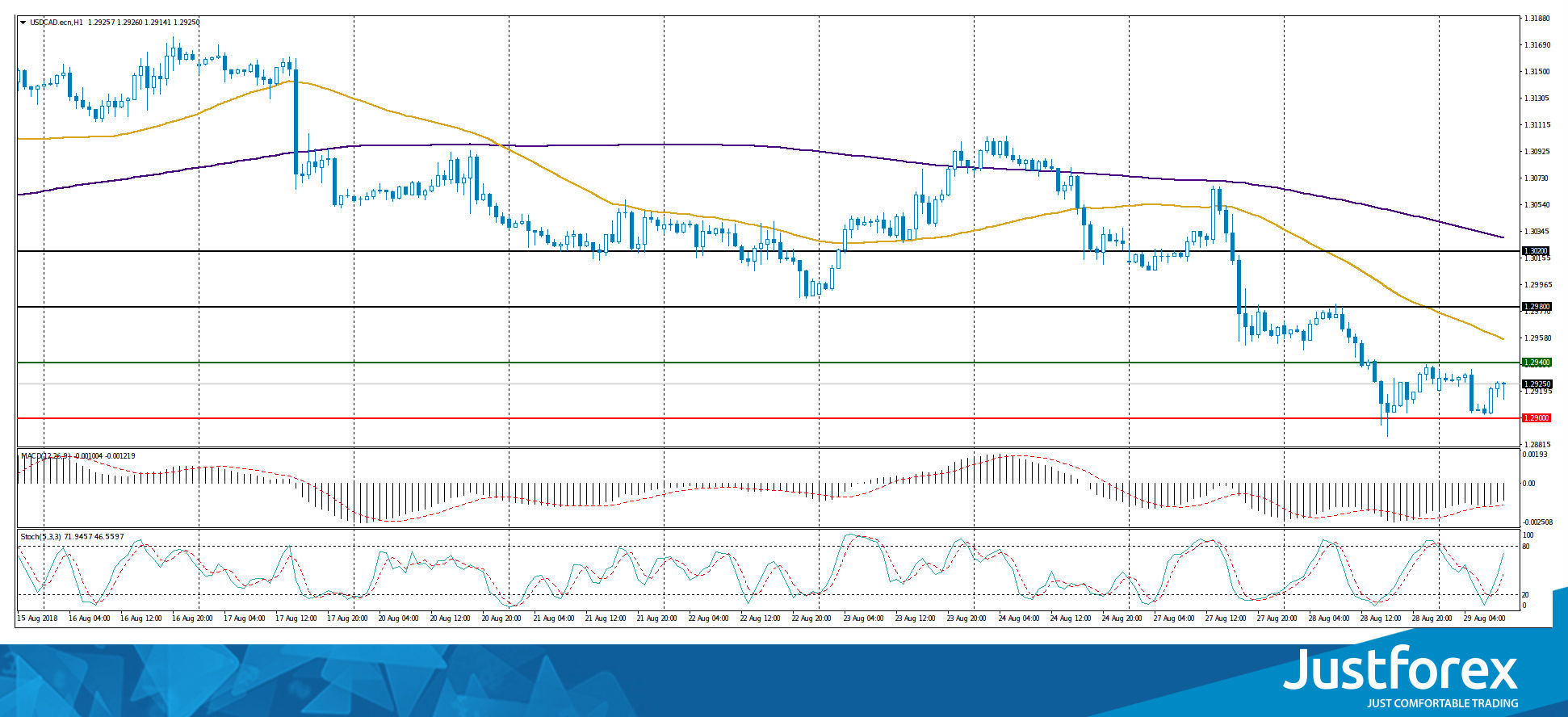
Indicators point to the power of sellers: the price has fixed below 50 MA and 200 MA.
The MACD histogram is in the negative zone, but above the signal line, which gives a weak signal to sell USD/CAD.
Stochastic Oscillator is located in the neutral zone, the %K line is above the %D line, which indicates the bullish sentiment.
Trading recommendations
Support levels: 1.29000, 1.28600
Resistance levels: 1.29400, 1.29800, 1.30200
If the price fixes below the round level of 1.29000, the USD/CAD quotes are expected to decline further. The movement is tending to 1.28600-1.28400.
Alternative option. If the price fixes above the resistance level of 1.29400, it is necessary to consider purchases of USD/CAD. The movement is tending to 1.29800-1.30000.
The USD/JPY currency pair:
Technical indicators of the currency pair:
Prev Open: 111.048
Open: 111.190
% chg. over the last day: +0.06
Day's range: 111.125 – 111.195
52 wk range: 104.56 – 114.74
Since the beginning of this week, the USD/JPY currency pair has been consolidating. Quotes are moving in flat. At the moment, local support and resistance levels are 111.100 and 111.300, respectively. The positions should be opened from these marks. Investors expect additional drivers. We recommend paying attention to the news feed on the US economy.
The publication of important economic reports from Japan is not planned.
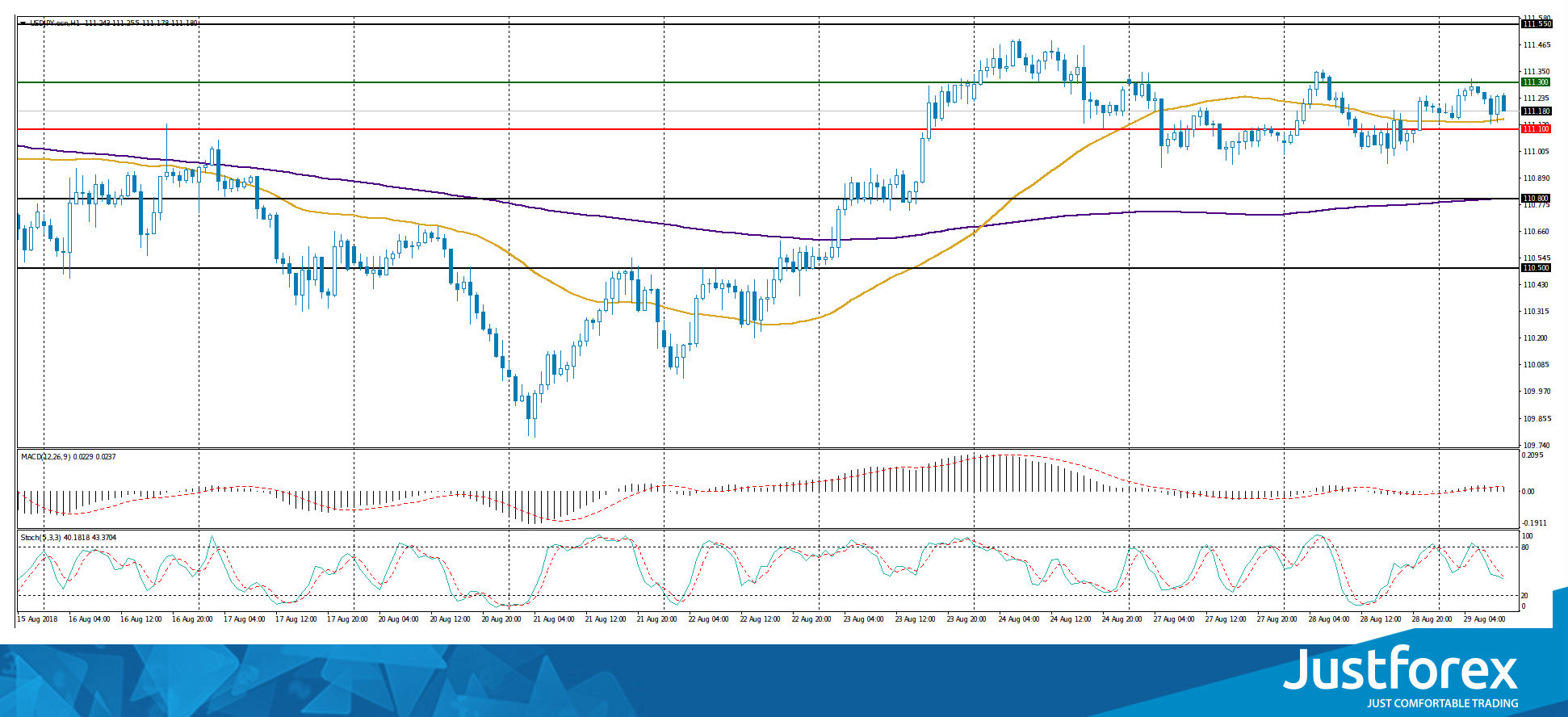
Indicators do not send accurate signals. The price is testing 50 MA, which is a strong dynamic support.
The MACD histogram is near the 0 mark.
Stochastic Oscillator is located in the neutral zone, the %K line is below the %D line, which indicates a decrease in the USD/JPY quotes.
Trading recommendations
Support levels: 111.100, 110.800, 110.500
Resistance levels: 111.300, 111.550
If the price fixes above the resistance level of 111.300, it is necessary to consider purchases of USD/JPY. The movement is tending to 111.500-111.700.
Alternative option. If the price fixes below 111.100, the USD/JPY currency pair is expected to decline. The movement is tending to 110.800-110.500.
S&P500 Maintaining Its Bull Momentum
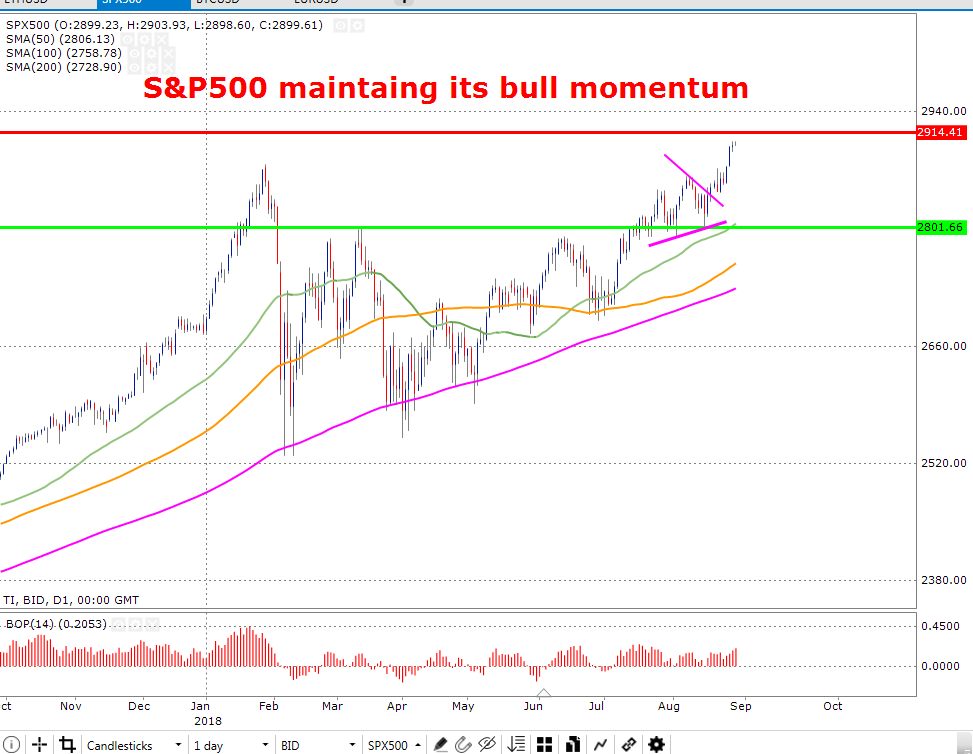
S&P500 maintaining its bull momentum
The Chart below on a 1 day time-frame shows the Index S&P 500 price trading above the moving averages and approaching the resistance zone which is at $2914.41 (colored in red). The strong upward trend in the chart evidently shows that the Index S&P500 is maintaining its bull momentum. The upward trend had begun around the support zone (colored in green) which is priced at $2,801.66
The Balance of Power chart shows that the bulls have been consistently in control and are sustaining an upward trend where the bulls hold dominance. These indications in the chart below indicate that the Index is highly likely to continue to rise and exceed its resistance zone (colored in red).
Major support: 2,801.66
Major resistance: 2,914.41
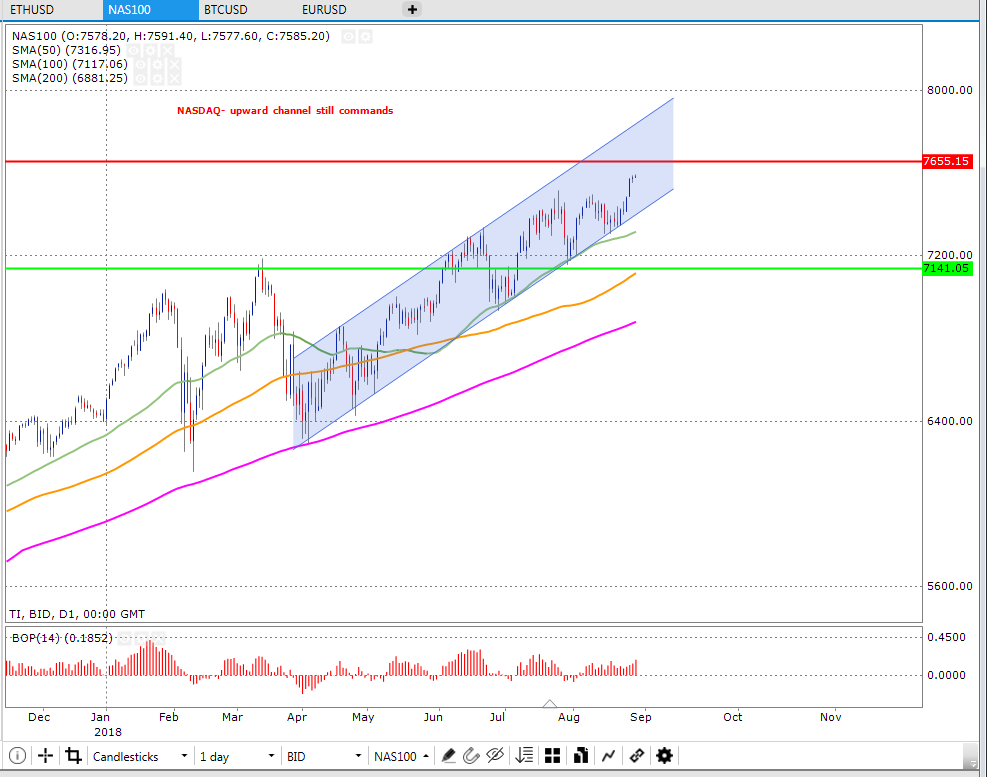
NASDAQ- upward channel still commands
The chart below on a 1 day time-frame shows the Index NASDAQ trading above all moving averages. Moreover, the price is increasing in an upward channel which is ongoing and is highly likely to continue and surpass the resistance zone (colored in red) which is priced at $7655.15. The chart below shows that the 50-day moving average (colored in green) is coming close to the price and is showing to be the most reactive moving average within the chart.
The Balance of Power chart below a consistent increase in price where the bulls are in full control and domination of the price. The Index is being driven high which may continue to grow. There are no signs of a bearish sentiment at present.
Major support: 7,141.05
Major resistance: 7,655.15
Fundamental Analysis: Oil And Gold
Gold:
Golds supremacy has come to a halt after seeing highs of $1,214.28 on Tuesday. It is natural for the price to retrace after seeing a bull run, however the bull run for gold have been very short lived. The profit taking has pushed the price of the yellow gold to $1,210.70. One of the reason that we have seen the weakness in the gold price is because the US economy is standing on robust ground and consumers are feeling confident about this as this was evident in yesterday’s economic data. The most vital factor which is in play is the fed rate hike cycle. The rate hikes are pushing investors the dollar higher and for investors dollar is more favourite instrument. Of course in the recent geopolitical events, we have also seen a new where investors have favoured dollar as a safe haven rather than gold
The profit taking has pushed the price of the yellow gold to $1,210.70. One of the reason that we have seen the weakness in the gold price is because the US economy is standing on robust ground and consumers are feeling confident about this as this was evident in yesterday’s economic data. The most vital factor which is in play is the fed rate hike cycle.
The rate hikes are pushing investors the dollar higher and for investors dollar is more favourite instrument. Of course in the recent geopolitical events, we have also seen a new where investors have favoured dollar as a safe haven rather than gold
Therefore, one of the ultimate reasons behind gold dropping and the greenback rising is due to the actions carried out by the fed. Moreover, interest rate hikes being scheduled to commence in September and December are acting as a negative concern for gold as investors will pull away from the precious metal and pull in to the dollar.
Oil:
U.S. sanctions on Iran have overthrown the doubt the markets may have had regarding an economic growth slowdown affecting the oil prices and demand. Sanctions on Iran without any doubt would have an impact on the global economic growth and of course on the supply side. But the concerns on the supply side are stronger hence we expect the price to recover some of its losses.
Another major factor which has given a reason to traders to have qualms around the demand equation is the on going spat between the US and China over the trade tariffs.
Initially, U.S. and China carrying out a duel of tariffs against each other brings about concern regarding demand in the economy as growth could be a vital consequence by these tariffs. However, at present sanctions being placed on Iran have moved the oil prices up. Also, looking at the supply equation, it becomes clear that the OPEC is only modestly increasing the supply which should help the price in the longer term.
We expect the price Brent to continue to move towards its resistance level of $79 as long as the support at $70 holds.