Sample Category Title
Into US session: Euro down as Turkish Lira loses another 3%, Sterling and Dollar firmer
Entering into US session, Euro suffers some heavy selling and is trading as the second weakest one for today, just next to Australian Dollar. ON the other hand Sterling leads the way higher, followed by Dollar. The renewed selloff in Turkish Lira is seen by us as the main driver of the forex markets today. Dollar and Sterling has suffered some selling against Euro and today's moves are just reversing these selloffs. Canadian Dollar is also trading a touch softer as focus is now on day 2 of Canada-US trade negotiations.
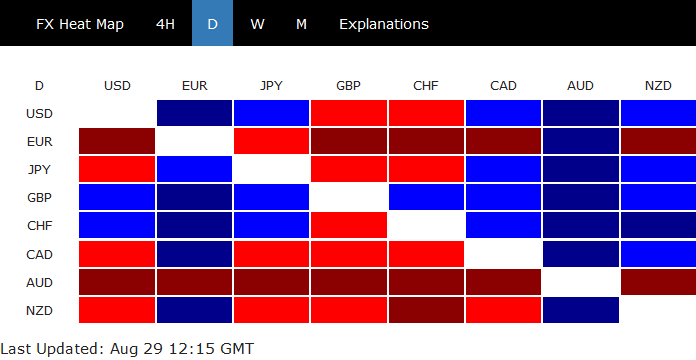
In other markets, European indices are mixed with FTSE down -0.32% at the time of writing, DA is up 0.17% and CAC is up 0.26%. German 10 year bund extends this week's rally and is currently up 0.015 at 0.396. 0.4 handle is back in sight. Earlier today, Asian markets were mixed with Nikkei and HSI up 0.15% and 0.23% respectively. But China SSA and Singapore Strait Times were down -0.31% and -0.11% respectively.
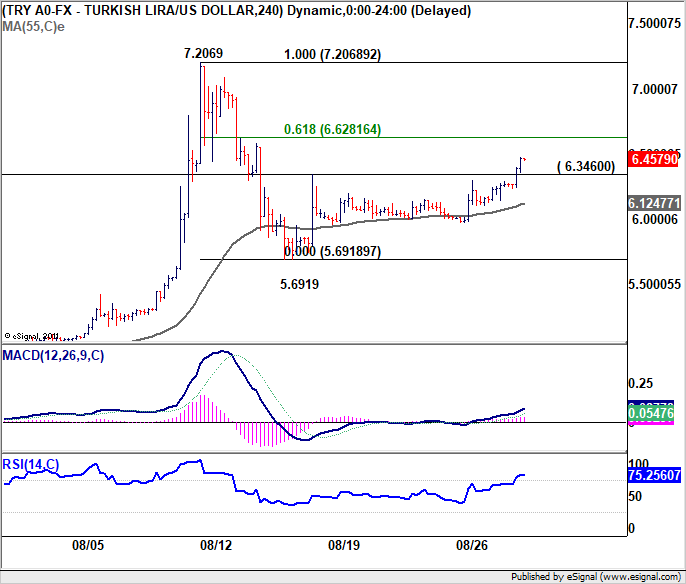
USD/TRY is rising another 3% today and hits as high as 6.4732. Break of 6.346 minor resistance confirms resumption of rebound from 5.6919. Further rise would be seen to 61.8% retracement to of 7.2068 to 5.6919 at 6.6281. Firm break there will put 7.000 handle back into focus. And such development could weigh on Euro again.
An update on EUR/AUD (cancel order) and GBP/CHF (exit short)
An update on EUR/AUD and GBP/CHF short strategy as mentioned in our weekly report.
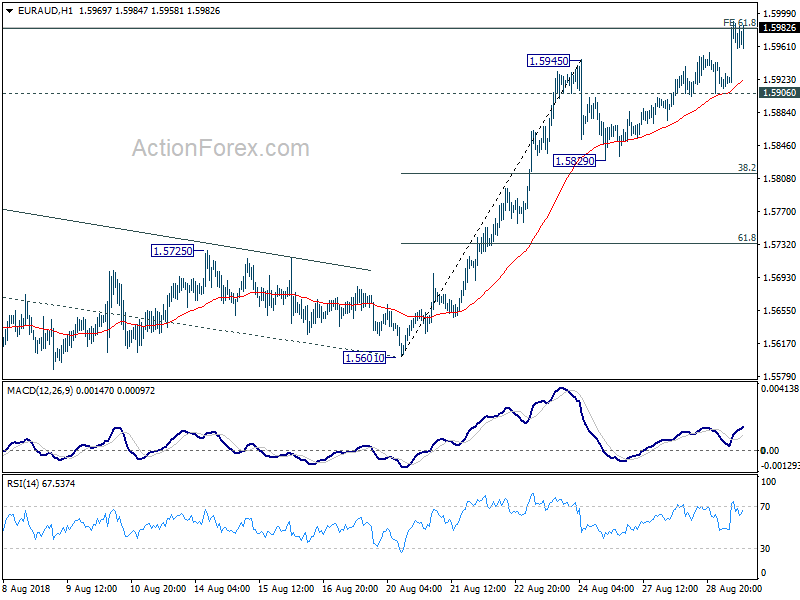
As noted in the report, we planned to buy EUR/AUD on dip to 1.5800, slightly below 38.2% retracement of 1.5601 to 1.5945 at 1.5814, in anticipate to rise to 100% projection of 1.5271 to 1.5886 from 1.5601 at 1.6216. The pull back was contained at 1.5829, above our entry. Thus, the order was not filled. Given that the rise resumption happened already and EUR/AUD has met 61.8% projection, we'll cancel the order and look for other opportunities.
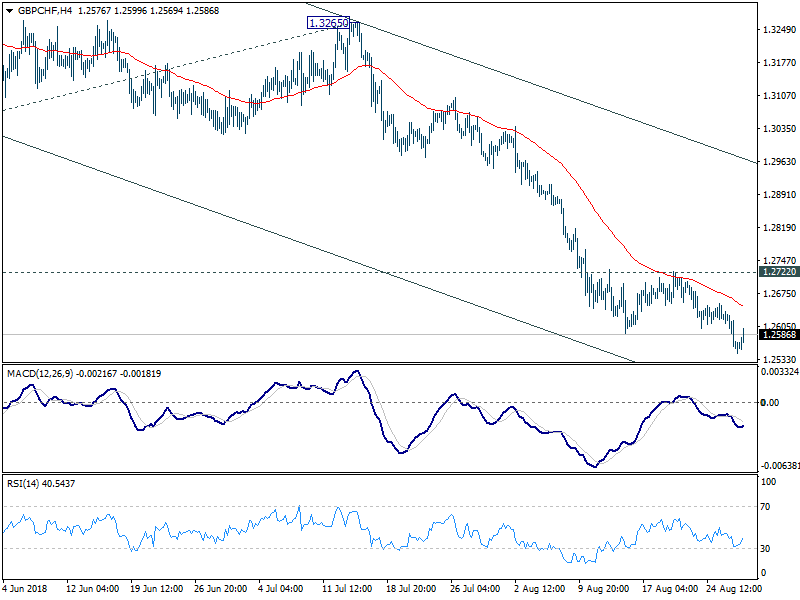
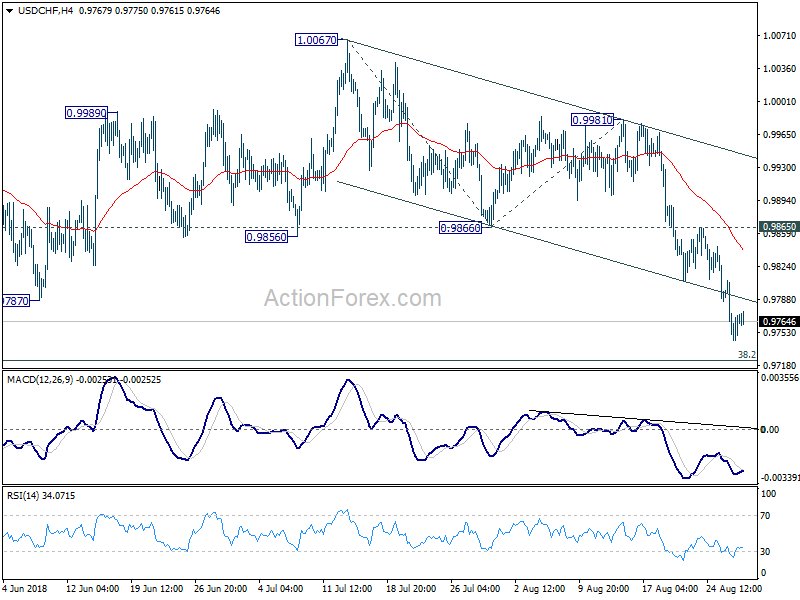
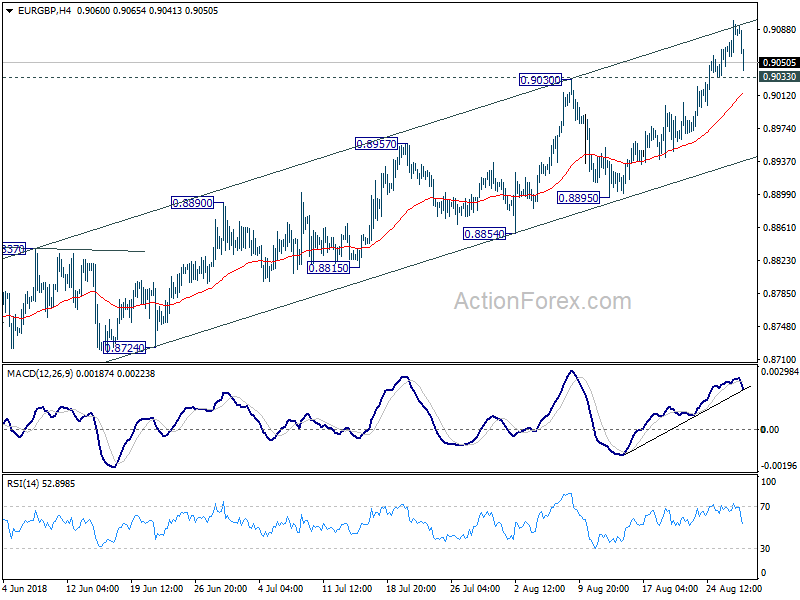
As noted in another update, we're holding on to GBP/CHF short, sold at 1.2971, stop at 1.2725. Target is 1.2500. But the downside momentum of the move from 1.2722 has been rather unconvincing. More importantly, we see that EUR/GBP retreats quite steeply after touching channel resistance. And, USD/CHF is close to 0.9724 key fibonacci level. There is material possibility for GBP/CHF to rebound ahead of 1.2500.
Therefore, we'll exit out short position at market (1.2587), and pocket 384 pips profits first.
Sterling Bounces In Quiet Markets, Trade Updates Awaited
Here are the latest developments in global markets:
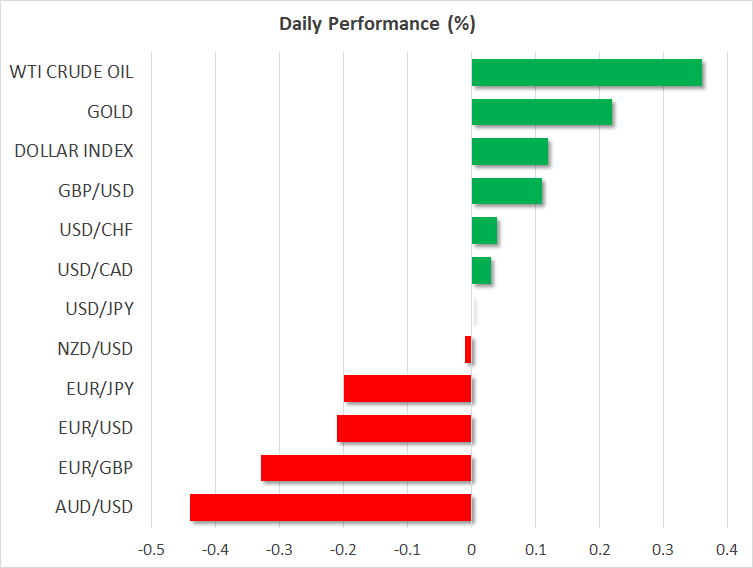
FOREX: The dollar index was up by 0.14% on Wednesday, drawing support from a robust reading on US consumer confidence yesterday, and looking set to snap a three-day losing streak. Against the euro, the dollar gained 0.21%, while it was practically flat against the Japanese yen. Meanwhile, the British pound was in recovery-mode, with investors seemingly brushing aside reports suggesting UK Brexit Secretary Raab is frustrated that EU chief negotiator Barnier is rarely available for face-to-face talks. Sterling/dollar edged up by 0.11%, while euro/sterling fell by 0.39%, erasing all of its upward move from yesterday – when the pair briefly touched a fresh one-year high of 0.9099. In commodity-related currencies, dollar/loonie held close to its opening levels as investors awaited updates on the US-Canada trade talks that are underway in Washington. Elsewhere, aussie/dollar underperformed, declining by 0.43%, while kiwi/dollar was nearly unchanged.
STOCKS: European stocks were a sea of red. The UK’s FTSE 100 was down by 0.59% amid a modest rebound in sterling. Since this index is constituted mainly by large multinational companies that earn most of their revenues abroad, a strengthening pound typically weighs on the FTSE, and vice versa. The Spanish IBEX 35 was the other underperformer – down by 0.80% –, dragged by a sizeable decline in Inditex’s stock (-5.94%). Elsewhere, losses were limited. Germany’s DAX 30 and Italy’s FTSE MIB both fell by 0.09%, while the French CAC 40 declined by a fractional 0.04%. The STOXX 50 and the STOXX 600 edged down by 0.09% and 0.14% respectively. In the US, futures tracking the S&P 500, Dow Jones, and Nasdaq 100 are pointing to a higher open today, albeit only marginally so.
COMMODITIES: Oil prices edged up, recovering some earlier losses. WTI was up by 0.31% at $68.74 per barrel, while Brent crude gained 0.18% to trade at $76.09/barrel. The rebound may have been aided by some comments from the head of the International Energy Agency, who said oil markets could tighten further this year. In precious metals, dollar-denominated gold was up by 0.18% near $1204 an ounce, even despite the greenback being higher on the day.
Day ahead: Second look at US GDP coming up; trade talks in the spotlight
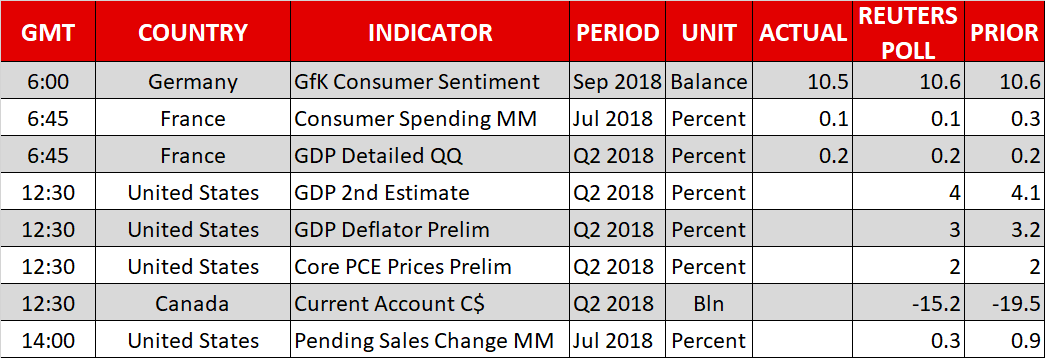
In terms of economic data, the highlight on Wednesday is likely to be the second estimate of US GDP growth for Q2, due for release at 1230 GMT. In the meantime, market participants will look to Washington for any updates in the US-Canada trade talks, which could drive the loonie.
Kicking off with the data, US GDP growth for Q2 is expected to be revised marginally lower to an annualized rate of 4.0%, from 4.1% in the preliminary estimate. Even if that is the case though, 4.0% would still represent a particularly strong figure, and is unlikely to materially alter investors’ expectations regarding the pace of future Fed hikes. Hence, for the dollar to react to this figure, it may require a much more pronounced revision than what is expected. A second look at the GDP deflator and core PCE prices for the same quarter will also be made public alongside the GDP print. Lastly, pending home sales for July are due out at 1400 GMT.
Meanwhile, Canada will see the release of current account data for Q2, at 1230 GMT as well. Expectations are for the nation’s deficit to have narrowed notably. While that could prove somewhat positive for the loonie on the news, the biggest determinant of the currency’s fortunes will likely be how the US-Canada trade talks play out. Reports in Canadian press yesterday indicated Ottawa is willing to make substantial concessions on some of the sticking points, including dairy issues, which suggests that further progress in the talks may be on the cards this week. Any encouraging signals on this front – particularly from Canada’s foreign minister Freeland and US trade representative Lighthizer – could bring the loonie under renewed buying pressure, as the NAFTA risk premium fades.
In oil markets, traders will keep an eye on the weekly EIA crude inventory data, due at 1430 GMT. Forecasts point to a drawdown of roughly 0.7m barrels, after stockpiles dropped by around 5.8m barrels in the preceding week.
Looking ahead, Australia’s capital expenditure (capex) data for Q2 will hit the markets at 0130 GMT on Thursday. Forecasts point to an acceleration in capex, which may help to alleviate some of the selling pressure on the aussie.
EURUSD – Halts Recovery, Faces Pullback Risk
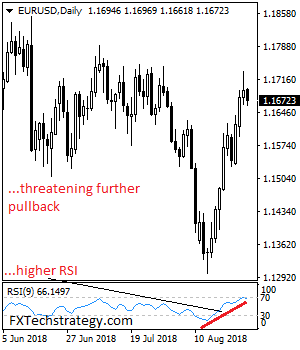
EURUSD - The pair now faces pullback risk after halting its upside pressure on Tuesday. On the upside, resistance comes in at 1.1700 level with a cut through here opening the door for more upside towards the 1.1750 level. Further up, resistance lies at the 1.1800 level where a break will expose the 1.1850 level. Conversely, support lies at the 1.1650 level where a violation will aim at the 1.1600 level. A break of here will aim at the 1.1550 level. Below here will open the door for more weakness towards the 1.1500. All in all, EURUSD faces further upside pressure.
GBPUSD Remains Weak Over Brexit Delay
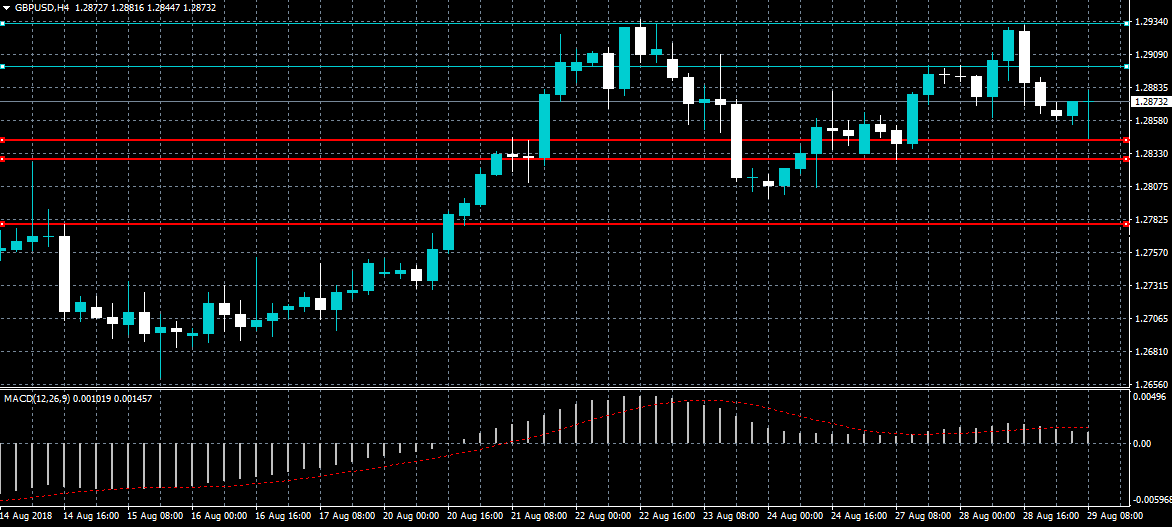
The British pound continues to trade to the downside against the US dollar, with price briefly dipping below the 1.2850 support level. The GBPUSD pair remains weak after EU and UK negotiators admitted that they would fail to meet the October deadline for a Brexit deal. Continued weakness below the 1.2850 level should encourage further selling, while buyers need to move price above the 1.2900 level.
The GBPUSD pair is bearish while trading below the 1.29000 level, key support is found at the 1.2850 and 1.2828 levels.
If the GBPUSD pair moves above the 1.2900 level, key resistance is then found at the 1.2930 and 1.2950 levels.
USDJPY Trapped In Descending Triangle Pattern
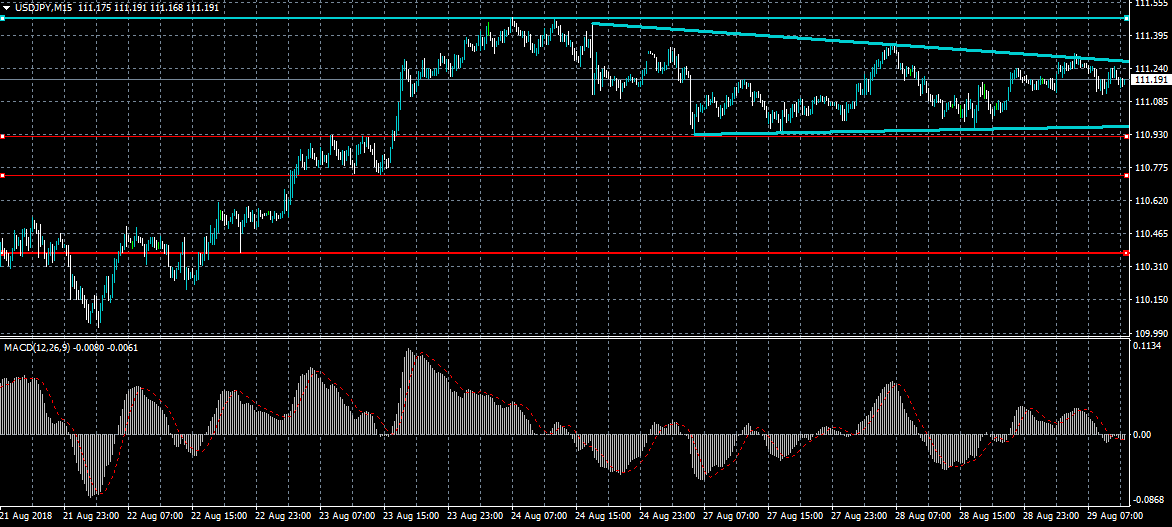
The US dollar remains trapped in a limited range against the Japanese yen currency on Wednesday, as price continues to hover around the 111.00 level. A bullish descending triangle pattern is now visible on the USDJPY pair, indicating that breakout may soon occur. Traders and investors now look to the US session, where we see the release of key GDP and PCE data from the United States economy.
The USDJPY pair is only intraday bullish while trading above the 111.28 level, key resistance is found at the 111.50 and 112.05 levels.
If the USDJPY pair trades below the 110.92 level, sellers will likely test towards the 110.55 and 110.10 support levels.
US 30 Index Close To 6-Month High, Positive Momentum Weakens
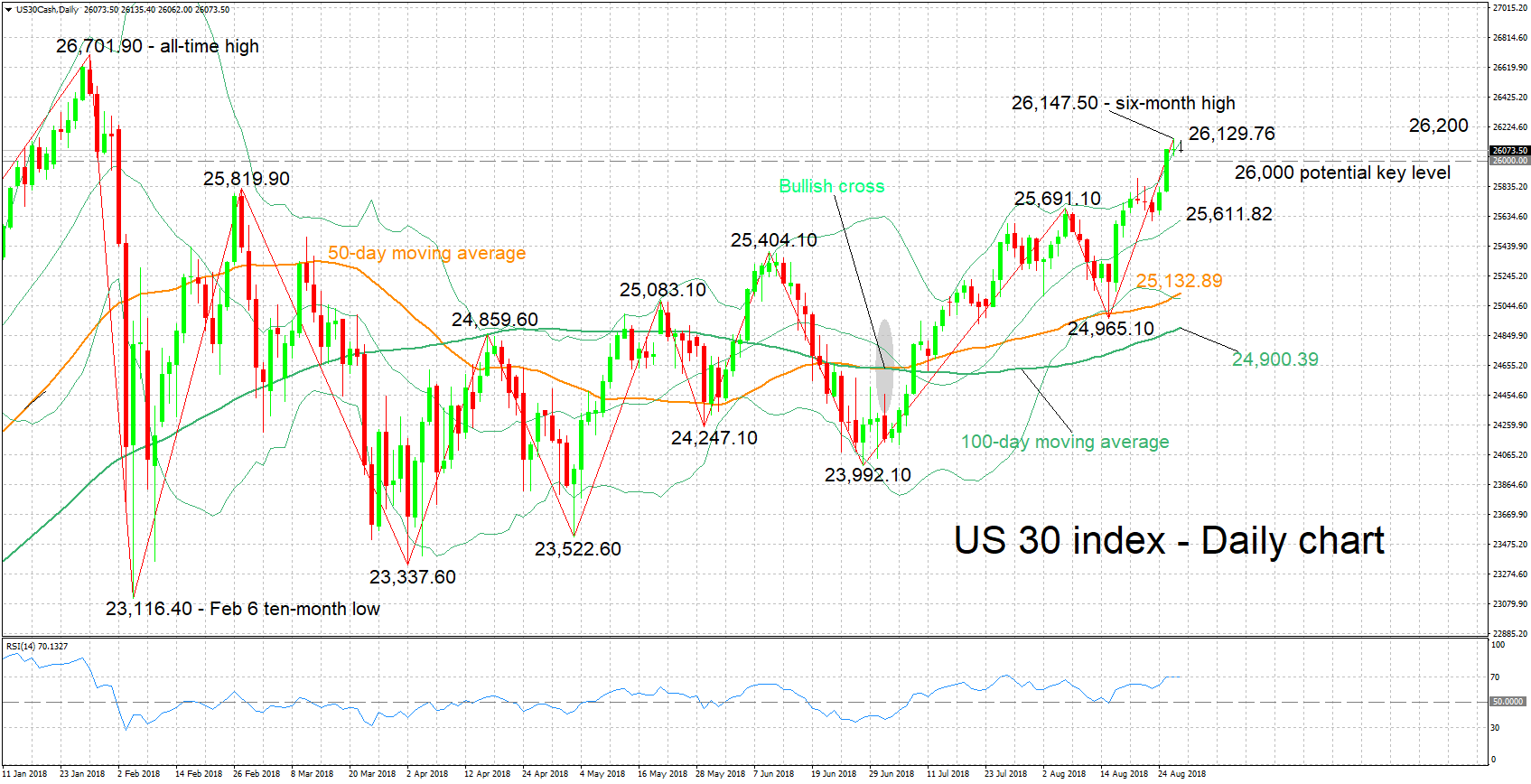
The US 30 index (Dow Jones Industrial Average) touched a fresh six-month high of 26,147.50 during Tuesday’s trading, while it is currently trading not far below this peak.
The RSI is comfortably in bullish territory above 50, though it has eased somewhat, pointing to weakening positive momentum in the short-term. Additionally, notice that the indicator is marginally above the 70 overbought level.
A drop in the index could meet support around the 26,000 handle which may carry psychological significance. Steeper losses would turn the attention to the region around the middle Bollinger line – a 20-day moving average line – at 25,611.82.
On the upside, resistance may come around the upper Bollinger band at 26,129.76, with the area around this also encapsulating yesterday’s six-month high of 26,147.50. A break above would increasingly bring into scope late January’s record-high of 26,701.90. Before that, numerous round figures such as 26,200 and 26,300 could provide some resistance.
In terms of the medium-term picture, it is bullish with trading activity taking place above both the 50- and 100-day MA lines.
Overall, the short-term bias is positive, but momentum appears to have weakened; there are some signs for an overextended rally as well. The medium-term outlook is also bullish. An appreciation by less than 2.5% from current levels would allow the index to post fresh all-time highs. The other two major US benchmarks, the S&P 500 and the Nasdaq Composite, have been lately posting record-highs.
EURJPY Steep Rally Stalls But Remains Within An Ascending Channel
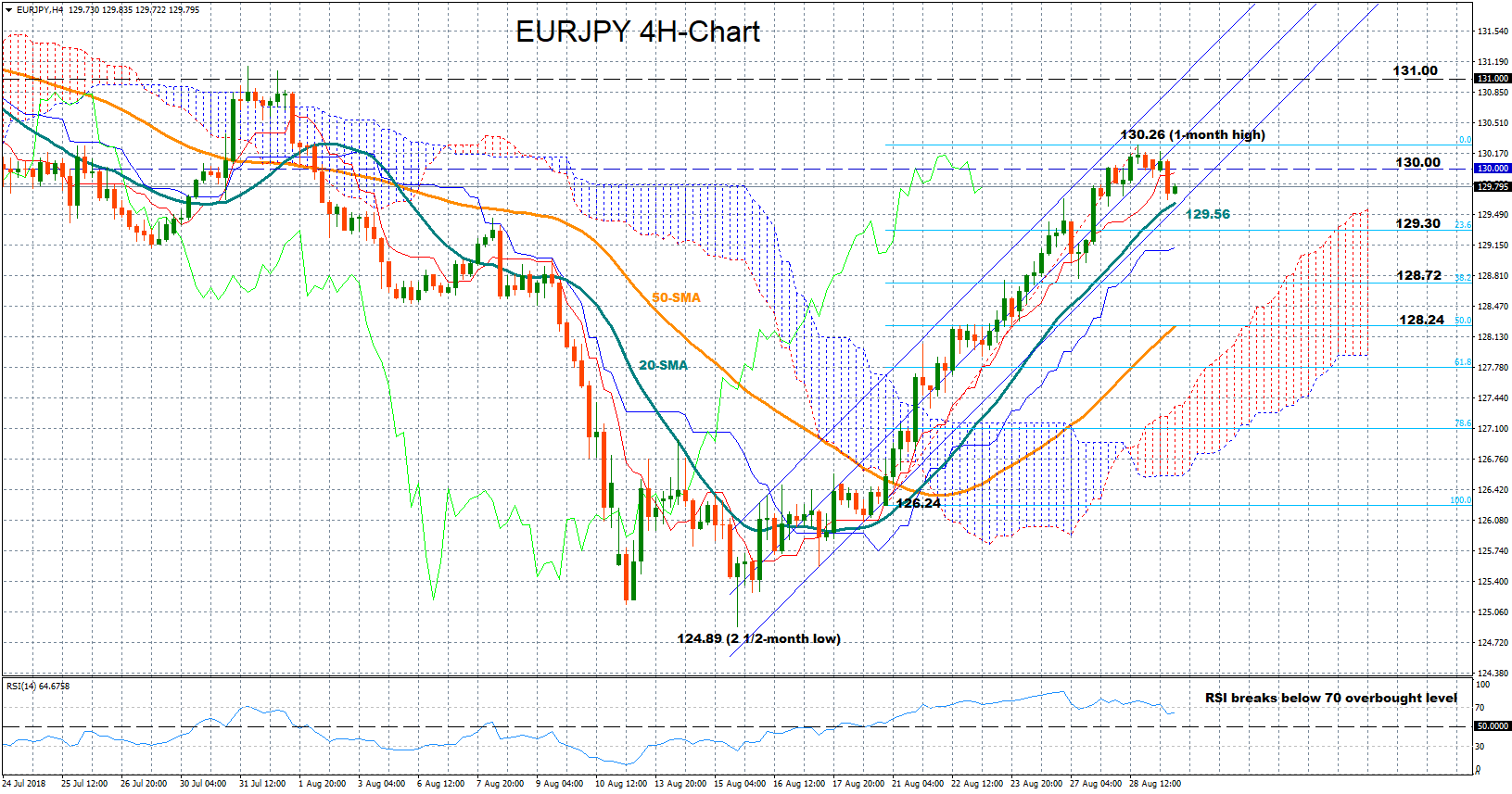
EURJPY rallied considerably, breaking above the Ichimoku cloud, after reaching 2 ½ -month lows at 124.89 on August 15. On Wednesday, though, the rally somewhat stalled, with the RSI in the 4-hour chart suggesting that weakness could persist in the short-term; the RSI exited overbought levels to steady slightly below 70. The red Tenkan-sen line and the blue Kijun-sen line have both flattened, painting a neutral short-term picture.
In case the market extends losses, the price could head lower until it reaches the 20-period simple moving average currently at 129.56, pausing marginally above the lower bound of the ascending channel. Should traders continue to sell the euro, sending the pair out of the channel, negative corrections may strengthen beneath the 23.6% Fibonacci of 129.30 of the upleg from 126.24 to 130.26 (August 21-28). Even lower, bears could play with the 38.2% Fibonacci of 128.72. If they manage to pass through that door, the next stop could come at the 50% Fibonacci 128.24 where the market took a small rest between August 22 and 23.
Alternatively, a reversal to the upside could find resistance at the 130 psychological point before the price inches up to touch the middle bound of the channel, currently seen near the almost 1-month high of 130.26 registered on Tuesday. Additional buying interest above from here may open the way towards the 131 key level, bringing the upper line of the channel into view as well.
AUD/USD No Support Level
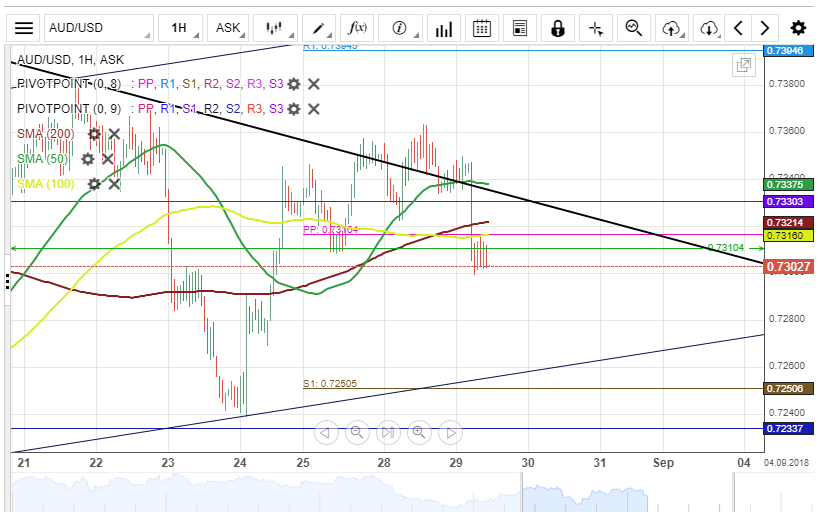
The Australian Dollar made no significant changes to its overall position against the US Dollar during the previous trading session. As the 0.7360 marks limited any attempts made by bulls traders to move the rate higher.
Bears managed to take control of the market during the Asian session on Wednesday and sent the currency pair crashing by about 50 base points. That resulted in the rate to breached both the 50-, 100-, and 200-hour SMAs and the weekly and the monthly PPs as well.
Given that the currency exchange rate has breached all significant support level, the potential target for the pair could be the lower boundary of an ascending channel.
USD/CAD Bounces Off Two Months Low Level
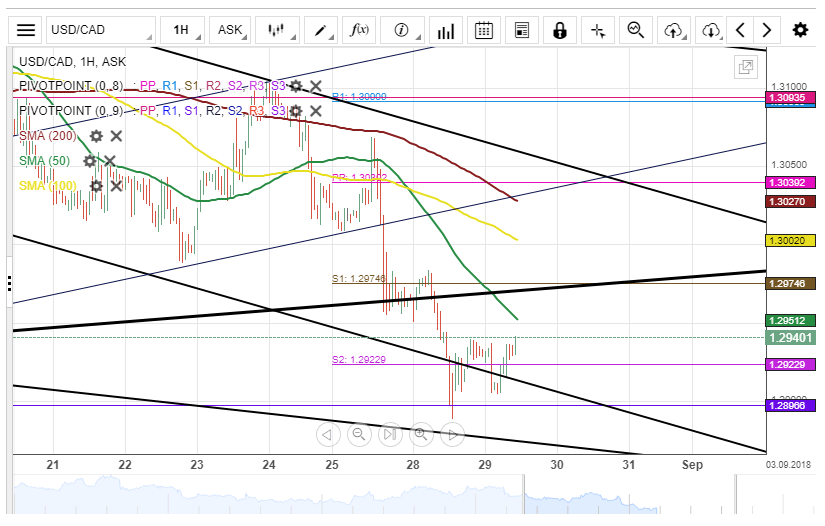
Bears guided the US Dollar to a two-month low level on Tuesday. The currency pair managed to reverse from its two months low at the end of the trading session. However, the weekly S2 limited the momentum of the bulls.
It seems that bullish sentiment has not still gained the necessary strength to breach the 50-hour simple moving average, so it is more likely that the exchange rate remains under the influence of bears today.
Everything being equal, the currency exchange rate could reverse from its current position at 1.2932 and aim for the lower boundary of a dominant descending channel during the following trading session.